
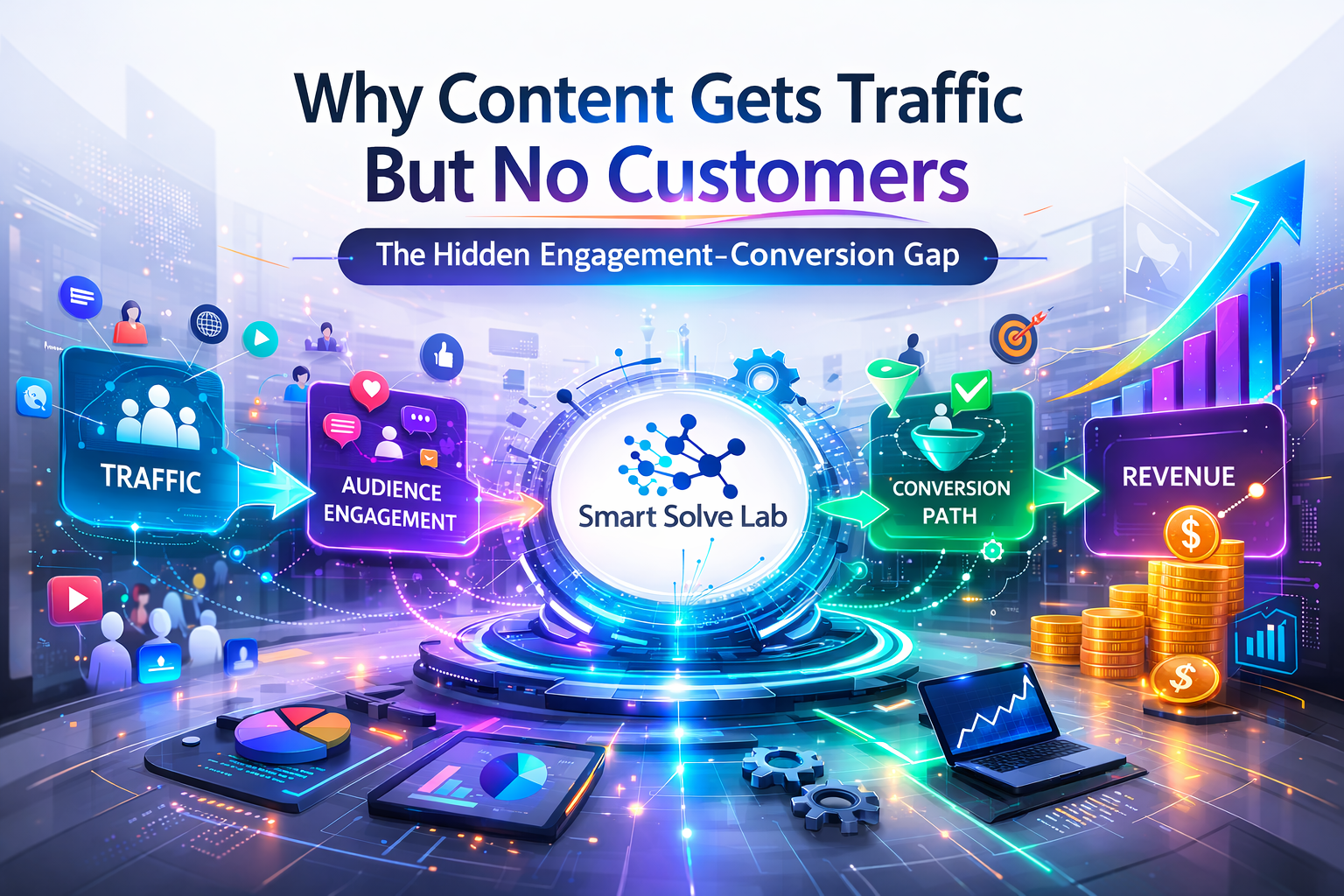
Your content attracts traffic but visitors never convert into customers. Discover the hidden engagement–conversion gap and how a digital growth system turns content traffic into real revenue.
Your content is attracting attention.
Blog posts are ranking in search engines. Social media shares are increasing. Visitors are reading your articles, spending time on the page, and engaging with the ideas you publish.
From a visibility perspective, everything appears to be working.
Traffic grows. Engagement metrics improve. The audience seems interested.
Yet something important is missing.
Revenue does not increase at the same pace.
Readers consume the content but rarely move toward becoming customers. Articles attract attention but fail to translate that attention into meaningful business outcomes. This is a classic case of why content gets traffic but no sales.
This situation creates one of the most frustrating problems in digital growth.
Businesses invest time, creativity, and resources into producing valuable content, yet the connection between engagement and conversion remains weak.
The reason is rarely the quality of the content itself.
More often, the issue lies in the absence of a structured digital growth system that connects content visibility with buyer readiness.
When content operates outside this system, it generates attention but fails to guide visitors toward the decision stage where real business value is created.
Understanding this gap is the first step toward transforming content from a traffic tool into a strategic pathway that converts readers into customers.
Table of Contents
The Engagement–Conversion Gap
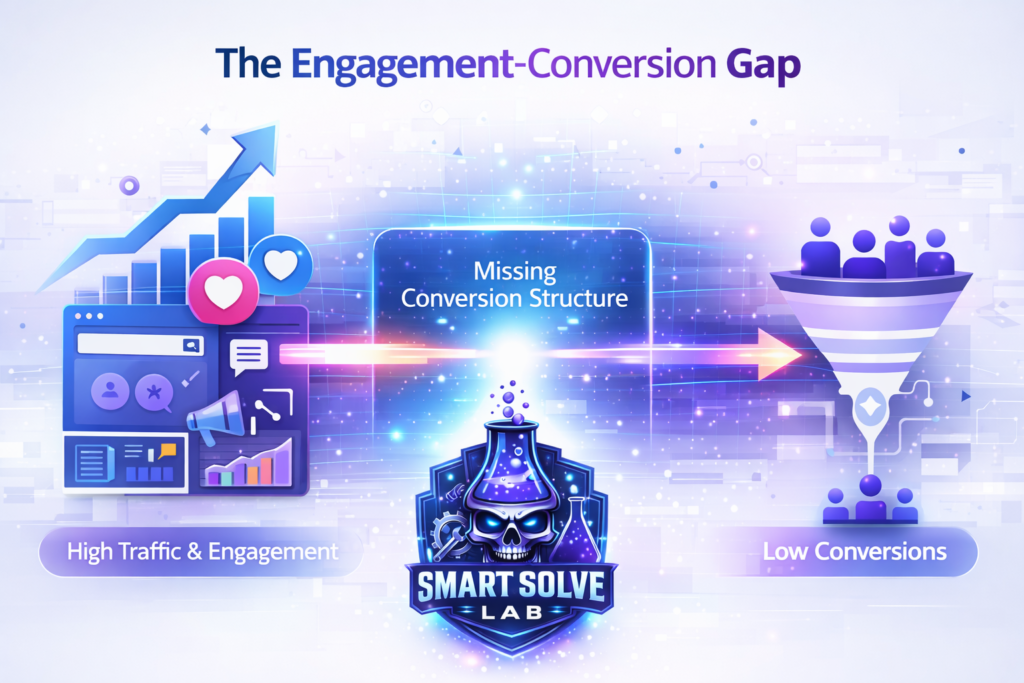
Many websites experience strong engagement signals such as comments, shares, and page views, yet conversions remain low. This often indicates that the content system is missing a structured pathway that guides engaged readers toward a clear business outcome.
Many businesses experience a confusing pattern in their digital performance.
Content performs well. Articles receive traffic. Readers spend time on the page. Social shares increase and engagement appears strong.
Yet despite this attention, very few visitors become customers.
This situation creates what can be described as the engagement–conversion gap.
On the surface, the content appears successful because it attracts readers. However, the deeper goal of content within a digital environment is not only to generate attention. Its purpose is to guide visitors toward a meaningful decision.
When this transition does not happen, businesses begin to realize that engagement alone does not create sustainable growth.
In many cases, the issue is not the quality of the content itself. The issue is that the content exists outside a structured digital growth system architecture that connects visibility, authority, and conversion into a coherent pathway.
Organizations that treat content purely as a traffic channel often miss this connection.
Instead of building a system that gradually moves readers toward solutions, they produce isolated pieces of content that generate attention but fail to create buyer readiness.
Over time, this disconnect produces a frustrating outcome.
Readers return repeatedly for information, yet the business struggles to convert that attention into revenue.
Another reason engagement fails to translate into revenue is the absence of systematic thinking when diagnosing digital challenges. Many organizations attempt to solve conversion problems through isolated tactics rather than applying a structured digital problem solving framework that examines the entire customer journey.
Research from HubSpot marketing research shows that businesses frequently confuse content engagement with conversion readiness, even though these represent completely different stages of the buyer journey.
Why Content Traffic Doesn’t Produce Customers
Many organizations assume that content marketing success can be measured purely by traffic numbers.
When blog posts begin attracting visitors from search engines or social platforms, it often feels like the strategy is working. Metrics such as page views, impressions, and engagement appear encouraging.
However, traffic alone does not guarantee that the visitors arriving on a website are ready to become customers.
Content attracts attention, but conversion requires alignment between the visitor’s intent and the solution being offered.
This is where many businesses encounter a structural disconnect.
Visitors may arrive while researching ideas, exploring trends, or trying to understand a problem. At this stage, they are gathering information rather than evaluating solutions.
When content focuses only on education without gradually introducing the pathway toward a solution, readers consume the information and then leave without progressing further in the decision journey.
In other words, attention enters the system, but buyer readiness never develops.
This challenge becomes more visible when businesses analyze how their digital visibility system attracts audiences.
If the discovery stage attracts a broad audience with mixed intent, the website may receive significant traffic while only a small percentage of visitors have genuine purchasing motivation.
As a result, engagement metrics rise but revenue remains inconsistent.
Another factor contributing to this gap is the absence of structured thinking when diagnosing digital growth challenges.
Businesses often treat content performance as an isolated marketing activity rather than analyzing how it connects to the broader digital problem solving system that guides visitors from awareness to decision.
Research published in Harvard Business Review digital strategy research explains that organizations achieve stronger conversion outcomes when marketing content is intentionally aligned with the stages of the buyer decision journey.
The Hidden Audience Intent Mismatch
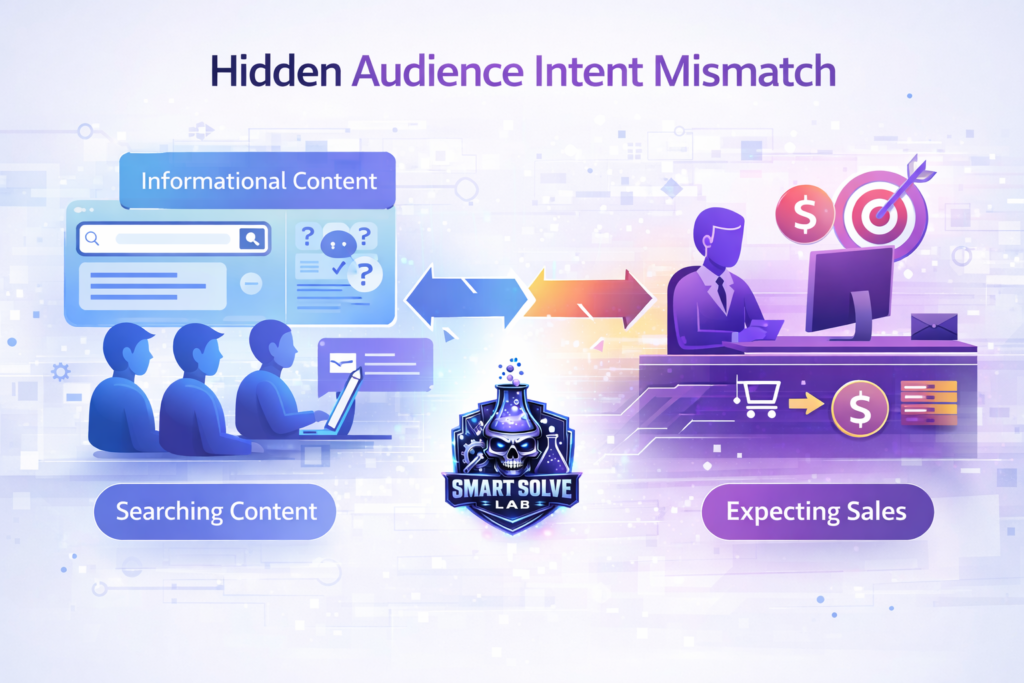
Audience intent plays a critical role in determining whether content generates customers or only attracts visitors. When the intent of the audience does not match the goal of the business, traffic increases but meaningful conversions remain limited.
One of the most common reasons content generates traffic without producing customers is a mismatch between audience intent and business positioning.
Visitors often arrive on a website with different motivations. Some are exploring ideas, others are researching potential solutions, and a smaller group may already be preparing to make a decision.
When content attracts audiences who are still in the early exploration stage, engagement may increase while conversions remain low.
This does not mean the content is ineffective.
It simply means that the intent of the audience does not yet align with the moment of purchase.
For example, a visitor reading about digital marketing strategies may be interested in learning new concepts rather than immediately investing in a solution.
If the content does not gradually connect educational insights with the solution pathway, readers leave with knowledge but without a reason to take the next step.
This is why understanding audience intent is critical inside a digital growth system.
Within a well-structured system, content is designed to guide visitors through a progression.
First, the content helps readers understand the problem.
Second, it introduces the strategic perspective needed to solve that problem.
Third, it shows how the solution logically follows from the insight they have gained.
When these stages operate together, content does more than generate attention. It prepares visitors for decision readiness.
Organizations that struggle with this alignment often lack a structured approach to diagnosing audience behavior.
Instead of analyzing intent patterns across content, they continue publishing new material without examining whether it attracts the right audience in the first place.
Applying a systematic digital problem solving framework helps businesses identify whether the traffic they attract matches the problems they are equipped to solve.
Research discussed in Search Engine Journal marketing research also highlights that understanding user intent is one of the most important factors for improving content-driven conversions.
Structural Breakpoints in Content Monetization
Even when content attracts the right audience, conversions may still remain inconsistent if the pathway between engagement and monetization is weak.
In many digital environments, content operates independently from the systems responsible for building authority, trust, and decision readiness.
When these elements are not connected, content may succeed at generating attention but fail to guide visitors toward meaningful action.
This creates structural breakpoints within the digital journey.
A breakpoint occurs when the momentum created by content engagement does not carry forward into the stages required for conversion.
Three breakpoints appear frequently in content-driven growth systems.
• Content attracts curiosity but does not introduce solution pathways.
• Authority signals are visible in educational material but disappear at the decision stage.
• Visitors understand the problem yet struggle to see why the offered solution logically follows.
Each of these breakpoints interrupts the connection between attention and revenue.
Instead of moving smoothly from learning to decision, visitors experience hesitation.
When hesitation appears, conversion stability declines.
Many organizations attempt to solve this problem by increasing content output. They publish more articles, expand topic coverage, or promote content through additional channels.
However, without strengthening the structure connecting content to monetization, additional traffic simply amplifies the same misalignment.
This is why businesses must examine how their digital visibility system connects discovery with authority and decision pathways.
A well-designed system ensures that every piece of content plays a strategic role within the broader growth architecture.
Instead of existing as isolated resources, articles become entry points into a structured journey that gradually prepares visitors for the solution being offered.
Organizations that fail to recognize these structural relationships often continue applying isolated tactics rather than approaching growth through a coordinated digital growth system architecture.
According to Content Marketing Institute research, businesses achieve significantly stronger conversion results when content strategy is aligned with the stages of the buyer journey rather than focusing solely on content volume.
How to Diagnose Content–Buyer Misalignment
Once the engagement–conversion gap becomes visible, the next step is diagnosing where the misalignment between content and buyer readiness occurs.
Many businesses assume that improving conversions requires stronger persuasion or more aggressive calls to action. In reality, the issue often begins earlier in the journey.
Diagnosis requires examining how visitors move from discovering content to evaluating solutions.
The first step is reviewing the discovery stage.
Ask whether the topics attracting traffic reflect the problems your business is designed to solve. If articles attract broad curiosity but not solution-focused visitors, the traffic entering the system may not match the intended audience.
This is why many organizations struggle even after producing valuable educational material.
The content succeeds in attracting readers, yet it fails to guide the right audience toward the decision stage.
A structured digital problem solving system helps businesses analyze this gap by examining how discovery, authority, and decision stages interact across the digital environment.
The second step is evaluating authority signals within the content itself.
Visitors who consume educational material should gradually recognize the expertise and structured thinking behind the solution being presented.
If content delivers useful information but does not demonstrate a clear methodology or system, readers may appreciate the insight while remaining uncertain about the credibility of the solution provider.
Businesses that implement a structured digital problem solving framework are better able to communicate this authority because the framework clarifies how the problem is analyzed and solved.
The third step is analyzing the transition between learning and decision.
Content should not abruptly shift from education to promotion. Instead, the solution should feel like a natural continuation of the insight the reader has already received.
When this transition is clear, visitors understand why the solution exists and how it connects to the problem they are trying to solve.
Research from McKinsey digital transformation research highlights that companies achieve stronger conversion outcomes when marketing insights, authority signals, and decision pathways operate as an integrated system.
Turning Content Engagement Into Revenue
Understanding Why Content Gets Traffic but No Sales
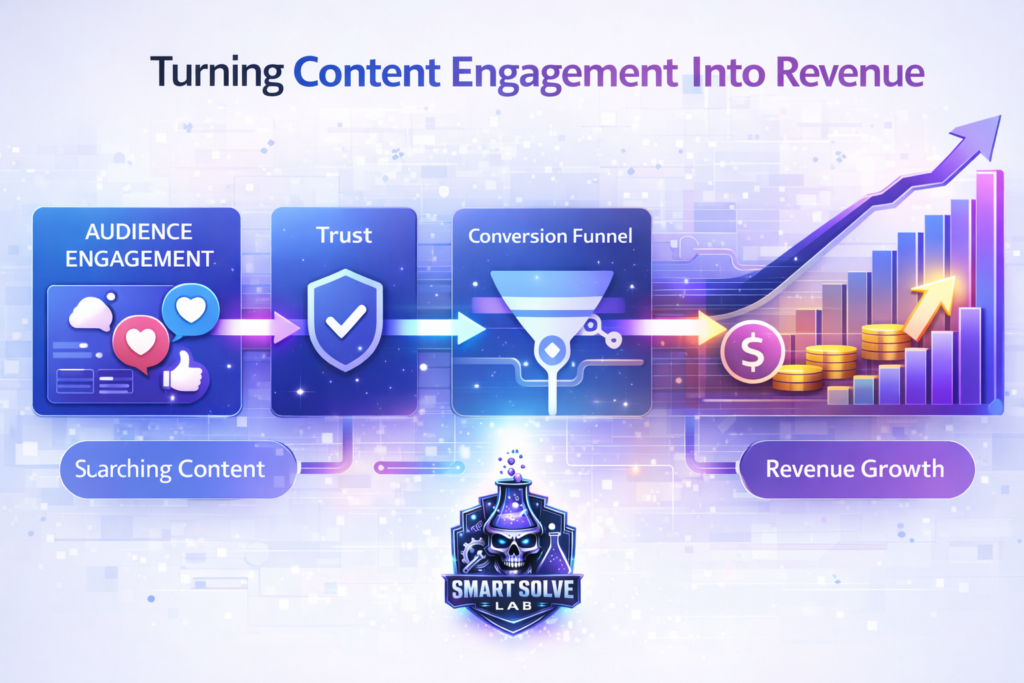
When engagement signals such as reader attention, trust, and interaction are properly integrated into a conversion framework, content begins to produce real business outcomes. A structured digital growth system ensures that audience engagement ultimately leads to revenue generation.
Once businesses understand why content attracts attention but fails to produce customers, the next step is transforming content from an isolated marketing activity into a strategic component of a digital growth system.
Content should not exist simply to generate traffic.
Its purpose is to guide visitors through a progression that gradually builds authority, strengthens trust, and prepares readers for decision readiness.
When content performs this role effectively, engagement becomes the starting point of a structured journey rather than the final outcome.
The first shift involves redefining the role of content within the broader growth architecture.
Instead of publishing articles purely to increase visibility, organizations must design content that connects directly with the problems their solutions address.
This ensures that discovery attracts visitors who are already moving toward a relevant decision stage.
Businesses that apply a structured digital growth system architecture are better able to align visibility with monetization because each stage of the visitor journey is intentionally connected.
The second shift involves reinforcing authority throughout the content experience.
Readers who spend time exploring educational material should gradually recognize that the insights they are receiving originate from a deeper system of thinking.
This recognition builds credibility and confidence before visitors ever encounter a conversion page.
Organizations that approach content creation through structured smart digital solutions often achieve stronger authority signals because their content reflects systematic problem solving rather than isolated marketing tactics.
The third shift involves creating a natural bridge between insight and action.
Content should guide readers toward understanding why the solution being offered logically follows from the problem explained in the article.
When this bridge exists, the transition from reading to decision feels intuitive rather than forced.
Research discussed in HubSpot marketing strategy research shows that businesses achieve stronger conversion outcomes when content is designed to support the entire buyer journey rather than focusing solely on attracting traffic.
When content, authority, trust, and decision pathways operate as a coordinated system, engagement begins to transform into predictable revenue rather than remaining a disconnected metric.
Conclusion
Many businesses interpret content success through traffic metrics alone.
Page views increase. Engagement rises. Articles receive attention across search engines and social platforms.
Yet despite this activity, revenue remains unpredictable.
The reason is rarely a lack of traffic.
The deeper issue is the absence of alignment between content engagement and buyer readiness.
Content attracts attention, but attention alone does not create customers.
Visitors must move through a structured progression where insight builds authority, authority strengthens trust, and trust prepares the reader for decision clarity.
When this progression is missing, engagement becomes disconnected from revenue.
Readers learn from the content but never feel prepared to take the next step.
Businesses experiencing this challenge often attempt to solve the problem by increasing output.
They publish more articles, expand their keyword strategy, or promote content through additional channels.
While these actions may increase visibility, they rarely solve the underlying issue if the pathway between content and monetization remains weak.
Organizations that approach growth through a structured digital growth system architecture recognize that content is not merely a traffic tool. It is the entry point of a system designed to guide visitors toward meaningful action.
Similarly, applying a structured digital problem solving system allows businesses to diagnose where the journey between discovery and decision breaks down.
Research from Harvard Business Review digital strategy research highlights that organizations achieve more predictable growth when marketing activities operate within a coordinated system rather than through isolated tactics.
When businesses align discovery, authority, trust, and decision pathways, content begins to perform its real function.
It transforms attention into confidence.
And confidence into customers.
FAQs
Why does content get traffic but fail to generate customers?
Content often attracts visitors who are still exploring ideas rather than looking for a solution. When the audience arriving on a website does not match the stage of decision required for conversion, engagement increases but sales remain low. This usually indicates a gap between content visibility and buyer intent alignment.
What is the engagement–conversion gap in content marketing?
The engagement–conversion gap appears when readers interact with content but do not move toward becoming customers. Businesses may see strong traffic, long reading time, and social engagement, yet conversions remain low because the content does not guide visitors toward the decision stage.
How can businesses turn content traffic into revenue?
Businesses can convert content traffic into revenue by aligning content with the buyer journey. Content should not only educate readers but also introduce the problem framework, demonstrate authority, and naturally guide visitors toward the solution that the business provides.
Why is audience intent important in content marketing?
Audience intent determines whether visitors are simply gathering information or preparing to make a purchase decision. When content attracts the wrong intent stage, engagement may grow but conversion remains weak because visitors are not yet ready to buy.
What role does a digital growth system play in content conversion?
FAQ Answer 5A digital growth system connects visibility, authority, trust, and conversion into a structured pathway. When content operates inside this system, readers move gradually from learning about a problem to understanding why the offered solution makes sense, which significantly improves conversion potential.
Leave a Reply