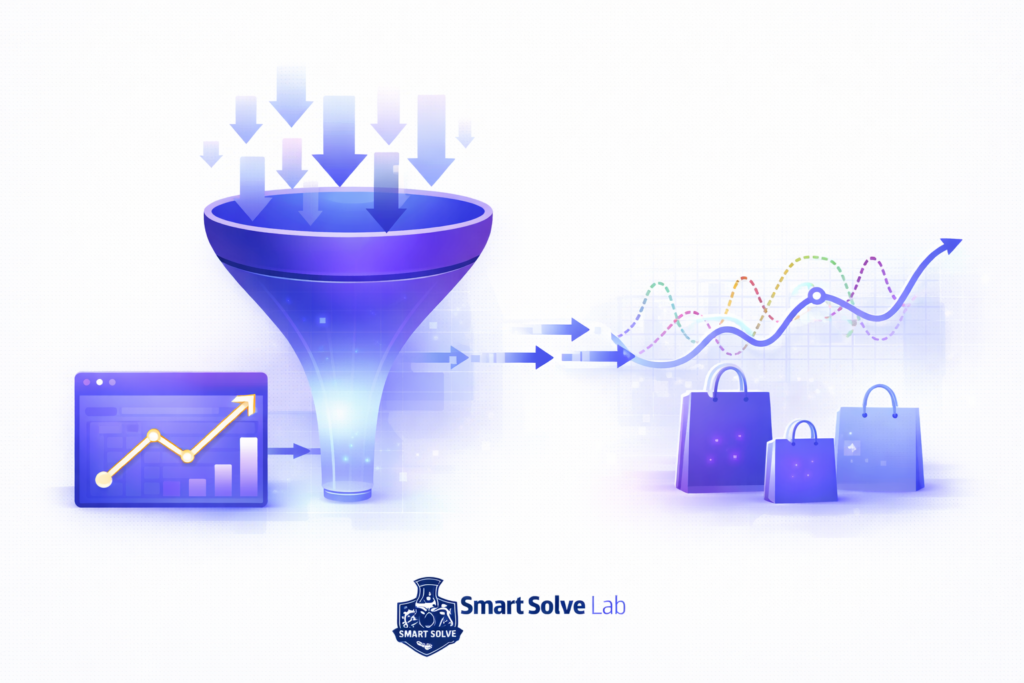
Your traffic is growing.
Analytics look promising. Impressions are rising. Clicks are increasing. Campaign reports show upward movement. On the surface, it appears that growth is happening.
In many digital environments, conversions fluctuate even while traffic continues to grow.
Yet revenue feels unstable.
Some days conversions spike. Other days they drop unexpectedly. A campaign performs well for a short period, then results decline without a clear explanation. Despite consistent effort and increasing visibility, sales refuse to stabilize.
This experience is more common than most businesses admit.
The natural assumption is that the issue must be traffic quality, targeting, pricing, or messaging tweaks. As a result, teams adjust ads, redesign landing pages, experiment with offers, or push for more volume.
But what if traffic is not the real issue?
In many cases, fluctuating conversions are not caused by insufficient visitors. They are caused by structural discontinuity within the conversion pathway itself.
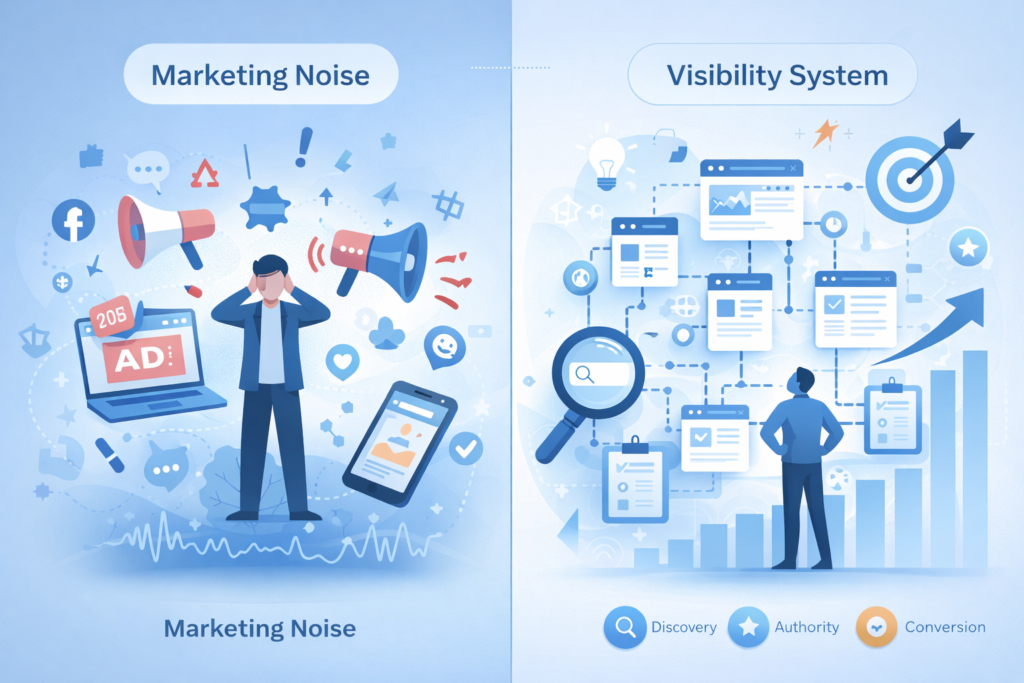
Traffic creates exposure.
Conversions require alignment.
When alignment is unstable, results fluctuate regardless of traffic growth.
Understanding this distinction is the first step toward diagnosing why your conversion performance feels inconsistent even when visibility increases.

Table of Contents
The Traffic–Conversion Illusion
One of the most persistent misconceptions in digital growth is the belief that more traffic naturally leads to stable revenue.
The logic seems simple:
More visitors should produce more opportunities.
More opportunities should produce more conversions.
More conversions should produce predictable growth.
But this linear assumption ignores how digital systems actually operate.
Traffic is exposure. It represents attention in the digital environment, a concept often explained through the attention economy.
Conversion, however, is not just a reaction to exposure. It is the outcome of a structured pathway that includes:
• Expectation alignment
• Authority perception
• Trust reinforcement
• Decision clarity
• Value continuity
If any part of this pathway weakens, conversion performance becomes unstable.
This creates what can be called the Traffic–Conversion Illusion.
From the outside, growth appears to be happening because visitor numbers increase. From the inside, revenue does not stabilize because the internal pathway that turns attention into action is inconsistent.
Imagine pouring more water into a pipeline that has loose joints. The pressure increases, but leakage prevents steady output. Adding more water does not fix the structural weakness.
Similarly, increasing traffic does not correct misalignment within the decision journey.
This is why businesses often experience periods where campaigns perform well temporarily. Traffic rises, conversions spike briefly, then decline again. The system cannot sustain performance because the internal structure does not consistently reinforce the decision process.
The illusion persists because traffic metrics are visible and easy to measure. Structural continuity, on the other hand, is less visible and harder to diagnose.
When organizations focus only on surface metrics, they attempt to solve conversion instability by increasing volume rather than strengthening alignment.
The result is effort expansion without stability.
To move beyond this illusion, it is necessary to shift focus from quantity of visitors to integrity of the conversion pathway.
Only then can fluctuating results be understood not as random volatility, but as a structural signal.
Symptoms of Conversion Instability
Conversion instability rarely appears as a complete collapse. Instead, it manifests through recurring patterns that signal underlying misalignment.
These patterns often include:
Revenue spikes followed by sudden drops
Campaign-dependent sales performance
High traffic with inconsistent conversion rates
Short-lived improvements after optimizations
Unpredictable monthly revenue trends
Each of these symptoms points to volatility rather than steady progression.
For example, a new campaign might produce impressive results during its launch phase. Engagement increases, sales improve, and performance appears strong. However, as time passes, the same campaign begins to underperform without a clear external cause.
In other cases, traffic from one channel converts significantly better than traffic from another, even when targeting appears similar. This inconsistency suggests that alignment between visitor expectation and decision experience varies across pathways.
Another common symptom is optimization fatigue. Teams continually adjust headlines, pricing structures, page layouts, and calls to action in search of incremental improvement. Some changes produce short-term gains, but overall stability remains elusive.
These recurring adjustments create the impression that conversion is a tactical problem.
Yet when volatility persists across different campaigns and time periods, the pattern indicates something deeper.
Stable systems produce stable outputs. When outputs fluctuate despite sustained effort, structural examination becomes necessary.
Conversion instability is not simply a matter of improving persuasion. It is often a signal that the connection between trust formation and decision execution is inconsistent.
Until that connection is understood, fluctuations will continue to appear unpredictable.
In the next section, we will explore the structural reason why this connection breaks, even when traffic continues to grow.
The Hidden Structural Cause
When conversions fluctuate despite increasing traffic, the instinct is to search for a visible fault.
Is the pricing wrong?
Is the offer weak?
Is the landing page poorly designed?
Is the traffic low quality?
While these factors can influence performance, they rarely explain recurring instability on their own.
The deeper issue often lies in what can be called a Trust–Conversion Discontinuity.
Trust is built gradually. It forms through content quality, authority signals, clarity of positioning, consistency of messaging, and perceived expertise. This process may happen across blog posts, social channels, email sequences, or educational material.
Conversion, however, occurs at a specific decision point.
The problem arises when the trust built in earlier stages does not seamlessly transfer into the moment of action.
Visitors may appreciate your content.
They may perceive expertise.
They may even agree with your ideas.
But when they reach the decision stage, something subtle shifts.
The message changes.
The tone changes.
The value proposition feels compressed.
The confidence built earlier weakens.
This creates a structural break between trust formation and decision execution.
The visitor does not consciously analyze this break. Instead, they experience hesitation.
Hesitation reduces conversion stability.
In structurally aligned digital growth systems, each stage prepares the next.. Authority builds trust. Trust prepares decision readiness. Decision pathways feel like a natural continuation of what the visitor has already experienced.
In misaligned systems, stages operate in isolation. Content educates, but sales pages push. Authority is demonstrated in one place, but credibility signals are missing in another. Messaging evolves during the journey rather than remaining coherent.
When this happens, traffic can grow indefinitely, yet conversion results will fluctuate because the internal pathway lacks continuity.
Traffic measures attention, a concept widely discussed in research about the attention economy.
Trust measures confidence.
Conversion requires the uninterrupted transfer of confidence into action.
When that transfer is inconsistent, instability becomes inevitable.
Three Structural Breakpoints
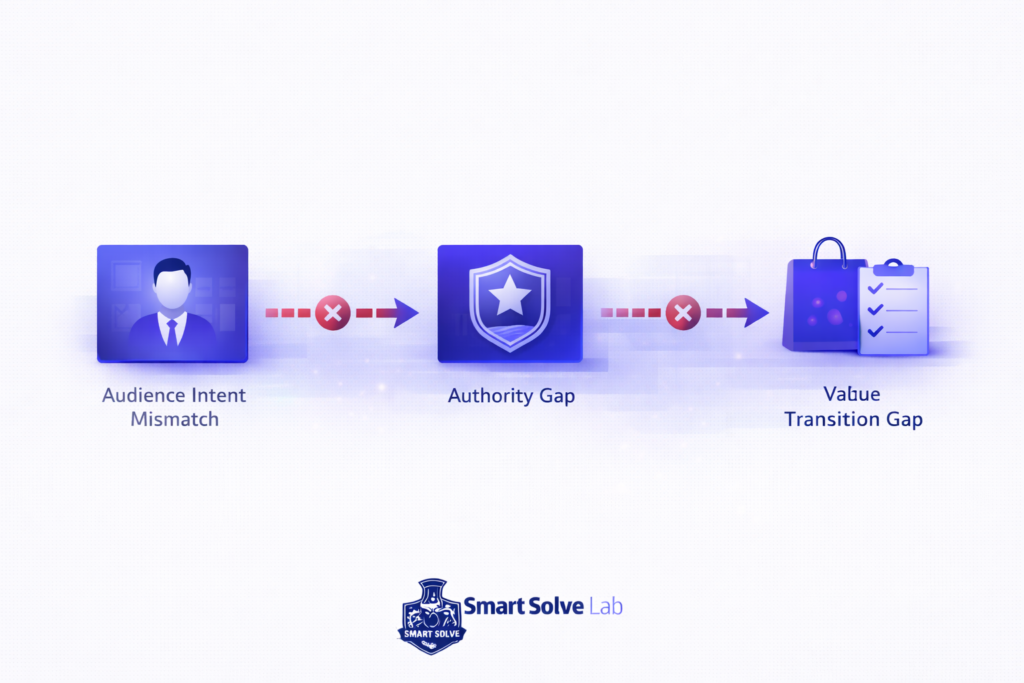
To understand conversion volatility more clearly, it is helpful to identify where structural discontinuity most commonly occurs.
There are three recurring breakpoints in digital systems that produce fluctuating results.
First Breakpoint: Misaligned Audience Intent
Traffic can increase while intent alignment decreases.
Visitors may arrive through broad keywords, trending topics, or expanded distribution channels shaped by digital visibility systems.
For example, content may attract readers seeking education, while the offer requires immediate purchase intent. When the expectation set during discovery does not match the decision context, conversion rates fluctuate depending on which segment of traffic dominates at a given time.
This creates variability rather than stability.
Second Breakpoint: Authority Not Reinforced at the Decision Stage
Authority is often strongest within long-form content, educational resources, or thought leadership material. However, when visitors transition to a decision page, authority cues may diminish.
If proof elements, credibility signals, or expertise positioning are not clearly reinforced at the conversion point, trust weakens precisely when it is needed most.
The visitor may think:
“This content was insightful.”
But at the decision moment:
“Is this really the right choice?”
That subtle doubt introduces volatility. Some visitors convert confidently. Others hesitate. Results fluctuate accordingly.
Third Breakpoint: Weak Value Transition
The transition from information to offer must feel coherent.
If content emphasizes insight and strategic thinking, but the offer emphasizes features or urgency, a disconnect occurs. The visitor struggles to connect the value they experienced with the value being sold.
In structurally aligned systems, the offer feels like a logical continuation of the journey.
In misaligned systems, the offer feels like a separate event.
When transitions are weak, conversion depends heavily on emotional timing, urgency, or external factors. This produces spikes rather than consistent performance.
These three breakpoints do not eliminate conversions entirely. Instead, they destabilize them.
Some traffic segments convert well. Others do not. Certain campaigns perform strongly for a period before fading. Revenue becomes sensitive to small variations in messaging or audience composition.
Without recognizing these structural breakpoints, teams continue adjusting surface elements while the underlying pathway remains inconsistent.
What Stable Conversions Actually Require
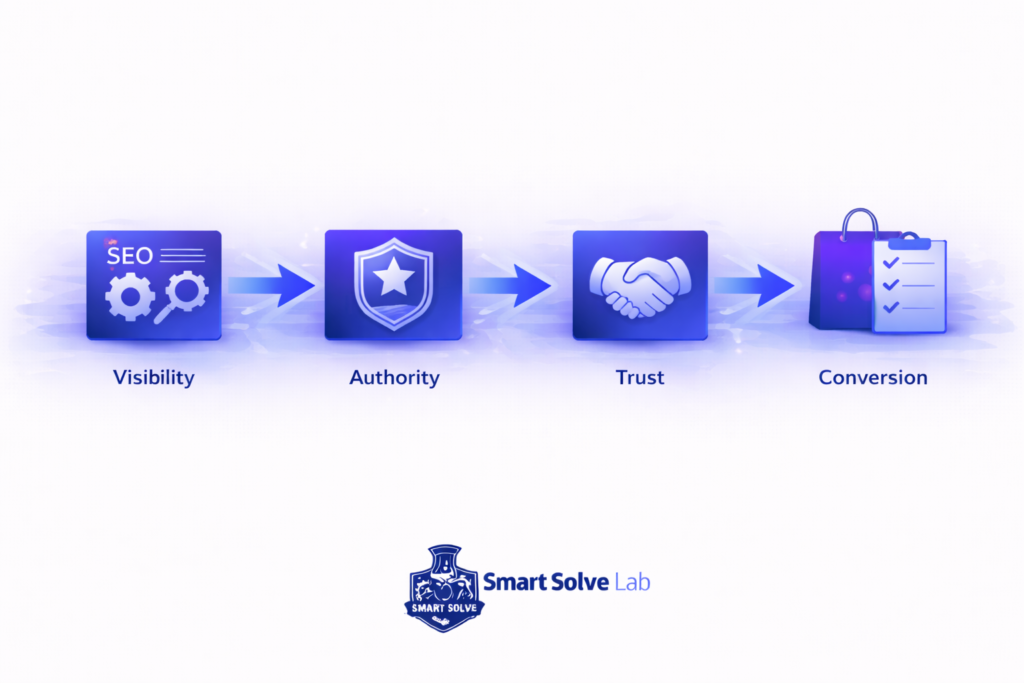
Stable conversions do not arise from persuasion intensity alone. They emerge from structural continuity.
Continuity means that each stage of the digital journey reinforces the next without friction or contradiction.
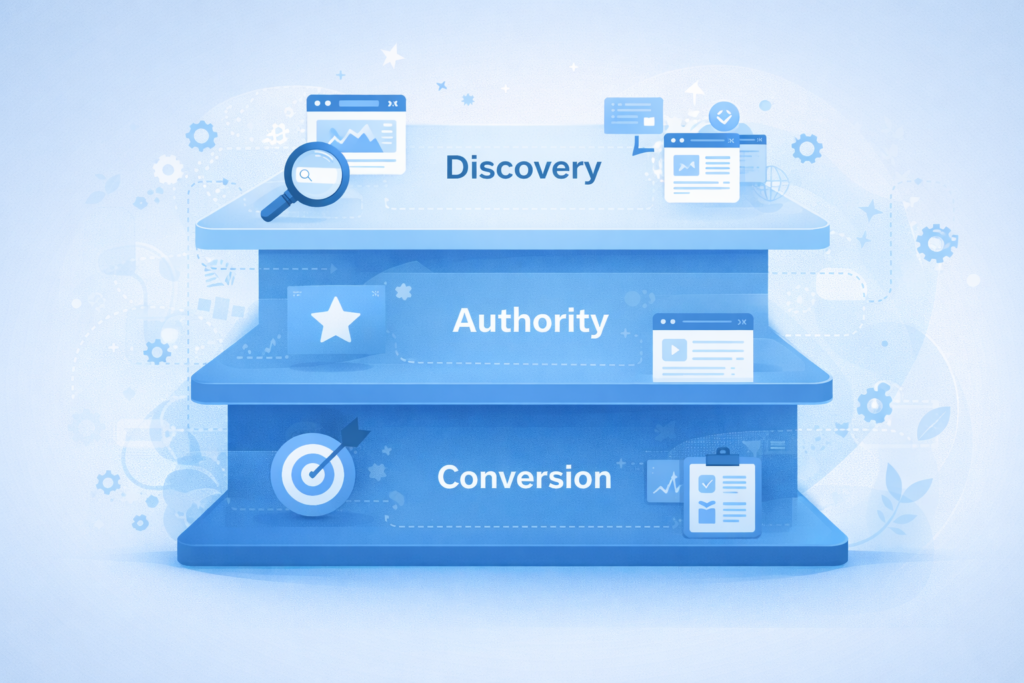
Visibility sets clear expectations.
Authority confirms expertise.
Trust deepens confidence.
Conversion offers a natural next step.
When this chain operates coherently, conversion becomes less dependent on temporary factors such as campaign novelty or urgency triggers.
Instead of fluctuating in response to small changes, performance stabilizes because the pathway itself is consistent.
Stable systems share three characteristics.
First, alignment across stages. Messaging, tone, positioning, and value emphasis remain coherent from first touchpoint to final decision.
Second, reinforced confidence at transition points. Authority signals and trust cues do not disappear at the moment of action. They intensify.
Third, clarity of decision logic. Visitors understand not only what they are buying, but why it logically follows from the journey they have experienced.
When these conditions exist, increasing traffic amplifies stable output rather than amplifying volatility.
If your conversions fluctuate despite rising traffic, the issue is unlikely to be volume alone.
It is more likely that structural continuity between trust and decision is inconsistent.
And until that continuity is examined and reinforced, performance will continue to feel unpredictable.
In the next section, we will explore how to begin thinking about diagnosing this instability in a structured way.
Diagnosing Conversion Instability as a Structural Problem
When conversion performance fluctuates, many businesses attempt to solve the issue through rapid optimization. Headlines are rewritten. Pricing is adjusted. Landing pages are redesigned. New campaigns are launched in search of better results.
While these actions may occasionally produce short-term improvements, they rarely resolve instability permanently.
The reason is simple: optimization modifies surface elements, while instability often originates from deeper structural relationships within the digital pathway.
To diagnose conversion instability effectively, organizations must shift their perspective from isolated metrics to connected stages of the user journey.
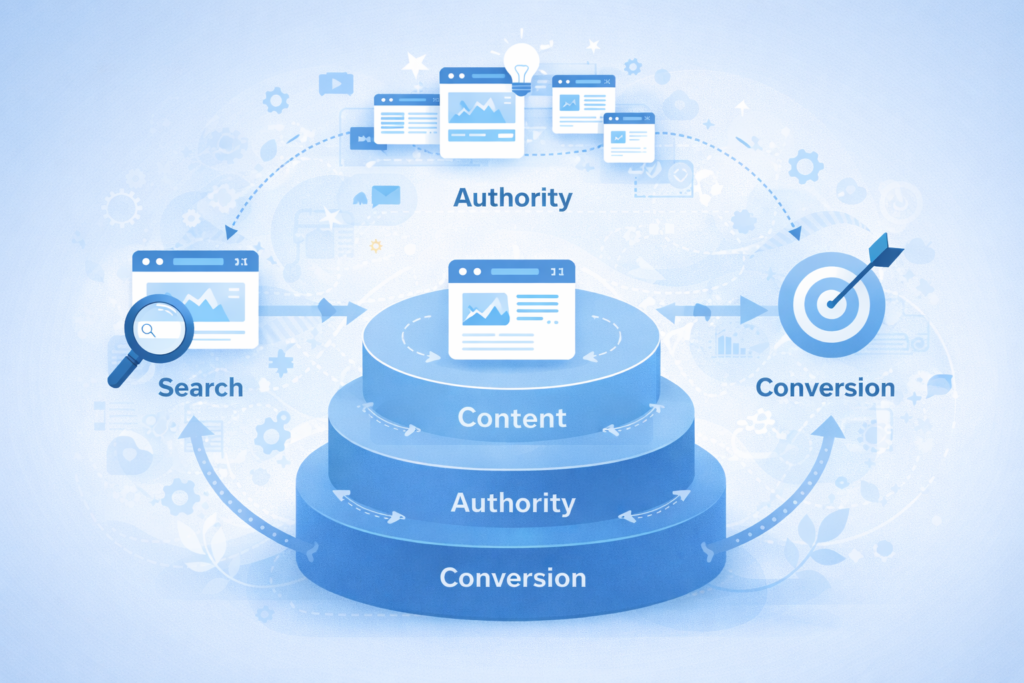
Conversion is not a single event. It is the final outcome of a sequence within a digital growth system that includes visibility, authority formation, trust reinforcement, and decision clarity.
When these stages operate independently rather than as a coherent chain, results become inconsistent.
Instead of asking “How can we increase conversions?”, a more useful question is:
Where does continuity break between trust and action?
Once this perspective is adopted, conversion instability becomes easier to interpret. Fluctuations are no longer mysterious. They become signals that one or more structural relationships require attention.
Tracing the Conversion Pathway
A practical starting point for diagnosing instability is mapping the journey a visitor experiences before reaching the decision point.
This pathway typically includes several stages:
Discovery through search, social platforms, or referral channels.
Engagement through educational content or problem-oriented material.
Authority recognition as visitors begin to perceive expertise or insight.
Trust formation through consistent messaging and credibility signals.
Decision readiness when the visitor evaluates whether action makes sense.
If conversions fluctuate, the disruption usually occurs somewhere within this pathway.
Visitors may discover valuable content yet fail to recognize clear expertise.
They may recognize authority but lack sufficient trust reinforcement.
They may trust the brand but encounter uncertainty at the moment of decision.
By tracing the pathway rather than focusing solely on the final metric, businesses begin to see where alignment weakens.
Identifying Structural Weak Points
Once the pathway is visible, the next step is identifying which connection between stages appears unstable.
For example, if traffic increases but engagement remains shallow, the issue may lie in expectation alignment during the discovery stage.
If engagement is strong but conversions remain inconsistent, authority may not be translating into trust at the decision level.
If trust appears high yet visitors hesitate to act, the transition from confidence to value clarity may be weak.
These weak points often remain hidden because traditional analytics tools emphasize outcomes rather than relationships.
Metrics can reveal what happened, but they rarely explain how different stages interact to produce that outcome.
Structural diagnosis therefore requires observing patterns rather than isolated numbers.
Moving from Symptoms to Structural Insight
When teams begin analyzing instability through this lens, the focus shifts from reactive optimization to systemic understanding.
Instead of treating every fluctuation as a new problem, recurring patterns reveal deeper structural causes.
Traffic volatility may indicate inconsistent discovery positioning.
Trust gaps may appear as high engagement but low action.
Decision uncertainty may appear as abandoned conversions or delayed purchases.
By recognizing these signals as structural indicators rather than tactical failures, organizations gain a clearer view of how their digital systems actually function.
Over time, this perspective allows businesses to move from constant experimentation toward smart digital solutions that improve structural alignment.
Closing Insight
If your conversions fluctuate even while traffic continues to grow, the issue is rarely random.
It is usually a signal that the pathway connecting attention, trust, and decision is not fully aligned.
Traffic alone cannot create stability.
Only a coherent system—where each stage reinforces the next—can produce consistent results.
When businesses begin examining conversions through a structural lens, instability stops feeling unpredictable. It becomes diagnosable.
And once the structural relationships behind conversion performance are understood, improving stability becomes a matter of reinforcing the pathway rather than endlessly increasing effort.
Traffic increases FAQs
What causes conversions to fluctuate even when website traffic increases?
Conversions fluctuate when the pathway between attention, trust, and decision is not structurally aligned. Traffic can increase exposure, but if authority signals, trust reinforcement, or decision clarity weaken at any stage of the journey, visitors hesitate at the moment of action. This hesitation creates unstable conversion performance even when visibility continues to grow.
Does increasing website traffic always lead to higher conversions?
No. Traffic increases exposure, but conversions depend on alignment between visitor expectations, perceived expertise, trust signals, and decision clarity. If these elements are inconsistent, more visitors simply amplify instability rather than producing predictable results.
What is the traffic–conversion illusion in digital marketing?
The traffic–conversion illusion is the assumption that more visitors automatically create stable revenue. While traffic measures attention, conversions require a structured decision pathway that includes authority perception, trust reinforcement, and value clarity. Without this alignment, traffic growth does not guarantee stable outcomes.
Why do some campaigns produce temporary conversion spikes but not long-term stability?
Temporary conversion spikes often occur when campaigns attract highly aligned traffic for a short period. However, if the internal decision pathway lacks structural continuity—such as weak authority reinforcement or unclear value transitions—results decline once that temporary alignment fades.
How can businesses identify structural gaps that affect conversions?
Businesses can identify structural gaps by examining the full visitor journey rather than focusing only on final conversion metrics. By mapping stages such as discovery, engagement, authority recognition, trust formation, and decision readiness, organizations can locate where continuity weakens and correct the underlying structure.
What creates stable conversions in digital growth systems?
Stable conversions emerge when every stage of the digital journey reinforces the next. Visibility sets expectations, authority confirms expertise, trust builds confidence, and the conversion step feels like a natural continuation of the visitor’s experience. When this pathway remains coherent, results become predictable rather than volatile.