• Why Your Sales Funnel Is Not Converting (And Where Customers Are Leaking)

    your sales funnel is not converting and where customers are leaking. Learn how structural funnel gaps affect conversions and how to fix them.

    Many businesses invest significant effort into building marketing funnels.

    Landing pages are designed carefully. Advertising campaigns attract visitors. Email sequences nurture potential buyers. Each stage of the funnel appears structured and intentional.

    From the outside, the system looks functional.

    Traffic arrives.

    Visitors move through the funnel.

    Yet a frustrating result continues to appear.

    Conversions remain low.

    People enter the funnel but rarely complete the journey. Prospects read the page, explore the offer, and sometimes even show interest, yet the final step never happens.

    For many organizations, this experience is confusing.

    If traffic is arriving and the funnel is technically working, why do so many potential customers disappear before converting?

    The answer usually lies in structural misalignment within the funnel itself.

    A funnel is not simply a sequence of pages.

    It is a decision pathway that guides attention toward trust, trust toward confidence, and confidence toward action.

    When this pathway contains friction, visitors hesitate.

    And hesitation causes leaks.

    This is why many funnels attract attention but fail to produce consistent conversions.

    The problem is rarely the existence of the funnel.

    The problem is the invisible structural gaps inside it.

    Many organizations attempt to solve this issue by making surface adjustments.

    They change headlines, redesign buttons, experiment with pricing, or test different calls to action.

    While these changes can occasionally improve performance, they rarely address the deeper structural reasons why visitors hesitate inside the funnel.

    Understanding why sales funnels fail to convert requires examining the system behind the funnel rather than focusing only on individual pages.

    Funnels succeed when the stages guiding the visitor from curiosity to decision operate as a coordinated system.

    When these stages become misaligned, the funnel begins losing potential customers at critical moments.

    Research from HubSpot marketing research shows that most funnel conversion problems originate from structural friction between stages rather than from isolated design issues.

    Recognizing these hidden leaks is the first step toward stabilizing funnel performance.

    Once the structural breakpoints become visible, businesses can begin strengthening the pathway that transforms visitor interest into confident decisions.

    The Funnel Conversion Illusion

    Many businesses believe that once traffic enters a funnel, conversions should follow naturally.

    The logic appears simple. If visitors click an advertisement, read a landing page, and explore the offer, at least some portion of them should eventually become customers.

    However, funnel performance rarely behaves this way.

    A funnel does not convert simply because visitors pass through it.

    Conversions occur only when the stages inside the funnel guide the visitor toward increasing confidence and clarity.

    When this progression becomes inconsistent, funnels begin losing potential customers.

    This creates what can be described as the funnel conversion illusion.

    Traffic enters the system, yet conversions remain unstable.

    Organizations experiencing this problem often assume the issue lies in the volume of visitors.

    They attempt to generate more traffic, increase advertising budgets, or expand promotion channels.

    While these actions may bring additional visitors into the funnel, they rarely solve the underlying conversion problem.

    The real issue often lies inside the decision pathway itself.

    Visitors may become interested in the offer but encounter subtle friction before completing the purchase.

    The message may change between pages. The value proposition may become unclear. Trust signals may weaken at the moment when confidence should be strongest.

    These small structural inconsistencies create hesitation.

    And hesitation is one of the most common reasons funnels leak customers.

    Businesses facing this challenge often benefit from applying a structured digital growth system approach that examines how each stage of the funnel reinforces the next.

    Instead of focusing only on isolated funnel pages, this perspective evaluates the complete pathway guiding the visitor from discovery to decision.

    Research from HubSpot marketing research suggests that funnel conversion problems frequently occur when stages within the customer journey fail to reinforce one another consistently.

    Understanding this illusion helps shift attention away from traffic volume and toward the structural alignment inside the funnel.


    Why Funnels Lose Customers Even When Traffic Is High

    Many funnels appear functional because visitors enter them regularly.

    However, the presence of traffic does not guarantee that the funnel itself supports confident decision making.

    Visitors may show curiosity without developing enough trust to act.

    They may understand the offer without feeling certain about its value.

    Or they may hesitate because the pathway toward the final decision feels unclear.

    When these conditions exist, potential customers quietly leave the funnel without converting.

    Recognizing this pattern allows businesses to begin diagnosing where those invisible leaks occur and why the funnel fails to transform attention into action.

    Structural Breakpoints Inside Sales Funnels

    When funnels fail to convert consistently, the issue rarely exists in a single page or design element.

    Most conversion problems originate from structural breakpoints inside the funnel journey.

    A funnel is meant to guide visitors through a sequence of reinforcing stages. Each stage should strengthen confidence and move the visitor closer to a clear decision.

    When one of these stages becomes weak or disconnected, the funnel begins losing potential customers.

    Understanding where these breakpoints occur allows businesses to diagnose why visitors disappear before reaching the final conversion step.


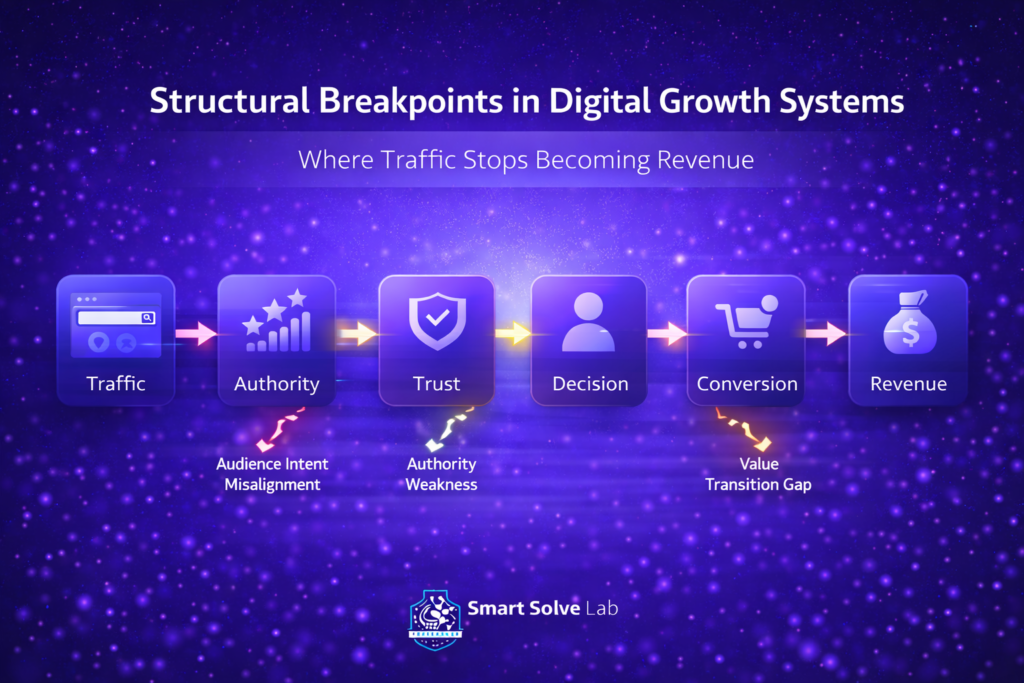
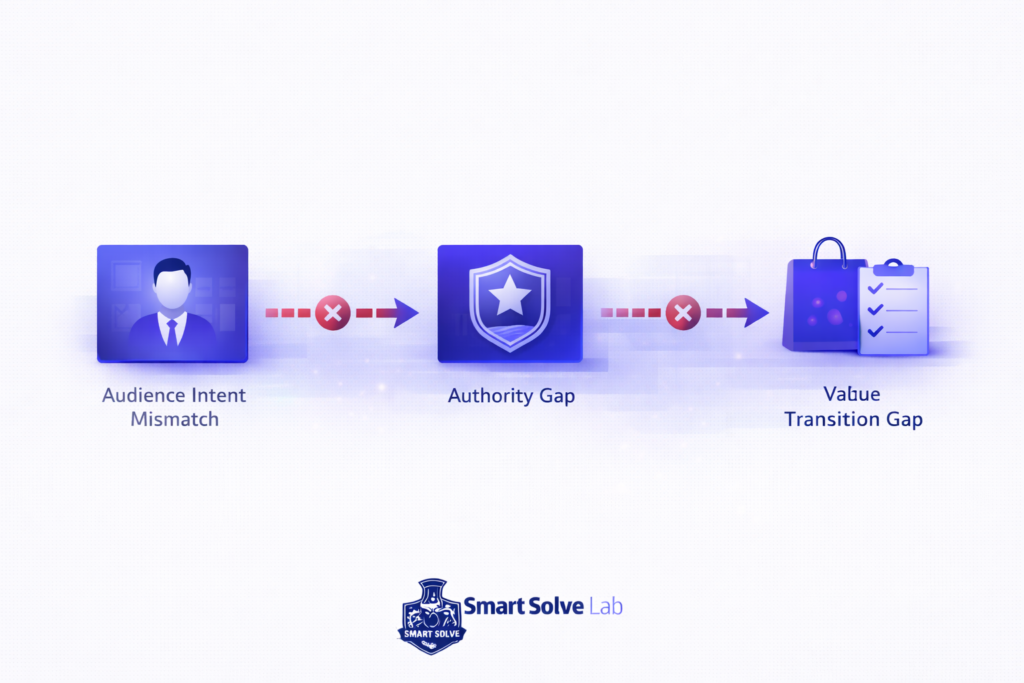
    Breakpoint 1 — Audience Intent Misalignment

    Many funnels attract visitors who are curious but not ready to buy.

    This usually happens when the traffic source focuses heavily on discovery or education rather than purchase intent.

    Visitors may click because the topic interests them, but their expectations may not match the offer presented inside the funnel.

    For example, a visitor reading educational material about marketing systems may still be exploring ideas rather than evaluating solutions.

    When the intent behind the traffic does not match the stage of the funnel, conversions naturally decline.

    Businesses experiencing this issue often need to refine the digital visibility system attracting visitors so that discovery channels align more closely with buyer intent.


    Breakpoint 2 — Trust Weakens at the Decision Stage

    Trust usually develops gradually as visitors read content, explore ideas, and recognize expertise.

    However, many funnels unintentionally weaken trust when the visitor reaches the final decision stage.

    The content that initially attracted attention may feel insightful and educational, yet the sales page may appear overly promotional or disconnected from the earlier message.

    When this happens, the visitor experiences hesitation.

    They may appreciate the information but feel uncertain about committing to the offer.

    Research from Harvard Business Review digital trust research shows that decision confidence plays a critical role in whether prospects move from interest to action.

    If the decision environment fails to reinforce trust, even interested visitors may leave the funnel.


    Breakpoint 3 — Unclear Value Transition

    The transition from information to offer must feel logical.

    Visitors should clearly understand why the offer naturally follows the insights they have already received.

    When this connection becomes unclear, the offer feels abrupt rather than helpful.

    For example, a funnel may present valuable strategic insights but suddenly shift toward features, discounts, or urgency tactics.

    Instead of reinforcing value, this shift creates confusion.

    Visitors may struggle to connect the educational content they appreciated with the product being offered.

    In well-structured funnels, the offer feels like a natural continuation of the journey.

    In poorly aligned funnels, the offer feels like a separate event.

    This disconnect is one of the most common reasons funnels lose potential customers before the final conversion step.

    How to Diagnose Funnel Conversion Leaks

    When funnels fail to convert consistently, the first instinct is often to redesign pages or adjust marketing tactics.

    Businesses rewrite headlines, change pricing, test different call-to-action buttons, or launch new campaigns.

    While these adjustments may produce short-term improvements, they rarely solve the deeper issue.

    Conversion instability usually originates from structural misalignment within the funnel journey.

    Diagnosing funnel leaks requires examining how the entire system guides visitors from attention to action.

    Instead of analyzing pages individually, organizations must evaluate how each stage reinforces the next.

    The process typically begins by mapping the funnel pathway.

    Visitors first discover the brand through search engines, social platforms, or marketing campaigns.

    They then encounter content designed to educate or introduce a problem.

    After engagement begins, the funnel should gradually reinforce expertise, credibility, and value.

    Only after these stages should the visitor encounter the decision environment.

    When this sequence becomes inconsistent, leaks appear.

    For example, traffic may arrive through educational content, yet the funnel immediately pushes a purchase without strengthening trust.

    In other cases, authority may be demonstrated clearly in blog content but disappear when the visitor reaches the offer page.

    These inconsistencies weaken decision confidence.

    Businesses facing this challenge often benefit from applying structured digital problem solving frameworks that analyze how different digital stages interact to produce outcomes.

    This perspective shifts the focus away from isolated metrics and toward the system behind the funnel.

    Research from McKinsey digital transformation research shows that organizations achieve more stable performance when marketing, content, and conversion environments operate as a coordinated system.

    When businesses begin diagnosing funnels through this lens, conversion leaks become easier to identify.

    Instead of reacting to fluctuating results, teams can observe where trust weakens, where expectations shift, and where visitors hesitate.

    Once these structural breakpoints are visible, strengthening the funnel becomes far more predictable.

    Building a Funnel That Converts Consistently

    Once funnel leaks become visible, the next step is strengthening the system guiding visitors toward a decision.

    Many businesses attempt to fix funnel problems by adjusting isolated elements such as page design, button placement, or pricing structure.

    While these changes may influence performance slightly, they rarely solve the deeper structural issue.

    Consistent conversions emerge when the funnel operates as a connected system rather than a collection of independent pages.

    Each stage of the funnel should reinforce the next stage in the visitor’s journey.

    The discovery stage introduces the problem and attracts attention.

    The engagement stage builds authority by explaining insights and demonstrating expertise.

    The trust stage reinforces credibility through consistent messaging, clarity, and confidence signals.

    The decision stage then presents the offer as a natural continuation of everything the visitor has already experienced.

    When these stages operate in alignment, visitors move through the funnel without hesitation.

    Confidence builds gradually, and the final decision feels logical rather than forced.

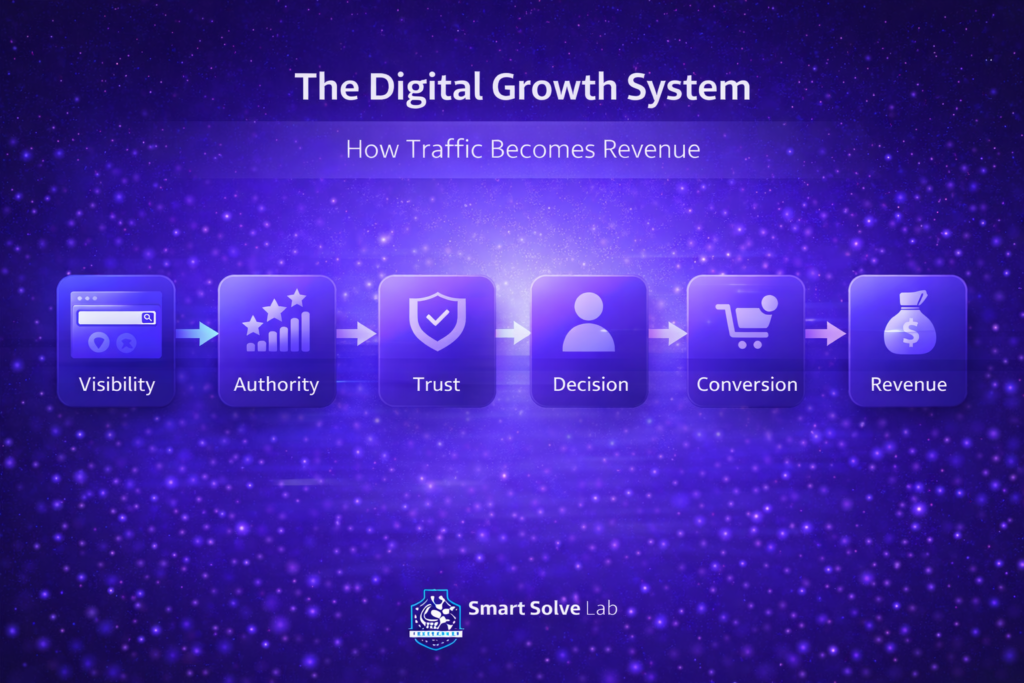
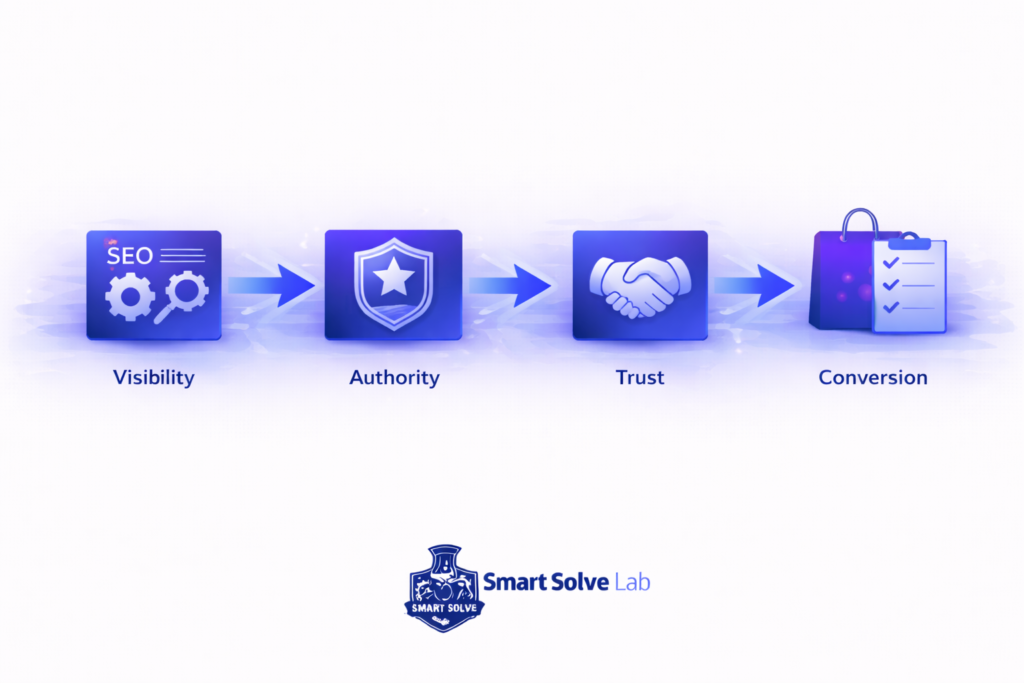
    Organizations that achieve stable funnel performance often design their funnels within a structured digital growth system that connects visibility, authority, trust, and conversion into a single pathway.

    Instead of treating marketing, content, and sales pages as separate activities, this approach aligns them around the visitor’s decision journey.

    Research from Content Marketing Institute conversion research shows that businesses achieve higher conversion stability when educational content, trust signals, and offers remain consistent throughout the buyer journey.

    This alignment reduces friction.

    Visitors clearly understand the problem being solved, the expertise behind the solution, and the value of taking action.

    When funnels operate within this coordinated structure, traffic no longer disappears inside the system.

    Instead, attention gradually transforms into trust, trust transforms into confidence, and confidence leads naturally toward conversion.

    Why Funnel Leaks Are a System Problem, Not a Page Problem

    When funnels fail to convert, most businesses immediately focus on fixing individual pages.

    They redesign landing pages, adjust headlines, change pricing structures, or experiment with new call-to-action buttons.

    While these changes may influence performance temporarily, they rarely solve the underlying problem.

    Funnels rarely fail because of a single weak page.

    They fail because the system guiding the visitor from discovery to decision lacks alignment.

    A visitor’s journey does not begin on the sales page.

    It begins the moment they first encounter the brand — through search results, social content, advertisements, or educational articles.

    From that point forward, every interaction contributes to the visitor’s perception of credibility, expertise, and value.

    When these signals remain consistent, the funnel strengthens trust.

    When they become fragmented, hesitation begins to appear.

    This is why many organizations experience situations where traffic flows through the funnel but conversions remain unstable.

    The system attracting attention is stronger than the system converting that attention into confident decisions.

    Businesses attempting to stabilize funnel performance must therefore shift their focus from page optimization to system alignment.

    A structured approach to digital problem solving allows organizations to analyze how visibility, authority, trust, and conversion interact inside the digital environment.

    Instead of asking “Which page is failing?”, a more useful question becomes:

    Where does the visitor’s confidence weaken during the journey?

    Research from Search Engine Journal conversion optimization research highlights that conversion improvements often occur when businesses examine the entire customer journey rather than optimizing isolated funnel pages.

    This broader perspective reveals why funnel leaks occur and how structural alignment restores stability.

    Once the system guiding the visitor journey becomes coherent, funnels begin performing more predictably.

    Traffic no longer disappears silently inside the funnel.

    Instead, attention transforms into understanding, understanding strengthens trust, and trust naturally leads toward action.

    Conclusion

    When a sales funnel fails to convert, the instinct is often to fix individual pages.

    Businesses redesign landing pages, adjust pricing, experiment with calls to action, or increase advertising budgets in the hope that conversions will improve.

    Sometimes these adjustments create short-term improvements.

    But when funnel leaks persist, the issue is rarely a single page.

    It is the system guiding the visitor journey.

    Funnels succeed when each stage strengthens the next stage.

    Discovery builds curiosity. Educational content builds authority. Consistent messaging reinforces trust. The decision environment then transforms that trust into confident action.

    When this sequence breaks, visitors hesitate.

    And hesitation causes potential customers to quietly leave the funnel.

    Understanding this dynamic allows businesses to move beyond surface optimization and begin examining the deeper structure behind funnel performance.

    Organizations that apply structured digital problem solving approaches are better able to identify where confidence weakens and why visitors abandon the decision pathway.

    Instead of reacting to fluctuating results, they strengthen the system guiding attention toward revenue.

    Research from HubSpot conversion optimization research shows that businesses achieve more stable conversions when the entire customer journey is aligned rather than optimized in isolated stages.

    Once funnel alignment improves, traffic no longer disappears inside the system.

    Visitors understand the value of the offer, trust the expertise behind it, and feel confident enough to act.

    At that point, the funnel stops leaking customers and begins functioning as it was originally intended — a pathway that converts attention into predictable business growth.

    If you want to understand how digital growth systems influence traffic, authority, and conversion stability, the following resources provide deeper insights.

    frequently Answers questions

    Why does my sales funnel get traffic but not conversions?

    Many sales funnels receive traffic but fail to convert because the visitor journey is structurally misaligned. Visitors may become interested in the topic but do not develop enough trust or decision clarity before encountering the offer. When visibility, authority, and trust signals are not aligned inside the funnel, visitors hesitate and leave without completing the purchase.

    What are the most common reasons funnels lose customers?

    Funnels typically lose customers due to three structural issues: audience intent misalignment, weak trust signals at the decision stage, and unclear value transitions between content and offer. When these elements are inconsistent, visitors may engage with the content but feel uncertain about taking the final action.

    How can businesses identify where their funnel is leaking customers?

    Businesses can diagnose funnel leaks by mapping the entire visitor journey from discovery to conversion. This process reveals where visitors hesitate, where trust weakens, and where decision clarity becomes unclear. Analyzing the system behind the funnel rather than focusing on individual pages helps identify structural conversion gaps.

    Does increasing traffic automatically improve funnel conversions?

    Increasing traffic does not automatically improve conversions. Traffic represents attention, but conversions occur only when the funnel provides a clear pathway from curiosity to trust and finally to confident decision making. Without structural alignment inside the funnel, higher traffic can simply increase the number of visitors who leave without converting.

    How can businesses build a funnel that converts consistently?

    Businesses build consistent funnels by aligning discovery channels, authority content, trust signals, and decision environments into a unified system. When visitors experience consistent messaging and clear value throughout the journey, confidence grows naturally and conversion rates stabilize.
  • Why Good Content Still Gets No Traffic (And the Visibility System That Fixes It)

    Many websites wonder why good content gets no traffic even after publishing helpful articles and guides.

    The problem is rarely content quality. In most cases, the real issue is a broken content visibility system that prevents search engines from discovering and ranking your pages.

    Blog posts are published regularly. Ideas are researched carefully. Information is valuable for readers.

    Despite this effort, search traffic remains low.

    Pages struggle to appear in search results, and the audience that could benefit from the content rarely discovers it.

    This situation is common across many websites.

    Good content alone does not automatically create visibility.

    Search engines evaluate far more than the quality of a single article. They examine topical authority, internal relationships between pages, and the structural signals that help determine whether a website represents genuine expertise.

    Without these signals, even well-written content may remain invisible.

    Understanding why good content gets no traffic requires looking beyond writing quality and examining the visibility system responsible for connecting content with audiences.

    When this system is weak, valuable information can remain hidden despite consistent publishing.

    The solution therefore lies not only in creating good content but in building the discovery framework that allows that content to be found.

    Why Good Content Still Gets No Traffic (And the Visibility System That Fixes It)

    Understanding Why Good Content Gets No Traffic

    Many businesses invest significant time creating content.

    They publish blog posts consistently, share insights on social media, and try to provide helpful information to their audience. From the outside, everything appears to be moving in the right direction.

    Content is being created. Effort is being invested. The strategy looks active.

    Yet one frustrating result continues to appear.

    Traffic remains low.

    Articles receive only a handful of visitors. Pages fail to appear in search results. Weeks or months pass, but meaningful discovery never happens.

    This situation confuses many organizations because they believe good content should naturally attract attention.

    If the content is helpful, informative, and relevant, visitors should eventually find it.

    However, digital visibility rarely works this way.

    Quality content alone does not guarantee discovery.

    Visibility emerges from a structured system that connects content creation, search relevance, authority signals, and distribution pathways.

    Without that system, even valuable content can remain invisible.

    This creates what can be described as a visibility paradox.

    Businesses produce useful material, yet the audience never sees it.

    From the inside, effort increases.

    From the outside, visibility remains limited.

    Understanding this paradox requires shifting perspective away from content quality alone and examining the structure behind digital discovery.

    Many organizations approach online growth through isolated actions rather than through a coordinated digital growth system.

    Content is created, but the system responsible for visibility is weak.

    When this happens, search engines struggle to interpret the importance of the content, distribution channels fail to amplify it, and potential readers never encounter it.

    Research from Search Engine Journal SEO research shows that strong content alone rarely ranks without supporting signals such as topical authority, internal linking, and structured visibility strategies.

    This means the problem is often not the content itself.

    The problem is the absence of a structured visibility system capable of bringing that content in front of the right audience.

    To understand why good content frequently remains invisible, it is necessary to examine how digital visibility actually works inside a functioning growth system.

    Why Good Content Often Remains Invisible

    Many businesses assume that producing helpful content should naturally attract traffic.

    The logic appears simple. If an article provides useful insights, answers important questions, or explains complex topics clearly, readers should eventually discover it through search engines or online sharing.

    However, digital visibility rarely depends on content quality alone.

    Search engines evaluate content within a broader ecosystem of signals that determine whether a page deserves attention. These signals include topical authority, internal linking relationships, content structure, and relevance within a larger digital visibility system.

    When these signals are weak or disconnected, search engines struggle to understand where the content fits within the broader knowledge landscape of the web.

    As a result, even valuable articles may remain buried beneath competing pages that provide stronger authority signals.

    Research from HubSpot content marketing research indicates that successful content strategies rely not only on high-quality articles but also on structured visibility frameworks that help search engines interpret relevance and authority.

    Understanding why good content often remains invisible therefore requires examining the structural conditions that influence discovery.

    Content creation is only one component of visibility.

    Without a system guiding how content connects to authority signals, search engines may interpret the material as isolated information rather than as part of a coherent expertise framework.


    The Difference Between Content Quality and Content Visibility

    Content quality refers to the usefulness, clarity, and depth of information presented to readers.

    Visibility, however, refers to whether that content is discoverable within search engines and digital distribution channels.

    These two factors operate differently.

    An article may be insightful and well written, yet remain undiscovered if the signals that help search engines evaluate authority are missing.

    Many organizations mistakenly assume that producing more content will eventually solve the problem.

    However, when the structural elements supporting discovery remain weak, additional content simply expands an invisible library rather than increasing visibility.

    This is why businesses often publish dozens of articles without seeing meaningful growth in search traffic.

    The missing element is not effort.

    The missing element is the structured system that connects content to discovery pathways.

    The Digital Visibility System Behind Content Discovery

    Content becomes discoverable only when it operates inside a structured visibility framework.

    Search engines do not evaluate pages in isolation. Instead, they examine how content connects to related topics, authority signals, and internal relationships across a website.

    When a website publishes content without a coordinated structure, each article behaves like a standalone page competing for attention.

    This makes it difficult for search engines to determine whether the site represents genuine expertise within a specific domain.

    However, when content operates within a connected digital growth system, discovery signals become clearer.

    Search engines can interpret topical relationships between articles, identify expertise patterns, and understand how different pieces of information contribute to a broader knowledge framework.

    This structured relationship between pages is what allows websites to gradually build authority in a specific subject area.

    Research from Search Engine Journal SEO research shows that websites demonstrating strong topical authority across related articles are significantly more likely to achieve consistent search visibility than sites publishing isolated pieces of content.

    In other words, visibility is rarely the result of a single article.

    It is the result of a coordinated system that strengthens discovery signals across an entire website.


    How Search Engines Interpret Authority

    Search engines analyze several factors when determining whether content deserves visibility.

    One important factor is topical relevance. When multiple articles explore related problems within the same subject area, search engines interpret the site as a source of expertise.

    Another factor is internal connectivity. When articles reference and reinforce one another, search engines gain clearer signals about how information on the site is organized.

    A third factor involves consistency of subject focus. Websites that repeatedly address a specific domain tend to build stronger authority signals than those publishing unrelated topics.

    When these elements operate together, content becomes easier for search engines to categorize and recommend to users searching for relevant solutions.

    Without these signals, even well-written articles may struggle to appear in search results because the surrounding structure does not clearly communicate authority.

    The Structural Reasons Good Content Fails to Gain Visibility

    When businesses examine why their content fails to attract traffic, they often focus on surface explanations.

    They assume the article might need better headlines, stronger keywords, or more promotion.

    While these factors can influence performance, they rarely explain why entire websites remain invisible despite consistent publishing.

    The deeper causes usually exist within the structural environment surrounding the content itself.

    Visibility problems rarely originate from a single mistake. Instead, they appear when the discovery pathways that connect content to audiences remain weak or incomplete.

    Understanding these structural breakpoints helps businesses identify why valuable content fails to generate meaningful discovery.


    Breakpoint 1 — Weak Topic Authority

    Search engines favor websites that demonstrate consistent expertise within a specific subject area.

    When content is scattered across unrelated topics, authority signals weaken because search engines cannot clearly identify the site’s primary expertise.

    This often happens when businesses publish articles without aligning them around a focused knowledge structure.

    Instead of reinforcing authority, each article competes independently for attention.

    Over time, this creates a fragmented content environment where even useful material struggles to gain traction.

    Organizations attempting to solve complex visibility challenges often benefit from applying structured digital problem solving frameworks that clarify how different content assets should reinforce one another.


    Breakpoint 2 — Lack of Internal Connectivity

    Content visibility also depends on how pages connect within the website itself.

    Internal links help search engines understand relationships between topics and distribute authority across the site.

    When articles remain isolated, search engines receive limited signals about how the information fits into a larger expertise structure.

    As a result, valuable pages may remain undiscovered because the surrounding architecture does not reinforce their importance.

    Strong internal connectivity transforms individual articles into parts of a coherent knowledge network.

    This network helps search engines interpret relevance more accurately.


    Breakpoint 3 — Absence of Discovery Signals

    Even high-quality content requires signals that guide search engines toward understanding its value.

    These signals include structured headings, consistent topic coverage, and connections to authoritative references.

    Research from Content Marketing Institute research suggests that organizations achieving consistent organic visibility tend to combine content quality with clear discovery frameworks that signal expertise and relevance.

    Without these signals, search engines may interpret the content as informative but not authoritative.

    This subtle distinction often determines whether an article appears prominently in search results or remains buried beneath competing pages.

    How Businesses Can Fix Content Visibility Problems

    Once businesses understand why good content remains invisible, the next step is correcting the structural conditions responsible for weak discovery.

    Many organizations initially attempt to solve visibility problems by increasing publishing frequency.

    They produce more blog posts, expand social media activity, or experiment with additional promotion channels.

    While these efforts increase activity, they rarely solve the underlying issue.

    Visibility does not improve simply because more content exists.

    Visibility improves when content operates within a coordinated discovery system.

    This system connects topic authority, internal knowledge relationships, and search relevance signals so that each article strengthens the visibility of the others.

    Businesses that apply structured digital problem solving approaches often begin identifying how their content ecosystem should be organized to support long-term discovery.

    When this structural alignment improves, search engines receive clearer signals about expertise and relevance.

    Over time, this clarity increases the likelihood that articles appear in search results for relevant problems.

    Research from Harvard Business Review digital strategy research highlights that organizations achieving sustainable digital growth typically organize their knowledge assets around clear problem-solution systems rather than publishing isolated content.

    In practical terms, this means shifting focus from producing individual articles to building an interconnected knowledge framework.


    Building a Visibility-Focused Content Structure

    A visibility-focused structure begins by defining the core problems a website intends to solve for its audience.

    Each content asset then supports that mission by exploring related questions, frameworks, and explanations connected to the same subject area.

    When articles reinforce one another through internal relationships, search engines interpret the website as a specialized source of expertise.

    This gradually strengthens topical authority.

    Instead of competing independently for visibility, the content begins working together as a system.

    Over time, this coordinated structure increases the probability that search engines recommend the site’s material to users searching for solutions within that topic.

    The Visibility System Most Businesses Are Missing

    Many organizations believe their visibility problem can be solved simply by improving individual articles.

    They adjust keywords, rewrite headlines, or publish additional content in the hope that search engines will eventually recognize the value of their material.

    While these actions can help in certain situations, they rarely solve the deeper structural problem behind digital invisibility.

    The real issue is that most businesses approach content creation as isolated activity rather than as part of a coordinated system.

    Articles are written independently, topics are selected randomly, and connections between ideas remain weak.

    As a result, the website fails to communicate a clear signal of expertise to search engines.

    Visibility improves only when content operates within a structured system that connects discovery, authority, and relevance.

    This is why many organizations begin seeing growth only after implementing a consistent digital visibility system that aligns their content with specific problem domains.

    When content consistently explores related problems, frameworks, and insights, search engines gradually recognize the website as a trusted source within that knowledge space.

    Research from Search Engine Journal SEO research indicates that websites demonstrating strong topical authority across interconnected articles often achieve more stable search rankings than those publishing unrelated content.

    The difference is not simply the amount of content produced.

    The difference is the structure connecting that content.


    Visibility Emerges From Systems, Not Individual Articles

    A single article rarely generates sustained search visibility.

    Instead, visibility emerges from a network of related content that collectively signals expertise within a topic.

    When articles reinforce one another through internal relationships, search engines gain a clearer understanding of the website’s authority.

    This interconnected structure transforms individual posts into components of a larger knowledge ecosystem.

    Within such systems, each article strengthens the visibility of the others.

    Over time, the combined authority of the network increases the likelihood that search engines recommend the site’s content to users searching for relevant solutions.

    Businesses that recognize this principle begin shifting their strategy.

    Instead of publishing isolated posts, they design structured visibility systems where content supports discovery, authority, and long-term growth.

    Conclusion:Fixing the Hidden Visibility Problem

    Many businesses believe their content struggles to gain visibility because the material itself is not strong enough.

    They assume the solution is simply to write better articles, publish more frequently, or experiment with different headlines and keywords.

    However, the deeper issue is rarely content quality alone.

    The real challenge usually lies in the structure surrounding the content.

    Good content can remain invisible when the discovery system responsible for connecting that content to audiences is weak.

    Search engines evaluate websites as ecosystems rather than as isolated pages. They look for patterns of expertise, internal relationships between topics, and signals that indicate a coherent knowledge framework.

    Without these signals, even valuable content may fail to attract meaningful traffic.

    When businesses begin organizing their articles within a structured digital growth system, visibility patterns gradually change.

    Instead of competing independently for attention, each piece of content begins reinforcing the authority of the others.

    Research from McKinsey digital strategy research suggests that organizations achieving consistent digital growth typically align their knowledge assets within coordinated systems rather than relying on isolated marketing activities.

    This principle applies directly to content visibility.

    Discovery improves when content operates within a system designed to signal expertise, relevance, and authority.

    Businesses that shift from random publishing toward structured visibility frameworks often experience the most sustainable improvements in search traffic.

    Over time, the combination of strong content and a coordinated discovery system allows valuable insights to reach the audience they were created to serve

    Frequently Answer Questions

    What is a digital visibility system?

    A digital visibility system is a structured framework that helps content become discoverable across search engines and digital platforms.Instead of publishing isolated articles, a visibility system organizes content around related topics, internal connections, and authority signals.When this structure exists, search engines can clearly understand the expertise of the website and recommend its content to users searching for relevant solutions.

    Why does good content sometimes receive no traffic?

    Good content may receive little traffic when the surrounding discovery signals are weak.Search engines rely on multiple indicators such as topical authority, internal linking, and structured content relationships.If these signals are missing, search engines may struggle to understand the importance of the article even if the information itself is valuable.

    How can businesses improve content visibility?

    Businesses can improve content visibility by organizing their articles into connected topic clusters and strengthening the internal relationships between related ideas.This approach helps search engines interpret the website as an authority within a specific subject area rather than as a collection of unrelated posts.Over time, this structured approach increases the likelihood that search engines recommend the site’s content to relevant audiences.

    Does publishing more content automatically increase traffic?

    Publishing more content does not automatically increase traffic if the articles are not connected within a clear discovery framework.Additional content may expand the knowledge available on the site, but without structured internal relationships and topical focus, search engines may still struggle to identify authority signals.Traffic growth usually occurs when content operates within a coordinated system rather than through isolated publishing efforts.

    Why is topical authority important for search visibility?

    Topical authority helps search engines recognize a website as a trusted source of expertise within a specific subject area.When multiple articles consistently explore related problems and frameworks, search engines gain stronger signals that the site provides comprehensive knowledge on that topic.This authority increases the probability that the website’s content appears in search results for users seeking solutions in that domain.

    Why does good content sometimes get no traffic?

    Good content may receive no traffic when search engines cannot easily discover it. This usually happens due to weak topic authority, poor internal linking, or missing visibility signals that help search engines understand the relevance and importance of the content

  • Why Your Content Gets Traffic but Visitors Never Convert

    Why Your Content Gets Traffic but Visitors Never Convert

    Your content attracts traffic but visitors never convert into customers. Discover the hidden engagement–conversion gap and how a digital growth system turns content traffic into real revenue.

    Your content is attracting attention.

    Blog posts are ranking in search engines. Social media shares are increasing. Visitors are reading your articles, spending time on the page, and engaging with the ideas you publish.

    From a visibility perspective, everything appears to be working.

    Traffic grows. Engagement metrics improve. The audience seems interested.

    Yet something important is missing.

    Revenue does not increase at the same pace.

    Readers consume the content but rarely move toward becoming customers. Articles attract attention but fail to translate that attention into meaningful business outcomes. This is a classic case of why content gets traffic but no sales.

    This situation creates one of the most frustrating problems in digital growth.

    Businesses invest time, creativity, and resources into producing valuable content, yet the connection between engagement and conversion remains weak.

    The reason is rarely the quality of the content itself.

    More often, the issue lies in the absence of a structured digital growth system that connects content visibility with buyer readiness.

    When content operates outside this system, it generates attention but fails to guide visitors toward the decision stage where real business value is created.

    Understanding this gap is the first step toward transforming content from a traffic tool into a strategic pathway that converts readers into customers.

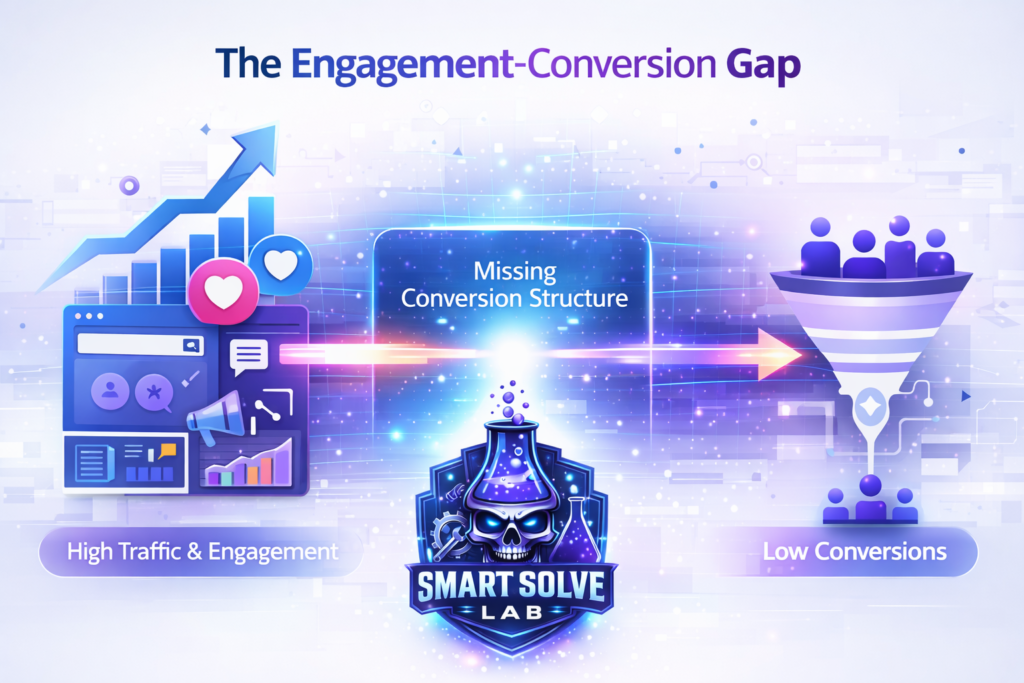
    The Engagement–Conversion Gap

    Illustration showing high content engagement but low conversions due to a structural gap in the content system.
    High engagement does not guarantee conversions when the system architecture is incomplete.

    Many websites experience strong engagement signals such as comments, shares, and page views, yet conversions remain low. This often indicates that the content system is missing a structured pathway that guides engaged readers toward a clear business outcome.

    Many businesses experience a confusing pattern in their digital performance.

    Content performs well. Articles receive traffic. Readers spend time on the page. Social shares increase and engagement appears strong.

    Yet despite this attention, very few visitors become customers.

    This situation creates what can be described as the engagement–conversion gap.

    On the surface, the content appears successful because it attracts readers. However, the deeper goal of content within a digital environment is not only to generate attention. Its purpose is to guide visitors toward a meaningful decision.

    When this transition does not happen, businesses begin to realize that engagement alone does not create sustainable growth.

    In many cases, the issue is not the quality of the content itself. The issue is that the content exists outside a structured digital growth system architecture that connects visibility, authority, and conversion into a coherent pathway.

    Organizations that treat content purely as a traffic channel often miss this connection.

    Instead of building a system that gradually moves readers toward solutions, they produce isolated pieces of content that generate attention but fail to create buyer readiness.

    Over time, this disconnect produces a frustrating outcome.

    Readers return repeatedly for information, yet the business struggles to convert that attention into revenue.

    Another reason engagement fails to translate into revenue is the absence of systematic thinking when diagnosing digital challenges. Many organizations attempt to solve conversion problems through isolated tactics rather than applying a structured digital problem solving framework that examines the entire customer journey.

    Research from HubSpot marketing research shows that businesses frequently confuse content engagement with conversion readiness, even though these represent completely different stages of the buyer journey.

    Why Content Traffic Doesn’t Produce Customers

    Many organizations assume that content marketing success can be measured purely by traffic numbers.

    When blog posts begin attracting visitors from search engines or social platforms, it often feels like the strategy is working. Metrics such as page views, impressions, and engagement appear encouraging.

    However, traffic alone does not guarantee that the visitors arriving on a website are ready to become customers.

    Content attracts attention, but conversion requires alignment between the visitor’s intent and the solution being offered.

    This is where many businesses encounter a structural disconnect.

    Visitors may arrive while researching ideas, exploring trends, or trying to understand a problem. At this stage, they are gathering information rather than evaluating solutions.

    When content focuses only on education without gradually introducing the pathway toward a solution, readers consume the information and then leave without progressing further in the decision journey.

    In other words, attention enters the system, but buyer readiness never develops.

    This challenge becomes more visible when businesses analyze how their digital visibility system attracts audiences.

    If the discovery stage attracts a broad audience with mixed intent, the website may receive significant traffic while only a small percentage of visitors have genuine purchasing motivation.

    As a result, engagement metrics rise but revenue remains inconsistent.

    Another factor contributing to this gap is the absence of structured thinking when diagnosing digital growth challenges.

    Businesses often treat content performance as an isolated marketing activity rather than analyzing how it connects to the broader digital problem solving system that guides visitors from awareness to decision.

    Research published in Harvard Business Review digital strategy research explains that organizations achieve stronger conversion outcomes when marketing content is intentionally aligned with the stages of the buyer decision journey.

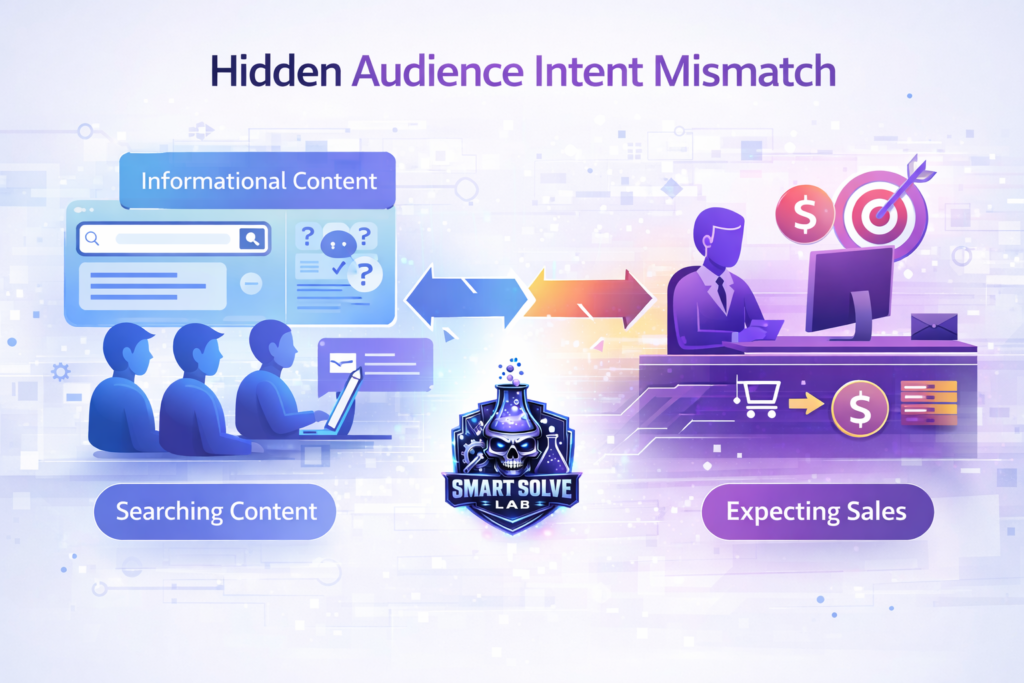
    The Hidden Audience Intent Mismatch

    Diagram explaining how mismatched audience intent can prevent content traffic from converting into customers.
    Content that attracts informational traffic often fails to convert when audience intent is misunderstood.

    Audience intent plays a critical role in determining whether content generates customers or only attracts visitors. When the intent of the audience does not match the goal of the business, traffic increases but meaningful conversions remain limited.

    One of the most common reasons content generates traffic without producing customers is a mismatch between audience intent and business positioning.

    Visitors often arrive on a website with different motivations. Some are exploring ideas, others are researching potential solutions, and a smaller group may already be preparing to make a decision.

    When content attracts audiences who are still in the early exploration stage, engagement may increase while conversions remain low.

    This does not mean the content is ineffective.

    It simply means that the intent of the audience does not yet align with the moment of purchase.

    For example, a visitor reading about digital marketing strategies may be interested in learning new concepts rather than immediately investing in a solution.

    If the content does not gradually connect educational insights with the solution pathway, readers leave with knowledge but without a reason to take the next step.

    This is why understanding audience intent is critical inside a digital growth system.

    Within a well-structured system, content is designed to guide visitors through a progression.

    First, the content helps readers understand the problem.
    Second, it introduces the strategic perspective needed to solve that problem.
    Third, it shows how the solution logically follows from the insight they have gained.

    When these stages operate together, content does more than generate attention. It prepares visitors for decision readiness.

    Organizations that struggle with this alignment often lack a structured approach to diagnosing audience behavior.

    Instead of analyzing intent patterns across content, they continue publishing new material without examining whether it attracts the right audience in the first place.

    Applying a systematic digital problem solving framework helps businesses identify whether the traffic they attract matches the problems they are equipped to solve.

    Research discussed in Search Engine Journal marketing research also highlights that understanding user intent is one of the most important factors for improving content-driven conversions.

    Structural Breakpoints in Content Monetization

    Even when content attracts the right audience, conversions may still remain inconsistent if the pathway between engagement and monetization is weak.

    In many digital environments, content operates independently from the systems responsible for building authority, trust, and decision readiness.

    When these elements are not connected, content may succeed at generating attention but fail to guide visitors toward meaningful action.

    This creates structural breakpoints within the digital journey.

    A breakpoint occurs when the momentum created by content engagement does not carry forward into the stages required for conversion.

    Three breakpoints appear frequently in content-driven growth systems.

    • Content attracts curiosity but does not introduce solution pathways.
    • Authority signals are visible in educational material but disappear at the decision stage.
    • Visitors understand the problem yet struggle to see why the offered solution logically follows.

    Each of these breakpoints interrupts the connection between attention and revenue.

    Instead of moving smoothly from learning to decision, visitors experience hesitation.

    When hesitation appears, conversion stability declines.

    Many organizations attempt to solve this problem by increasing content output. They publish more articles, expand topic coverage, or promote content through additional channels.

    However, without strengthening the structure connecting content to monetization, additional traffic simply amplifies the same misalignment.

    This is why businesses must examine how their digital visibility system connects discovery with authority and decision pathways.

    A well-designed system ensures that every piece of content plays a strategic role within the broader growth architecture.

    Instead of existing as isolated resources, articles become entry points into a structured journey that gradually prepares visitors for the solution being offered.

    Organizations that fail to recognize these structural relationships often continue applying isolated tactics rather than approaching growth through a coordinated digital growth system architecture.

    According to Content Marketing Institute research, businesses achieve significantly stronger conversion results when content strategy is aligned with the stages of the buyer journey rather than focusing solely on content volume.

    How to Diagnose Content–Buyer Misalignment

    Once the engagement–conversion gap becomes visible, the next step is diagnosing where the misalignment between content and buyer readiness occurs.

    Many businesses assume that improving conversions requires stronger persuasion or more aggressive calls to action. In reality, the issue often begins earlier in the journey.

    Diagnosis requires examining how visitors move from discovering content to evaluating solutions.

    The first step is reviewing the discovery stage.

    Ask whether the topics attracting traffic reflect the problems your business is designed to solve. If articles attract broad curiosity but not solution-focused visitors, the traffic entering the system may not match the intended audience.

    This is why many organizations struggle even after producing valuable educational material.

    The content succeeds in attracting readers, yet it fails to guide the right audience toward the decision stage.

    A structured digital problem solving system helps businesses analyze this gap by examining how discovery, authority, and decision stages interact across the digital environment.

    The second step is evaluating authority signals within the content itself.

    Visitors who consume educational material should gradually recognize the expertise and structured thinking behind the solution being presented.

    If content delivers useful information but does not demonstrate a clear methodology or system, readers may appreciate the insight while remaining uncertain about the credibility of the solution provider.

    Businesses that implement a structured digital problem solving framework are better able to communicate this authority because the framework clarifies how the problem is analyzed and solved.

    The third step is analyzing the transition between learning and decision.

    Content should not abruptly shift from education to promotion. Instead, the solution should feel like a natural continuation of the insight the reader has already received.

    When this transition is clear, visitors understand why the solution exists and how it connects to the problem they are trying to solve.

    Research from McKinsey digital transformation research highlights that companies achieve stronger conversion outcomes when marketing insights, authority signals, and decision pathways operate as an integrated system.

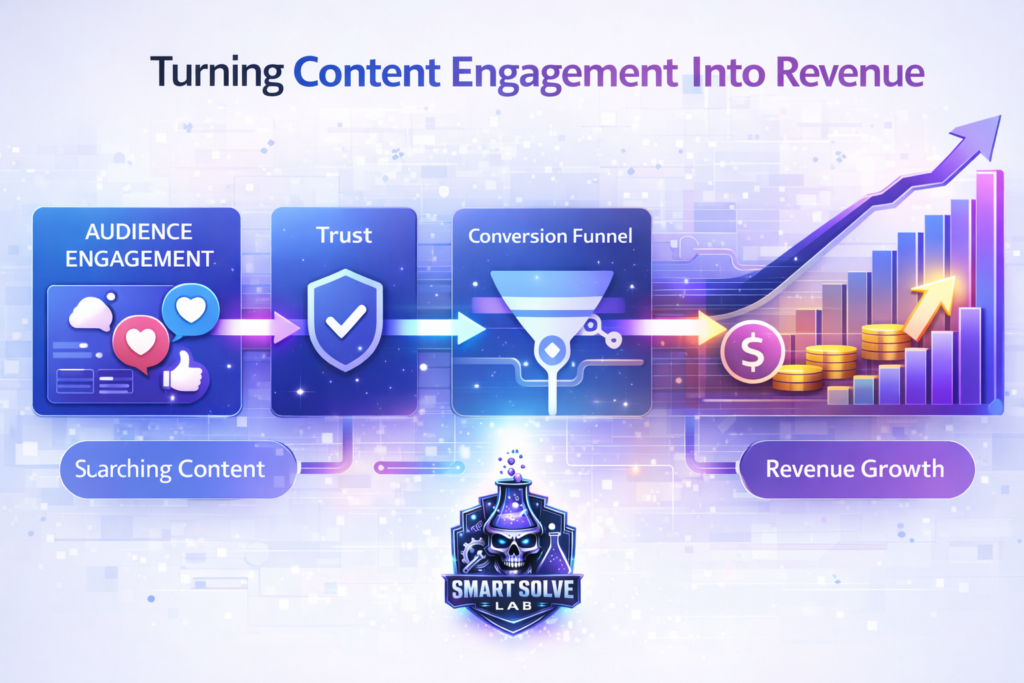
    Turning Content Engagement Into Revenue

    Understanding Why Content Gets Traffic but No Sales

    Infographic showing how audience engagement can be transformed into revenue through a structured digital growth system.
    A well-designed content system converts engagement signals into measurable revenue growth.

    When engagement signals such as reader attention, trust, and interaction are properly integrated into a conversion framework, content begins to produce real business outcomes. A structured digital growth system ensures that audience engagement ultimately leads to revenue generation.

    Once businesses understand why content attracts attention but fails to produce customers, the next step is transforming content from an isolated marketing activity into a strategic component of a digital growth system.

    Content should not exist simply to generate traffic.

    Its purpose is to guide visitors through a progression that gradually builds authority, strengthens trust, and prepares readers for decision readiness.

    When content performs this role effectively, engagement becomes the starting point of a structured journey rather than the final outcome.

    The first shift involves redefining the role of content within the broader growth architecture.

    Instead of publishing articles purely to increase visibility, organizations must design content that connects directly with the problems their solutions address.

    This ensures that discovery attracts visitors who are already moving toward a relevant decision stage.

    Businesses that apply a structured digital growth system architecture are better able to align visibility with monetization because each stage of the visitor journey is intentionally connected.

    The second shift involves reinforcing authority throughout the content experience.

    Readers who spend time exploring educational material should gradually recognize that the insights they are receiving originate from a deeper system of thinking.

    This recognition builds credibility and confidence before visitors ever encounter a conversion page.

    Organizations that approach content creation through structured smart digital solutions often achieve stronger authority signals because their content reflects systematic problem solving rather than isolated marketing tactics.

    The third shift involves creating a natural bridge between insight and action.

    Content should guide readers toward understanding why the solution being offered logically follows from the problem explained in the article.

    When this bridge exists, the transition from reading to decision feels intuitive rather than forced.

    Research discussed in HubSpot marketing strategy research shows that businesses achieve stronger conversion outcomes when content is designed to support the entire buyer journey rather than focusing solely on attracting traffic.

    When content, authority, trust, and decision pathways operate as a coordinated system, engagement begins to transform into predictable revenue rather than remaining a disconnected metric.

    Conclusion

    Many businesses interpret content success through traffic metrics alone.

    Page views increase. Engagement rises. Articles receive attention across search engines and social platforms.

    Yet despite this activity, revenue remains unpredictable.

    The reason is rarely a lack of traffic.

    The deeper issue is the absence of alignment between content engagement and buyer readiness.

    Content attracts attention, but attention alone does not create customers.

    Visitors must move through a structured progression where insight builds authority, authority strengthens trust, and trust prepares the reader for decision clarity.

    When this progression is missing, engagement becomes disconnected from revenue.

    Readers learn from the content but never feel prepared to take the next step.

    Businesses experiencing this challenge often attempt to solve the problem by increasing output.

    They publish more articles, expand their keyword strategy, or promote content through additional channels.

    While these actions may increase visibility, they rarely solve the underlying issue if the pathway between content and monetization remains weak.

    Organizations that approach growth through a structured digital growth system architecture recognize that content is not merely a traffic tool. It is the entry point of a system designed to guide visitors toward meaningful action.

    Similarly, applying a structured digital problem solving system allows businesses to diagnose where the journey between discovery and decision breaks down.

    Research from Harvard Business Review digital strategy research highlights that organizations achieve more predictable growth when marketing activities operate within a coordinated system rather than through isolated tactics.

    When businesses align discovery, authority, trust, and decision pathways, content begins to perform its real function.

    It transforms attention into confidence.

    And confidence into customers.

    FAQs

    Why does content get traffic but fail to generate customers?

    Content often attracts visitors who are still exploring ideas rather than looking for a solution. When the audience arriving on a website does not match the stage of decision required for conversion, engagement increases but sales remain low. This usually indicates a gap between content visibility and buyer intent alignment.


    What is the engagement–conversion gap in content marketing?

    The engagement–conversion gap appears when readers interact with content but do not move toward becoming customers. Businesses may see strong traffic, long reading time, and social engagement, yet conversions remain low because the content does not guide visitors toward the decision stage.


    How can businesses turn content traffic into revenue?

    Businesses can convert content traffic into revenue by aligning content with the buyer journey. Content should not only educate readers but also introduce the problem framework, demonstrate authority, and naturally guide visitors toward the solution that the business provides.


    Why is audience intent important in content marketing?

    Audience intent determines whether visitors are simply gathering information or preparing to make a purchase decision. When content attracts the wrong intent stage, engagement may grow but conversion remains weak because visitors are not yet ready to buy.

    What role does a digital growth system play in content conversion?

    FAQ Answer 5A digital growth system connects visibility, authority, trust, and conversion into a structured pathway. When content operates inside this system, readers move gradually from learning about a problem to understanding why the offered solution makes sense, which significantly improves conversion potential.

    recommended reading

  • High Website Traffic Still Fails to Generate Revenue

    High Website Traffic Still Fails to Generate Revenue

    High website traffic but no revenue is one of the most confusing problems businesses face when their digital growth system is misaligned.

    Your website traffic is growing.

    Analytics dashboards look encouraging. Organic impressions are increasing. Social media posts are attracting attention. Campaigns are bringing new visitors to your website every day.

    From the outside, everything appears to be moving in the right direction.

    More visibility usually signals growth. Many businesses interpret rising traffic as proof that their marketing strategy is working.

    But then a frustrating realization appears.

    Revenue does not grow at the same pace.

    Traffic increases, yet sales remain inconsistent. Visitors explore pages but do not convert into customers. Some campaigns generate thousands of visits while producing only a handful of purchases.

    This situation confuses many organizations because it challenges one of the most common assumptions in digital marketing:

    More traffic should produce more revenue.

    In reality, digital growth rarely works this way.

    Traffic is not revenue.

    Traffic is only attention.

    Revenue emerges only when attention moves through a structured pathway that transforms curiosity into trust, trust into confidence, and confidence into action.

    When this pathway is incomplete or misaligned, traffic can grow indefinitely without producing proportional business results.

    This is why many websites experience what can be called a Traffic–Revenue Disconnection.

    From the outside, visibility expands. From the inside, monetization remains unstable.

    Understanding this disconnection requires shifting perspective from traffic quantity to system alignment.

    Instead of asking:

    “How can we increase traffic further?”

    A more useful question becomes:

    “Why is our traffic not translating into predictable revenue?”

    Answering this question reveals a deeper structural issue within many digital environments — the absence of a digital growth system that connects visibility with monetization.

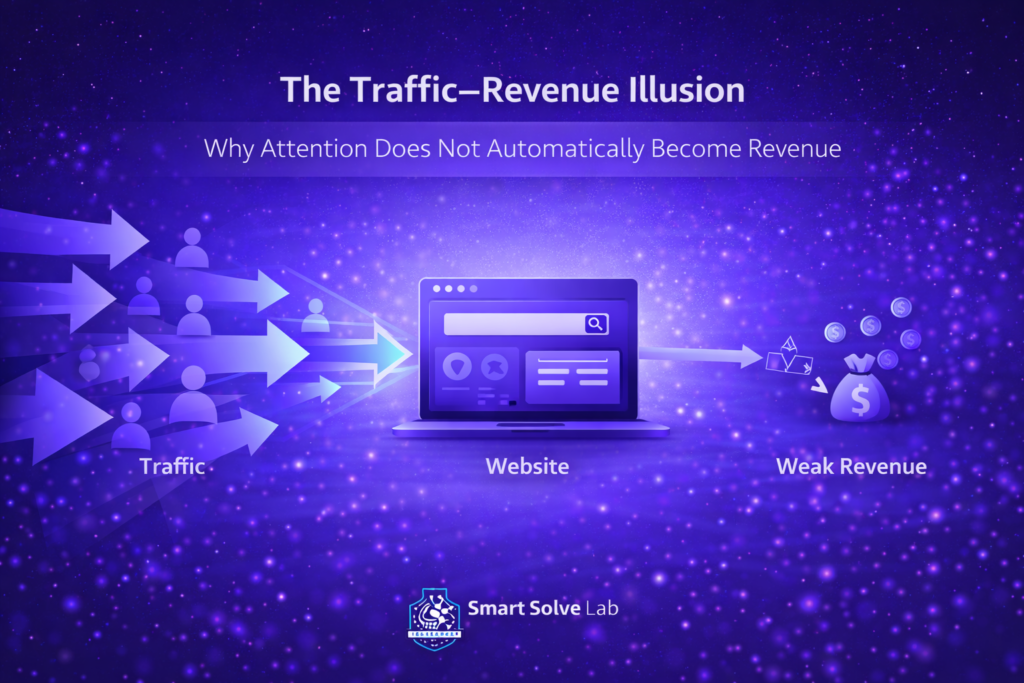
    The Traffic–Revenue Illusion

    Traffic revenue illusion diagram showing how website visitors increase without producing proportional revenue
    The traffic–revenue illusion occurs when visitor growth creates the appearance of progress while monetization systems remain weak.

    Many digital strategies focus heavily on attracting visitors while overlooking the structural pathway required to convert attention into economic value. When the system connecting traffic acquisition and monetization is incomplete, organizations experience the traffic–revenue illusion where visibility expands but revenue does not follow.

    One of the most persistent misconceptions in digital marketing is the belief that traffic automatically leads to business growth.

    The reasoning appears logical.

    If more people visit a website, more opportunities for conversion should exist. If opportunities increase, revenue should increase as well.

    However, this assumption treats traffic as if it directly causes revenue.

    In reality, traffic is only the beginning of the digital growth process.

    Visitors arrive with different intentions, expectations, and levels of awareness. Some are exploring ideas. Others are researching options. Only a small portion may be ready to make a decision.

    Without a structured system guiding these visitors through a meaningful journey, most traffic simply passes through the website without becoming economic value.

    This creates the Traffic–Revenue Illusion.

    The illusion occurs when businesses observe rising visitor numbers and assume monetization should naturally follow.

    When revenue does not increase proportionally, teams often react by increasing marketing activity.

    They publish more content.
    They launch additional campaigns.
    They experiment with new traffic sources.

    These actions may temporarily increase visibility, but they rarely solve the fundamental issue.

    The problem is not always traffic generation.

    The problem is the absence of alignment between traffic acquisition and revenue architecture.

    In other words, attention is arriving faster than the system designed to convert that attention into business outcomes.

    When this imbalance exists, traffic becomes a misleading metric.

    It signals activity but does not guarantee value creation.

    This explains why some websites receive thousands of visitors every day yet struggle to generate sustainable revenue.

    Their visibility layer is active, but their monetization pathway is weak.

    To understand this problem more clearly, it is necessary to examine how traffic actually becomes revenue within a functioning digital system.

    The Hidden Layer Between Traffic and Revenue

    Most digital strategies treat traffic generation and revenue generation as separate objectives.

    Marketing teams focus on attracting visitors through SEO, content marketing, social media distribution, or advertising.

    Sales or conversion teams focus on optimizing landing pages, pricing structures, and calls to action.

    While these activities are valuable, separating them often creates a structural gap between visibility and monetization.

    In reality, traffic and revenue are connected through a sequence of reinforcing stages that operate together as a digital growth system.

    Digital growth system architecture illustrating the stages from visibility and authority to trust decision clarity and conversion
    A digital growth system connects visibility authority trust decision clarity and conversion into a coordinated pathway that produces revenue.

    Revenue emerges when visitors move through a structured system rather than isolated marketing activities. Visibility attracts attention, authority demonstrates expertise, trust builds confidence, and decision clarity prepares the visitor for action. When these stages reinforce one another, traffic gradually transforms into predictable business growth.

    These stages typically include:

    Visibility
    Authority
    Trust
    Decision clarity
    Conversion

    Each stage prepares the next.

    Visibility introduces the brand to new audiences.
    Authority demonstrates expertise and credibility.
    Trust reinforces reliability and confidence.
    Decision clarity helps visitors understand why action makes sense.
    Conversion transforms confidence into measurable revenue.

    When these stages operate as a continuous system, traffic gradually transforms into customers.

    However, when these stages operate independently, the pathway breaks.

    Visitors may discover the website but fail to recognize clear expertise.
    They may perceive expertise but remain uncertain about credibility.
    They may trust the brand but hesitate at the moment of decision.

    Every break in this pathway weakens the connection between traffic and revenue.

    The result is a digital environment where attention flows in but economic value struggles to flow out.

    This is why businesses often experience rising traffic without proportional revenue growth.

    The system attracting attention is stronger than the system converting attention into action.

    Understanding this structural gap is the first step toward diagnosing why high website traffic sometimes fails to produce meaningful business results.

    Structural Breakpoints Between Traffic and Revenue

    Structural breakpoints diagram showing audience intent misalignment authority gaps and weak value transitions in a digital growth system
    Structural breakpoints interrupt the pathway that converts website traffic into predictable revenue.

    Conversion instability rarely occurs randomly. It often appears when structural gaps interrupt the connection between visibility, authority, trust, and conversion. Identifying these breakpoints helps organizations understand why increasing traffic sometimes fails to generate proportional revenue.

    Many businesses experience high website traffic but no revenue because their digital growth system lacks alignment.

    When traffic increases but revenue does not follow, the issue usually exists within the structural pathway that connects visibility to monetization.

    Digital performance rarely fails at a single point. Instead, instability appears when the stages of visibility, authority, trust, and conversion do not reinforce one another consistently.

    Understanding where this breakdown occurs requires identifying the most common structural breakpoints that interrupt the journey from attention to revenue.

    Three breakpoints appear repeatedly across digital environments.

    Breakpoint 1 — Audience Intent Misalignment

    Traffic can grow while buyer intent weakens.

    Visitors may arrive through informational searches, educational content, or broad discovery channels. While this traffic increases visibility, it may not always align with the stage of decision required for conversion.

    For example, a visitor reading educational content about digital marketing systems may still be exploring ideas rather than evaluating solutions.

    When the expectations created during discovery do not match the decision environment presented later, conversions become inconsistent.

    Businesses experiencing this issue often focus heavily on expanding traffic sources instead of refining the digital visibility system that attracts the right audience in the first place.

    Breakpoint 2 — Authority Not Reinforced at the Decision Stage

    Authority is frequently built through long-form content, educational resources, and strategic insights.

    However, when visitors move from informational content to a conversion page, authority signals sometimes disappear.

    The visitor may have recognized expertise while reading the content but encounter fewer credibility indicators at the moment of decision.

    Without reinforced authority cues, trust weakens precisely when it should be strongest.

    Many organizations experience this challenge because their content and conversion environments operate separately rather than within a unified digital growth system.

    Breakpoint 3 — Weak Value Transition

    The transition from information to offer must feel natural.

    If the content emphasizes strategic thinking but the offer focuses only on features or urgency, visitors struggle to connect the value they received with the value being sold.

    In well-structured systems, the offer feels like a logical continuation of the journey.

    In misaligned systems, the offer feels abrupt or disconnected.

    This disconnect creates hesitation, and hesitation reduces conversion stability.

    Research from McKinsey digital strategy research suggests that organizations achieve consistent digital growth only when marketing visibility, authority positioning, and revenue architecture operate as a coordinated system.

    How to Diagnose the Traffic–Revenue Alignment Problem

    Understanding why high website traffic produces no revenue requires analyzing the structural pathway between visibility and conversion.

    Once businesses recognize that traffic growth does not automatically translate into revenue, the next step is diagnosis.

    The goal is not simply to increase traffic further, but to understand where the connection between visibility and monetization is weakening.

    Many organizations struggle with this step because they focus on surface metrics such as page views, impressions, or click-through rates. While these indicators measure attention, they do not always reveal whether the digital system is capable of converting that attention into economic value.

    A more useful approach is to examine how visitors move through the stages of the digital journey.

    These stages typically include visibility, authority recognition, trust formation, and finally the decision to take action.

    When these stages reinforce one another, traffic gradually transforms into consistent business outcomes. However, when one stage weakens or disconnects, the pathway between traffic and revenue becomes unstable.

    Businesses that approach this challenge through structured digital problem solving are more likely to identify the real cause of monetization instability rather than repeatedly adjusting surface tactics.

    Step 1 — Evaluate Traffic Intent

    The first step in diagnosing the alignment problem is evaluating the intent behind incoming traffic.

    Not all traffic is equal. Some visitors arrive seeking information, while others are exploring potential solutions. Only a small percentage may be actively comparing providers or preparing to make a decision.

    If the majority of traffic originates from early-stage discovery queries, revenue instability is likely to appear even when visitor numbers increase.

    In such situations, businesses must examine whether their digital visibility system is attracting the correct audience or simply maximizing exposure.

    Step 2 — Examine Authority Signals

    The second diagnostic step focuses on authority.

    Visitors rarely convert if they do not perceive credible expertise behind the content they consume.

    Authority signals may include in-depth insights, research-driven explanations, structured frameworks, and consistent positioning across the website.

    When authority is weak or inconsistent, visitors may engage with content yet hesitate to trust the organization enough to move toward a decision.

    Step 3 — Analyze the Decision Environment

    Even when visibility and authority function well, revenue can remain unstable if the decision environment is unclear.

    Visitors must understand not only what a business offers, but also why taking action is the logical next step.

    If messaging, value explanation, and conversion pathways are inconsistent, hesitation emerges during the final stage of the journey Strategic analysis from Harvard Business Review research suggests that organizations achieve more predictable growth when marketing visibility, authority signals, and conversion pathways operate as a unified system rather than separate initiatives.

    Building a Traffic-to-Revenue Alignment System

    Once the structural causes behind traffic–revenue disconnection become visible, the next step is building a system that reconnects these stages.

    Instead of treating traffic generation and revenue generation as separate activities, businesses must design a structure where visibility, authority, trust, and conversion reinforce one another continuously.

    This approach transforms marketing from a collection of isolated tactics into a coordinated digital growth system where each stage prepares the next.

    When this alignment exists, traffic no longer behaves like random attention. It becomes a predictable source of opportunity because the system surrounding that traffic is designed to guide visitors toward meaningful decisions.

    Align Visibility with Audience Intent

    The first requirement of alignment is ensuring that visibility attracts the right type of audience.

    Traffic growth alone is not the objective. The objective is attracting visitors whose expectations match the solutions being offered.

    Businesses often expand traffic sources rapidly without refining the digital visibility system that determines who actually discovers their content.

    When visibility attracts audiences with aligned intent, the rest of the conversion pathway becomes significantly more stable.

    Reinforce Authority Throughout the Journey

    Authority should not appear only within blog articles or educational resources.

    It must remain visible across every stage of the visitor journey, including landing pages, solution descriptions, and decision environments.

    When authority signals disappear at the moment of evaluation, visitors may hesitate even if earlier content demonstrated expertise.

    Strong systems ensure that authority cues — insights, frameworks, credibility indicators, and strategic explanations — remain consistent from discovery to decision.

    Create a Clear Decision Environment

    The final step in alignment is creating a decision environment where visitors understand exactly why taking action is the logical continuation of the journey they have experienced.

    This requires clear messaging, coherent value explanation, and visible pathways for taking the next step.

    Research from Content Marketing Institute research highlights that organizations achieve stronger revenue outcomes when content authority and conversion pathways operate as an integrated experience rather than disconnected marketing activities.

    When visibility attracts the right audience, authority builds confidence, and decision pathways remain clear, traffic begins to translate into predictable revenue rather than fluctuating results.

    From Traffic Growth to Revenue Stability

    Traffic growth can be an encouraging signal, but it should never be mistaken for business success on its own.

    Many organizations celebrate rising visitor numbers while overlooking the structural pathway required to convert attention into revenue.

    When visibility increases without alignment between authority, trust, and decision clarity, traffic behaves like temporary attention rather than sustainable opportunity.

    This is why businesses often experience cycles of excitement followed by frustration. Campaigns attract visitors, engagement appears promising, yet revenue remains inconsistent.

    The problem rarely lies in traffic alone.

    More often, it lies in how organizations approach digital problem solving when performance metrics fail to translate into stable business outcomes.

    Stable growth emerges only when the stages of visibility, authority, trust, and conversion operate as a coordinated digital growth system rather than disconnected marketing activities.

    In such systems, traffic does not simply arrive and disappear. It enters a structured pathway where visitors gradually recognize expertise, develop confidence, and reach decisions with clarity.

    Research in digital strategy consistently supports this principle. Insights from Search Engine Journal analysis emphasize that sustainable online growth occurs when visibility strategies and conversion systems evolve together rather than independently.

    Understanding this distinction changes how businesses interpret their digital performance.

    Instead of chasing higher traffic numbers alone, they begin strengthening the systems that transform visibility into authority and authority into revenue.

    When that structural alignment exists, traffic growth no longer produces unpredictable spikes. It becomes the foundation of stable and scalable digital performance.

    FAQs

    Why does high website traffic not always generate revenue?

    High website traffic does not automatically generate revenue because traffic represents attention, not purchasing intent. Visitors may arrive at a website to gather information, explore ideas, or research solutions without being ready to make a decision. When the stages of visibility, authority, trust, and conversion are not properly aligned, traffic may increase while revenue remains unstable. Businesses that connect these stages through a structured digital system are more likely to convert traffic into consistent business outcomes.

    What is the traffic–revenue disconnection in digital marketing?

    Traffic–revenue disconnection occurs when a website attracts visitors but fails to convert that attention into measurable business results. This usually happens when marketing visibility grows faster than the system designed to guide visitors toward a decision. Without strong authority signals, trust reinforcement, and clear decision pathways, traffic flows through the website without producing consistent revenue.

    How can businesses diagnose why traffic is not converting into sales?

    Businesses can diagnose traffic conversion problems by analyzing the structural pathway between visibility and revenue. This includes evaluating traffic intent, examining authority signals across the website, and reviewing the clarity of decision environments. When these stages operate independently rather than as a coordinated system, traffic may grow without producing stable conversions.

    What role does authority play in converting website traffic?

    Authority plays a critical role in converting website traffic because visitors rarely make decisions without recognizing credible expertise. Authority signals such as in-depth insights, research-based explanations, and consistent positioning help visitors trust the information they encounter. When authority remains visible throughout the visitor journey, confidence increases and conversion decisions become easier.

    How can businesses align traffic with revenue growth?

    Businesses can align traffic with revenue growth by designing a system where visibility, authority, trust, and conversion operate as connected stages of the digital journey. Instead of focusing only on attracting visitors, organizations must ensure that traffic sources match audience intent, authority signals remain strong across the website, and decision pathways clearly guide visitors toward action.

  • Why Your Conversions Fluctuate Even When Traffic Increases

    Website traffic increasing while conversions fluctuate illustration
    High traffic does not always translate into stable conversions.

    Your traffic is growing.

    Analytics look promising. Impressions are rising. Clicks are increasing. Campaign reports show upward movement. On the surface, it appears that growth is happening.

    In many digital environments, conversions fluctuate even while traffic continues to grow.

    Yet revenue feels unstable.

    Some days conversions spike. Other days they drop unexpectedly. A campaign performs well for a short period, then results decline without a clear explanation. Despite consistent effort and increasing visibility, sales refuse to stabilize.

    This experience is more common than most businesses admit.

    The natural assumption is that the issue must be traffic quality, targeting, pricing, or messaging tweaks. As a result, teams adjust ads, redesign landing pages, experiment with offers, or push for more volume.

    But what if traffic is not the real issue?

    In many cases, fluctuating conversions are not caused by insufficient visitors. They are caused by structural discontinuity within the conversion pathway itself.

    Traffic creates exposure.

    Conversions require alignment.

    When alignment is unstable, results fluctuate regardless of traffic growth.

    Understanding this distinction is the first step toward diagnosing why your conversion performance feels inconsistent even when visibility increases.

    Traffic increasing but conversions leaking from the funnel diagram
    Growing traffic can hide structural weaknesses in the conversion pathway.

    The Traffic–Conversion Illusion

    One of the most persistent misconceptions in digital growth is the belief that more traffic naturally leads to stable revenue.

    The logic seems simple:

    More visitors should produce more opportunities.
    More opportunities should produce more conversions.
    More conversions should produce predictable growth.

    But this linear assumption ignores how digital systems actually operate.

    Traffic is exposure. It represents attention in the digital environment, a concept often explained through the attention economy.

    Conversion, however, is not just a reaction to exposure. It is the outcome of a structured pathway that includes:

    • Expectation alignment
    • Authority perception
    • Trust reinforcement
    • Decision clarity
    • Value continuity

    If any part of this pathway weakens, conversion performance becomes unstable.

    This creates what can be called the Traffic–Conversion Illusion.

    From the outside, growth appears to be happening because visitor numbers increase. From the inside, revenue does not stabilize because the internal pathway that turns attention into action is inconsistent.

    Imagine pouring more water into a pipeline that has loose joints. The pressure increases, but leakage prevents steady output. Adding more water does not fix the structural weakness.

    Similarly, increasing traffic does not correct misalignment within the decision journey.

    This is why businesses often experience periods where campaigns perform well temporarily. Traffic rises, conversions spike briefly, then decline again. The system cannot sustain performance because the internal structure does not consistently reinforce the decision process.

    The illusion persists because traffic metrics are visible and easy to measure. Structural continuity, on the other hand, is less visible and harder to diagnose.

    When organizations focus only on surface metrics, they attempt to solve conversion instability by increasing volume rather than strengthening alignment.

    The result is effort expansion without stability.

    To move beyond this illusion, it is necessary to shift focus from quantity of visitors to integrity of the conversion pathway.

    Only then can fluctuating results be understood not as random volatility, but as a structural signal.

    Symptoms of Conversion Instability

    Conversion instability rarely appears as a complete collapse. Instead, it manifests through recurring patterns that signal underlying misalignment.

    These patterns often include:

    Revenue spikes followed by sudden drops
    Campaign-dependent sales performance
    High traffic with inconsistent conversion rates
    Short-lived improvements after optimizations
    Unpredictable monthly revenue trends

    Each of these symptoms points to volatility rather than steady progression.

    For example, a new campaign might produce impressive results during its launch phase. Engagement increases, sales improve, and performance appears strong. However, as time passes, the same campaign begins to underperform without a clear external cause.

    In other cases, traffic from one channel converts significantly better than traffic from another, even when targeting appears similar. This inconsistency suggests that alignment between visitor expectation and decision experience varies across pathways.

    Another common symptom is optimization fatigue. Teams continually adjust headlines, pricing structures, page layouts, and calls to action in search of incremental improvement. Some changes produce short-term gains, but overall stability remains elusive.

    These recurring adjustments create the impression that conversion is a tactical problem.

    Yet when volatility persists across different campaigns and time periods, the pattern indicates something deeper.

    Stable systems produce stable outputs. When outputs fluctuate despite sustained effort, structural examination becomes necessary.

    Conversion instability is not simply a matter of improving persuasion. It is often a signal that the connection between trust formation and decision execution is inconsistent.

    Until that connection is understood, fluctuations will continue to appear unpredictable.

    In the next section, we will explore the structural reason why this connection breaks, even when traffic continues to grow.

    The Hidden Structural Cause

    When conversions fluctuate despite increasing traffic, the instinct is to search for a visible fault.

    Is the pricing wrong?
    Is the offer weak?
    Is the landing page poorly designed?
    Is the traffic low quality?

    While these factors can influence performance, they rarely explain recurring instability on their own.

    The deeper issue often lies in what can be called a Trust–Conversion Discontinuity.

    Trust is built gradually. It forms through content quality, authority signals, clarity of positioning, consistency of messaging, and perceived expertise. This process may happen across blog posts, social channels, email sequences, or educational material.

    Conversion, however, occurs at a specific decision point.

    The problem arises when the trust built in earlier stages does not seamlessly transfer into the moment of action.

    Visitors may appreciate your content.
    They may perceive expertise.
    They may even agree with your ideas.

    But when they reach the decision stage, something subtle shifts.

    The message changes.
    The tone changes.
    The value proposition feels compressed.
    The confidence built earlier weakens.

    This creates a structural break between trust formation and decision execution.

    The visitor does not consciously analyze this break. Instead, they experience hesitation.

    Hesitation reduces conversion stability.

    In structurally aligned digital growth systems, each stage prepares the next.. Authority builds trust. Trust prepares decision readiness. Decision pathways feel like a natural continuation of what the visitor has already experienced.

    In misaligned systems, stages operate in isolation. Content educates, but sales pages push. Authority is demonstrated in one place, but credibility signals are missing in another. Messaging evolves during the journey rather than remaining coherent.

    When this happens, traffic can grow indefinitely, yet conversion results will fluctuate because the internal pathway lacks continuity.

    Traffic measures attention, a concept widely discussed in research about the attention economy.

    Trust measures confidence.

    Conversion requires the uninterrupted transfer of confidence into action.

    When that transfer is inconsistent, instability becomes inevitable.

    Three Structural Breakpoints

    Conversion pathway with structural breakpoints diagram
    Conversion instability often originates from structural gaps between stages of the decision journey.

    To understand conversion volatility more clearly, it is helpful to identify where structural discontinuity most commonly occurs.

    There are three recurring breakpoints in digital systems that produce fluctuating results.

    First Breakpoint: Misaligned Audience Intent

    Traffic can increase while intent alignment decreases.

    Visitors may arrive through broad keywords, trending topics, or expanded distribution channels shaped by digital visibility systems.

    For example, content may attract readers seeking education, while the offer requires immediate purchase intent. When the expectation set during discovery does not match the decision context, conversion rates fluctuate depending on which segment of traffic dominates at a given time.

    This creates variability rather than stability.

    Second Breakpoint: Authority Not Reinforced at the Decision Stage

    Authority is often strongest within long-form content, educational resources, or thought leadership material. However, when visitors transition to a decision page, authority cues may diminish.

    If proof elements, credibility signals, or expertise positioning are not clearly reinforced at the conversion point, trust weakens precisely when it is needed most.

    The visitor may think:

    “This content was insightful.”

    But at the decision moment:

    “Is this really the right choice?”

    That subtle doubt introduces volatility. Some visitors convert confidently. Others hesitate. Results fluctuate accordingly.

    Third Breakpoint: Weak Value Transition

    The transition from information to offer must feel coherent.

    If content emphasizes insight and strategic thinking, but the offer emphasizes features or urgency, a disconnect occurs. The visitor struggles to connect the value they experienced with the value being sold.

    In structurally aligned systems, the offer feels like a logical continuation of the journey.

    In misaligned systems, the offer feels like a separate event.

    When transitions are weak, conversion depends heavily on emotional timing, urgency, or external factors. This produces spikes rather than consistent performance.

    These three breakpoints do not eliminate conversions entirely. Instead, they destabilize them.

    Some traffic segments convert well. Others do not. Certain campaigns perform strongly for a period before fading. Revenue becomes sensitive to small variations in messaging or audience composition.

    Without recognizing these structural breakpoints, teams continue adjusting surface elements while the underlying pathway remains inconsistent.

    What Stable Conversions Actually Require

    Stable conversion pathway from visibility to trust to conversion
    Stable conversions emerge from aligned stages in the digital growth system.

    Stable conversions do not arise from persuasion intensity alone. They emerge from structural continuity.

    Continuity means that each stage of the digital journey reinforces the next without friction or contradiction.

    Visibility sets clear expectations.
    Authority confirms expertise.
    Trust deepens confidence.
    Conversion offers a natural next step.

    When this chain operates coherently, conversion becomes less dependent on temporary factors such as campaign novelty or urgency triggers.

    Instead of fluctuating in response to small changes, performance stabilizes because the pathway itself is consistent.

    Stable systems share three characteristics.

    First, alignment across stages. Messaging, tone, positioning, and value emphasis remain coherent from first touchpoint to final decision.

    Second, reinforced confidence at transition points. Authority signals and trust cues do not disappear at the moment of action. They intensify.

    Third, clarity of decision logic. Visitors understand not only what they are buying, but why it logically follows from the journey they have experienced.

    When these conditions exist, increasing traffic amplifies stable output rather than amplifying volatility.

    If your conversions fluctuate despite rising traffic, the issue is unlikely to be volume alone.

    It is more likely that structural continuity between trust and decision is inconsistent.

    And until that continuity is examined and reinforced, performance will continue to feel unpredictable.

    In the next section, we will explore how to begin thinking about diagnosing this instability in a structured way.

    Diagnosing Conversion Instability as a Structural Problem

    When conversion performance fluctuates, many businesses attempt to solve the issue through rapid optimization. Headlines are rewritten. Pricing is adjusted. Landing pages are redesigned. New campaigns are launched in search of better results.

    While these actions may occasionally produce short-term improvements, they rarely resolve instability permanently.

    The reason is simple: optimization modifies surface elements, while instability often originates from deeper structural relationships within the digital pathway.

    To diagnose conversion instability effectively, organizations must shift their perspective from isolated metrics to connected stages of the user journey.

    Conversion is not a single event. It is the final outcome of a sequence within a digital growth system that includes visibility, authority formation, trust reinforcement, and decision clarity.

    When these stages operate independently rather than as a coherent chain, results become inconsistent.

    Instead of asking “How can we increase conversions?”, a more useful question is:

    Where does continuity break between trust and action?

    Once this perspective is adopted, conversion instability becomes easier to interpret. Fluctuations are no longer mysterious. They become signals that one or more structural relationships require attention.

    Tracing the Conversion Pathway

    A practical starting point for diagnosing instability is mapping the journey a visitor experiences before reaching the decision point.

    This pathway typically includes several stages:

    Discovery through search, social platforms, or referral channels.
    Engagement through educational content or problem-oriented material.
    Authority recognition as visitors begin to perceive expertise or insight.
    Trust formation through consistent messaging and credibility signals.
    Decision readiness when the visitor evaluates whether action makes sense.

    If conversions fluctuate, the disruption usually occurs somewhere within this pathway.

    Visitors may discover valuable content yet fail to recognize clear expertise.
    They may recognize authority but lack sufficient trust reinforcement.
    They may trust the brand but encounter uncertainty at the moment of decision.

    By tracing the pathway rather than focusing solely on the final metric, businesses begin to see where alignment weakens.

    Identifying Structural Weak Points

    Once the pathway is visible, the next step is identifying which connection between stages appears unstable.

    For example, if traffic increases but engagement remains shallow, the issue may lie in expectation alignment during the discovery stage.

    If engagement is strong but conversions remain inconsistent, authority may not be translating into trust at the decision level.

    If trust appears high yet visitors hesitate to act, the transition from confidence to value clarity may be weak.

    These weak points often remain hidden because traditional analytics tools emphasize outcomes rather than relationships.

    Metrics can reveal what happened, but they rarely explain how different stages interact to produce that outcome.

    Structural diagnosis therefore requires observing patterns rather than isolated numbers.

    Moving from Symptoms to Structural Insight

    When teams begin analyzing instability through this lens, the focus shifts from reactive optimization to systemic understanding.

    Instead of treating every fluctuation as a new problem, recurring patterns reveal deeper structural causes.

    Traffic volatility may indicate inconsistent discovery positioning.
    Trust gaps may appear as high engagement but low action.
    Decision uncertainty may appear as abandoned conversions or delayed purchases.

    By recognizing these signals as structural indicators rather than tactical failures, organizations gain a clearer view of how their digital systems actually function.

    Over time, this perspective allows businesses to move from constant experimentation toward smart digital solutions that improve structural alignment.

    Closing Insight

    If your conversions fluctuate even while traffic continues to grow, the issue is rarely random.

    It is usually a signal that the pathway connecting attention, trust, and decision is not fully aligned.

    Traffic alone cannot create stability.

    Only a coherent system—where each stage reinforces the next—can produce consistent results.

    When businesses begin examining conversions through a structural lens, instability stops feeling unpredictable. It becomes diagnosable.

    And once the structural relationships behind conversion performance are understood, improving stability becomes a matter of reinforcing the pathway rather than endlessly increasing effort.

    Traffic increases FAQs

    What causes conversions to fluctuate even when website traffic increases?

    Conversions fluctuate when the pathway between attention, trust, and decision is not structurally aligned. Traffic can increase exposure, but if authority signals, trust reinforcement, or decision clarity weaken at any stage of the journey, visitors hesitate at the moment of action. This hesitation creates unstable conversion performance even when visibility continues to grow.

    Does increasing website traffic always lead to higher conversions?

    No. Traffic increases exposure, but conversions depend on alignment between visitor expectations, perceived expertise, trust signals, and decision clarity. If these elements are inconsistent, more visitors simply amplify instability rather than producing predictable results.

    What is the traffic–conversion illusion in digital marketing?

    The traffic–conversion illusion is the assumption that more visitors automatically create stable revenue. While traffic measures attention, conversions require a structured decision pathway that includes authority perception, trust reinforcement, and value clarity. Without this alignment, traffic growth does not guarantee stable outcomes.

    Why do some campaigns produce temporary conversion spikes but not long-term stability?

    Temporary conversion spikes often occur when campaigns attract highly aligned traffic for a short period. However, if the internal decision pathway lacks structural continuity—such as weak authority reinforcement or unclear value transitions—results decline once that temporary alignment fades.

    How can businesses identify structural gaps that affect conversions?

    Businesses can identify structural gaps by examining the full visitor journey rather than focusing only on final conversion metrics. By mapping stages such as discovery, engagement, authority recognition, trust formation, and decision readiness, organizations can locate where continuity weakens and correct the underlying structure.

    What creates stable conversions in digital growth systems?

    Stable conversions emerge when every stage of the digital journey reinforces the next. Visibility sets expectations, authority confirms expertise, trust builds confidence, and the conversion step feels like a natural continuation of the visitor’s experience. When this pathway remains coherent, results become predictable rather than volatile.