
High website traffic but no revenue is one of the most confusing problems businesses face when their digital growth system is misaligned.
Your website traffic is growing.
Analytics dashboards look encouraging. Organic impressions are increasing. Social media posts are attracting attention. Campaigns are bringing new visitors to your website every day.
From the outside, everything appears to be moving in the right direction.
More visibility usually signals growth. Many businesses interpret rising traffic as proof that their marketing strategy is working.
But then a frustrating realization appears.
Revenue does not grow at the same pace.
Traffic increases, yet sales remain inconsistent. Visitors explore pages but do not convert into customers. Some campaigns generate thousands of visits while producing only a handful of purchases.
This situation confuses many organizations because it challenges one of the most common assumptions in digital marketing:
More traffic should produce more revenue.
In reality, digital growth rarely works this way.
Traffic is not revenue.
Traffic is only attention.
Revenue emerges only when attention moves through a structured pathway that transforms curiosity into trust, trust into confidence, and confidence into action.
When this pathway is incomplete or misaligned, traffic can grow indefinitely without producing proportional business results.
This is why many websites experience what can be called a Traffic–Revenue Disconnection.
From the outside, visibility expands. From the inside, monetization remains unstable.
Understanding this disconnection requires shifting perspective from traffic quantity to system alignment.
Instead of asking:
“How can we increase traffic further?”
A more useful question becomes:
“Why is our traffic not translating into predictable revenue?”
Answering this question reveals a deeper structural issue within many digital environments — the absence of a digital growth system that connects visibility with monetization.
Table of Contents
The Traffic–Revenue Illusion
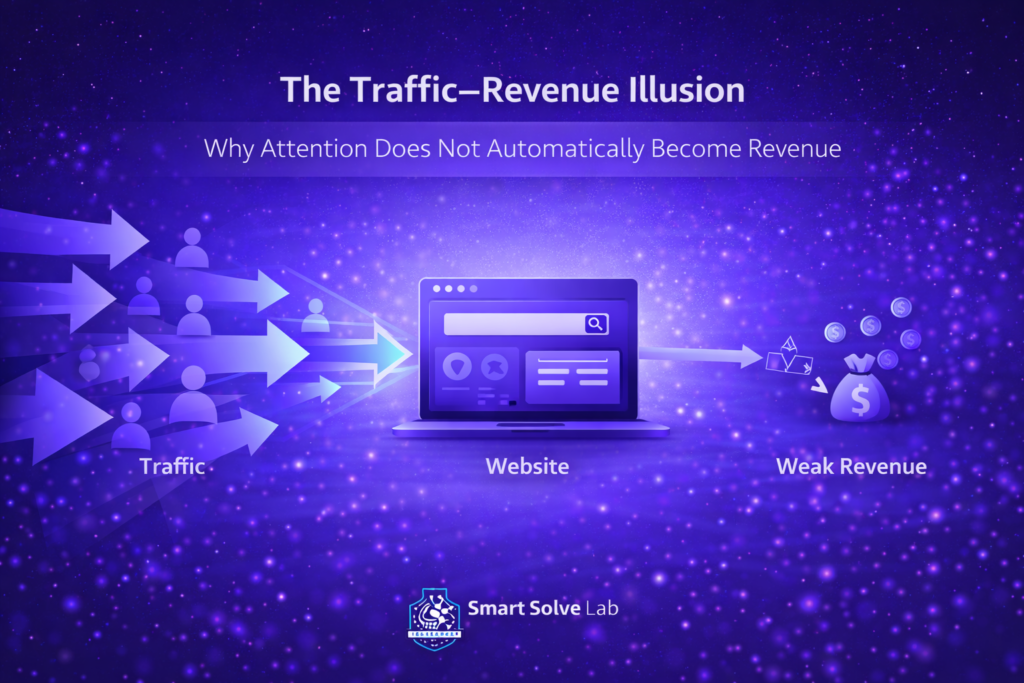
Many digital strategies focus heavily on attracting visitors while overlooking the structural pathway required to convert attention into economic value. When the system connecting traffic acquisition and monetization is incomplete, organizations experience the traffic–revenue illusion where visibility expands but revenue does not follow.
One of the most persistent misconceptions in digital marketing is the belief that traffic automatically leads to business growth.
The reasoning appears logical.
If more people visit a website, more opportunities for conversion should exist. If opportunities increase, revenue should increase as well.
However, this assumption treats traffic as if it directly causes revenue.
In reality, traffic is only the beginning of the digital growth process.
Visitors arrive with different intentions, expectations, and levels of awareness. Some are exploring ideas. Others are researching options. Only a small portion may be ready to make a decision.
Without a structured system guiding these visitors through a meaningful journey, most traffic simply passes through the website without becoming economic value.
This creates the Traffic–Revenue Illusion.
The illusion occurs when businesses observe rising visitor numbers and assume monetization should naturally follow.
When revenue does not increase proportionally, teams often react by increasing marketing activity.
They publish more content.
They launch additional campaigns.
They experiment with new traffic sources.
These actions may temporarily increase visibility, but they rarely solve the fundamental issue.
The problem is not always traffic generation.
The problem is the absence of alignment between traffic acquisition and revenue architecture.
In other words, attention is arriving faster than the system designed to convert that attention into business outcomes.
When this imbalance exists, traffic becomes a misleading metric.
It signals activity but does not guarantee value creation.
This explains why some websites receive thousands of visitors every day yet struggle to generate sustainable revenue.
Their visibility layer is active, but their monetization pathway is weak.
To understand this problem more clearly, it is necessary to examine how traffic actually becomes revenue within a functioning digital system.
The Hidden Layer Between Traffic and Revenue
Most digital strategies treat traffic generation and revenue generation as separate objectives.
Marketing teams focus on attracting visitors through SEO, content marketing, social media distribution, or advertising.
Sales or conversion teams focus on optimizing landing pages, pricing structures, and calls to action.
While these activities are valuable, separating them often creates a structural gap between visibility and monetization.
In reality, traffic and revenue are connected through a sequence of reinforcing stages that operate together as a digital growth system.
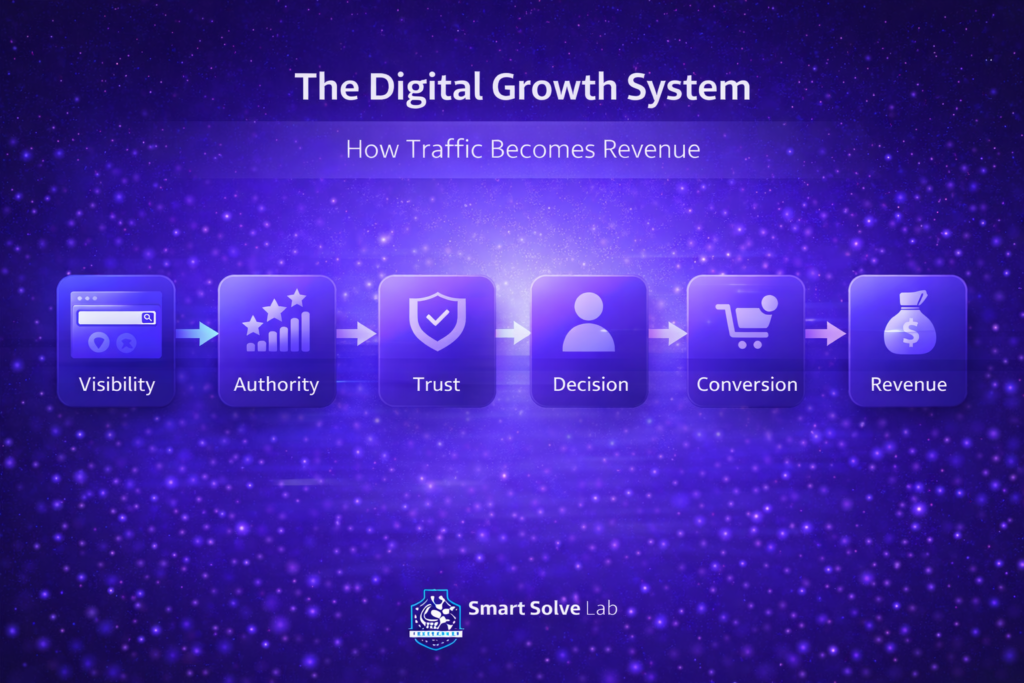
Revenue emerges when visitors move through a structured system rather than isolated marketing activities. Visibility attracts attention, authority demonstrates expertise, trust builds confidence, and decision clarity prepares the visitor for action. When these stages reinforce one another, traffic gradually transforms into predictable business growth.
These stages typically include:
Visibility
Authority
Trust
Decision clarity
Conversion
Each stage prepares the next.
Visibility introduces the brand to new audiences.
Authority demonstrates expertise and credibility.
Trust reinforces reliability and confidence.
Decision clarity helps visitors understand why action makes sense.
Conversion transforms confidence into measurable revenue.
When these stages operate as a continuous system, traffic gradually transforms into customers.
However, when these stages operate independently, the pathway breaks.
Visitors may discover the website but fail to recognize clear expertise.
They may perceive expertise but remain uncertain about credibility.
They may trust the brand but hesitate at the moment of decision.
Every break in this pathway weakens the connection between traffic and revenue.
The result is a digital environment where attention flows in but economic value struggles to flow out.
This is why businesses often experience rising traffic without proportional revenue growth.
The system attracting attention is stronger than the system converting attention into action.
Understanding this structural gap is the first step toward diagnosing why high website traffic sometimes fails to produce meaningful business results.
Structural Breakpoints Between Traffic and Revenue
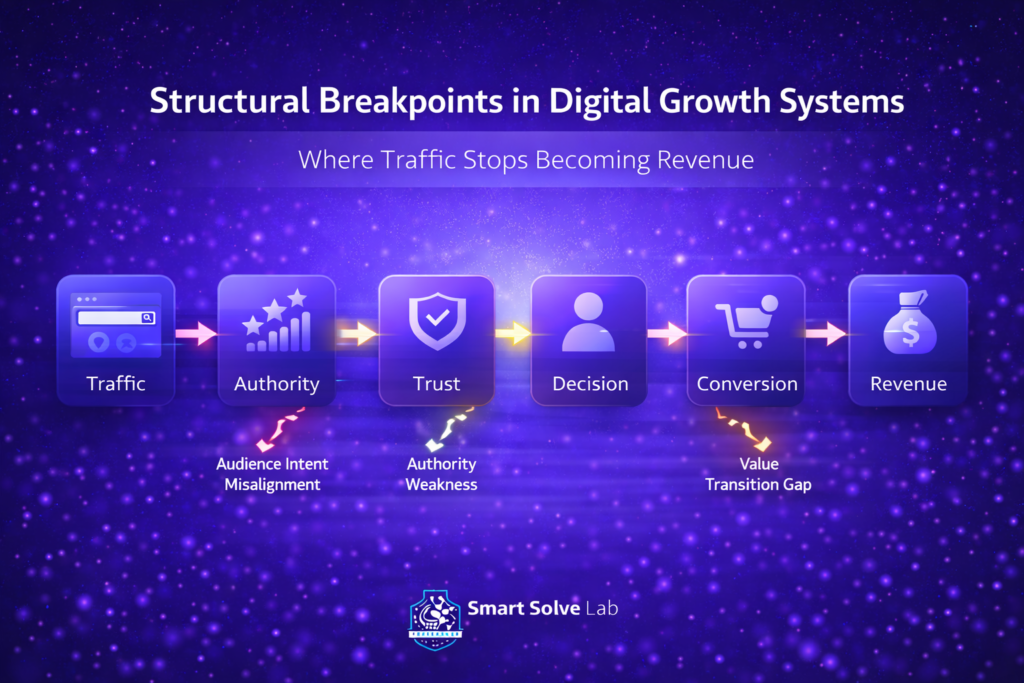
Conversion instability rarely occurs randomly. It often appears when structural gaps interrupt the connection between visibility, authority, trust, and conversion. Identifying these breakpoints helps organizations understand why increasing traffic sometimes fails to generate proportional revenue.
Many businesses experience high website traffic but no revenue because their digital growth system lacks alignment.
When traffic increases but revenue does not follow, the issue usually exists within the structural pathway that connects visibility to monetization.
Digital performance rarely fails at a single point. Instead, instability appears when the stages of visibility, authority, trust, and conversion do not reinforce one another consistently.
Understanding where this breakdown occurs requires identifying the most common structural breakpoints that interrupt the journey from attention to revenue.
Three breakpoints appear repeatedly across digital environments.
Breakpoint 1 — Audience Intent Misalignment
Traffic can grow while buyer intent weakens.
Visitors may arrive through informational searches, educational content, or broad discovery channels. While this traffic increases visibility, it may not always align with the stage of decision required for conversion.
For example, a visitor reading educational content about digital marketing systems may still be exploring ideas rather than evaluating solutions.
When the expectations created during discovery do not match the decision environment presented later, conversions become inconsistent.
Businesses experiencing this issue often focus heavily on expanding traffic sources instead of refining the digital visibility system that attracts the right audience in the first place.
Breakpoint 2 — Authority Not Reinforced at the Decision Stage
Authority is frequently built through long-form content, educational resources, and strategic insights.
However, when visitors move from informational content to a conversion page, authority signals sometimes disappear.
The visitor may have recognized expertise while reading the content but encounter fewer credibility indicators at the moment of decision.
Without reinforced authority cues, trust weakens precisely when it should be strongest.
Many organizations experience this challenge because their content and conversion environments operate separately rather than within a unified digital growth system.
Breakpoint 3 — Weak Value Transition
The transition from information to offer must feel natural.
If the content emphasizes strategic thinking but the offer focuses only on features or urgency, visitors struggle to connect the value they received with the value being sold.
In well-structured systems, the offer feels like a logical continuation of the journey.
In misaligned systems, the offer feels abrupt or disconnected.
This disconnect creates hesitation, and hesitation reduces conversion stability.
Research from McKinsey digital strategy research suggests that organizations achieve consistent digital growth only when marketing visibility, authority positioning, and revenue architecture operate as a coordinated system.
How to Diagnose the Traffic–Revenue Alignment Problem
Understanding why high website traffic produces no revenue requires analyzing the structural pathway between visibility and conversion.
Once businesses recognize that traffic growth does not automatically translate into revenue, the next step is diagnosis.
The goal is not simply to increase traffic further, but to understand where the connection between visibility and monetization is weakening.
Many organizations struggle with this step because they focus on surface metrics such as page views, impressions, or click-through rates. While these indicators measure attention, they do not always reveal whether the digital system is capable of converting that attention into economic value.
A more useful approach is to examine how visitors move through the stages of the digital journey.
These stages typically include visibility, authority recognition, trust formation, and finally the decision to take action.
When these stages reinforce one another, traffic gradually transforms into consistent business outcomes. However, when one stage weakens or disconnects, the pathway between traffic and revenue becomes unstable.
Businesses that approach this challenge through structured digital problem solving are more likely to identify the real cause of monetization instability rather than repeatedly adjusting surface tactics.
Step 1 — Evaluate Traffic Intent
The first step in diagnosing the alignment problem is evaluating the intent behind incoming traffic.
Not all traffic is equal. Some visitors arrive seeking information, while others are exploring potential solutions. Only a small percentage may be actively comparing providers or preparing to make a decision.
If the majority of traffic originates from early-stage discovery queries, revenue instability is likely to appear even when visitor numbers increase.
In such situations, businesses must examine whether their digital visibility system is attracting the correct audience or simply maximizing exposure.
Step 2 — Examine Authority Signals
The second diagnostic step focuses on authority.
Visitors rarely convert if they do not perceive credible expertise behind the content they consume.
Authority signals may include in-depth insights, research-driven explanations, structured frameworks, and consistent positioning across the website.
When authority is weak or inconsistent, visitors may engage with content yet hesitate to trust the organization enough to move toward a decision.
Step 3 — Analyze the Decision Environment
Even when visibility and authority function well, revenue can remain unstable if the decision environment is unclear.
Visitors must understand not only what a business offers, but also why taking action is the logical next step.
If messaging, value explanation, and conversion pathways are inconsistent, hesitation emerges during the final stage of the journey Strategic analysis from Harvard Business Review research suggests that organizations achieve more predictable growth when marketing visibility, authority signals, and conversion pathways operate as a unified system rather than separate initiatives.
Building a Traffic-to-Revenue Alignment System
Once the structural causes behind traffic–revenue disconnection become visible, the next step is building a system that reconnects these stages.
Instead of treating traffic generation and revenue generation as separate activities, businesses must design a structure where visibility, authority, trust, and conversion reinforce one another continuously.
This approach transforms marketing from a collection of isolated tactics into a coordinated digital growth system where each stage prepares the next.
When this alignment exists, traffic no longer behaves like random attention. It becomes a predictable source of opportunity because the system surrounding that traffic is designed to guide visitors toward meaningful decisions.
Align Visibility with Audience Intent
The first requirement of alignment is ensuring that visibility attracts the right type of audience.
Traffic growth alone is not the objective. The objective is attracting visitors whose expectations match the solutions being offered.
Businesses often expand traffic sources rapidly without refining the digital visibility system that determines who actually discovers their content.
When visibility attracts audiences with aligned intent, the rest of the conversion pathway becomes significantly more stable.
Reinforce Authority Throughout the Journey
Authority should not appear only within blog articles or educational resources.
It must remain visible across every stage of the visitor journey, including landing pages, solution descriptions, and decision environments.
When authority signals disappear at the moment of evaluation, visitors may hesitate even if earlier content demonstrated expertise.
Strong systems ensure that authority cues — insights, frameworks, credibility indicators, and strategic explanations — remain consistent from discovery to decision.
Create a Clear Decision Environment
The final step in alignment is creating a decision environment where visitors understand exactly why taking action is the logical continuation of the journey they have experienced.
This requires clear messaging, coherent value explanation, and visible pathways for taking the next step.
Research from Content Marketing Institute research highlights that organizations achieve stronger revenue outcomes when content authority and conversion pathways operate as an integrated experience rather than disconnected marketing activities.
When visibility attracts the right audience, authority builds confidence, and decision pathways remain clear, traffic begins to translate into predictable revenue rather than fluctuating results.
From Traffic Growth to Revenue Stability
Traffic growth can be an encouraging signal, but it should never be mistaken for business success on its own.
Many organizations celebrate rising visitor numbers while overlooking the structural pathway required to convert attention into revenue.
When visibility increases without alignment between authority, trust, and decision clarity, traffic behaves like temporary attention rather than sustainable opportunity.
This is why businesses often experience cycles of excitement followed by frustration. Campaigns attract visitors, engagement appears promising, yet revenue remains inconsistent.
The problem rarely lies in traffic alone.
More often, it lies in how organizations approach digital problem solving when performance metrics fail to translate into stable business outcomes.
Stable growth emerges only when the stages of visibility, authority, trust, and conversion operate as a coordinated digital growth system rather than disconnected marketing activities.
In such systems, traffic does not simply arrive and disappear. It enters a structured pathway where visitors gradually recognize expertise, develop confidence, and reach decisions with clarity.
Research in digital strategy consistently supports this principle. Insights from Search Engine Journal analysis emphasize that sustainable online growth occurs when visibility strategies and conversion systems evolve together rather than independently.
Understanding this distinction changes how businesses interpret their digital performance.
Instead of chasing higher traffic numbers alone, they begin strengthening the systems that transform visibility into authority and authority into revenue.
When that structural alignment exists, traffic growth no longer produces unpredictable spikes. It becomes the foundation of stable and scalable digital performance.
FAQs
Why does high website traffic not always generate revenue?
High website traffic does not automatically generate revenue because traffic represents attention, not purchasing intent. Visitors may arrive at a website to gather information, explore ideas, or research solutions without being ready to make a decision. When the stages of visibility, authority, trust, and conversion are not properly aligned, traffic may increase while revenue remains unstable. Businesses that connect these stages through a structured digital system are more likely to convert traffic into consistent business outcomes.
What is the traffic–revenue disconnection in digital marketing?
Traffic–revenue disconnection occurs when a website attracts visitors but fails to convert that attention into measurable business results. This usually happens when marketing visibility grows faster than the system designed to guide visitors toward a decision. Without strong authority signals, trust reinforcement, and clear decision pathways, traffic flows through the website without producing consistent revenue.
How can businesses diagnose why traffic is not converting into sales?
Businesses can diagnose traffic conversion problems by analyzing the structural pathway between visibility and revenue. This includes evaluating traffic intent, examining authority signals across the website, and reviewing the clarity of decision environments. When these stages operate independently rather than as a coordinated system, traffic may grow without producing stable conversions.
What role does authority play in converting website traffic?
Authority plays a critical role in converting website traffic because visitors rarely make decisions without recognizing credible expertise. Authority signals such as in-depth insights, research-based explanations, and consistent positioning help visitors trust the information they encounter. When authority remains visible throughout the visitor journey, confidence increases and conversion decisions become easier.
How can businesses align traffic with revenue growth?
Businesses can align traffic with revenue growth by designing a system where visibility, authority, trust, and conversion operate as connected stages of the digital journey. Instead of focusing only on attracting visitors, organizations must ensure that traffic sources match audience intent, authority signals remain strong across the website, and decision pathways clearly guide visitors toward action.
Leave a Reply