
Introduction:
revenue problems keep moving
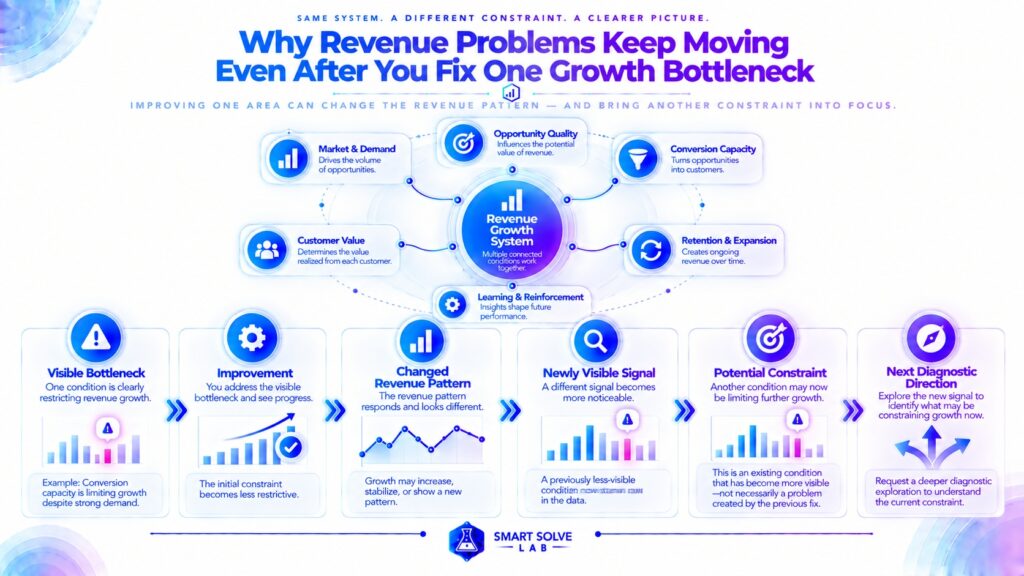
Fixing a revenue bottleneck can feel like the moment the business should finally begin moving forward. A visible constraint improves, performance changes, and the business expects the broader revenue problem to become easier to solve. Yet sometimes the restriction remains. The pattern changes, but growth still feels difficult to explain.
This can create a confusing situation: “We fixed the problem we identified—so why does another revenue problem now seem to be appearing?”
The answer is not necessarily that the first improvement failed or that it created a new problem. Revenue performance is influenced by connected conditions, and when one condition becomes less restrictive, another condition that was already present may become more noticeable.
For example, a business may improve one area of its revenue process and see a different pattern emerge afterward. The new pattern may reveal a weakness that was previously less visible because the first bottleneck was placing greater restriction on the overall outcome.
That creates an important distinction:
A newly visible constraint is not necessarily a problem created by the previous improvement.
This is why revenue problems should not always be viewed as isolated events. The relevant constraint can change as conditions within the broader revenue environment change.
The useful question therefore moves beyond “What is the bottleneck?” It becomes:
“What changed after the improvement, what signal became more visible, and which condition may now require deeper diagnostic attention?”
This article explores that principle without presenting a complete constraint-mapping methodology. Instead, it focuses on how businesses can understand the relationship between a bottleneck, an improvement, a changed revenue pattern, and a newly visible signal.
The goal is not to provide a guaranteed path to revenue growth. It is to create a clearer way to understand constraint movement:
Bottleneck → Improvement → Changed Pattern → New Signal → Potential Constraint → Diagnostic Direction
By the end, you should have a clearer understanding of why fixing one growth bottleneck does not always end the revenue problem—and why the next visible constraint may have been present all along, waiting for the surrounding pattern to change.
Table of Contents
Why Fixing One Growth Bottleneck Does Not Always Solve the Revenue Problem
The Business Improves One Area but Growth Still Feels Restricted
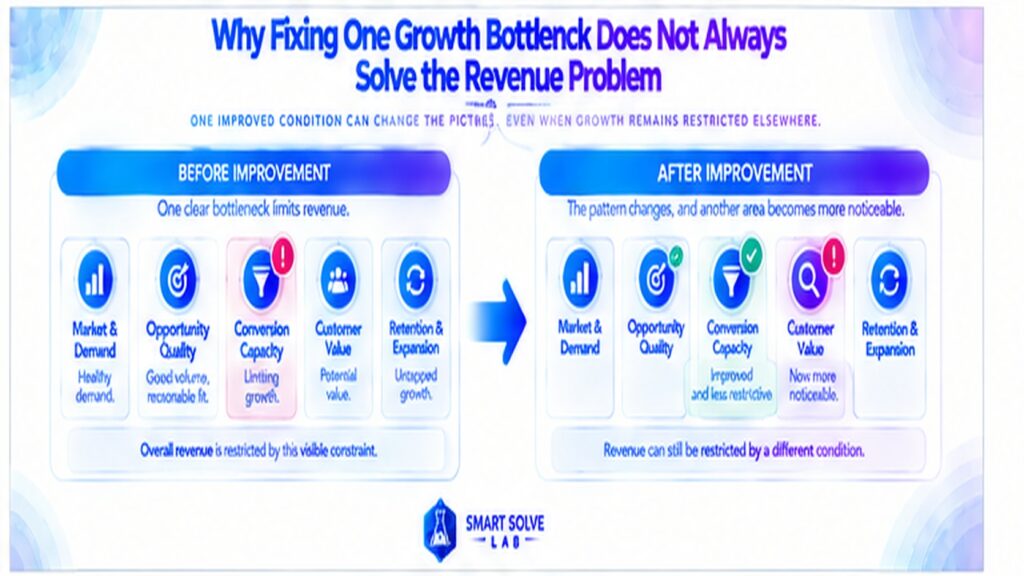
Fixing a visible revenue bottleneck can produce a meaningful improvement without necessarily removing every restriction affecting revenue growth. A business may improve one area, see better performance, and still find that overall growth remains inconsistent or difficult to explain.
This does not automatically mean the improvement was ineffective. It may mean that the condition being addressed was only one part of a broader connected revenue environment.
When one condition becomes less restrictive, the overall pattern can change. A different condition may then become more noticeable because the first bottleneck is no longer dominating the outcome to the same extent.
Why a Visible Bottleneck May Not Be the Only Constraint
The most visible revenue problem is not necessarily the only condition influencing the result. Revenue is affected by multiple connected areas, including demand, opportunity quality, conversion capacity, customer value, retention and expansion, and learning and reinforcement.
For this reason, identifying one bottleneck should not automatically be treated as identifying the only constraint in the revenue environment.
A business may improve the condition that currently appears most restrictive while another condition remains less visible in the background. As the first condition improves, the relationship between these areas can change—and that can alter what the business sees in its revenue pattern.
What Can Change After One Revenue Condition Improves
After an improvement, several things may change. Revenue performance may become stronger in one area, the pattern between periods may change, or a previously weaker signal may become easier to notice.
The important point is that a changed pattern should be examined rather than immediately interpreted as evidence that the previous improvement created another problem.
Instead, the business can ask:
- What changed after the improvement?
- Did the revenue pattern change?
- What became more visible?
- Which condition now appears more relevant?
- What evidence supports that interpretation?
Why Revenue Problems Can Appear to “Move”
Revenue problems can appear to move because the relative influence or visibility of different conditions can change over time.
One constraint may become less restrictive while another becomes more noticeable. The second condition may not be new at all. It may simply have been less visible while the first bottleneck was placing greater pressure on the overall revenue outcome.
This creates an important diagnostic distinction:
A newly visible constraint is not necessarily a problem created by the previous improvement.
Understanding this distinction helps businesses move away from treating every new revenue signal as a separate failure. Instead, the changing pattern becomes something to examine: what changed, what became visible, and where should the next diagnostic attention go?
What It Means When a Revenue Constraint Changes
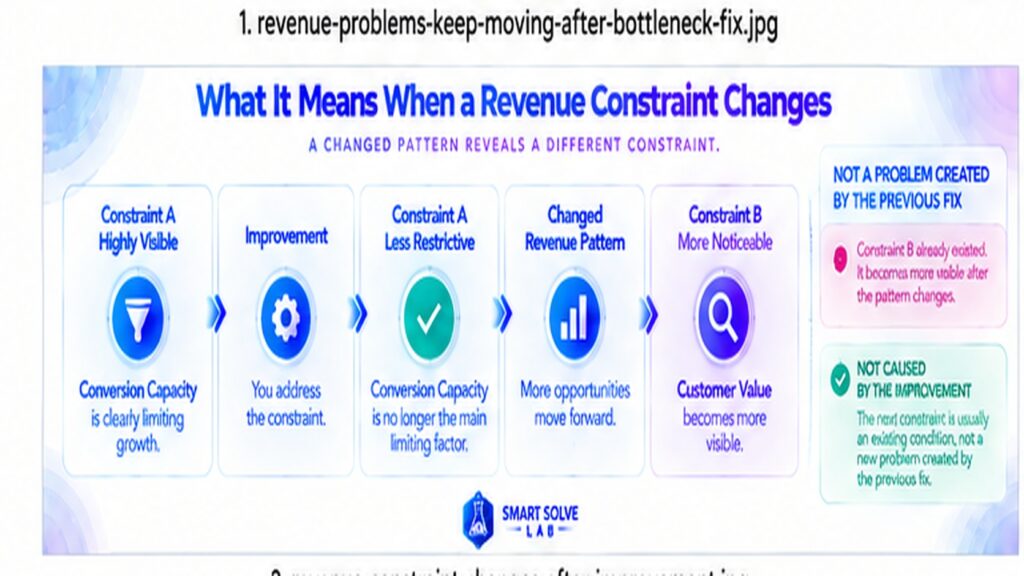
A Constraint Can Become Less Restrictive
A revenue constraint can become less restrictive when the condition limiting performance improves. The improvement may change how the business performs, how revenue develops across periods, or how different parts of the revenue system interact.
But reducing the influence of one constraint does not necessarily mean that every other condition has also improved.
This is why the phrase “we fixed the bottleneck” can sometimes describe only part of what happened. The original constraint may genuinely have improved while another condition remains capable of restricting progress.
Another Condition Can Become More Noticeable
When the first constraint becomes less restrictive, another condition may become easier to see.
Imagine that one condition was previously creating the strongest visible limitation. Other weaknesses may have existed at the same time, but their effect was harder to distinguish because the first constraint dominated the pattern.
After improvement, the overall pattern can change enough for another signal to become more noticeable.
This does not necessarily mean that a new problem has been created. It may mean that an existing condition has moved from the background into clearer diagnostic view.
Why the Revenue Pattern May Change After an Improvement
Revenue is an outcome of multiple connected conditions. When one condition changes, the resulting revenue pattern can change as well.
A business might see stronger performance in one area while continuing to experience inconsistency elsewhere. It might also notice that the periods that previously looked similar now behave differently.
These changes matter because they provide evidence about what may have changed within the broader revenue environment.
The useful response is not to assume the reason immediately. Instead, the changed pattern can be examined against the conditions that may have influenced it.
Constraint Movement Is Not the Same as Failure
When the relevant constraint changes, it can be tempting to interpret the situation as another failure.
But constraint movement can represent a change in what deserves attention rather than proof that the previous improvement was unsuccessful.
The distinction is important:
- Previous constraint: the condition that was receiving the strongest diagnostic attention.
- Improvement: the condition becomes less restrictive.
- Changed pattern: the revenue picture changes after the improvement.
- New signal: another condition becomes more noticeable.
- Potential next constraint: an area that may now deserve deeper examination.
The purpose is not to assume that the next visible signal is automatically the next root cause. It is to recognize that the diagnostic question can change as the revenue environment changes.
Understanding the Revenue Constraint Shift
From One Visible Constraint to Another
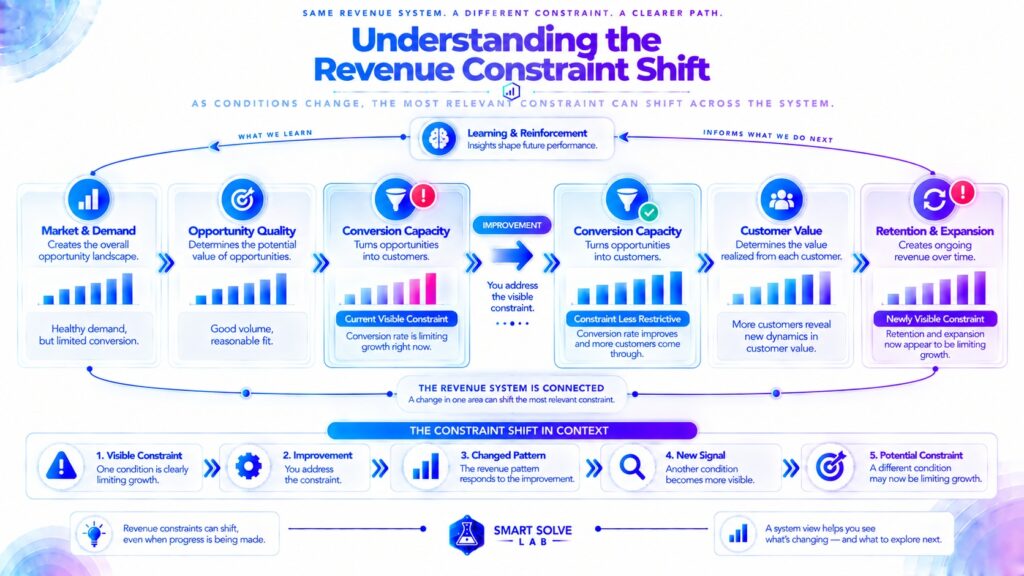
A revenue constraint shift does not necessarily mean that the original problem disappeared and a completely new problem was created. It can mean that the relative importance or visibility of different conditions changed after an improvement.
One condition may initially appear to be the strongest restriction on revenue performance. Once that condition becomes less restrictive, another connected condition may become more noticeable.
The diagnostic focus can therefore move from the condition that was previously most visible toward another condition that now appears more relevant.
Why Connected Revenue Conditions Matter
Revenue does not develop through one isolated condition. Market and demand conditions, opportunity quality, conversion capacity, customer value, retention and expansion, and learning and reinforcement can all contribute to the broader revenue environment.
Because these conditions are connected, a change in one area can alter the pattern observed in another area. This does not mean that every condition directly causes every other condition. It means that the broader revenue picture needs to be understood in context rather than examined as a collection of completely independent problems.
That connected perspective becomes particularly important after an improvement. Instead of asking only whether the original bottleneck improved, the business can also examine what changed across the surrounding revenue conditions.
How Improving One Area Can Change the Overall Pattern
When a significant constraint becomes less restrictive, the revenue pattern may change. The business may see different results across periods, different customer-level outcomes, or a different relationship between activity and revenue.
The changed pattern provides a new diagnostic signal.
For example, if one condition previously limited the overall outcome, improving that condition may allow another condition to have greater influence on what happens next. The second condition was not necessarily created by the improvement; its relevance may simply have become easier to observe.
This is why before-and-after comparison matters. Looking only at the current problem can miss the relationship between the original constraint, the improvement, and the changed pattern.
The Difference Between a New Constraint and a Newly Visible Constraint
There is an important distinction between a constraint being newly created and an existing constraint becoming newly visible.
A newly created problem suggests that the improvement itself introduced an undesirable condition. A newly visible constraint means that the condition may already have existed but was less apparent while another constraint was more restrictive.
Without evidence, it is not appropriate to assume which explanation is correct.
The more useful diagnostic question is:
What changed after the improvement, and what evidence explains why another condition now appears more relevant?
This keeps the focus on understanding the changing revenue pattern rather than automatically treating every new signal as evidence of failure.
Why Fixing One Bottleneck Can Reveal Another Problem
The First Bottleneck May Have Been Limiting What You Could See
A dominant bottleneck can affect how the rest of the revenue pattern appears. When one condition is strongly restrictive, other conditions may exist without becoming the clearest explanation for the overall result.
This can create a natural diagnostic blind spot: the business sees the strongest visible restriction and understandably focuses attention there, while other conditions remain less noticeable.
Once the dominant bottleneck becomes less restrictive, the surrounding pattern can become easier to examine.
Improvement Can Change the Revenue Pattern
An improvement can change more than the condition that was directly addressed. It can also change the pattern through which revenue performance is observed.
The business may experience a different relationship between periods, customer outcomes, or revenue activity. Those changes can provide additional signals about what deserves attention next.
This is why the period after an improvement can be diagnostically important. The question is not simply whether performance improved. It is also what the new pattern reveals.
Another Weak Condition May Become More Relevant
When the first bottleneck becomes less restrictive, another condition may become relatively more important to the overall revenue outcome.
That condition does not automatically become the root cause simply because it is now more visible. It remains a potential constraint that needs to be interpreted against the changed pattern and supporting evidence.
Why This Does Not Mean the First Improvement Was Wrong
Seeing another constraint after an improvement does not, by itself, prove that the first improvement was ineffective.
The first condition may genuinely have improved while the broader revenue environment continues to contain other restrictions. In that situation, the next diagnostic question changes because the system has changed.
The distinction is important: the appearance of a newly visible constraint does not necessarily mean the previous improvement created the problem.
Instead, the business can examine the sequence of events, compare the pattern before and after the improvement, and determine what signal now deserves deeper attention.
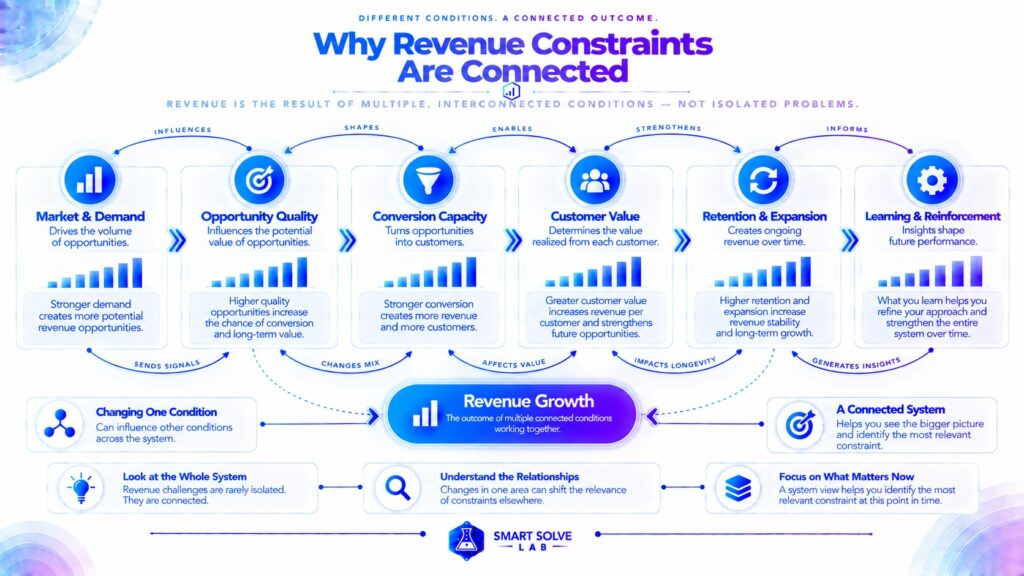
Why Revenue Constraints Are Connected
Revenue Is an Outcome of Multiple Conditions
Revenue growth is not produced by one isolated condition. It emerges from multiple parts of the broader growth system working together, including market and demand conditions, opportunity quality, conversion capacity, customer value, retention and expansion, and learning and reinforcement.
This means that a constraint in one area can exist alongside conditions in other areas that also influence the eventual revenue outcome.
Looking at these areas independently can therefore make the revenue problem appear simpler than it actually is. A change in one condition may alter the pattern through which another condition becomes visible.
Demand Can Influence Opportunity Quality
Market and demand conditions influence the environment in which opportunities are created. When the level, type, or relevance of demand changes, the quality of the opportunities entering the revenue process can change as well.
This does not mean that weak opportunity quality is always caused by demand. It means that the two conditions can be related and should not automatically be interpreted as completely isolated layers.
Opportunity Quality Can Influence Conversion
The opportunities entering a sales process can affect what conversion performance looks like. A change in opportunity quality may change the conditions under which conversion is taking place, even when the sales process itself has not changed.
As a result, a conversion signal should be interpreted in the context of the opportunities being converted rather than treated as an isolated number.
Customer Value Can Influence Revenue Development
Revenue development also extends beyond the initial sale. The value created through customer relationships can influence how revenue develops over time.
If customer value conditions change, the resulting revenue pattern may change even when acquisition or sales activity remains active. This is one reason why revenue constraints cannot always be understood by examining sales activity alone.
Retention and Expansion Can Influence Continuity
Customer relationships can also influence the continuity of revenue. Retention determines whether relationships continue, while expansion represents opportunities for existing relationships to develop further.
These conditions belong to the broader connected revenue environment. They are not being diagnosed again here; rather, they are recognized as possible conditions that can influence what becomes visible after another constraint changes.
Why These Conditions Should Not Be Treated as Isolated Problems
The purpose of connecting these conditions is not to create a new list of problems. It is to understand why a change in one area can alter the revenue picture elsewhere.
When a bottleneck improves, the business should therefore examine the changed pattern across the relevant conditions rather than immediately assuming that the next visible signal is unrelated.
The broader principle is simple: revenue constraints exist within a connected environment, so the condition requiring attention can change as that environment changes.
How Revenue Problems Can Shift Across the Growth System
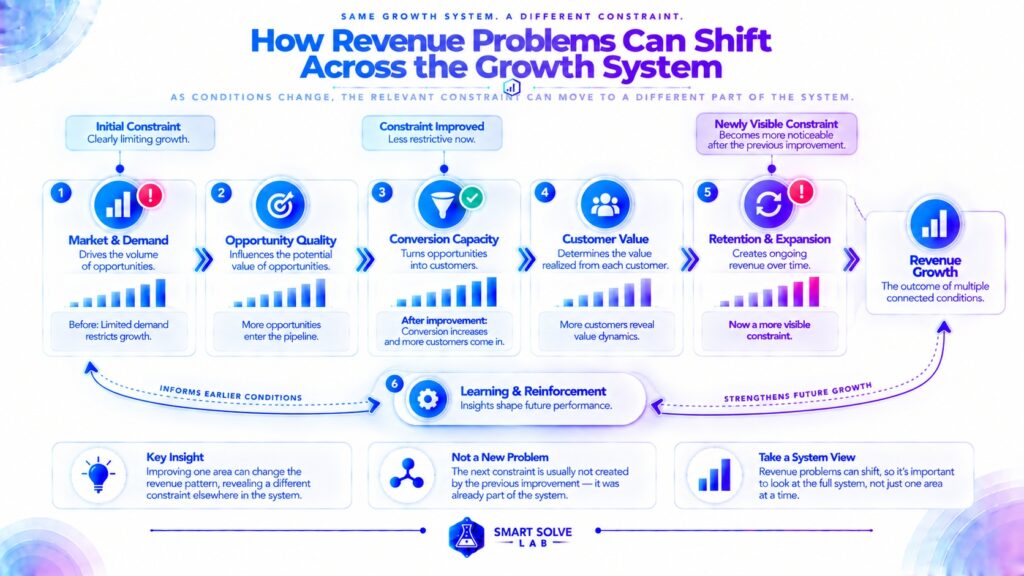
From Demand Conditions to Opportunity Conditions
A revenue constraint can become more noticeable at a different point in the growth system as conditions change. For example, a business may initially focus on demand because insufficient demand appears to restrict growth. After that condition improves, the quality of the opportunities being created may deserve closer examination.
This does not mean that demand was irrelevant or that opportunity quality suddenly became a problem. The relative visibility of the conditions may simply have changed.
From Opportunity Conditions to Conversion Conditions
As opportunity conditions improve, conversion capacity may become more relevant to the revenue pattern.
A business can therefore experience a situation in which opportunities are being created more effectively, yet the resulting revenue pattern remains restricted. The next diagnostic question may then move toward the conditions affecting progression and conversion.
The important point is that the diagnostic focus changes because the surrounding conditions have changed—not because every previous diagnosis was incorrect.
From Conversion Conditions to Customer-Level Conditions
Improving conversion can change the number or type of customers entering the business. As that happens, customer value can become a more relevant part of the revenue picture.
The business may therefore move from asking why opportunities are not converting toward asking what happens after customers are acquired and how customer-level outcomes develop over time.
From Customer Value to Retention and Expansion
Customer value and relationship continuity can also become more visible as the revenue pattern develops.
A business may improve its ability to acquire customers and create initial value, while the longer-term revenue pattern remains influenced by whether those relationships continue and whether additional value can develop through retention and expansion.
These conditions are referenced here as connected parts of the broader system. The purpose is not to repeat the detailed retention or customer-value diagnosis covered in earlier articles.
Why the Relevant Constraint Can Change as Conditions Change
The relevant constraint can change because the revenue environment itself is not static. An improvement can alter the pattern, and the changed pattern can make another condition more visible.
That creates a useful diagnostic sequence:
Bottleneck → Improvement → Changed Pattern → New Signal → Potential Constraint → Diagnostic Direction
This sequence does not mean that every improvement will reveal another constraint. It means that when the revenue pattern changes and another signal becomes noticeable, the business should examine that change rather than assuming the previous bottleneck remains the only relevant explanation.
Why Solving the Visible Problem May Not Create Stable Growth
The Visible Bottleneck May Be Only One Part of the Pattern
A visible bottleneck can be important without explaining the entire revenue pattern. It may represent the condition that currently appears most restrictive, while other connected conditions continue to influence what happens across the broader revenue system.
This is why solving the visible problem does not automatically mean that revenue growth will become stable or predictable. The improvement may address one important restriction while leaving other conditions unchanged.
Improvement Can Change What Becomes Limiting
When a bottleneck improves, the surrounding revenue pattern can change. A condition that previously had less influence on the visible outcome may become more noticeable after the first restriction becomes less significant.
The resulting signal should be interpreted carefully. The appearance of another constraint does not necessarily mean that the first improvement failed. It may indicate that the revenue environment has changed enough for another existing condition to require attention.
Why More Optimization Is Not Always the Answer
When growth remains restricted after an improvement, the natural reaction may be to optimize the same area again. But repeated optimization of the previous bottleneck may not address the condition that is now limiting progress.
The more useful question is whether the revenue pattern has changed and, if so, what that change indicates about the conditions currently influencing the outcome.
This shifts the focus from continuously improving the last problem toward understanding the changing constraint environment.
Why the Next Diagnostic Question Matters
Once the first bottleneck has improved, the next diagnostic question should reflect the new situation.
Instead of asking only, “How can we improve the same area further?” the business can ask:
- What changed after the improvement?
- What part of the revenue pattern remains restricted?
- What signal has become more visible?
- Which connected condition may now deserve attention?
This does not reveal the complete process for mapping constraints. It establishes the principle that diagnostic attention may need to move when the revenue environment changes.
The Conditions Behind Shifting Revenue Constraints
Market and Demand Conditions
Changes in market conditions or demand can influence the environment in which revenue opportunities are created. A shift in demand can therefore change the pattern the business observes, even when other revenue activities remain active.
Opportunity Quality
The quality and relevance of opportunities can also influence what happens after demand is created. If opportunity conditions change, the resulting revenue pattern may change as well.
Conversion Capacity
Conversion capacity determines how effectively relevant opportunities progress toward customers. Changes in this condition can affect the relationship between opportunity activity and revenue outcomes.
Customer Value
Revenue development does not end with the initial customer transaction. Customer value can influence how the revenue relationship develops over time, which means changes at the customer level can become relevant when examining a changing revenue pattern.
Retention and Expansion
Retention and expansion influence whether customer relationships continue and whether existing relationships can contribute additional value. These conditions can therefore become more visible when earlier constraints become less restrictive.
Learning and Reinforcement
Learning and reinforcement represent the ability to understand changing results and use that understanding to strengthen the broader revenue system over time.
When conditions change, the signals produced by the system can change as well. This makes learning relevant to understanding why a constraint that appeared important in one period may not remain the most important diagnostic focus later.
How Changes in One Condition Can Affect Another
These conditions should not be interpreted as independent levers that always move in a predictable sequence. They form a connected environment in which changes in one area can alter what becomes visible elsewhere.
The important diagnostic principle is therefore not that one condition always causes another to change. It is that a meaningful improvement can change the overall pattern, creating new signals that deserve examination.
This is the foundation for understanding constraint movement without assuming that every newly visible condition was created by the previous improvement.
Why the Next Constraint May Not Be Obvious
Revenue Results Do Not Directly Reveal the Constraint
Revenue performance can show that something has changed without immediately explaining what condition is responsible for that change. A stronger or weaker revenue result is an outcome; it does not automatically identify the condition influencing it.
This becomes especially important after an improvement. The business may see a different revenue pattern but still need to determine what changed within the conditions surrounding that outcome.
For that reason, the next potential constraint should not be selected simply because it appears alongside the latest revenue problem.
The Most Recent Problem Is Not Automatically the Next Constraint
A newly visible problem can attract attention because it is easier to see than the conditions that preceded it. But visibility alone does not establish that the condition is the constraint limiting progress.
The business needs to distinguish between a signal that deserves investigation and a condition that has sufficient evidence to justify deeper diagnostic attention.
This distinction prevents a common mistake: immediately replacing one assumption with another simply because the first bottleneck has improved.
Multiple Conditions Can Change at the Same Time
Revenue conditions do not always change one at a time. Demand, opportunity quality, conversion, customer value, and retention-related conditions can change during the same period.
When several signals change together, identifying the most relevant constraint becomes more difficult. The business needs to examine the pattern and the supporting evidence rather than assuming that the most noticeable change is automatically the most important one.
Why Evidence Matters More Than Assumption
The purpose of examining a changing revenue pattern is to move from assumption toward a more structured understanding of what changed.
A useful diagnostic perspective asks:
- What changed after the improvement?
- Which signals changed with it?
- Which revenue condition is associated with the changed pattern?
- What evidence supports that relationship?
- What still needs to be examined before treating a condition as the next constraint?
This does not require assuming that every signal has a single cause. It simply creates a more disciplined way to decide which condition deserves deeper diagnostic attention.
How to Recognize When a Revenue Constraint Has Shifted
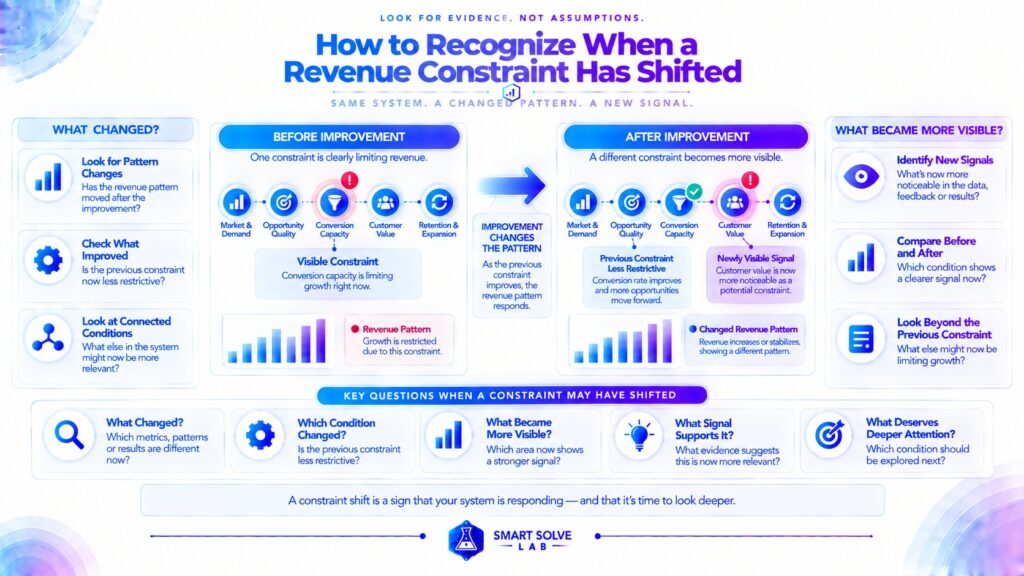
What Changed After the First Improvement?
The first question is not necessarily “What is the new problem?” It is “What changed after the previous improvement?”
Compare the revenue environment before and after the improvement. Look for meaningful changes in the pattern, the conditions surrounding revenue activity, and the signals that have become more noticeable.
Did the Revenue Pattern Change?
A constraint shift may become easier to recognize when the revenue pattern changes after an improvement. The change could appear through differences between periods, customer-level outcomes, revenue continuity, or the relationship between activity and results.
Tools such as Google Analytics trend change detection can help identify meaningful changes in measured patterns, although analytics signals alone do not establish which revenue condition is responsible.
Did Another Weak Signal Become More Visible?
Once the original bottleneck becomes less restrictive, another weak signal may become easier to distinguish from the broader revenue pattern.
The important distinction is between visibility and diagnosis. A signal can become more visible without automatically being confirmed as the next constraint.
Which Condition Is Now Restricting Progress?
After identifying a changed signal, the next question is which connected revenue condition may now be restricting progress.
Potential areas can include market and demand, opportunity quality, conversion capacity, customer value, retention and expansion, or learning and reinforcement.
The purpose is not to assume that one of these areas is responsible simply because it appears relevant. The condition needs to be interpreted in relation to the changed pattern and available evidence.
What Evidence Supports the New Signal?
A potential constraint becomes more meaningful when the observed pattern is supported by relevant evidence. Compare what happened before and after the improvement, examine the conditions that changed, and look for signals that consistently correspond with the new pattern.
This helps separate a meaningful diagnostic signal from a temporary fluctuation or an assumption based only on visibility.
What Requires Deeper Diagnostic Attention?
The final question is not simply “What is wrong?” It is “What deserves deeper examination next?”
That distinction keeps the process focused on diagnostic direction rather than premature certainty. A changing constraint environment may require the business to revisit its understanding of the revenue system as new evidence becomes available.
The broader principle remains:
Bottleneck → Improvement → Changed Pattern → New Signal → Potential Constraint → Diagnostic Direction.
This article stops at that principle. The structured process for mapping changing constraints belongs to the Revenue Constraint Mapping Diagnostic, rather than being fully reproduced here.
From Bottleneck Fixing to Constraint Understanding
Stop Treating Each Revenue Problem as an Isolated Issue
When revenue problems are treated as isolated issues, each new signal can appear to be a completely separate problem. This can lead the business to repeatedly fix individual symptoms without understanding how the broader revenue pattern is changing.
A more useful perspective is to recognize that revenue conditions can be connected. An improvement in one area can change the pattern in which other conditions become visible.
Compare the Pattern Before and After an Improvement
The change that follows an improvement provides useful diagnostic context. Comparing the revenue pattern before and after the improvement can help clarify whether the original restriction became less significant and what changed afterward.
The purpose of this comparison is not to assume that every difference represents a new constraint. It is to establish a clearer basis for interpreting what changed.
Examine What Became More Visible
Once the pattern has changed, examine which signals have become more noticeable. A previously less-visible condition may now appear more relevant because the original bottleneck is no longer restricting the overall pattern to the same degree.
This is where the distinction between a newly visible constraint and a problem created by the previous improvement becomes important.
Connect the Changing Conditions
The next step is to consider how the changing signals relate to the connected revenue conditions. Demand, opportunity quality, conversion capacity, customer value, retention and expansion, and learning and reinforcement can all form part of the broader environment influencing revenue outcomes.
These relationships should be interpreted rather than assumed. The goal is to understand how the revenue picture changed, not to force every change into a predetermined explanation.
Determine Where the Next Diagnostic Question Should Go
Once the changed pattern and newly visible signals are understood, the business can determine where deeper diagnostic attention should be directed next.
This creates a shift from repeatedly fixing isolated bottlenecks toward understanding how the relevant constraint environment changes over time.
The central question becomes:
What changed, what became more visible, and where should the next diagnostic question go?
The Key Insight: Improving One Constraint Can Change the Revenue Picture
A Constraint Does Not Exist in Isolation
A revenue constraint should not automatically be treated as an isolated problem. Revenue outcomes reflect multiple connected conditions, and the relevance of those conditions can change as the surrounding environment changes.
This means that improving one restriction can affect the overall pattern without necessarily resolving every condition influencing revenue.
Improvement Can Alter the Overall Pattern
When a visible bottleneck becomes less restrictive, the business may observe a different revenue pattern. That change can provide new information about the conditions that were previously less visible.
The improvement therefore has diagnostic value beyond the immediate change it produces: it can help reveal what becomes relevant once the original restriction is reduced.
Another Constraint Can Become More Visible
A newly visible constraint does not necessarily represent a problem created by the previous improvement. The condition may have already existed but been less noticeable while the earlier bottleneck was exerting greater influence on the revenue outcome.
This distinction helps prevent the business from interpreting every newly visible restriction as evidence that the previous improvement was unsuccessful.
Revenue Diagnosis Is Therefore a Connected Process
Because revenue conditions can interact and change, diagnosis should account for the changing pattern rather than treating each observation as a permanent explanation.
The question can therefore move from “What is the problem?” toward “What changed in the constraint environment?”
The Goal Is Understanding the Changing Constraint Environment
The purpose of this perspective is not to provide a complete constraint-mapping method. It is to establish a clearer understanding of why diagnostic attention may need to change after an improvement.
The central insight is simple:
Improving one constraint can change the revenue picture without necessarily creating a new problem.
What becomes visible afterward may provide the next signal for deeper diagnostic attention.
From One Constraint to the Next Diagnostic Direction
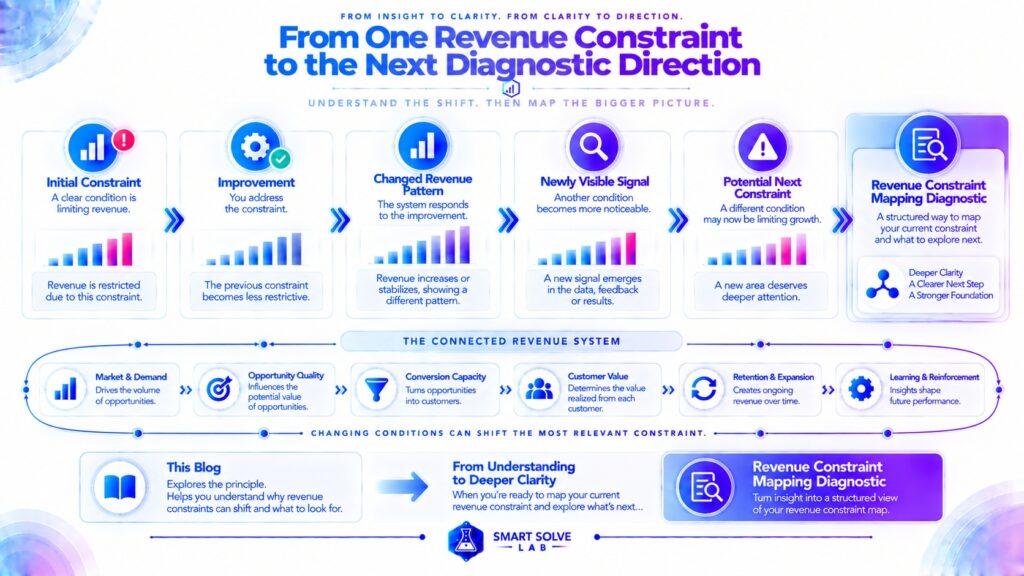
From Bottleneck → Improvement
The process begins with a visible revenue bottleneck that appears to be restricting progress. Once that condition has been examined and an improvement is made, the revenue environment may begin to look different.
The important point is that the improvement changes the context in which the next diagnostic question is asked.
From Improvement → Changed Pattern
After an improvement, the business can observe whether the broader revenue pattern has changed. The change may appear in the relationship between activity and outcomes, across different periods, or within another part of the customer and revenue journey.
A changed pattern does not automatically identify the next constraint. It provides a new signal that requires interpretation.
From Changed Pattern → New Signal
When the pattern changes, another signal may become more noticeable. This signal could point toward a condition that was previously less visible while the original bottleneck was more restrictive.
The distinction remains important: a newly visible signal is something to examine, not automatic proof that a new problem has been created.
From New Signal → Potential Constraint
The next step is to consider whether the newly visible signal corresponds with a potential constraint within the connected revenue environment.
This requires evidence and interpretation rather than simply selecting the most recent or most noticeable problem.
From Potential Constraint → Diagnostic Direction
Once a potential constraint has been identified, the business can determine where deeper diagnostic attention may be appropriate.
The resulting direction is therefore based on the changed pattern and the signals that emerged after the previous improvement—not on the assumption that fixing one bottleneck should permanently resolve the entire revenue problem.
The high-level progression is:
Bottleneck → Improvement → Changed Pattern → New Signal → Potential Constraint → Diagnostic Direction
This progression explains the principle of constraint movement without revealing the complete proprietary mapping methodology behind the Revenue Constraint Mapping Diagnostic.
Where to Go Next: Diagnose Your Revenue Constraint Map
One Revenue Bottleneck Has Already Been Improved
If your business has already identified and improved one revenue bottleneck, the next question may not be whether that improvement was worthwhile. The more useful question may be what changed in the revenue pattern afterward.
Another Revenue Problem Has Now Become More Noticeable
If another revenue problem has become more noticeable after the improvement, avoid assuming that the previous fix created the problem. The new signal may represent a condition that was already present but was less visible before the surrounding pattern changed.
Growth Improves in One Area but Remains Restricted Elsewhere
When performance improves in one area while growth remains restricted elsewhere, the business may need to understand how the relevant revenue conditions have changed rather than continuing to optimize the original bottleneck.
The Business Keeps Encountering Different Revenue Constraints
If different revenue constraints appear at different stages of growth, the issue may require a broader view of how those conditions relate to one another. Repeatedly treating each constraint as an isolated problem can make the changing pattern harder to understand.
You Need to Understand How Constraints Relate Across the Growth System
This is where a structured diagnostic view becomes useful. Instead of asking only which bottleneck exists today, the business can examine how the constraint environment changed after an improvement, what became more visible, and where the next diagnostic attention should be directed.
The Revenue Constraint Mapping Diagnostic is designed for this focused diagnostic purpose: helping businesses map changing revenue constraints, compare the pattern before and after improvement, interpret newly visible signals, and determine the next area requiring deeper diagnostic attention.
It does not promise guaranteed revenue growth or replace the complete Revenue Growth System. Its role is to provide clarity around constraint movement so the business can better understand what changed and where to look next.
Next diagnostic direction: Map the changing revenue constraint environment before deciding what requires deeper attention.
Key Takeaways
- Fixing one revenue bottleneck does not necessarily resolve every restriction affecting revenue growth.
- An improvement can change the revenue pattern and make another previously less-visible condition more noticeable.
- A newly visible constraint is not necessarily a problem created by the previous improvement.
- Revenue constraints can exist within a connected environment involving market and demand, opportunity quality, conversion capacity, customer value, retention and expansion, and learning and reinforcement.
- The most recent or most visible problem is not automatically the next constraint.
- Comparing the revenue pattern before and after an improvement can provide useful diagnostic context.
- Evidence matters when determining whether a newly visible signal deserves deeper diagnostic attention.
- The high-level constraint movement pattern can be understood as: Bottleneck → Improvement → Changed Pattern → New Signal → Potential Constraint → Diagnostic Direction.
- The goal is not to assume that every changing signal represents a new problem, but to understand how the relevant constraint environment has changed.
Conclusion
Revenue problems can become difficult to understand when a business expects one successful improvement to permanently remove the broader restriction on growth.
A bottleneck can become less restrictive, the revenue pattern can change, and another condition can become more visible. That does not necessarily mean the first improvement failed or created a new problem. It may simply mean that the surrounding revenue environment can now be observed differently.
This is why constraint movement deserves a different diagnostic perspective.
Instead of repeatedly asking only, “What is the bottleneck?”, the business can also ask:
“What changed after the improvement, what signal became more visible, and which condition may now require deeper diagnostic attention?”
The high-level progression is:
Bottleneck → Improvement → Changed Pattern → New Signal → Potential Constraint → Diagnostic Direction
Understanding this progression helps separate a newly visible constraint from the idea that a previous improvement necessarily created another problem.
The broader Revenue Growth System contains multiple connected conditions, so the relevant diagnostic focus can change as those conditions change. Recognizing that movement is an important step toward understanding why revenue growth can remain restricted even after a meaningful improvement.
If your business has already improved one revenue bottleneck but another restriction has become noticeable, the next useful step is to understand how the constraint environment changed rather than automatically returning to the previous problem.
That is the role of Revenue Constraint Mapping: understanding what changed, what became visible, and where the next diagnostic direction may need to go.
FAQs
Why does fixing one revenue bottleneck reveal another problem?
Fixing one bottleneck can change the overall revenue pattern and make another previously less-visible condition more noticeable. This does not necessarily mean the first improvement created a new problem. The newly visible condition may have already existed but was less apparent while the original bottleneck was more restrictive.
What does it mean when a revenue constraint shifts?
A revenue constraint shifts when the condition that appears most restrictive changes after the surrounding revenue pattern changes. An improvement can make the original constraint less restrictive while another connected condition becomes more noticeable. The shift should be interpreted through evidence rather than assumed from the latest visible problem.
Why are revenue constraints connected?
Revenue is an outcome influenced by multiple connected conditions, including market and demand, opportunity quality, conversion capacity, customer value, retention and expansion, and learning and reinforcement. Because these conditions exist within the broader revenue environment, a meaningful change in one area can alter what becomes visible elsewhere.
Can solving one revenue problem create another problem?
Not necessarily. When another constraint becomes visible after an improvement, it should not automatically be treated as a problem created by the previous fix. The condition may have already existed but become more noticeable after the original bottleneck became less restrictive.
How can I tell if my revenue constraint has changed?
Compare the revenue pattern before and after the improvement. Examine what changed, which signals became more visible, which connected conditions changed, and what evidence supports the new signal. A changed pattern can indicate a potential shift in diagnostic attention, but it does not automatically confirm a new constraint.
Why is the next revenue constraint sometimes difficult to identify?
Revenue results do not directly reveal the condition responsible for them, and multiple revenue conditions can change at the same time. The most recent or most visible problem is therefore not automatically the next constraint. Evidence, pattern comparison, and interpretation are needed to determine which condition deserves deeper diagnostic attention.
How can I map changing revenue constraints?
Start by understanding the bottleneck that was visible, the improvement that was made, and the revenue pattern that changed afterward. Then examine newly visible signals and consider which connected condition may now require deeper attention. The complete structured mapping methodology, scoring, decision process, and worksheets belong to the Revenue Constraint Mapping Diagnostic rather than this article.