
Why Customers Don’t Feel Safe Enough to Buy :
A customer visits your website, understands your offer, and sees value in what you provide. Your business may even appear credible and professional. Yet, when it is time to make a purchase, the customer hesitates or leaves without buying.
Why does this happen?
The answer may lie in a difference that businesses often overlook: trusting a business and feeling safe enough to buy from it are not the same thing.
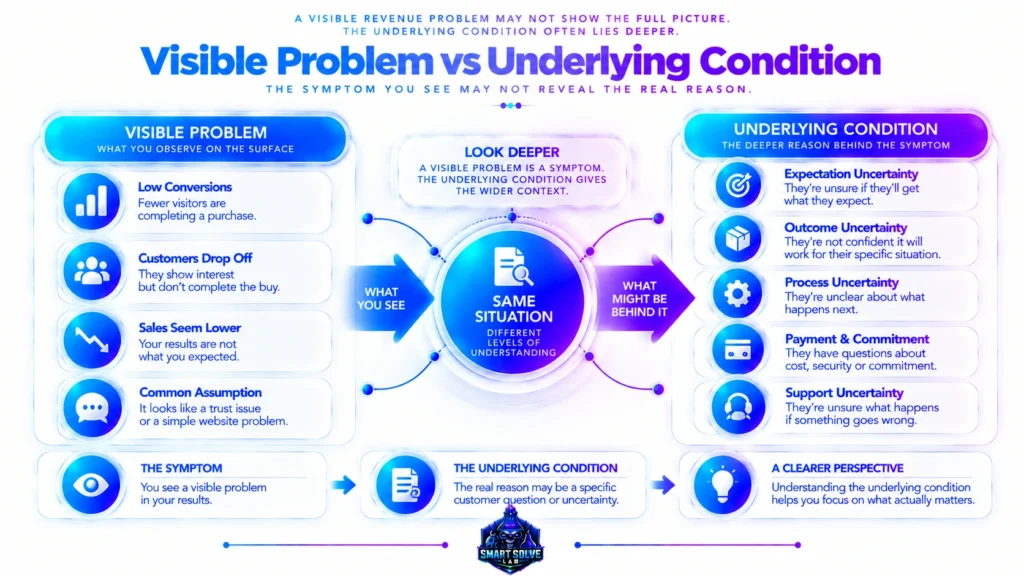
Even when customers believe your business is legitimate, they may still have unanswered questions. Will the product meet their expectations? Will it work for their specific situation? What happens if something goes wrong? Is the payment process clear, and what exactly are they committing to?
These questions create perceived purchase risk—the uncertainty or potential negative consequences a customer associates with making a purchase.
The challenge is not necessarily that customers distrust your business or dislike your offer. They may simply lack enough relevant information to feel comfortable making the decision.
Understanding this distinction helps you look beyond surface-level website improvements and examine what might be making the purchase itself feel uncertain. Let’s explore the questions customers may have, the website signals that can influence their perception of risk, and why identifying the right source of hesitation matters before deciding what to change.
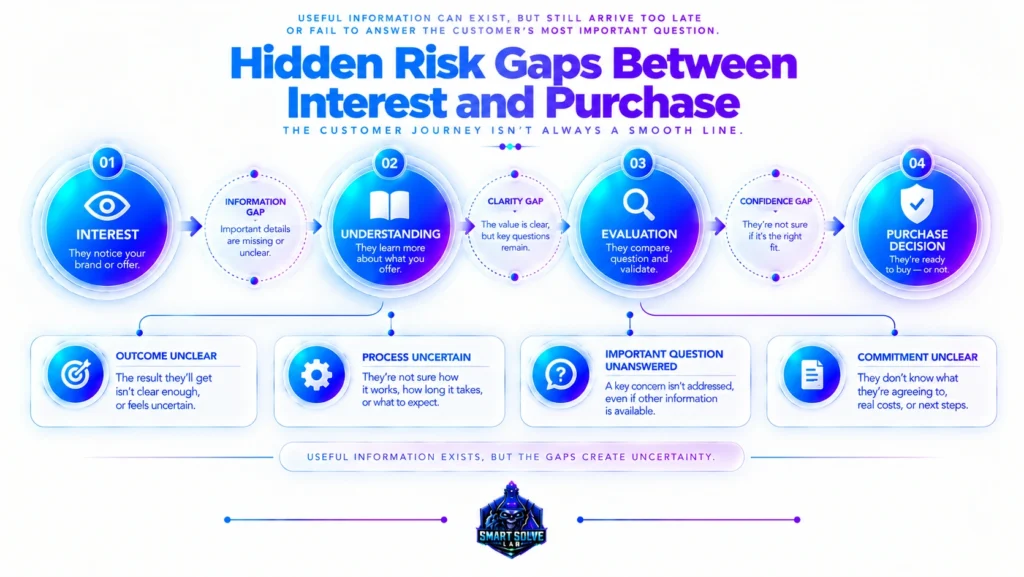
Table of Contents
Why Customers Can Want Your Product and Still Not Buy
A customer can be interested in your product without being ready to purchase it. They may understand what you offer, recognize its value, and consider your business credible, yet still hesitate when they have to commit their money or make a decision.
The difference lies between liking an offer and feeling comfortable acting on it.
For example, a visitor may find your digital product useful but remain unsure about what the download will include. Someone considering a service may understand its benefits but wonder whether it will suit their particular needs. Another customer may like your offer but hesitate because they do not understand what happens after payment.
In each case, the offer may be relevant. The hesitation may come from questions that remain unanswered at the point of purchase.
Interest Is Not the Same as Purchase Confidence
Interest encourages a visitor to explore an offer. Purchase confidence involves a different consideration: whether the customer feels sufficiently informed to accept the potential consequences of buying.
That decision can involve questions such as:
- Will I receive what I expect?
- Is this suitable for my situation?
- Will I understand how to use what I purchase?
- What support or options are available if something goes wrong?
- Do I understand the commitment I am making?
Not every customer will have all these concerns. The questions that matter depend on the product, its price, the customer’s experience, and the consequences they associate with making the wrong decision.
Hesitation Does Not Automatically Mean the Offer Is Bad
When a customer does not buy, it is tempting to assume that the product needs a lower price, a stronger headline, or a more persuasive sales message. Those changes may be relevant in some situations, but hesitation alone does not tell you which explanation is correct.
The customer might not see enough value. The offer might not match their needs. Alternatively, they might see the value but still have unresolved questions about the purchase itself.
These are different conditions, and they should not automatically receive the same response.
If you want to explore the broader distinction between customer trust and website buying behaviour, read Why Customers Don’t Trust Your Website Even When It Looks Professional. That article examines the wider trust problem, while this article focuses specifically on the uncertainty that can remain when a customer is deciding whether to buy.
Recognizing this difference gives you a more useful starting point: instead of assuming that customers need more persuasion, consider whether they have enough relevant information to make a confident decision.
What Is Perceived Risk in an Online Purchase?
Perceived purchase risk is the uncertainty or potential negative consequence a customer associates with buying a product or service.
It describes how a purchase looks from the customer’s perspective: what they believe could go wrong, what they are unsure about, and what they think they might lose if the decision does not meet their expectations.
Online purchases can make some of these questions harder to answer. Customers may not be able to examine a physical product before ordering, speak directly with the provider, experience a service in advance, or fully understand a digital product until they access it.
As a result, customers often rely on the information available before purchase to form expectations about what they will receive and what the experience may involve.
The amount of uncertainty varies. Buying a low-cost downloadable template may involve a different level of perceived risk from purchasing an expensive service or making a long-term commitment.
Relevant, clear information can help customers evaluate these decisions. For guidance on creating useful, reliable, people-first content, see Google Search Central’s guidance on creating helpful, reliable, people-first content. This guidance supports the principle of serving visitors with useful information; it should not be interpreted as Google directly measuring perceived purchase risk.
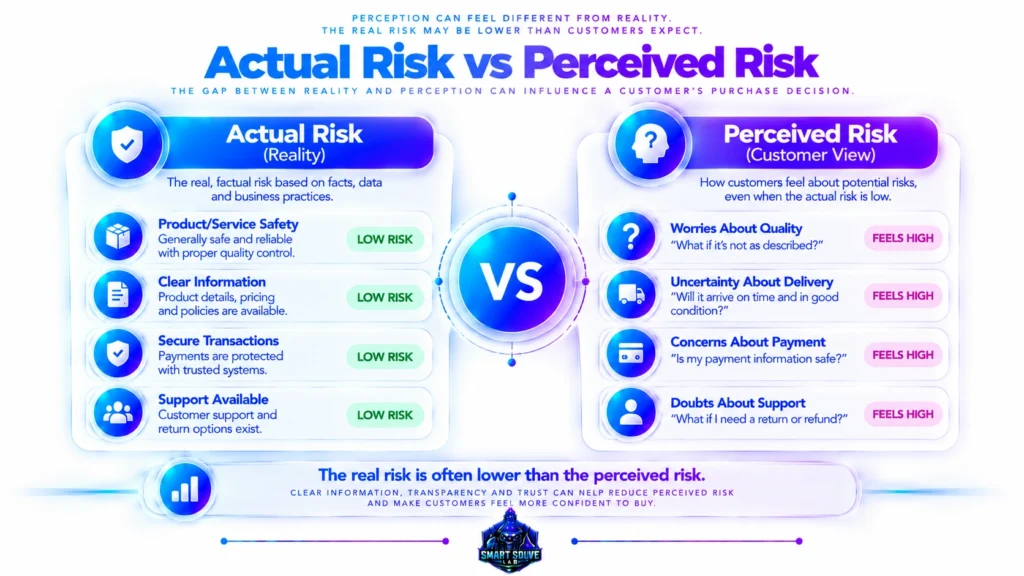
Actual Risk vs. Perceived Risk
Actual risk and perceived risk are related, but they are not identical.
Actual risk concerns the real possibility of a negative outcome. For example, a digital product might genuinely lack a feature that a customer needs.
Perceived risk concerns what the customer believes or worries could happen. A customer might fear that a product will not meet their needs because the description does not explain its contents clearly—even when the product itself is well designed.
These situations can overlap, but they can also differ. A customer may underestimate a genuine risk, or they may worry about a problem that is unlikely to occur.
This distinction matters because adding reassurance is not always the right response. If a genuine limitation exists, it should be addressed honestly. If the problem is missing information, clearer explanations may help. If the offer does not fit the customer’s needs, additional reassurance will not necessarily make it suitable.
The purpose is not to make every purchase appear risk-free. It is to help customers understand what they are choosing, what they can reasonably expect, and which uncertainties remain.
The Five Questions That Can Create Purchase Hesitation
When customers hesitate to buy, their concerns may relate to different parts of the purchase decision. Understanding these differences is more useful than assuming that every customer simply needs more trust or reassurance.
The following five questions illustrate common forms of purchase uncertainty. They are general examples to help you understand the customer’s perspective, not a complete diagnostic checklist.
1. “Will I Get What I Expect?”
Customers may hesitate when they are unsure what they will receive or whether the actual experience will match what the website describes.
For a digital product, they may wonder which files, templates, resources, or features are included. For a service, they may be uncertain about the scope of work, delivery time, or expected outcome.
This is expectation risk. It can arise when important details are missing, vague, difficult to find, or open to different interpretations.
Clear descriptions help customers form realistic expectations before they commit.
2. “Will This Actually Work for My Situation?”
A customer may understand what a product does but remain unsure whether it is appropriate for their circumstances.
For example, a business owner may like a marketing framework but wonder whether it applies to their business model. A buyer considering a template may be unsure whether it supports their software or workflow.
This is outcome or performance uncertainty. The question is not simply whether the product has value, but whether that value is relevant to this particular customer.
Explaining the intended audience, suitable use cases, requirements, and limitations can help customers judge the fit more accurately.
3. “What Happens If Something Goes Wrong?”
Customers may also consider what happens after the purchase if they encounter a problem.
Depending on the business, they may want to understand how to access a digital download, request support, report a delivery issue, return a product, or seek a correction.
This is failure and support risk. Uncertainty can remain when customers cannot easily understand what assistance is available or what the business’s relevant policies cover.
Clear, accurate information about support and applicable policies helps set expectations. Businesses should explain only the options they genuinely provide.
4. “Is My Money Safe Here?”
Payment introduces a financial consideration into the decision. Customers may want to know who they are paying, what amount will be charged, whether additional charges apply, and what confirmation they will receive.
For an unfamiliar business, uncertainty about the transaction or the payment process can make the purchase feel less comfortable.
This is payment and financial uncertainty. Clear pricing, understandable checkout information, and accurate explanations of the transaction can help customers evaluate the decision.
Businesses should never make unsupported promises about payment security, refunds, or financial protection. Any statements about these matters should reflect the actual payment arrangements and applicable policies.
5. “What Am I Committing Myself To?”
Some purchases involve more than paying once. A customer may be committing to a subscription, a longer service relationship, a recurring payment, a complex onboarding process, or a product that requires considerable time to use.
Even a one-time purchase can feel like a significant commitment if its limitations, requirements, or terms are unclear.
This is commitment risk. Customers may hesitate when they do not fully understand what they are agreeing to or how difficult it might be to change course later.
Making relevant terms, requirements, cancellation conditions, and ongoing obligations clear before purchase allows customers to make a more informed decision.
Why These Questions Matter
These five questions concern different aspects of a purchase. A customer who is unsure about product fit may need different information from someone who is worried about payment or post-purchase support.
That is why adding generic reassurance to every page may not resolve the uncertainty that matters most. The useful next step is to understand the nature of the customer’s question before deciding what information or change might be appropriate.
Where Website Signals Can Increase or Reduce Perceived Risk
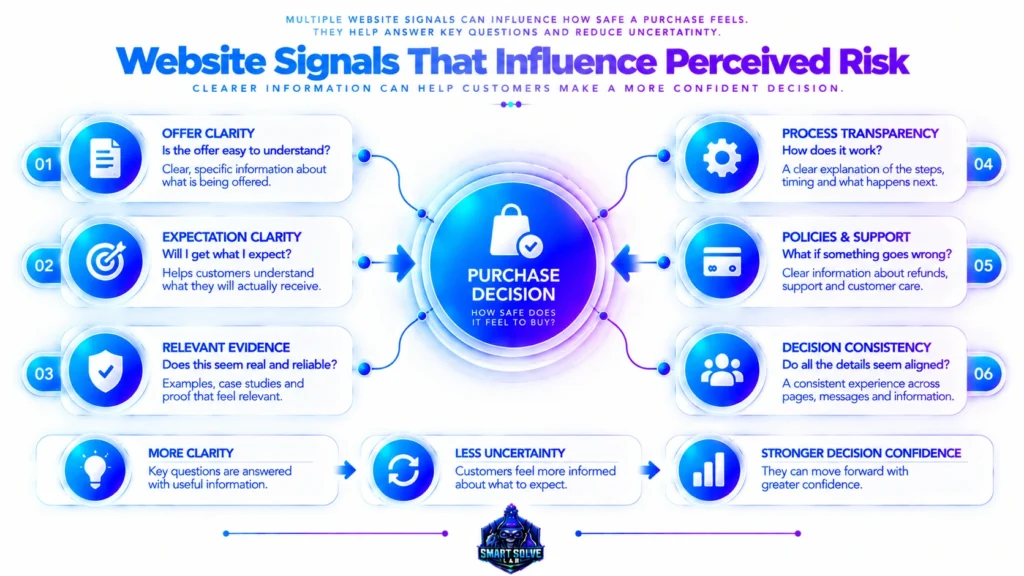
Your website communicates more than the words written on its pages. Visitors also form impressions from how clearly the offer is presented, how the buying process is explained, what evidence is available, and whether important questions are answered before they commit.
These signals can help customers feel more comfortable with a purchase. However, the same website can also leave important uncertainties unresolved, even when the business itself is legitimate and the product is useful.
Offer Clarity
Customers need to understand what they are buying, who the offer is for, and what is included. If the offer is vague, visitors may struggle to judge whether it matches their needs. Unclear descriptions can create hesitation because customers have to guess what they will receive.
Expectation Clarity
Visitors should be able to form a reasonable understanding of what the product or service can deliver. Overly broad promises, missing limitations, or unclear deliverables can create uncertainty about the eventual experience. Clear expectations help customers evaluate an offer more realistically.
Relevant Evidence
Examples, demonstrations, case studies, and customer feedback can help visitors understand how an offer works. Their usefulness depends on relevance. Evidence that reflects the customer’s situation is often more informative than a collection of unrelated testimonials or impressive-looking claims.
Process Transparency
Customers may want to know what happens after they place an order, how delivery works, whether they need to complete additional steps, and when they can expect communication. When these details are difficult to find, the buying process may feel less predictable.
Policies and Support
Refund conditions, cancellation terms, delivery information, and available customer support can influence how comfortable a purchase feels. The relevant information depends on the offer. What matters is that customers can find accurate, understandable answers to the questions that matter for their decision.
Consistency Across the Website
Conflicting prices, different promises across pages, unclear button labels, or inconsistent delivery information can make visitors question which details are correct. Even small inconsistencies may introduce doubt when a customer is already evaluating a purchase.
The goal is not to add every possible trust signal to every page. It is to understand which website details help customers evaluate the actual offer and which unanswered questions may be making the decision harder.
Why More Trust Signals Don’t Always Make Customers Feel Safer
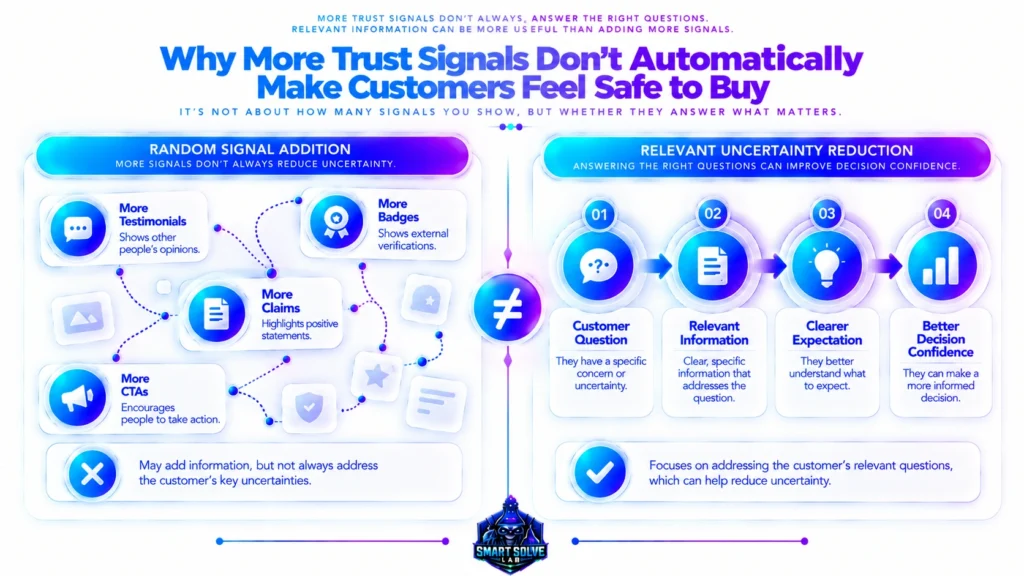
When customers hesitate, it can be tempting to add more testimonials, security badges, guarantees, statistics, or calls to action. These elements can be useful in the right context, but adding more of them does not automatically resolve the uncertainty behind a customer’s decision.
The important distinction is between showing that a business appears credible and helping a customer understand whether a specific purchase is right for them.
More Testimonials May Not Answer the Relevant Question
A page may contain many positive reviews, yet a potential customer may still wonder whether the product suits their circumstances. Testimonials can provide useful evidence, but their relevance matters more than their quantity alone.
A Security Badge Cannot Explain the Whole Offer
Security indicators may help visitors understand aspects of a website’s technical protection. They do not, by themselves, explain what a product includes, whether a service meets a customer’s needs, or what happens if expectations are not met.
A Guarantee May Leave Important Details Unclear
A guarantee can reduce some concerns when its terms are clear and appropriate. If customers cannot understand the conditions, exclusions, time limits, or process for making a claim, the guarantee may leave them with additional questions instead of resolving existing ones.
More Information Can Still Create Confusion
Adding long explanations, multiple offers, repeated promises, and several competing calls to action may make it harder to identify the information needed for a decision. More content is not necessarily more clarity.
Relevant Answers Matter More Than Random Additions
Consider what a first-time customer is trying to establish: what they will receive, whether it fits their situation, how the process works, what the commitment involves, and where they can get help. Website information becomes more useful when it addresses these questions clearly and at the point where they matter.
This does not mean every hesitation comes from missing website information. Price, timing, product fit, competing priorities, or other factors may also influence a decision. The aim is to distinguish a genuine information gap from assumptions about what customers need.
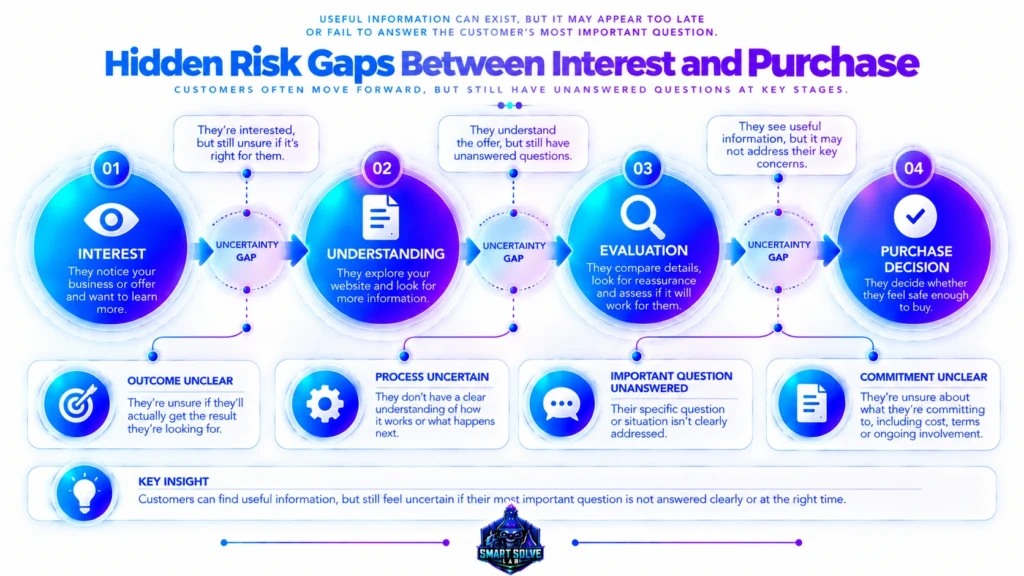
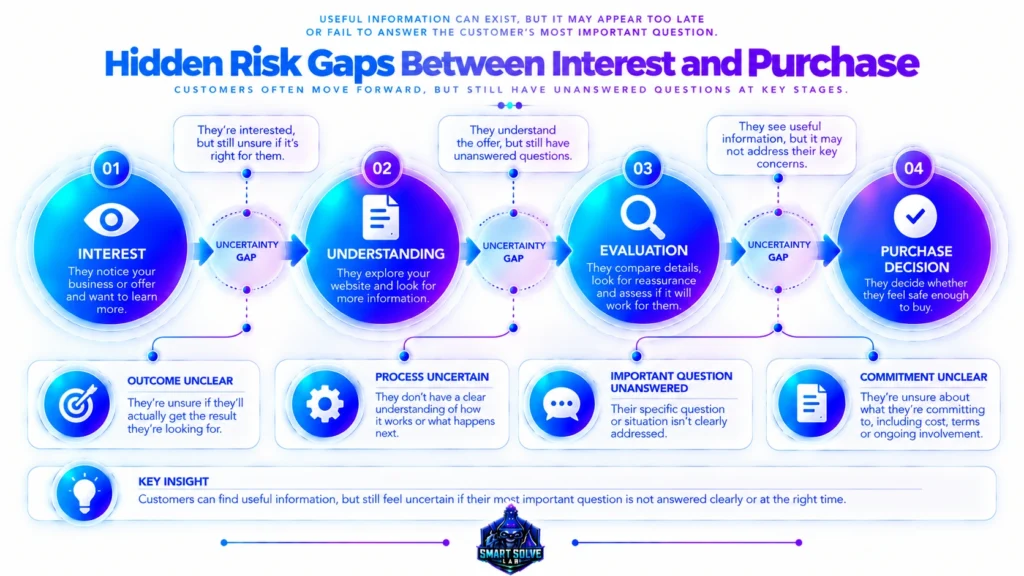
The Hidden Risk Gaps Between Interest and Purchase
A customer can be interested in an offer without feeling ready to commit. They may read the page, explore product details, compare options, or revisit the website, yet still leave without buying. The visible behaviour shows that a decision has not been completed; it does not, by itself, reveal the reason.
One possibility is that a question remains unanswered somewhere between initial interest and the final decision.
The Expected Outcome Is Still Unclear
A visitor may understand the general purpose of a product but remain unsure about the result they can reasonably expect. If the offer’s scope, deliverables, or limitations are difficult to understand, the customer may postpone the decision.
The Buying Process Feels Uncertain
Customers may hesitate when they cannot tell what happens after clicking a button, completing payment, booking a service, or submitting their information. Uncertainty about the next step can make an otherwise attractive offer feel harder to evaluate.
An Important Question Has Not Been Answered
A product page may explain its features while overlooking practical questions about compatibility, suitability, delivery, access, support, or ongoing obligations. The relevant questions vary according to the product and the customer.
The Commitment Is Not Fully Understood
Visitors may want clarification about recurring charges, cancellation conditions, time requirements, contract terms, or what they will need to do after purchasing. When these details are unclear, waiting can feel safer than making a decision.
The Answer Appears Too Late
Useful information may exist somewhere on the website but be difficult to find at the moment the customer needs it. If visitors must search several pages to understand a key condition, the effort itself can interrupt their decision process.
These are possible risk gaps, not proof of the cause behind every abandoned purchase. Customers may also leave because of price, timing, distraction, comparison shopping, or a mismatch between the offer and their needs. Understanding the pattern requires looking at the broader buying journey rather than treating every exit as the same problem.
Why Customers Can Hesitate at the Final Decision Stage
Sometimes a customer reaches the final stage of the buying journey but still does not complete the purchase. They may understand the offer, recognise its potential value, and consider the business credible. Yet something about making the actual commitment remains unresolved.
This is where perceived purchase risk can become particularly relevant. Exploring an offer is different from accepting the consequences of a purchase. Before committing, customers may pay closer attention to the price, the terms, the expected outcome, and what could happen if the experience does not match their expectations.
The Final Step Introduces a Clear Commitment
Earlier in the journey, a visitor can browse, compare, and gather information without making a significant commitment. At checkout or the point of booking, the decision becomes more concrete. Customers may reconsider whether the offer meets their needs and whether they are comfortable proceeding.
Important Details May Become More Noticeable
A delivery charge, payment condition, recurring fee, cancellation term, or additional requirement may become apparent only near the final step. If a detail changes the customer’s understanding of the offer, hesitation may follow.
Interest Does Not Always Mean Readiness
A visitor may genuinely want a product but still need more time, have budget constraints, or be comparing alternatives. Not every incomplete purchase signals a website problem, and not every hesitation can be resolved through additional information.
Look Beyond the Abandoned Action
A customer leaving at checkout tells you where the journey stopped, but it does not establish why. Reviewing the checkout experience, customer questions, pricing clarity, and available feedback can help you explore possible explanations without assuming a single cause.
The useful question is not simply, “Why didn’t the customer click the button?” It is, “What might have made completing this particular purchase feel uncertain, unsuitable, or premature?” That question opens the door to a more accurate understanding of the buying experience.
How to Review Your Website for Perceived Purchase Risk
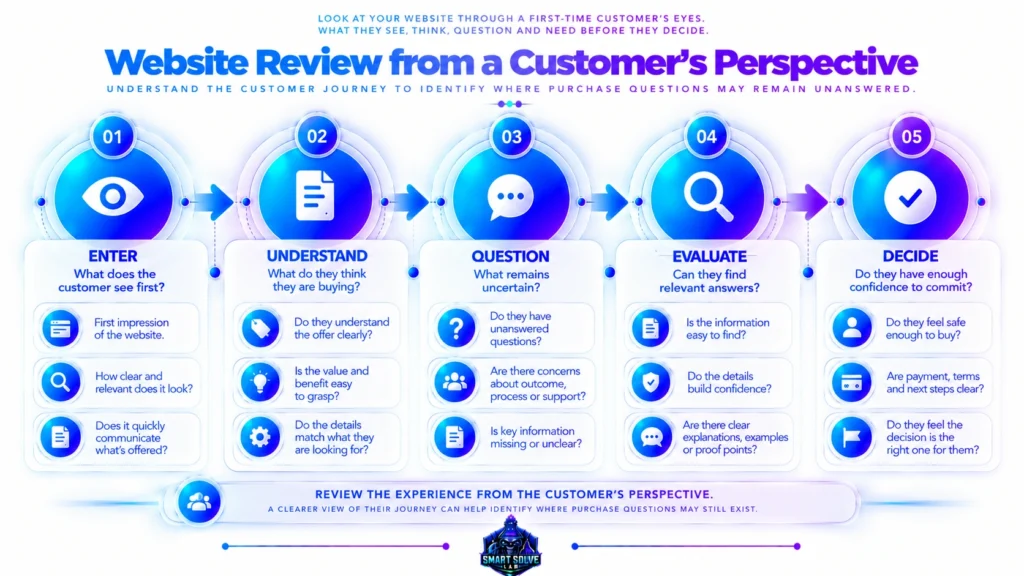
You do not need to assume that every visitor who leaves is experiencing purchase risk. A more useful starting point is to review your website from the perspective of someone who has never purchased from your business before.
Read the Page as a First-Time Customer
Look at the offer without relying on knowledge that you already have about your business. Can a new visitor understand what is included, who the offer is intended for, and what happens after purchase? Information that feels obvious to the business owner may not be obvious to someone encountering the offer for the first time.
Identify the Questions a Customer Could Reasonably Ask
Consider the practical uncertainties associated with your particular offer. Customers may want to understand suitability, deliverables, delivery timelines, payment terms, support, or limitations. Focus on questions that genuinely matter to the buying decision rather than adding generic information simply to make the page longer.
Check Whether Answers Are Easy to Find
Important information may already exist on your website but be buried in another page, hidden in lengthy text, or available only after a customer contacts you. Review whether visitors can find essential details without unnecessary searching.
Consider When the Information Appears
An answer can be accurate and still arrive too late. For example, a customer may need to understand delivery charges before deciding whether an offer fits their budget. Consider whether important conditions are visible when they are most relevant to the decision.
Look for Contradictions and Ambiguity
Compare the information presented across product pages, pricing sections, checkout screens, FAQs, and policies. Inconsistent descriptions or unclear terms can make it difficult for customers to form a reliable understanding of what they are purchasing.
Separate Purchase Risk From Other Possible Problems
If visitors are not buying, uncertainty is only one possible explanation. The offer may not fit their needs, the price may be unsuitable, the right audience may not be reaching the page, or the checkout may have a technical issue. Website observations become more useful when considered alongside customer feedback and relevant behavioural evidence.
This review is an initial way to notice possible uncertainty, not a definitive diagnosis. The aim is to identify questions worth investigating instead of automatically adding more badges, testimonials, or persuasive copy.
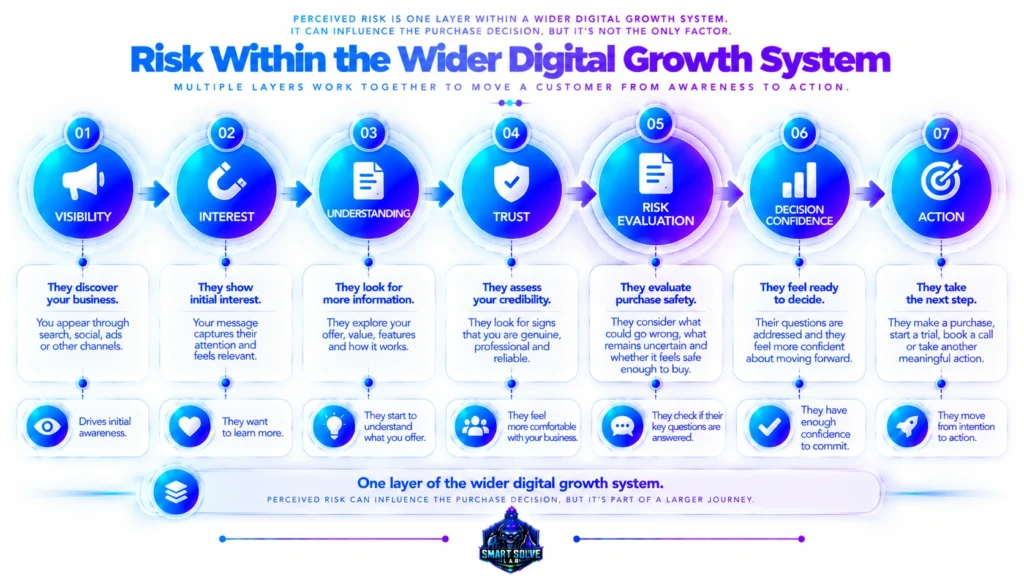
Perceived Risk Is One Layer of a Larger Digital Growth System
Customers do not make purchase decisions in isolation. Their experience begins before they reach a product page and continues through understanding the offer, evaluating the business, considering the commitment, and deciding whether to proceed.
Perceived purchase risk is one part of this larger journey. It can help explain why an interested visitor may hesitate, but it should not be treated as the explanation for every traffic, lead generation, or sales problem.
Visibility: Can the Right Audience Find You?
Before customers can evaluate an offer, they need an opportunity to discover it. If the website is not reaching relevant people, the problem may involve visibility, search relevance, distribution, or audience targeting rather than purchase risk.
Interest: Does the Offer Match Their Needs?
Visitors may arrive at a website without having a strong reason to buy. The offer may not address their current problem, or they may be researching rather than preparing to purchase. Interest depends partly on the relationship between the customer’s needs and what the business offers.
Understanding: Can They Evaluate the Offer?
Customers need to understand what the product or service does, what it includes, and how it relates to their situation. If the offer is difficult to understand, uncertainty may arise before the customer reaches the stage of evaluating purchase risk.
Trust and Risk Evaluation: Can They Make an Informed Decision?
Trust concerns whether a customer finds the business credible. Perceived risk concerns whether the customer feels comfortable with the uncertainty and commitment associated with buying. These factors are related, but they are not interchangeable.
Decision and Action: Are They Ready to Proceed?
Even when the offer is understood and the business appears credible, customers may decide not to purchase because of price, timing, competing priorities, or a lack of fit. Others may encounter friction in the checkout or booking process.
Seeing these stages as connected helps businesses avoid treating every disappointing result as the same problem. The more accurately a business distinguishes between visibility, relevance, understanding, trust, perceived risk, and action, the more clearly it can identify what deserves further investigation.
Key Takeaways
- Trust and purchase safety are different. A customer may believe a business is credible but still feel uncertain about committing to a particular purchase.
- Perceived risk is about uncertainty from the customer’s perspective. It may involve expectations, suitability, support, payment, or the commitment involved.
- Website signals need to answer relevant questions. More testimonials, badges, guarantees, and content do not automatically resolve the uncertainty behind a decision.
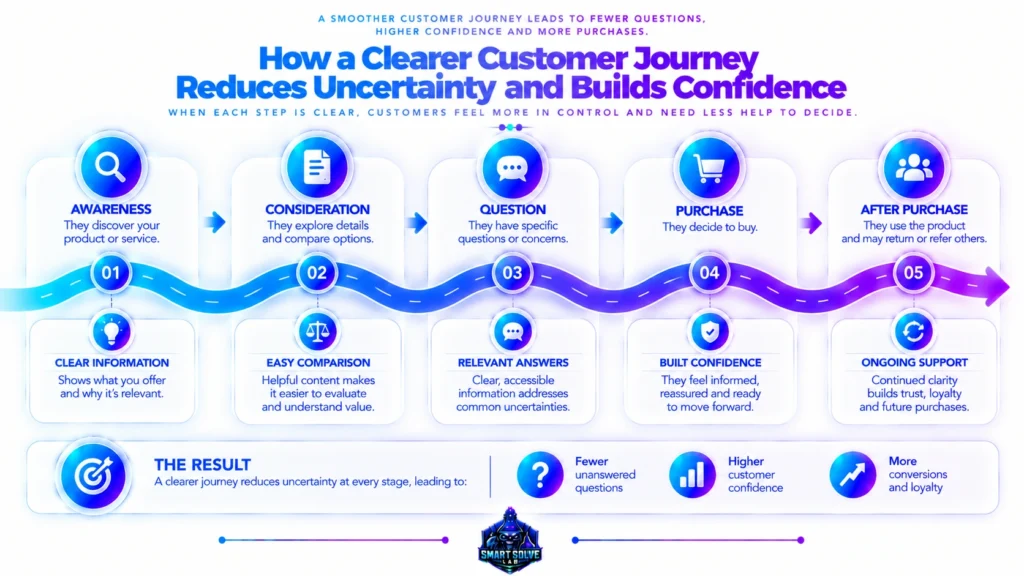
- Clarity matters across the buying journey. Offer details, realistic expectations, process information, policies, and consistent communication can help customers evaluate an offer.
- Purchase hesitation does not have one universal cause. Price, timing, poor product fit, technical problems, and other factors may also explain why a visitor does not buy.
- Where a customer leaves does not prove why they left. Website behaviour can point toward questions worth investigating, but it should be considered alongside other relevant evidence.
- Review the complete customer journey. Visibility, interest, understanding, trust, perceived risk, and the final buying experience are connected, but each can present a different problem.
The goal is not to eliminate every possible concern. It is to help customers understand the offer, evaluate relevant uncertainties, and make an informed purchase decision.
Conclusion: Customers Need Enough Confidence to Commit
When customers understand an offer and find a business credible but still hesitate to buy, perceived purchase risk is one possible explanation worth exploring.
The hesitation may come from uncertainty about the expected outcome, whether the offer suits their situation, what happens if something goes wrong, how payment works, or what commitment they are accepting. In other cases, the reason may be unrelated to perceived risk altogether.
This is why adding more persuasive content or generic trust signals is not always the most useful next step. Businesses first need a clearer understanding of what customers may be uncertain about and whether the available evidence supports that explanation.
The Smart Solve Lab Perceived Risk Diagnostic is the relevant next step for businesses that want to investigate potential gaps between customer interest, trust, and purchase confidence. It provides a diagnostic direction for examining possible sources of hesitation without assuming that every incomplete purchase has the same cause.
Understanding the problem comes before deciding what to change. When businesses can distinguish perceived purchase risk from other possible barriers, they are better positioned to choose a relevant next step rather than making random website changes.
Frequently Asked Questions
1. Why do customers hesitate to buy from my website?
Customers may hesitate because they are unsure about the offer, expected results, product suitability, payment terms, support, or the commitment involved. Other causes can include price, timing, technical issues, or a mismatch between the offer and their needs.
2. What is perceived risk in online buying?
Perceived risk is the uncertainty a customer experiences when considering an online purchase. They may wonder whether the product will meet their expectations, whether it will work for their situation, whether their payment is secure, or what happens if something goes wrong.
3. What makes customers feel unsafe buying online?
Unclear product descriptions, unrealistic promises, missing delivery information, confusing payment conditions, difficult-to-find policies, and inconsistent details may increase uncertainty. The specific concerns depend on the product and the customer.
4. Does trust automatically remove purchase risk?
No. Trust and perceived purchase risk are related but different. A customer may believe a business is legitimate and still feel uncertain about product suitability, the expected outcome, the cost, or the commitment involved.
5. How can a website reduce customer uncertainty before purchase?
A website can help by explaining the offer clearly, setting realistic expectations, presenting relevant evidence, describing the buying process, and making applicable policies and support information easy to find.
6. Why do customers add products to their cart but not buy?
Customers may abandon a cart because of unexpected costs, complicated checkout steps, payment difficulties, purchase uncertainty, comparison shopping, distraction, or changing priorities. Cart abandonment alone does not prove that perceived risk is the cause.
7. How can I identify what is making customers hesitant to buy?
Review the buying journey, offer clarity, information available before purchase, checkout usability, and recurring customer questions. Also consider price, audience relevance, product fit, and technical problems. A structured diagnostic review can help investigate possible causes without assuming one universal explanation.
Recommended Reading
Perceived purchase risk is connected to other parts of the customer journey. These articles explore related problems from different diagnostic perspectives.
- Why Customers Don’t Trust Your Website — Explore the trust-related concerns that may affect how visitors evaluate a business.
- Why Website Traffic Doesn’t Become Leads — Understand why attracting visitors does not necessarily lead to meaningful enquiries.
- Why Your Sales Funnel Is Not Converting — Explore possible problems across the journey from initial interest to the desired action.
Each article addresses a related but distinct part of the broader digital growth system. The aim is to understand the nature of the problem before deciding what needs to change.