
Customers Drop Off Before Buying:
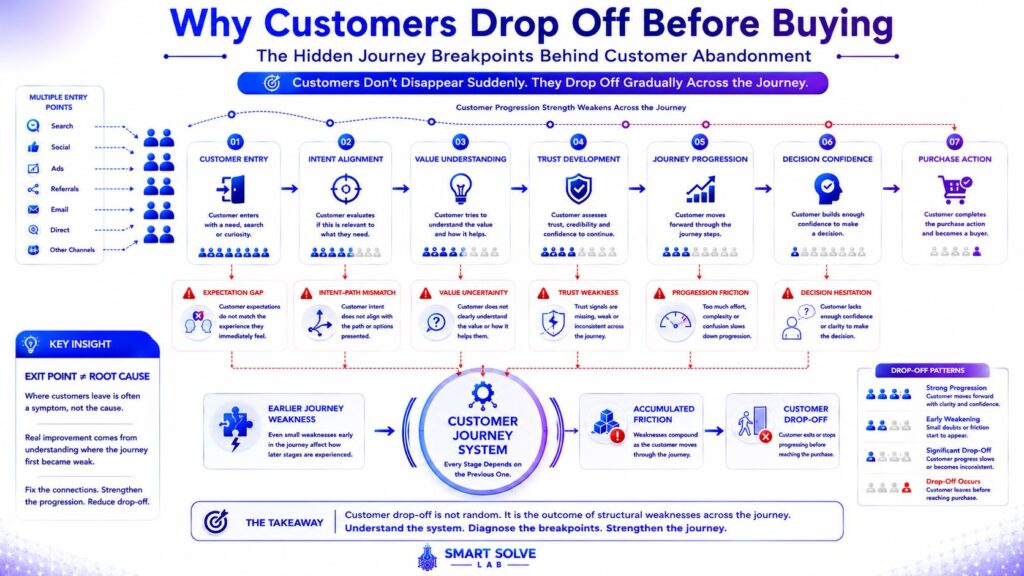
Customers rarely decide to buy the moment they discover a business. Instead, they move through a series of decisions that gradually shape their confidence, understanding, and willingness to continue. They first determine whether the business is relevant to their needs, then whether the value is clear, whether the information feels trustworthy, and finally whether they have enough confidence to make a purchase. Every stage of this progression influences the next.
Yet many businesses experience a frustrating pattern. Visitors arrive, browse multiple pages, compare products or services, return later, and sometimes even begin the buying process—only to leave before completing it. Because the most visible problem is where customers exit, businesses often assume the solution is to improve that specific page. They redesign landing pages, rewrite CTA buttons, add testimonials, simplify forms, or change pricing displays, expecting those changes alone to solve the problem.
Sometimes these improvements produce small gains, but the same pattern of customer drop-off often returns. New visitors continue entering the journey, while many still disappear before buying. This suggests that the visible exit point may not be the place where the customer journey first became weak.
Customer drop-off is not always an isolated conversion failure. It can be the accumulated outcome of small structural weaknesses that developed earlier across the buying journey. A slight mismatch between customer expectations and the initial experience, gradually decreasing value clarity, trust that fails to strengthen as commitment increases, or friction that interrupts natural progression can combine over time until continuing no longer feels worthwhile. By the time customers leave, the underlying problem may have existed long before the final decision point.
This distinction is important because the page where customers leave does not necessarily explain why they leave. The exit often reveals the moment when earlier uncertainty, reduced confidence, and accumulated friction become strong enough to stop progression. Focusing only on the final interaction can therefore improve one part of the experience while leaving the deeper journey constraints untouched.
Understanding customer drop-off requires looking beyond individual pages and examining how customers experience the journey as a connected system. Rather than asking only, “Where did customers leave?”, a more valuable diagnostic question is, “Where did the journey first become weak enough that eventual drop-off became likely?” That shift changes the focus from isolated page optimization to understanding how different stages of the customer journey influence one another.
In this article, we’ll explore what customer drop-off actually means, why interested customers still leave before buying, the six structural breakpoints that weaken customer progression, how small friction points accumulate across the journey, and what a stronger customer journey architecture needs to support more consistent progression toward confident purchase decisions.
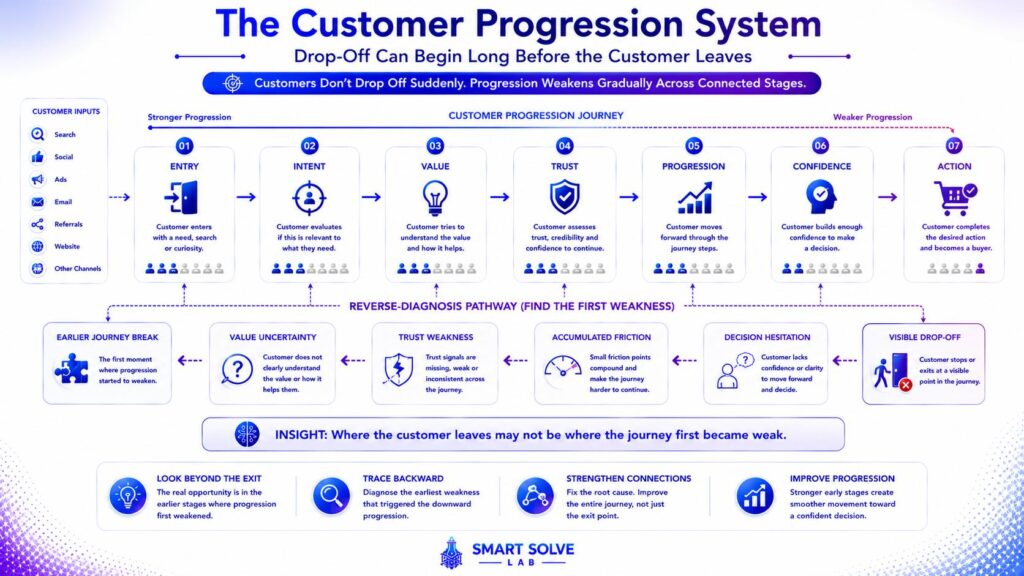
Table of Contents
What Does Customer Drop-Off Actually Mean?
When businesses think about customer drop-off, they often focus on the moment a visitor leaves the website. Analytics may show customers abandoning a landing page, exiting a pricing page, closing the checkout process, or leaving after reading a product description. Because these exit points are the most visible part of the journey, they naturally receive the most attention.
However, customer drop-off is not simply the act of leaving a website. It is the point where a customer’s willingness to continue the buying journey becomes weaker than their motivation to move forward. In many cases, that change begins much earlier than the final exit itself.
A customer journey is built through a series of connected decisions rather than one single action. Every stage either strengthens or weakens the customer’s confidence to continue. As customers progress, they continually evaluate whether the business understands their needs, whether the offered value remains relevant, whether enough trust has been established, and whether taking the next step feels worthwhile. When one or more of these elements weaken, progression slows. If enough uncertainty accumulates, the journey eventually stops.
Interest Does Not Automatically Equal Purchase Readiness
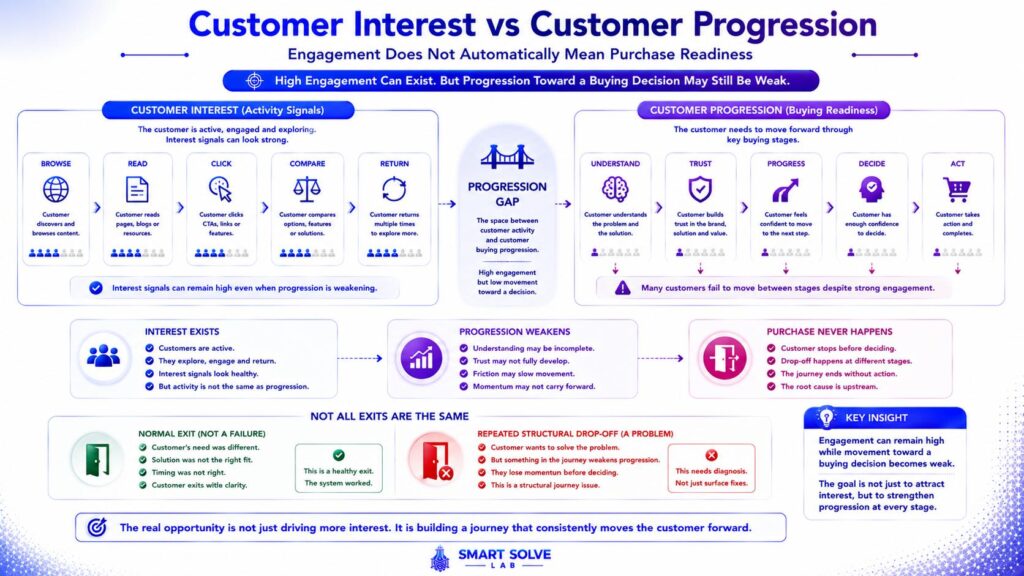
One of the most common misconceptions is assuming that customer interest automatically means a customer is ready to buy. While interest is an important first step, it represents curiosity rather than commitment.
Many customers explore websites because they want to learn more, compare available options, or understand whether a solution matches their needs. They may spend several minutes reading content, visit multiple pages, download resources, or return to the website more than once. These behaviors demonstrate engagement, but they do not necessarily indicate that the customer has developed enough confidence to make a purchasing decision.
As customers move closer to buying, the level of commitment required gradually increases. Each new step asks them to invest more attention, trust, or confidence than the previous one. If the journey does not support this increasing commitment, interested visitors can remain engaged while still deciding not to progress further.
Where Drop-Off Can Happen Across the Journey
Customer drop-off should also be viewed as something that can occur between stages of the journey rather than only on individual pages.
A visitor may leave after discovering that the information does not match their expectations. Another customer may understand the solution but remain uncertain about its value. Others may trust the information but hesitate when the required commitment becomes greater. Some customers reach the final buying stage yet still postpone their decision because earlier questions were never fully resolved.
This means customer abandonment is often the visible outcome of a progression problem rather than an isolated page problem. The journey itself may contain several transition points where confidence gradually weakens before the customer finally exits.
Why Engagement Can Exist Without Progression
Businesses sometimes interpret high engagement metrics as evidence that the customer journey is working effectively. Longer session durations, multiple page views, returning visitors, and resource downloads can all appear encouraging. While these signals indicate attention, they do not automatically confirm that customers are moving closer to a buying decision.
Customers can continue consuming information while remaining uncertain about whether to proceed. They may compare alternatives, revisit important pages, or delay action because essential questions remain unanswered. From a business perspective, engagement appears healthy, yet progression toward purchase becomes increasingly fragile.
Recognizing the difference between engagement and progression helps explain why some websites generate substantial activity without producing proportional business outcomes.
Normal Customer Exit vs Structural Drop-Off
Not every visitor is expected to become a customer. Some people are simply researching, gathering information, or determining whether a solution is relevant to their situation. Their decision to leave does not necessarily indicate a weakness in the customer journey.
Structural drop-off becomes a concern when similar patterns repeatedly appear among qualified or genuinely interested visitors. If customers who demonstrate clear buying intent consistently struggle to move beyond particular stages of the journey, the issue is less likely to be random behavior and more likely to reflect a structural constraint within the journey itself.
Distinguishing between normal exits and repeated structural drop-off prevents businesses from trying to optimize for every visitor instead of identifying meaningful progression barriers.
What Repeated Customer Drop-Off Reveals About the Journey
When customer drop-off follows consistent patterns over time, it often reveals that one or more stages of the journey are no longer supporting smooth progression. Rather than viewing each abandoned session as an isolated event, businesses can begin looking for recurring weaknesses that influence customer decisions across multiple interactions.
The most valuable diagnostic question therefore shifts from identifying where customers left to understanding where the journey first started losing momentum. The final exit simply marks the point where accumulated uncertainty became greater than the customer’s confidence to continue.
Understanding this distinction creates the foundation for diagnosing customer journeys more systematically. Instead of treating every exit page as the primary problem, businesses can begin examining the underlying conditions that gradually weaken customer progression across the entire buying experience.
Recommended Reading
customers leave without taking action
Why Customers Drop Off Even When They Seem Interested
One of the most confusing challenges for businesses is watching customers show genuine interest without eventually becoming buyers. Visitors explore products, read detailed information, compare solutions, subscribe to emails, return to the website multiple times, or even begin the purchasing process. From the outside, these behaviors suggest that customers are moving steadily toward a buying decision.
Yet many of them never complete that journey.
Because customer interest is visible, businesses often assume the final buying stage must be the problem. They may rewrite calls to action, redesign landing pages, or adjust pricing in an attempt to encourage more purchases. While these improvements may influence specific interactions, they do not always explain why interested customers gradually lose the confidence to continue.
Interest is only the beginning of the customer journey. As customers progress, every new stage asks them to make a slightly larger commitment than the previous one. If the journey does not strengthen confidence at the same pace that commitment increases, progression begins to weaken—even while interest remains.
Their Intent and the Next Step Don’t Match
Every customer enters a website with a different level of readiness. Some are only exploring a problem, while others are actively comparing potential solutions or preparing to make a purchase. A strong customer journey recognizes these differences and guides customers toward the next step that matches their current intent.
Problems arise when the journey asks customers to make a larger commitment than they are prepared for. A visitor who is still trying to understand a solution may immediately encounter requests for consultations, demos, or purchases before enough context has been established. Conversely, customers who are ready to move forward may be slowed down by unnecessary steps that delay progress.
When customer intent and the required next action become misaligned, progression naturally slows. Customers may remain interested in the solution while deciding that continuing no longer feels appropriate for where they are in their decision-making process.
Value Becomes Less Clear as They Progress
Initial curiosity often develops because customers believe a product or service might solve an important problem. However, maintaining that curiosity requires increasing clarity rather than simply providing more information.
As customers move deeper into the journey, they continuously evaluate whether the solution remains relevant to their situation. If explanations become overly complex, disconnected, or fail to reinforce the original value proposition, understanding begins to weaken. More content does not automatically create more clarity.
When customers no longer feel confident about the value they are receiving, their motivation to continue gradually declines. They may still find the solution interesting, but uncertainty begins replacing conviction.
Trust Doesn’t Grow With the Required Commitment
Trust develops progressively throughout a customer journey. Reading a helpful article requires relatively little trust, while sharing personal information, requesting a proposal, or completing a purchase requires significantly more.
As commitment increases, customers naturally expect stronger evidence that continuing is the right decision. If trust remains static while the required commitment grows, hesitation becomes increasingly likely.
This does not necessarily mean customers distrust the business. Instead, they may simply feel that the confidence needed for the next decision has not yet been fully established. The journey continues asking for more commitment without providing an equally strong increase in reassurance.
Friction Interrupts Momentum
Every customer journey contains moments where visitors must make decisions, process information, or complete actions. Small amounts of friction are normal, but when unnecessary complexity begins interrupting natural progression, momentum weakens.
Friction can appear in many forms. Customers may struggle to understand the next logical step, encounter disconnected messaging, experience unnecessary complexity, or feel uncertain about what happens next. Individually, these obstacles may appear minor. Together, they gradually increase the effort required to continue.
As the journey becomes more demanding, customers begin questioning whether moving forward is worth the additional effort. Eventually, even highly interested visitors may decide to postpone or abandon the process altogether.
Decision Uncertainty Appears Before Action
The final stage of a buying journey is rarely determined by a single page or interaction. Instead, it reflects the confidence customers have accumulated throughout every earlier stage.
When customers reach the point of making a purchase, they often review all the uncertainty they have experienced during the journey. Questions that were never fully answered, value that never became completely clear, trust that never strengthened enough, or friction that repeatedly interrupted progression combine into one final decision.
As a result, customers may remain genuinely interested in the solution while still deciding not to act. The issue is not necessarily a lack of interest—it is a lack of sufficient confidence to transform that interest into commitment.
This distinction explains why businesses can attract engaged, qualified visitors yet still experience significant customer drop-off. Interest alone does not carry customers to the finish line. The journey itself must continuously strengthen their confidence, reduce uncertainty, and make each next decision feel both logical and worthwhile.
Core Insight: A customer can remain interested in the solution while gradually losing confidence in continuing the journey.
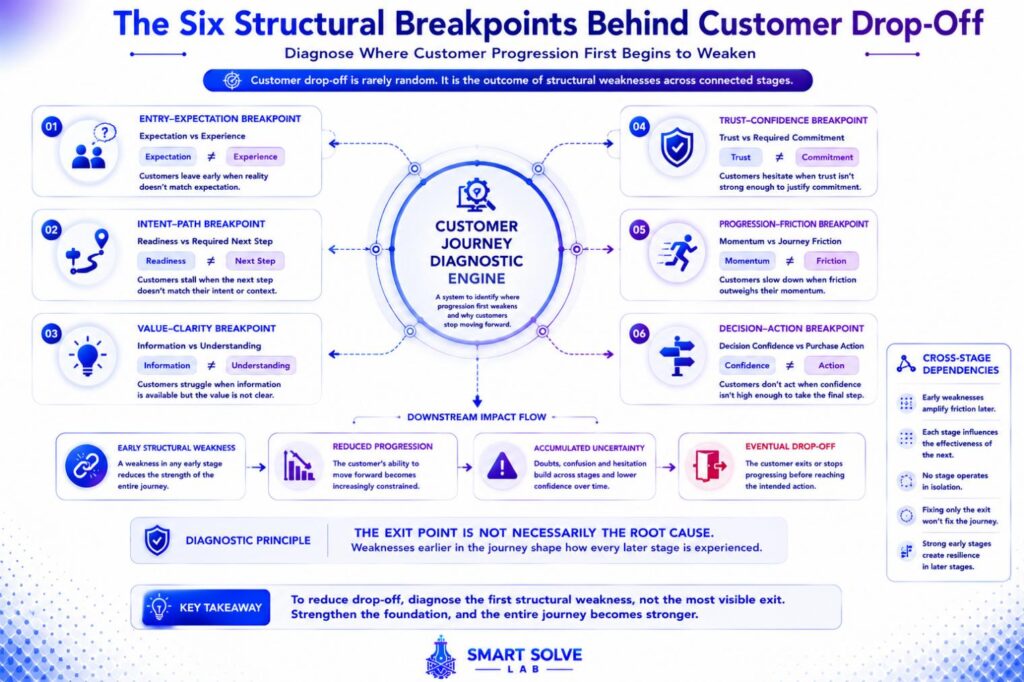
The Six Structural Breakpoints Behind Customer Drop-Off
If customer drop-off is viewed only as the moment someone leaves a website, businesses naturally concentrate on fixing the page where the exit occurred. However, a customer journey is not a collection of isolated pages. It is a connected progression where every stage influences the customer’s experience of the next.
When progression repeatedly breaks, the underlying cause often exists within the structure of the journey itself. Certain transition points become weaker over time, allowing uncertainty, hesitation, or friction to accumulate until customers no longer feel confident enough to continue.
These structural breakpoints do not guarantee that customers will leave. Instead, they reduce the journey’s ability to consistently move interested visitors toward confident purchase decisions.
1. Entry–Expectation Breakpoint
Every customer begins the journey with an expectation. That expectation may come from a search result, a recommendation, an advertisement, or previous interactions with the business.
The first experience should reinforce the reason the customer arrived. When the initial experience clearly aligns with the customer’s expectations, confidence begins to develop naturally. The customer feels that continuing the journey is likely to provide the answers or solutions they were looking for.
Problems emerge when the experience differs from what the customer anticipated. The content may address a different problem, the messaging may feel inconsistent, or the solution may appear less relevant than expected. Although many visitors continue exploring, the first reduction in confidence has already occurred.
This early mismatch may seem insignificant, but it creates a weaker foundation for every stage that follows.
2. Intent–Path Breakpoint
Customers do not all enter the journey with the same level of readiness. Some are still understanding their problem, while others are actively evaluating solutions or preparing to make a purchase.
A strong customer journey provides a logical next step that matches the customer’s current intent. Rather than pushing every visitor toward the same outcome, it allows progression to feel natural and appropriately paced.
A structural breakpoint appears when the required next action demands more commitment than the customer is prepared to make. Asking for a consultation before enough understanding exists or delaying obvious next steps for customers who are ready to proceed can both interrupt progression.
The issue is not necessarily the action itself but the mismatch between customer readiness and journey progression.
3. Value–Clarity Breakpoint
As customers move through the buying journey, they continually reassess whether the solution remains valuable to their situation.
Many businesses respond to uncertainty by adding more information. However, increasing the amount of information does not automatically improve understanding. When explanations become overly detailed, inconsistent, or disconnected from the customer’s priorities, value may become more difficult—not easier—to recognize.
A customer who understood the initial benefit can gradually become less certain about why continuing still matters.
Without increasing clarity, interest slowly gives way to hesitation, even though the solution itself may remain highly relevant.
4. Trust–Confidence Breakpoint
Trust is not built all at once. It develops progressively as customers continue moving through the journey.
Early interactions require relatively little confidence. Reading an article or exploring a website asks for far less commitment than requesting a proposal or making a purchase. As commitment increases, customers naturally expect stronger reasons to believe they are making a sound decision.
A structural breakpoint develops when trust grows more slowly than commitment. Customers may appreciate the business, value its expertise, and still hesitate because they do not yet feel sufficiently confident to take the next step.
The journey has advanced, but confidence has not advanced at the same pace.
5. Progression–Friction Breakpoint
Every transition within the customer journey should make moving forward feel clear and reasonable.
When unnecessary complexity begins appearing between stages, progression becomes increasingly difficult. Customers may struggle to understand the next logical step, encounter inconsistent messaging, or experience interruptions that reduce momentum.
Individually, these moments of friction may appear too small to matter. Collectively, however, they require customers to invest additional effort at every stage.
Over time, progression feels less natural, and continuing the journey demands more energy than customers initially expected.
6. Decision–Action Breakpoint
The final buying decision represents the combined outcome of every earlier stage rather than an isolated moment.
By the time customers reach the purchase stage, they have already formed opinions about relevance, value, trust, and the overall quality of the journey. If earlier uncertainty remains unresolved, the final decision becomes increasingly difficult.
Many businesses interpret this hesitation as a problem with pricing, checkout, or the final call to action. While those elements certainly matter, they often reveal uncertainty that developed much earlier rather than creating it.
Customers may arrive at the final decision fully interested in the solution yet still lack the accumulated confidence required to act.
Diagnostic Principle
The most important insight is that the point where customers leave is not necessarily the point where the customer journey first became weak.
Visible customer exits are often the final expression of uncertainty that has gradually accumulated across multiple stages of the journey. Treating the exit page as the primary cause can therefore improve one interaction while leaving earlier structural weaknesses untouched.
A more effective diagnostic approach asks how each stage influences the next and where customer progression first begins losing strength. Identifying that earlier breakpoint provides a much stronger foundation for understanding why customer drop-off continues to repeat.
Recommended Reading
conversion problems keep repeating
Why Fixing the Exit Page Often Doesn’t Fix Customer Drop-Off
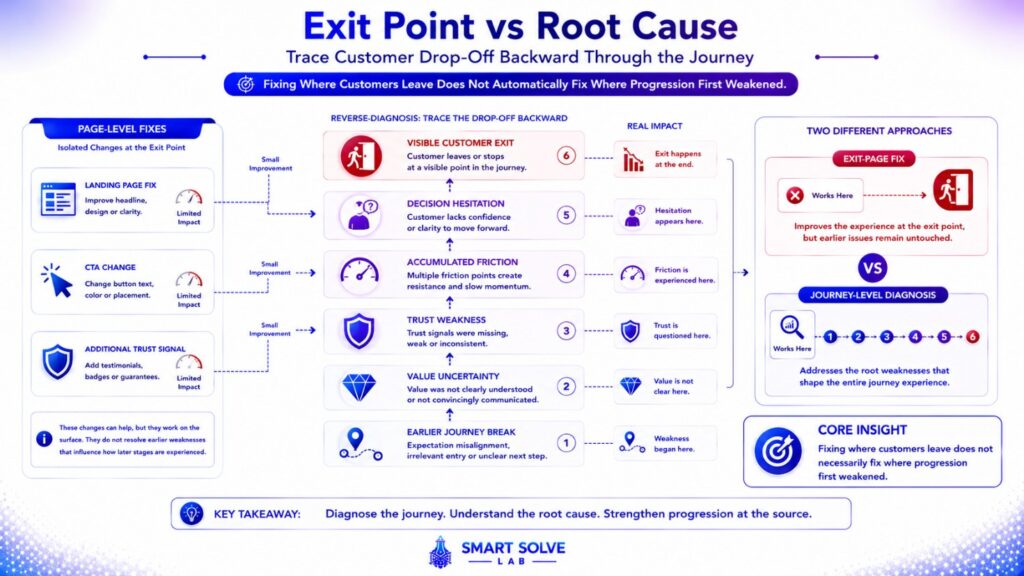
After identifying the six structural breakpoints, it becomes easier to understand why many customer journey improvements produce only temporary results. Businesses frequently optimize the page where customers leave because it represents the most visible part of the problem. If analytics show visitors abandoning a pricing page, checkout, or landing page, the logical response is often to improve that specific interaction.
While these improvements can certainly enhance the customer experience, they do not automatically resolve the deeper structural conditions that caused confidence to weaken throughout the journey. A customer’s final decision is influenced by every stage that came before it, not solely by the page where the journey ends.
This is why some businesses continue experiencing similar customer drop-off patterns even after redesigning individual pages. The visible exit changes, but the underlying progression constraints remain.
The Exit Page May Only Reveal an Earlier Weakness
The page where customers leave is often the point where accumulated uncertainty finally outweighs their confidence to continue. It is the visible outcome of the journey—not necessarily the beginning of the problem.
For example, a customer may leave during checkout because they hesitate before making a payment. However, that hesitation may have started much earlier when the value proposition became less clear, important questions remained unanswered, or trust failed to develop alongside increasing commitment.
By the time customers reach the final stage, they are making decisions based on everything they have experienced throughout the journey. The exit page simply reveals where that accumulated uncertainty became too great to overcome.
Landing-Page Improvements Can Fix an Interaction Without Fixing Progression
Landing pages play an important role in introducing customers to a business and guiding early progression. Improving messaging, design, or navigation can strengthen the first interaction and create a better initial experience.
However, a stronger landing page cannot compensate for weaknesses that appear later in the journey. Customers may begin with greater confidence, but if value becomes less clear, trust fails to grow, or progression becomes increasingly difficult, the earlier improvements eventually lose their influence.
Optimizing one interaction does not automatically strengthen the entire customer journey. Progression depends on how each stage supports the next rather than how well any single page performs in isolation.
CTA Changes Can Improve Direction Without Resolving Uncertainty
Calls to action help customers understand what they should do next. Clearer wording or improved placement may encourage more visitors to continue moving through the journey.
Yet even the most effective CTA cannot remove uncertainty that developed earlier. Customers may understand exactly what action is being requested while still questioning whether they feel confident enough to take it.
Direction and confidence are different challenges. A customer who lacks confidence rarely benefits simply from receiving clearer instructions.
Trust Signals Cannot Repair Poor Value Alignment
Businesses often respond to customer hesitation by adding testimonials, certifications, guarantees, or other trust-building elements. These additions can reinforce credibility and reduce certain forms of uncertainty.
However, trust signals are most effective when customers already understand the value being offered. If visitors remain unclear about how the solution addresses their needs, additional proof alone cannot create genuine confidence.
Customers first need to understand why the solution matters before evidence can strengthen their belief in it. Trust supports value—it does not replace it.
Customers Carry Earlier Friction Into Later Decisions
Every stage of the journey influences how customers experience the stages that follow.
A customer who has already encountered confusing messaging, inconsistent expectations, or unclear value will naturally become more sensitive to additional friction later. Even relatively small obstacles can feel more significant because earlier confidence has already weakened.
By contrast, customers whose journey has consistently reinforced relevance, understanding, and trust often navigate the same later stages with much greater confidence.
This demonstrates that later interactions cannot be evaluated independently from everything that happened before them.
Why Local Fixes Can Produce Gains Without Journey Stability
Improving individual pages often generates measurable improvements. Conversion rates may increase temporarily, engagement may improve, or more customers may complete specific actions.
These gains are valuable, but they do not necessarily indicate that the customer journey has become structurally stronger. If earlier weaknesses remain unresolved, customers may simply encounter the same progression constraints further along the journey.
Long-term improvement comes from strengthening how the entire journey works together rather than continuously optimizing isolated components.
Reverse Diagnostic Chain
Instead of beginning with the page where customers leave, a stronger diagnostic approach traces the journey backward.
Visible Customer Exit
⬆
Decision Hesitation
⬆
Accumulated Friction
⬆
Trust Weakness
⬆
Value Uncertainty
⬆
Earlier Journey Break
Following this reverse diagnostic sequence helps businesses identify where progression first began weakening instead of focusing only on where customers finally exited. This shift transforms customer drop-off from a page-level optimization problem into a customer journey diagnosis problem.
How Small Friction Points Compound Across the Customer Journey
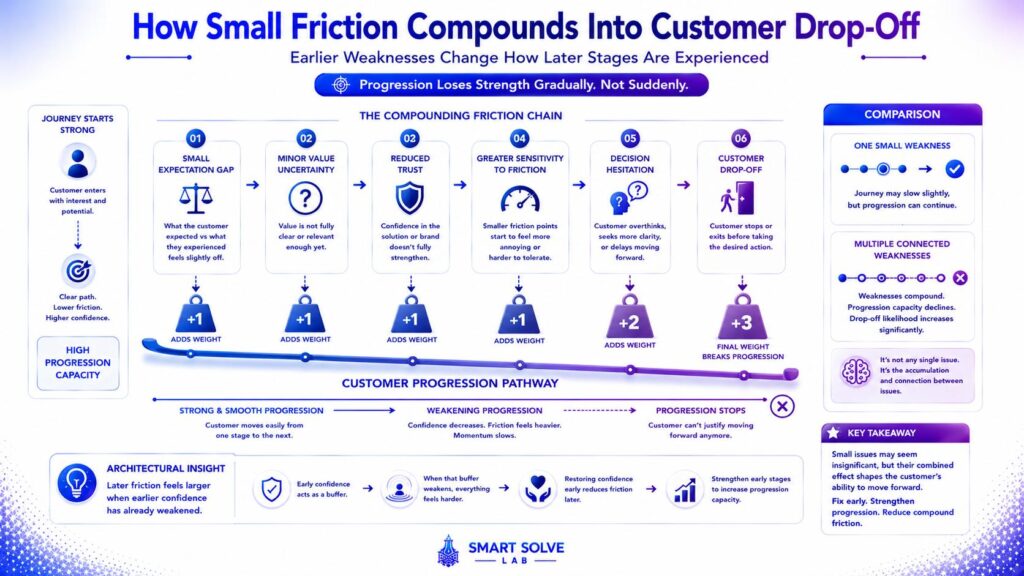
Not every weakness in a customer journey is powerful enough to stop a customer from buying. In fact, many individual problems appear too small to deserve immediate attention. A slightly unclear message, a small delay in understanding value, a minor trust concern, or an unnecessary step may seem insignificant when viewed independently.
The challenge is that customers do not experience these weaknesses independently. They experience them as one connected journey.
Every small moment of uncertainty influences how the next stage is perceived. As these moments accumulate, customers gradually become less confident, less motivated, and less willing to continue. By the time they reach the final buying decision, the combined effect of many small weaknesses can become far more influential than any single issue alone.
This is why customer drop-off often appears unexpected. Businesses may struggle to identify one obvious problem because no single interaction seems severe enough to explain the outcome. The real issue lies in how multiple weaknesses reinforce one another across the journey.
One Weakness May Not Stop the Journey
A customer who encounters a small expectation mismatch during the first interaction does not automatically abandon the journey. Many visitors continue exploring because they still believe the solution may be relevant.
Similarly, a brief moment of uncertainty about value or a small amount of additional effort rarely causes an immediate exit. Customers are generally willing to tolerate minor imperfections when they believe the journey is still moving toward a worthwhile outcome.
This is why businesses should avoid assuming that every isolated weakness is responsible for customer abandonment. Many customers successfully progress despite encountering occasional friction.
Multiple Weaknesses Reduce Progression Capacity
The situation changes when several small weaknesses appear throughout the customer journey.
A slight expectation mismatch may reduce initial confidence. Later, value becomes less clear than expected. Trust develops more slowly than commitment increases. Additional friction interrupts momentum. Individually, none of these weaknesses may appear serious. Together, however, they gradually reduce the customer’s willingness to continue.
Rather than one dramatic failure, the journey experiences a gradual decline in progression capacity.
This cumulative pattern can be visualized as:
Small Expectation Gap
↓
Minor Value Uncertainty
↓
Reduced Trust
↓
Greater Sensitivity to Friction
↓
Decision Hesitation
↓
Customer Drop-Off
The final decision is influenced not by one isolated weakness but by the combined effect of everything the customer experienced beforehand.
Earlier Weaknesses Change How Later Stages Are Experienced
One of the most important principles of customer journey diagnosis is that earlier experiences shape how customers interpret everything that follows.
A checkout process, consultation request, pricing page, or contact form may appear completely reasonable when viewed in isolation. For customers whose confidence has been strengthened throughout the journey, these stages often feel like natural next steps.
However, customers who have already experienced uncertainty, inconsistent messaging, or weakening trust perceive the same interactions very differently. The exact same checkout process can feel more complicated. The same request for commitment can seem more demanding. The same purchasing decision can appear more risky.
The later stage has not necessarily changed. What has changed is the customer’s confidence when arriving there.
This is why improving only the final interaction often fails to eliminate customer drop-off. The experience of that interaction has already been shaped by everything that happened earlier in the journey.
Compounding Friction Is a Journey Problem, Not a Page Problem
Businesses sometimes attempt to eliminate friction by optimizing whichever page shows the highest abandonment rate. While this approach may improve a specific interaction, it rarely explains why customers became increasingly sensitive to friction in the first place.
Compounding friction develops across connected stages rather than within one isolated page. It reflects how expectation, value, trust, progression, and decision confidence interact over time.
Reducing avoidable customer drop-off therefore requires understanding how these elements influence one another across the entire journey instead of treating each page as an independent optimization project.
When businesses begin viewing customer progression as a connected system, small weaknesses become easier to recognize before they accumulate into larger structural constraints. Rather than waiting for customer exits to reveal the problem, they can identify where confidence first begins to weaken and strengthen the journey before that weakness spreads to later stages.
What a Strong Customer Journey Actually Needs
After identifying where customer progression begins to weaken, the next step is not to optimize every page individually. A stronger customer journey is built by ensuring that each stage prepares customers for the next one. Rather than functioning as separate interactions, the stages should work together as a connected progression that gradually increases understanding, confidence, and readiness to act.
This perspective shifts the focus from isolated improvements to journey architecture. Instead of asking whether one page performs well, businesses begin asking whether every stage helps customers move naturally toward the next decision.
A well-connected customer journey does not remove every obstacle or guarantee that every visitor becomes a customer. Its purpose is to reduce avoidable uncertainty by creating a clear and logical progression from initial interest to confident action.
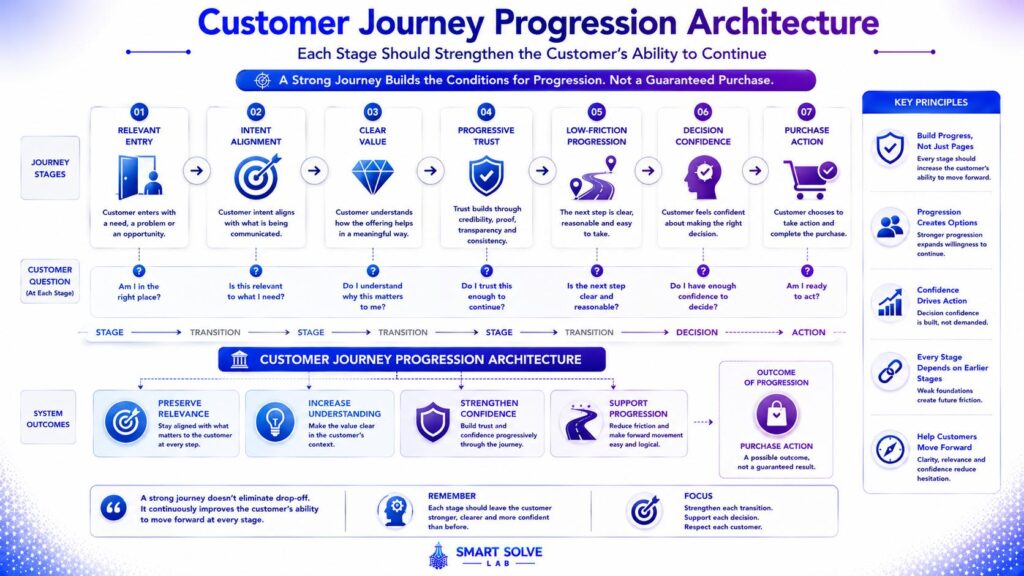
Customer Journey Progression Architecture
A strong customer journey can be understood as a sequence of connected stages, each with a specific responsibility.
Relevant Entry
↓
Intent Alignment
↓
Clear Value
↓
Progressive Trust
↓
Low-Friction Progression
↓
Decision Confidence
↓
Purchase Action
Each stage strengthens the customer’s ability to continue rather than attempting to complete the entire selling process at once. When one stage performs its role effectively, it creates the conditions that allow the next stage to succeed.
Every Stage Should Answer a Different Customer Question
Customers do not move through the buying journey simply because information is available. They progress because each stage resolves an important question that naturally leads to the next decision.
Am I in the right place?
The journey begins by confirming that the business understands the customer’s problem and offers something relevant to their needs.
↓
Is this relevant to what I need?
Customers then determine whether the solution genuinely connects with their situation rather than presenting a generic promise.
↓
Do I understand why this matters to me?
As they continue, value should become clearer instead of becoming more complicated. Customers need increasing understanding, not simply increasing amounts of information.
↓
Do I trust this enough to continue?
Because commitment gradually increases throughout the journey, trust should also develop progressively. Confidence cannot remain static while expectations continue rising.
↓
Is the next step clear and reasonable?
Every transition should feel logical. Customers should understand why the next action is appropriate without feeling rushed or uncertain.
↓
Do I have enough confidence to decide?
Before acting, customers naturally review everything they have experienced throughout the journey. A connected progression strengthens confidence long before this final evaluation occurs.
↓
Am I ready to act?
Purchase decisions become easier when earlier stages have consistently reduced uncertainty and supported progression rather than introducing new questions.
Strong Customer Journeys Reduce Uncertainty at Every Stage
One of the defining characteristics of an effective customer journey is that uncertainty decreases as customers move forward.
Early stages reduce uncertainty about relevance.
Middle stages reduce uncertainty about value.
Later stages reduce uncertainty about trust, commitment, and decision-making.
Instead of expecting customers to overcome unanswered questions on their own, the journey continuously supports their progression by making each next decision feel clearer than the previous one.
Understanding how customers move through these stages is also an important part of improving the overall journey. Measuring meaningful interactions across the buying process helps businesses identify where progression weakens and where additional investigation may be needed. Google’s guidance on customer journey measurement provides a helpful overview of evaluating customer interactions across multiple touchpoints rather than focusing on a single page or session.
This type of measurement complements journey diagnosis by providing evidence about where customers slow down, disengage, or leave before completing their intended path.
Journey Architecture Is Stronger Than Individual Optimization
Businesses often improve individual pages while expecting overall customer progression to improve automatically. Although page-level optimization remains valuable, it cannot replace a connected journey architecture.
A customer does not experience one page at a time in isolation. They experience a sequence of decisions, expectations, transitions, and interactions that together shape their confidence.
When every stage preserves relevance, increases understanding, strengthens trust, reduces unnecessary friction, and prepares customers for the next decision, the journey becomes more resilient. Individual improvements then contribute to a stronger overall system rather than functioning as isolated optimizations.
The System Insight: Customers Experience a Journey, Not Individual Pages
One of the biggest reasons businesses struggle to reduce customer drop-off is that they often evaluate the buying experience one page at a time. Landing pages are reviewed separately from product pages, product pages are analyzed independently from checkout, and individual interactions are optimized without considering how they influence the journey as a whole.
While this approach can improve specific components, it does not necessarily strengthen the customer journey itself.
Customers do not experience a business as disconnected pages. They experience a continuous sequence of interactions where every stage influences how the next stage is perceived. The confidence they bring into one decision is shaped by everything they experienced before reaching it.
Understanding this distinction changes how customer drop-off should be diagnosed. Instead of asking whether a single page is performing well, businesses begin examining whether the connections between stages consistently support customer progression.
Customers Experience Progression, Not Individual Components
From a business perspective, websites are often organized into separate assets—landing pages, service pages, product pages, pricing pages, contact forms, and checkout processes. Each component has its own purpose and performance metrics.
Customers, however, rarely think in these categories.
They experience one continuous journey that moves from discovering a problem to understanding a solution, developing trust, evaluating available options, and deciding whether to take action. Every interaction becomes part of one larger experience rather than an isolated event.
This means that improving an individual component does not automatically improve the customer’s overall journey. A highly optimized landing page cannot compensate for confusion later in the process, just as a well-designed checkout cannot fully overcome uncertainty that developed much earlier.
The Connections Between Stages Shape Customer Confidence
The quality of a customer journey depends not only on how well each stage performs individually but also on how effectively one stage prepares customers for the next.
A relevant entry should naturally lead to stronger intent alignment.
Intent alignment should increase understanding of value.
Greater value clarity should strengthen trust.
Growing trust should make progression feel easier.
Reduced friction should support greater decision confidence.
Decision confidence should make taking action feel like a logical next step.
When these transitions remain connected, customers experience a journey that gradually reduces uncertainty instead of increasing it. When those connections weaken, even well-designed individual stages struggle to maintain progression.
Strong Journey Architecture Creates Stronger Customer Progression
Journey architecture is ultimately about creating consistency across the entire buying experience.
Rather than optimizing pages independently, businesses begin evaluating how relevance, understanding, trust, progression, and confidence interact as one connected system. Every stage has a distinct responsibility, but each stage also supports the success of the next.
This systems perspective makes customer drop-off easier to interpret. Instead of viewing abandonment as a failure of one page, it becomes a signal that somewhere within the connected journey, customer progression has gradually weakened.
Understanding those relationships allows businesses to move beyond isolated improvements and toward a more structured approach to customer journey optimization.
Core Authority Principle
Strong customer journeys do not succeed because individual pages are highly optimized.
They succeed because every stage preserves relevance, increases understanding, strengthens confidence, and makes the next decision easier to take.
When customer progression is supported consistently across the entire journey, businesses are better positioned to reduce avoidable drop-off and create a more connected buying experience without relying on isolated page-level improvements.
From Customer Drop-Off to Customer Journey Optimization
Understanding why customers leave before buying is only the first step. The greater value comes from using that understanding to strengthen the customer journey systematically rather than reacting to individual symptoms.
Many businesses improve isolated pages whenever customer drop-off becomes visible. They redesign landing pages, rewrite calls to action, simplify forms, or adjust individual interactions based on where customers appear to exit. Although these improvements can enhance specific parts of the experience, they often address the visible symptom rather than the structural conditions that allowed progression to weaken in the first place.
A system-level approach begins differently. Instead of asking how to improve one page, it asks how the entire customer journey functions as a connected progression.
Customer Journey Optimization Begins With Diagnosis
Optimization should not begin with assumptions. It begins with understanding how customers actually move through the journey and identifying where progression first starts losing strength.
Rather than treating every drop-off as an independent problem, businesses can evaluate how customer intent, value understanding, trust, progression, and decision confidence interact across multiple stages. This creates a clearer picture of how different parts of the journey influence one another.
Only after those relationships become visible does optimization become more purposeful. Improvements are guided by diagnosis instead of guesswork.
Prioritize Structural Constraints Before Local Improvements
Not every weakness within a customer journey deserves the same level of attention.
Some issues affect only one interaction, while others influence several stages simultaneously. A structural constraint that weakens customer progression early in the journey can create downstream effects that appear across multiple pages and decision points.
Prioritizing these structural constraints allows businesses to strengthen the journey where improvements can have the greatest overall impact. Instead of repeatedly addressing isolated symptoms, they focus on the conditions that shape progression throughout the entire buying experience.
This approach encourages more strategic decision-making by distinguishing between localized improvements and broader journey constraints.
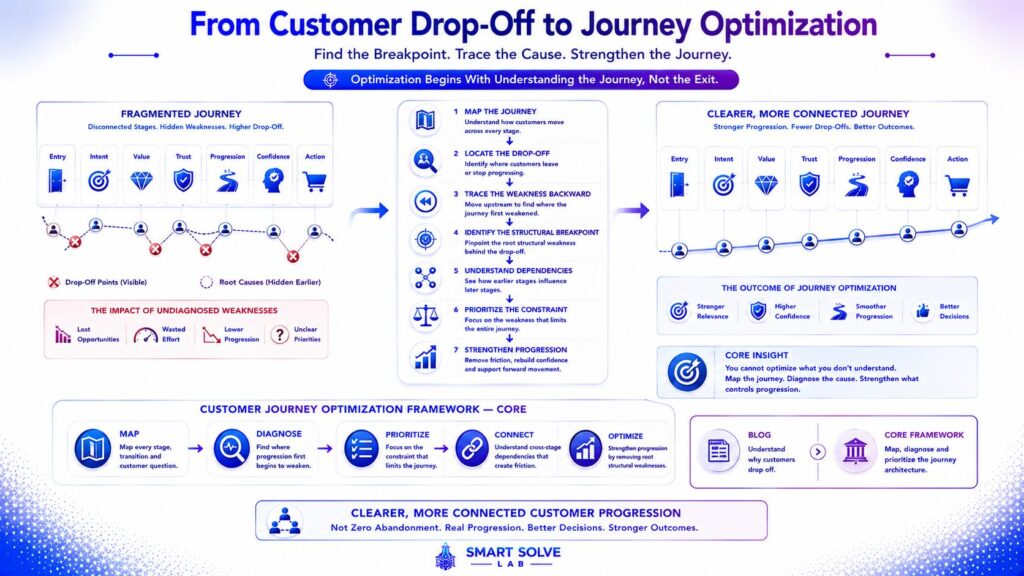
The Customer Journey Optimization Framework
The Customer Journey Optimization Framework provides a structured approach for understanding and strengthening customer progression across the buying journey.
Rather than focusing on isolated conversion elements, the framework helps businesses examine how the journey functions as one connected system.
Its diagnostic direction follows five progressive stages:
Map
↓
Understand how customers move through the complete buying journey.
↓
Diagnose
↓
Identify where customer progression first begins to weaken.
↓
Prioritize
↓
Determine which structural constraints create the greatest impact on progression.
↓
Connect
↓
Understand how different journey stages influence one another.
↓
Optimize
↓
Strengthen the customer journey by improving progression rather than isolated interactions.
The objective is not to optimize every stage equally.
The objective is to identify where customer progression is breaking, understand what is causing that break, recognize the dependencies influencing it, and prioritize the structural constraint that should be addressed first.
This creates a more systematic approach than simply responding to whichever page currently experiences the highest customer abandonment.
Blog → Framework Boundary
This article has focused on diagnosing why customers drop off before buying and explaining how structural weaknesses across the customer journey gradually reduce progression.
The Customer Journey Optimization Framework extends that foundation by providing a structured process for mapping the complete buying journey, identifying structural breakpoints, understanding their dependencies, prioritizing journey constraints, and creating a systematic optimization direction.
Rather than offering isolated conversion tactics, the framework helps businesses evaluate the customer journey as a connected architecture where every stage contributes to the customer’s overall progression.
Conclusion
Customer drop-off is rarely explained by one page, one button, or one interaction alone. More often, it reflects a gradual decline in customer confidence that develops across multiple stages of the buying journey.
By the time customers leave, the visible exit may simply represent the point where accumulated uncertainty finally becomes greater than their willingness to continue. Focusing only on that final interaction can improve a local experience while leaving the underlying journey constraints unchanged.
A more effective approach begins by understanding how customer progression develops from initial interest to confident action. Instead of asking only where customers leave, businesses can trace the journey backward to discover where progression first became weak, identify the structural breakpoint responsible, understand how that weakness influenced later stages, and prioritize the constraint that most affects the overall journey.
That diagnostic sequence transforms customer drop-off from a page-level optimization problem into a customer journey architecture problem. As a result, improvements become more strategic, more connected, and more capable of strengthening progression across the entire buying experience.
Ultimately, the goal is not to eliminate every customer exit. Every buying journey naturally includes visitors who decide not to continue. The objective is to reduce avoidable customer drop-off by creating a clearer, more connected progression that consistently strengthens relevance, understanding, trust, confidence, and readiness to act.
Recommended Reading
Continue exploring related Smart Solve Lab resources to better understand customer progression, conversion challenges, and journey optimization.
Why Customers Leave Without Taking Action (Even When They Seem Interested)
Learn why interested visitors often leave without progressing and how repeated inaction can reveal deeper weaknesses across the customer journey.
Why Conversion Problems Keep Repeating (Even After Fixing Individual Pages)
Discover why page-level improvements may produce only temporary gains and how recurring conversion problems often indicate broader structural issues.
Why Customer Engagement Doesn’t Turn Into Revenue (Even When Customers Interact)
Explore why engagement metrics alone don’t guarantee business results and how stronger customer progression helps transform engagement into meaningful outcomes.
FAQs
Why do customers drop off before buying?
Customers often drop off before buying because their confidence weakens somewhere during the customer journey. This can happen when expectations are not met, value becomes unclear, trust fails to develop, or unnecessary friction interrupts progression. The visible exit is not always the point where the underlying problem began.
Is customer drop-off always caused by a poor landing page?
No. While a landing page can influence the first impression, customer drop-off is often the result of multiple connected experiences across the buying journey. Improving one page may help, but it may not resolve structural weaknesses that developed earlier.
What is the difference between customer engagement and customer progression?
Customer engagement measures how customers interact with your website, such as reading content, viewing pages, or clicking links. Customer progression focuses on whether those interactions consistently move customers closer to making a confident purchase decision.
What are structural breakpoints in a customer journey?
Structural breakpoints are stages where customer progression begins to weaken. These may include expectation mismatches, unclear value, insufficient trust, unnecessary friction, or decision uncertainty that gradually increases the likelihood of customer drop-off.
Why doesn’t fixing the exit page always reduce customer drop-off?
The exit page often reflects the point where accumulated uncertainty becomes greater than the customer’s confidence to continue. If earlier stages of the journey remain weak, improving the final interaction alone may produce only temporary improvements.
How does journey friction affect customer decisions?
Small friction points rarely stop customers on their own. However, when several minor weaknesses accumulate across the journey, they gradually reduce confidence, increase hesitation, and make customers more likely to leave before completing a purchase.
What is customer journey optimization?
Customer journey optimization is the process of understanding how customers move through the buying journey, identifying structural constraints that weaken progression, and strengthening the connections between stages to support clearer, more confident decision-making.
How can businesses reduce avoidable customer drop-off?
Businesses can reduce avoidable customer drop-off by mapping the customer journey, identifying where progression first becomes weak, understanding how different stages influence one another, prioritizing structural constraints, and improving the overall journey rather than focusing only on isolated pages.