
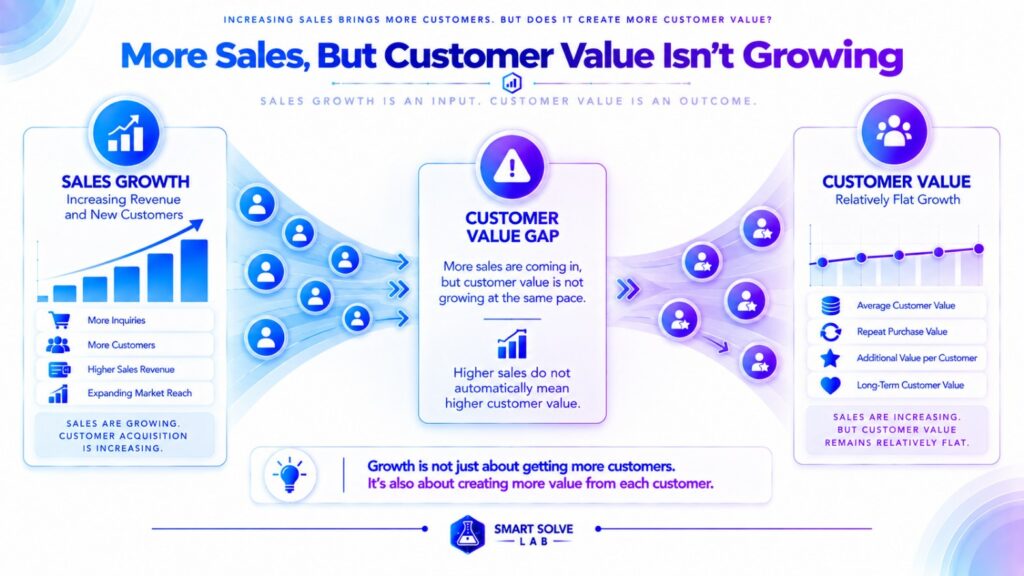
Customer value is not growing after sales :
Increasing sales can make a business look healthier, but higher sales do not always mean that customer value is growing at the same rate. A business may be acquiring more customers and generating more initial purchases while the value created by those customers remains relatively limited.
This is an important distinction because the first sale is only one part of the customer relationship. What happens after that purchase can influence how much value a customer creates over time. If customers make limited repeat purchases, have little opportunity to expand their relationship with the business, or do not continue creating additional value, sales growth can hide a deeper customer-value problem.
That is why the right question is not simply, “Are sales increasing?” It is also, “Is customer value increasing with them?”
Understanding that difference helps reveal the customer value gap—the situation where sales are growing, but customer-level business value is not improving proportionately. The goal is not to assume the cause immediately, but to identify where customer value may be weakening and where deeper diagnosis may be needed.
Table of Contents
Why More Sales Do Not Always Mean More Customer Value
More sales usually indicate that a business is successfully generating purchases, but sales volume alone does not show how much value those customers may create beyond the initial transaction.
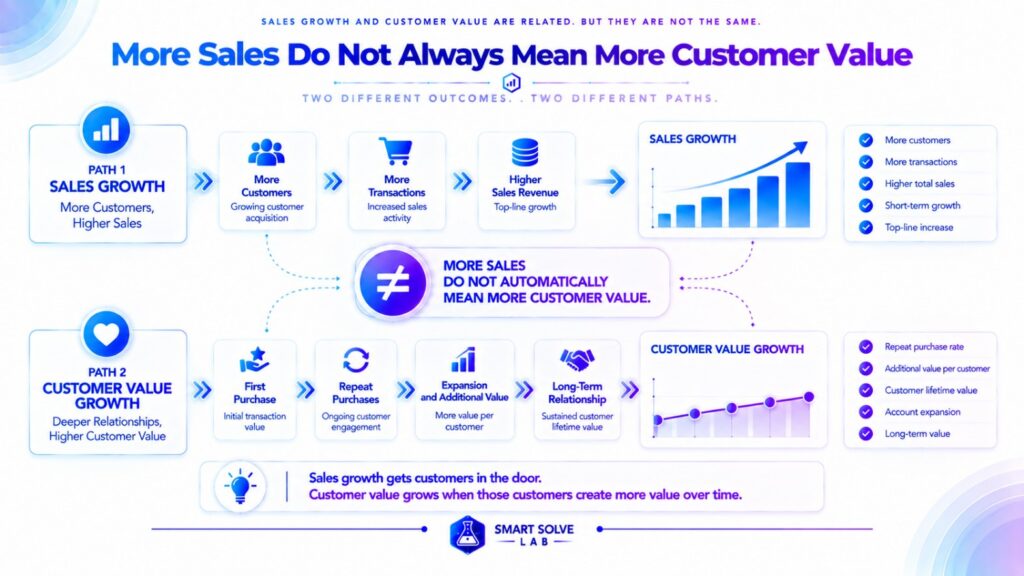
Sales Growth Is Not the Same as Customer Value Growth
A business can increase sales by acquiring more customers without seeing the same level of improvement in customer-level value. If most of the growth comes from new purchases, the business may be increasing transaction volume while the value generated by each customer remains relatively limited.
This means sales growth should not automatically be interpreted as evidence that customer value is improving. The two can move in the same direction while growing at very different rates.
More Customers Can Create More Revenue Without Proportionate Value
Suppose a business attracts a large number of new customers and its sales increase as a result. That growth may look positive at the surface level. But if many customers make only an initial purchase and create little additional value afterward, the increase in sales may not reflect stronger customer economics.
The important diagnostic question is therefore not only how many customers were acquired, but what value those customers are actually creating over the course of their relationship with the business.
The Difference Between Acquisition and Customer Value
Customer acquisition creates an opportunity for value, but acquisition itself is not the same as customer value. The first purchase establishes a commercial relationship; what happens afterward determines whether that relationship has the potential to create additional value.
This distinction helps separate two different growth signals: bringing more customers into the business and increasing the value created by those customers. A business can improve the first while the second remains weak.
Why Sales Growth Can Hide a Customer Value Problem
When new customer sales continue to increase, they can temporarily make overall business performance appear stronger even when customer-level value is not developing proportionately. This can make it difficult to see whether growth is being supported by stronger customer value or simply by acquiring more customers.
That is why increasing sales should be examined alongside what happens to customer value. The gap between these two signals can provide an important starting point for deeper diagnosis.
What Customer Value Actually Means
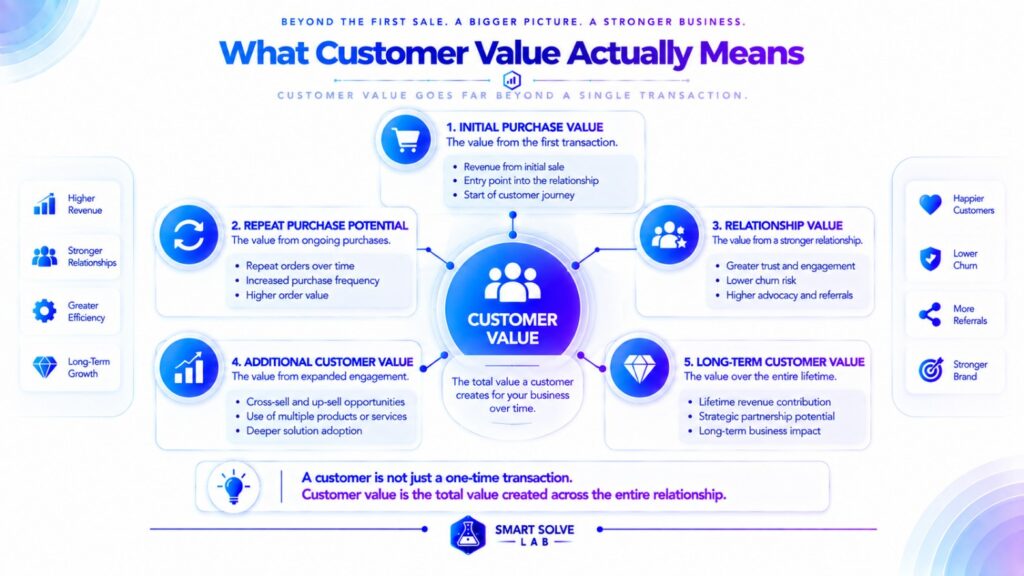
Customer value is broader than the amount generated from a customer’s first purchase. It looks at the value that can develop through the customer relationship over time, including what happens after the initial transaction.
Initial Purchase Value
The first purchase is the point at which a customer begins creating measurable commercial value for the business. It provides an important signal, but it should not automatically be treated as the full value of the customer relationship.
Repeat Purchase Potential
Some customers may have opportunities to purchase again, while others may have limited reasons to return. The potential for repeat purchases can therefore influence how much value a customer may create beyond the initial transaction.
Relationship Value
Customer value can also depend on the strength and continuity of the relationship. When a customer remains meaningfully connected to a business, there may be more opportunities for the relationship to develop rather than ending after a single purchase.
Additional Customer Value
Additional value can emerge when customers have relevant opportunities to purchase more, expand their relationship, or engage with other suitable offers. If those opportunities are limited or do not develop, customer value may remain relatively low even when initial sales are increasing.
Why Customer Value Extends Beyond the First Sale
The first sale tells you that a customer has purchased. It does not, by itself, explain what the customer relationship may produce afterward. Looking beyond the initial transaction helps reveal whether sales growth is also creating stronger customer-level value or whether a gap is developing between acquisition and longer-term value.
The Customer Value Gap
The customer value gap appears when sales increase but the value being generated at the customer level does not improve at a similar rate. This does not necessarily mean that sales growth is weak. It means the growth being achieved may not be translating into stronger customer-level value.
When Sales Increase but Customer Value Stays Flat
A business can generate more sales by bringing in additional customers while the value created by those customers remains relatively unchanged. In this situation, the sales number moves upward, but the underlying customer value does not develop proportionately.
The difference between these two signals is worth examining because it can reveal that acquisition is contributing to growth while another part of the customer relationship is limiting additional value.
Revenue From New Customers vs. Value From Existing Customers
New customers can contribute immediate revenue through their initial purchases. However, customer value asks a broader question: what additional value can those customers create after entering the business?
Looking at new-customer revenue separately from existing-customer value can therefore provide a clearer view of whether growth is being supported by stronger customer relationships or primarily by continued acquisition.
Where Customer Value Can Weaken
Customer value can weaken at different points in the customer relationship. A customer may make an initial purchase but have limited opportunity to purchase again, expand their relationship, or receive additional relevant value from the business.
These situations do not automatically identify the root cause. They simply provide signals that help narrow down where customer value may be failing to develop.
Why the Gap Matters
The customer value gap matters because continued sales growth can sometimes conceal limited value development at the customer level. If a business relies mainly on acquiring more customers to maintain growth, it may become harder to understand the underlying quality and sustainability of that growth.
Recognizing the gap creates a better starting point for diagnosis: instead of asking only whether sales are increasing, the business can examine whether customer value is increasing with them and where that progression may be weakening.
Why Acquiring More Customers Can Hide the Problem
When customer value is not developing strongly, increasing customer acquisition can sometimes make the overall business numbers look healthier than the underlying customer economics actually are. More customers can create more initial purchases, which may keep sales moving upward even when each customer is creating limited additional value.
More Customers Can Increase Activity
Acquiring more customers naturally creates more transactions, conversations, orders, and customer activity. These signals can make the business appear to be growing, but activity and customer value are not necessarily the same thing.
A higher number of customers can therefore increase the visible level of business activity without showing whether the value created by each customer is also improving.
Acquisition Can Compensate for Weak Customer Value
If individual customers are creating limited value after their first purchase, continued acquisition can temporarily compensate for that weakness. New customers keep entering the business and generating initial sales, which can reduce the visibility of the underlying customer-value gap.
This can create a cycle in which the business continues focusing on acquiring more customers because acquisition is producing measurable results, while the deeper question of customer value remains less visible.
Growth Can Look Healthy While Customer Economics Weaken
Overall sales can increase even when the value generated by individual customer relationships is not improving proportionately. This creates an important distinction between growth in sales volume and growth in customer value.
When these signals are examined separately, a business may discover that its growth depends heavily on continuously adding new customers rather than developing greater value from the customers it has already acquired.
Why More Acquisition Is Not Always the Answer
When sales are growing but customer value remains weak, simply increasing acquisition may add more customers without addressing the condition limiting additional value. The better diagnostic approach is to understand what happens after customers enter the business and identify where their value stops developing.
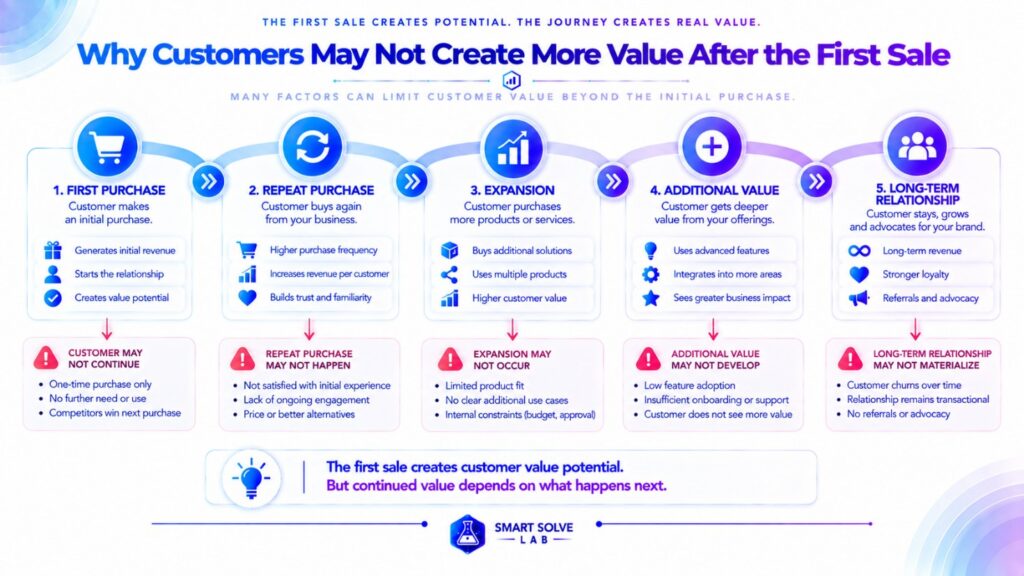
Why Customers May Not Create More Value After the First Sale
A first purchase confirms that a customer has entered into a commercial relationship with the business. But that first transaction does not automatically mean the customer will create additional value afterward. The relationship may continue to develop, or it may stop at the initial purchase.
Limited Repeat Purchases
Some customers may have a reason to purchase again, while others may not return after the first transaction. When repeat-purchase potential is limited or does not develop, the value created by each customer may remain concentrated around the initial sale.
Low Expansion Potential
Customers may also have limited opportunities to expand their relationship with the business. If relevant products, services, upgrades, or additional solutions are not available—or do not become relevant to the customer—the potential for additional value can remain limited.
Weak Product or Offer Continuity
Customer value can become difficult to develop when the relationship effectively ends with the first offer. If there is no clear continuity between the initial purchase and relevant future needs, customers may have little reason to continue the relationship.
Limited Relationship Depth
A transaction can take place without creating a strong ongoing customer relationship. When the business has limited understanding of the customer’s continuing needs, it may become harder to identify opportunities where additional value could naturally develop.
Missed Additional Value Opportunities
Even when customers could potentially create more value, those opportunities may not become visible or actionable. The issue may therefore be less about the number of customers acquired and more about what happens after acquisition.
These signals do not establish a single root cause on their own. They indicate areas that may deserve deeper examination when sales are increasing but customer value is not growing proportionately.
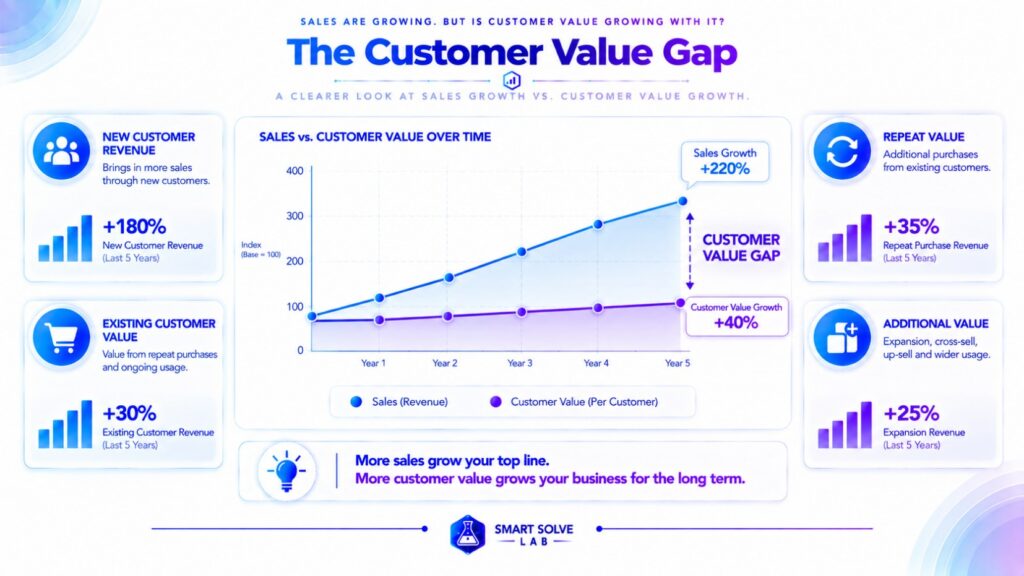
Where Customer Value Can Break Down
Customer value does not develop at a single point in the customer journey. It can weaken before the first purchase, after the purchase, or later as opportunities for continued value fail to develop. Looking at these stages separately can help reveal where the customer-value progression may be breaking down.
Before the First Purchase
Customer value can be influenced by what happens before the first transaction. Customer fit, expectations, perceived relevance, and the alignment between the customer’s needs and the offer can affect the foundation of the relationship.
After the First Purchase
The first purchase creates an initial commercial relationship, but what happens afterward can determine whether that relationship develops further. If customers do not see a clear reason to continue, the value created may remain limited to the original transaction.
Between Purchases
The period between purchases can reveal whether a customer relationship is continuing to develop or becoming inactive. Limited engagement, weak continuity, or a lack of relevant next opportunities may reduce the potential for additional customer value.
During Expansion Opportunities
Even when customers have additional needs, those needs may not translate into additional value for the business. Relevant expansion opportunities may be unclear, poorly aligned, or simply not developing within the customer relationship.
Across the Customer Relationship
Customer value is ultimately influenced by the broader relationship rather than by one isolated transaction. Examining the journey across these stages can help distinguish a simple sales-volume increase from genuine growth in customer-level value.
The purpose of this examination is not to assume that every stage contains a problem. It is to identify where the progression of customer value appears weaker and where deeper diagnostic attention may be warranted.
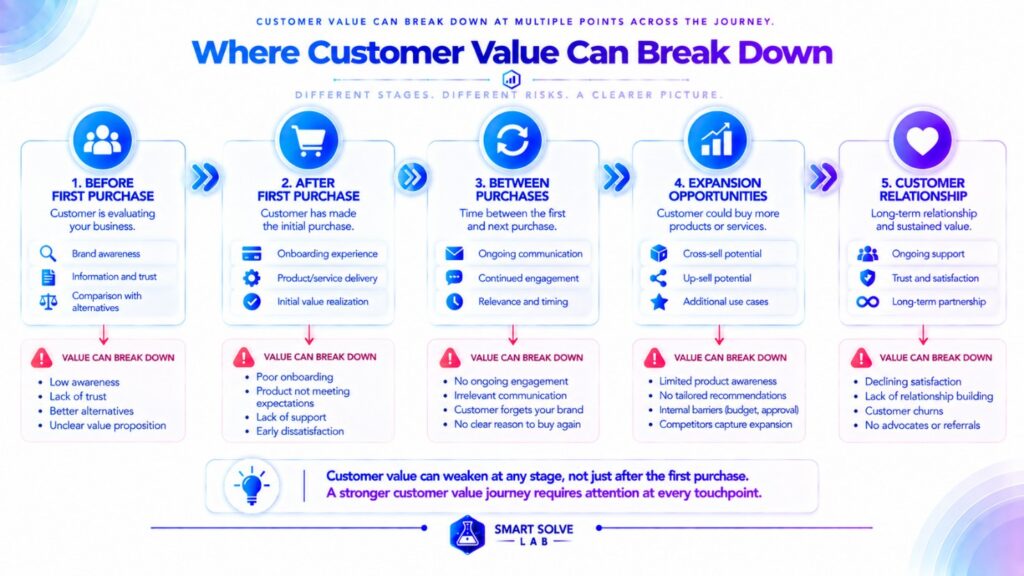
Why Revenue Growth Can Depend on Customer Value
Revenue growth is not determined only by how many new customers a business can acquire. The value created by those customers can also influence how effectively sales growth develops into broader business growth.
New Customer Acquisition Has Limits
Acquiring new customers can create additional sales, but acquisition cannot continue indefinitely without considering the value those customers create. As the business grows, understanding what happens after acquisition becomes increasingly important.
Existing Customers Can Influence Revenue Quality
Existing customers already have a relationship with the business. When that relationship creates opportunities for continued or additional value, the business may be able to generate more value without relying entirely on acquiring another new customer for every increase in sales.
This makes customer-level value an important layer to examine alongside new-customer sales rather than treating acquisition as the complete explanation for growth.
Customer Value and Revenue Sustainability
Sales growth can show that transactions are increasing, but customer value can provide another perspective on how that growth is developing. If customer relationships consistently create limited additional value, the business may need to rely more heavily on continued acquisition to maintain momentum. This broader connection between marketing activity, sales, and revenue growth is explored in Why Marketing Campaigns Work But Revenue Still Doesn’t Grow.
Why Acquisition Alone Cannot Explain Growth Quality
A business can grow its customer base and increase sales while still having questions about the quality and depth of the value being created by those customers. Examining customer value alongside sales therefore provides a clearer diagnostic view of what is supporting growth and where additional value may be getting lost.
The Conditions Behind Weak Customer Value
When customer value remains low despite increasing sales, the visible gap does not automatically reveal the underlying condition. Several parts of the customer relationship can influence how much value develops after acquisition. Examining these conditions helps move the diagnosis beyond the simple observation that customers are not creating enough additional value.
Customer Fit
Customer value can be influenced by how closely the customer fits the business, its offer, and the problem being solved. A strong initial purchase does not necessarily mean that the customer has strong potential for continued value.
Offer Relevance
The relevance of the offer can affect whether customers have meaningful reasons to continue or expand their relationship with the business. If future offers do not align with evolving customer needs, additional value may remain limited.
Perceived Value
Customers need to recognize sufficient value in continuing the relationship. If the perceived benefit does not remain clear after the initial purchase, the opportunity for further value creation may weaken.
Repeat Purchase Conditions
Repeat value depends on whether there is a genuine reason and suitable opportunity for customers to purchase again. When those conditions are weak or absent, customer value may remain concentrated around the first transaction.
Expansion Potential
Some customer relationships naturally have more room for additional products, services, or solutions than others. Understanding whether meaningful expansion potential exists can help distinguish a genuine customer-value limitation from a simple lack of available opportunity.
Customer Relationship Strength
The strength of the ongoing relationship can also influence how customer value develops. When the relationship has little continuity beyond the initial transaction, opportunities for additional value may be harder to identify or develop.
These conditions should be treated as diagnostic signals rather than automatic explanations. The objective is to determine which conditions appear relevant to the specific customer-value gap and which require deeper examination.
Why the Visible Customer Value Problem May Not Be the Real Problem
When customer value appears weak, it can be tempting to assume that the problem begins with what happens after the sale. But the visible value gap may be influenced by conditions that existed earlier in the customer journey. A customer may create limited value not because the post-purchase relationship is inherently weak, but because an earlier condition affected the quality or potential of that relationship.
Value Can Be Affected by Customer Fit
If the customers being acquired are not a strong fit for the business or its offers, their potential to create additional value may naturally be limited. In that case, the customer-value problem may partly reflect an earlier acquisition or targeting condition rather than only a post-purchase issue. This is why it can be useful to examine earlier-stage problems such as Why Your Sales Funnel Is Not Converting (And Where Customers Are Leaking).
Value Can Be Affected by Offer Alignment
An initial purchase can occur even when the broader offer is not closely aligned with the customer’s continuing needs. If that alignment weakens after the first transaction, opportunities for additional value may become limited.
Value Can Be Affected by Customer Experience
The experience customers have throughout their relationship with the business can influence whether they continue engaging and recognize further value. A weak experience may therefore appear later as limited customer value, even though the underlying condition developed earlier.
Value Can Be Affected by Retention
Customer value and retention are closely connected, but they are not the same diagnostic question. A customer who does not remain engaged long enough may create limited value, while the reasons behind that short relationship may require a separate examination of retention conditions.
This distinction becomes important because the next stage of the revenue-growth journey examines what happens when customers do not stay long enough to support continued growth.
Why the Visible Symptom Needs Deeper Examination
The customer-value gap is therefore a signal, not automatically the root cause. The right diagnostic approach is to examine the conditions surrounding the customer relationship, identify where value development weakens, and determine whether the visible problem is connected to an earlier stage or a later relationship condition.
How to Diagnose a Customer Value Gap
Diagnosing a customer value gap starts by comparing sales growth with what customers are actually contributing to the business over time. The goal is not to assume a cause immediately, but to identify where the progression from initial purchase to additional customer value appears to weaken.
Is Sales Growth Actually Increasing?
First, establish whether sales are genuinely increasing and understand what is driving that increase. Growth may be coming primarily from acquiring more customers, from existing customers, or from a combination of both.
Is Customer Value Increasing With It?
Next, examine whether customer-level value is moving in proportion to sales growth. If sales are increasing significantly faster than customer value, that difference can provide an important signal that the business is relying more heavily on acquisition than on developing additional value from customer relationships.
What Happens After the First Purchase?
The next question is what customers do after the initial transaction. Examine whether customers return, continue engaging, expand their relationship, or create other forms of additional value. The objective is to understand what happens beyond the first sale rather than treating the first purchase as the complete customer-value picture.
Where Does Additional Value Stop Developing?
If additional value is limited, identify where the progression appears to weaken. The signal may relate to repeat purchasing, offer continuity, expansion opportunities, customer fit, relationship strength, or another condition affecting the customer journey.
What Evidence Supports the Signal?
Customer-level analysis should be based on actual evidence rather than assumptions. Relevant analytics can help examine customer behavior and value over time. For example, Google Analytics user lifetime data can provide a useful reference for understanding user behavior and value across the customer lifetime.
Is the Visible Value Problem Coming From Somewhere Earlier?
Finally, consider whether the customer-value gap may be connected to an earlier condition. Customer fit, acquisition quality, offer alignment, or the initial customer journey can influence the potential for value to develop later. This helps prevent the business from treating the visible customer-value symptom as the root cause without deeper examination.
The purpose of diagnosis is therefore to move from “customer value is not growing” to a clearer understanding of where the value progression weakens and what deserves deeper diagnostic attention.
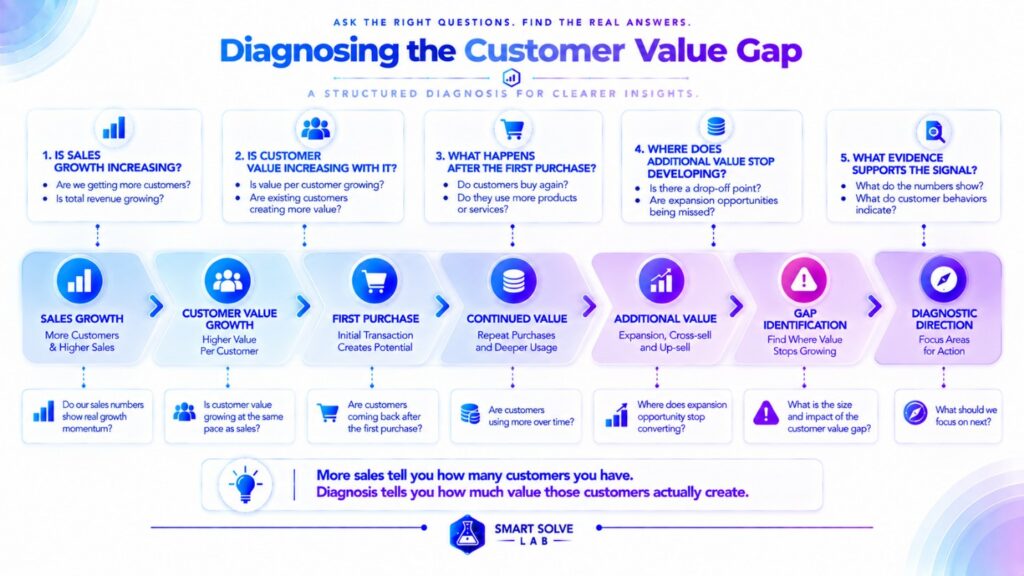
From Sales Growth to Customer Value Understanding
Once a business recognizes that increasing sales does not automatically mean increasing customer value, the way growth is evaluated needs to become more connected. Instead of looking at new sales as the complete growth signal, the business can examine what those sales create at the customer level and what happens after acquisition.
Stop Measuring New Sales in Isolation
New sales remain important, but they provide only one part of the customer-value picture. Looking at sales alongside customer-level behavior helps reveal whether growth is being supported by stronger value or primarily by continued acquisition.
Connect Sales With Customer-Level Value
The next step is to connect sales outcomes with the value created by the customers behind those outcomes. This makes it easier to see whether increasing sales are also producing proportionate improvement in customer value.
Examine What Happens After Acquisition
Customer value becomes clearer when the analysis continues beyond the first purchase. Examine whether customers return, continue their relationship, expand their purchases, or create other forms of additional value after entering the business.
Identify Where Value Growth Weakens
If customer value is not developing proportionately, identify where the progression becomes weaker. The signal may appear around repeat purchasing, offer continuity, expansion opportunities, customer fit, or another condition affecting the relationship.
Determine What Needs Deeper Diagnosis
The objective is not to immediately prescribe an optimization. It is to establish where the customer-value gap appears and determine which condition requires closer examination. This creates a clearer diagnostic direction before decisions are made about what should change.
The Key Insight: More Customers Do Not Automatically Create More Customer Value
Acquiring more customers can increase sales, but it does not automatically mean that each customer is creating greater value for the business. Customer acquisition creates the potential for value; the customer relationship determines how that potential develops.
Sales Is an Outcome
Sales provide an important measure of commercial activity and show that customers are purchasing from the business. But sales alone do not explain how much value those customer relationships may create beyond the initial transaction.
Customer Value Is a Deeper Economic Layer
Customer value looks beyond the first sale and examines what the customer relationship can contribute over time. This makes it a deeper layer of understanding than simply measuring how many transactions have taken place.
Acquisition Creates Potential
Every new customer can create an opportunity for additional value, but that opportunity is not guaranteed. The customer’s needs, fit, relationship with the business, and available opportunities can influence how much value eventually develops.
Relationship and Expansion Influence Value
When a customer relationship continues to develop, there may be opportunities for repeat purchases, relevant additional offers, or broader engagement. When those opportunities do not develop, customer value may remain concentrated around the initial sale.
More Customers Cannot Automatically Repair Weak Customer Value
If customer value is weak, acquiring more customers may increase the number of initial transactions without addressing the condition limiting additional value. The more useful diagnostic question is therefore not simply whether the customer base is growing, but whether the value created by those customers is growing with it.
From More Sales to Better Customer Value Understanding
The shift from sales-focused thinking to customer-value understanding does not mean ignoring sales. It means placing sales within a broader view of what happens after customers enter the business.
From Acquisition to Relationship
Instead of viewing acquisition as the end goal, examine what kind of relationship begins after the first purchase. This helps reveal whether new customers are becoming ongoing sources of value or remaining primarily one-time transactions.
From First Purchase to Continued Value
The first purchase establishes an initial value signal. Continued value requires examining what happens afterward, including whether customers have reasons and opportunities to purchase again or develop their relationship with the business.
From Revenue Volume to Customer Economics
Revenue volume shows how much business is being generated, while customer-level analysis helps reveal how that revenue is distributed across customer relationships. Connecting these perspectives can make differences in growth quality easier to identify.
From Symptoms to Conditions
“Customer value is not growing” describes the visible problem. A stronger diagnostic approach asks what conditions may be influencing that outcome, where value development weakens, and whether the signal is connected to an earlier or later part of the customer journey.
From More Sales to Better Diagnostic Direction
The ultimate shift is from simply pursuing more sales to understanding what those sales are creating. Once the customer-value gap is visible, the business can determine which area deserves deeper examination instead of assuming that more acquisition is automatically the solution.
Where to Go Next: Diagnose Your Customer Value Gap
If your sales are increasing but customer-level value is not growing proportionately, the next step is not necessarily to acquire even more customers. The more useful step is to understand where the customer-value gap is appearing and which conditions may be limiting additional value.
Sales Are Growing but Customer Value Is Not
This is the clearest signal that sales growth and customer value growth may be moving at different rates. Comparing these two outcomes can help establish whether a meaningful gap exists.
Customers Purchase Once but Create Limited Additional Value
If customers commonly make an initial purchase but create little value afterward, examine what happens between the first transaction and any potential repeat, expansion, or continued relationship.
Repeat or Expansion Value Is Unclear
When it is difficult to understand whether customers are returning, expanding their relationship, or creating additional value, customer-level economics may require closer examination.
Customer-Level Economics Are Difficult to Understand
If overall sales numbers are clear but the value created by individual customer relationships is difficult to see, a more structured diagnostic view can help identify where the value progression may be weakening.
The Customer Value Gap Diagnostic is designed for this focused diagnostic problem: helping businesses identify and interpret where increasing sales may be failing to translate into proportionate customer value, and determine where deeper diagnostic attention may be needed.
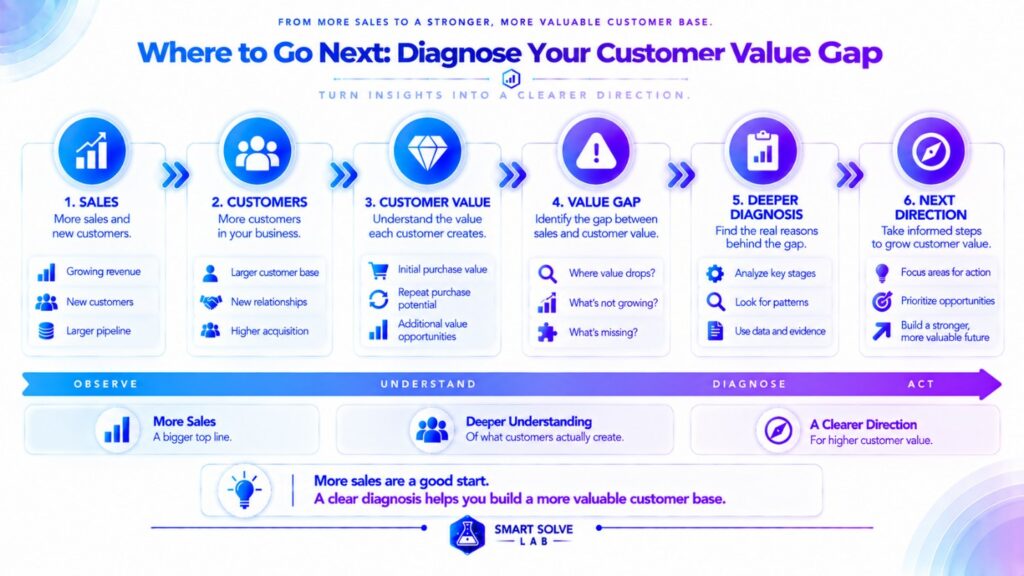
Key Takeaways
- More sales do not automatically mean more customer value. Sales growth and customer-value growth are related but distinct signals.
- The first purchase is only one part of customer value. Repeat purchases, continued relationships, and relevant additional opportunities can influence the value created afterward.
- More customer acquisition can hide a customer-value gap. New customers can increase sales while customer-level value remains relatively limited.
- Customer value can weaken at different points. Customer fit, offer relevance, repeat-purchase conditions, relationship strength, and expansion potential can all provide diagnostic signals.
- The visible customer-value problem may not be the root cause. Earlier customer or acquisition conditions can influence the value that develops later.
- Customer value should be examined alongside sales growth. Comparing the two can reveal whether customer-level value is developing proportionately.
- The goal is diagnostic clarity, not an assumed solution. Identifying where value growth weakens provides a better direction for deeper diagnosis.
Conclusion
Increasing sales is an important growth signal, but it does not automatically tell you whether customer value is growing with them. A business can acquire more customers and generate more initial sales while the value created by those customer relationships remains limited.
That is why the difference between sales growth and customer value growth deserves closer attention. The first purchase creates an initial commercial outcome, but what happens afterward can determine whether the customer relationship develops additional value.
If customer value is not growing proportionately, the answer may not simply be to acquire more customers. The more useful question is where the customer-value progression is weakening—whether around customer fit, offer relevance, repeat purchasing, expansion opportunities, relationship strength, or another underlying condition.
Once that gap becomes visible, the business has a stronger starting point for deeper diagnosis. Instead of treating limited customer value as an isolated symptom, it can examine the conditions influencing customer-level value and determine what deserves attention next.
More sales create growth potential. Understanding customer value helps reveal how that potential is actually developing.
FAQs
Why can sales increase while customer value stays flat?
Sales can increase when a business acquires more customers and generates more initial purchases, while the value created by those customers remains relatively limited. In this situation, sales growth is occurring, but customer-level value is not increasing at the same rate.
What is customer value?
Customer value refers to the value a customer can create for a business through the broader customer relationship, not only through the first purchase. It can include initial purchase value, repeat purchase potential, additional value, expansion opportunities, and continued relationship value.
Why is customer value important for revenue growth?
Customer value provides a deeper view of growth beyond the number of new sales. When customer relationships create additional value over time, the business may be less dependent on acquiring new customers for every increase in sales. Examining customer value alongside sales can therefore provide a clearer understanding of how growth is developing.
Can acquiring more customers hide a customer value problem?
Yes. Acquiring more customers can increase initial purchases and overall sales even when the value created by individual customer relationships remains limited. This can make the business appear to be growing while a customer-value gap remains less visible.
What can cause customer value to remain low after a sale?
Customer value can remain limited for several possible reasons, including customer fit, offer relevance, limited repeat-purchase opportunities, weak offer continuity, limited expansion potential, or a relationship that does not develop beyond the initial transaction. These are diagnostic signals rather than automatic root causes.
How does repeat purchasing affect customer value?
Repeat purchasing can create additional value beyond the first transaction. When customers have relevant reasons and opportunities to purchase again, the customer relationship may generate greater value over time. If repeat-purchase potential is limited, value may remain concentrated around the initial sale.
How can I identify what is limiting customer value growth?
Start by comparing sales growth with customer-level value and then examine what happens after the first purchase. Look for signals around repeat purchasing, relationship continuity, expansion opportunities, customer fit, and offer relevance. The objective is to identify where value development weakens and determine where deeper diagnostic attention may be needed.