
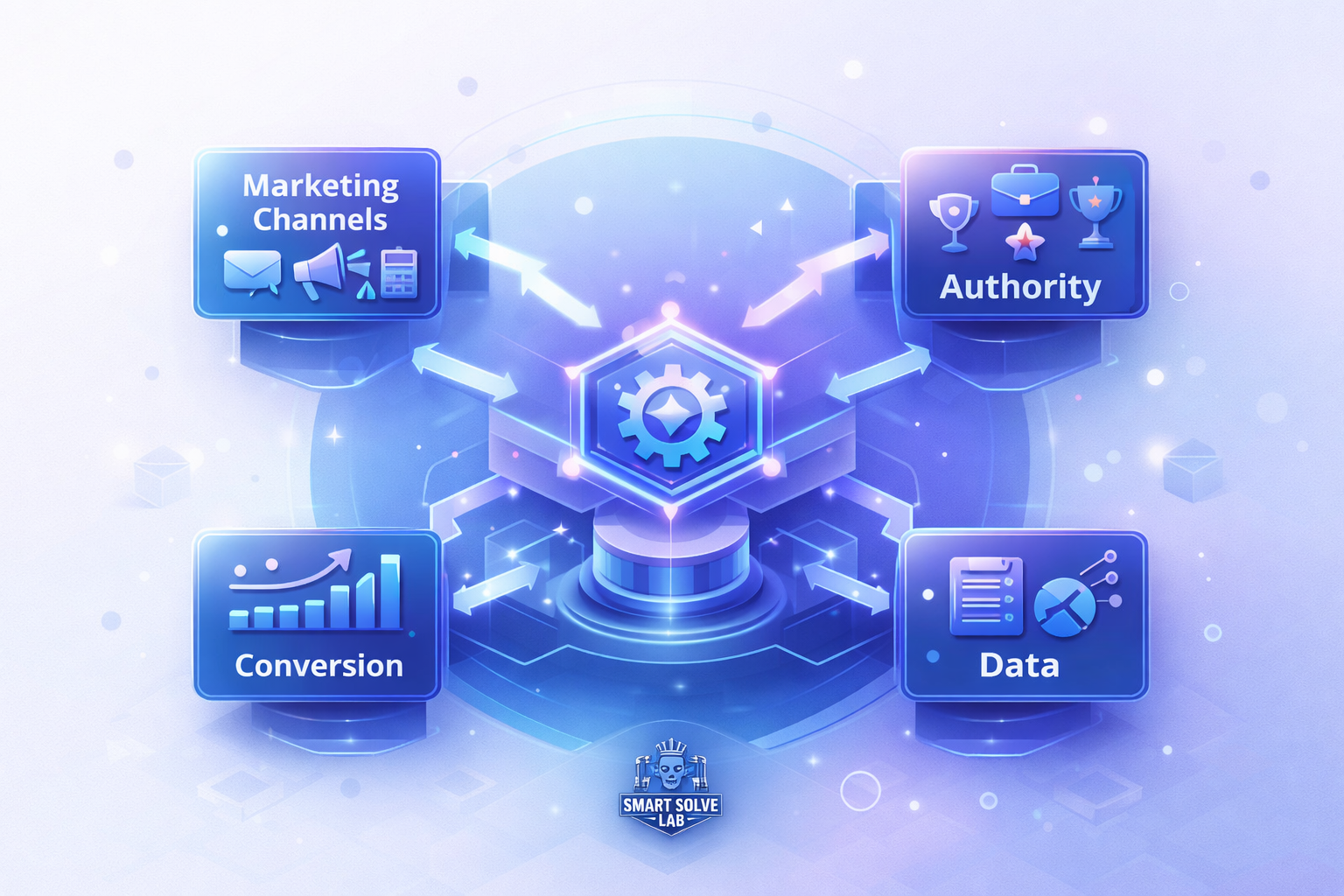
Many businesses today are active in marketing but stagnant in growth.
They publish content, run campaigns, invest in tools, and maintain multiple digital channels — yet measurable business progress remains inconsistent or slow.
This creates a common but rarely explained reality: marketing activity is visible, but growth is not.
The issue is often misunderstood as poor strategy, weak content, or insufficient effort.In most cases, however, the real cause is structural.
Growth does not depend on isolated marketing actions.It depends on the presence of an integrated digital growth system — a structured architecture that connects strategy, execution, data, and optimization into a coordinated engine.
Without this system layer, marketing remains fragmented. With it, activities align, learning compounds, and growth becomes scalable.
This article explains why growth frequently stalls despite active marketing — and introduces the digital growth system architecture that enables consistent and compounding business scale.
Table of Contents
Why Growth Stalls Even When Marketing Is Active

Many organizations today appear highly active in their marketing efforts. They publish content, run campaigns, optimize SEO, and engage across multiple channels.
From the outside, it seems as though everything required for growth is already happening. Yet despite this constant activity, measurable and sustained growth often remains limited or inconsistent.
This situation creates a common frustration: In most cases, organizations are already doing enough.
The real problem is structural. Marketing actions frequently exist as isolated initiatives rather than coordinated components of a unified growth system.
Each channel operates independently, each campaign pursues its own objectives, and each team measures success in isolation. Without integration, even strong execution produces fragmented outcomes.
Growth, however, is not the sum of separate actions. It emerges from connected processes that reinforce one another over time. When marketing operates without a shared system architecture, activities remain temporary and disconnected. Traffic does not consistently convert, content does not compound authority, and campaigns do not strengthen long-term positioning.
This is why many organizations experience cycles of effort followed by stagnation. Activity increases, but structural growth does not accumulate.
Sustained growth requires more than execution. It requires system coordination.
The Difference Between Marketing Activity and Growth Systems
According to research on the difference between marketing and growth strategy, sustainable growth depends on integrated systems rather than isolated campaigns.
Marketing activity refers to individual actions performed to promote a business: publishing content, running ads, sending emails, posting on social media, or optimizing search visibility. These activities are essential, but by themselves they do not guarantee scalable growth.
A growth system, in contrast, is an integrated structure that connects all marketing functions into a continuous flow of awareness, authority, conversion, and data feedback.
The distinction lies in coordination.
In activity-driven environments, each channel pursues short-term outputs. Content is created for publishing schedules. Ads are optimized for campaign metrics. SEO is measured by rankings.
While each activity may succeed individually, the overall system lacks continuity. Visitors arrive but do not convert consistently. Leads are captured but not nurtured effectively. Data exists but does not inform strategic decisions.
In a growth system, these same activities operate within a shared architecture. Content builds authority that improves search visibility. Search traffic feeds conversion pathways. Conversion data informs future content strategy.
Each component strengthens the others.
The difference is not effort. It is integration.
Marketing activity produces motion.Growth systems produce momentum.
What Is a Digital Growth System
A digital growth system is a structured architecture that connects strategy, execution channels, and performance feedback into a unified engine of scalable growth.
At its core, a digital growth system aligns three layers:
- Strategic direction
- Operational systems
- Execution channels
Strategy defines positioning, audience, and value. Systems translate strategy into repeatable processes.
Channels deliver those processes to the market.When these layers are connected, growth becomes cumulative rather than episodic.
A digital growth system ensures that every action contributes to long-term expansion. Content strengthens authority. Authority improves reach. Reach feeds conversion. Conversion generates data. Data refines strategy. The cycle then repeats with increasing efficiency.
This compounding loop is what differentiates sustainable growth from temporary marketing performance.
Without a digital growth system, organizations rely on campaigns and initiatives. With a system, they operate an engine.
Core Components of a Digital Growth Architecture
A functional digital growth architecture consists of several interconnected components that together create a coherent system.
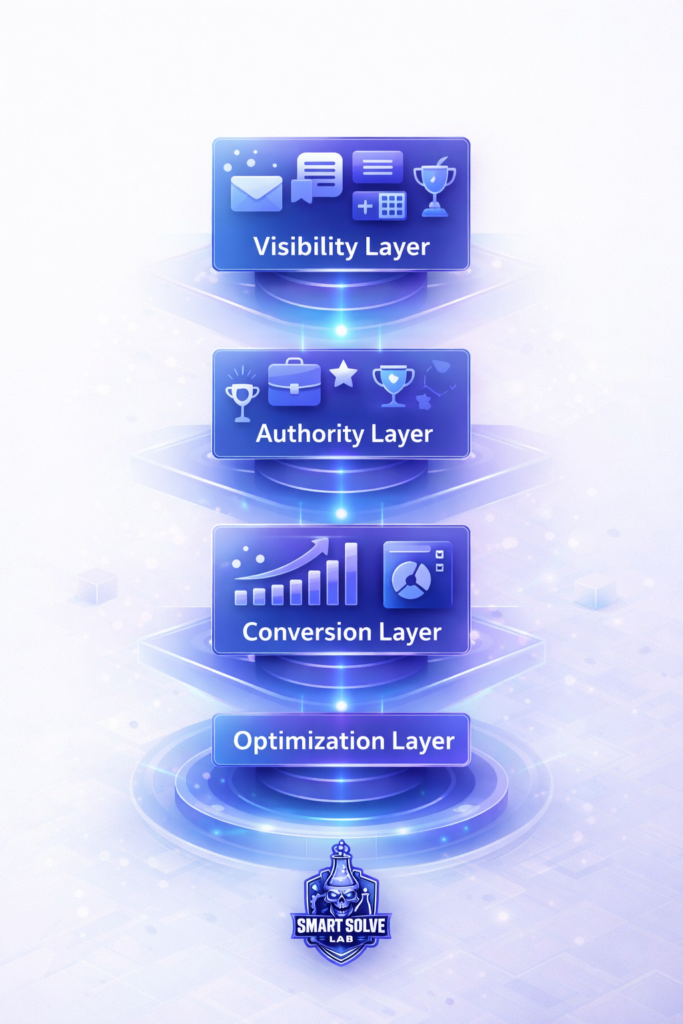
1. Data LayerThe data layer captures
behavioral signals from all interactions: traffic sources, engagement patterns, conversions, and retention indicators. This layer provides visibility into what is working and why.
Effective growth systems rely heavily on data-driven marketing insights to refine strategy and execution.
2. Authority Layer
Authority is built through consistent value delivery, expertise demonstration, and trust signals. Content quality, credibility, and topical depth contribute to this layer. Authority improves both reach and conversion efficiency.
3. Visibility Layer
Visibility ensures the system is discoverable. Search optimization, distribution channels, and amplification mechanisms bring qualified audiences into the ecosystem. Visibility converts authority into attention.
4. Conversion Layer
The conversion layer structures pathways that transform visitors into leads or customers. Offers, messaging alignment, and decision support mechanisms operate here. Effective conversion depends on prior authority and visibility.
5. Workflow Layer
Workflows connect activities into repeatable processes. Content production, distribution cycles, and optimization routines ensure consistent execution across channels.
6. Feedback Layer
Feedback closes the loop by connecting performance data back to strategy and execution decisions. Continuous improvement occurs within this layer.
When these components operate in isolation, growth remains unstable. When they operate as an integrated architecture, they form a self-reinforcing system.
How Growth Systems Create Compounding Results
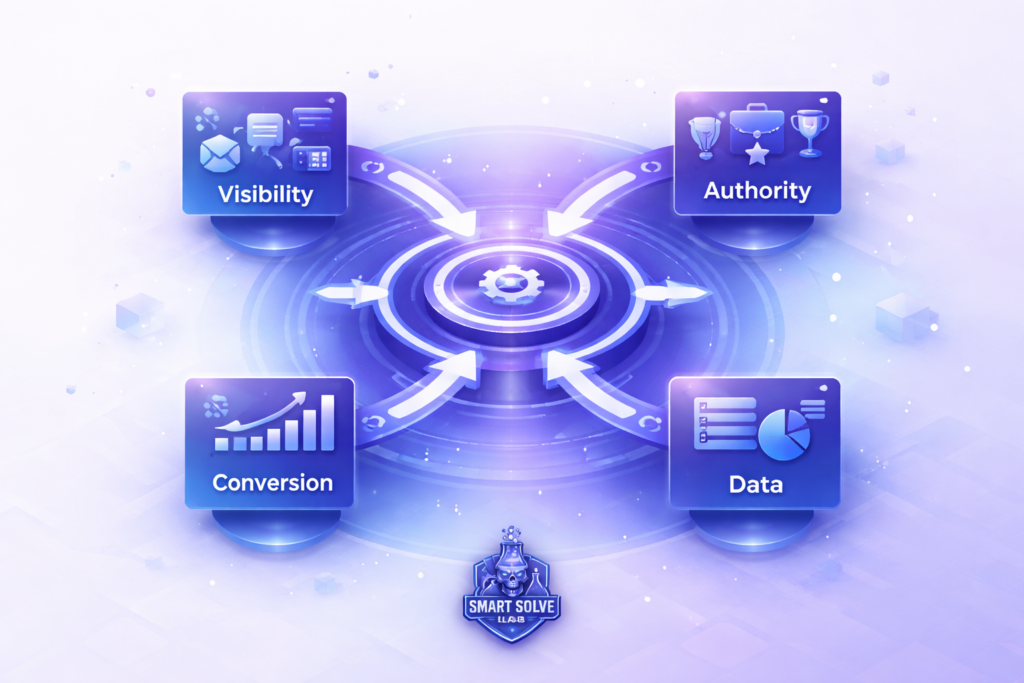
Strong authority and visibility create compounding content marketing effects over time.
Compounding growth occurs when each action increases the effectiveness of future actions. Growth systems enable this by ensuring continuity between activities.
For example, high-quality content builds authority. Increased authority improves search visibility. Higher visibility brings qualified traffic. Qualified traffic converts more efficiently. Conversion data reveals audience priorities. Insights then guide future content strategy. Each cycle improves performance.
This compounding effect transforms growth from linear to exponential over time.
Without a system, efforts reset after each campaign or initiative. With a system, every output remains active and contributes to cumulative expansion.
Articles continue attracting traffic. Authority continues strengthening trust.Data continues refining decisions.
Compounding does not arise from intensity. It arises from integration.
Organizations that implement growth systems gradually experience increasing returns from the same level of effort. The system becomes more efficient as it matures. Activities that once required constant promotion begin generating results organically.
This is the defining advantage of system-based growth: sustainability.
Signs Your Business Lacks a Growth System
Many organizations operate without realizing their growth structure is fragmented. Several indicators reveal the absence of a coordinated system.
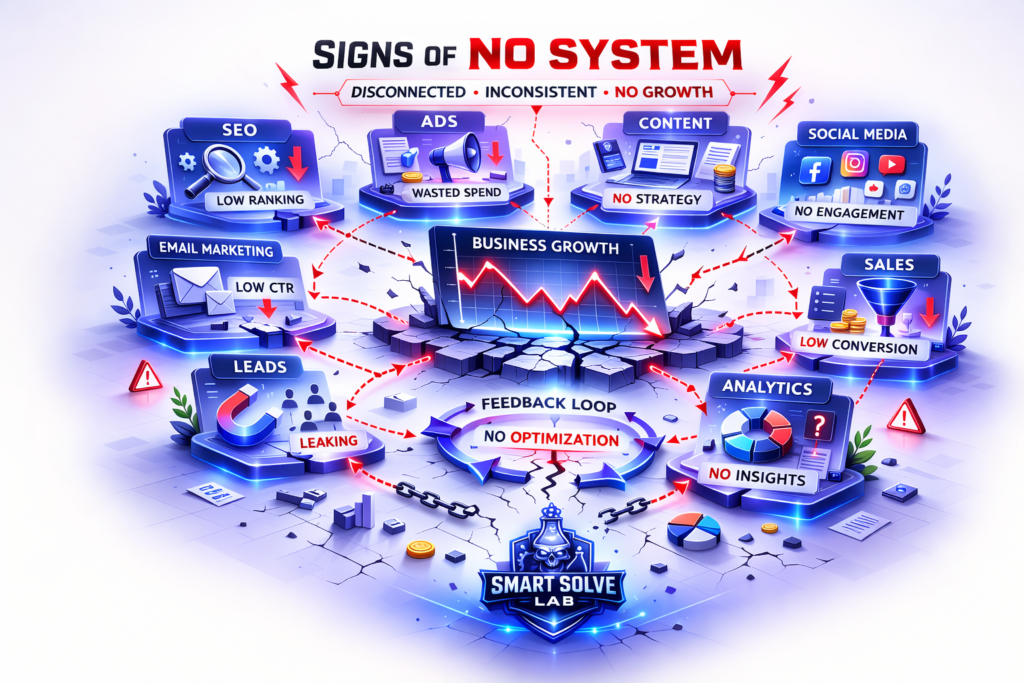
First, marketing results depend heavily on campaigns. When campaigns stop, traffic and leads decline sharply. This suggests that ongoing authority and visibility are not integrated.
Second, channels operate independently. Content, SEO, ads, and analytics exist but do not reinforce one another. Teams report metrics separately without shared optimization.
Third, performance fluctuates. Periods of high activity alternate with stagnation. Results feel unpredictable rather than steadily improving.
Fourth, insights are underutilized. Data is collected but does not consistently guide strategy or execution adjustments.
Fifth, growth requires constant effort escalation. More content, more campaigns, more spending are needed to maintain similar outcomes. This indicates lack of compounding.
These symptoms point to structural fragmentation rather than inadequate marketing.
Recognizing them is the first step toward system design.
How to Start Building One
Building a digital growth system begins with alignment rather than expansion. The goal is not to add more activities, but to connect existing ones.
1. Map Current Activities
List all marketing actions across channels. Identify how each contributes to awareness, authority, or conversion. This reveals fragmentation and overlap.
2. Define Strategic Core
Clarify positioning, audience focus, and value proposition. Systems operate effectively only when guided by coherent strategy.
3. Design Layer Connections
Determine how visibility leads to authority, how authority supports conversion, and how conversion feeds data. Establish explicit pathways between layers.
4. Create Workflow Continuity
Transform isolated tasks into repeatable processes. Content creation, distribution, and optimization should function as a cycle rather than separate events.
5. Implement Feedback Loops
Connect analytics to decision-making. Ensure insights inform future content, offers, and channel priorities.
6. Optimize Gradually
Growth systems evolve through refinement. Monitor interactions between layers and strengthen weak connections over time.
System building is iterative. Integration improves progressively as clarity increases.
A digital growth system transforms marketing from activity into architecture. When components align, effort compounds rather than dissipates. Businesses that adopt system thinking move beyond campaigns toward sustained expansion.
Growth then becomes predictable, scalable, and resilient.
Digital growth system FAQs
Q1: What is a digital growth system?
A: A digital growth system is a structured architecture that connects marketing activities, data, and optimization into a coordinated process that produces consistent and scalable business growth.
Q2: Why do businesses fail to grow despite active marketing?
Businesses often run campaigns, content, and ads, but without an integrated growth system these activities remain disconnected, preventing compounding results.
Q3: What are the core components of a growth system?
The core components include visibility, authority, conversion, and optimization layers working together through shared data and feedback loops.
How does a growth system create compounding results?
When marketing, content, and data are connected in a system, each improvement strengthens the others, creating cumulative and accelerating growth over time.
Leave a Reply to High Website Traffic but No Revenue: Fixing high-website-traffic-but-no-revenue Cancel reply