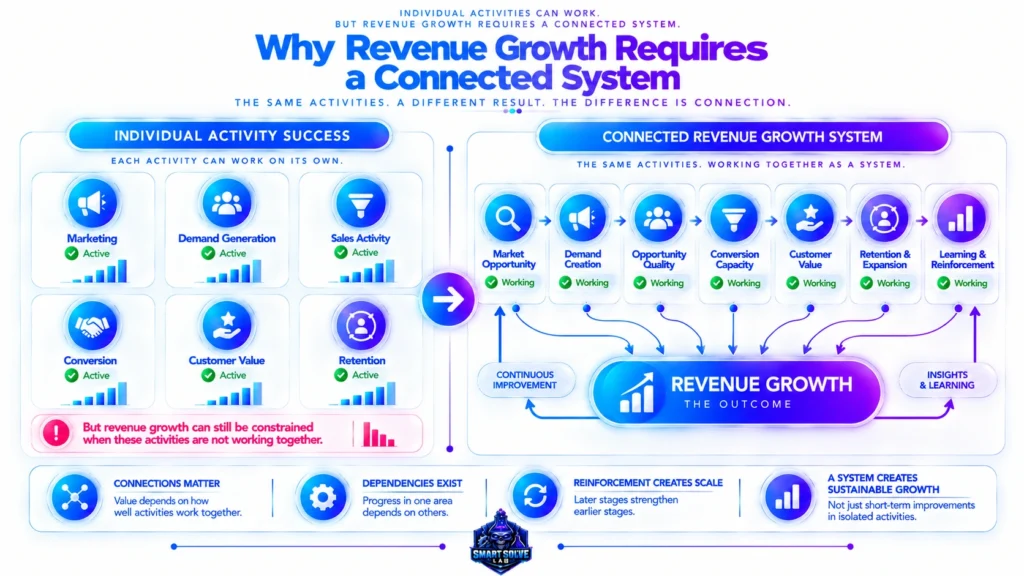
Revenue growth can feel difficult even when a business is busy.
Marketing campaigns may be running. Demand may be increasing. Leads may be coming in. Sales conversations may be happening. Customers may be buying, and existing customers may still be engaging with the business.
Yet the overall revenue picture can remain harder to understand than expected.
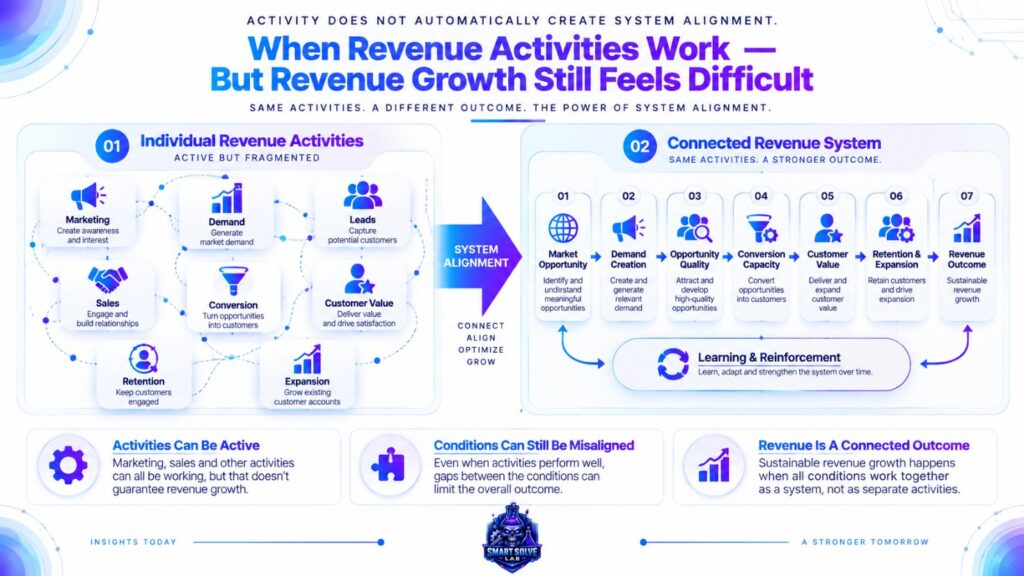
The natural response is often to increase activity — more marketing, more traffic, more leads, more campaigns, or more sales effort. But activity in one part of the business does not automatically mean that the wider revenue system is working as a connected whole.
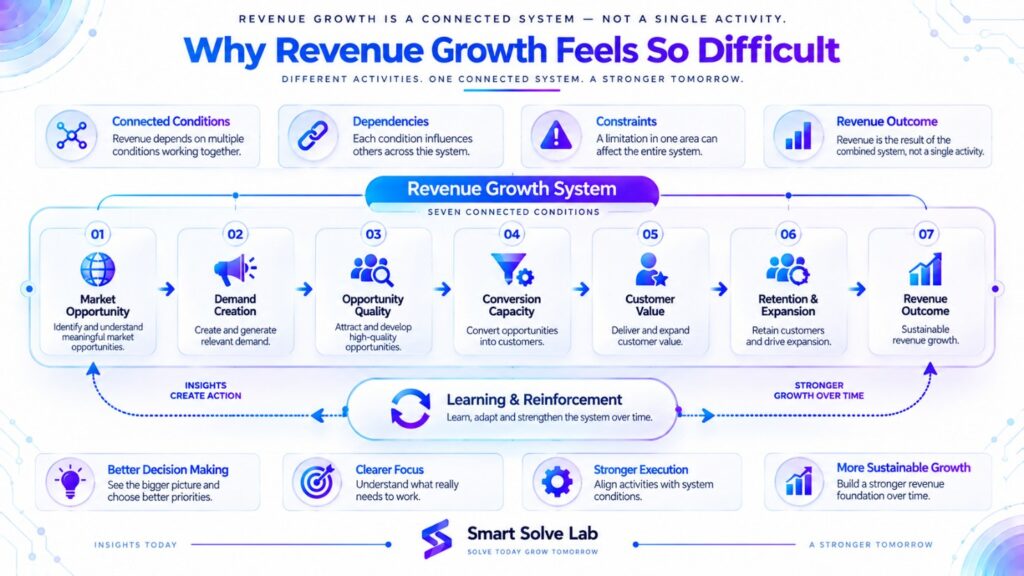
Revenue is an outcome of multiple conditions working together.
A business needs a meaningful market opportunity. It needs to create relevant demand, generate quality opportunities, convert those opportunities into customers, create customer value, maintain and expand customer relationships, and continuously learn from what happens across the system.
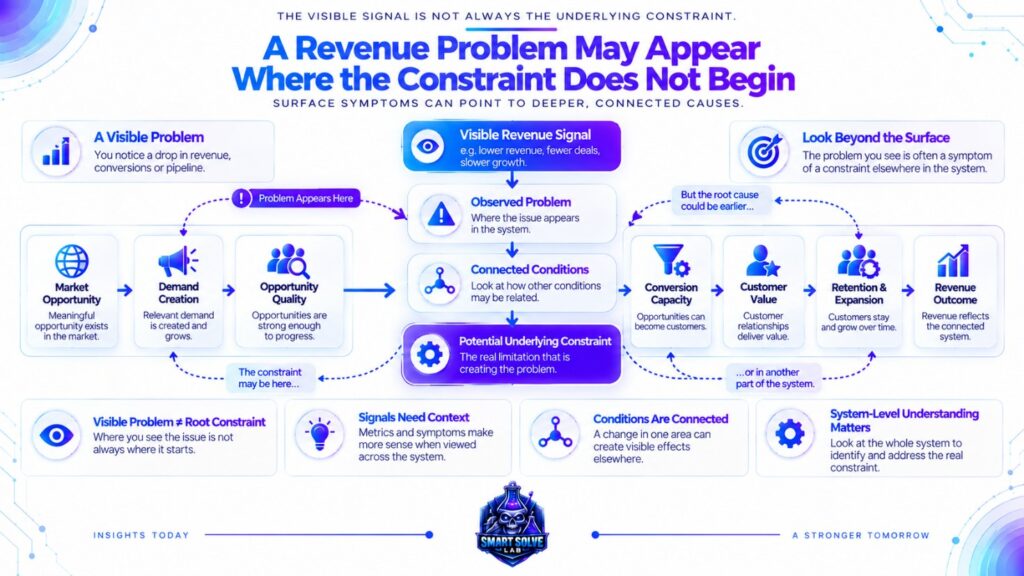
This is why a revenue problem can sometimes appear in one area while its underlying limitation exists somewhere else.
A conversion problem, for example, may not be explained by conversion alone. Opportunity quality, demand, customer value, or another connected condition may also influence what eventually happens to revenue.
There is another important consideration: improving one condition does not necessarily mean the entire revenue system is now complete. As one constraint improves, another condition may become more visible. The revenue picture can change as the system changes.
This means revenue growth cannot always be understood through a single metric or isolated activity.
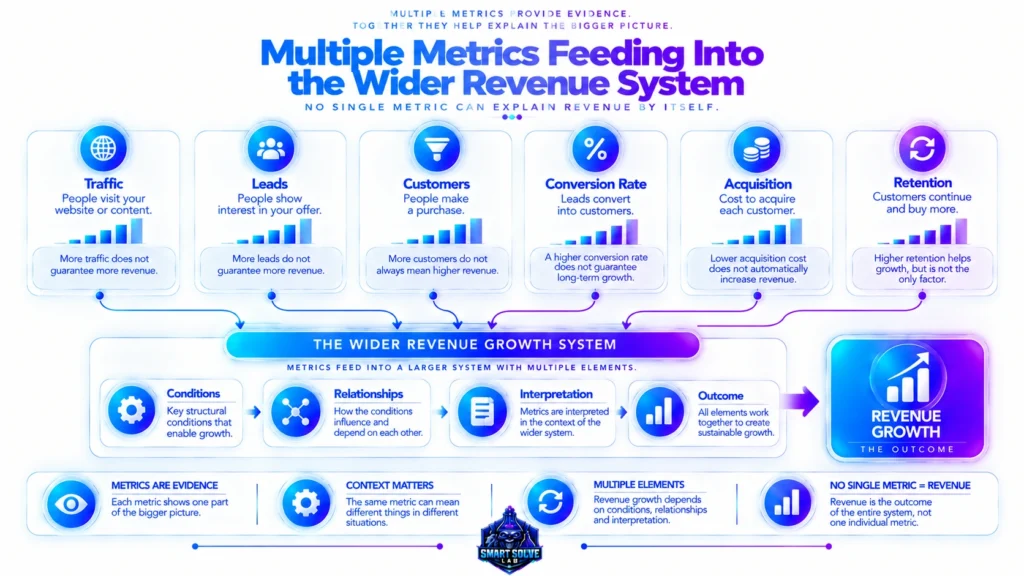
Traffic is not revenue. Leads are not revenue. Customers are not revenue. Conversion rate is not revenue. Acquisition is not revenue. Retention is not revenue.
These measures provide useful evidence, but they represent different parts of a much larger system.
The more useful question is therefore not simply:
“Which revenue activity should we increase?”
It is:
“How are the different conditions connected, and where might the wider system be limiting the revenue outcome?”
This article introduces that system-level way of thinking about revenue growth — and explains why more marketing does not automatically solve every revenue growth problem.
Table of Contents
Why Revenue Growth Requires a Connected System
Revenue growth cannot always be explained by one activity.
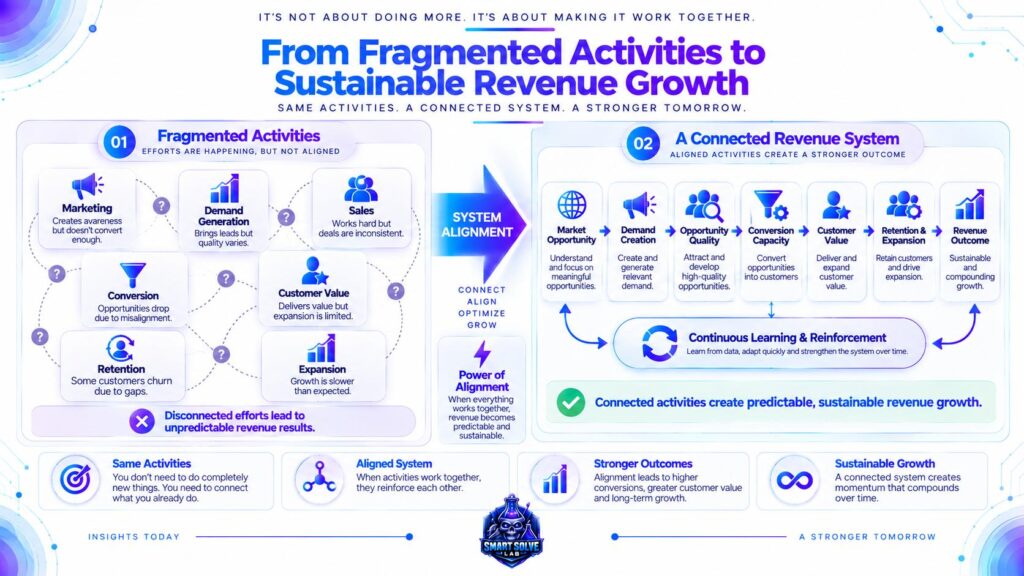
A business may be running marketing campaigns, publishing content, generating leads, improving its sales process, increasing conversions, and working to retain customers. Each activity can appear productive on its own, yet the overall revenue outcome may still remain difficult to understand.
This happens because marketing, sales, conversion, customer value, retention, and expansion do not operate as completely separate activities. They influence one another.
A business can therefore be highly active without having a fully connected revenue growth system.
Why Revenue Cannot Be Explained by One Activity
Revenue is an outcome created through multiple connected conditions.
Marketing can create demand. Demand can create opportunities. Opportunity quality can influence progression. Conversion capacity can influence whether opportunities become customers. Customer value can influence the strength of the relationship, while retention and expansion can influence how that relationship contributes to longer-term revenue.
What happens in one area can therefore affect what happens somewhere else.
This is why increasing one activity does not automatically increase the overall revenue outcome.
Why Marketing, Sales, Conversion, Customer Value and Retention Are Interconnected
Consider a business that increases its marketing activity and generates more leads.
That increase may look positive. But if the opportunities are poorly aligned with the offer, sales growth may remain weak. If opportunities are strong but the conversion process creates friction, customers may still fail to move forward. If customers buy but do not experience sufficient ongoing value, retention and expansion may remain limited.
Each condition can influence the next.
This is why a business can experience a situation where one metric improves while the wider revenue picture does not improve proportionally.
Why Businesses Can Be Highly Active Yet Struggle With Growth
Activity creates movement, but movement is not automatically the same as connected growth.
A business may have more traffic, more leads, more sales conversations, more customers, or more campaigns while still struggling to create consistent revenue growth.
For example, high website traffic can still fail to generate revenue when the connection between attention and the wider revenue system is weak.
The important question is therefore not simply whether each activity is happening.
The more useful question is whether these activities are working together as part of a connected system.
Activity-Level Success vs System-Level Performance
An individual activity can perform well while the wider system remains constrained.
Marketing may generate attention. Sales may generate conversations. Conversion rates may improve. Customers may continue purchasing. Yet these improvements do not automatically mean that the complete revenue system is functioning effectively.
System-level performance requires understanding how the conditions connect, where influence moves between them, and how changes in one area affect the wider outcome.
Why Improving One Activity Does Not Automatically Improve the Whole Outcome
Improving one part of the system can be valuable, but it does not necessarily remove every limitation affecting revenue growth.
A stronger demand-generation process may reveal an opportunity-quality issue. Better opportunities may reveal a conversion limitation. Improved conversion may make customer-value or retention conditions more visible.
The system changes as its conditions change.
That is why revenue growth is better understood as a connected system rather than a collection of independent activities.
The next step is to understand what this connected system actually consists of.
What Is a Revenue Growth System?
A Revenue Growth System is a connected set of conditions through which a business creates demand, develops opportunities, converts customers, creates customer value, retains and expands customer relationships, and learns from the results.
Revenue is therefore not an independent activity that operates separately from the rest of the business. It is an outcome influenced by how these conditions work together.
This distinction matters because businesses often look at revenue through individual activities. Marketing may be measured through campaigns and traffic. Sales may be measured through leads and opportunities. Conversion may be measured through conversion rates. Customer relationships may be measured through retention or repeat purchases.
These measures can provide useful evidence, but they do not describe the complete revenue system on their own.
The Seven Structural Conditions
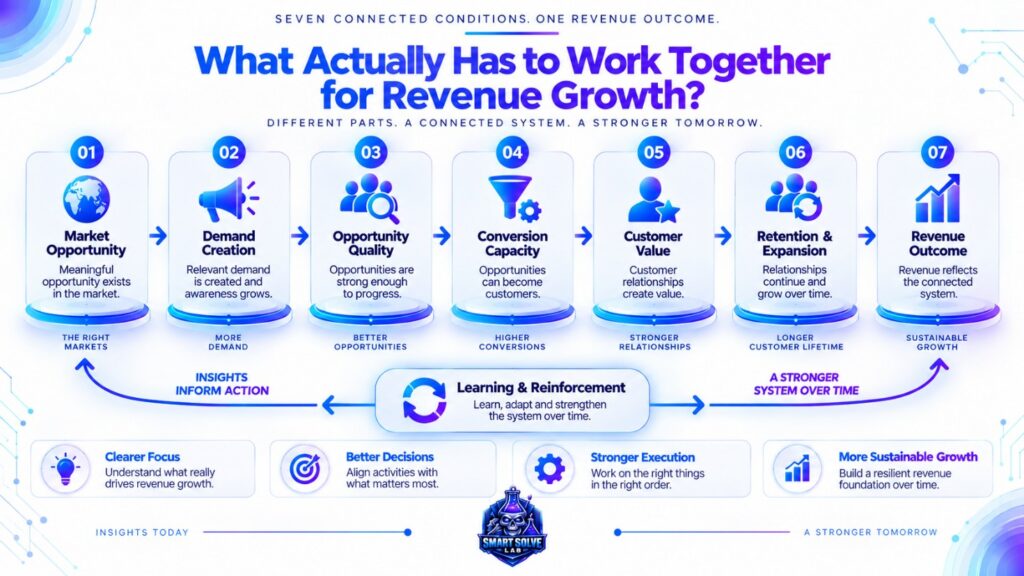
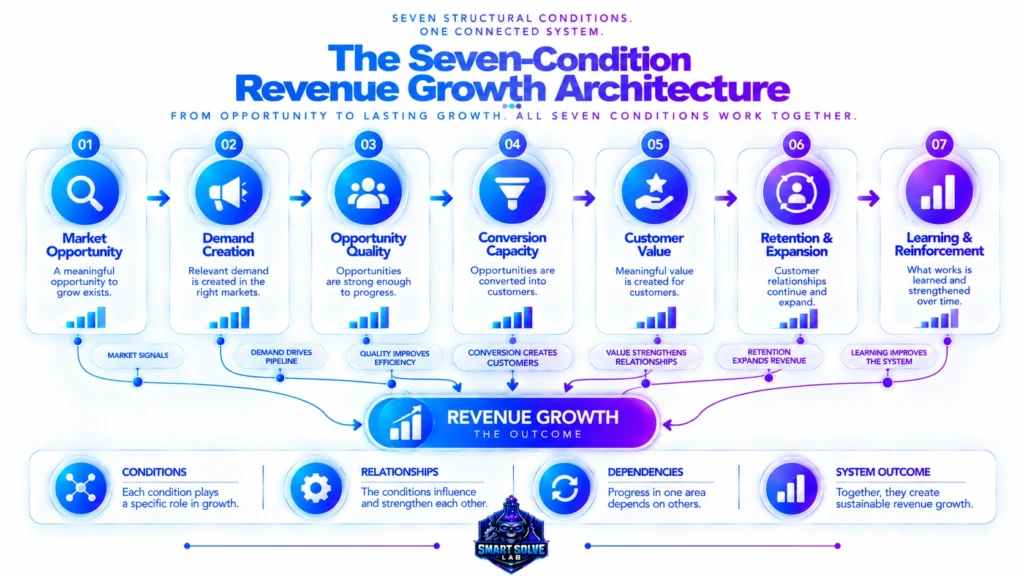
A connected Revenue Growth System can be understood through seven structural conditions:
- Market Opportunity — whether a meaningful opportunity exists.
- Demand Creation — whether the business can create relevant demand.
- Opportunity Quality — whether opportunities are strong enough to progress.
- Conversion Capacity — whether opportunities can become customers.
- Customer Value — whether the customer relationship creates meaningful value.
- Retention & Expansion — whether customer relationships continue and grow.
- Learning & Reinforcement — whether the business can learn from results and strengthen what works.
These conditions should not be treated as seven unrelated tactics. They are connected parts of a wider system.
System Thinking vs Isolated Optimization
Isolated optimization asks questions such as, “How can we get more traffic?” or “How can we increase conversion?”
System thinking asks a broader question: “How is this condition influencing the wider revenue outcome, and what other conditions are connected to it?”
This shift in perspective helps explain why improving one activity does not always produce the expected change in revenue.
The goal is not simply to increase activity everywhere. It is to understand how the conditions interact and contribute to the overall revenue outcome.
The Seven Structural Conditions Behind Revenue Growth
Revenue growth depends on more than one successful activity. It emerges from several structural conditions that influence how the business creates, converts, retains, and reinforces economic value.
The seven conditions provide a way to view the wider revenue architecture without reducing revenue growth to a single metric or department.
1. Market Opportunity
The system begins with a meaningful market opportunity. The business needs a relevant environment in which its products, services, or solutions can create economic value.
2. Demand Creation
Market opportunity alone is not enough. The business also needs to create relevant demand and connect that demand with the opportunity it can serve.
3. Opportunity Quality
Not every opportunity has the same potential. Opportunity quality influences whether generated demand can progress toward meaningful commercial outcomes.
4. Conversion Capacity
Strong opportunities still need a system capable of converting them into customers. Conversion capacity includes the conditions that help people progress from opportunity toward a customer relationship.
5. Customer Value
The first transaction is not the entire economic relationship. Customer value concerns whether the relationship creates meaningful value beyond the initial purchase.
6. Retention & Expansion
Revenue growth can become stronger when customer relationships continue and expand. Retention and expansion therefore connect customer relationships with longer-term revenue contribution.
7. Learning & Reinforcement
A revenue system also needs to learn from what happens. Evidence from results can help the business understand changing conditions and reinforce what is working.
Together, these seven conditions create a broader view of revenue growth:
Market Opportunity → Demand Creation → Opportunity Quality → Conversion Capacity → Customer Value → Retention & Expansion → Learning & Reinforcement → Revenue Growth
The arrows represent relationships and influence rather than a rigid linear funnel. Conditions can affect one another, and learning can feed information back into the wider system.
Market Opportunity
Market Opportunity is the starting condition in the Revenue Growth System.
Before demand can be created, opportunities can be developed, or customers can be converted, there needs to be a meaningful opportunity for the business to serve.
Why Market Opportunity Matters
A business can increase its marketing activity, publish more content, generate more traffic, or create more campaigns without automatically creating a stronger market opportunity.
Market opportunity concerns whether there is meaningful demand potential for what the business offers and whether that opportunity is relevant to the business.
Market Opportunity Is More Than Having an Audience
An audience can provide attention, but attention alone does not establish a meaningful revenue opportunity.
The important question is whether the business is positioned within an opportunity where its offer can create relevant value.
Why Activity Cannot Compensate for Every Market Limitation
More activity can increase visibility and create additional movement, but it cannot automatically resolve every limitation within the market environment.
This is why revenue growth should not be viewed only through the amount of marketing, traffic, or sales activity taking place.
Market Opportunity Is Not the Same as Traffic
Traffic can provide useful evidence of attention and visibility, but traffic alone does not establish the strength of the underlying revenue opportunity.
A business can receive significant website traffic and still struggle to translate that attention into revenue when other conditions in the system are not aligned.
Understanding Market Opportunity therefore provides the first layer of context for understanding how the wider Revenue Growth System can create sustainable economic outcomes.
Demand Creation
Market opportunity creates the potential for growth, but potential alone does not create revenue. A business also needs to create relevant demand and connect that demand with the opportunity it can serve.
Awareness Is Not the Same as Genuine Demand
People can see a brand, visit a website, watch content, or interact with a campaign without having meaningful demand for the offer.
Attention can therefore be useful, but attention alone does not establish that the revenue system is creating the right kind of demand.
Interest Is Not the Same as Commercial Relevance
A person may show interest without having the need, timing, fit, or intent required to become a meaningful opportunity.
This is why demand creation should be understood in relation to the wider revenue system rather than judged only by the amount of attention a campaign generates.
Why More Marketing Does Not Automatically Produce More Revenue
Increasing marketing activity can create more visibility and potentially more demand, but more activity does not automatically strengthen every condition that follows.
Marketing campaigns can work and still fail to produce proportional revenue growth when the connection between demand and the rest of the revenue system is weak.
For example, marketing campaigns can work while revenue still does not grow when other connected conditions limit the overall outcome.
Demand Needs to Connect to Opportunity Quality
Relevant demand should create opportunities that can meaningfully progress through the wider system.
This creates an important connection between Demand Creation and Opportunity Quality. Generating more demand is valuable only when that demand can contribute to stronger opportunities and, eventually, meaningful customer and revenue outcomes.
Opportunity Quality
Demand can create attention and potential opportunities, but not every opportunity has the same potential to contribute to revenue growth.
Opportunity Quality concerns whether the opportunities entering the revenue system are strong enough to progress toward meaningful commercial outcomes.
Not Every Lead or Opportunity Is Equal
A business can generate a large number of leads or opportunities while still experiencing weak sales growth.
Volume alone does not tell us whether those opportunities are relevant, well aligned, or capable of progressing through the wider revenue system.
Quality, Fit and Progression Potential
Opportunity quality can be influenced by factors such as relevance, fit, intent, and the potential for progression.
These conditions matter because an opportunity that is poorly aligned with the business may require significant effort without producing a proportional commercial outcome.
Why Opportunity Volume Does Not Automatically Strengthen the System
More opportunities can appear positive at an activity level. But if opportunity quality does not support progression, increasing volume may simply increase the amount of work required from the sales system.
This is why opportunity quantity should not be treated as a complete explanation of sales or revenue performance.
Opportunity Quality Connects Demand With Conversion
Opportunity Quality sits between demand creation and conversion capacity.
Relevant demand needs to develop into opportunities that are strong enough to progress. Those opportunities then depend on the business’s ability to convert them into customer relationships.
This connection means Opportunity Quality cannot be understood completely in isolation from the conditions before and after it.
The next condition is Conversion Capacity: the system’s ability to turn meaningful opportunities into customers.
Conversion Capacity
Strong opportunities still need a system capable of converting them into customers.
Conversion Capacity describes the conditions that influence whether meaningful opportunities can progress toward a customer relationship.
Conversion Is a System Condition
Conversion is often reduced to a single percentage, but the wider conversion condition can involve much more than the final conversion rate.
Decision clarity, trust, progression, friction, relevance, and the overall experience can influence whether an opportunity moves forward.
Why Conversion Rate Alone Is Not Enough
A conversion rate can show what happened, but it does not automatically explain why it happened.
A weaker conversion outcome may be connected to opportunity quality, demand relevance, customer expectations, or other conditions surrounding the conversion process.
Where Conversion Fits Within the Revenue System
Conversion Capacity connects Opportunity Quality with Customer Value.
Even strong opportunities need an effective path toward becoming customers. Once customers enter the system, the business then needs to create meaningful value and support the customer relationship beyond the initial transaction.
Why Funnel Problems May Reflect Wider Relationships
A business may see a visible problem at a particular point in its funnel, but that visible problem does not necessarily explain the entire situation.
For a deeper look at how a sales funnel can struggle to convert, see Why Your Sales Funnel Is Not Converting.
The important system-level question is not only whether conversion is happening. It is how Conversion Capacity connects with the conditions that create opportunities and the conditions that determine what happens after customers enter the business.
Customer Value
Conversion creates the customer relationship, but the revenue system does not end with the first transaction.
Customer Value concerns whether the relationship creates meaningful value beyond the initial purchase and contributes to the strength of the wider revenue system.
Why Customer Value Matters
A business can acquire customers successfully while still struggling to create strong long-term economic outcomes.
The number of customers entering the business is therefore only one part of the revenue picture. What happens within the customer relationship also matters.
Customer Value Goes Beyond the First Transaction
The first purchase establishes a commercial relationship, but it does not fully explain the value that relationship can create over time.
Customer value can influence the strength of the relationship and create the conditions for continued engagement, future purchases, and broader economic contribution.
How Customer Value Connects to Retention and Expansion
Customer Value is closely connected with Retention & Expansion.
When customers continue to experience meaningful value, the relationship has a stronger basis for continuing. That continued relationship can also create opportunities for expansion over time.
This does not mean that customer value alone determines retention or revenue. Rather, it is one connected condition within the wider Revenue Growth System.
Why Acquisition Alone Is Not Enough
Acquiring more customers can increase customer numbers, but customer acquisition does not automatically create sustainable revenue growth.
The wider system also needs to create value within those relationships and support the conditions that allow them to continue and expand.
Customer Value therefore acts as an important connection between conversion and the longer-term customer relationship.
Retention & Expansion
Customer acquisition can bring people into the business, but sustainable revenue growth also depends on what happens after customers enter the relationship.
Retention Is Different From Acquisition
Acquisition focuses on bringing customers into the business. Retention concerns whether those customer relationships continue.
A business can acquire customers consistently while still losing existing customers at a rate that limits longer-term revenue growth.
Why Relationship Continuity Matters
Retention reflects the continuation of the customer relationship beyond the initial transaction.
When relationships continue, the business has a stronger opportunity to maintain the economic value created through acquisition and customer value.
Retention and Expansion Are Connected
Retention is not the only longer-term consideration. Existing customer relationships can also expand through continued purchases, broader engagement, or additional value creation.
This creates the connection:
Customer Value → Retention → Expansion → Longer-Term Revenue Contribution
Why Retention Problems Can Affect Revenue Growth
If customers do not stay long enough to support the wider relationship, the business may need to rely heavily on continued acquisition simply to replace lost relationships.
This can make revenue growth more difficult to sustain and can hide weaknesses within the customer side of the revenue system.
Retention and Expansion Within the Complete System
Retention and Expansion should therefore be understood as connected conditions rather than isolated customer metrics.
The strength of the customer relationship depends partly on the value created for customers, while continued relationships can influence the longer-term revenue outcome.
Learning & Reinforcement
A Revenue Growth System is not static.
Market conditions change. Customer behavior changes. Demand changes. Opportunities change. Conversion conditions can change, and customer relationships can develop differently over time.
Why the System Needs to Learn
Results create evidence about what is happening within the system.
That evidence can help a business understand whether a condition is strengthening, weakening, changing, or influencing another part of the revenue system.
Evidence Can Strengthen Future Decisions
Metrics and business results can provide useful signals, but the value of those signals comes from understanding them within the wider system.
A change in traffic, leads, conversion, customers, or retention can indicate something important, but the metric itself does not automatically explain the underlying condition.
From Learning to Reinforcement
Learning becomes more valuable when it strengthens the conditions that support revenue growth.
The relationship can be viewed as:
Revenue Activity → Evidence → Learning → Reinforcement → Stronger Conditions
This creates a feedback relationship within the Revenue Growth System rather than treating growth as a one-time sequence of activities.
Why Reinforcement Matters
When useful learning is repeatedly applied, the system can become stronger over time.
The goal is not simply to collect more metrics. It is to understand what the evidence is showing, interpret it in context, and use that learning to reinforce the wider system.
This is why Learning & Reinforcement connects the different revenue conditions over time and helps the system respond as its environment changes.
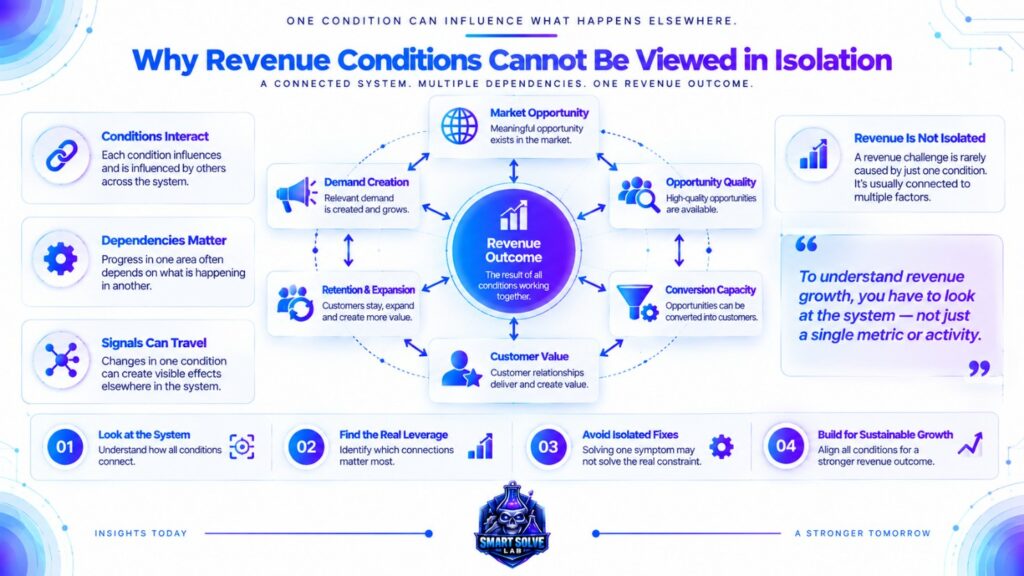
How the Seven Conditions Depend on One Another
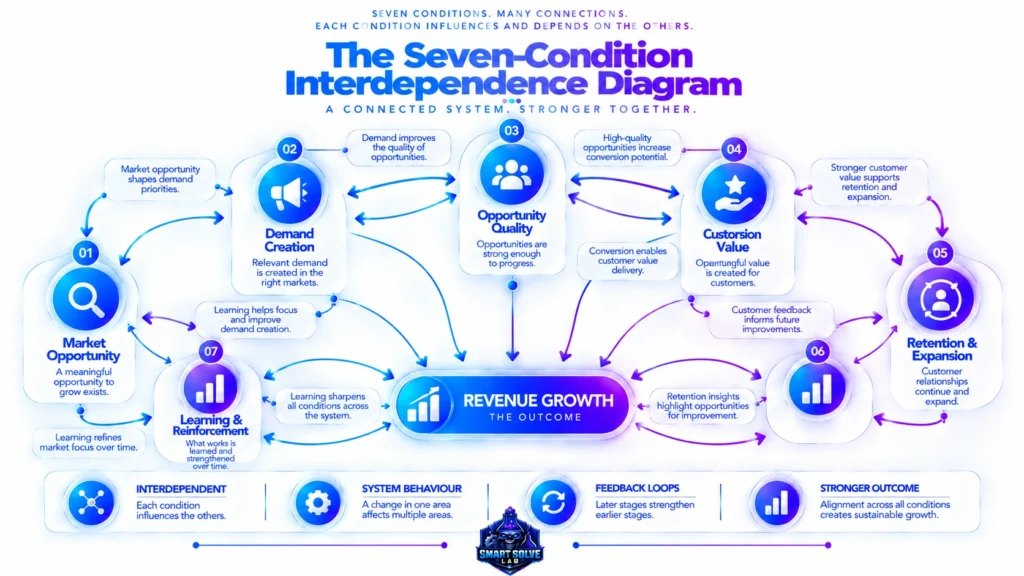
The seven structural conditions behind revenue growth should not be viewed as isolated stages.
They influence one another, and a change in one condition can affect how the wider revenue system performs.
Market Opportunity Influences Demand Creation
A meaningful market opportunity provides the context in which demand can be created. If the opportunity is relevant, demand creation has a stronger foundation.
Demand Creation Influences Opportunities
Demand creation brings attention and interest into the system, but its value depends partly on whether that demand can develop into relevant opportunities.
Opportunity Quality Influences Progression
Strong opportunities have greater potential to progress through the revenue system. Poorly aligned opportunities can create activity without producing proportional commercial outcomes.
Conversion Capacity Influences Customer Creation
Even strong opportunities need an effective ability to progress toward customer relationships. Conversion Capacity therefore connects opportunity conditions with customer creation.
Customer Value Influences Relationship Strength
Once customers enter the system, the value created through the relationship can influence its strength and its potential to continue.
Retention & Expansion Influences Longer-Term Revenue
Continued and expanding customer relationships can contribute to longer-term revenue strength, connecting customer relationships with the wider revenue outcome.
Learning & Reinforcement Feeds the System
The system also produces evidence. That evidence can create learning, and learning can help reinforce stronger conditions across the wider architecture.
This means the Revenue Growth System is not simply a straight-line funnel. It is a connected structure of relationships, dependencies, influence, and feedback.
Why a Revenue Problem Can Appear Somewhere Different From Its Underlying Constraint
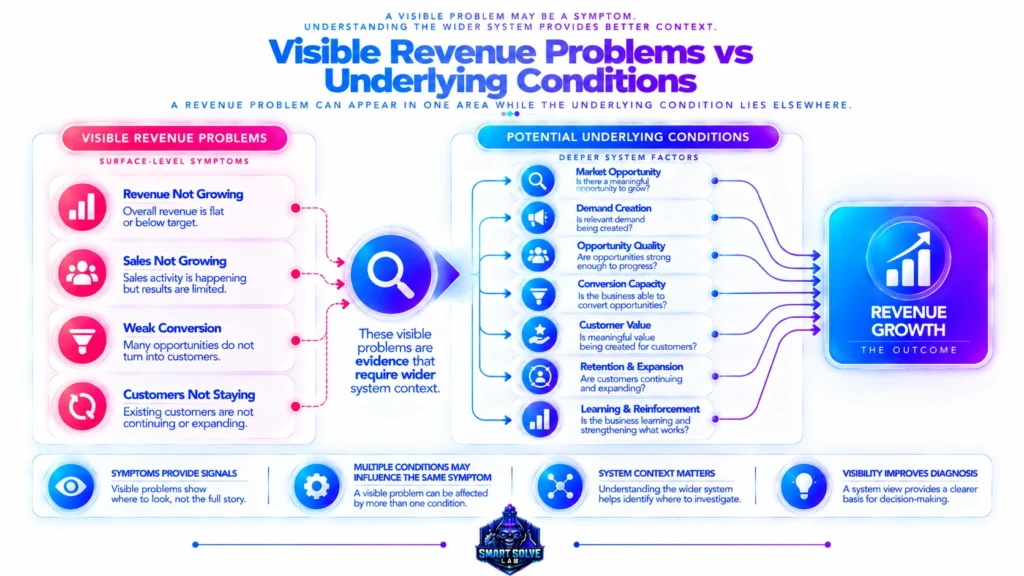
One of the most important implications of a connected revenue system is that the visible problem is not always the same as the condition influencing it.
Visible Symptoms Are Not Always the Whole Problem
A business may notice that sales are weak, conversion is declining, customers are leaving, or revenue is fluctuating.
These observations are important, but they describe what is happening rather than automatically explaining why it is happening.
A Sales Problem May Connect to Opportunity Quality
If sales are not growing, the visible issue may appear to be within the sales process.
However, the quality and relevance of the opportunities entering that process can also influence what happens further downstream.
A Conversion Problem May Connect to Earlier Conditions
A weak conversion outcome can be visible at the conversion stage, while demand relevance or opportunity quality may also influence the conditions surrounding that outcome.
This does not mean every conversion problem originates earlier in the system. It means the wider system provides important context for understanding the visible result.
A Retention Problem May Connect to Customer Value
When customers do not continue their relationship with a business, retention is the visible condition.
Customer value and the broader customer experience can also influence whether that relationship continues. The retention outcome therefore needs to be understood within its wider context.
Revenue Problems Can Reflect Multiple Connected Conditions
Revenue is the outcome of the wider system. A change in revenue can therefore reflect the combined influence of multiple conditions rather than one isolated activity.
The useful system-level perspective is to distinguish between what is visible and what may be influencing that visible result.
This creates a more useful way to understand revenue problems without assuming that the first visible symptom is automatically the underlying constraint.
Why Revenue Constraints Can Move Across the System
A connected revenue system can change when one of its conditions improves.
This means the condition limiting growth at one point in time may not remain the most visible limitation after the system changes.
What Happens When One Condition Improves?
Suppose a business strengthens one part of its revenue system.
The improvement can change the conditions surrounding other parts of the system. A limitation that was previously hidden may become easier to see because the earlier constraint is no longer restricting the system in the same way.
A New Visible Constraint Does Not Mean the Previous Improvement Failed
This distinction is important.
If another limitation becomes visible after an earlier condition improves, it does not automatically mean that the previous improvement created a new problem.
The system may simply be revealing a different constraint that was previously less visible.
Why Revenue Constraints Are Connected
Because the revenue conditions influence one another, changing one condition can change the overall pattern.
For example, stronger demand may reveal an opportunity-quality limitation. Better opportunities may reveal a conversion limitation. Stronger conversion may make customer value or retention conditions more visible.
The constraint environment can therefore change as the system changes.
Understanding Constraint Movement
The useful question is not only, “What is the current problem?”
It is also:
“How has the revenue system changed, and what condition may now be limiting the outcome?”
This perspective helps businesses understand revenue growth as a changing system rather than a fixed list of problems.
Why Isolated Optimization Does Not Always Create Revenue Growth
Improving an individual part of the revenue system can create a useful result, but that improvement does not automatically mean the complete revenue system will produce stronger growth.
More Traffic Is Not Automatically More Revenue
Increasing traffic can create greater visibility and more opportunities for engagement. But traffic still needs to connect with relevant demand, opportunity quality, conversion, customer value, and the conditions that support longer-term relationships.
More Leads Are Not Automatically More Sales
Generating more leads can increase activity within the sales system. However, lead volume alone does not establish whether those opportunities are relevant, strong enough to progress, or capable of producing meaningful sales outcomes.
Better Conversion Is Not Automatically Complete Revenue Growth
Improving conversion can strengthen the movement from opportunity to customer. But the wider revenue system still depends on what happens before conversion and what happens after the customer relationship begins.
More Customers Are Not Automatically Sustainable Growth
Customer acquisition can increase the number of customers entering the business. Yet sustainable revenue growth also depends on customer value, retention, expansion, and the ability of the wider system to learn and reinforce what works.
Why Local Improvement Can Produce a Different System Outcome
Each improvement can matter while still being only one part of the wider architecture.
A stronger result in one condition can change the relationships around it. It may improve the overall system, reveal another limitation, or change which condition deserves attention next.
This does not mean every condition must be optimized simultaneously. It means that individual improvements should be understood within the context of the connected revenue system.
The objective is therefore not simply to maximize every activity. It is to understand how improvements in one condition influence the wider revenue outcome.
Why One Revenue Metric Cannot Explain the Whole System
Revenue growth can be measured through many different metrics, but no single metric can explain the complete revenue system.
Traffic Is Not Revenue
Traffic can show that people are reaching a website or digital property, but traffic alone does not explain whether those visitors create meaningful commercial outcomes.
Leads Are Not Revenue
Leads can indicate that demand is entering the system, but lead volume does not automatically tell us whether those leads are relevant, qualified, progressing, or becoming customers.
Customers Are Not Revenue
Customer numbers provide useful information about acquisition, but they do not fully explain customer value, retention, expansion, or the economic contribution of those relationships.
Conversion Rate Is Not Revenue
Conversion rate can show how a particular part of the system is performing, but it does not automatically explain the conditions surrounding that result or what happens after conversion.
Acquisition Is Not Revenue
Acquiring customers is an important part of growth, but acquisition alone does not establish whether customer relationships continue, expand, or contribute sustainably to revenue.
Retention Is Not Revenue
Retention provides important evidence about customer relationship continuity, but it is also one condition within a wider system that includes market opportunity, demand, opportunities, conversion, customer value, and learning.
Metrics Are Evidence, Not the Whole System
Metrics are valuable because they provide evidence about what is happening.
However, a metric does not automatically explain the reason behind a change, the relationships influencing that change, or the condition that may be limiting the wider revenue outcome.
For example, Google Analytics can provide measurement data that helps businesses understand activity and performance, but interpreting that evidence still requires context from the wider revenue system.
The broader principle is:
Metrics = Evidence
System = Conditions + Relationships + Interpretation + Outcome
Understanding revenue growth therefore requires more than watching individual numbers. It requires understanding what those numbers represent within the connected system.
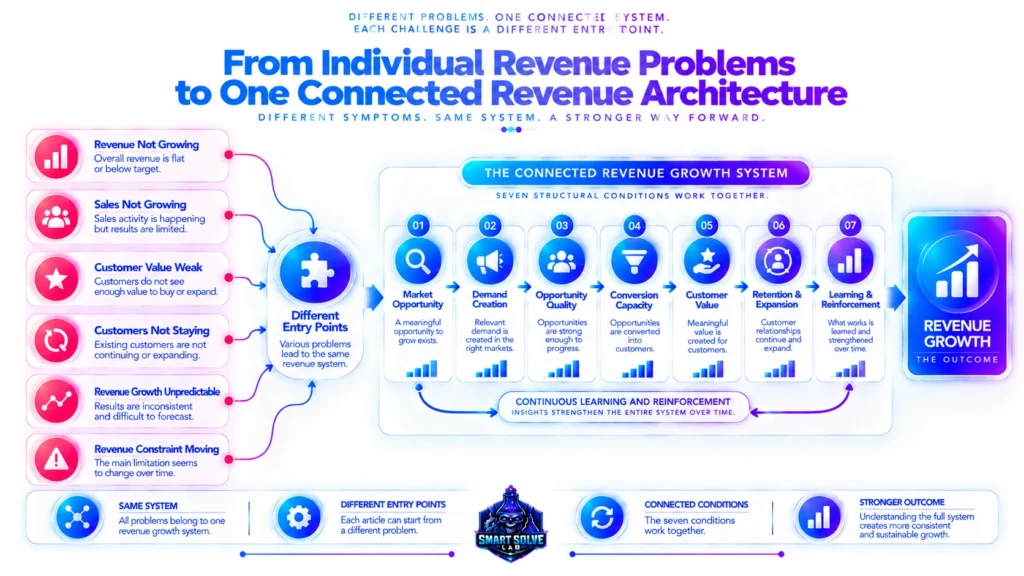
From Individual Revenue Problems to One Connected Revenue Architecture
Revenue problems are often experienced as separate issues.
A business may notice weak sales, inconsistent conversion, customer loss, insufficient demand, or revenue that does not grow as expected. Each problem can appear to belong to a different part of the business.
But these problems can also represent different entry points into the same connected revenue system.
From Problem to Condition
An individual problem can provide a signal about a condition within the wider system.
Weak sales may raise questions about opportunity quality or conversion capacity. Customer loss may raise questions about customer value and relationship continuity. Revenue fluctuations may raise questions about how several conditions are interacting.
The purpose is not to assume one fixed cause. It is to understand the relationship between the visible problem and the wider system.
From Condition to Relationship
Once a condition is considered, the next layer is understanding how it connects with other conditions.
Demand connects with opportunity quality. Opportunity quality connects with conversion. Conversion connects with customer creation. Customer value connects with retention and expansion. Learning connects evidence from across the system back into future decisions.
From Relationship to Revenue Outcome
These relationships ultimately influence the revenue outcome.
This creates a broader way to understand the journey:
Problem → Condition → Relationship → Constraint → Revenue Outcome → Learning → Reinforcement
The individual revenue problems are therefore not necessarily separate systems. They can be different perspectives through which the wider Revenue Growth System becomes visible.
Why the Connected Architecture Matters
Seeing the problems within one architecture helps prevent isolated thinking.
Instead of asking only which individual activity needs improvement, the business can begin asking how the relevant conditions interact and how those relationships influence the wider revenue outcome.
This creates a clearer bridge from individual revenue problems toward a complete Revenue Growth System.
How to Think About Revenue Growth at the System Level
Understanding revenue growth as a connected system changes the questions a business asks.
From “What Should We Do More Of?”
A common approach is to respond to a revenue problem by increasing activity.
More marketing. More traffic. More leads. More sales activity. More campaigns.
These actions can be useful, but they do not automatically explain which condition is influencing the current revenue pattern.
To “Which Condition Is Influencing the Current Pattern?”
A system-level approach asks a more useful question:
Which condition is influencing the current revenue pattern, and how is it connected to the wider system?
This shifts attention from activity volume toward relationships, conditions, evidence, and outcomes.
Diagnose Before Optimizing
Before increasing activity, it is useful to understand what the current evidence may be showing.
The goal is not to stop taking action. It is to make action more informed by understanding the system in which that action operates.
Interpret Metrics in Context
Metrics can provide valuable evidence, but they become more useful when interpreted alongside the conditions and relationships surrounding them.
Examine Relationships
A change in one condition can influence another. Looking at these relationships can provide a broader understanding than evaluating each metric independently.
Understand Constraints and Changing Conditions
The condition limiting growth can change as the system changes. A business therefore needs to recognize that the revenue picture may evolve after an improvement is made.
Learn From Evidence and Reinforce What Works
Results provide opportunities for learning. That learning can then help strengthen the conditions that support the wider revenue system.
This is the essence of system-level thinking: understand the architecture, examine the relationships, interpret the evidence, and recognize how the system changes over time.
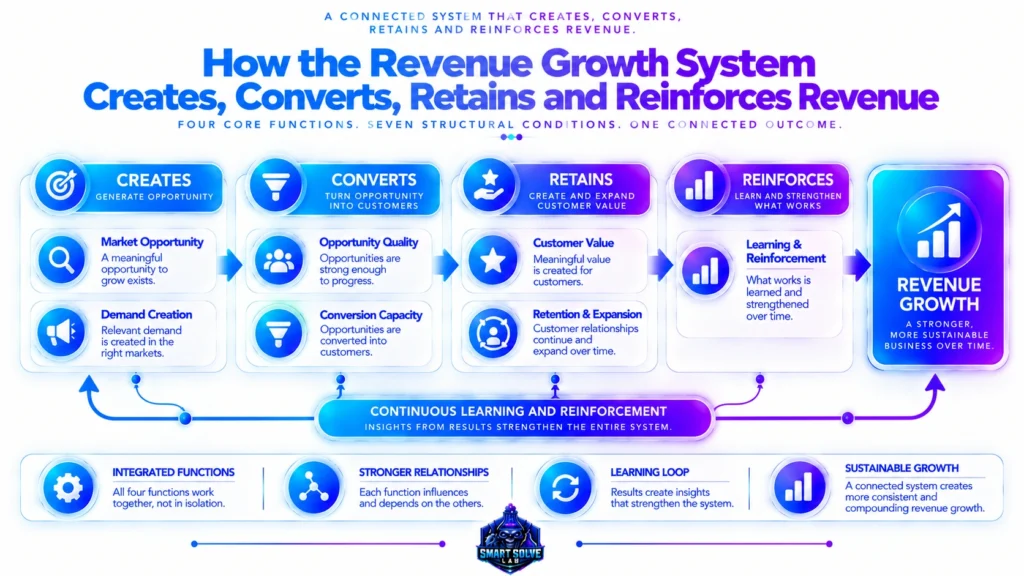
How the Revenue Growth System Creates, Converts, Retains and Reinforces Revenue
The complete Revenue Growth System can be understood through four connected movements: create, convert, retain, and reinforce.
Creates: Market Opportunity + Demand Creation
The system begins by identifying a meaningful market opportunity and creating relevant demand around that opportunity.
Market Opportunity provides the context, while Demand Creation helps connect the business with people who may have a relevant need or interest.
Converts: Opportunity Quality + Conversion Capacity
Demand needs to develop into meaningful opportunities. Opportunity Quality influences whether those opportunities are strong enough to progress, while Conversion Capacity influences whether they can become customers.
Retains: Customer Value + Retention & Expansion
Once customers enter the system, Customer Value contributes to the strength of the relationship. Retention & Expansion then connect that relationship with continued and potentially growing revenue contribution.
Reinforces: Learning & Reinforcement
The system produces evidence through its results.
Learning from that evidence can help the business understand changing conditions and reinforce what is working across the wider architecture.
Revenue Growth Is the Outcome
These connected movements can be summarized as:
Creates → Converts → Retains → Reinforces → Revenue Growth
Revenue growth is therefore not a separate activity sitting outside the system. It is the outcome of conditions working together, supported by learning and reinforcement over time.
The arrows should not be interpreted as a rigid funnel. They represent relationships and influence within a connected system.
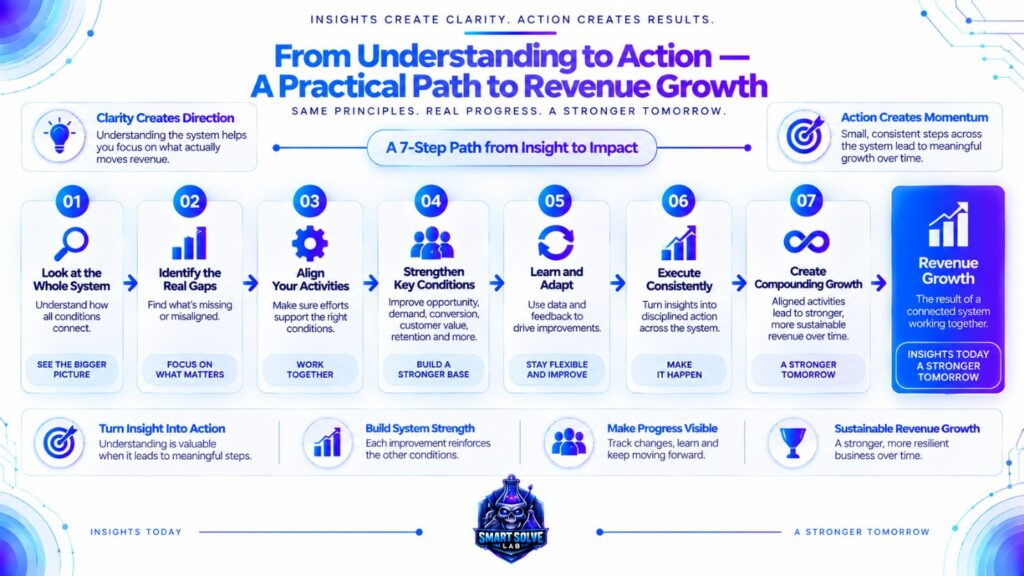
Building a Connected Revenue Growth System
Building a connected Revenue Growth System starts with understanding how the different conditions work together rather than treating revenue growth as a collection of separate activities.
1. Understand the Architecture
Begin by understanding the seven structural conditions: Market Opportunity, Demand Creation, Opportunity Quality, Conversion Capacity, Customer Value, Retention & Expansion, and Learning & Reinforcement.
2. Identify the Relevant Conditions
Consider which conditions are most relevant to the current revenue pattern. The goal is not to assume that every condition has the same level of influence at every moment.
3. Examine the Relationships
Look beyond individual metrics and consider how the relevant conditions connect with one another.
A change in demand may affect opportunities. Opportunity quality may influence conversion. Customer value may influence retention. Results across the system may create evidence that informs future decisions.
4. Understand the Constraints
Revenue growth can become limited when one or more conditions restrict the wider system.
Understanding the constraint requires looking at the wider context rather than automatically treating the most visible symptom as the complete explanation.
5. Strengthen Connected Conditions
Once the relevant conditions and relationships are understood, improvements can be considered in the context of the wider system.
The objective is not simply to maximize one activity. It is to strengthen the conditions that contribute to the revenue outcome.
6. Learn From Changes
After changes occur, the system creates new evidence.
That evidence can help the business understand how the revenue picture has changed and whether another condition has become more important.
7. Reinforce What Works
Learning becomes valuable when it can strengthen the wider system over time.
This creates a continuous relationship between conditions, outcomes, learning, and reinforcement.
A complete operational diagnostic or implementation process requires a deeper level of analysis than this high-level architecture. The purpose here is to establish the system-level understanding needed to see revenue growth as a connected structure.
The Complete Revenue Growth System: Putting Everything Together
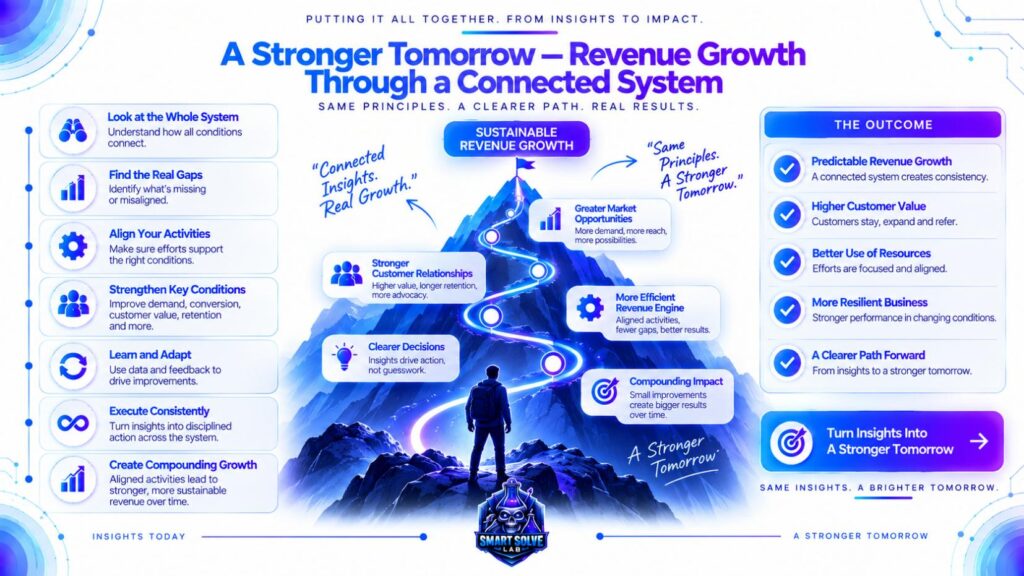
The Revenue Growth System can now be viewed as one connected architecture rather than a collection of separate business activities.
Market Opportunity
↓
Demand Creation
↓
Opportunity Quality
↓
Conversion Capacity
↓
Customer Value
↓
Retention & Expansion
↓
Learning & Reinforcement
↺
Revenue Growth
How the Architecture Works
Market Opportunity provides the context for meaningful growth. Demand Creation connects the business with relevant demand. Opportunity Quality determines whether that demand can develop into meaningful opportunities, while Conversion Capacity influences whether those opportunities become customers.
Customer Value then influences the strength of the customer relationship. Retention & Expansion connect that relationship with continued and potentially growing economic contribution.
Learning & Reinforcement completes the wider system by creating a feedback relationship between results, evidence, learning, and stronger conditions.
The Arrows Represent Relationships, Not a Rigid Funnel
The architecture should not be interpreted as a simple one-directional funnel.
The conditions influence one another, and the system can change as individual conditions change. Learning can also feed information back into the wider system.
This is why revenue growth is better understood as a connected system of conditions, relationships, constraints, outcomes, and reinforcement.
Revenue is the outcome of that connected system rather than an isolated stage within it.
Where to Go Next: Diagnose Your Revenue Growth System
A system-level view becomes especially useful when individual revenue problems are no longer easy to explain through one metric or activity.
When Individual Problems Keep Appearing
If sales, conversion, customer value, retention, or revenue performance continue to create questions, the wider system may need to be understood rather than each problem being treated as completely separate.
When Multiple Activities Are Already Working
A business may already be investing in marketing, generating opportunities, converting customers, and maintaining customer relationships.
When activity is present but the overall revenue picture remains difficult to understand, looking at the relationships between conditions can provide a more useful perspective.
When Metrics Provide Evidence but Not Clarity
Metrics can show what changed, but they do not always explain why it changed or which connected condition may be influencing the outcome.
This is where a system-level diagnostic perspective can become valuable.
When Revenue Constraints Keep Changing
If improving one area makes another limitation more visible, the business may need to understand how constraints are connected and how the wider revenue system changes over time.
Understanding the Complete Revenue Growth System
The next step is to move from individual revenue questions toward a complete understanding of the conditions, relationships, and constraints influencing the wider system.
The Revenue Growth System — Premium is designed as the deeper SSL diagnostic layer for understanding revenue growth at the system level.
Its role is to provide structured diagnostic clarity around the connected revenue architecture rather than simply adding another isolated revenue tactic.
For businesses ready for implementation, the corresponding Revenue Execution System — Premium represents the execution layer, where system understanding can be translated into practical implementation.
Further ahead, a future Revenue Intelligence Engine could extend this system into ongoing analysis, tracking, decision support, and revenue intelligence.
The journey is therefore not simply about doing more revenue activities. It is about moving from individual problems to system understanding, from system understanding to diagnosis, and from diagnosis to execution.
Key Takeaways
- Revenue growth is an outcome of a connected system rather than one isolated activity.
- The Revenue Growth System includes seven structural conditions: Market Opportunity, Demand Creation, Opportunity Quality, Conversion Capacity, Customer Value, Retention & Expansion, and Learning & Reinforcement.
- These conditions influence and depend on one another, so revenue problems cannot always be understood by looking at one activity in isolation.
- A visible revenue problem may not reveal the condition influencing the outcome.
- Revenue constraints can change as the system changes and one condition improves.
- Improving one activity does not automatically complete the wider revenue system.
- Traffic, leads, customers, conversion rate, acquisition, and retention are useful evidence, but none of them represents the complete
Conclusion
Revenue growth is not created by one activity working harder in isolation.
It is the outcome of a connected system that creates relevant demand, develops meaningful opportunities, converts those opportunities into customers, creates customer value, supports retention and expansion, and learns from what happens across the system.
When these conditions are viewed separately, revenue problems can appear fragmented. A business may see a traffic problem, a lead problem, a conversion problem, a customer problem, or a revenue problem without immediately seeing how those conditions relate to one another.
A connected Revenue Growth System provides a broader perspective.
It helps explain why a visible problem may not represent the underlying constraint, why improving one condition can make another limitation more visible, and why individual metrics cannot explain the complete revenue outcome.
The goal is therefore not simply to create more activity.
It is to understand the architecture behind revenue growth, recognize the relationships between its conditions, interpret evidence within the wider system, and reinforce what strengthens the system over time.
Once revenue is viewed this way, individual growth problems can be understood as connected parts of a larger system rather than isolated business issues.
FAQs
What is a Revenue Growth System?
A Revenue Growth System is a connected set of conditions through which a business creates demand, develops opportunities, converts customers, creates customer value, retains and expands customer relationships, and learns from results. Revenue is the outcome of these connected conditions rather than an isolated activity.
What are the seven structural conditions behind revenue growth?
The seven structural conditions are Market Opportunity, Demand Creation, Opportunity Quality, Conversion Capacity, Customer Value, Retention & Expansion, and Learning & Reinforcement. Together, they provide a system-level view of the conditions influencing revenue growth.
Why is revenue an outcome rather than a separate stage?
Revenue is influenced by multiple connected conditions across the business. Market opportunity, demand, opportunities, conversion, customer value, retention, expansion, and learning can all contribute to the eventual revenue outcome.
Why doesn’t more marketing automatically create more revenue?
More marketing can increase activity, visibility, or demand, but revenue also depends on the quality of opportunities, conversion capacity, customer value, retention, expansion, and other connected conditions. Increasing one activity does not automatically strengthen the entire system.
Why can a revenue problem appear in one area while its constraint exists elsewhere?
A visible result can be influenced by connected conditions elsewhere in the system. For example, a sales problem may be influenced by opportunity quality, while a retention problem may be connected to customer value. The visible symptom does not always explain the wider condition influencing it.
Why can revenue constraints change after one problem improves?
Improving one condition can change the surrounding system and make another limitation more visible. A newly visible constraint does not necessarily mean the previous improvement failed; the revenue system may simply have changed.
How can a business understand revenue growth as a connected system?
A business can begin by understanding the seven structural conditions, examining how they relate to one another, interpreting metrics as evidence rather than complete explanations, recognizing changing constraints, and learning from results to reinforce stronger conditions.
Recommended Reading
- Why Revenue Growth Feels So Difficult (And Why More Marketing Doesn’t Always Fix It) — Understand why revenue growth can remain difficult even when individual revenue activities are active.
- Why Revenue Problems Keep Moving Even After You Fix One Growth Bottleneck — Explore how improving one revenue constraint can make another constraint more visible.
- Why Marketing Campaigns Work But Revenue Doesn’t Grow — Understand why successful marketing activity does not automatically translate into proportional revenue growth.