
Introduction
Revenue growth can feel difficult even when a business is busy.
Marketing campaigns may be running. Demand may be increasing. Leads may be coming in. Sales conversations may be happening. Customers may be buying, and existing customers may still be engaging with the business.
Yet the overall revenue picture can remain harder to understand than expected.
The natural response is often to increase activity — more marketing, more traffic, more leads, more campaigns, or more sales effort. But activity in one part of the business does not automatically mean that the wider revenue system is working as a connected whole.
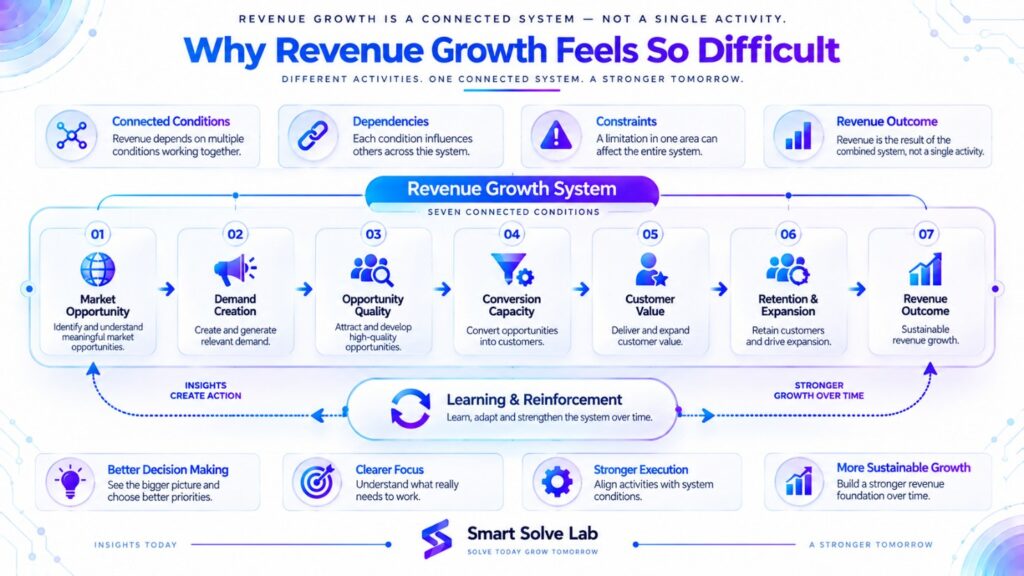
Revenue is an outcome of multiple conditions working together.
A business needs a meaningful market opportunity. It needs to create relevant demand, generate quality opportunities, convert those opportunities into customers, create customer value, maintain and expand customer relationships, and continuously learn from what happens across the system.
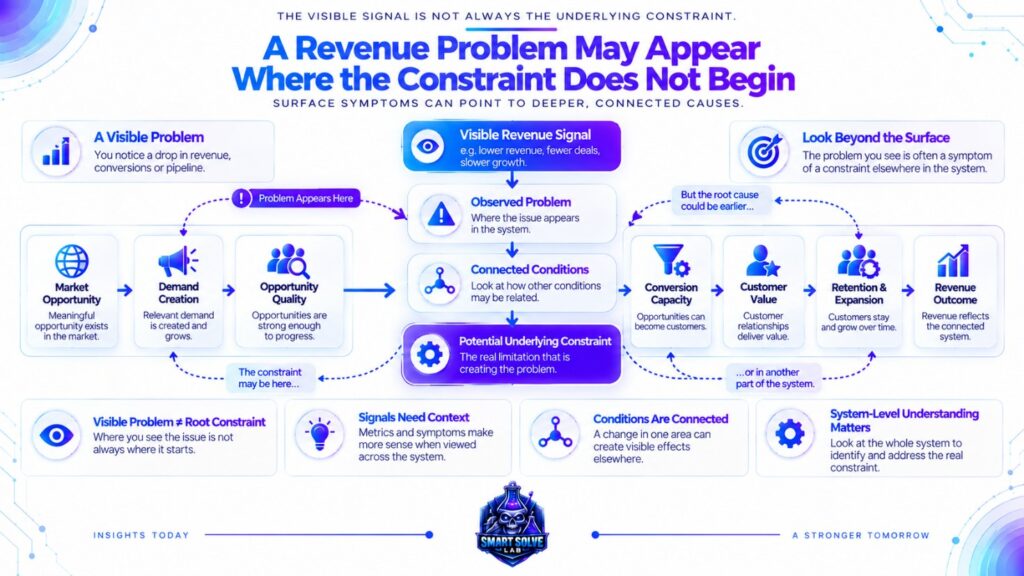
This is why a revenue problem can sometimes appear in one area while its underlying limitation exists somewhere else.
A conversion problem, for example, may not be explained by conversion alone. Opportunity quality, demand, customer value, or another connected condition may also influence what eventually happens to revenue.
There is another important consideration: improving one condition does not necessarily mean the entire revenue system is now complete. As one constraint improves, another condition may become more visible. The revenue picture can change as the system changes.
This means revenue growth cannot always be understood through a single metric or isolated activity.
Traffic is not revenue. Leads are not revenue. Customers are not revenue. Conversion rate is not revenue. Acquisition is not revenue. Retention is not revenue.
These measures provide useful evidence, but they represent different parts of a much larger system.
The more useful question is therefore not simply:
“Which revenue activity should we increase?”
It is:
“How are the different conditions connected, and where might the wider system be limiting the revenue outcome?”
This article introduces that system-level way of thinking about revenue growth — and explains why more marketing does not automatically solve every revenue growth problem.
Table of Contents
Why Revenue Growth Can Feel Difficult Even When Business Is Active
Revenue growth can feel difficult even when a business is clearly active.
Marketing campaigns may be running. Demand may be increasing. Leads may be coming in. Sales conversations may be happening. Customers may be buying, and existing customers may still be engaging with the business.
Yet the overall revenue picture can remain harder to understand than expected.
This happens because business activity and revenue growth are not the same thing. A business can generate significant activity across different areas without those activities combining into a strong, connected revenue outcome.
For example, a business may increase website traffic while seeing little change in revenue. It may generate more leads without seeing proportional sales growth. It may acquire new customers while existing customer relationships remain weak.
These situations do not necessarily mean that one activity is completely failing. They may indicate that different parts of the revenue system are not contributing to the outcome in the same way.
This is why looking at revenue growth through a single activity can create an incomplete picture.
The more useful starting point is to understand what is happening between business activity and the final revenue outcome.
Why More Marketing Does Not Automatically Create More Revenue
When revenue growth feels difficult, increasing marketing activity is often one of the first responses.
A business may invest in more campaigns, increase traffic generation, publish more content, expand advertising, or try to generate more leads.
These activities can be useful. But more marketing activity does not automatically mean more revenue.
Marketing can create attention, demand, traffic, and opportunities. Revenue depends on what happens across the conditions that follow.
If the opportunities being created are not strong enough, increasing their volume may not solve the underlying problem. If conversion capacity is limited, additional demand may simply create more opportunities that fail to progress. If customer value or retention is weak, acquiring more customers may not produce the expected long-term revenue effect.
This is why a business can be marketing actively while still struggling to explain why revenue is not growing proportionally.
The issue is not necessarily that marketing is ineffective. The issue may be that marketing is being viewed as an isolated growth lever rather than as one part of a wider revenue system.
As explained in Why Marketing Campaigns Work But Revenue Doesn’t Grow, marketing activity can produce results without those results necessarily translating into proportional revenue growth.
Understanding that difference changes the question from “How can we do more marketing?” to “What happens to the value created by our marketing as it moves through the wider revenue system?”
That question leads to a deeper system-level view of revenue growth.
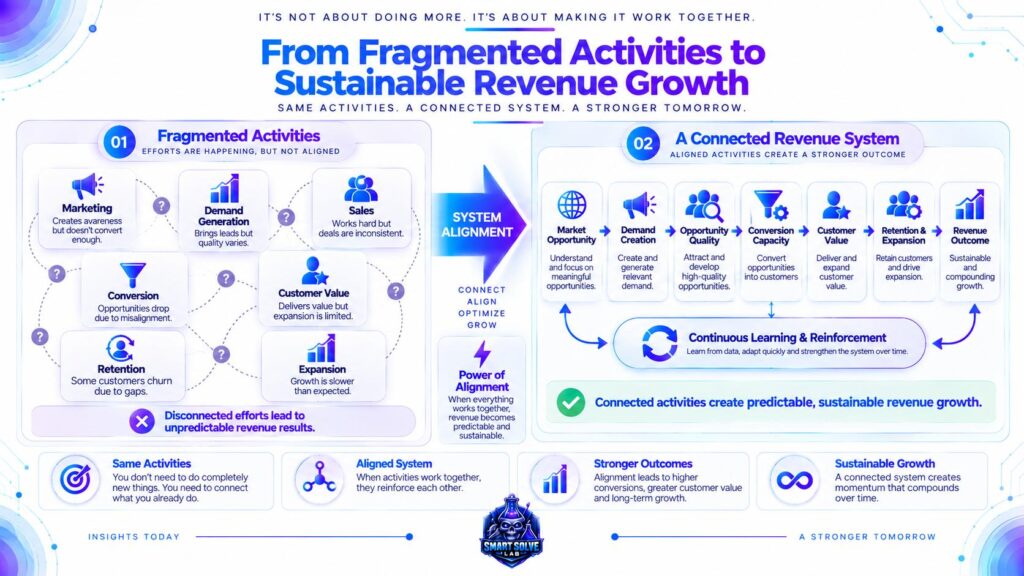
The Hidden Problem: Revenue Activities May Be Working Without Working Together
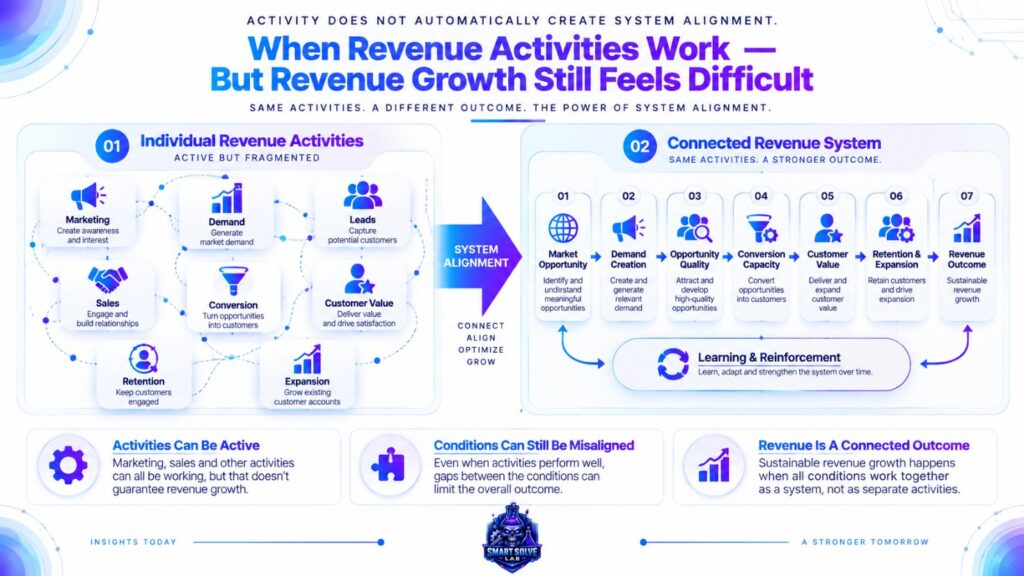
One of the more difficult revenue problems to recognize is when individual activities appear to be working, but the overall system still does not produce the expected revenue outcome.
Marketing may be generating attention. Sales may be having conversations. The website may be receiving visitors. Customers may be purchasing. Existing customers may still be engaging with the business.
Looking at each activity separately can make the business appear healthy.
But revenue growth depends on how these activities connect.
Traffic needs to reach relevant opportunities. Opportunities need sufficient quality to progress. The system needs the capacity to convert those opportunities into customers. Customers need to receive enough value for the relationship to continue and potentially expand.
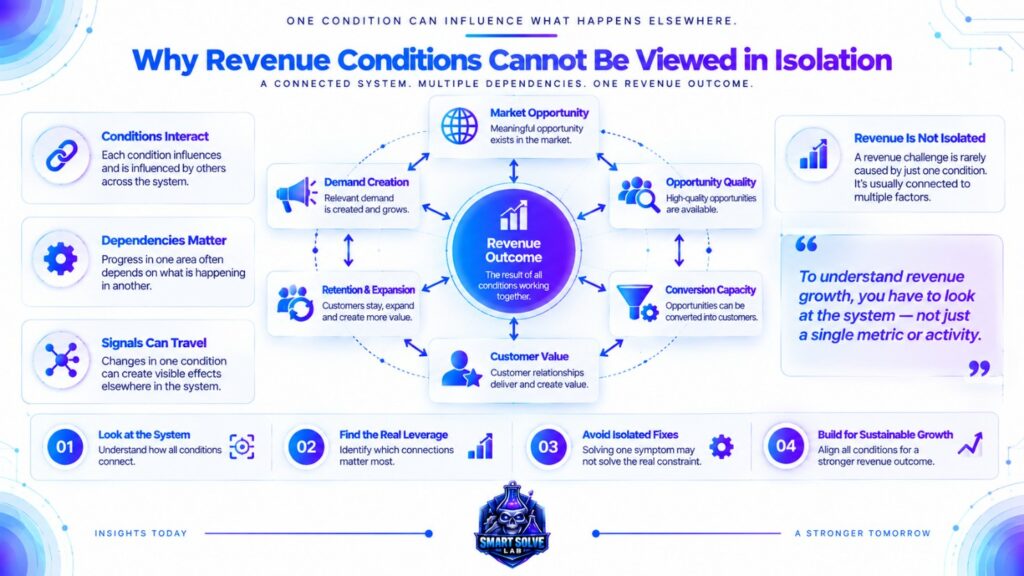
This means a weakness in one connected condition can influence what happens elsewhere.
For example, strong traffic does not automatically create revenue if the visitors are poorly aligned with the business. Similarly, strong lead volume does not automatically create sales if opportunity quality or conversion capacity is limiting progression.
This is why high website traffic can still fail to produce revenue. Traffic is an important signal, but it is only one part of the wider revenue picture.
The hidden problem, therefore, may not be a complete absence of activity. It may be a lack of connection between the activities that are already happening.
Once revenue is viewed as a connected outcome rather than a collection of isolated activities, the next question becomes much more useful: what actually has to work together for revenue growth to occur?
What Actually Has to Work Together for Revenue Growth?
Once it becomes clear that revenue growth cannot be explained by marketing activity alone, the next question is what actually has to work together.
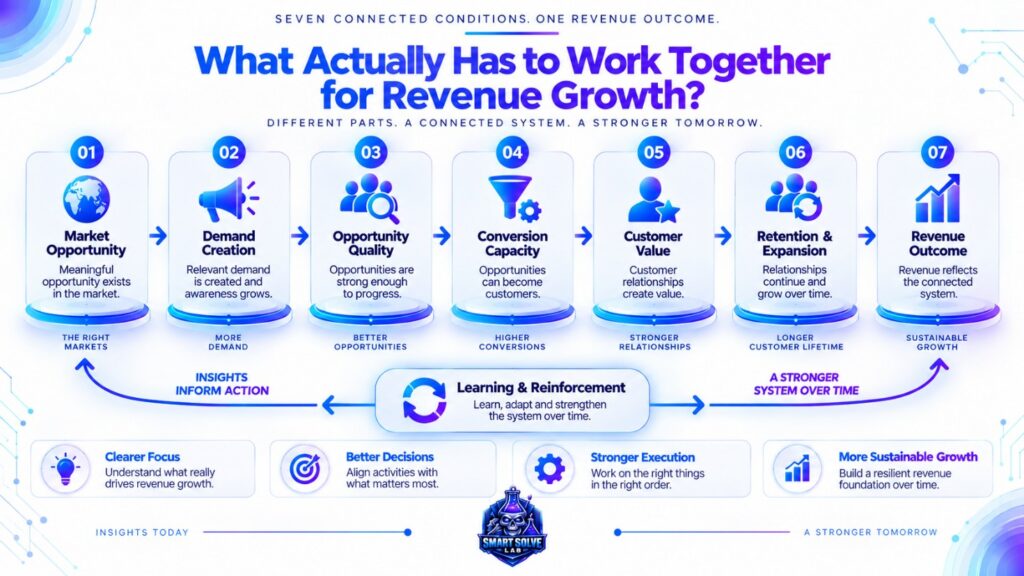
Revenue growth depends on several connected conditions rather than one isolated activity.
A business first needs a meaningful Market Opportunity. It then needs Demand Creation to bring relevant attention and interest into the system.
That demand needs to develop into Opportunity Quality — opportunities that are sufficiently relevant and strong enough to progress.
The business then needs Conversion Capacity to turn suitable opportunities into customers.
But the system does not end when a customer is acquired. Customer Value influences the economic strength of the relationship, while Retention & Expansion determine whether customer relationships can continue and grow.
Finally, Learning & Reinforcement allows the business to learn from what is happening across the system and strengthen the conditions that support future growth.
These conditions can be viewed as a connected architecture:
Market Opportunity → Demand Creation → Opportunity Quality → Conversion Capacity → Customer Value → Retention & Expansion → Revenue Outcome → Learning & Reinforcement
The important point is not to treat these as seven separate tactics. Their relationship is what makes the architecture useful.
Market Opportunity: Is There a Meaningful Opportunity to Grow?
Revenue growth begins with the opportunity available to the business.
A business can have strong marketing activity, an active sales team, and an efficient conversion process, but those activities still operate within a market context.
The first question is therefore whether there is a meaningful opportunity for the business to grow within the market it is serving.
This includes considering whether the business is addressing a meaningful need, whether there is sufficient demand for the type of value being offered, and whether the market provides room for the business to create and capture economic value.
This does not mean that market opportunity alone creates revenue.
It means that the wider revenue system is operating within a particular opportunity environment.
If the opportunity is limited, unclear, poorly aligned, or difficult to access, increasing activity further down the system may not fully compensate for that limitation.
This is one reason revenue growth should not be examined only through marketing, sales, or conversion metrics. Those metrics describe activity and performance within the system, but they do not independently explain the entire revenue opportunity.
The market therefore forms one of the structural conditions that needs to be understood before interpreting the performance of the conditions that follow.
Demand Creation: Can the Business Create Relevant Demand?
Having a market opportunity does not automatically mean that relevant demand will reach the business.
Demand creation is the condition through which the business creates awareness, interest, and meaningful demand among people or organizations that may have a genuine need for what it offers.
This is where marketing activity becomes part of the wider revenue architecture.
But the important question is not simply whether marketing is active.
The more useful question is whether the activity is creating relevant demand that can move into the next conditions of the system.
A business may generate large amounts of attention without creating proportionate commercial opportunity. Traffic may increase, impressions may rise, or campaigns may generate engagement, while the resulting demand remains poorly aligned with the business or its offer.
This is why marketing performance needs to be interpreted within the wider revenue pathway rather than treated as the final outcome.
For example, high website traffic can still exist without proportional revenue when the attention being generated does not translate effectively into the conditions that follow.
Demand creation therefore plays an important role in the revenue system, but it is only one connected condition.
The next question is whether the demand being created develops into opportunities strong enough to progress.
Opportunity Quality: Are the Opportunities Strong Enough to Progress?
Creating demand is only one step in the revenue system. The next question is whether that demand develops into opportunities that are strong enough to move forward.
Not every visitor, lead, inquiry, or prospect represents the same level of opportunity.
Some may have a genuine need and strong alignment with the business. Others may be curious but not ready to act. Some may fit the audience but have limited relevance to the specific offer.
This difference matters because increasing the volume of opportunities does not automatically increase the quality of the opportunities entering the revenue system.
A business can therefore experience strong demand activity while still seeing limited progression further down the system.
This is one reason why revenue growth cannot be understood simply by counting leads or opportunities. The quality and relevance of those opportunities influence what can happen next.
Opportunity quality also connects directly with conversion capacity. If opportunities are poorly aligned, even a strong conversion process may have limited ability to produce proportional results.
Understanding this distinction helps separate a quantity problem from a quality and alignment problem.
The question is therefore not simply how many opportunities the business is creating, but whether the opportunities being created are sufficiently relevant and strong enough to progress.
Conversion Capacity: Can the System Convert Opportunity Into Customers?
Even when a business has a meaningful market opportunity, creates relevant demand, and generates suitable opportunities, revenue growth still depends on what happens next.
The system needs the capacity to convert suitable opportunities into customers.
Conversion capacity is broader than a single conversion rate.
It includes the conditions that help a potential customer understand the offer, evaluate its relevance, develop sufficient confidence, and move toward a decision.
This is why a business can have traffic, leads, and opportunities while still experiencing weak or inconsistent customer acquisition.
For example, visitors may reach the website but fail to understand the next step. Prospects may show interest but hesitate before making a decision. A sales funnel may receive opportunities but lose them at specific stages of the journey.
These situations can indicate a conversion condition that needs deeper understanding rather than simply a need for more traffic.
As Why Your Sales Funnel Is Not Converting explains, customers can enter a funnel and still fail to complete the journey when important structural conditions are not aligned.
Conversion therefore sits within the wider revenue architecture. It connects opportunity quality with customer acquisition, rather than operating as an isolated metric.
And even successful conversion does not complete the revenue system. Once customers enter the business, another set of conditions determines the strength and continuity of the customer relationship.
Customer Value: Does the Customer Relationship Create Economic Strength?
Revenue growth does not end when a customer is acquired.
Customer acquisition creates an important transition in the revenue system, but the economic strength of that relationship depends on the value created after the customer enters the business.
Customer value is therefore another important condition within the revenue architecture.
A customer may purchase once, but the wider revenue outcome can depend on whether the relationship creates meaningful value for both the customer and the business.
This includes the customer’s experience of the product or service, the relevance of the solution over time, and the strength of the relationship created through continued value.
Weak customer value can influence what happens later in the system. Customers may not continue the relationship, may not return, or may have little reason to expand their engagement.
This is why acquisition numbers alone cannot explain the full revenue picture.
A business can successfully bring customers into the system while still having difficulty creating the level of customer value needed to support stronger and more sustainable revenue outcomes.
Customer value therefore connects the conversion stage with what happens after acquisition — including retention and expansion.
The important system-level question becomes: after a customer enters the business, does the relationship create enough ongoing value to support continued economic strength?
Retention & Expansion: Can Customer Relationships Continue and Grow?
Customer acquisition is not the end of the revenue system. What happens after acquisition can influence how much economic value a business is able to create from its customer relationships over time.
Retention refers to the ability to maintain customer relationships, while expansion considers whether those relationships can grow in meaningful ways.
A business may acquire customers successfully but still experience limited revenue growth if customers do not remain engaged, return, renew, or continue the relationship.
This creates an important distinction between customer acquisition and customer continuity.
Retention and expansion can also be influenced by conditions that developed earlier in the system. Customer fit, expectations, product or service experience, ongoing relevance, and the value created through the relationship can all affect what happens after acquisition.
This means that a retention problem should not automatically be interpreted as a problem that begins only after the customer has been acquired.
The wider revenue system matters.
If customer relationships continue and create additional value, they can strengthen the revenue outcome. If relationships end too early or fail to develop, the business may need to replace lost value through continued acquisition.
Retention and expansion therefore connect customer value with the longer-term revenue outcome.
Learning & Reinforcement: Can the System Strengthen What Works?
A revenue system does not remain static.
Markets change. Customer behaviour changes. Demand changes. Opportunities change. Conversion patterns change. Customer relationships change.
This means revenue growth also depends on the business’s ability to learn from what is happening across the system.
Learning & Reinforcement is the condition that allows the business to interpret experience, recognize meaningful patterns, and strengthen the parts of the system that are supporting growth.
This is different from simply collecting more metrics.
Metrics can provide evidence, but evidence becomes more useful when it is interpreted in context.
For example, a change in conversion rate may be meaningful, but understanding why it changed may require looking at opportunity quality, demand, customer fit, or another connected condition.
Similarly, an increase in customer acquisition may appear positive while the wider system reveals a different pattern in customer value or retention.
Learning therefore helps the business move beyond isolated observations and understand what the changing revenue picture may be indicating.
The reinforcement part is equally important. When the business understands which conditions are supporting growth, it can strengthen those conditions rather than repeatedly treating every revenue change as a completely separate problem.
This creates an important system loop:
Growth → Learning → Reinforcement → Stronger Growth
The purpose is not to assume that every positive result will continue automatically. It is to recognize that sustainable system improvement requires learning from what actually happens.
How the Seven Conditions Depend on One Another
The seven conditions become more useful when they are viewed as connected parts of one revenue system rather than as separate departments or independent growth tactics.
Market Opportunity influences the environment in which growth can occur.
Demand Creation helps bring relevant attention and interest into the system.
Opportunity Quality influences whether that demand develops into opportunities that can meaningfully progress.
Conversion Capacity determines how effectively suitable opportunities can become customers.
Customer Value influences the economic strength of the customer relationship.
Retention & Expansion determine whether those relationships can continue and develop.
Learning & Reinforcement allows the business to learn from the system and strengthen what is working.
Because these conditions are connected, weakness in one area can affect what becomes visible elsewhere.
A business may therefore observe a conversion problem when the deeper limitation is partly related to opportunity quality. It may see a retention problem when customer expectations or value were not sufficiently aligned earlier in the relationship.
This does not mean that every visible problem originates somewhere else. It means that the visible symptom should be interpreted within the wider system before assuming that the symptom itself is the complete explanation.
This is one of the central ideas behind system-level revenue thinking: the conditions should be understood together because their relationships influence the overall revenue outcome.
Why a Revenue Problem May Appear Somewhere Different From Its Underlying Constraint
One of the reasons revenue problems can be difficult to understand is that the place where a problem becomes visible is not always the place where its underlying limitation exists.
A business may notice that sales are weak, for example, but the visible sales problem may be influenced by the quality of opportunities entering the sales process.
Similarly, a conversion problem may appear on a website or sales funnel while the wider issue is related to demand relevance, opportunity quality, customer fit, or another connected condition.
The same principle can apply after acquisition.
A business may observe weak retention, but the conditions influencing that outcome may include expectations established before purchase, customer value, product or service experience, or the relevance of the relationship over time.
This does not mean that every visible problem has a hidden cause somewhere else.
It means that the visible symptom should be treated as evidence rather than automatically treated as the complete diagnosis.
This distinction matters because fixing only the visible symptom can sometimes leave the wider constraint unchanged.
A more useful approach is to ask:
What condition could be influencing this outcome, and how is that condition connected to the rest of the revenue system?
That question moves the business from isolated problem-solving toward system-level understanding.
Why Revenue Constraints Are Connected
Revenue constraints rarely exist in complete isolation.
The seven conditions discussed earlier are connected, which means a limitation in one part of the system can influence the performance that becomes visible somewhere else.
For example, increasing demand may create more opportunities, but if opportunity quality does not improve with that demand, the additional volume may not produce proportional revenue growth.
Similarly, improving conversion capacity may increase customer acquisition, but if customer value or retention remains weak, the overall revenue outcome may still remain limited.
This is why improving one area does not automatically mean that the wider revenue system is now optimized.
When one constraint improves, the relative importance of another condition can become more visible.
The business may therefore experience a changing revenue picture even though the original improvement was real.
This should not automatically be interpreted as the previous improvement failing.
It can simply mean that the system has changed and another condition now deserves greater diagnostic attention.
The important principle is:
Revenue growth is influenced by connected conditions, so constraints should be understood in relation to the wider system rather than as isolated problems.
Why One Revenue Metric Cannot Explain the Whole System
Revenue growth is often reduced to a small number of visible metrics.
Traffic may be increasing. Leads may be increasing. Conversion rate may be improving. Customer numbers may be rising.
These measurements can all provide useful evidence, but none of them independently explains the complete revenue system.
Traffic is not revenue.
Leads are not revenue.
Customers are not revenue.
Conversion rate is not revenue.
Acquisition is not revenue.
Retention is not revenue.
Each measure describes a different part of the system.
A traffic increase, for example, may indicate stronger demand creation, but it does not by itself explain opportunity quality, conversion capacity, customer value, or retention.
Likewise, an improvement in conversion rate can be meaningful while still leaving questions about customer value and longer-term revenue contribution.
This is why metrics are best treated as evidence rather than as the entire explanation.
A system-level view asks what the metric is showing, what it does not show, and which connected conditions may help explain the pattern.
For businesses using analytics, this broader interpretation is particularly important because measurement tools can provide detailed performance data without automatically providing the full business diagnosis.
For example, Google Analytics can help businesses understand website and user behaviour data, but those measurements still need to be interpreted within the wider revenue context.
The goal is therefore not to stop measuring individual metrics. It is to understand what each metric can tell you — and where the wider system needs to be considered.
Why Isolated Optimization Can Keep Revenue Growth Difficult
Once revenue growth is viewed as a connected system, another problem becomes easier to recognize: improving individual activities in isolation does not necessarily improve the complete revenue outcome.
A business may optimize its traffic, improve its lead generation, increase its conversion rate, or strengthen customer acquisition.
Each improvement can be meaningful on its own.
But the overall revenue result still depends on how those improvements interact with the other conditions in the system.
For example, generating more traffic may increase the number of visitors entering the business. But if the additional visitors are not sufficiently relevant, the increase may have limited impact further down the system.
Similarly, improving conversion capacity can increase customer acquisition, while customer value or retention conditions may still determine how much longer-term economic value those customers create.
This is why isolated optimization can create a cycle of continuous activity without resolving the wider revenue challenge.
The question is not whether individual areas should be improved. They should.
The deeper question is whether those improvements are being understood within the connected revenue architecture.
A system-level approach therefore looks beyond individual performance and asks how each improvement changes the wider revenue picture.
That shift moves the business from optimizing activities toward understanding relationships between conditions.
Seeing the Complete Revenue Growth Architecture
At this point, the revenue system can be viewed as a connected architecture rather than a collection of separate activities.
The complete structure brings together the conditions discussed throughout this article:
Market Opportunity
↓
Demand Creation
↓
Opportunity Quality
↓
Conversion Capacity
↓
Customer Value
↓
Retention & Expansion
↓
Revenue Outcome
↓
Learning & Reinforcement
This architecture does not suggest that revenue always moves through a perfectly linear sequence.
Instead, it provides a way to understand how different conditions contribute to the overall revenue outcome and how learning from the system can strengthen future growth.
The value of this perspective is that it prevents the business from treating every revenue problem as a completely separate problem.
A weak result can be examined in context.
A strong result can also be interpreted in context.
And when one condition changes, the business can consider what that change means for the conditions connected to it.
This is the difference between looking at revenue as a number and looking at revenue as the outcome of a connected system.
How to Think About Revenue Growth at the System Level
Thinking about revenue growth at the system level does not mean ignoring individual metrics, activities, or business functions.
It means placing them into context.
Instead of asking only:
“Which activity should we increase?”
the business can also ask:
“Which condition is influencing the current revenue pattern, and how is it connected to the wider system?”
This creates a more useful way to interpret revenue problems.
A traffic increase can be examined as evidence about demand and visibility.
A change in lead quality can provide evidence about opportunity conditions.
A conversion change can provide evidence about progression and conversion capacity.
Customer behaviour can provide evidence about value, retention, and expansion.
Changes across several areas can then be considered together rather than interpreted as unrelated events.
This does not automatically reveal the answer to every revenue problem. It creates a stronger framework for asking the right questions and identifying where deeper diagnostic attention may be needed.
That distinction is important because system-level understanding comes before system-level optimization.
Once the architecture is visible, the next step is to understand how revenue problems can be interpreted within that architecture.
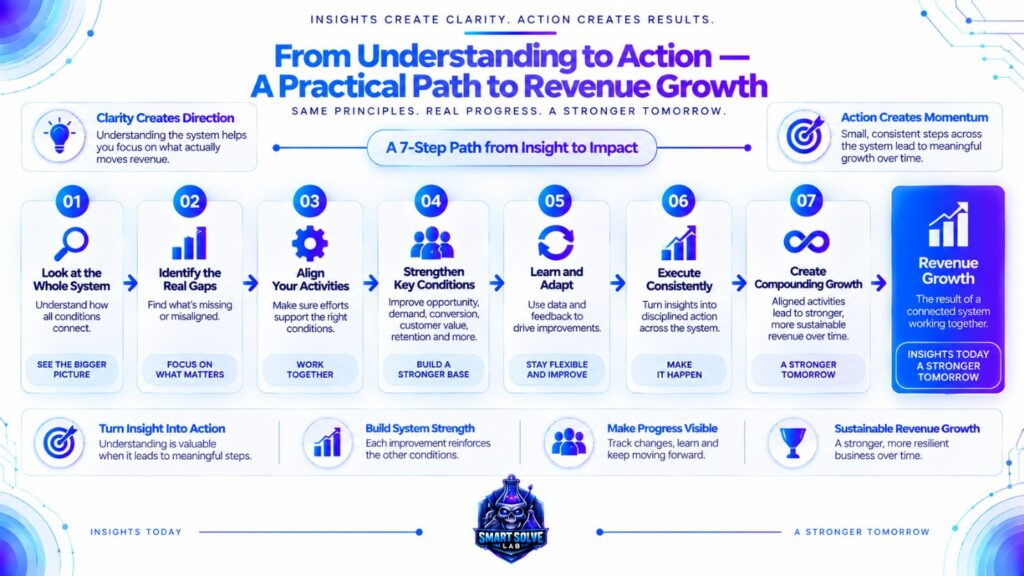
From Revenue Problems to Revenue Architecture
Once revenue growth is viewed as a connected system, individual revenue problems begin to look different.
A decline in sales, inconsistent conversion, weak customer retention, or limited customer value may still be important problems. But each one can also provide information about the wider revenue architecture.
Instead of treating every symptom as an isolated issue, the business can ask where that symptom sits within the connected system.
For example, a sales problem may raise questions about opportunity quality or conversion capacity. A customer retention problem may raise questions about customer value and relationship continuity. A revenue fluctuation may require looking across several connected conditions rather than focusing on one metric.
This creates a shift from “What is going wrong?” to “What does this pattern tell us about the revenue system?”
The purpose of this approach is not to assume that every visible problem has a hidden cause somewhere else.
It is to create enough system-level context to understand the problem before deciding what should be changed.
That distinction becomes increasingly important as a business grows. More activity creates more data, more interactions, and more opportunities for problems to appear in different parts of the system.
A connected revenue architecture provides a way to organize that complexity.
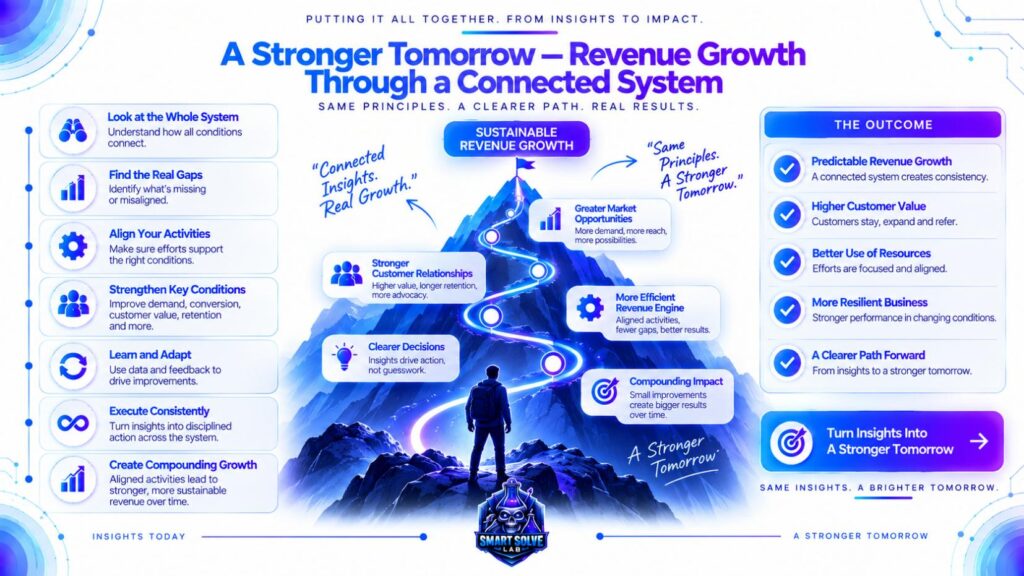
Key Insight: Revenue Growth Is a Connected System
The central idea is simple: revenue growth is not created by one activity, one metric, or one department working independently.
Revenue is an outcome of connected conditions.
Market opportunity influences the environment for growth. Demand creation brings relevant attention and interest into the system. Opportunity quality influences progression. Conversion capacity influences customer acquisition. Customer value influences the strength of the customer relationship. Retention and expansion influence what happens after acquisition. Learning and reinforcement help the system improve through experience.
These conditions do not operate in isolation.
That is why a business can be busy across many revenue activities and still struggle to understand why growth feels difficult.
It is also why improving one condition may change what becomes visible elsewhere in the system.
The goal is therefore not simply to do more.
The goal is to understand how the different parts of the revenue system work together, where the current pattern may be constrained, and what the business needs to understand next.
This system-level perspective provides a stronger foundation for deeper revenue diagnosis and more deliberate execution.
Where to Go Next: Understand Your Complete Revenue Growth System
If revenue growth feels difficult even when marketing, sales, conversion, customer acquisition, and other activities are active, the next step is not necessarily to add more activity.
The more useful next step may be to understand how the conditions behind revenue growth are connected.
This means looking beyond individual metrics and examining the wider relationship between Market Opportunity, Demand Creation, Opportunity Quality, Conversion Capacity, Customer Value, Retention & Expansion, and Learning & Reinforcement.
Each condition can matter on its own, but the larger insight comes from understanding how they interact.
For businesses that need a broader system-level understanding, the next layer is the Revenue Growth System — a deeper framework for understanding the architecture, relationships, dependencies, and constraints that can shape revenue growth.
That deeper layer belongs beyond this article’s introductory explanation. It is designed to help businesses move from recognizing individual revenue problems toward understanding the complete revenue system they operate within.
From there, the practical question becomes more specific: which conditions require deeper diagnostic attention, how are they connected, and where should the business focus next?
Key Takeaways
- Revenue growth is a connected outcome, not the result of one isolated activity.
- More marketing activity does not automatically create proportional revenue growth.
- Market Opportunity, Demand Creation, Opportunity Quality, Conversion Capacity, Customer Value, Retention & Expansion, and Learning & Reinforcement are connected conditions within the revenue system.
- A visible revenue problem may not always represent the complete underlying constraint.
- Improving one condition can change the wider revenue picture and make another constraint more visible.
- Traffic, leads, customers, conversion rate, acquisition, and retention are useful evidence, but no single metric explains the complete revenue system.
- System-level understanding helps businesses interpret revenue problems in context rather than treating every symptom as an isolated issue.
- The next step is to understand how the complete revenue architecture connects and where deeper diagnostic attention may be needed.
Conclusion
Revenue growth can feel difficult even when a business is active across marketing, demand generation, sales, conversion, customer acquisition, and customer relationships.
The difficulty is often not simply a lack of activity.
It can come from the way different revenue conditions interact.
Market opportunity, demand creation, opportunity quality, conversion capacity, customer value, retention and expansion, and learning and reinforcement all contribute to the wider revenue picture.
That is why more marketing does not automatically solve every revenue problem.
More traffic does not automatically create revenue. More leads do not automatically create sales. More customers do not automatically create sustainable revenue growth.
Each activity provides information about part of the system.
The deeper understanding comes from seeing how those parts connect.
Once revenue is viewed as a connected system, individual problems become easier to place within a wider context. A visible symptom can be investigated without automatically assuming that it represents the complete underlying constraint.
And when one condition improves, the business can recognize that the revenue picture may change and that another condition may require attention.
The goal is therefore not simply to increase activity.
It is to understand the architecture behind the activity.
That system-level perspective creates the foundation for deeper revenue diagnosis, clearer priorities, and more deliberate execution.
If you want to move beyond individual revenue problems and understand the complete structure connecting these conditions, the next layer is the Revenue Growth System — where the wider architecture, dependencies, constraints, and reinforcement cycle can be examined together.
Recommended Reading
- High Website Traffic Still Fails to Generate Revenue — Understand why traffic and attention do not automatically translate into revenue.
- Why Marketing Campaigns Work But Revenue Doesn’t Grow — Explore the gap between marketing activity and the wider revenue outcome.
- Digital Growth Systems — Explore related growth-system content covering visibility, conversion, trust, and revenue connections.
FAQs
Why does revenue growth feel difficult even when marketing is working?
Revenue growth can feel difficult because marketing is only one condition within a wider revenue system. Demand, opportunity quality, conversion capacity, customer value, retention and expansion, and learning also influence the overall revenue outcome. Marketing activity can therefore be active without automatically producing proportional revenue growth.
Why doesn’t more marketing always create more revenue?
More marketing can increase attention, demand, traffic, or opportunities, but revenue depends on what happens across the connected conditions that follow. If opportunity quality, conversion capacity, customer value, or retention conditions are limiting growth, increasing marketing activity alone may not resolve the wider revenue constraint.
What are the seven conditions that influence revenue growth?
The seven conditions are Market Opportunity, Demand Creation, Opportunity Quality, Conversion Capacity, Customer Value, Retention & Expansion, and Learning & Reinforcement. They should be understood as connected conditions within a wider revenue architecture rather than as seven independent tactics.
Why is revenue an outcome rather than a single growth lever?
Revenue reflects the combined effect of multiple conditions across the business. Market opportunity, demand, opportunity quality, conversion, customer value, retention, expansion, and learning can all influence the final revenue outcome. This is why revenue cannot be fully explained by one activity or metric.
Why can a revenue problem appear in one area but originate somewhere else?
A revenue problem can become visible at one stage while being influenced by connected conditions elsewhere. For example, a sales problem may involve opportunity quality, while a retention problem may be influenced by customer value or expectations established earlier. The visible symptom should therefore be interpreted as evidence within the wider system rather than automatically treated as the complete diagnosis.
Why can improving one revenue condition make another constraint more visible?
Revenue conditions are connected. When one limitation improves, the relative importance of another condition can become more visible. This does not necessarily mean the previous improvement failed. It can mean that the revenue system has changed and another condition now requires deeper attention.
How can a business understand revenue growth as a connected system?
Start by looking beyond individual metrics and examining the relationships between Market Opportunity, Demand Creation, Opportunity Quality, Conversion Capacity, Customer Value, Retention & Expansion, and Learning & Reinforcement. The goal is to understand how these conditions interact and where the wider system may be limiting the revenue outcome.
Leave a Reply