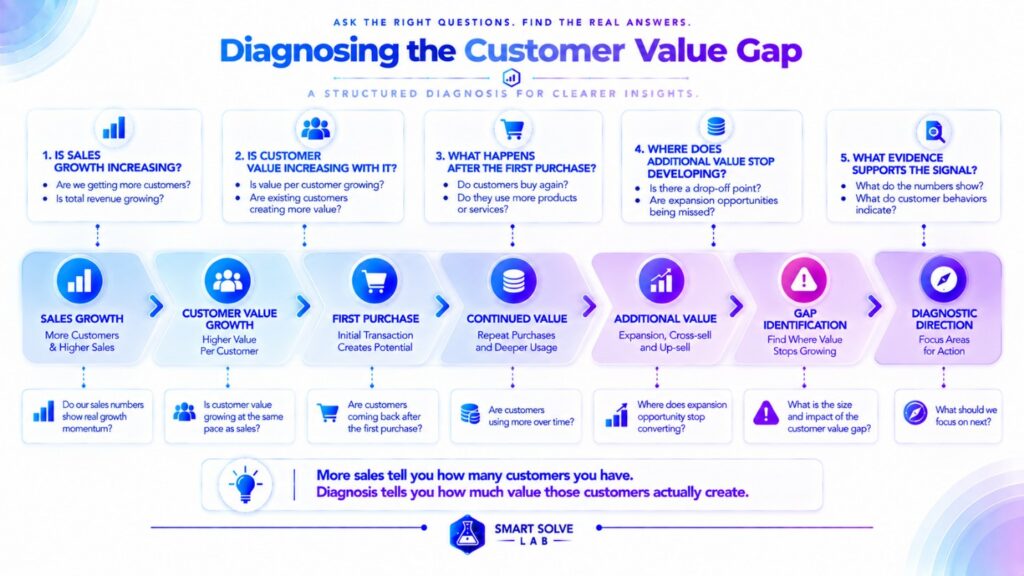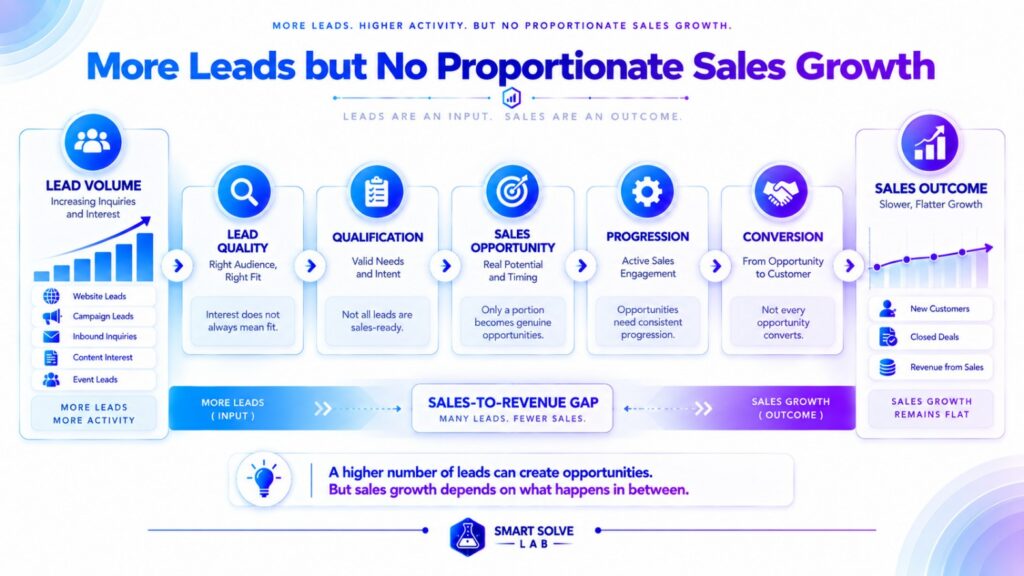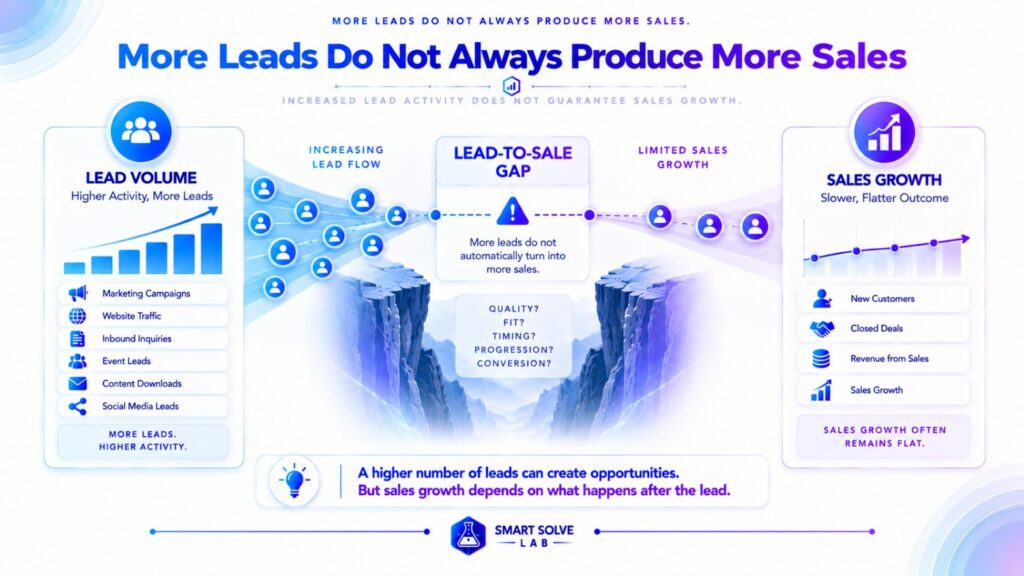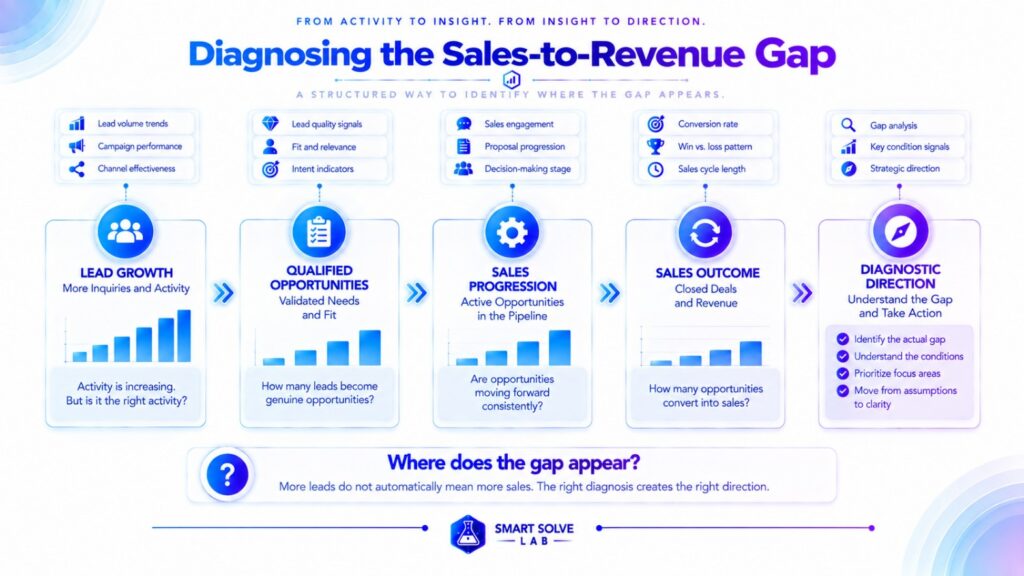
• Why Revenue Growth Feels So Difficult (And Why More Marketing Doesn’t Always Fix It)

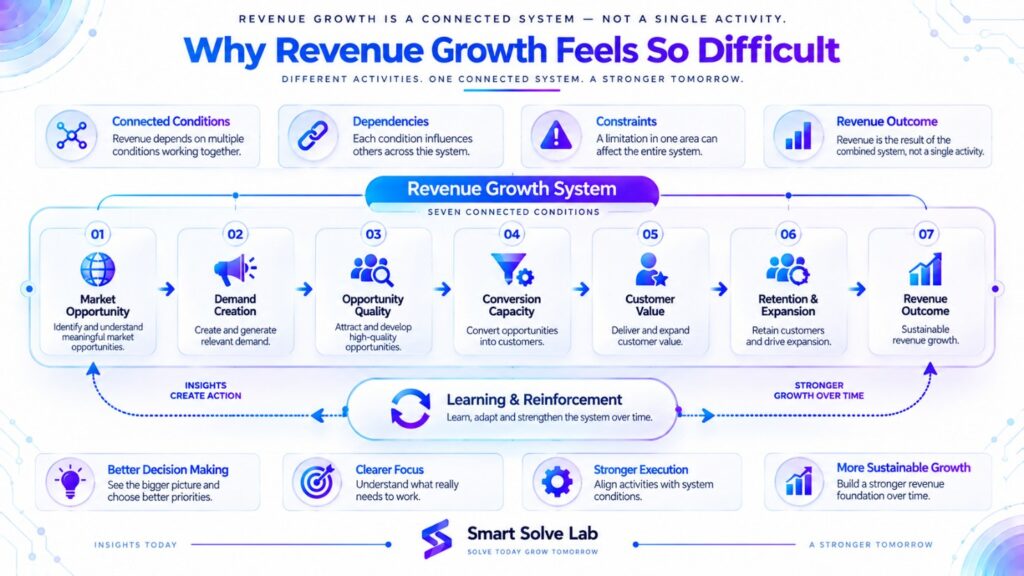
    Revenue growth system showing market opportunity, demand creation, opportunity quality, conversion capacity, customer value, retention and expansion, and learning and reinforcement

    Introduction

    Revenue growth can feel difficult even when a business is busy.

    Marketing campaigns may be running. Demand may be increasing. Leads may be coming in. Sales conversations may be happening. Customers may be buying, and existing customers may still be engaging with the business.

    Yet the overall revenue picture can remain harder to understand than expected.

    The natural response is often to increase activity — more marketing, more traffic, more leads, more campaigns, or more sales effort. But activity in one part of the business does not automatically mean that the wider revenue system is working as a connected whole.

    Revenue is an outcome of multiple conditions working together.

    A business needs a meaningful market opportunity. It needs to create relevant demand, generate quality opportunities, convert those opportunities into customers, create customer value, maintain and expand customer relationships, and continuously learn from what happens across the system.

    This is why a revenue problem can sometimes appear in one area while its underlying limitation exists somewhere else.

    A conversion problem, for example, may not be explained by conversion alone. Opportunity quality, demand, customer value, or another connected condition may also influence what eventually happens to revenue.

    There is another important consideration: improving one condition does not necessarily mean the entire revenue system is now complete. As one constraint improves, another condition may become more visible. The revenue picture can change as the system changes.

    This means revenue growth cannot always be understood through a single metric or isolated activity.

    Traffic is not revenue. Leads are not revenue. Customers are not revenue. Conversion rate is not revenue. Acquisition is not revenue. Retention is not revenue.

    These measures provide useful evidence, but they represent different parts of a much larger system.

    The more useful question is therefore not simply:

    “Which revenue activity should we increase?”

    It is:

    “How are the different conditions connected, and where might the wider system be limiting the revenue outcome?”

    This article introduces that system-level way of thinking about revenue growth — and explains why more marketing does not automatically solve every revenue growth problem.

    Why Revenue Growth Can Feel Difficult Even When Business Is Active
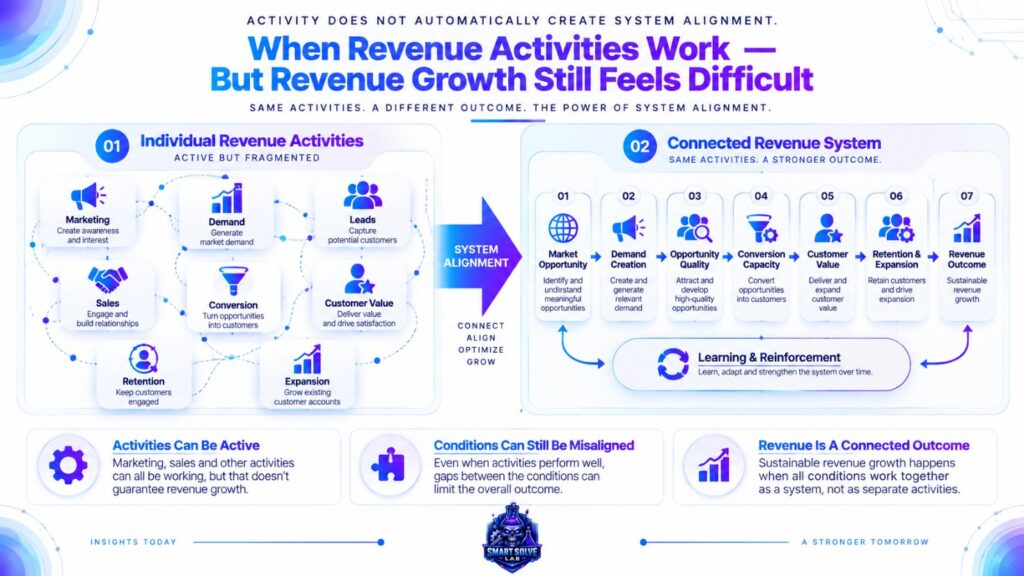
    Connected revenue system showing how marketing, demand, leads, sales, conversion, customer value, retention, and expansion work together

    Revenue growth can feel difficult even when a business is clearly active.

    Marketing campaigns may be running. Demand may be increasing. Leads may be coming in. Sales conversations may be happening. Customers may be buying, and existing customers may still be engaging with the business.

    Yet the overall revenue picture can remain harder to understand than expected.

    This happens because business activity and revenue growth are not the same thing. A business can generate significant activity across different areas without those activities combining into a strong, connected revenue outcome.

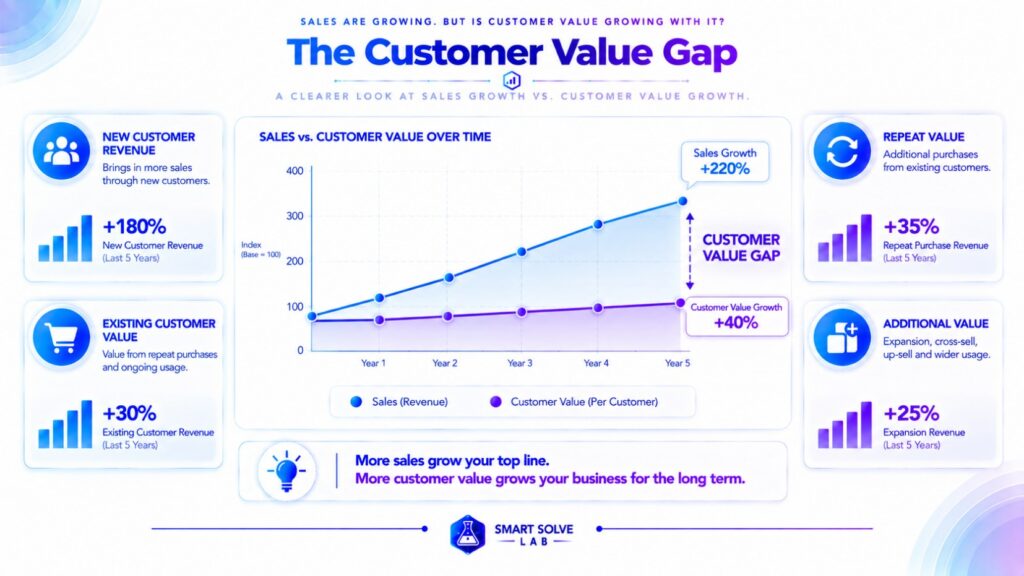
    For example, a business may increase website traffic while seeing little change in revenue. It may generate more leads without seeing proportional sales growth. It may acquire new customers while existing customer relationships remain weak.

    These situations do not necessarily mean that one activity is completely failing. They may indicate that different parts of the revenue system are not contributing to the outcome in the same way.

    This is why looking at revenue growth through a single activity can create an incomplete picture.

    The more useful starting point is to understand what is happening between business activity and the final revenue outcome.

    Why More Marketing Does Not Automatically Create More Revenue

    When revenue growth feels difficult, increasing marketing activity is often one of the first responses.

    A business may invest in more campaigns, increase traffic generation, publish more content, expand advertising, or try to generate more leads.

    These activities can be useful. But more marketing activity does not automatically mean more revenue.

    Marketing can create attention, demand, traffic, and opportunities. Revenue depends on what happens across the conditions that follow.

    If the opportunities being created are not strong enough, increasing their volume may not solve the underlying problem. If conversion capacity is limited, additional demand may simply create more opportunities that fail to progress. If customer value or retention is weak, acquiring more customers may not produce the expected long-term revenue effect.

    This is why a business can be marketing actively while still struggling to explain why revenue is not growing proportionally.

    The issue is not necessarily that marketing is ineffective. The issue may be that marketing is being viewed as an isolated growth lever rather than as one part of a wider revenue system.
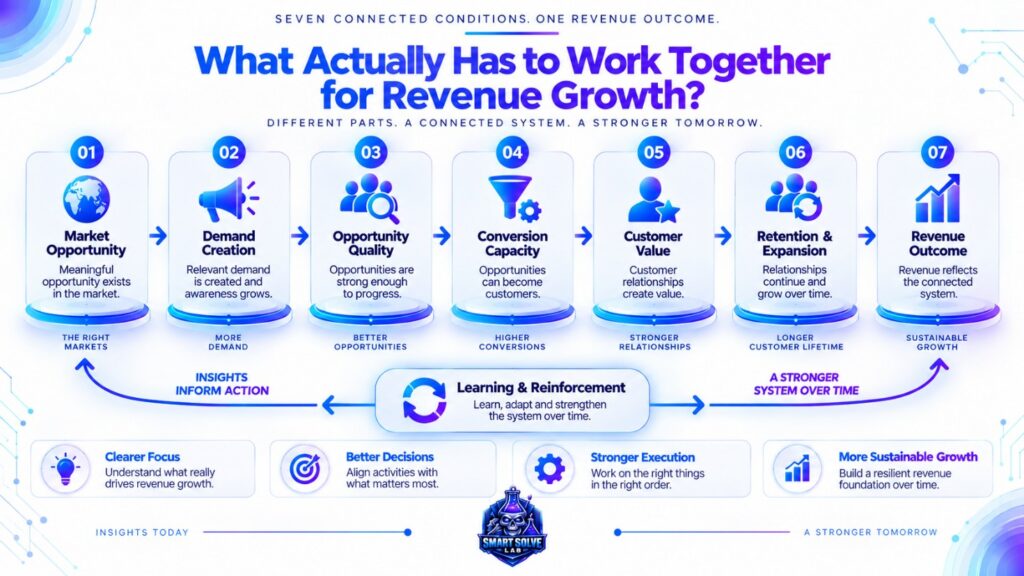
    Seven connected conditions of revenue growth from market opportunity and demand creation to conversion, customer value, retention and revenue outcome

    As explained in Why Marketing Campaigns Work But Revenue Doesn’t Grow, marketing activity can produce results without those results necessarily translating into proportional revenue growth.

    Understanding that difference changes the question from “How can we do more marketing?” to “What happens to the value created by our marketing as it moves through the wider revenue system?”

    That question leads to a deeper system-level view of revenue growth.

    The Hidden Problem: Revenue Activities May Be Working Without Working Together

    One of the more difficult revenue problems to recognize is when individual activities appear to be working, but the overall system still does not produce the expected revenue outcome.

    Marketing may be generating attention. Sales may be having conversations. The website may be receiving visitors. Customers may be purchasing. Existing customers may still be engaging with the business.

    Looking at each activity separately can make the business appear healthy.

    But revenue growth depends on how these activities connect.

    Traffic needs to reach relevant opportunities. Opportunities need sufficient quality to progress. The system needs the capacity to convert those opportunities into customers. Customers need to receive enough value for the relationship to continue and potentially expand.

    This means a weakness in one connected condition can influence what happens elsewhere.

    For example, strong traffic does not automatically create revenue if the visitors are poorly aligned with the business. Similarly, strong lead volume does not automatically create sales if opportunity quality or conversion capacity is limiting progression.

    This is why high website traffic can still fail to produce revenue. Traffic is an important signal, but it is only one part of the wider revenue picture.
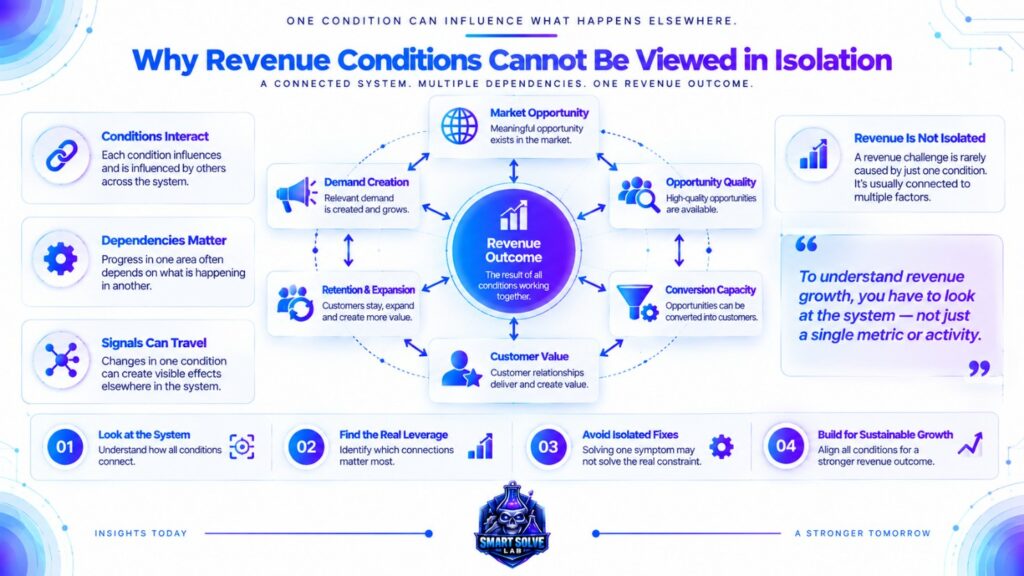
    Interconnected revenue growth conditions showing how market opportunity, demand, opportunity quality, conversion, customer value, and retention influence revenue

    The hidden problem, therefore, may not be a complete absence of activity. It may be a lack of connection between the activities that are already happening.

    Once revenue is viewed as a connected outcome rather than a collection of isolated activities, the next question becomes much more useful: what actually has to work together for revenue growth to occur?

    What Actually Has to Work Together for Revenue Growth?

    Once it becomes clear that revenue growth cannot be explained by marketing activity alone, the next question is what actually has to work together.

    Revenue growth depends on several connected conditions rather than one isolated activity.

    A business first needs a meaningful Market Opportunity. It then needs Demand Creation to bring relevant attention and interest into the system.

    That demand needs to develop into Opportunity Quality — opportunities that are sufficiently relevant and strong enough to progress.

    The business then needs Conversion Capacity to turn suitable opportunities into customers.

    But the system does not end when a customer is acquired. Customer Value influences the economic strength of the relationship, while Retention & Expansion determine whether customer relationships can continue and grow.

    Finally, Learning & Reinforcement allows the business to learn from what is happening across the system and strengthen the conditions that support future growth.

    These conditions can be viewed as a connected architecture:

    Market Opportunity → Demand Creation → Opportunity Quality → Conversion Capacity → Customer Value → Retention & Expansion → Revenue Outcome → Learning & Reinforcement

    The important point is not to treat these as seven separate tactics. Their relationship is what makes the architecture useful.
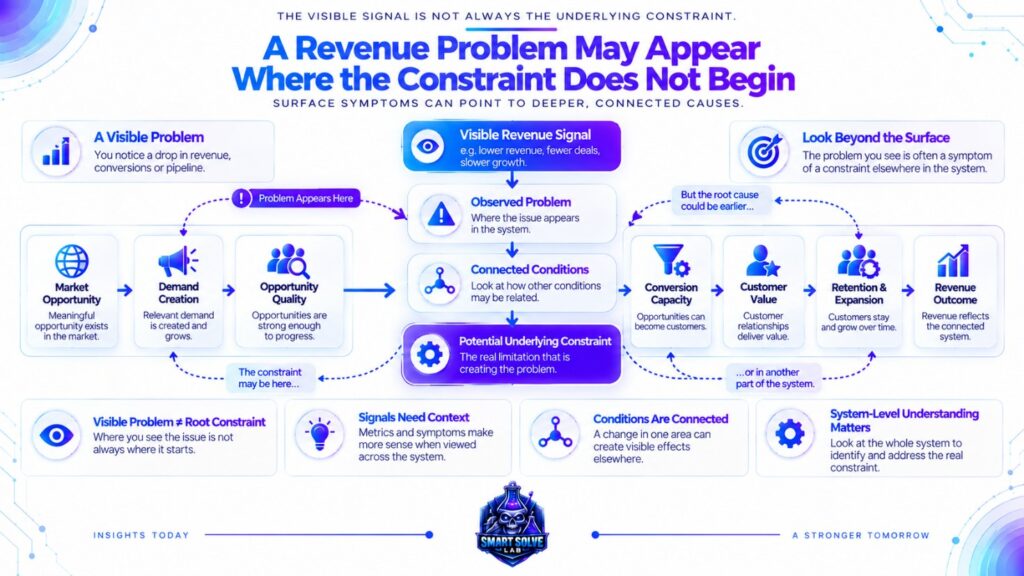
    Revenue diagnostic framework showing how a visible revenue problem can differ from the underlying constraint within the connected growth system
    A visible revenue problem is not always the underlying constraint.

    Market Opportunity: Is There a Meaningful Opportunity to Grow?

    Revenue growth begins with the opportunity available to the business.

    A business can have strong marketing activity, an active sales team, and an efficient conversion process, but those activities still operate within a market context.

    The first question is therefore whether there is a meaningful opportunity for the business to grow within the market it is serving.

    This includes considering whether the business is addressing a meaningful need, whether there is sufficient demand for the type of value being offered, and whether the market provides room for the business to create and capture economic value.

    This does not mean that market opportunity alone creates revenue.

    It means that the wider revenue system is operating within a particular opportunity environment.

    If the opportunity is limited, unclear, poorly aligned, or difficult to access, increasing activity further down the system may not fully compensate for that limitation.

    This is one reason revenue growth should not be examined only through marketing, sales, or conversion metrics. Those metrics describe activity and performance within the system, but they do not independently explain the entire revenue opportunity.

    The market therefore forms one of the structural conditions that needs to be understood before interpreting the performance of the conditions that follow.
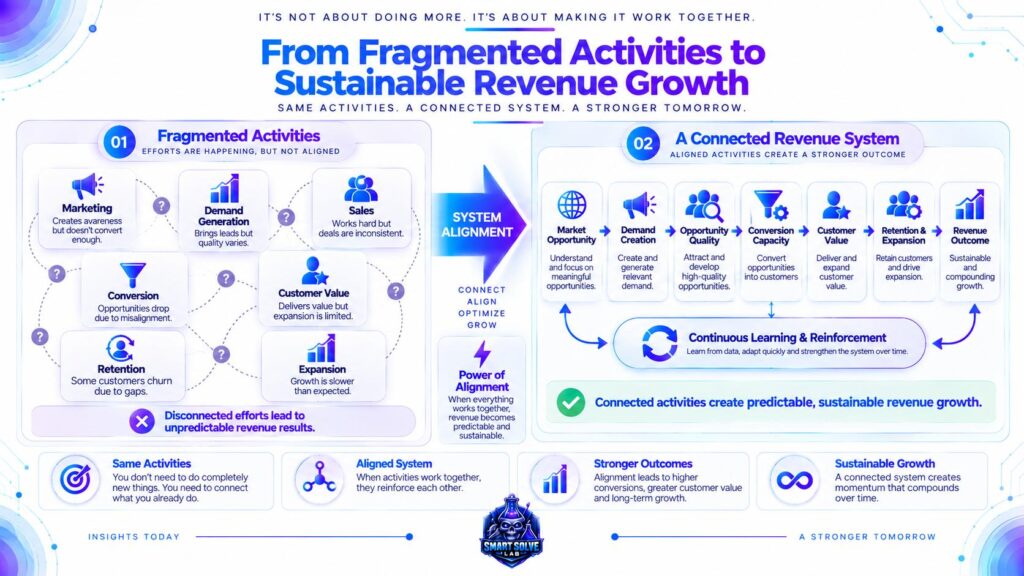
    Revenue constraint system showing how improving one condition can make another constraint more visible
    Improving one constraint can change the revenue picture and reveal another constraint.

    Demand Creation: Can the Business Create Relevant Demand?

    Having a market opportunity does not automatically mean that relevant demand will reach the business.

    Demand creation is the condition through which the business creates awareness, interest, and meaningful demand among people or organizations that may have a genuine need for what it offers.

    This is where marketing activity becomes part of the wider revenue architecture.

    But the important question is not simply whether marketing is active.

    The more useful question is whether the activity is creating relevant demand that can move into the next conditions of the system.

    A business may generate large amounts of attention without creating proportionate commercial opportunity. Traffic may increase, impressions may rise, or campaigns may generate engagement, while the resulting demand remains poorly aligned with the business or its offer.

    This is why marketing performance needs to be interpreted within the wider revenue pathway rather than treated as the final outcome.

    For example, high website traffic can still exist without proportional revenue when the attention being generated does not translate effectively into the conditions that follow.

    Demand creation therefore plays an important role in the revenue system, but it is only one connected condition.

    The next question is whether the demand being created develops into opportunities strong enough to progress.
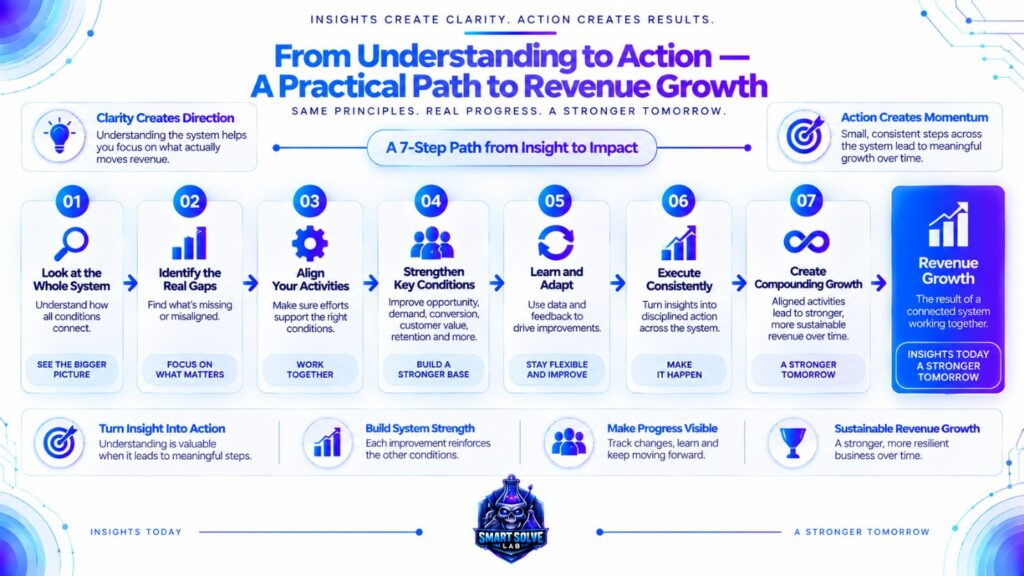
    Revenue growth system showing why traffic, leads, customers, conversion rate, acquisition, and retention metrics cannot explain the whole revenue system individually
    Individual metrics provide signals, but no single metric explains the complete revenue system.

    Opportunity Quality: Are the Opportunities Strong Enough to Progress?

    Creating demand is only one step in the revenue system. The next question is whether that demand develops into opportunities that are strong enough to move forward.

    Not every visitor, lead, inquiry, or prospect represents the same level of opportunity.

    Some may have a genuine need and strong alignment with the business. Others may be curious but not ready to act. Some may fit the audience but have limited relevance to the specific offer.

    This difference matters because increasing the volume of opportunities does not automatically increase the quality of the opportunities entering the revenue system.

    A business can therefore experience strong demand activity while still seeing limited progression further down the system.

    This is one reason why revenue growth cannot be understood simply by counting leads or opportunities. The quality and relevance of those opportunities influence what can happen next.

    Opportunity quality also connects directly with conversion capacity. If opportunities are poorly aligned, even a strong conversion process may have limited ability to produce proportional results.

    Understanding this distinction helps separate a quantity problem from a quality and alignment problem.

    The question is therefore not simply how many opportunities the business is creating, but whether the opportunities being created are sufficiently relevant and strong enough to progress.

    Conversion Capacity: Can the System Convert Opportunity Into Customers?

    Even when a business has a meaningful market opportunity, creates relevant demand, and generates suitable opportunities, revenue growth still depends on what happens next.

    The system needs the capacity to convert suitable opportunities into customers.

    Conversion capacity is broader than a single conversion rate.

    It includes the conditions that help a potential customer understand the offer, evaluate its relevance, develop sufficient confidence, and move toward a decision.

    This is why a business can have traffic, leads, and opportunities while still experiencing weak or inconsistent customer acquisition.

    For example, visitors may reach the website but fail to understand the next step. Prospects may show interest but hesitate before making a decision. A sales funnel may receive opportunities but lose them at specific stages of the journey.

    These situations can indicate a conversion condition that needs deeper understanding rather than simply a need for more traffic.

    As Why Your Sales Funnel Is Not Converting explains, customers can enter a funnel and still fail to complete the journey when important structural conditions are not aligned.

    Conversion therefore sits within the wider revenue architecture. It connects opportunity quality with customer acquisition, rather than operating as an isolated metric.

    And even successful conversion does not complete the revenue system. Once customers enter the business, another set of conditions determines the strength and continuity of the customer relationship.

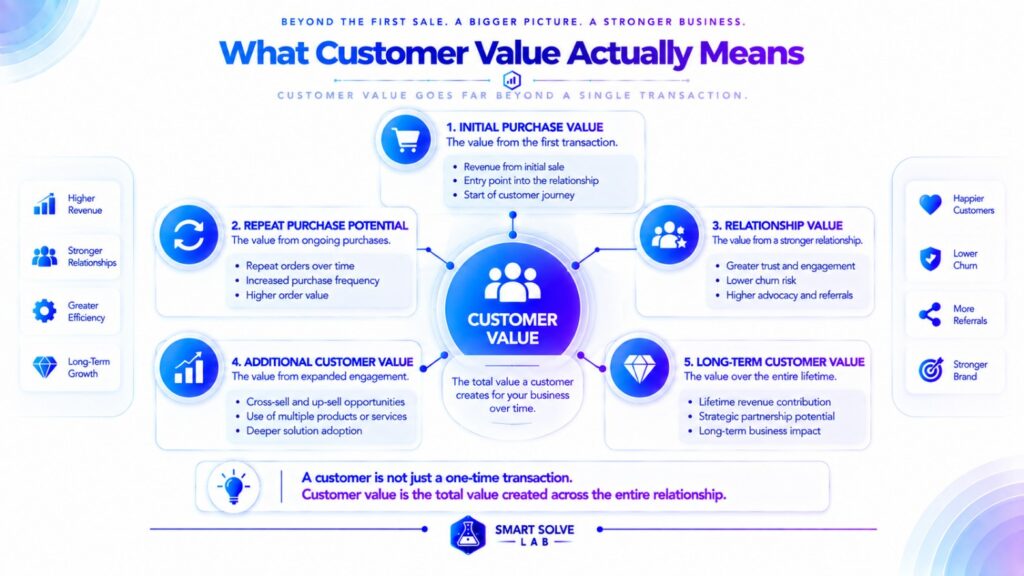
    Customer Value: Does the Customer Relationship Create Economic Strength?

    Revenue growth does not end when a customer is acquired.

    Customer acquisition creates an important transition in the revenue system, but the economic strength of that relationship depends on the value created after the customer enters the business.

    Customer value is therefore another important condition within the revenue architecture.

    A customer may purchase once, but the wider revenue outcome can depend on whether the relationship creates meaningful value for both the customer and the business.

    This includes the customer’s experience of the product or service, the relevance of the solution over time, and the strength of the relationship created through continued value.

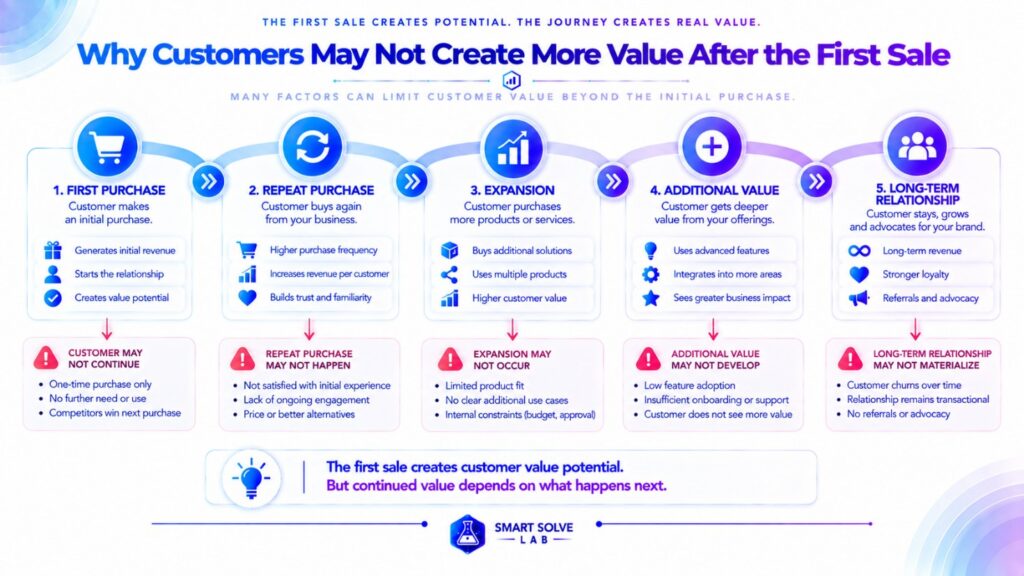
    Weak customer value can influence what happens later in the system. Customers may not continue the relationship, may not return, or may have little reason to expand their engagement.

    This is why acquisition numbers alone cannot explain the full revenue picture.

    A business can successfully bring customers into the system while still having difficulty creating the level of customer value needed to support stronger and more sustainable revenue outcomes.

    Customer value therefore connects the conversion stage with what happens after acquisition — including retention and expansion.

    The important system-level question becomes: after a customer enters the business, does the relationship create enough ongoing value to support continued economic strength?
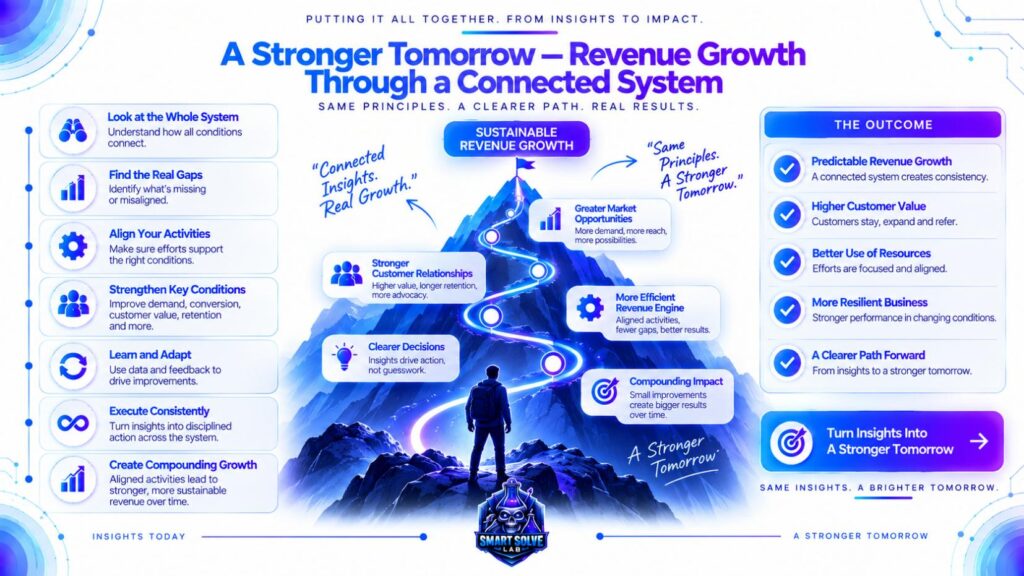
    Revenue growth architecture connecting revenue problems, signals, conditions, dependencies, constraints, and system-level understanding

    Retention & Expansion: Can Customer Relationships Continue and Grow?

    Customer acquisition is not the end of the revenue system. What happens after acquisition can influence how much economic value a business is able to create from its customer relationships over time.

    Retention refers to the ability to maintain customer relationships, while expansion considers whether those relationships can grow in meaningful ways.

    A business may acquire customers successfully but still experience limited revenue growth if customers do not remain engaged, return, renew, or continue the relationship.

    This creates an important distinction between customer acquisition and customer continuity.

    Retention and expansion can also be influenced by conditions that developed earlier in the system. Customer fit, expectations, product or service experience, ongoing relevance, and the value created through the relationship can all affect what happens after acquisition.

    This means that a retention problem should not automatically be interpreted as a problem that begins only after the customer has been acquired.

    The wider revenue system matters.

    If customer relationships continue and create additional value, they can strengthen the revenue outcome. If relationships end too early or fail to develop, the business may need to replace lost value through continued acquisition.

    Retention and expansion therefore connect customer value with the longer-term revenue outcome.

    Learning & Reinforcement: Can the System Strengthen What Works?

    A revenue system does not remain static.

    Markets change. Customer behaviour changes. Demand changes. Opportunities change. Conversion patterns change. Customer relationships change.

    This means revenue growth also depends on the business’s ability to learn from what is happening across the system.

    Learning & Reinforcement is the condition that allows the business to interpret experience, recognize meaningful patterns, and strengthen the parts of the system that are supporting growth.

    This is different from simply collecting more metrics.

    Metrics can provide evidence, but evidence becomes more useful when it is interpreted in context.

    For example, a change in conversion rate may be meaningful, but understanding why it changed may require looking at opportunity quality, demand, customer fit, or another connected condition.

    Similarly, an increase in customer acquisition may appear positive while the wider system reveals a different pattern in customer value or retention.

    Learning therefore helps the business move beyond isolated observations and understand what the changing revenue picture may be indicating.

    The reinforcement part is equally important. When the business understands which conditions are supporting growth, it can strengthen those conditions rather than repeatedly treating every revenue change as a completely separate problem.

    This creates an important system loop:

    Growth → Learning → Reinforcement → Stronger Growth

    The purpose is not to assume that every positive result will continue automatically. It is to recognize that sustainable system improvement requires learning from what actually happens.

    How the Seven Conditions Depend on One Another

    The seven conditions become more useful when they are viewed as connected parts of one revenue system rather than as separate departments or independent growth tactics.

    Market Opportunity influences the environment in which growth can occur.

    Demand Creation helps bring relevant attention and interest into the system.

    Opportunity Quality influences whether that demand develops into opportunities that can meaningfully progress.

    Conversion Capacity determines how effectively suitable opportunities can become customers.

    Customer Value influences the economic strength of the customer relationship.

    Retention & Expansion determine whether those relationships can continue and develop.

    Learning & Reinforcement allows the business to learn from the system and strengthen what is working.

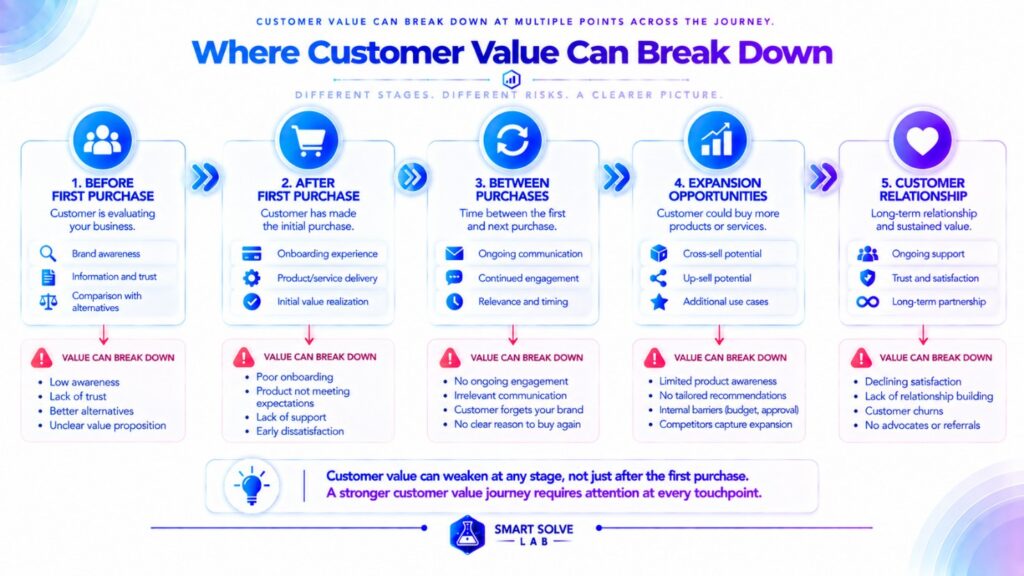
    Because these conditions are connected, weakness in one area can affect what becomes visible elsewhere.

    A business may therefore observe a conversion problem when the deeper limitation is partly related to opportunity quality. It may see a retention problem when customer expectations or value were not sufficiently aligned earlier in the relationship.

    This does not mean that every visible problem originates somewhere else. It means that the visible symptom should be interpreted within the wider system before assuming that the symptom itself is the complete explanation.

    This is one of the central ideas behind system-level revenue thinking: the conditions should be understood together because their relationships influence the overall revenue outcome.

    Why a Revenue Problem May Appear Somewhere Different From Its Underlying Constraint

    One of the reasons revenue problems can be difficult to understand is that the place where a problem becomes visible is not always the place where its underlying limitation exists.

    A business may notice that sales are weak, for example, but the visible sales problem may be influenced by the quality of opportunities entering the sales process.

    Similarly, a conversion problem may appear on a website or sales funnel while the wider issue is related to demand relevance, opportunity quality, customer fit, or another connected condition.

    The same principle can apply after acquisition.

    A business may observe weak retention, but the conditions influencing that outcome may include expectations established before purchase, customer value, product or service experience, or the relevance of the relationship over time.

    This does not mean that every visible problem has a hidden cause somewhere else.

    It means that the visible symptom should be treated as evidence rather than automatically treated as the complete diagnosis.

    This distinction matters because fixing only the visible symptom can sometimes leave the wider constraint unchanged.

    A more useful approach is to ask:

    What condition could be influencing this outcome, and how is that condition connected to the rest of the revenue system?

    That question moves the business from isolated problem-solving toward system-level understanding.

    Why Revenue Constraints Are Connected

    Revenue constraints rarely exist in complete isolation.

    The seven conditions discussed earlier are connected, which means a limitation in one part of the system can influence the performance that becomes visible somewhere else.

    For example, increasing demand may create more opportunities, but if opportunity quality does not improve with that demand, the additional volume may not produce proportional revenue growth.

    Similarly, improving conversion capacity may increase customer acquisition, but if customer value or retention remains weak, the overall revenue outcome may still remain limited.

    This is why improving one area does not automatically mean that the wider revenue system is now optimized.

    When one constraint improves, the relative importance of another condition can become more visible.

    The business may therefore experience a changing revenue picture even though the original improvement was real.

    This should not automatically be interpreted as the previous improvement failing.

    It can simply mean that the system has changed and another condition now deserves greater diagnostic attention.

    The important principle is:

    Revenue growth is influenced by connected conditions, so constraints should be understood in relation to the wider system rather than as isolated problems.

    Why One Revenue Metric Cannot Explain the Whole System

    Revenue growth is often reduced to a small number of visible metrics.

    Traffic may be increasing. Leads may be increasing. Conversion rate may be improving. Customer numbers may be rising.

    These measurements can all provide useful evidence, but none of them independently explains the complete revenue system.

    Traffic is not revenue.

    Leads are not revenue.

    Customers are not revenue.

    Conversion rate is not revenue.

    Acquisition is not revenue.

    Retention is not revenue.

    Each measure describes a different part of the system.

    A traffic increase, for example, may indicate stronger demand creation, but it does not by itself explain opportunity quality, conversion capacity, customer value, or retention.

    Likewise, an improvement in conversion rate can be meaningful while still leaving questions about customer value and longer-term revenue contribution.

    This is why metrics are best treated as evidence rather than as the entire explanation.

    A system-level view asks what the metric is showing, what it does not show, and which connected conditions may help explain the pattern.

    For businesses using analytics, this broader interpretation is particularly important because measurement tools can provide detailed performance data without automatically providing the full business diagnosis.

    For example, Google Analytics can help businesses understand website and user behaviour data, but those measurements still need to be interpreted within the wider revenue context.

    The goal is therefore not to stop measuring individual metrics. It is to understand what each metric can tell you — and where the wider system needs to be considered.

    Why Isolated Optimization Can Keep Revenue Growth Difficult

    Once revenue growth is viewed as a connected system, another problem becomes easier to recognize: improving individual activities in isolation does not necessarily improve the complete revenue outcome.

    A business may optimize its traffic, improve its lead generation, increase its conversion rate, or strengthen customer acquisition.

    Each improvement can be meaningful on its own.

    But the overall revenue result still depends on how those improvements interact with the other conditions in the system.

    For example, generating more traffic may increase the number of visitors entering the business. But if the additional visitors are not sufficiently relevant, the increase may have limited impact further down the system.

    Similarly, improving conversion capacity can increase customer acquisition, while customer value or retention conditions may still determine how much longer-term economic value those customers create.

    This is why isolated optimization can create a cycle of continuous activity without resolving the wider revenue challenge.

    The question is not whether individual areas should be improved. They should.

    The deeper question is whether those improvements are being understood within the connected revenue architecture.

    A system-level approach therefore looks beyond individual performance and asks how each improvement changes the wider revenue picture.

    That shift moves the business from optimizing activities toward understanding relationships between conditions.

    Seeing the Complete Revenue Growth Architecture

    At this point, the revenue system can be viewed as a connected architecture rather than a collection of separate activities.

    The complete structure brings together the conditions discussed throughout this article:

    Market Opportunity
    ↓
    Demand Creation
    ↓
    Opportunity Quality
    ↓
    Conversion Capacity
    ↓
    Customer Value
    ↓
    Retention & Expansion
    ↓
    Revenue Outcome
    ↓
    Learning & Reinforcement

    This architecture does not suggest that revenue always moves through a perfectly linear sequence.

    Instead, it provides a way to understand how different conditions contribute to the overall revenue outcome and how learning from the system can strengthen future growth.

    The value of this perspective is that it prevents the business from treating every revenue problem as a completely separate problem.

    A weak result can be examined in context.

    A strong result can also be interpreted in context.

    And when one condition changes, the business can consider what that change means for the conditions connected to it.

    This is the difference between looking at revenue as a number and looking at revenue as the outcome of a connected system.

    How to Think About Revenue Growth at the System Level

    Thinking about revenue growth at the system level does not mean ignoring individual metrics, activities, or business functions.

    It means placing them into context.

    Instead of asking only:

    “Which activity should we increase?”

    the business can also ask:

    “Which condition is influencing the current revenue pattern, and how is it connected to the wider system?”

    This creates a more useful way to interpret revenue problems.

    A traffic increase can be examined as evidence about demand and visibility.

    A change in lead quality can provide evidence about opportunity conditions.

    A conversion change can provide evidence about progression and conversion capacity.

    Customer behaviour can provide evidence about value, retention, and expansion.

    Changes across several areas can then be considered together rather than interpreted as unrelated events.

    This does not automatically reveal the answer to every revenue problem. It creates a stronger framework for asking the right questions and identifying where deeper diagnostic attention may be needed.

    That distinction is important because system-level understanding comes before system-level optimization.

    Once the architecture is visible, the next step is to understand how revenue problems can be interpreted within that architecture.

    From Revenue Problems to Revenue Architecture

    Once revenue growth is viewed as a connected system, individual revenue problems begin to look different.

    A decline in sales, inconsistent conversion, weak customer retention, or limited customer value may still be important problems. But each one can also provide information about the wider revenue architecture.

    Instead of treating every symptom as an isolated issue, the business can ask where that symptom sits within the connected system.

    For example, a sales problem may raise questions about opportunity quality or conversion capacity. A customer retention problem may raise questions about customer value and relationship continuity. A revenue fluctuation may require looking across several connected conditions rather than focusing on one metric.

    This creates a shift from “What is going wrong?” to “What does this pattern tell us about the revenue system?”

    The purpose of this approach is not to assume that every visible problem has a hidden cause somewhere else.

    It is to create enough system-level context to understand the problem before deciding what should be changed.

    That distinction becomes increasingly important as a business grows. More activity creates more data, more interactions, and more opportunities for problems to appear in different parts of the system.

    A connected revenue architecture provides a way to organize that complexity.

    Key Insight: Revenue Growth Is a Connected System

    The central idea is simple: revenue growth is not created by one activity, one metric, or one department working independently.

    Revenue is an outcome of connected conditions.

    Market opportunity influences the environment for growth. Demand creation brings relevant attention and interest into the system. Opportunity quality influences progression. Conversion capacity influences customer acquisition. Customer value influences the strength of the customer relationship. Retention and expansion influence what happens after acquisition. Learning and reinforcement help the system improve through experience.

    These conditions do not operate in isolation.

    That is why a business can be busy across many revenue activities and still struggle to understand why growth feels difficult.

    It is also why improving one condition may change what becomes visible elsewhere in the system.

    The goal is therefore not simply to do more.

    The goal is to understand how the different parts of the revenue system work together, where the current pattern may be constrained, and what the business needs to understand next.

    This system-level perspective provides a stronger foundation for deeper revenue diagnosis and more deliberate execution.

    Where to Go Next: Understand Your Complete Revenue Growth System

    If revenue growth feels difficult even when marketing, sales, conversion, customer acquisition, and other activities are active, the next step is not necessarily to add more activity.

    The more useful next step may be to understand how the conditions behind revenue growth are connected.

    This means looking beyond individual metrics and examining the wider relationship between Market Opportunity, Demand Creation, Opportunity Quality, Conversion Capacity, Customer Value, Retention & Expansion, and Learning & Reinforcement.

    Each condition can matter on its own, but the larger insight comes from understanding how they interact.

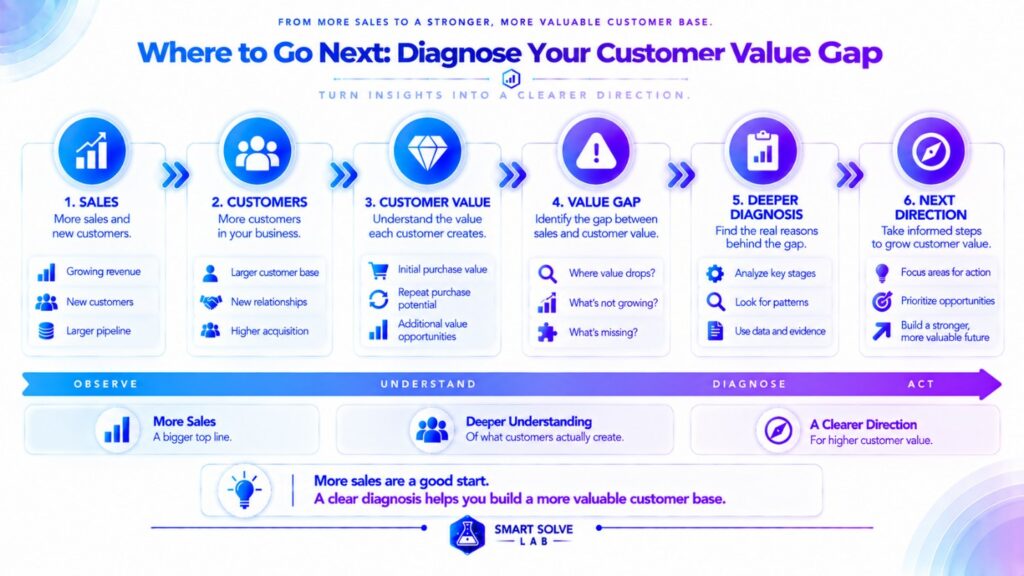
    For businesses that need a broader system-level understanding, the next layer is the Revenue Growth System — a deeper framework for understanding the architecture, relationships, dependencies, and constraints that can shape revenue growth.

    That deeper layer belongs beyond this article’s introductory explanation. It is designed to help businesses move from recognizing individual revenue problems toward understanding the complete revenue system they operate within.

    From there, the practical question becomes more specific: which conditions require deeper diagnostic attention, how are they connected, and where should the business focus next?

    Key Takeaways

    • Revenue growth is a connected outcome, not the result of one isolated activity.
    • More marketing activity does not automatically create proportional revenue growth.
    • Market Opportunity, Demand Creation, Opportunity Quality, Conversion Capacity, Customer Value, Retention & Expansion, and Learning & Reinforcement are connected conditions within the revenue system.
    • A visible revenue problem may not always represent the complete underlying constraint.
    • Improving one condition can change the wider revenue picture and make another constraint more visible.
    • Traffic, leads, customers, conversion rate, acquisition, and retention are useful evidence, but no single metric explains the complete revenue system.
    • System-level understanding helps businesses interpret revenue problems in context rather than treating every symptom as an isolated issue.
    • The next step is to understand how the complete revenue architecture connects and where deeper diagnostic attention may be needed.

    Conclusion

    Revenue growth can feel difficult even when a business is active across marketing, demand generation, sales, conversion, customer acquisition, and customer relationships.

    The difficulty is often not simply a lack of activity.

    It can come from the way different revenue conditions interact.

    Market opportunity, demand creation, opportunity quality, conversion capacity, customer value, retention and expansion, and learning and reinforcement all contribute to the wider revenue picture.

    That is why more marketing does not automatically solve every revenue problem.

    More traffic does not automatically create revenue. More leads do not automatically create sales. More customers do not automatically create sustainable revenue growth.

    Each activity provides information about part of the system.

    The deeper understanding comes from seeing how those parts connect.

    Once revenue is viewed as a connected system, individual problems become easier to place within a wider context. A visible symptom can be investigated without automatically assuming that it represents the complete underlying constraint.

    And when one condition improves, the business can recognize that the revenue picture may change and that another condition may require attention.

    The goal is therefore not simply to increase activity.

    It is to understand the architecture behind the activity.

    That system-level perspective creates the foundation for deeper revenue diagnosis, clearer priorities, and more deliberate execution.

    If you want to move beyond individual revenue problems and understand the complete structure connecting these conditions, the next layer is the Revenue Growth System — where the wider architecture, dependencies, constraints, and reinforcement cycle can be examined together.

    Recommended Reading

    FAQs

    Why does revenue growth feel difficult even when marketing is working?

    Revenue growth can feel difficult because marketing is only one condition within a wider revenue system. Demand, opportunity quality, conversion capacity, customer value, retention and expansion, and learning also influence the overall revenue outcome. Marketing activity can therefore be active without automatically producing proportional revenue growth.

    Why doesn’t more marketing always create more revenue?

    More marketing can increase attention, demand, traffic, or opportunities, but revenue depends on what happens across the connected conditions that follow. If opportunity quality, conversion capacity, customer value, or retention conditions are limiting growth, increasing marketing activity alone may not resolve the wider revenue constraint.

    What are the seven conditions that influence revenue growth?

    The seven conditions are Market Opportunity, Demand Creation, Opportunity Quality, Conversion Capacity, Customer Value, Retention & Expansion, and Learning & Reinforcement. They should be understood as connected conditions within a wider revenue architecture rather than as seven independent tactics.

    Why is revenue an outcome rather than a single growth lever?

    Revenue reflects the combined effect of multiple conditions across the business. Market opportunity, demand, opportunity quality, conversion, customer value, retention, expansion, and learning can all influence the final revenue outcome. This is why revenue cannot be fully explained by one activity or metric.

    Why can a revenue problem appear in one area but originate somewhere else?

    A revenue problem can become visible at one stage while being influenced by connected conditions elsewhere. For example, a sales problem may involve opportunity quality, while a retention problem may be influenced by customer value or expectations established earlier. The visible symptom should therefore be interpreted as evidence within the wider system rather than automatically treated as the complete diagnosis.

    Why can improving one revenue condition make another constraint more visible?

    Revenue conditions are connected. When one limitation improves, the relative importance of another condition can become more visible. This does not necessarily mean the previous improvement failed. It can mean that the revenue system has changed and another condition now requires deeper attention.

    How can a business understand revenue growth as a connected system?

    Start by looking beyond individual metrics and examining the relationships between Market Opportunity, Demand Creation, Opportunity Quality, Conversion Capacity, Customer Value, Retention & Expansion, and Learning & Reinforcement. The goal is to understand how these conditions interact and where the wider system may be limiting the revenue outcome.
  • Why Revenue Growth Becomes Unpredictable Even When Sales Are Happening

    Revenue growth becoming unpredictable even when sales are happening

    revenue growth unpredictable :

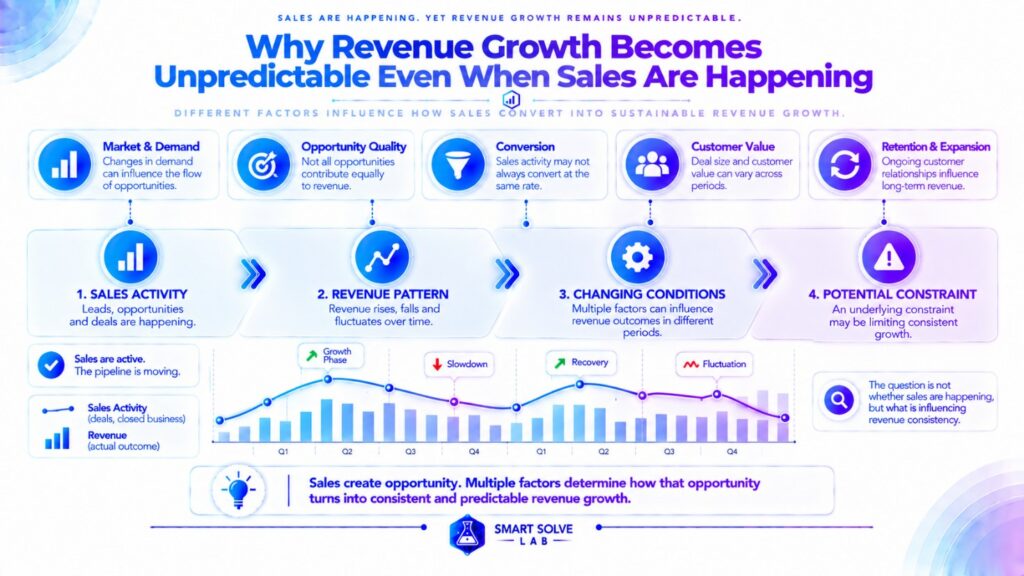
    Revenue growth can look healthy on the surface while remaining surprisingly difficult to predict. Sales are happening, customers are being acquired, and revenue is being generated, yet one period may produce strong growth while another slows down or stalls. The business sees activity, but the relationship between that activity and the final revenue outcome is not always clear.

    This creates a different problem from simply having low revenue. When revenue growth is unpredictable, the challenge is often not knowing whether sales are happening, but understanding why the resulting growth changes from one period to another.

    A strong sales period does not necessarily create the same revenue pattern every time. Changes in demand, opportunity quality, conversion capacity, customer value, retention, and expansion can influence what happens between business activity and revenue outcomes. These conditions do not operate as isolated numbers; they can contribute to different revenue patterns across different periods.

    That is why looking at revenue alone can leave an important question unanswered:

    What condition may be restricting more consistent revenue growth?

    The answer is not necessarily the most visible problem. A revenue slowdown may appear at the end of the process while the relevant condition exists earlier in the journey. Sales may be active, for example, while another condition is influencing the consistency of the resulting revenue.

    This article looks at revenue unpredictability through a constraint perspective. Rather than treating revenue as a single growth lever, we will examine the relationship between revenue patterns, changing conditions, potential constraints, and the areas that may deserve deeper diagnostic attention.

    The goal is not to provide a complete revenue optimization system or guarantee predictable growth. It is to help you understand the pattern behind inconsistent revenue performance and move from revenue fluctuation → signal → potential constraint → diagnostic direction.

    By the end, you should have a clearer way to think about why revenue growth can remain inconsistent even when sales are happening—and what deserves closer examination when the underlying reason is difficult to explain.

    Table of Contents

    Why Revenue Growth Can Become Unpredictable Even When Sales Are Happening

    Revenue growth can look healthy in one period and unexpectedly weaken in another—even when sales are still happening. The business may be generating opportunities, closing deals, and bringing in revenue, yet the overall growth pattern remains difficult to explain.

    This is different from simply having low revenue. The deeper issue is inconsistency: revenue rises strongly during some periods, slows during others, and may sometimes stop growing altogether.

    Sales activity provides an important signal, but it does not explain the entire revenue outcome. The conditions surrounding demand, opportunity quality, conversion, customer value, and retention can vary from one period to another. As those conditions change, the resulting revenue pattern can change as well.

    This is why a business can appear active and still struggle to understand why its revenue growth is not becoming more predictable.

    Sales Can Be Happening While Revenue Growth Fluctuates

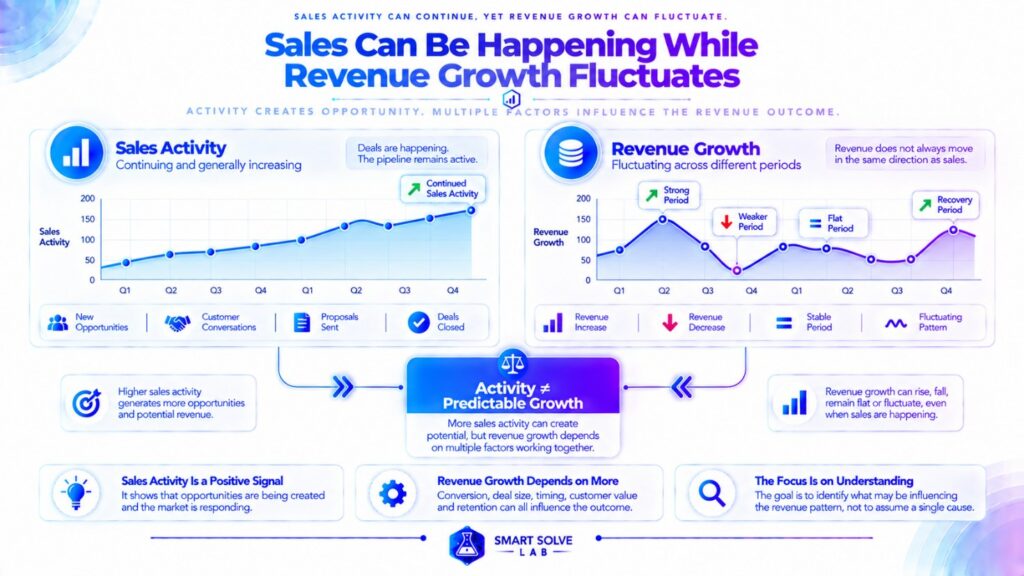
    A business may look busy on the surface: leads are arriving, opportunities are being created, sales conversations are taking place, and customers are buying. Yet the revenue produced by that activity may not remain consistent.

    One month may produce strong revenue growth. The next may be considerably weaker. Another period may recover again without an obvious change in sales activity.

    The important question is therefore not only “Are we making sales?” but also:

    “What is changing between periods when revenue growth is strong and periods when it becomes weak?”

    That question moves the analysis beyond sales volume and toward the conditions influencing the revenue outcome.
    Revenue Growth Is Not Always a Straight Line

    Predictable revenue growth does not mean that revenue must increase by exactly the same amount every period. Normal variation can occur.

    The diagnostic concern begins when the pattern becomes difficult to explain—when strong and weak periods appear without a clear understanding of what changed between them.

    Looking at the pattern across time can reveal signals that a single revenue number cannot show.

    Why Positive Results Can Still Be Inconsistent

    A positive sales result in one period does not automatically mean the same conditions will produce the same revenue outcome later.

    Demand can shift. Opportunity quality can vary. Conversion conditions can change. Customer value can differ across transactions, while retention and expansion can influence how revenue develops beyond the initial sale.

    These differences can create a situation where the business is doing many of the right activities, yet revenue growth remains uneven.

    The Difference Between Business Activity and Predictable Growth

    Business activity tells you that something is happening. Predictable growth requires understanding how the conditions behind that activity contribute to revenue outcomes over time.

    When those conditions are not examined together, revenue fluctuations can appear random even when there is an underlying pattern.

    That is where a constraint perspective becomes useful: instead of asking only whether sales are happening, the business can begin examining which conditions may be restricting more consistent revenue growth.

    Sales activity continuing while revenue growth fluctuates across periods

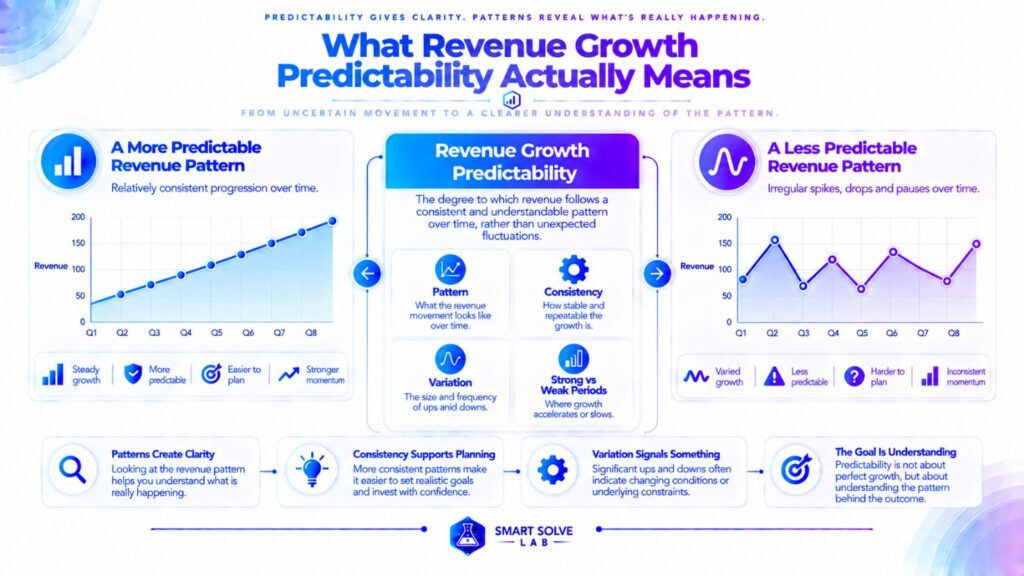
    What Revenue Growth Predictability Actually Means

    Revenue growth predictability is not the same as guaranteed growth. No business can assume that revenue will increase by exactly the same amount every period.

    Instead, predictability is about being able to understand the pattern behind revenue performance: what tends to change, when performance becomes weaker, which conditions appear associated with those changes, and whether the business can explain the difference between stronger and weaker periods.

    Consistent Growth vs. Occasional Growth

    Occasional revenue growth can happen without creating a predictable growth pattern. A business may experience a strong month or quarter while being unable to explain why the result was stronger than the periods before or after it.

    Consistent growth understanding comes from recognizing the conditions and patterns that repeatedly influence revenue performance—not simply celebrating individual periods of strong results.

    Why Revenue Patterns Matter

    A single revenue figure tells you where the business ended up. A revenue pattern can provide clues about how and when performance changes.

    Comparing stronger and weaker periods can help reveal whether changes in demand, opportunities, conversion, customer value, or retention appear alongside changes in revenue.

    This does not automatically prove that one condition is the cause. It creates a signal that deserves deeper examination.

    Predictability Is Not the Same as Guaranteed Growth

    Predictability should therefore be understood as greater clarity around revenue patterns and their influencing conditions, rather than a promise that revenue will always grow.

    The purpose of diagnosis is not to eliminate every variation. It is to understand meaningful variation well enough to identify where further investigation may be needed.

    Why Businesses Struggle to Explain Revenue Fluctuations

    Revenue is an outcome of multiple connected conditions. When those conditions are reviewed separately, the reason behind a change in revenue can remain unclear.

    A business may look at sales numbers, marketing activity, customer numbers, or individual transactions in isolation. Each metric can provide useful information, but none necessarily explains the complete revenue pattern.

    This is why understanding predictability requires moving from revenue numbers → revenue patterns → changing conditions.

    Revenue growth predictability shown through consistent and inconsistent revenue patterns

    Understanding the Revenue Growth Constraint

    When revenue growth becomes unpredictable, the visible problem is often the changing revenue outcome—not necessarily the condition creating that change.

    A revenue growth constraint is a condition that may restrict how consistently the business can translate its existing growth activity into revenue growth.

    This does not mean that every fluctuation proves the existence of a single constraint. Instead, the pattern can provide a signal that one or more underlying conditions deserve closer examination.

    When Sales Activity Does Not Produce Consistent Revenue Growth

    Sales activity can remain active while revenue growth changes from one period to another. This can happen when the conditions surrounding those sales are not producing the same outcome consistently.

    For example, the business may generate opportunities, but the quality of those opportunities can vary. Customers may buy, but the value created per customer can differ. Existing customers may remain active during one period and contribute less during another.

    The important diagnostic question is not simply whether an activity exists. It is whether the conditions behind that activity are supporting a consistent revenue outcome.

    Where Revenue Growth Can Become Restricted

    Revenue growth can potentially become restricted across different parts of the broader revenue system. Demand conditions, opportunity quality, conversion capacity, customer value, and retention and expansion can all influence how revenue develops.

    Learning and reinforcement can also matter because the business’s ability to recognize patterns and respond to changing conditions can influence how effectively it understands its revenue performance.

    These areas should be treated as potential constraint areas, not automatic diagnoses. The purpose of examining them is to determine where the available evidence points for deeper investigation.

    Why One Strong Area Cannot Always Compensate for Another Weak Area

    A strong result in one area does not necessarily remove a restriction elsewhere. More sales activity, for example, may not create predictable revenue growth if another condition is limiting the resulting outcome.

    Similarly, stronger conversion may not fully resolve inconsistent revenue if customer value or retention conditions vary significantly across periods.

    This is why revenue growth needs to be interpreted through connected conditions rather than through one isolated growth activity.

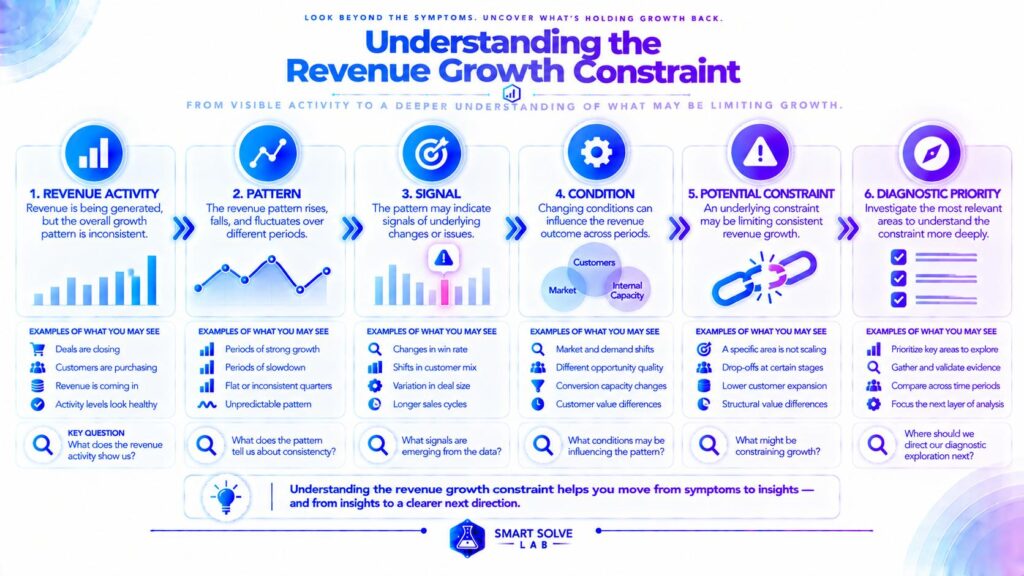
    The Difference Between a Revenue Symptom and a Revenue Constraint

    A revenue slowdown is a visible outcome. A potential constraint is an underlying condition that may help explain why that outcome is occurring.

    Moving from the symptom to the potential constraint requires examining the pattern, identifying what changed, and looking for evidence that connects the changing condition with the revenue pattern.

    The goal is not to label a condition as the cause too early. It is to move from “revenue is fluctuating” toward a more useful question: “Which condition may be restricting consistent growth, and what evidence supports that signal?”

    Revenue growth constraint framework showing activity, pattern, signal, condition, and constraint

    Why Sales Can Happen While Revenue Growth Still Fluctuates

    Sales are an important part of revenue generation, but sales activity alone does not explain whether revenue growth will remain consistent.

    A business can close deals during one period and still experience weaker revenue growth in another because the conditions surrounding those sales may change. The number, quality, value, and continuity of customer relationships can all influence the resulting revenue pattern.

    Sales Are an Important Signal, Not the Entire Revenue System

    Sales tell you that customers are making purchasing decisions. They do not necessarily tell you whether the same conditions will continue producing similar revenue outcomes over time.

    This distinction matters when a business is trying to understand why revenue growth fluctuates despite continued sales activity.

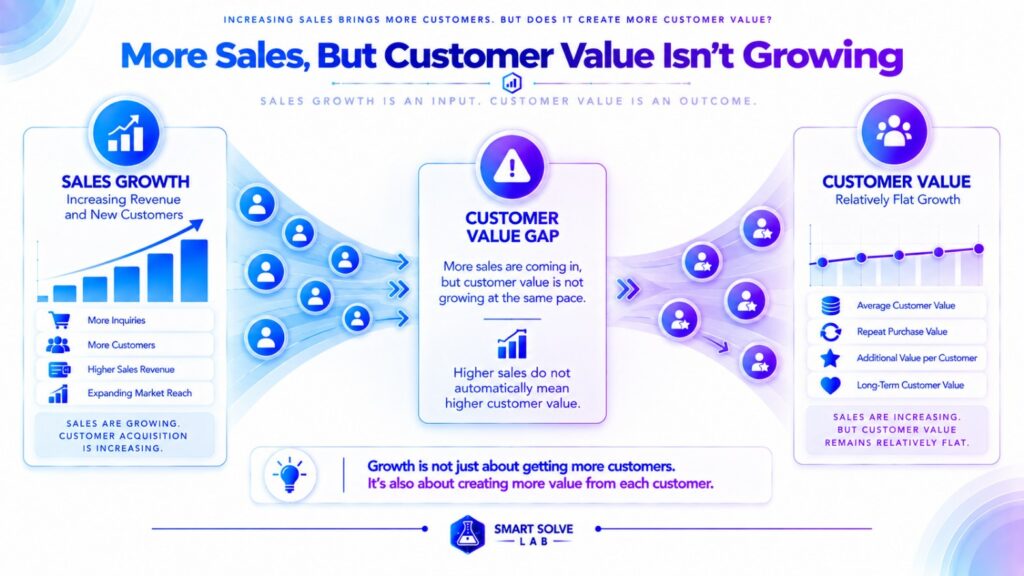
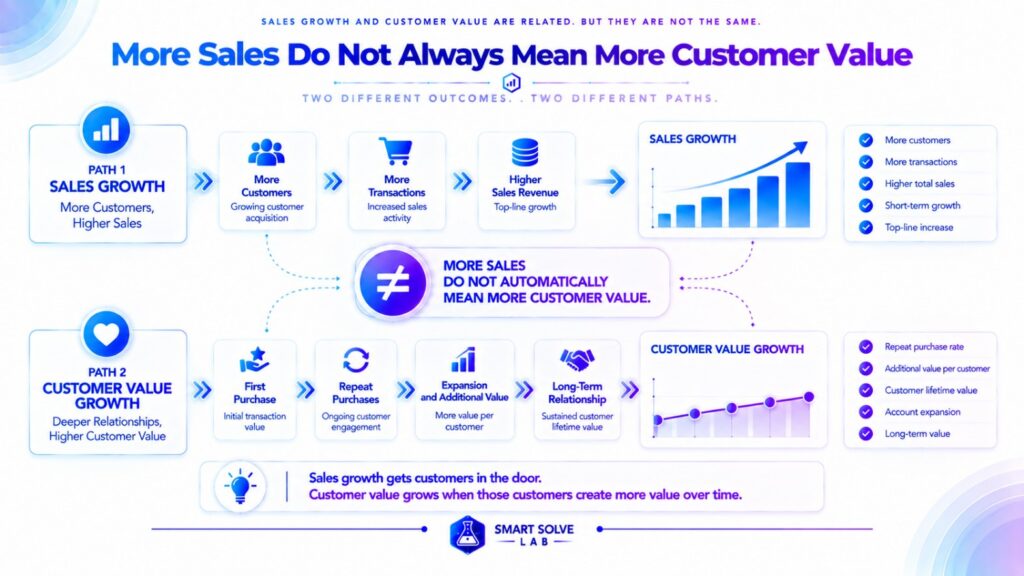
    Customer Value Can Influence Revenue Outcomes

    Not every sale contributes the same amount of value. Differences in transaction value, purchasing depth, product or service mix, and continued customer activity can influence the revenue generated during different periods.

    Therefore, sales can remain active while the value produced from those sales changes.

    Retention and Expansion Can Influence Revenue Continuity

    Revenue can also be influenced by what happens after the initial sale. Customers who continue their relationship with a business can contribute differently from customers who purchase once and then disengage.

    Retention and expansion are therefore relevant conditions when examining why revenue growth may remain inconsistent, without making them the automatic explanation for every revenue fluctuation.

    Why Sales Activity Alone Cannot Explain Revenue Stability</h3

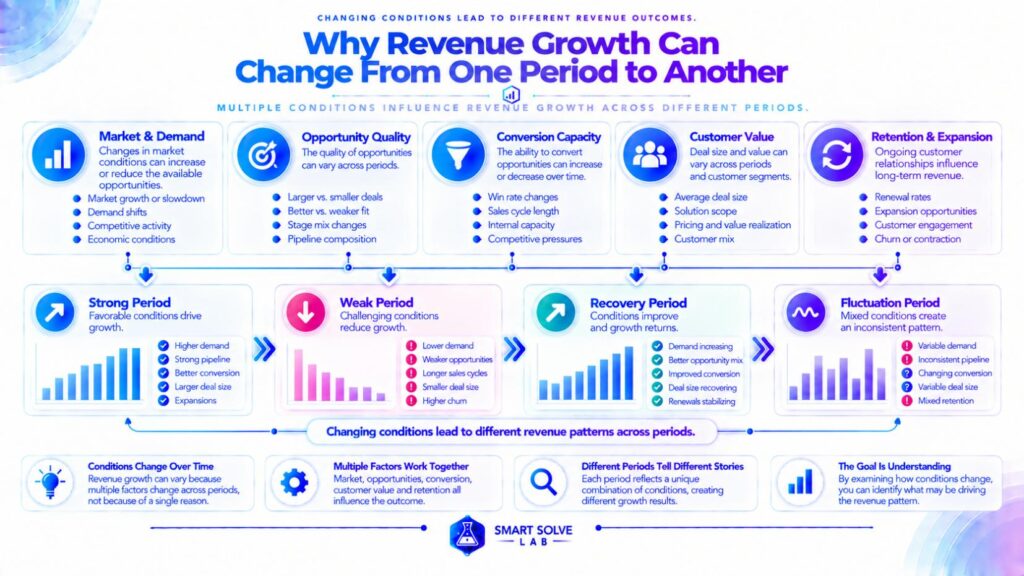
    Why Revenue Growth Can Change From One Period to Another

    Revenue growth can change because the conditions influencing revenue are not necessarily constant. A business may experience stronger performance during one period and weaker performance during another even when its overall sales activity appears similar.

    The useful diagnostic question is therefore not simply “Why did revenue fall?” but “What changed between the stronger and weaker periods?”

    Demand Can Change

    Changes in market interest, customer demand, timing, or purchasing conditions can influence the number and type of opportunities entering the business.

    When demand changes, the resulting revenue pattern can change as well—even when other parts of the business remain active.

    Opportunity Quality Can Change

    The quantity of opportunities does not necessarily remain connected to their quality. A period with many opportunities can produce a different revenue outcome from a period with fewer but more suitable opportunities.

    This means that changes in opportunity quality can become an important signal when comparing strong and weak revenue periods.

    Conversion Capacity Can Change

    The conditions that turn opportunities into customers can also vary. Differences in qualification, customer readiness, sales progression, or the ability to move opportunities toward a purchase can affect revenue outcomes.

    As a result, similar levels of opportunity activity can produce different revenue results.

    Customer Value Can Change

    Customers do not necessarily contribute the same level of value across every period. Differences in purchase size, product or service mix, repeat purchasing, or additional value can influence the revenue generated from customer relationships.

    This is one reason why increasing sales activity does not automatically create the same revenue growth pattern every time.

    Retention and Expansion Can Change

    The continuity of customer relationships can also influence revenue over time. When customers continue purchasing, remain engaged, or expand their relationship with the business, the resulting revenue pattern can differ from periods where those relationships weaken.

    Why Different Conditions Can Produce Different Revenue Patterns

    These conditions can change independently or alongside one another. A stronger period may therefore reflect a different combination of conditions from a weaker period.

    The objective is not to assume that one condition caused the change. Instead, comparing periods helps identify signals that may point toward a potential constraint and determine where deeper diagnostic attention is warranted.

    Changing revenue conditions causing different growth patterns across periods

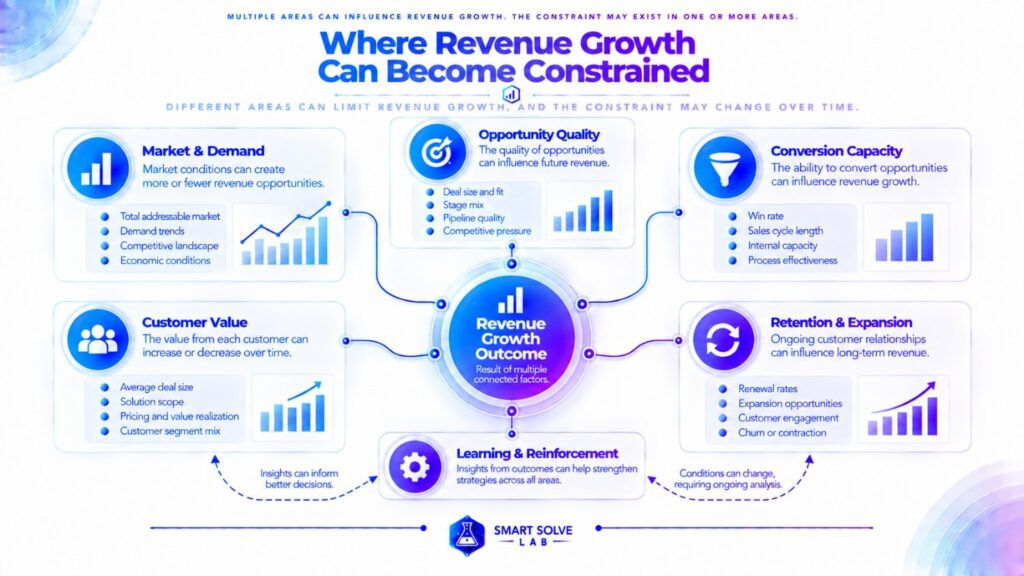
    Where Revenue Growth Can Become Constrained

    Once revenue growth is viewed as an outcome of multiple conditions, the next question is where those conditions may become restricted.

    A constraint does not necessarily appear where the revenue problem becomes visible. The revenue outcome may weaken later in the process while the relevant condition exists earlier. This is why potential constraint areas need to be examined across the broader revenue journey.

    Market and Demand Conditions

    Revenue growth can be influenced by whether enough relevant demand exists and whether that demand is reaching the business consistently.

    Changes in market interest, customer needs, timing, or demand strength can therefore create different revenue conditions across different periods.

    Opportunity Quality

    Having opportunities does not necessarily mean having opportunities with the same revenue potential. Differences in fit, relevance, intent, and commercial potential can influence what those opportunities eventually contribute.

    A change in opportunity quality may therefore become an important signal when revenue performance changes.

    Conversion Capacity

    Even when relevant opportunities exist, the conditions required to convert them into customers may vary.

    Differences in qualification, customer readiness, sales progression, or the ability to move opportunities toward a decision can influence the revenue outcome.
    Customer Value

    Revenue growth can also be influenced by the value generated from each customer relationship. Purchase size, product or service mix, repeat purchasing, and additional customer value can differ across periods.

    When customer-level value changes, the resulting revenue pattern may change even when sales remain active.

    Retention and Expansion

    Revenue continuity can also depend on what happens after the initial purchase. Customers who remain, continue purchasing, or expand their relationship can contribute differently from customers whose relationship ends after the first transaction.

    This makes retention and expansion another potential condition to examine when revenue growth becomes inconsistent.

    Why the Constraint May Not Be Where the Revenue Problem Appears

    Revenue is the final visible outcome. A weakness in the outcome does not automatically identify the condition creating it.

    A useful diagnostic approach is therefore to move backward from the revenue pattern and examine the conditions associated with stronger and weaker periods.

    The purpose is not to assume a root cause too early. It is to identify which potential constraint areas show meaningful signals and deserve deeper examination.

    Revenue growth constraint areas across demand, opportunity, conversion, customer value, and retention

    Why Improving One Revenue Area Does Not Always Create Predictable Growth

    When revenue growth becomes inconsistent, it can be tempting to focus immediately on the most visible area of activity. A business may increase its sales pipeline, improve conversion, or acquire more customers and expect the revenue pattern to become stable.

    But improving one area does not necessarily change every condition influencing the final revenue outcome.

    A Stronger Sales Pipeline Is Not the Entire Answer

    A stronger pipeline can create more opportunities, but the resulting revenue still depends on what happens to those opportunities afterward.

    If opportunity quality, conversion conditions, customer value, or retention conditions vary, a larger pipeline may not produce proportionate or predictable revenue growth.

    This does not make pipeline growth unimportant. It means that its effect needs to be interpreted within the wider revenue context.

    Better Conversion Does Not Automatically Stabilize Revenue

    Improving conversion can increase the number of opportunities becoming customers. However, the revenue contribution of those customers can still vary.

    Customer value, purchasing patterns, and relationship continuity can influence what happens after conversion. As a result, stronger conversion alone does not establish that revenue growth will become predictable.

    More Customers Do Not Automatically Create Sustainable Growth

    Acquiring more customers can increase the customer base, but customer acquisition is only one part of the revenue picture.

    If customers generate different levels of value or do not remain long enough to support continued revenue, additional acquisition may not resolve the underlying inconsistency.

    This is why customer growth should be interpreted alongside customer value and retention conditions rather than treated as an independent guarantee of sustainable growth.

    Why Improvements Need to Be Interpreted Within the Larger Revenue System

    Revenue outcomes emerge from multiple connected conditions. An improvement in one area can therefore change the overall pattern without necessarily removing every factor influencing revenue performance.

    The diagnostic question becomes:

    “After this area improves, what does the revenue pattern tell us about the remaining conditions?”

    This keeps the analysis focused on understanding the revenue pattern and potential constraints rather than assuming that one improvement should automatically create predictable growth.

    The Conditions Behind Unpredictable Revenue Growth

    Revenue growth becomes difficult to explain when the conditions influencing it are viewed separately. A stronger diagnostic perspective is to examine the different conditions that can contribute to revenue performance and then look at how those conditions vary across stronger and weaker periods.

    Demand Conditions

    Revenue depends partly on whether relevant demand exists and reaches the business consistently. Changes in market interest, customer needs, timing, or demand strength can influence the opportunities available during different periods.

    When demand conditions change, revenue performance may change with them.

    Opportunity Conditions

    Not every opportunity carries the same potential. Differences in relevance, fit, intent, and commercial quality can influence what opportunities eventually contribute to revenue.

    This means that changes in opportunity conditions can help explain why similar levels of sales activity may produce different revenue outcomes.

    Conversion Conditions

    Opportunities also depend on the conditions that allow them to progress toward a purchase. Qualification, customer readiness, sales progression, and conversion capacity can vary over time.

    When these conditions change, the relationship between opportunities and revenue can change as well.

    Customer-Level Conditions

    Customers can contribute different levels of value depending on what they purchase, how much they purchase, and whether additional value develops after the initial transaction.

    Customer value can therefore influence the revenue pattern even when the number of sales remains active.

    Retention and Expansion Conditions

    The continuity of customer relationships can influence revenue beyond the initial purchase. Continued purchasing, relationship strength, and expansion opportunities can contribute differently across periods.

    When these conditions weaken or vary, revenue continuity may also change.

    Reinforcement and Learning

    Revenue performance can also be influenced by how effectively a business recognizes patterns, learns from results, and strengthens the conditions that support future performance.

    This does not mean that every revenue fluctuation is caused by a learning problem. Rather, learning and reinforcement are part of the broader set of conditions that can influence how a revenue system responds over time.

    Why These Conditions Can Influence One Another

    These conditions do not necessarily operate in isolation. A change in demand can affect opportunity quality. Changes in opportunity quality can influence conversion. Customer value and retention can influence the continuity of revenue produced from acquired customers.

    Understanding these relationships helps explain why revenue growth may fluctuate even when individual business activities appear to be working.

    Why the Visible Revenue Problem May Not Be the Real Constraint

    When revenue growth becomes unpredictable, the most visible signal is usually the revenue number itself. But the visible outcome does not necessarily reveal the condition influencing it.

    This distinction is important because revenue sits at the end of a broader chain of conditions. A change in revenue can therefore be a signal that something earlier in that chain deserves examination.

    Revenue Is the Outcome

    Revenue is the measurable result of multiple underlying conditions working together. It tells the business what happened, but by itself it does not explain why the result changed.

    That is why a revenue decline or slowdown should be treated as a signal for investigation rather than an automatic diagnosis.

    Sales May Be Only One Visible Signal

    Sales activity is often one of the easiest areas to observe. But sales can remain active while other conditions influencing revenue change.

    A business may therefore conclude that sales are not the problem while still lacking clarity about what is affecting revenue consistency.

    A Weak Downstream Result Can Have an Upstream Condition

    A revenue outcome can weaken because of a condition that appears earlier in the customer or revenue journey.

    For example, changes in demand or opportunity quality may eventually appear as weaker revenue. Similarly, changes in customer value or retention may influence revenue after the initial sale has already occurred.

    The visible revenue problem is therefore not necessarily the location of the underlying constraint.

    Multiple Conditions Can Interact

    Sometimes the pattern cannot be explained by examining one condition alone. Several conditions may change at the same time or influence one another.

    This is why the diagnostic process should avoid prematurely declaring a single cause and instead examine which conditions changed alongside the revenue pattern.

    Why Revenue Volatility Needs Deeper Examination

    The objective is not to assume that every fluctuation represents a structural problem. The objective is to determine whether the pattern contains a meaningful signal and, if it does, where that signal points.

    Moving from revenue outcome → pattern → changing conditions → potential constraint creates a more useful basis for deciding what deserves deeper diagnostic attention.

    That shift—from reacting to the visible revenue problem to examining the conditions behind it—is central to understanding unpredictable revenue growth.

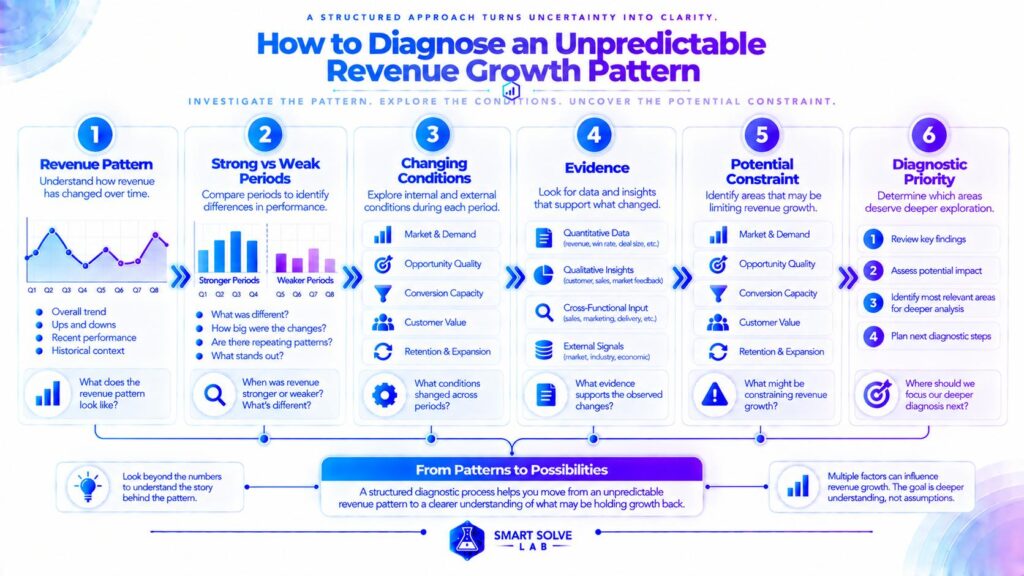
    How to Diagnose an Unpredictable Revenue Growth Pattern

    Once revenue growth appears inconsistent, the next step is not to immediately choose a tactic to fix it. The more useful starting point is to examine the pattern, identify what changed, and determine which conditions may be associated with the difference.

    Is Revenue Actually Becoming More Volatile?

    Start by looking across multiple periods rather than focusing on one unusually strong or weak result.

    Compare revenue performance over time and ask whether the changes represent normal variation or a recurring pattern of stronger and weaker periods. This distinction matters because not every fluctuation indicates a meaningful constraint.

    For businesses using Google Analytics, Google Analytics trend change detection can provide an additional way to identify meaningful changes in time-series patterns. It should be treated as supporting evidence rather than as a complete revenue diagnosis.

    What Is Changing Between Strong and Weak Periods?

    Once a meaningful pattern is visible, compare the conditions surrounding stronger and weaker periods.

    Look for changes in demand, opportunity quality, conversion conditions, customer value, retention, or expansion. The goal is to identify what changed alongside the revenue pattern—not to assume that correlation automatically proves causation.

    Which Revenue Conditions Are Changing?

    Examine the relevant conditions individually and then consider their relationship to the overall revenue pattern.

    A condition that changes consistently alongside stronger or weaker revenue periods may provide a useful diagnostic signal. However, the signal still requires interpretation and supporting evidence before it can be treated as a likely constraint.

    Where Does the Pattern Become Weaker?

    Ask where the difference between stronger and weaker periods becomes most visible.

    The point at which performance appears to weaken can help narrow the areas that deserve deeper examination. This can prevent the business from focusing only on the final revenue number while overlooking an earlier condition.

    What Evidence Supports the Signal?

    A potential constraint should be supported by observable evidence rather than assumption.

    Compare relevant data, customer patterns, opportunity characteristics, sales progression, and period-level changes where available. The stronger the evidence connecting a changing condition with the revenue pattern, the more useful that signal becomes for prioritizing further diagnosis.

    Is the Visible Revenue Problem Coming From Somewhere Earlier?

    Revenue is an outcome, so the condition influencing the outcome may exist earlier in the revenue journey.

    Trace the pattern backward and ask whether a change in demand, opportunity quality, conversion, customer value, or retention could be contributing to what eventually appears as revenue volatility.

    What Deserves Deeper Diagnostic Attention?

    The final step is to determine which potential constraint area deserves closer examination.

    This does not require declaring a definitive root cause at this stage. The purpose is to move from an unclear revenue fluctuation toward a diagnostic priority—an area where the available pattern and evidence suggest that deeper analysis may be valuable.

    The resulting direction can then be used to structure a more focused revenue constraint diagnosis.

    Diagnostic process for identifying patterns and potential constraints in unpredictable revenue growth

    From Revenue Activity to Revenue Stability Understanding

    Diagnosing unpredictable revenue growth requires a shift in how revenue activity is interpreted. Instead of looking at individual activities as isolated indicators of growth, the business can examine how those activities relate to revenue performance across time.

    Stop Measuring Sales Activity in Isolation

    Sales activity remains important, but activity alone does not explain whether revenue growth is becoming more consistent.

    Sales numbers become more useful when they are examined alongside the revenue outcomes they produce and the conditions surrounding those outcomes.

    Connect Sales With Customer-Level Outcomes

    Sales should also be interpreted alongside what happens after customers are acquired.

    Differences in customer value, continued purchasing, retention, and expansion can influence how sales activity develops into revenue over time.

    Examine Revenue Patterns Across Time

    Comparing periods helps reveal whether revenue performance is consistently developing or repeatedly moving between stronger and weaker states.

    The purpose is not to expect identical results every period. It is to identify meaningful patterns that may otherwise remain hidden when each period is viewed separately.

    Compare Strong and Weak Growth Periods

    Once stronger and weaker periods are identified, examine what was different between them.

    Look for changes in the conditions surrounding demand, opportunities, conversion, customer value, and retention. These comparisons can reveal signals that deserve deeper examination.

    Identify Potential Constraint Areas

    The next step is to connect those signals to potential constraint areas without prematurely declaring a single root cause.

    A potential constraint is useful diagnostically when the available evidence suggests that a particular condition may be restricting the consistency of the revenue outcome.
    Determine Where Deeper Diagnosis Is Needed

    The purpose of this process is ultimately to create direction.

    Instead of stopping at “revenue growth is unpredictable,” the business can move toward a clearer understanding of which condition appears most relevant and where deeper diagnostic attention should begin.

    This creates a more structured path from revenue activity to revenue stability understanding—without assuming that one visible metric or one improvement can explain the entire revenue pattern.

    The Key Insight: Revenue Growth Is an Outcome of Connected Conditions

    One of the most important shifts in understanding unpredictable revenue growth is recognizing that revenue is not a single independent growth lever. It is an outcome shaped by multiple conditions across the broader revenue system.

    Revenue Is Not a Single Independent Growth Lever

    Revenue does not increase simply because one activity becomes stronger. Different conditions can influence how business activity develops into revenue and how that revenue continues over time.

    This is why focusing on revenue as an isolated number can make an underlying constraint difficult to see.

    Sales Activity Is One Part of the Revenue Picture

    Sales activity provides an important indication that opportunities are progressing toward customer transactions. But sales activity alone does not explain the consistency of the resulting revenue outcome.

    The quality of opportunities, conversion conditions, customer value, and relationship continuity can all influence what sales ultimately contribute.

    Customer Value Influences Revenue Development

    The value generated from customers can vary across periods. Differences in purchase value, repeat purchasing, product or service mix, and additional customer value can influence how revenue develops after a sale.

    Customer value is therefore one condition to consider when interpreting an unpredictable revenue pattern.

    Retention and Expansion Influence Revenue Continuity

    Revenue can also develop differently depending on whether customer relationships continue and expand after acquisition.

    Retention and expansion can influence the continuity of revenue, making them relevant when examining why revenue performance may vary across periods.

    Connected Conditions Influence Revenue Outcomes

    The broader insight is that revenue growth emerges from conditions that can influence one another. Demand affects opportunities, opportunities affect conversion possibilities, and customer-level conditions can influence the revenue that develops after acquisition.

    Therefore, when revenue growth becomes unpredictable, the useful question is not simply “Which activity should we increase?” but “Which connected condition may be restricting the revenue outcome, and what evidence points toward it?”

    This perspective creates the foundation for moving from revenue fluctuation toward potential constraint understanding.

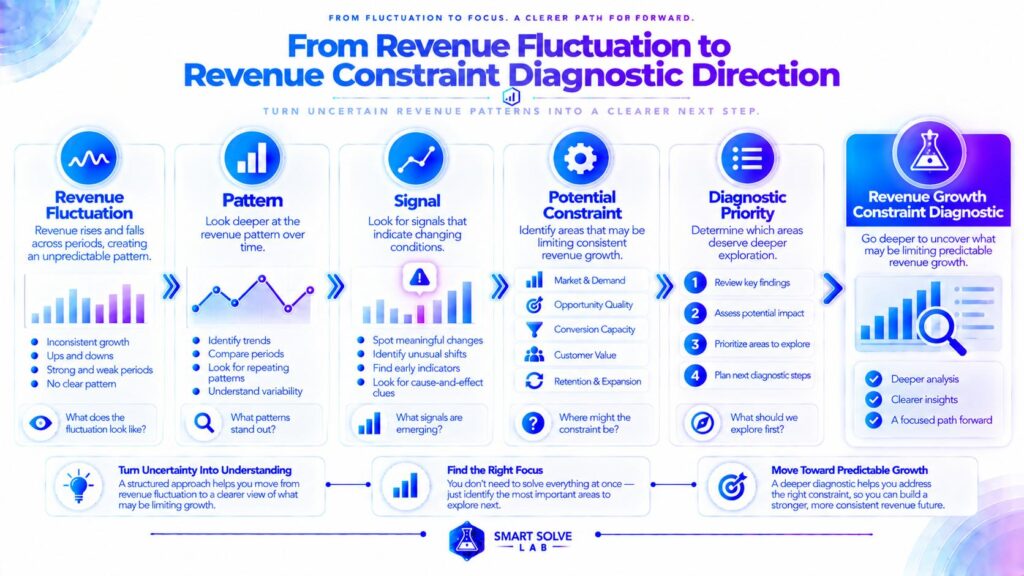
    From Revenue Fluctuation to Revenue Constraint Understanding

    Revenue fluctuation becomes more useful diagnostically when it is treated as a pattern to understand rather than simply a result to react to.

    The diagnostic journey can be viewed as a progression from what is visible to what may deserve deeper examination.

    From Volatility → Pattern

    Begin with the revenue movement itself. Identify whether the business is experiencing meaningful differences between stronger, weaker, and stagnant periods.

    The goal is to establish the pattern before attempting to explain it.

    From Pattern → Signal

    Once a pattern is visible, examine what changes alongside it.

    A recurring difference between stronger and weaker periods can provide a signal that one or more underlying conditions may deserve investigation.

    From Signal → Potential Constraint

    A signal can then be connected to a potential constraint area.

    This does not mean the condition has been proven to be the root cause. It means the evidence provides enough direction to warrant deeper examination of that condition.

    From Constraint → Diagnostic Priority

    Not every potential constraint deserves the same level of attention at the same time.

    The available evidence can help determine which area appears most relevant to the current revenue pattern and therefore deserves deeper diagnostic attention first.

    From Symptoms → Diagnostic Direction

    The final shift is from simply describing the symptom to creating a direction for investigation.

    Revenue fluctuation → Pattern → Signal → Potential Constraint → Diagnostic Priority

    This does not provide a complete revenue optimization methodology. Instead, it creates a clearer diagnostic path for understanding why revenue growth may be inconsistent and where further investigation should begin.

    Where to Go Next: Diagnose Your Revenue Growth Constraint

    By this point, the key issue is no longer simply whether your business is generating sales. The more useful question is whether you can explain the pattern behind your revenue performance and identify the conditions that may be influencing it.

    If revenue growth is strong in some periods but weak in others, the pattern deserves closer examination rather than an immediate assumption about what needs to be fixed.

    Revenue Growth Is Strong in Some Periods but Weak in Others

    When revenue repeatedly moves between stronger and weaker periods, examine what changes alongside those movements.

    Comparing the conditions surrounding different periods can help reveal whether the variation is simply normal business fluctuation or a signal of a deeper constraint.

    Sales Are Happening but Revenue Growth Remains Inconsistent

    If sales continue but revenue growth does not develop consistently, sales activity may not be the only condition worth examining.

    Look beyond sales volume and consider the broader conditions that can influence revenue outcomes, including opportunity quality, conversion capacity, customer value, and retention and expansion.

    Revenue Performance Is Difficult to Explain

    If the business can see what happened but cannot clearly explain why one period performed differently from another, the revenue pattern may require a more structured diagnostic review.

    The goal is to move from unexplained fluctuation toward evidence-based diagnostic direction.

    Multiple Growth Conditions Appear Active but Results Still Fluctuate

    A business can have active demand, opportunities, sales activity, customers, and ongoing relationships while still experiencing inconsistent revenue growth.

    This does not automatically mean that every condition is problematic. It means the relationship between those conditions and the revenue outcome may need deeper examination.

    The Business Cannot Clearly Identify What Is Limiting Revenue Growth

    When the business knows revenue growth is inconsistent but cannot determine which condition deserves attention, a structured constraint diagnosis can help organize the investigation.

    The objective is to identify the revenue pattern, interpret the associated conditions, prioritize a potential constraint area, and establish where deeper diagnostic attention should begin.

    Revenue Growth Constraint Diagnostic is designed for this focused purpose: helping businesses understand the conditions associated with unpredictable revenue growth and determine where further diagnostic attention may be needed.

    Revenue fluctuation → Pattern → Signal → Potential Constraint → Diagnostic Priority

    Diagnostic direction from unpredictable revenue growth toward a potential revenue constraint

    Key Takeaways

    • Sales happening does not automatically mean revenue growth will be predictable. Sales are an important signal, but they represent only part of the broader revenue picture.
    • Revenue is an outcome of connected conditions. Demand, opportunity quality, conversion capacity, customer value, retention and expansion, and learning and reinforcement can all influence revenue performance.
    • Revenue fluctuation should be examined as a pattern. Comparing stronger and weaker periods can reveal signals that a single revenue number cannot show.
    • The visible revenue problem may not be the underlying constraint. A condition earlier in the revenue journey can eventually appear as a weaker revenue outcome.
    • One improvement does not automatically create predictable growth. Strengthening one revenue area does not necessarily change every condition influencing the final outcome.
    • A potential constraint should be supported by evidence. The objective is not to assume a root cause prematurely, but to identify which area deserves deeper diagnostic attention.
    • The diagnostic progression is: Revenue Fluctuation → Pattern → Signal → Potential Constraint → Diagnostic Priority.

    The central idea is simple: when revenue growth is unpredictable, understanding the conditions behind the pattern is more useful than reacting only to the visible revenue outcome.

    Conclusion

    Revenue growth can become difficult to predict even when sales are happening. The problem is not necessarily a lack of activity; it may be that the conditions influencing revenue are changing in ways the business has not yet clearly understood.

    Looking only at the final revenue number can show the symptom without revealing the condition behind it. A stronger diagnostic perspective examines the pattern across time, compares stronger and weaker periods, identifies what changed, and considers which conditions may be associated with those changes.

    Demand, opportunity quality, conversion capacity, customer value, retention and expansion, and learning and reinforcement can all contribute to the revenue outcome. They should not automatically be treated as problems, but they provide relevant areas for investigation when revenue performance becomes inconsistent.
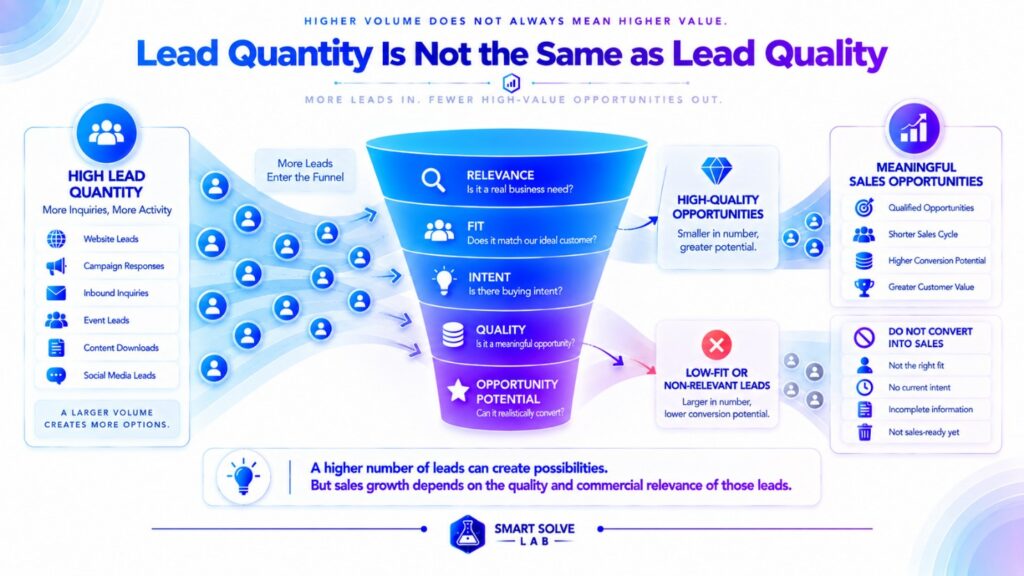
    The central shift is from asking “Why is revenue fluctuating?” to asking:

    “What pattern is visible, which conditions are changing, and what potential constraint deserves deeper diagnostic attention?”

    That creates a clearer path from revenue fluctuation → pattern → signal → potential constraint → diagnostic priority.

    Understanding this pattern does not guarantee revenue growth, nor does it replace a complete Revenue Growth System. Its purpose is more focused: to create clarity about where unpredictable revenue performance may be constrained and where deeper diagnosis should begin.

    When the business can move beyond the visible revenue outcome and examine the conditions behind it, revenue unpredictability becomes something that can be investigated systematically rather than simply experienced as unexplained fluctuation.

    Why is my revenue growth unpredictable even when sales are happening?

    Sales activity is only one part of the broader revenue picture. Changes in demand, opportunity quality, conversion capacity, customer value, retention, and expansion can influence how sales activity translates into revenue across different periods. Comparing stronger and weaker periods can help identify which conditions may be associated with the changing revenue pattern.

    What does predictable revenue growth mean?

    Predictable revenue growth does not mean that revenue must increase by exactly the same amount every period. It means the business has greater clarity around its revenue patterns, the conditions influencing those patterns, and the reasons performance changes between stronger and weaker periods.

    What is a revenue growth constraint?

    A revenue growth constraint is a condition that may restrict how consistently business activity translates into revenue growth. It should not be assumed to be the root cause simply because revenue is fluctuating. The relevant condition needs to be examined against the revenue pattern and supporting evidence.

    Why can sales increase while revenue growth remains inconsistent?

    Sales can increase while other revenue conditions change. Opportunity quality, conversion conditions, customer value, retention, and expansion can vary across periods, meaning similar or higher sales activity may not always produce the same revenue outcome.
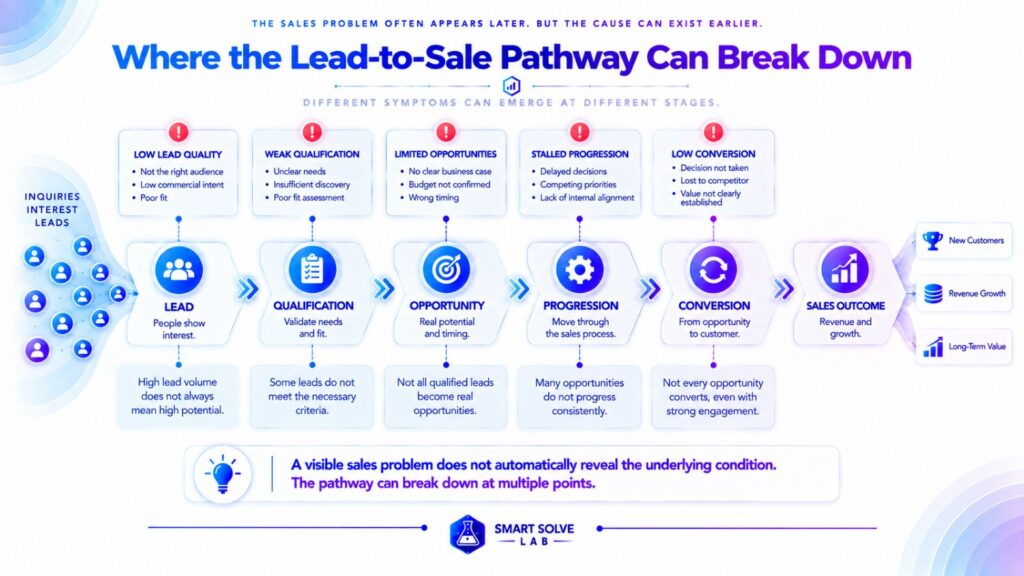
    What can cause revenue growth to fluctuate?

    Revenue growth can fluctuate when the conditions influencing revenue change. Relevant areas can include market and demand conditions, opportunity quality, conversion capacity, customer value, retention and expansion, and learning and reinforcement. The specific condition should be determined through evidence rather than assumption.

    How can I identify what is limiting my revenue growth?

    Start by examining the revenue pattern across multiple periods. Compare stronger and weaker periods, identify what changed, examine the conditions associated with those changes, and determine which potential constraint area has the strongest supporting signal. This creates a direction for deeper diagnostic attention.

    Can fixing one revenue problem make another constraint more visible?

    Improving one revenue area can change the overall pattern and make another condition more noticeable. However, the broader phenomenon of constraints shifting after an improvement belongs to the next diagnostic layer of the Revenue Growth System. The focus here is identifying and interpreting a potential constraint rather than providing a complete shifting-constraint methodology.

  • Why Your Customer Value Isn’t Growing Even After You Increase Sales

    Customer value not growing despite increasing sales

    Customer value is not growing after sales :

    Increasing sales can make a business look healthier, but higher sales do not always mean that customer value is growing at the same rate. A business may be acquiring more customers and generating more initial purchases while the value created by those customers remains relatively limited.

    This is an important distinction because the first sale is only one part of the customer relationship. What happens after that purchase can influence how much value a customer creates over time. If customers make limited repeat purchases, have little opportunity to expand their relationship with the business, or do not continue creating additional value, sales growth can hide a deeper customer-value problem.

    That is why the right question is not simply, “Are sales increasing?” It is also, “Is customer value increasing with them?”

    Understanding that difference helps reveal the customer value gap—the situation where sales are growing, but customer-level business value is not improving proportionately. The goal is not to assume the cause immediately, but to identify where customer value may be weakening and where deeper diagnosis may be needed.

    Table of Contents

    Why More Sales Do Not Always Mean More Customer Value

    More sales usually indicate that a business is successfully generating purchases, but sales volume alone does not show how much value those customers may create beyond the initial transaction.

    Sales Growth Is Not the Same as Customer Value Growth

    A business can increase sales by acquiring more customers without seeing the same level of improvement in customer-level value. If most of the growth comes from new purchases, the business may be increasing transaction volume while the value generated by each customer remains relatively limited.

    This means sales growth should not automatically be interpreted as evidence that customer value is improving. The two can move in the same direction while growing at very different rates.

    More Customers Can Create More Revenue Without Proportionate Value

    Suppose a business attracts a large number of new customers and its sales increase as a result. That growth may look positive at the surface level. But if many customers make only an initial purchase and create little additional value afterward, the increase in sales may not reflect stronger customer economics.

    The important diagnostic question is therefore not only how many customers were acquired, but what value those customers are actually creating over the course of their relationship with the business.

    The Difference Between Acquisition and Customer Value

    Customer acquisition creates an opportunity for value, but acquisition itself is not the same as customer value. The first purchase establishes a commercial relationship; what happens afterward determines whether that relationship has the potential to create additional value.

    This distinction helps separate two different growth signals: bringing more customers into the business and increasing the value created by those customers. A business can improve the first while the second remains weak.

    Why Sales Growth Can Hide a Customer Value Problem

    When new customer sales continue to increase, they can temporarily make overall business performance appear stronger even when customer-level value is not developing proportionately. This can make it difficult to see whether growth is being supported by stronger customer value or simply by acquiring more customers.

    That is why increasing sales should be examined alongside what happens to customer value. The gap between these two signals can provide an important starting point for deeper diagnosis.

    More sales not leading to proportionate customer value growth

    What Customer Value Actually Means

    Customer value is broader than the amount generated from a customer’s first purchase. It looks at the value that can develop through the customer relationship over time, including what happens after the initial transaction.

    Initial Purchase Value

    The first purchase is the point at which a customer begins creating measurable commercial value for the business. It provides an important signal, but it should not automatically be treated as the full value of the customer relationship.

    Repeat Purchase Potential

    Some customers may have opportunities to purchase again, while others may have limited reasons to return. The potential for repeat purchases can therefore influence how much value a customer may create beyond the initial transaction.

    Relationship Value

    Customer value can also depend on the strength and continuity of the relationship. When a customer remains meaningfully connected to a business, there may be more opportunities for the relationship to develop rather than ending after a single purchase.

    Additional Customer Value

    Additional value can emerge when customers have relevant opportunities to purchase more, expand their relationship, or engage with other suitable offers. If those opportunities are limited or do not develop, customer value may remain relatively low even when initial sales are increasing.

    Why Customer Value Extends Beyond the First Sale

    The first sale tells you that a customer has purchased. It does not, by itself, explain what the customer relationship may produce afterward. Looking beyond the initial transaction helps reveal whether sales growth is also creating stronger customer-level value or whether a gap is developing between acquisition and longer-term value.

    Customer value components from first purchase to long-term value

    The Customer Value Gap

    The customer value gap appears when sales increase but the value being generated at the customer level does not improve at a similar rate. This does not necessarily mean that sales growth is weak. It means the growth being achieved may not be translating into stronger customer-level value.

    When Sales Increase but Customer Value Stays Flat

    A business can generate more sales by bringing in additional customers while the value created by those customers remains relatively unchanged. In this situation, the sales number moves upward, but the underlying customer value does not develop proportionately.

    The difference between these two signals is worth examining because it can reveal that acquisition is contributing to growth while another part of the customer relationship is limiting additional value.

    Revenue From New Customers vs. Value From Existing Customers

    New customers can contribute immediate revenue through their initial purchases. However, customer value asks a broader question: what additional value can those customers create after entering the business?

    Looking at new-customer revenue separately from existing-customer value can therefore provide a clearer view of whether growth is being supported by stronger customer relationships or primarily by continued acquisition.

    Where Customer Value Can Weaken

    Customer value can weaken at different points in the customer relationship. A customer may make an initial purchase but have limited opportunity to purchase again, expand their relationship, or receive additional relevant value from the business.

    These situations do not automatically identify the root cause. They simply provide signals that help narrow down where customer value may be failing to develop.

    Why the Gap Matters

    The customer value gap matters because continued sales growth can sometimes conceal limited value development at the customer level. If a business relies mainly on acquiring more customers to maintain growth, it may become harder to understand the underlying quality and sustainability of that growth.

    Recognizing the gap creates a better starting point for diagnosis: instead of asking only whether sales are increasing, the business can examine whether customer value is increasing with them and where that progression may be weakening.

    Customer value gap between sales growth and customer value growth

    Why Acquiring More Customers Can Hide the Problem

    When customer value is not developing strongly, increasing customer acquisition can sometimes make the overall business numbers look healthier than the underlying customer economics actually are. More customers can create more initial purchases, which may keep sales moving upward even when each customer is creating limited additional value.

    More Customers Can Increase Activity

    Acquiring more customers naturally creates more transactions, conversations, orders, and customer activity. These signals can make the business appear to be growing, but activity and customer value are not necessarily the same thing.

    A higher number of customers can therefore increase the visible level of business activity without showing whether the value created by each customer is also improving.

    Acquisition Can Compensate for Weak Customer Value

    If individual customers are creating limited value after their first purchase, continued acquisition can temporarily compensate for that weakness. New customers keep entering the business and generating initial sales, which can reduce the visibility of the underlying customer-value gap.

    This can create a cycle in which the business continues focusing on acquiring more customers because acquisition is producing measurable results, while the deeper question of customer value remains less visible.

    Growth Can Look Healthy While Customer Economics Weaken

    Overall sales can increase even when the value generated by individual customer relationships is not improving proportionately. This creates an important distinction between growth in sales volume and growth in customer value.

    When these signals are examined separately, a business may discover that its growth depends heavily on continuously adding new customers rather than developing greater value from the customers it has already acquired.

    Why More Acquisition Is Not Always the Answer

    When sales are growing but customer value remains weak, simply increasing acquisition may add more customers without addressing the condition limiting additional value. The better diagnostic approach is to understand what happens after customers enter the business and identify where their value stops developing.

    Why Customers May Not Create More Value After the First Sale

    A first purchase confirms that a customer has entered into a commercial relationship with the business. But that first transaction does not automatically mean the customer will create additional value afterward. The relationship may continue to develop, or it may stop at the initial purchase.

    Limited Repeat Purchases

    Some customers may have a reason to purchase again, while others may not return after the first transaction. When repeat-purchase potential is limited or does not develop, the value created by each customer may remain concentrated around the initial sale.

    Low Expansion Potential

    Customers may also have limited opportunities to expand their relationship with the business. If relevant products, services, upgrades, or additional solutions are not available—or do not become relevant to the customer—the potential for additional value can remain limited.

    Weak Product or Offer Continuity

    Customer value can become difficult to develop when the relationship effectively ends with the first offer. If there is no clear continuity between the initial purchase and relevant future needs, customers may have little reason to continue the relationship.

    Limited Relationship Depth

    A transaction can take place without creating a strong ongoing customer relationship. When the business has limited understanding of the customer’s continuing needs, it may become harder to identify opportunities where additional value could naturally develop.

    Missed Additional Value Opportunities

    Even when customers could potentially create more value, those opportunities may not become visible or actionable. The issue may therefore be less about the number of customers acquired and more about what happens after acquisition.

    These signals do not establish a single root cause on their own. They indicate areas that may deserve deeper examination when sales are increasing but customer value is not growing proportionately.

    Customer value after first sale through repeat and additional value

    Where Customer Value Can Break Down

    Customer value does not develop at a single point in the customer journey. It can weaken before the first purchase, after the purchase, or later as opportunities for continued value fail to develop. Looking at these stages separately can help reveal where the customer-value progression may be breaking down.

    Before the First Purchase

    Customer value can be influenced by what happens before the first transaction. Customer fit, expectations, perceived relevance, and the alignment between the customer’s needs and the offer can affect the foundation of the relationship.

    After the First Purchase

    The first purchase creates an initial commercial relationship, but what happens afterward can determine whether that relationship develops further. If customers do not see a clear reason to continue, the value created may remain limited to the original transaction.

    Between Purchases

    The period between purchases can reveal whether a customer relationship is continuing to develop or becoming inactive. Limited engagement, weak continuity, or a lack of relevant next opportunities may reduce the potential for additional customer value.

    During Expansion Opportunities

    Even when customers have additional needs, those needs may not translate into additional value for the business. Relevant expansion opportunities may be unclear, poorly aligned, or simply not developing within the customer relationship.

    Across the Customer Relationship

    Customer value is ultimately influenced by the broader relationship rather than by one isolated transaction. Examining the journey across these stages can help distinguish a simple sales-volume increase from genuine growth in customer-level value.

    The purpose of this examination is not to assume that every stage contains a problem. It is to identify where the progression of customer value appears weaker and where deeper diagnostic attention may be warranted.

    Customer value breakdown points across the customer relationship

    Why Revenue Growth Can Depend on Customer Value

    Revenue growth is not determined only by how many new customers a business can acquire. The value created by those customers can also influence how effectively sales growth develops into broader business growth.

    New Customer Acquisition Has Limits

    Acquiring new customers can create additional sales, but acquisition cannot continue indefinitely without considering the value those customers create. As the business grows, understanding what happens after acquisition becomes increasingly important.

    Existing Customers Can Influence Revenue Quality

    Existing customers already have a relationship with the business. When that relationship creates opportunities for continued or additional value, the business may be able to generate more value without relying entirely on acquiring another new customer for every increase in sales.

    This makes customer-level value an important layer to examine alongside new-customer sales rather than treating acquisition as the complete explanation for growth.

    Customer Value and Revenue Sustainability

    Sales growth can show that transactions are increasing, but customer value can provide another perspective on how that growth is developing. If customer relationships consistently create limited additional value, the business may need to rely more heavily on continued acquisition to maintain momentum. This broader connection between marketing activity, sales, and revenue growth is explored in Why Marketing Campaigns Work But Revenue Still Doesn’t Grow.

    Why Acquisition Alone Cannot Explain Growth Quality

    A business can grow its customer base and increase sales while still having questions about the quality and depth of the value being created by those customers. Examining customer value alongside sales therefore provides a clearer diagnostic view of what is supporting growth and where additional value may be getting lost.

    The Conditions Behind Weak Customer Value

    When customer value remains low despite increasing sales, the visible gap does not automatically reveal the underlying condition. Several parts of the customer relationship can influence how much value develops after acquisition. Examining these conditions helps move the diagnosis beyond the simple observation that customers are not creating enough additional value.

    Customer Fit

    Customer value can be influenced by how closely the customer fits the business, its offer, and the problem being solved. A strong initial purchase does not necessarily mean that the customer has strong potential for continued value.

    Offer Relevance

    The relevance of the offer can affect whether customers have meaningful reasons to continue or expand their relationship with the business. If future offers do not align with evolving customer needs, additional value may remain limited.

    Perceived Value

    Customers need to recognize sufficient value in continuing the relationship. If the perceived benefit does not remain clear after the initial purchase, the opportunity for further value creation may weaken.

    Repeat Purchase Conditions

    Repeat value depends on whether there is a genuine reason and suitable opportunity for customers to purchase again. When those conditions are weak or absent, customer value may remain concentrated around the first transaction.

    Expansion Potential

    Some customer relationships naturally have more room for additional products, services, or solutions than others. Understanding whether meaningful expansion potential exists can help distinguish a genuine customer-value limitation from a simple lack of available opportunity.

    Customer Relationship Strength

    The strength of the ongoing relationship can also influence how customer value develops. When the relationship has little continuity beyond the initial transaction, opportunities for additional value may be harder to identify or develop.

    These conditions should be treated as diagnostic signals rather than automatic explanations. The objective is to determine which conditions appear relevant to the specific customer-value gap and which require deeper examination.

    Why the Visible Customer Value Problem May Not Be the Real Problem

    When customer value appears weak, it can be tempting to assume that the problem begins with what happens after the sale. But the visible value gap may be influenced by conditions that existed earlier in the customer journey. A customer may create limited value not because the post-purchase relationship is inherently weak, but because an earlier condition affected the quality or potential of that relationship.

    Value Can Be Affected by Customer Fit

    If the customers being acquired are not a strong fit for the business or its offers, their potential to create additional value may naturally be limited. In that case, the customer-value problem may partly reflect an earlier acquisition or targeting condition rather than only a post-purchase issue. This is why it can be useful to examine earlier-stage problems such as Why Your Sales Funnel Is Not Converting (And Where Customers Are Leaking).

    Value Can Be Affected by Offer Alignment

    An initial purchase can occur even when the broader offer is not closely aligned with the customer’s continuing needs. If that alignment weakens after the first transaction, opportunities for additional value may become limited.

    Value Can Be Affected by Customer Experience

    The experience customers have throughout their relationship with the business can influence whether they continue engaging and recognize further value. A weak experience may therefore appear later as limited customer value, even though the underlying condition developed earlier.

    Value Can Be Affected by Retention

    Customer value and retention are closely connected, but they are not the same diagnostic question. A customer who does not remain engaged long enough may create limited value, while the reasons behind that short relationship may require a separate examination of retention conditions.

    This distinction becomes important because the next stage of the revenue-growth journey examines what happens when customers do not stay long enough to support continued growth.

    Why the Visible Symptom Needs Deeper Examination

    The customer-value gap is therefore a signal, not automatically the root cause. The right diagnostic approach is to examine the conditions surrounding the customer relationship, identify where value development weakens, and determine whether the visible problem is connected to an earlier stage or a later relationship condition.

    How to Diagnose a Customer Value Gap

    Diagnosing a customer value gap starts by comparing sales growth with what customers are actually contributing to the business over time. The goal is not to assume a cause immediately, but to identify where the progression from initial purchase to additional customer value appears to weaken.

    Is Sales Growth Actually Increasing?

    First, establish whether sales are genuinely increasing and understand what is driving that increase. Growth may be coming primarily from acquiring more customers, from existing customers, or from a combination of both.

    Is Customer Value Increasing With It?

    Next, examine whether customer-level value is moving in proportion to sales growth. If sales are increasing significantly faster than customer value, that difference can provide an important signal that the business is relying more heavily on acquisition than on developing additional value from customer relationships.

    What Happens After the First Purchase?

    The next question is what customers do after the initial transaction. Examine whether customers return, continue engaging, expand their relationship, or create other forms of additional value. The objective is to understand what happens beyond the first sale rather than treating the first purchase as the complete customer-value picture.

    Where Does Additional Value Stop Developing?

    If additional value is limited, identify where the progression appears to weaken. The signal may relate to repeat purchasing, offer continuity, expansion opportunities, customer fit, relationship strength, or another condition affecting the customer journey.

    What Evidence Supports the Signal?

    Customer-level analysis should be based on actual evidence rather than assumptions. Relevant analytics can help examine customer behavior and value over time. For example, Google Analytics user lifetime data can provide a useful reference for understanding user behavior and value across the customer lifetime.

    Is the Visible Value Problem Coming From Somewhere Earlier?

    Finally, consider whether the customer-value gap may be connected to an earlier condition. Customer fit, acquisition quality, offer alignment, or the initial customer journey can influence the potential for value to develop later. This helps prevent the business from treating the visible customer-value symptom as the root cause without deeper examination.

    The purpose of diagnosis is therefore to move from “customer value is not growing” to a clearer understanding of where the value progression weakens and what deserves deeper diagnostic attention.

    Customer value gap diagnostic framework

    From Sales Growth to Customer Value Understanding

    Once a business recognizes that increasing sales does not automatically mean increasing customer value, the way growth is evaluated needs to become more connected. Instead of looking at new sales as the complete growth signal, the business can examine what those sales create at the customer level and what happens after acquisition.

    Stop Measuring New Sales in Isolation

    New sales remain important, but they provide only one part of the customer-value picture. Looking at sales alongside customer-level behavior helps reveal whether growth is being supported by stronger value or primarily by continued acquisition.

    Connect Sales With Customer-Level Value

    The next step is to connect sales outcomes with the value created by the customers behind those outcomes. This makes it easier to see whether increasing sales are also producing proportionate improvement in customer value.

    Examine What Happens After Acquisition

    Customer value becomes clearer when the analysis continues beyond the first purchase. Examine whether customers return, continue their relationship, expand their purchases, or create other forms of additional value after entering the business.

    Identify Where Value Growth Weakens

    If customer value is not developing proportionately, identify where the progression becomes weaker. The signal may appear around repeat purchasing, offer continuity, expansion opportunities, customer fit, or another condition affecting the relationship.

    Determine What Needs Deeper Diagnosis

    The objective is not to immediately prescribe an optimization. It is to establish where the customer-value gap appears and determine which condition requires closer examination. This creates a clearer diagnostic direction before decisions are made about what should change.

    The Key Insight: More Customers Do Not Automatically Create More Customer Value

    Acquiring more customers can increase sales, but it does not automatically mean that each customer is creating greater value for the business. Customer acquisition creates the potential for value; the customer relationship determines how that potential develops.

    Sales Is an Outcome

    Sales provide an important measure of commercial activity and show that customers are purchasing from the business. But sales alone do not explain how much value those customer relationships may create beyond the initial transaction.

    Customer Value Is a Deeper Economic Layer

    Customer value looks beyond the first sale and examines what the customer relationship can contribute over time. This makes it a deeper layer of understanding than simply measuring how many transactions have taken place.

    Acquisition Creates Potential

    Every new customer can create an opportunity for additional value, but that opportunity is not guaranteed. The customer’s needs, fit, relationship with the business, and available opportunities can influence how much value eventually develops.

    Relationship and Expansion Influence Value

    When a customer relationship continues to develop, there may be opportunities for repeat purchases, relevant additional offers, or broader engagement. When those opportunities do not develop, customer value may remain concentrated around the initial sale.

    More Customers Cannot Automatically Repair Weak Customer Value

    If customer value is weak, acquiring more customers may increase the number of initial transactions without addressing the condition limiting additional value. The more useful diagnostic question is therefore not simply whether the customer base is growing, but whether the value created by those customers is growing with it.

    From More Sales to Better Customer Value Understanding

    The shift from sales-focused thinking to customer-value understanding does not mean ignoring sales. It means placing sales within a broader view of what happens after customers enter the business.

    From Acquisition to Relationship

    Instead of viewing acquisition as the end goal, examine what kind of relationship begins after the first purchase. This helps reveal whether new customers are becoming ongoing sources of value or remaining primarily one-time transactions.

    From First Purchase to Continued Value

    The first purchase establishes an initial value signal. Continued value requires examining what happens afterward, including whether customers have reasons and opportunities to purchase again or develop their relationship with the business.

    From Revenue Volume to Customer Economics

    Revenue volume shows how much business is being generated, while customer-level analysis helps reveal how that revenue is distributed across customer relationships. Connecting these perspectives can make differences in growth quality easier to identify.

    From Symptoms to Conditions

    “Customer value is not growing” describes the visible problem. A stronger diagnostic approach asks what conditions may be influencing that outcome, where value development weakens, and whether the signal is connected to an earlier or later part of the customer journey.

    From More Sales to Better Diagnostic Direction

    The ultimate shift is from simply pursuing more sales to understanding what those sales are creating. Once the customer-value gap is visible, the business can determine which area deserves deeper examination instead of assuming that more acquisition is automatically the solution.

    Where to Go Next: Diagnose Your Customer Value Gap

    If your sales are increasing but customer-level value is not growing proportionately, the next step is not necessarily to acquire even more customers. The more useful step is to understand where the customer-value gap is appearing and which conditions may be limiting additional value.

    Sales Are Growing but Customer Value Is Not

    This is the clearest signal that sales growth and customer value growth may be moving at different rates. Comparing these two outcomes can help establish whether a meaningful gap exists.

    Customers Purchase Once but Create Limited Additional Value

    If customers commonly make an initial purchase but create little value afterward, examine what happens between the first transaction and any potential repeat, expansion, or continued relationship.

    Repeat or Expansion Value Is Unclear

    When it is difficult to understand whether customers are returning, expanding their relationship, or creating additional value, customer-level economics may require closer examination.

    Customer-Level Economics Are Difficult to Understand

    If overall sales numbers are clear but the value created by individual customer relationships is difficult to see, a more structured diagnostic view can help identify where the value progression may be weakening.

    The Customer Value Gap Diagnostic is designed for this focused diagnostic problem: helping businesses identify and interpret where increasing sales may be failing to translate into proportionate customer value, and determine where deeper diagnostic attention may be needed.

    Diagnostic direction for understanding customer value growth gaps

    Key Takeaways

    • More sales do not automatically mean more customer value. Sales growth and customer-value growth are related but distinct signals.
    • The first purchase is only one part of customer value. Repeat purchases, continued relationships, and relevant additional opportunities can influence the value created afterward.
    • More customer acquisition can hide a customer-value gap. New customers can increase sales while customer-level value remains relatively limited.
    • Customer value can weaken at different points. Customer fit, offer relevance, repeat-purchase conditions, relationship strength, and expansion potential can all provide diagnostic signals.
    • The visible customer-value problem may not be the root cause. Earlier customer or acquisition conditions can influence the value that develops later.
    • Customer value should be examined alongside sales growth. Comparing the two can reveal whether customer-level value is developing proportionately.
    • The goal is diagnostic clarity, not an assumed solution. Identifying where value growth weakens provides a better direction for deeper diagnosis.

    Conclusion

    Increasing sales is an important growth signal, but it does not automatically tell you whether customer value is growing with them. A business can acquire more customers and generate more initial sales while the value created by those customer relationships remains limited.

    That is why the difference between sales growth and customer value growth deserves closer attention. The first purchase creates an initial commercial outcome, but what happens afterward can determine whether the customer relationship develops additional value.

    If customer value is not growing proportionately, the answer may not simply be to acquire more customers. The more useful question is where the customer-value progression is weakening—whether around customer fit, offer relevance, repeat purchasing, expansion opportunities, relationship strength, or another underlying condition.

    Once that gap becomes visible, the business has a stronger starting point for deeper diagnosis. Instead of treating limited customer value as an isolated symptom, it can examine the conditions influencing customer-level value and determine what deserves attention next.

    More sales create growth potential. Understanding customer value helps reveal how that potential is actually developing.

    FAQs

    Why can sales increase while customer value stays flat?

    Sales can increase when a business acquires more customers and generates more initial purchases, while the value created by those customers remains relatively limited. In this situation, sales growth is occurring, but customer-level value is not increasing at the same rate.

    What is customer value?

    Customer value refers to the value a customer can create for a business through the broader customer relationship, not only through the first purchase. It can include initial purchase value, repeat purchase potential, additional value, expansion opportunities, and continued relationship value.

    Why is customer value important for revenue growth?

    Customer value provides a deeper view of growth beyond the number of new sales. When customer relationships create additional value over time, the business may be less dependent on acquiring new customers for every increase in sales. Examining customer value alongside sales can therefore provide a clearer understanding of how growth is developing.

    Can acquiring more customers hide a customer value problem?

    Yes. Acquiring more customers can increase initial purchases and overall sales even when the value created by individual customer relationships remains limited. This can make the business appear to be growing while a customer-value gap remains less visible.

    What can cause customer value to remain low after a sale?

    Customer value can remain limited for several possible reasons, including customer fit, offer relevance, limited repeat-purchase opportunities, weak offer continuity, limited expansion potential, or a relationship that does not develop beyond the initial transaction. These are diagnostic signals rather than automatic root causes.

    How does repeat purchasing affect customer value?

    Repeat purchasing can create additional value beyond the first transaction. When customers have relevant reasons and opportunities to purchase again, the customer relationship may generate greater value over time. If repeat-purchase potential is limited, value may remain concentrated around the initial sale.

    How can I identify what is limiting customer value growth?

    Start by comparing sales growth with customer-level value and then examine what happens after the first purchase. Look for signals around repeat purchasing, relationship continuity, expansion opportunities, customer fit, and offer relevance. The objective is to identify where value development weakens and determine where deeper diagnostic attention may be needed.

  • Why Your Sales Are Not Growing Even When You’re Getting More Leads

    Sales-to-revenue gap showing increasing leads without proportionate sales growth

    Sales Not growing despite leads:

    A business can generate more leads and still struggle to achieve the sales growth it expects. Lead generation may be increasing, marketing activity may be strong, the sales team may be following up with more prospects, and the pipeline may appear active—yet actual sales can remain unexpectedly flat.

    This creates an important question: if more leads are entering the business, why aren’t sales growing proportionately?

    The problem may not simply be the number of leads being generated. There can be a gap between lead volume and the sales outcome those leads are expected to produce. That gap may be connected to lead quality, qualification, opportunity progression, conversion capacity, customer decision readiness, or another condition within the lead-to-sale pathway.

    This does not mean every sales-growth problem has the same cause. It means that lead generation needs to be understood in relation to what happens after the lead enters the business.

    In this article, we’ll examine why more leads do not always produce more sales, where the lead-to-sale pathway can weaken, and how to identify the areas that may require deeper diagnostic attention.

    Table of Contents

    Why More Leads Do Not Always Produce More Sales

    More Leads Can Create More Activity

    A business can generate more leads and still experience limited sales growth. More leads can increase the amount of activity entering the sales process, but additional activity does not automatically mean that more customers will complete a purchase.

    Lead Volume Is Not Sales Growth

    Lead volume measures how many potential customers are entering the business. Sales growth reflects the number and value of customers actually converting. These outcomes are connected, but they are not interchangeable. A business can see lead volume increase while sales remain flat if the additional leads do not progress effectively toward a sale.

    The Gap Between Leads and Sales

    When leads are increasing but sales are not growing at a similar rate, a gap may exist somewhere between lead generation and the sales outcome. The gap could relate to the quality of incoming leads, qualification, opportunity progression, conversion, or another condition affecting the journey from lead to sale.

    Why More Lead Generation May Not Solve the Problem

    If the existing leads are not progressing effectively, generating even more leads may simply increase the volume entering the same pathway. This can create more work for the sales team without addressing the condition that is limiting sales growth.

    The important question is therefore not simply how many more leads the business can generate, but whether those leads are creating proportionate sales opportunities and outcomes.

    Increasing lead volume compared with flat sales growth

    What Has to Happen Between a Lead and a Sale

    Lead Quality

    Not every lead has the same level of relevance, intent, or potential value. A growing lead count becomes more meaningful when the additional leads are aligned with the business, its offer, and the type of customer it can realistically serve.

    Lead Qualification

    Leads also need to be distinguished according to whether they represent meaningful sales opportunities. If a large share of incoming leads has limited fit or intent, the sales team may have substantial activity without a comparable increase in genuine opportunities.

    Sales Opportunity

    A qualified lead needs to develop into an opportunity that can realistically progress toward a purchase. This is where the difference between simply receiving a lead and creating a commercially meaningful sales opportunity becomes important.

    Sales Conversation

    The sales interaction can influence whether an opportunity continues moving forward. If relevant opportunities are entering the process but are not progressing through meaningful sales conversations, potential sales value can be lost before the final decision.

    Purchase Decision

    Even when a customer shows interest and reaches a sales opportunity, the journey still needs to reach a purchase decision. Customer readiness, perceived value, fit, and other conditions can influence whether that progression results in an actual sale.

    Why Lead-to-Sale Progression Matters

    The journey from lead to sale is therefore a progression rather than a single event. Looking only at the number of leads can hide where that progression becomes weaker and why additional lead volume may not be producing the expected sales outcome.

    More leads create potential opportunities, but sales growth depends on what happens to those opportunities after they enter the business.

    Lead-to-sale progression pathway from lead quality to sales outcome

    The Sales-to-Revenue Gap

    When Leads Increase but Sales Stay Flat

    A sales-to-revenue gap can become visible when lead volume increases but sales remain flat or grow much more slowly. The business may be generating more potential opportunities, yet the expected sales outcome is not following at the same rate.

    Input vs. Sales Outcome

    Lead generation is an input into the sales process, while sales represent an important business outcome. Comparing the two helps reveal whether increasing lead activity is actually producing the level of sales growth the business expects.

    Where Value Can Be Lost Between Lead and Sale

    Potential sales value can weaken at different points along the lead-to-sale pathway. Leads may have limited relevance, qualification may be inconsistent, opportunities may fail to progress, or suitable opportunities may not convert. The visible sales gap therefore does not automatically identify where the underlying weakness begins.

    Why the Gap Matters More Than Lead Volume

    A growing lead count can create the impression that the sales engine is improving. But if sales do not follow, the more useful question becomes whether those additional leads are progressing toward meaningful sales outcomes.

    The sales-to-revenue gap is therefore not simply about generating too few leads. It is about understanding where increasing lead activity stops translating into proportionate sales growth.

    Sales-to-revenue gap between increasing leads and weak sales outcomes

    Why More Leads Can Sometimes Make the Sales Problem Worse

    More Leads Can Increase Sales Workload

    When lead volume increases, the sales team may need to handle more follow-ups, conversations, qualification activity, and opportunity management. If the additional leads are not producing proportionate sales opportunities, the increase in volume can create more workload without creating equivalent business value.

    Poor-Fit Leads Consume Capacity

    Leads that have limited relevance, weak intent, or poor alignment with the offer can consume sales capacity even when they are unlikely to progress toward a purchase. This can reduce the time and attention available for opportunities with stronger potential.

    Sales Teams Can Become Busier Without Becoming More Effective

    A larger number of leads can make a sales team appear more active because there are more people to contact and more opportunities to manage. However, higher activity does not necessarily mean that the team is converting a greater proportion of meaningful opportunities into sales.

    Volume Can Hide a Quality Problem

    When lead volume becomes the primary measure of progress, a business may overlook whether those leads are actually relevant and capable of progressing through the sales process. This can make a lead-quality or opportunity-quality problem look like a simple need for more volume.

    More leads can therefore increase activity without resolving the condition that is limiting sales growth.

    Why Lead Quality Matters More Than Lead Quantity

    Not Every Lead Has Equal Revenue Potential

    A growing number of leads can look encouraging, but each lead does not necessarily have the same potential to become a valuable customer. Some may have strong relevance and intent, while others may have limited fit with the business, its offer, or its target customer.

    Intent and Fit

    Lead quality is influenced by how closely a potential customer aligns with what the business offers and how seriously they are considering a purchase. When additional leads have weak relevance or limited intent, increasing lead volume may create more activity without creating proportionate sales opportunities.

    Qualified vs. Unqualified Opportunities

    A business can receive many enquiries while having far fewer opportunities that are genuinely capable of progressing toward a sale. Distinguishing between general lead volume and commercially meaningful opportunities can therefore provide a clearer view of what the sales team is actually receiving.

    When Lead Volume Creates a False Sense of Growth

    Lead growth can create a positive signal even when the quality of those leads is declining. If the business measures success mainly through the number of leads generated, it may overlook a weakening connection between lead generation and actual sales potential.

    The more useful question is therefore not only “How many leads are we getting?” but also “What kind of sales opportunities are those leads creating?”

    A business can receive many enquiries while having far fewer opportunities that are genuinely capable of progressing toward a sale. Distinguishing between general lead volume and commercially meaningful opportunities can therefore provide a clearer view of what the sales team is actually receiving. If the gap appears earlier in the journey, Why Your Website Traffic Doesn’t Become Leads explores how hidden barriers can prevent visitors from becoming meaningful leads.

    Lead quality and commercial relevance compared with increasing lead quantity

    Where Leads Can Break Down Before Becoming Sales

    Leads That Are Not Properly Qualified

    Some leads may enter the sales process without having enough relevance, intent, or commercial potential to become strong opportunities. When qualification is weak, the sales team may spend significant time handling leads that are unlikely to progress.

    Leads That Do Not Progress

    Even relevant leads can fail to move forward. A lead may show initial interest but never develop into a meaningful sales opportunity, creating a gap between the number of leads entering the business and the opportunities reaching later stages.

    Leads That Lose Interest

    Some potential customers may engage initially but become less responsive as the sales process continues. This can reduce the number of opportunities that eventually reach a purchase decision and make overall sales growth weaker than the initial lead volume suggests.

    Leads That Reach Sales but Do Not Convert

    Other leads may progress far enough to become genuine sales opportunities but still fail to convert. In these cases, the issue may relate to conversion capacity, customer decision readiness, offer alignment, or another condition affecting the final progression toward a sale.

    Why Different Breakdowns Point to Different Conditions

    These situations may produce a similar visible outcome—sales are not growing as expected—but they do not necessarily have the same underlying cause. Understanding where progression appears to weaken can therefore provide a more useful diagnostic direction than simply increasing lead volume.

    The key is to identify where the lead-to-sale pathway appears to weaken, rather than assuming that every sales problem requires more leads.

    Potential breakdown points across the lead-to-sale progression

    Why Sales Teams Can Be Busy Without Sales Growing

    More Follow-Ups

    When lead volume increases, sales teams may naturally have more follow-ups to manage. More calls, messages, emails, and meetings can create a high level of sales activity, but that activity does not automatically mean that more opportunities are moving toward a sale.

    More Sales Conversations

    A growing number of sales conversations can indicate that the team is actively engaging with prospects. However, conversations alone do not confirm that prospects are progressing toward a purchase or that the additional activity is producing proportionate sales outcomes.

    More Opportunities in the Pipeline

    A larger pipeline can also create the appearance of stronger sales performance. Yet opportunities may remain at different stages, progress slowly, or fail to convert. The size of the pipeline therefore needs to be understood in relation to the sales outcomes it produces.

    More Work Does Not Guarantee More Closed Sales

    When the sales team is handling more activity without seeing comparable sales growth, simply increasing effort may not address the underlying limitation. The issue may exist in the quality, progression, or conversion of the opportunities being managed.

    Sales Activity vs. Sales Outcome

    Sales activity shows what the team is doing, while sales outcome shows what that activity is producing. Looking at both together can reveal whether increased sales effort is translating into meaningful commercial results.

    A busy sales team can therefore be a sign of high activity without being proof of effective sales growth.

    The Conditions Behind Weak Sales Growth

    Demand Quality

    Sales growth can be affected when the demand entering the business is not sufficiently aligned with the customers the business is trying to serve. Strong lead volume does not necessarily compensate for weak relevance or intent.

    Opportunity Quality

    Leads need to develop into opportunities with genuine potential to progress toward a sale. If many leads enter the business but relatively few become meaningful opportunities, sales growth may remain limited despite increasing lead activity.

    Sales Conversion Capacity

    Even relevant opportunities may not produce sales if the business has difficulty converting them effectively. The limitation may involve how opportunities are handled, progressed, or moved toward a purchase decision.

    Sales Process Friction

    Unnecessary friction within the sales process can make it harder for suitable opportunities to progress. When prospects encounter barriers or delays, potential sales can weaken even when lead generation remains strong.

    Customer Decision Readiness

    A prospect can have genuine interest without being ready to make a purchase decision. Differences in timing, perceived value, confidence, or other decision conditions can influence whether an opportunity progresses to a sale.

    Sales Capacity and Follow-Through

    Growing lead volume can place additional demands on the sales team. If opportunities are not consistently followed through or managed effectively as volume increases, some potential sales may fail to progress.

    These are potential condition areas, not a fixed diagnosis. The same sales symptom can have different underlying causes, which is why the actual limitation needs to be interpreted through evidence rather than assumed from lead volume alone.

    Why the Visible Sales Problem May Not Be the Real Problem

    Sales Can Be Affected by Lead Quality

    When sales are weak, it can be tempting to assume that the sales team simply needs to improve its conversion performance. But if the leads entering the process have weak relevance or intent, the visible sales problem may actually begin before the sales conversation.

    Sales Can Be Affected by Offer Alignment

    Even relevant prospects may not progress when the offer does not align clearly with what they need or value. In such cases, the sales outcome can be affected by a condition that is not limited to sales activity itself.

    Sales Can Be Affected by Conversion Friction

    A suitable opportunity may still encounter barriers during the progression toward purchase. Delays, uncertainty, unclear value, or other forms of friction can reduce the likelihood that an opportunity will reach a sales outcome.

    Sales Can Be Affected by Customer Readiness

    A prospect may be interested but not sufficiently ready to make a purchase decision. This distinction matters because weak sales outcomes do not always mean that the opportunity was poorly handled; the customer’s decision conditions can also influence progression.

    Why the First Visible Symptom Needs Deeper Examination

    The first visible symptom is often where the problem becomes noticeable, not necessarily where it begins. Looking beyond the immediate sales result can help distinguish between a sales conversion issue and an earlier condition affecting the lead-to-sale pathway.

    A weak sales outcome should therefore be treated as a signal to investigate the pathway, rather than as automatic proof that the sales team is the underlying problem.

    How to Diagnose a Sales-to-Revenue Gap

    Are Leads Actually Increasing?

    First, establish whether lead volume is genuinely increasing rather than assuming that a larger number of leads is being generated. This creates the starting point for comparing lead activity with the sales outcome.

    Are Qualified Opportunities Increasing?

    Next, consider whether the increase in leads is producing a comparable increase in meaningful sales opportunities. If lead volume grows while qualified opportunities remain limited, the gap may be appearing before the later stages of the sales process.

    Are Sales Increasing at the Expected Rate?

    The next question is whether sales are moving proportionately with the additional opportunities being generated. When sales remain flat or grow significantly more slowly, the difference becomes a useful signal that a sales-to-revenue gap may exist.

    Where Does Lead-to-Sale Progression Weaken?

    Once a gap is visible, attention can move toward the progression from lead to qualification, opportunity, conversion, and final sales outcome. The purpose is to understand where progression appears weaker, rather than immediately assuming which condition is responsible.

    What Evidence Supports the Signal?

    A possible constraint should not be treated as a confirmed diagnosis simply because it appears plausible. The stronger approach is to examine the available evidence and determine whether the observed signals support that direction. For website and digital activity data, Google Analytics dimensions and metrics can help provide measurable signals for understanding what is happening across relevant user and page interactions.

    Is the Visible Sales Problem Coming From Somewhere Earlier?

    A sales conversion problem may sometimes reflect an earlier issue with lead quality, opportunity quality, or customer readiness. Looking across the pathway helps prevent the business from treating the first visible symptom as the complete diagnosis.

    The goal is not to immediately decide what the business should change. The goal is to clarify where the sales-to-revenue gap appears and which condition may require deeper diagnostic attention.

    Diagnostic framework for identifying where lead-to-sale progression weakens

    From Lead Generation to Sales Alignment

    Stop Measuring Leads in Isolation

    Lead volume can be useful, but it becomes more meaningful when considered alongside the sales outcome it is expected to influence. Looking at leads alone can make growth appear stronger than the actual commercial result.

    Connect Lead Quality With Sales Outcomes

    The quality and relevance of incoming leads can influence how many meaningful opportunities the business is able to create. Connecting lead signals with sales outcomes can therefore provide a clearer view of whether additional lead activity is producing genuine commercial value.

    Examine Progression, Not Just Volume

    The number of leads entering the business is only one part of the picture. Understanding how those leads progress toward qualified opportunities, sales conversations, and eventual purchase can reveal where the expected sales outcome begins to weaken.

    Identify Where the Sales Gap Appears

    When lead activity and sales outcomes are considered together, the business can begin to identify where a potential gap appears within the lead-to-sale pathway. This creates a more useful starting point for understanding the conditions that may deserve further attention.

    Determine What Needs Deeper Diagnosis

    Once a potential gap becomes visible, the next step is not automatically to increase lead generation or change the sales process. The more useful question is which condition requires deeper examination before deciding what action should be taken.

    Sales alignment means understanding whether lead generation is creating the quality, progression, and sales outcomes the business actually needs—not simply whether lead volume is increasing.

    The Key Insight: More Leads Are Valuable Only When They Create More Sales Opportunities

    Lead Growth Is an Input

    Increasing lead volume can expand the number of potential customers entering the business. But lead growth remains an input into the wider sales process rather than proof that the business has achieved sales growth.

    Sales Growth Is an Outcome

    Sales growth reflects what the business ultimately produces from its available opportunities. When lead volume increases without a comparable improvement in sales, the difference between the input and outcome becomes an important signal to examine.

    Quality Influences Progression

    Relevant and commercially meaningful leads have a stronger basis for progressing toward genuine sales opportunities. When quality is weak, additional lead volume may create more activity without creating equivalent sales potential.

    Conversion Influences Economic Value

    Even suitable opportunities still need to progress toward a purchase before they create a sales outcome. When conversion weakens, potential value can remain trapped within the sales pathway despite strong lead generation activity.

    More Volume Cannot Automatically Repair a Weak Sales Boundary

    If the limitation exists somewhere between lead generation and sales conversion, increasing the number of leads may simply send more volume through the same weak point. Understanding the gap first can therefore be more useful than automatically increasing activity.

    The central insight is simple: more leads create more potential, but sales growth depends on what the business is able to turn those leads into.

    From More Leads to Better Sales Understanding

    From Volume → Quality

    Increasing lead volume can be useful when those additional leads are relevant to the business and capable of becoming meaningful opportunities. The focus therefore needs to move beyond how many leads are being generated toward what those leads actually represent.

    From Activity → Outcome

    Sales activity can increase through more follow-ups, conversations, and opportunities in the pipeline. But the more important question is whether that additional activity is producing a comparable improvement in sales outcomes.

    From Symptoms → Conditions

    Flat sales can be the visible symptom of a deeper condition somewhere in the lead-to-sale pathway. Looking at quality, qualification, progression, conversion, and customer readiness can help create a more useful direction for understanding what may be limiting the outcome.

    From More Leads → Better Diagnostic Direction

    Once the relationship between lead activity and sales outcomes becomes clearer, the business can move away from automatically pursuing more volume and toward understanding where deeper examination may be needed.

    The shift is from asking “How can we generate more leads?” to asking “What is preventing the leads we already generate from producing proportionate sales growth?”

    Where to Go Next: Diagnose Your Sales-to-Revenue Gap

    When Leads Are Growing but Sales Are Not

    If lead volume is increasing but sales are not growing at a comparable rate, the first priority is to understand where the gap may be occurring rather than simply generating more leads.

    When Sales Activity Is High but Results Remain Weak

    A sales team may be handling more follow-ups, conversations, and opportunities while the final sales outcome remains limited. When activity is high but results remain weak, the underlying condition deserves closer examination.

    When Lead Quality Is Unclear

    If the business knows that leads are increasing but cannot clearly determine whether those leads have sufficient relevance, intent, or commercial potential, lead volume alone cannot explain the sales outcome.

    When You Cannot Identify Where Lead-to-Sale Progression Breaks

    When it is unclear whether the gap relates to lead quality, qualification, opportunity progression, conversion, customer readiness, or another condition, a focused diagnostic can provide a clearer starting point for deeper investigation.

    The Next Logical Step: Sales-to-Revenue Gap Diagnostic

    The Sales-to-Revenue Gap Diagnostic is designed for this specific situation. It helps businesses examine the relationship between increasing lead volume and sales outcomes, identify where a potential lead-to-sale gap appears, interpret the conditions that may be contributing to it, and determine where deeper diagnostic attention may be needed.

    The goal is not to promise more sales. The goal is to replace uncertainty about the lead-to-sale gap with clearer diagnostic direction.

    The Sales Growth Diagnostic Path

    Understand the Sales Gap
    ↓
    Sales-to-Revenue Gap Diagnostic — Identify and interpret the lead-to-sale gap
    ↓
    Sales Conversion Improvement System — Move diagnosis toward execution
    ↓
    Sales Growth Analyzer — Future tool for structured analysis and decision support

    Key Takeaways

    • More leads do not automatically mean more sales. Lead volume is an input, while sales growth is an outcome.
    • Lead quality matters. A larger number of poorly aligned leads may create more activity without creating proportionate sales opportunities.
    • Sales activity and sales outcomes are different. More follow-ups, conversations, and pipeline activity do not guarantee more closed sales.
    • The lead-to-sale pathway can weaken at different points. Qualification, opportunity progression, conversion, customer readiness, and other conditions can influence the final outcome.
    • The visible sales problem may not be the underlying problem. A weak sales result can sometimes be connected to an earlier condition in the pathway.
    • Better diagnosis can be more useful than simply generating more leads. Understanding where the sales-to-revenue gap appears creates a stronger basis for deciding what deserves deeper attention.

    The key question is not only how many leads the business is generating, but how effectively those leads are progressing toward proportionate sales growth.

    Conclusion

    Getting more leads is usually a positive signal, but lead growth alone does not guarantee sales growth. A business can generate more enquiries, increase sales activity, and expand its pipeline while still seeing sales remain flat or grow more slowly than expected.

    When this happens, the more useful question is not simply whether the business needs more leads. It is whether the leads being generated are creating meaningful opportunities and progressing effectively toward sales.

    Lead quality, qualification, opportunity progression, conversion, customer readiness, and sales follow-through can all represent different conditions within the wider lead-to-sale pathway. The visible sales problem therefore needs to be understood as a signal rather than automatically treated as the complete diagnosis.

    If your leads are growing but sales are not growing proportionately, understanding where the sales-to-revenue gap appears can provide a much clearer starting point for deeper diagnostic attention.

    That is the purpose of the Sales-to-Revenue Gap Diagnostic: not to promise guaranteed sales growth, but to help businesses identify and interpret where increasing lead volume may be failing to translate into proportionate sales outcomes.

    FAQs

    Why are my leads increasing but sales are not growing?

    Increasing leads does not automatically produce increasing sales. The gap may be related to lead quality, qualification, opportunity progression, conversion, customer readiness, or another condition within the lead-to-sale pathway.

    Can more leads actually make a sales problem worse?

    Yes. If existing leads are not progressing effectively, generating more leads can increase sales workload without producing proportionate sales opportunities or outcomes.

    Why is lead quality more important than lead quantity?

    Not every lead has the same relevance, intent, or commercial potential. A smaller number of well-aligned leads can create stronger sales opportunities than a larger volume of poorly aligned leads.

    What is the sales-to-revenue gap?

    The sales-to-revenue gap describes the difference that can appear when lead generation increases but sales do not grow proportionately. It helps direct attention toward where the lead-to-sale pathway may be weakening.

    How can poor conversion affect sales growth?

    When suitable opportunities fail to progress toward a purchase, potential sales value can be lost even when lead generation remains strong. This can contribute to a gap between lead activity and sales outcomes.

    Why can a sales team be busy without increasing sales?

    A sales team can handle more follow-ups, conversations, and opportunities without achieving proportionate sales growth. High activity does not automatically mean that meaningful opportunities are progressing effectively.

    How can I identify what is limiting my sales growth?

    Start by comparing lead growth with qualified opportunities, progression, and sales outcomes. When the relationship between these signals is unclear, a focused sales-to-revenue diagnostic can help identify where deeper diagnostic attention may be needed.

    Recommended Reading