
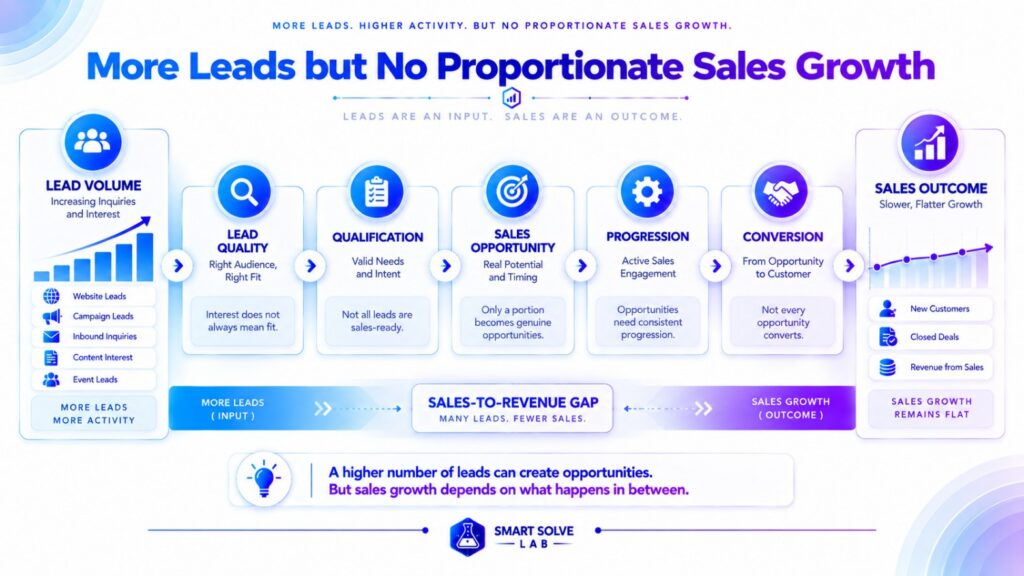
Sales Not growing despite leads:
A business can generate more leads and still struggle to achieve the sales growth it expects. Lead generation may be increasing, marketing activity may be strong, the sales team may be following up with more prospects, and the pipeline may appear active—yet actual sales can remain unexpectedly flat.
This creates an important question: if more leads are entering the business, why aren’t sales growing proportionately?
The problem may not simply be the number of leads being generated. There can be a gap between lead volume and the sales outcome those leads are expected to produce. That gap may be connected to lead quality, qualification, opportunity progression, conversion capacity, customer decision readiness, or another condition within the lead-to-sale pathway.
This does not mean every sales-growth problem has the same cause. It means that lead generation needs to be understood in relation to what happens after the lead enters the business.
In this article, we’ll examine why more leads do not always produce more sales, where the lead-to-sale pathway can weaken, and how to identify the areas that may require deeper diagnostic attention.
Table of Contents
Why More Leads Do Not Always Produce More Sales
More Leads Can Create More Activity
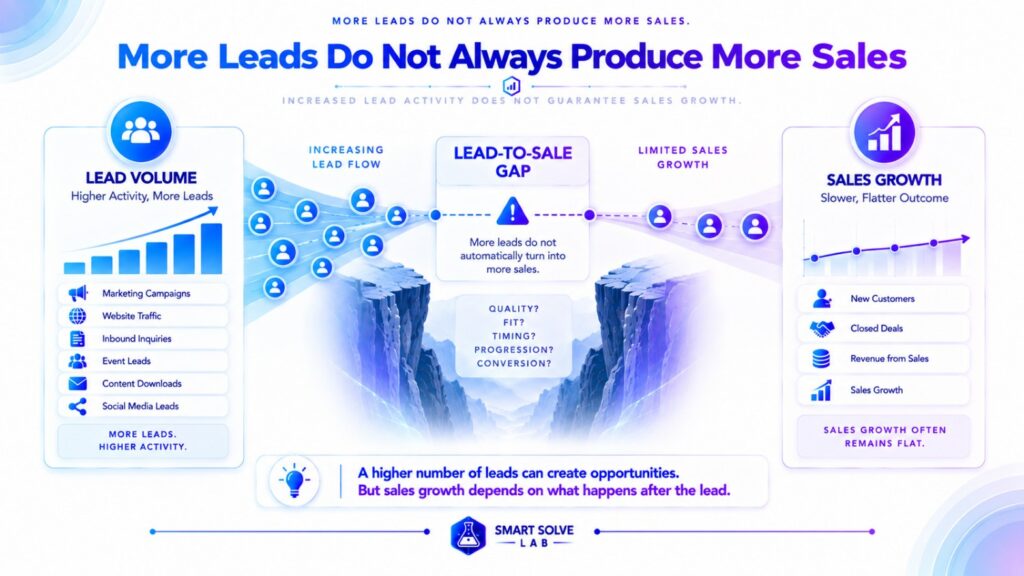
A business can generate more leads and still experience limited sales growth. More leads can increase the amount of activity entering the sales process, but additional activity does not automatically mean that more customers will complete a purchase.
Lead Volume Is Not Sales Growth
Lead volume measures how many potential customers are entering the business. Sales growth reflects the number and value of customers actually converting. These outcomes are connected, but they are not interchangeable. A business can see lead volume increase while sales remain flat if the additional leads do not progress effectively toward a sale.
The Gap Between Leads and Sales
When leads are increasing but sales are not growing at a similar rate, a gap may exist somewhere between lead generation and the sales outcome. The gap could relate to the quality of incoming leads, qualification, opportunity progression, conversion, or another condition affecting the journey from lead to sale.
Why More Lead Generation May Not Solve the Problem
If the existing leads are not progressing effectively, generating even more leads may simply increase the volume entering the same pathway. This can create more work for the sales team without addressing the condition that is limiting sales growth.
The important question is therefore not simply how many more leads the business can generate, but whether those leads are creating proportionate sales opportunities and outcomes.
What Has to Happen Between a Lead and a Sale
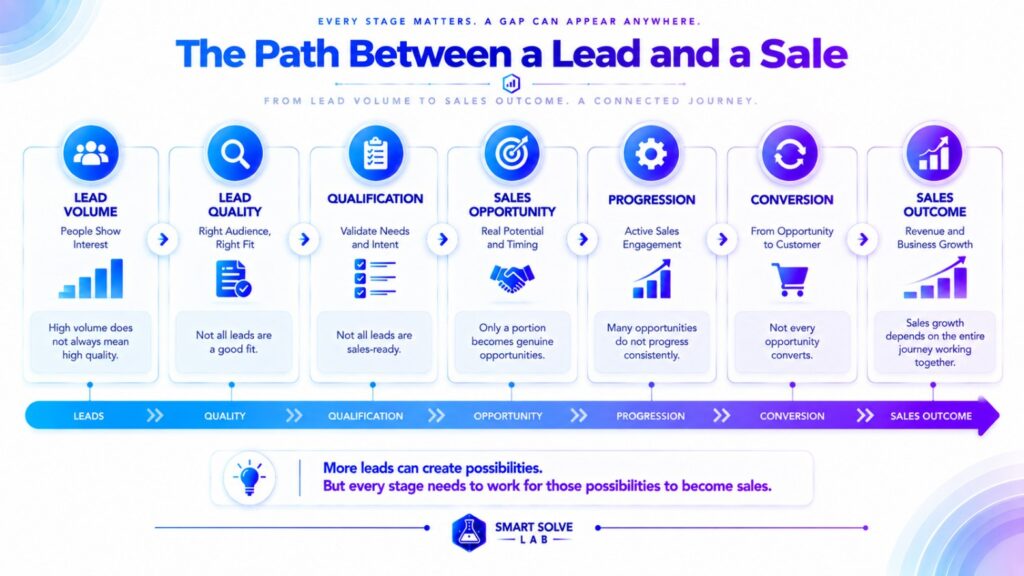
Lead Quality
Not every lead has the same level of relevance, intent, or potential value. A growing lead count becomes more meaningful when the additional leads are aligned with the business, its offer, and the type of customer it can realistically serve.
Lead Qualification
Leads also need to be distinguished according to whether they represent meaningful sales opportunities. If a large share of incoming leads has limited fit or intent, the sales team may have substantial activity without a comparable increase in genuine opportunities.
Sales Opportunity
A qualified lead needs to develop into an opportunity that can realistically progress toward a purchase. This is where the difference between simply receiving a lead and creating a commercially meaningful sales opportunity becomes important.
Sales Conversation
The sales interaction can influence whether an opportunity continues moving forward. If relevant opportunities are entering the process but are not progressing through meaningful sales conversations, potential sales value can be lost before the final decision.
Purchase Decision
Even when a customer shows interest and reaches a sales opportunity, the journey still needs to reach a purchase decision. Customer readiness, perceived value, fit, and other conditions can influence whether that progression results in an actual sale.
Why Lead-to-Sale Progression Matters
The journey from lead to sale is therefore a progression rather than a single event. Looking only at the number of leads can hide where that progression becomes weaker and why additional lead volume may not be producing the expected sales outcome.
More leads create potential opportunities, but sales growth depends on what happens to those opportunities after they enter the business.
The Sales-to-Revenue Gap
When Leads Increase but Sales Stay Flat
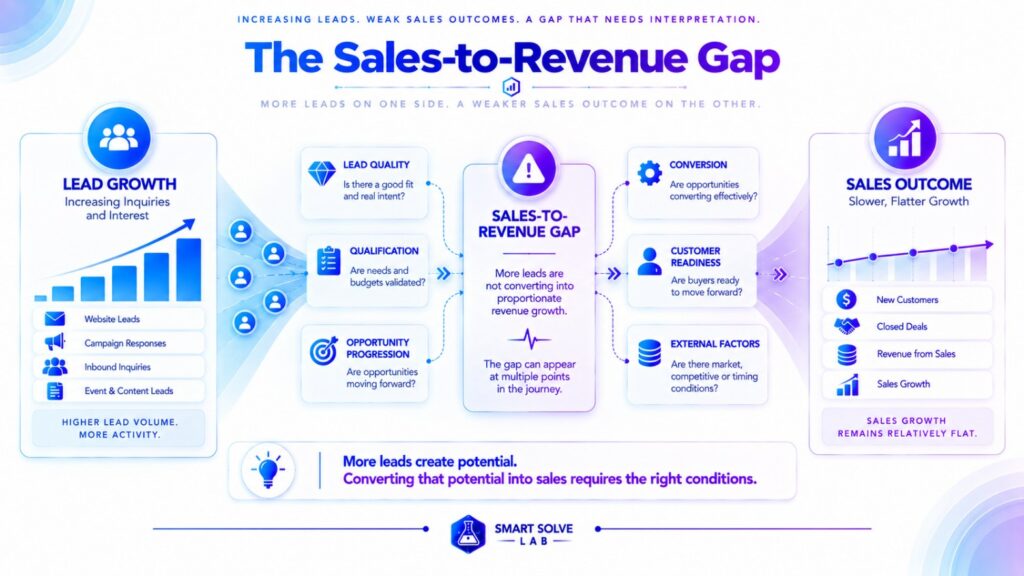
A sales-to-revenue gap can become visible when lead volume increases but sales remain flat or grow much more slowly. The business may be generating more potential opportunities, yet the expected sales outcome is not following at the same rate.
Input vs. Sales Outcome
Lead generation is an input into the sales process, while sales represent an important business outcome. Comparing the two helps reveal whether increasing lead activity is actually producing the level of sales growth the business expects.
Where Value Can Be Lost Between Lead and Sale
Potential sales value can weaken at different points along the lead-to-sale pathway. Leads may have limited relevance, qualification may be inconsistent, opportunities may fail to progress, or suitable opportunities may not convert. The visible sales gap therefore does not automatically identify where the underlying weakness begins.
Why the Gap Matters More Than Lead Volume
A growing lead count can create the impression that the sales engine is improving. But if sales do not follow, the more useful question becomes whether those additional leads are progressing toward meaningful sales outcomes.
The sales-to-revenue gap is therefore not simply about generating too few leads. It is about understanding where increasing lead activity stops translating into proportionate sales growth.
Why More Leads Can Sometimes Make the Sales Problem Worse
More Leads Can Increase Sales Workload
When lead volume increases, the sales team may need to handle more follow-ups, conversations, qualification activity, and opportunity management. If the additional leads are not producing proportionate sales opportunities, the increase in volume can create more workload without creating equivalent business value.
Poor-Fit Leads Consume Capacity
Leads that have limited relevance, weak intent, or poor alignment with the offer can consume sales capacity even when they are unlikely to progress toward a purchase. This can reduce the time and attention available for opportunities with stronger potential.
Sales Teams Can Become Busier Without Becoming More Effective
A larger number of leads can make a sales team appear more active because there are more people to contact and more opportunities to manage. However, higher activity does not necessarily mean that the team is converting a greater proportion of meaningful opportunities into sales.
Volume Can Hide a Quality Problem
When lead volume becomes the primary measure of progress, a business may overlook whether those leads are actually relevant and capable of progressing through the sales process. This can make a lead-quality or opportunity-quality problem look like a simple need for more volume.
More leads can therefore increase activity without resolving the condition that is limiting sales growth.
Why Lead Quality Matters More Than Lead Quantity
Not Every Lead Has Equal Revenue Potential
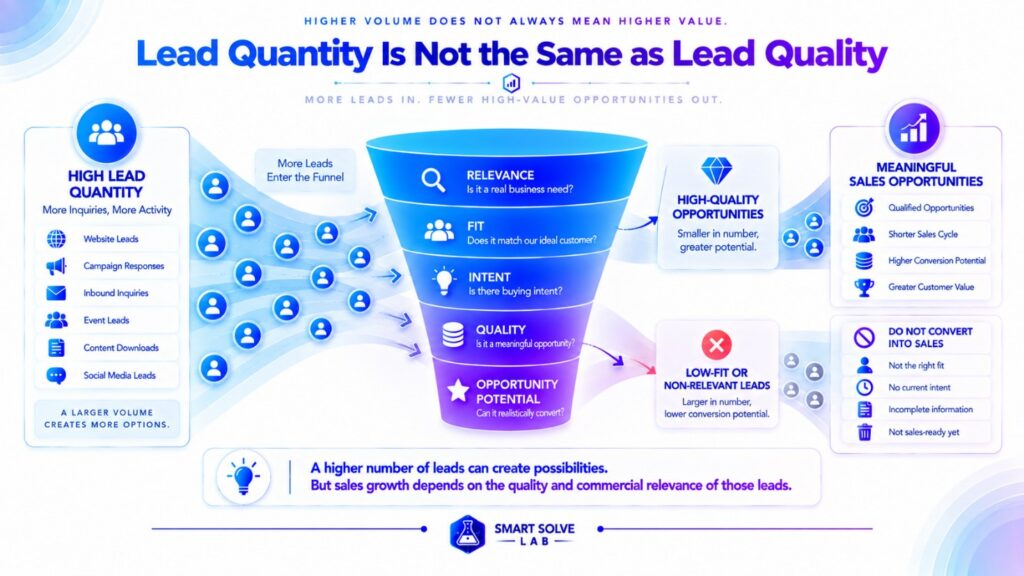
A growing number of leads can look encouraging, but each lead does not necessarily have the same potential to become a valuable customer. Some may have strong relevance and intent, while others may have limited fit with the business, its offer, or its target customer.
Intent and Fit
Lead quality is influenced by how closely a potential customer aligns with what the business offers and how seriously they are considering a purchase. When additional leads have weak relevance or limited intent, increasing lead volume may create more activity without creating proportionate sales opportunities.
Qualified vs. Unqualified Opportunities
A business can receive many enquiries while having far fewer opportunities that are genuinely capable of progressing toward a sale. Distinguishing between general lead volume and commercially meaningful opportunities can therefore provide a clearer view of what the sales team is actually receiving.
When Lead Volume Creates a False Sense of Growth
Lead growth can create a positive signal even when the quality of those leads is declining. If the business measures success mainly through the number of leads generated, it may overlook a weakening connection between lead generation and actual sales potential.
The more useful question is therefore not only “How many leads are we getting?” but also “What kind of sales opportunities are those leads creating?”
A business can receive many enquiries while having far fewer opportunities that are genuinely capable of progressing toward a sale. Distinguishing between general lead volume and commercially meaningful opportunities can therefore provide a clearer view of what the sales team is actually receiving. If the gap appears earlier in the journey, Why Your Website Traffic Doesn’t Become Leads explores how hidden barriers can prevent visitors from becoming meaningful leads.
Where Leads Can Break Down Before Becoming Sales
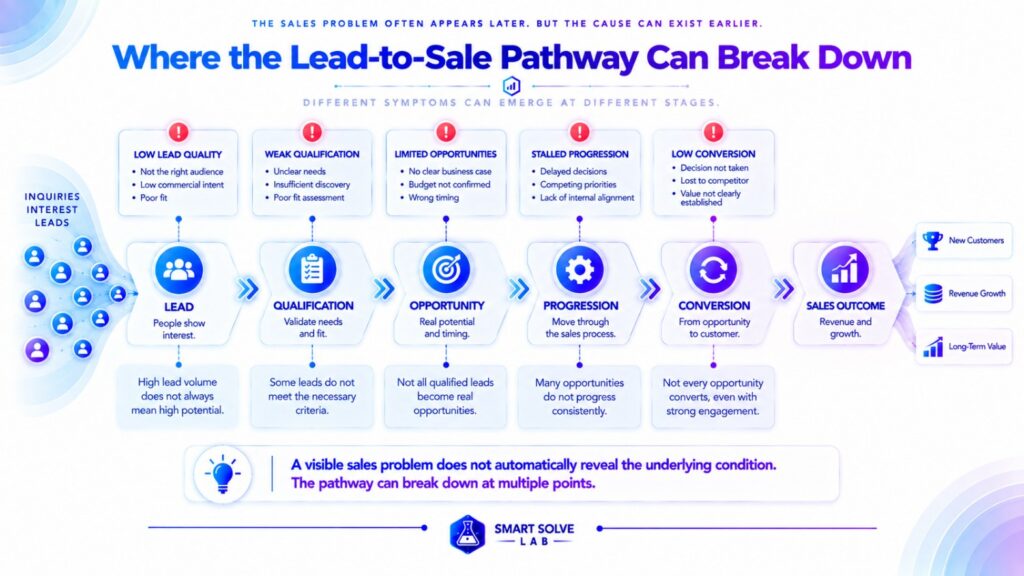
Leads That Are Not Properly Qualified
Some leads may enter the sales process without having enough relevance, intent, or commercial potential to become strong opportunities. When qualification is weak, the sales team may spend significant time handling leads that are unlikely to progress.
Leads That Do Not Progress
Even relevant leads can fail to move forward. A lead may show initial interest but never develop into a meaningful sales opportunity, creating a gap between the number of leads entering the business and the opportunities reaching later stages.
Leads That Lose Interest
Some potential customers may engage initially but become less responsive as the sales process continues. This can reduce the number of opportunities that eventually reach a purchase decision and make overall sales growth weaker than the initial lead volume suggests.
Leads That Reach Sales but Do Not Convert
Other leads may progress far enough to become genuine sales opportunities but still fail to convert. In these cases, the issue may relate to conversion capacity, customer decision readiness, offer alignment, or another condition affecting the final progression toward a sale.
Why Different Breakdowns Point to Different Conditions
These situations may produce a similar visible outcome—sales are not growing as expected—but they do not necessarily have the same underlying cause. Understanding where progression appears to weaken can therefore provide a more useful diagnostic direction than simply increasing lead volume.
The key is to identify where the lead-to-sale pathway appears to weaken, rather than assuming that every sales problem requires more leads.
Why Sales Teams Can Be Busy Without Sales Growing
More Follow-Ups
When lead volume increases, sales teams may naturally have more follow-ups to manage. More calls, messages, emails, and meetings can create a high level of sales activity, but that activity does not automatically mean that more opportunities are moving toward a sale.
More Sales Conversations
A growing number of sales conversations can indicate that the team is actively engaging with prospects. However, conversations alone do not confirm that prospects are progressing toward a purchase or that the additional activity is producing proportionate sales outcomes.
More Opportunities in the Pipeline
A larger pipeline can also create the appearance of stronger sales performance. Yet opportunities may remain at different stages, progress slowly, or fail to convert. The size of the pipeline therefore needs to be understood in relation to the sales outcomes it produces.
More Work Does Not Guarantee More Closed Sales
When the sales team is handling more activity without seeing comparable sales growth, simply increasing effort may not address the underlying limitation. The issue may exist in the quality, progression, or conversion of the opportunities being managed.
Sales Activity vs. Sales Outcome
Sales activity shows what the team is doing, while sales outcome shows what that activity is producing. Looking at both together can reveal whether increased sales effort is translating into meaningful commercial results.
A busy sales team can therefore be a sign of high activity without being proof of effective sales growth.
The Conditions Behind Weak Sales Growth
Demand Quality
Sales growth can be affected when the demand entering the business is not sufficiently aligned with the customers the business is trying to serve. Strong lead volume does not necessarily compensate for weak relevance or intent.
Opportunity Quality
Leads need to develop into opportunities with genuine potential to progress toward a sale. If many leads enter the business but relatively few become meaningful opportunities, sales growth may remain limited despite increasing lead activity.
Sales Conversion Capacity
Even relevant opportunities may not produce sales if the business has difficulty converting them effectively. The limitation may involve how opportunities are handled, progressed, or moved toward a purchase decision.
Sales Process Friction
Unnecessary friction within the sales process can make it harder for suitable opportunities to progress. When prospects encounter barriers or delays, potential sales can weaken even when lead generation remains strong.
Customer Decision Readiness
A prospect can have genuine interest without being ready to make a purchase decision. Differences in timing, perceived value, confidence, or other decision conditions can influence whether an opportunity progresses to a sale.
Sales Capacity and Follow-Through
Growing lead volume can place additional demands on the sales team. If opportunities are not consistently followed through or managed effectively as volume increases, some potential sales may fail to progress.
These are potential condition areas, not a fixed diagnosis. The same sales symptom can have different underlying causes, which is why the actual limitation needs to be interpreted through evidence rather than assumed from lead volume alone.
Why the Visible Sales Problem May Not Be the Real Problem
Sales Can Be Affected by Lead Quality
When sales are weak, it can be tempting to assume that the sales team simply needs to improve its conversion performance. But if the leads entering the process have weak relevance or intent, the visible sales problem may actually begin before the sales conversation.
Sales Can Be Affected by Offer Alignment
Even relevant prospects may not progress when the offer does not align clearly with what they need or value. In such cases, the sales outcome can be affected by a condition that is not limited to sales activity itself.
Sales Can Be Affected by Conversion Friction
A suitable opportunity may still encounter barriers during the progression toward purchase. Delays, uncertainty, unclear value, or other forms of friction can reduce the likelihood that an opportunity will reach a sales outcome.
Sales Can Be Affected by Customer Readiness
A prospect may be interested but not sufficiently ready to make a purchase decision. This distinction matters because weak sales outcomes do not always mean that the opportunity was poorly handled; the customer’s decision conditions can also influence progression.
Why the First Visible Symptom Needs Deeper Examination
The first visible symptom is often where the problem becomes noticeable, not necessarily where it begins. Looking beyond the immediate sales result can help distinguish between a sales conversion issue and an earlier condition affecting the lead-to-sale pathway.
A weak sales outcome should therefore be treated as a signal to investigate the pathway, rather than as automatic proof that the sales team is the underlying problem.
How to Diagnose a Sales-to-Revenue Gap
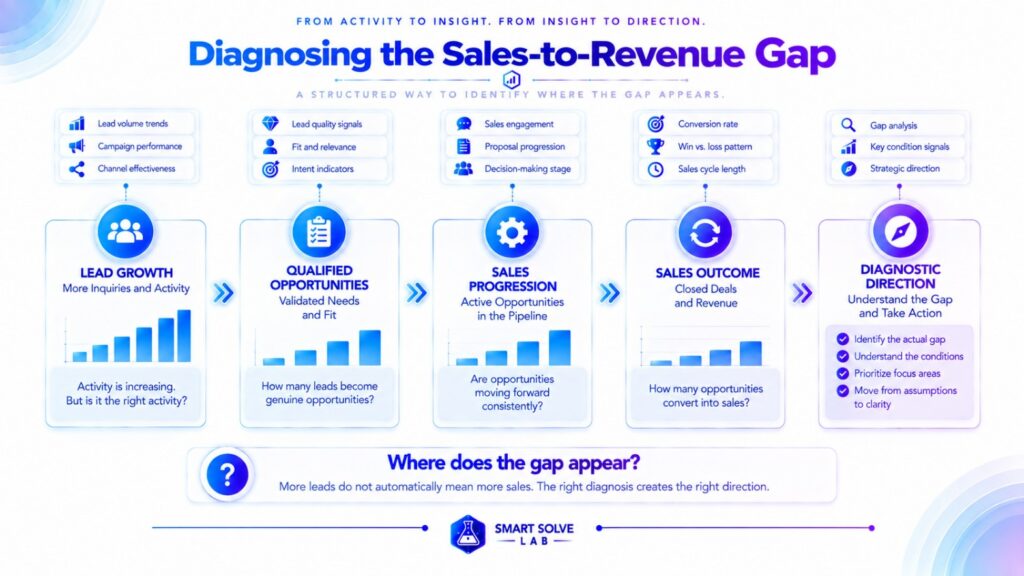
Are Leads Actually Increasing?
First, establish whether lead volume is genuinely increasing rather than assuming that a larger number of leads is being generated. This creates the starting point for comparing lead activity with the sales outcome.
Are Qualified Opportunities Increasing?
Next, consider whether the increase in leads is producing a comparable increase in meaningful sales opportunities. If lead volume grows while qualified opportunities remain limited, the gap may be appearing before the later stages of the sales process.
Are Sales Increasing at the Expected Rate?
The next question is whether sales are moving proportionately with the additional opportunities being generated. When sales remain flat or grow significantly more slowly, the difference becomes a useful signal that a sales-to-revenue gap may exist.
Where Does Lead-to-Sale Progression Weaken?
Once a gap is visible, attention can move toward the progression from lead to qualification, opportunity, conversion, and final sales outcome. The purpose is to understand where progression appears weaker, rather than immediately assuming which condition is responsible.
What Evidence Supports the Signal?
A possible constraint should not be treated as a confirmed diagnosis simply because it appears plausible. The stronger approach is to examine the available evidence and determine whether the observed signals support that direction. For website and digital activity data, Google Analytics dimensions and metrics can help provide measurable signals for understanding what is happening across relevant user and page interactions.
Is the Visible Sales Problem Coming From Somewhere Earlier?
A sales conversion problem may sometimes reflect an earlier issue with lead quality, opportunity quality, or customer readiness. Looking across the pathway helps prevent the business from treating the first visible symptom as the complete diagnosis.
The goal is not to immediately decide what the business should change. The goal is to clarify where the sales-to-revenue gap appears and which condition may require deeper diagnostic attention.
From Lead Generation to Sales Alignment
Stop Measuring Leads in Isolation
Lead volume can be useful, but it becomes more meaningful when considered alongside the sales outcome it is expected to influence. Looking at leads alone can make growth appear stronger than the actual commercial result.
Connect Lead Quality With Sales Outcomes
The quality and relevance of incoming leads can influence how many meaningful opportunities the business is able to create. Connecting lead signals with sales outcomes can therefore provide a clearer view of whether additional lead activity is producing genuine commercial value.
Examine Progression, Not Just Volume
The number of leads entering the business is only one part of the picture. Understanding how those leads progress toward qualified opportunities, sales conversations, and eventual purchase can reveal where the expected sales outcome begins to weaken.
Identify Where the Sales Gap Appears
When lead activity and sales outcomes are considered together, the business can begin to identify where a potential gap appears within the lead-to-sale pathway. This creates a more useful starting point for understanding the conditions that may deserve further attention.
Determine What Needs Deeper Diagnosis
Once a potential gap becomes visible, the next step is not automatically to increase lead generation or change the sales process. The more useful question is which condition requires deeper examination before deciding what action should be taken.
Sales alignment means understanding whether lead generation is creating the quality, progression, and sales outcomes the business actually needs—not simply whether lead volume is increasing.
The Key Insight: More Leads Are Valuable Only When They Create More Sales Opportunities
Lead Growth Is an Input
Increasing lead volume can expand the number of potential customers entering the business. But lead growth remains an input into the wider sales process rather than proof that the business has achieved sales growth.
Sales Growth Is an Outcome
Sales growth reflects what the business ultimately produces from its available opportunities. When lead volume increases without a comparable improvement in sales, the difference between the input and outcome becomes an important signal to examine.
Quality Influences Progression
Relevant and commercially meaningful leads have a stronger basis for progressing toward genuine sales opportunities. When quality is weak, additional lead volume may create more activity without creating equivalent sales potential.
Conversion Influences Economic Value
Even suitable opportunities still need to progress toward a purchase before they create a sales outcome. When conversion weakens, potential value can remain trapped within the sales pathway despite strong lead generation activity.
More Volume Cannot Automatically Repair a Weak Sales Boundary
If the limitation exists somewhere between lead generation and sales conversion, increasing the number of leads may simply send more volume through the same weak point. Understanding the gap first can therefore be more useful than automatically increasing activity.
The central insight is simple: more leads create more potential, but sales growth depends on what the business is able to turn those leads into.
From More Leads to Better Sales Understanding
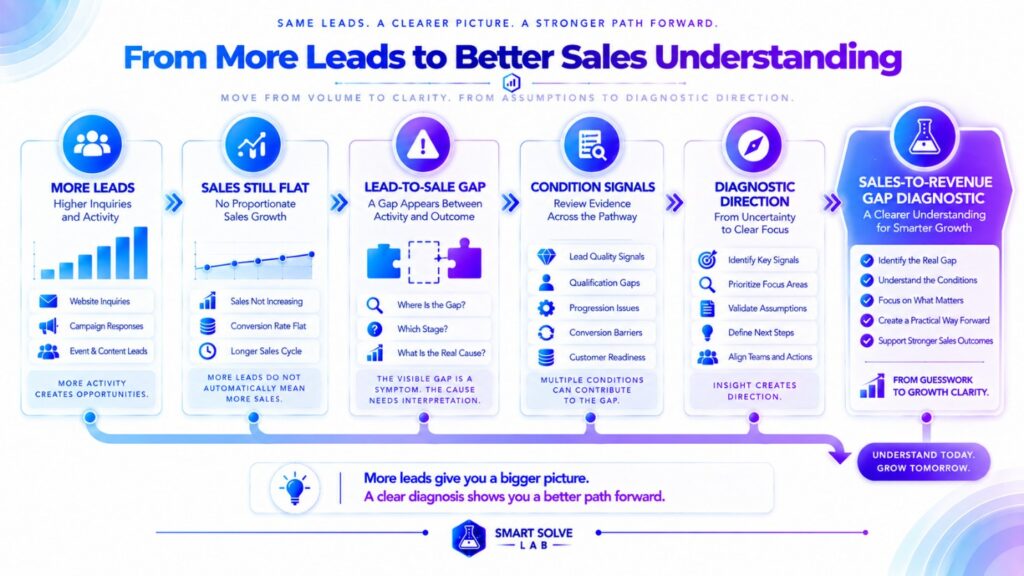
From Volume → Quality
Increasing lead volume can be useful when those additional leads are relevant to the business and capable of becoming meaningful opportunities. The focus therefore needs to move beyond how many leads are being generated toward what those leads actually represent.
From Activity → Outcome
Sales activity can increase through more follow-ups, conversations, and opportunities in the pipeline. But the more important question is whether that additional activity is producing a comparable improvement in sales outcomes.
From Symptoms → Conditions
Flat sales can be the visible symptom of a deeper condition somewhere in the lead-to-sale pathway. Looking at quality, qualification, progression, conversion, and customer readiness can help create a more useful direction for understanding what may be limiting the outcome.
From More Leads → Better Diagnostic Direction
Once the relationship between lead activity and sales outcomes becomes clearer, the business can move away from automatically pursuing more volume and toward understanding where deeper examination may be needed.
The shift is from asking “How can we generate more leads?” to asking “What is preventing the leads we already generate from producing proportionate sales growth?”
Where to Go Next: Diagnose Your Sales-to-Revenue Gap
When Leads Are Growing but Sales Are Not
If lead volume is increasing but sales are not growing at a comparable rate, the first priority is to understand where the gap may be occurring rather than simply generating more leads.
When Sales Activity Is High but Results Remain Weak
A sales team may be handling more follow-ups, conversations, and opportunities while the final sales outcome remains limited. When activity is high but results remain weak, the underlying condition deserves closer examination.
When Lead Quality Is Unclear
If the business knows that leads are increasing but cannot clearly determine whether those leads have sufficient relevance, intent, or commercial potential, lead volume alone cannot explain the sales outcome.
When You Cannot Identify Where Lead-to-Sale Progression Breaks
When it is unclear whether the gap relates to lead quality, qualification, opportunity progression, conversion, customer readiness, or another condition, a focused diagnostic can provide a clearer starting point for deeper investigation.
The Next Logical Step: Sales-to-Revenue Gap Diagnostic
The Sales-to-Revenue Gap Diagnostic is designed for this specific situation. It helps businesses examine the relationship between increasing lead volume and sales outcomes, identify where a potential lead-to-sale gap appears, interpret the conditions that may be contributing to it, and determine where deeper diagnostic attention may be needed.
The goal is not to promise more sales. The goal is to replace uncertainty about the lead-to-sale gap with clearer diagnostic direction.
The Sales Growth Diagnostic Path
Understand the Sales Gap
↓
Sales-to-Revenue Gap Diagnostic — Identify and interpret the lead-to-sale gap
↓
Sales Conversion Improvement System — Move diagnosis toward execution
↓
Sales Growth Analyzer — Future tool for structured analysis and decision support
Key Takeaways
- More leads do not automatically mean more sales. Lead volume is an input, while sales growth is an outcome.
- Lead quality matters. A larger number of poorly aligned leads may create more activity without creating proportionate sales opportunities.
- Sales activity and sales outcomes are different. More follow-ups, conversations, and pipeline activity do not guarantee more closed sales.
- The lead-to-sale pathway can weaken at different points. Qualification, opportunity progression, conversion, customer readiness, and other conditions can influence the final outcome.
- The visible sales problem may not be the underlying problem. A weak sales result can sometimes be connected to an earlier condition in the pathway.
- Better diagnosis can be more useful than simply generating more leads. Understanding where the sales-to-revenue gap appears creates a stronger basis for deciding what deserves deeper attention.
The key question is not only how many leads the business is generating, but how effectively those leads are progressing toward proportionate sales growth.
Conclusion
Getting more leads is usually a positive signal, but lead growth alone does not guarantee sales growth. A business can generate more enquiries, increase sales activity, and expand its pipeline while still seeing sales remain flat or grow more slowly than expected.
When this happens, the more useful question is not simply whether the business needs more leads. It is whether the leads being generated are creating meaningful opportunities and progressing effectively toward sales.
Lead quality, qualification, opportunity progression, conversion, customer readiness, and sales follow-through can all represent different conditions within the wider lead-to-sale pathway. The visible sales problem therefore needs to be understood as a signal rather than automatically treated as the complete diagnosis.
If your leads are growing but sales are not growing proportionately, understanding where the sales-to-revenue gap appears can provide a much clearer starting point for deeper diagnostic attention.
That is the purpose of the Sales-to-Revenue Gap Diagnostic: not to promise guaranteed sales growth, but to help businesses identify and interpret where increasing lead volume may be failing to translate into proportionate sales outcomes.
FAQs
Why are my leads increasing but sales are not growing?
Increasing leads does not automatically produce increasing sales. The gap may be related to lead quality, qualification, opportunity progression, conversion, customer readiness, or another condition within the lead-to-sale pathway.
Can more leads actually make a sales problem worse?
Yes. If existing leads are not progressing effectively, generating more leads can increase sales workload without producing proportionate sales opportunities or outcomes.
Why is lead quality more important than lead quantity?
Not every lead has the same relevance, intent, or commercial potential. A smaller number of well-aligned leads can create stronger sales opportunities than a larger volume of poorly aligned leads.
What is the sales-to-revenue gap?
The sales-to-revenue gap describes the difference that can appear when lead generation increases but sales do not grow proportionately. It helps direct attention toward where the lead-to-sale pathway may be weakening.
How can poor conversion affect sales growth?
When suitable opportunities fail to progress toward a purchase, potential sales value can be lost even when lead generation remains strong. This can contribute to a gap between lead activity and sales outcomes.
Why can a sales team be busy without increasing sales?
A sales team can handle more follow-ups, conversations, and opportunities without achieving proportionate sales growth. High activity does not automatically mean that meaningful opportunities are progressing effectively.
How can I identify what is limiting my sales growth?
Start by comparing lead growth with qualified opportunities, progression, and sales outcomes. When the relationship between these signals is unclear, a focused sales-to-revenue diagnostic can help identify where deeper diagnostic attention may be needed.
Recommended Reading
- Why Your Website Traffic Doesn’t Become Leads (Even When Visitors Keep Coming) — Explore the barriers that can affect whether website visitors become meaningful leads.
- Why Your Sales Funnel Is Not Converting (And Where Customers Are Leaking) — Understand where prospects can lose momentum or drop out before completing the conversion journey.
- Why Marketing Campaigns Work But Revenue Still Doesn’t Grow (And the Revenue System That Fixes It) — See how successful marketing activity can still remain disconnected from the wider revenue outcome.
Leave a Reply