
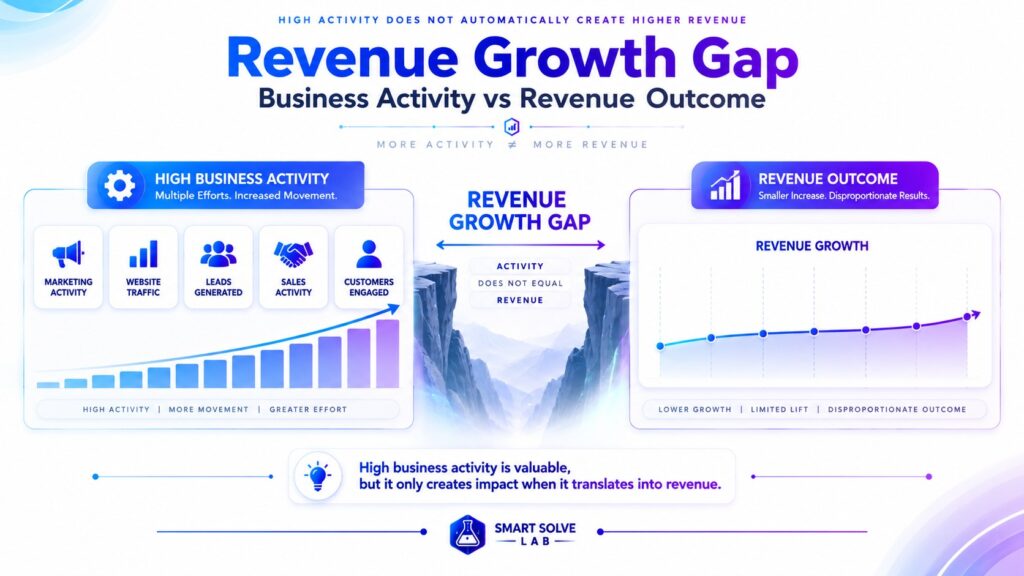
revenue growth gap :
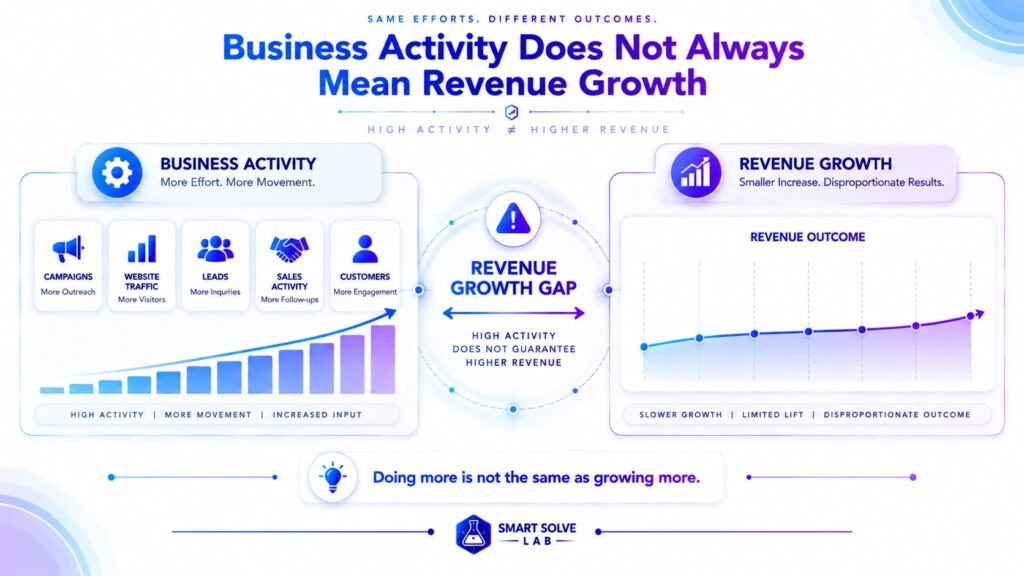
A business can be extremely busy without seeing revenue grow at the same pace. Marketing campaigns may be running, website traffic may be increasing, leads may be coming in, sales activity may be active, and customers may still be arriving—yet revenue can remain unexpectedly flat.
This creates a frustrating question: if so much is happening inside the business, why isn’t revenue growing proportionately?
The problem may not simply be a lack of activity. Sometimes there is a gap between the activity a business generates and the revenue outcome that activity produces. Understanding where that gap appears can reveal whether the underlying issue may be connected to demand, opportunity quality, conversion, customer value, retention, or another revenue condition.
This does not mean every revenue problem has the same cause. It means that business activity needs to be understood in relation to the outcome it is expected to produce.
In this article, we’ll examine why a busy business can still experience weak revenue growth, where value may be lost between activity and revenue, and how to identify the areas that may deserve deeper diagnostic attention.
Table of Contents
Why Revenue Can Stay Flat Even When Business Activity Is High
Busy Does Not Always Mean Growing
A business can have a full pipeline of activity and still experience limited revenue growth. Campaigns may be running, teams may be active, leads may be entering the business, and sales conversations may be taking place without those activities producing a proportionate increase in revenue.
The Difference Between Activity and Revenue
Activity measures what the business is doing. Revenue reflects the economic outcome produced by those activities. The two are connected, but they are not interchangeable. More traffic, more leads, more campaigns, or more sales activity can increase workload without necessarily creating an equivalent increase in revenue.
Why More Effort Can Still Produce Flat Results
When additional effort produces little change in revenue, the issue may be less about how much activity is taking place and more about what happens between that activity and the final business outcome. A weakness somewhere along that path can limit how effectively activity translates into revenue.
The important question is therefore not simply how busy the business is, but whether its activity is producing the revenue outcome it is expected to produce.
What Actually Has to Happen for Activity to Become Revenue
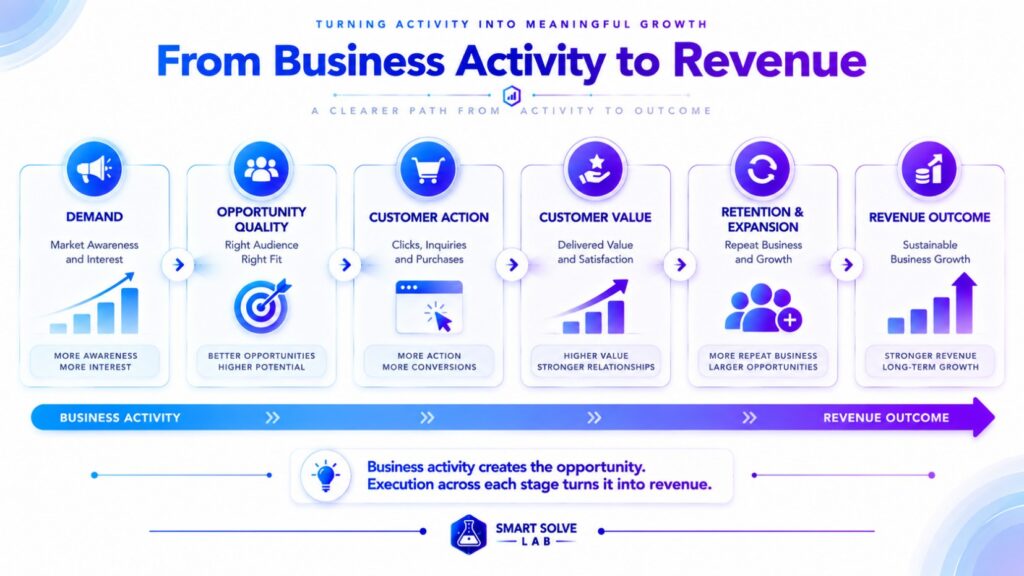
Demand Has to Reach the Right Market
Business activity becomes more meaningful when it creates demand among people who are relevant to the business and its offer. More visibility or activity alone does not establish that the right market is being reached.
Opportunities Need the Right Quality
Not every visitor, lead, or sales opportunity has the same potential value. Revenue progression depends partly on whether the opportunities created by business activity are aligned with what the business can realistically convert and serve.
Customers Need to Move Toward Action
Demand and opportunities still need to progress toward meaningful customer action. If progression weakens before a purchase or other valuable outcome, increasing activity at the beginning of the journey may not resolve the revenue gap.
Customer Value Needs to Continue After the Sale
Revenue is not determined only by acquiring a customer. The value created after the initial transaction can also influence the overall revenue outcome, particularly when customers have opportunities to return, continue, or expand their relationship with the business.
Retention and Expansion Can Strengthen Revenue
When customers remain engaged and continue purchasing or expanding their relationship with a business, existing customer value can contribute to revenue beyond the initial transaction. This makes retention and expansion important parts of the broader revenue picture.
Why These Conditions Cannot Be Viewed Completely Separately
These conditions can influence one another. A weakness in demand quality may affect opportunities, weak conversion may limit customer acquisition, and limited customer value or retention may restrict the revenue produced after acquisition.
Revenue therefore depends not only on how much activity a business generates, but on whether that activity creates meaningful progression toward economic value.
The Revenue Growth Gap: Where Activity Loses Economic Value
When More Activity Does Not Produce Proportionate Revenue
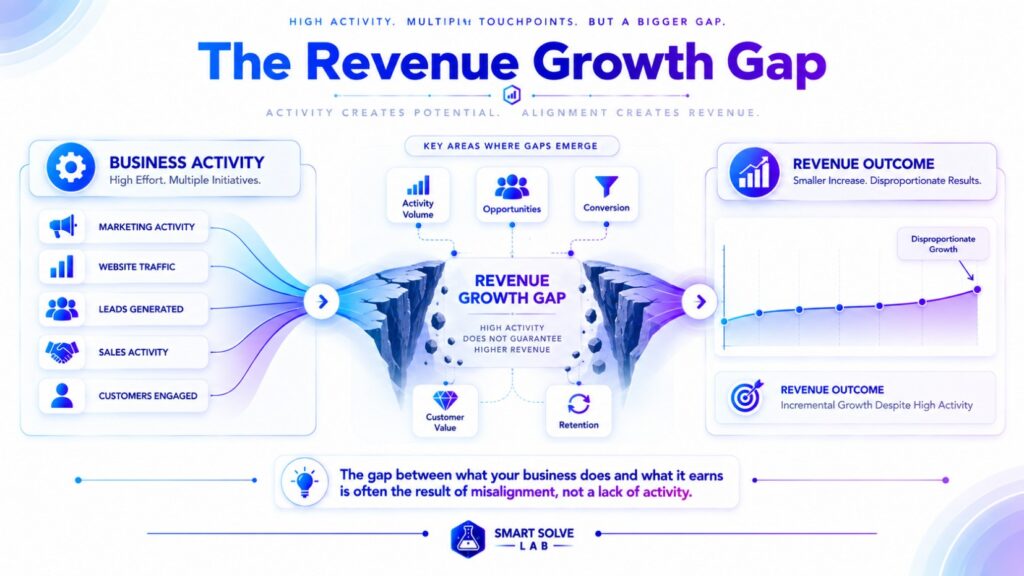
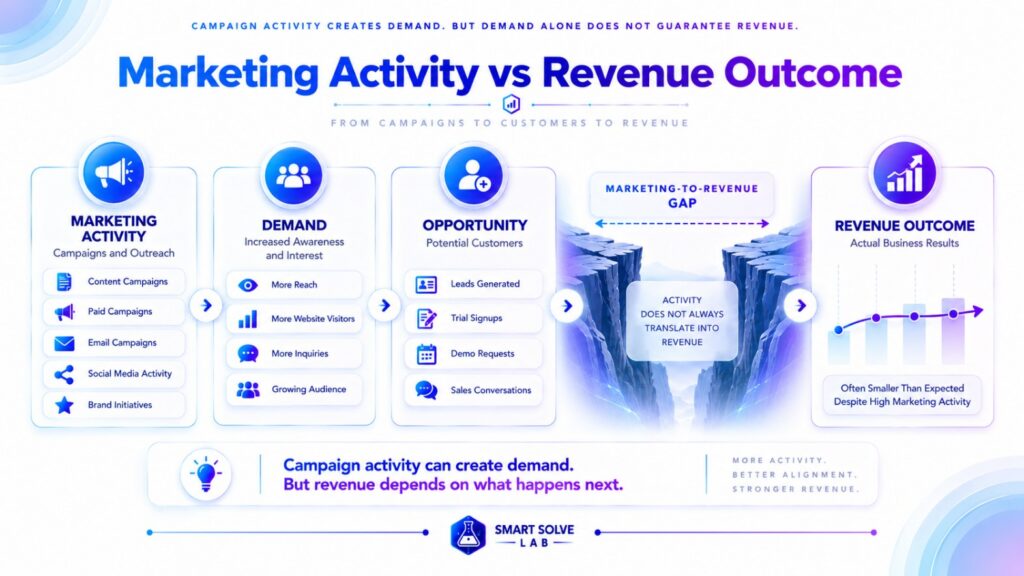
A revenue growth gap appears when business activity increases but the resulting revenue does not move in proportion. The business may be doing more, reaching more people, or creating more opportunities, yet the economic outcome remains weaker than expected.
Input vs. Business Outcome
Inputs such as campaigns, traffic, leads, sales activity, and customer acquisition represent what the business is generating or doing. Revenue represents the outcome. Looking at both sides together can reveal whether increasing activity is actually translating into meaningful business value.
Where Value Can Be Lost Between Activity and Revenue
Value can weaken at different points between initial activity and revenue. Demand may not create the right opportunities, opportunities may not progress toward action, or customers may generate less value after acquisition than expected. The visible revenue gap therefore does not automatically identify where the underlying weakness began.
Why the Gap Matters More Than the Amount of Activity
A growing amount of activity can create the impression that the business is moving forward. But when revenue does not follow, the more useful question becomes whether the activity is creating the right progression toward economic value.
The revenue growth gap is therefore not simply about doing too little. It is about understanding where business activity stops translating into proportionate revenue.
Why More Marketing Does Not Automatically Increase Revenue
Traffic Is Not the Same as Revenue
Marketing can increase visibility, website visits, leads, and other forms of activity without producing a proportionate increase in revenue. These outcomes can be valuable signals, but they do not by themselves confirm that the business is generating sufficient economic value from its marketing activity.
Campaign Activity Is Not the Same as Business Outcome
A campaign may generate strong engagement or reach its activity targets while revenue remains weak. This can happen when the activity being measured does not align closely enough with the outcome the business actually needs.
Demand Quality Matters
The amount of demand generated is only part of the picture. If marketing attracts people who have limited relevance, weak intent, or poor alignment with the offer, increasing marketing activity may increase workload without solving the underlying revenue problem.
The Missing Connection Between Marketing and Revenue
When marketing activity is increasing but revenue is not following, the important question is not simply whether marketing is working. It is whether the demand being created is progressing toward meaningful revenue outcomes. Why Marketing Campaigns Work But Revenue Doesn’t Grow explores this marketing-to-revenue gap in greater depth.
More marketing can create more activity, but sustainable revenue growth depends on whether that activity creates the right kind of demand and meaningful progression toward revenue.
Why High Traffic Can Still Produce Weak Revenue
Attention Is Not Revenue
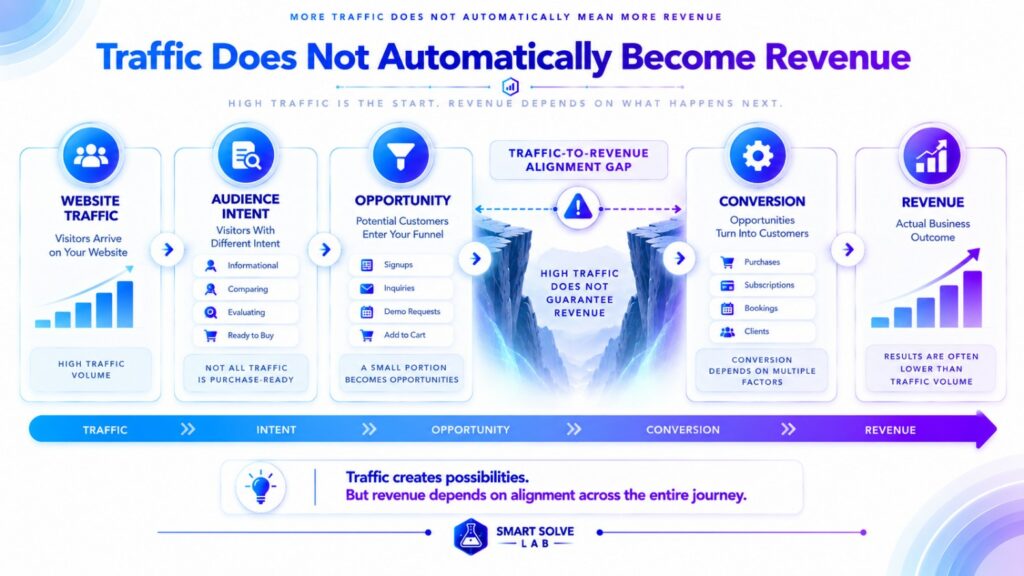
A website can attract a large number of visitors while producing relatively little revenue. Traffic shows that people are reaching the business, but it does not necessarily show that those visitors have the intent, relevance, or progression needed to create economic value.
Audience Intent Matters
Different visitors arrive with different levels of interest and different reasons for being on a website. When traffic is poorly aligned with the business offer, increasing visitor volume may create more attention without creating a comparable increase in revenue.
Traffic-to-Revenue Alignment
The more useful question is not simply whether traffic is growing, but whether the traffic being generated is contributing to meaningful customer progression. If visitors are not moving toward valuable actions, the revenue gap may exist somewhere between acquisition and conversion.
The Hidden Path Between Visibility and Monetization
Visibility creates an opportunity, but revenue requires that the opportunity continue toward a valuable business outcome. Understanding where that progression weakens can help distinguish a traffic problem from a deeper alignment problem.
High traffic can therefore be a sign of strong activity without being proof of strong revenue performance. If this is the situation your business is experiencing, High Website Traffic Still Fails to Generate Revenue provides a deeper diagnostic look at the traffic-to-revenue gap.
Why Conversion Problems Can Become Revenue Problems
Weak Conversion Capacity
A business can generate relevant demand and still experience weak revenue growth if too few opportunities progress toward a valuable customer action. In that situation, increasing activity at the top of the journey may create more opportunities without producing a proportionate increase in revenue.
Customer Progression
Conversion is not simply about whether someone buys. It also involves whether customers can progress from interest toward the next meaningful action. When that progression weakens, potential revenue can be lost before the sale occurs.
Where Revenue Can Be Lost Before the Sale
Revenue can weaken when visitors do not become leads, leads do not become qualified opportunities, or opportunities fail to progress toward purchase. These different symptoms can point to different underlying conditions, so the visible conversion problem does not always reveal the full reason revenue is being constrained.
Why Conversion Cannot Be Viewed Completely in Isolation
Conversion performance is influenced by what happens before the conversion point and can also affect what happens afterward. The quality of demand, the strength of the opportunity, and the value created from acquired customers can all shape the revenue outcome.
When conversion is weak, the issue may therefore be more than a funnel problem—it may be one part of a wider revenue growth gap. For a deeper look at where customers can be lost during the journey, see Why Your Sales Funnel Is Not Converting.
Why Customer Value and Retention Matter to Revenue Growth
Revenue Per Customer
Revenue growth is influenced not only by how many customers a business acquires, but also by the value generated from each customer. When customer value remains limited, increasing acquisition activity may not produce the level of revenue growth the business expects.
Repeat Purchases
For businesses with opportunities for repeat purchases, the initial transaction may represent only part of the customer’s potential value. When customers return and continue purchasing, the revenue generated from existing relationships can strengthen the overall growth outcome.
Retention
Customer retention can influence how much value a business ultimately receives from the customers it acquires. If customers leave quickly or do not continue their relationship with the business, acquisition activity may have to work harder simply to maintain the existing revenue base.
Expansion Opportunities
Some businesses can increase customer value through additional products, services, upgrades, or other forms of expansion. When these opportunities exist but are not being realized, revenue growth may remain weaker even when customer acquisition is active.
Acquisition vs. Sustainable Customer Value
Acquiring customers creates an important starting point, but sustainable revenue growth depends on what happens after acquisition as well. Looking only at new customer activity can therefore hide weaknesses in the value and retention side of the revenue outcome.
A busy acquisition engine can still produce limited revenue growth when the value generated after acquisition remains weak.
Why Revenue Problems Can Move Across the Business
Marketing → Opportunity
Marketing influences the demand and opportunities entering the business. If the demand being generated is poorly aligned with the offer or customer need, the resulting opportunity quality can affect what happens further along the revenue path.
Opportunity → Conversion
The quality and relevance of opportunities can influence how effectively they progress toward purchase. When opportunities are weak or poorly aligned, conversion performance may appear to be the problem even when the underlying condition began earlier.
Conversion → Customer Value
Acquiring a customer is an important revenue event, but it does not determine the full value of the relationship. The experience and value created after conversion can influence whether that customer continues to contribute to revenue.
Customer Value → Retention & Expansion
When customers receive ongoing value, opportunities for retention, repeat purchases, or expansion may become stronger. When customer value is weak, the business may struggle to sustain revenue even if acquisition activity remains high.
How One Weakness Can Expose Another
These relationships mean that a visible revenue problem may not always originate where it first appears. A weakness in one area can reduce the effectiveness of another, making the overall revenue outcome more difficult to understand when each activity is examined separately.
This is why revenue problems should be viewed as connected conditions rather than automatically treated as isolated departmental problems.
The Hidden Constraints Behind Flat Revenue
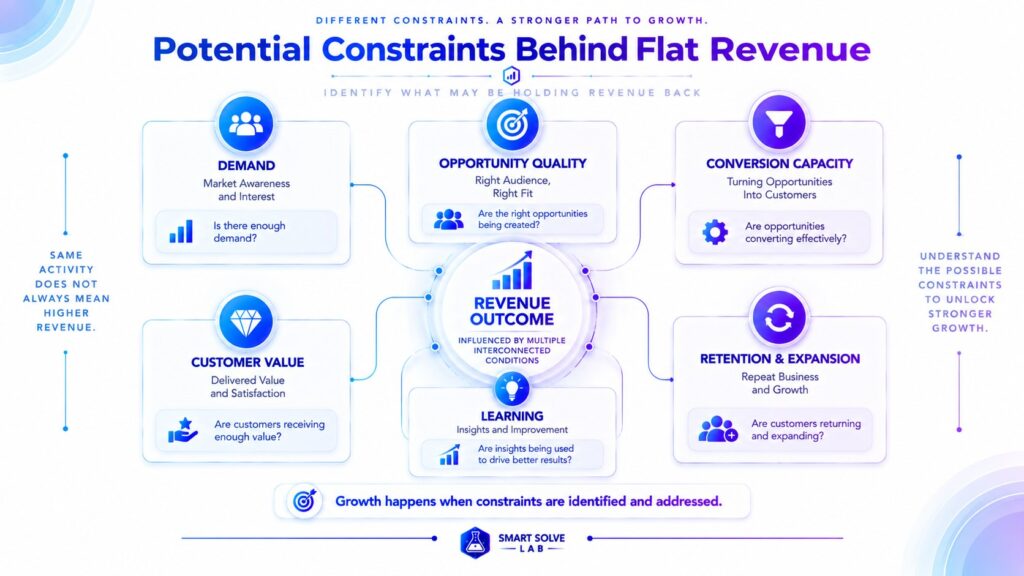
Demand Constraint
Revenue growth can be limited when the business is not generating enough relevant demand from the market it is trying to reach. In this situation, increasing general activity may not resolve the underlying limitation if the demand itself is insufficient or poorly aligned.
Opportunity Quality Constraint
A business may generate leads or opportunities without creating enough opportunities that are genuinely capable of progressing toward revenue. When opportunity quality is weak, activity levels can appear healthy while the resulting business outcome remains limited.
Conversion Constraint
Revenue can also be constrained when relevant opportunities fail to progress toward purchase or another valuable customer action. This can leave the business with substantial activity but insufficient revenue produced from that activity.
Customer Value Constraint
Even when customers are being acquired, revenue growth may remain limited if the value generated from those customer relationships is lower than expected. The constraint may therefore exist after the initial transaction rather than at the acquisition stage.
Retention & Expansion Constraint
When customers do not remain engaged, return, or expand their relationship with the business, the revenue contribution from existing customers can remain limited. This can place greater pressure on ongoing acquisition activity to support growth.
Learning Constraint
A business can also struggle to improve when it cannot clearly understand what its revenue activity is revealing. Without useful learning from observed outcomes, teams may continue increasing activity without gaining enough clarity about what is actually limiting revenue growth.
These are potential constraint areas, not a fixed diagnosis. The same revenue symptom can have different underlying conditions, which is why identifying the actual constraint requires evidence and deeper diagnostic attention rather than assumptions based on activity alone.
Why a Busy Business Can Still Lack Revenue Alignment
Everyone Is Working
In a busy business, teams may be consistently producing work, managing campaigns, handling leads, speaking with prospects, serving customers, and pursuing new opportunities. The presence of constant activity can make the business feel as though it is moving forward.
Every Department Has Activity
Different parts of the business can each have reasonable activity levels while the overall revenue outcome remains weaker than expected. Marketing may be generating attention, sales may be following up with opportunities, and customer teams may be supporting existing customers, yet the combined result may still fall short of the desired revenue growth.
Different Activities Can Still Pull in Different Directions
Activity across the business does not automatically mean that those activities are contributing toward the same revenue outcome. One area may increase volume while another struggles to convert it, or acquisition may increase while customer value and retention remain limited.
Activity Alignment vs. Revenue Alignment
Activity alignment means different parts of the business are contributing toward a common direction. Revenue alignment goes further by asking whether those activities are actually producing the economic outcomes the business needs. This distinction helps explain why a business can be highly active without becoming proportionately more profitable or revenue-generating.
The real issue may therefore not be a lack of effort, but a lack of alignment between what the business is doing and the revenue outcome it needs to produce.
How to Diagnose a Revenue Growth Gap
Where Is Activity Increasing?
Start by looking at where business activity is actually increasing. This could include marketing activity, website traffic, leads, sales opportunities, customer acquisition, or activity involving existing customers. The purpose is not to judge whether the business is busy, but to understand where effort and volume are being generated.
Where Is Revenue Failing to Follow?
Next, compare that activity with the revenue outcome it is expected to influence. If activity is increasing while revenue remains flat or grows much more slowly, the difference can provide an important signal that a revenue growth gap may exist.
Which Revenue Condition Appears Weak?
Once the gap becomes visible, attention can move toward the conditions that may be limiting revenue. These can include demand, opportunity quality, conversion, customer value, retention and expansion, or the business’s ability to learn from its outcomes.
What Evidence Supports That Signal?
A suspected constraint should not be treated as a confirmed diagnosis simply because it appears plausible. The stronger approach is to examine the available evidence and determine whether the observed signals actually support that direction. Reviewing Google Analytics dimensions and metrics can help businesses understand the data available for evaluating activity and outcomes, but stronger diagnosis still requires understanding the relationships behind those numbers.
Is the Visible Problem Actually the Underlying Constraint?
The most visible weakness is not always the condition creating the wider revenue problem. A conversion issue, for example, may reflect an earlier demand or opportunity-quality problem. This is why revenue diagnosis needs to look beyond the first symptom and consider what may be contributing to it.
The goal is not to immediately decide what the business should change. The goal is to gain enough clarity about the revenue gap to understand where deeper diagnostic attention is warranted.
From Revenue Activity to Revenue Alignment
Stop Measuring Activity in Isolation
Activity metrics can show how much work or volume the business is generating, but they become more useful when considered alongside the revenue outcome they are expected to influence. Looking at activity in isolation can make a busy business appear healthier than its actual revenue performance suggests.
Connect Revenue Conditions
Revenue growth becomes easier to understand when demand, opportunity quality, conversion, customer value, and retention are considered as related conditions rather than completely separate areas. This does not mean every condition is equally responsible for every revenue problem; it means their relationship should not be ignored.
Look at Relationships, Not Just Individual Metrics
A single metric can describe what happened without explaining why the broader outcome occurred. Looking at relationships between activity and outcomes can reveal where performance appears to weaken and where additional evidence may be needed.
Identify Where the Revenue Gap Appears
The objective is to locate the point where business activity stops producing the expected economic outcome. This creates a more useful starting point for understanding whether the gap may be associated with demand, opportunity quality, conversion, customer value, retention, or another condition.
Understand What Needs Deeper Diagnosis
Once a potential gap becomes visible, the next step is not automatically to apply a solution. The more valuable question is which area requires deeper examination before decisions are made.
Moving from activity to revenue alignment means shifting the focus from “How much are we doing?” to “What is that activity actually producing, and where does the gap appear?”
The Key System Insight: Revenue Is a Connected Outcome
Revenue Is Not Created by One Activity
Revenue is rarely the result of a single business activity. Marketing can create demand, sales can develop opportunities, conversion can turn opportunities into customers, and customer relationships can generate additional value over time. Each activity contributes differently to the overall revenue outcome.
Marketing, Conversion, Customer Value and Retention Influence One Another
These areas can affect the effectiveness of one another. The quality of demand can influence conversion, the quality of the customer experience can influence ongoing value, and retention can influence how much revenue the business ultimately generates from acquired customers.
A Weak Condition Can Affect the Wider Revenue Path
When one important condition becomes weak, its effect may extend beyond the immediate area where the weakness appears. This can make a revenue problem look larger, or different, from its original source.
More Activity Is Not Always the Answer
If the existing activity is not translating into proportionate revenue, simply increasing that activity may increase volume without resolving the underlying gap. The more useful direction is to understand which revenue condition appears constrained and why.
The central insight is simple: revenue is a connected outcome. Understanding the relationships behind that outcome is often more valuable than measuring activity alone.
From a Busy Business to a Revenue-Aligned Business
From Activity → Understanding
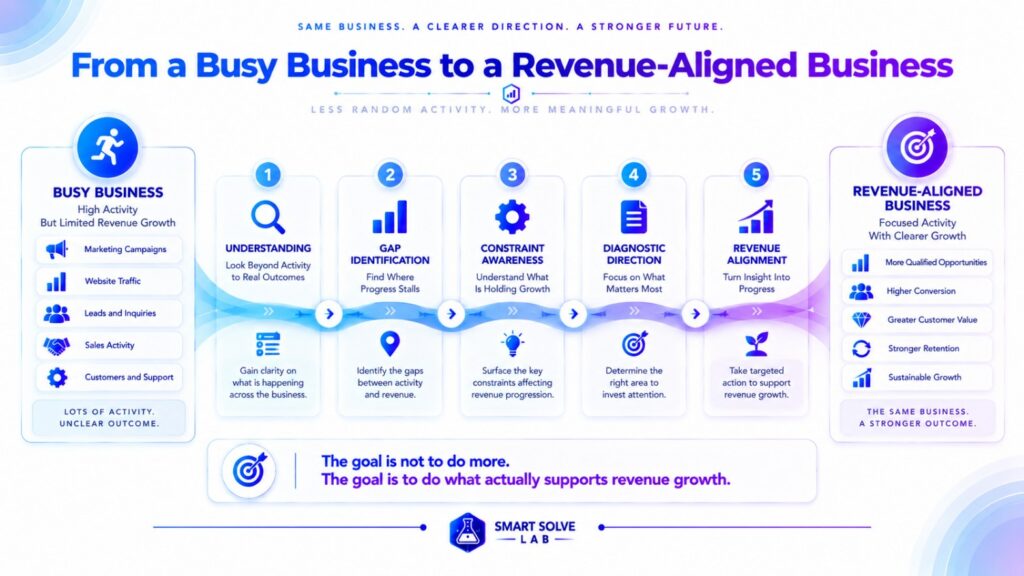
A busy business does not necessarily need more activity. It may first need a clearer understanding of what its existing activity is producing. Comparing business activity with revenue outcomes can reveal where expectations and actual results begin to diverge.
From Symptoms → Constraints
Flat revenue is a symptom, not automatically a diagnosis. Moving beyond the symptom means examining the conditions that may be limiting revenue and distinguishing visible problems from the areas that may require deeper investigation.
From Isolated Problems → Connected Conditions
Revenue problems can appear in marketing, opportunity quality, conversion, customer value, or retention, but these areas can influence one another. Understanding those relationships creates a stronger basis for interpreting why revenue is not growing proportionately.
From More Effort → Better Diagnostic Direction
The objective is not simply to make the business work harder. It is to gain better direction about where the revenue gap appears and which condition deserves closer examination before additional resources are committed.
A revenue-aligned business is therefore not simply a busy business. It is a business that understands how its activity contributes to the revenue outcome it is trying to create.
Where to Go Next: Diagnose Your Revenue Growth Gap
When Your Business Is Busy but Revenue Is Not Growing Proportionately
If your business is generating substantial activity but revenue is not increasing at the same pace, the first priority is to understand where the gap may be occurring rather than simply adding more activity.
When Multiple Activities Are Increasing but the Gap Remains Unclear
Marketing, traffic, leads, sales activity, and customer activity can all increase while the overall revenue outcome remains weaker than expected. When several signals are moving at once, identifying the actual limitation becomes more important than reacting to any single metric.
When You Cannot Identify the Actual Revenue Limitation
If it is unclear whether the main issue relates to demand, opportunity quality, conversion, customer value, retention and expansion, or another revenue condition, a focused diagnostic can help create a clearer starting point for deeper investigation.
The Next Logical Step: Revenue Growth Gap Diagnostic
The Revenue Growth Gap Diagnostic is designed for this specific situation. It helps businesses examine the relationship between activity and revenue outcome, identify where a potential gap appears, interpret the revenue conditions that may be contributing to it, and determine where deeper diagnostic attention may be needed.
The goal is not to promise instant revenue growth. The goal is to replace uncertainty with a clearer understanding of where the revenue gap may be occurring.
The Revenue Growth Diagnostic Path
Understand the Revenue Gap
↓
Revenue Growth Gap Diagnostic — Identify and interpret the underlying revenue gap
↓
Revenue Growth Optimization Framework — Move diagnosis toward execution
↓
Revenue Growth Analyzer — Future tool for structured analysis and decision support
Key Takeaways
- Being busy does not automatically mean the business is growing. High levels of marketing, traffic, leads, sales activity, and customer activity can exist while revenue remains relatively flat.
- Activity and revenue are different measures. Activity shows what the business is doing, while revenue reflects the economic outcome produced by those activities.
- A revenue growth gap can appear when activity increases without proportionate revenue growth. The gap may indicate that value is being lost somewhere between business activity and the final revenue outcome.
- Revenue problems can involve different conditions. Demand, opportunity quality, conversion, customer value, retention and expansion, and learning can all potentially influence the revenue outcome.
- The visible problem is not always the underlying constraint. A weakness in one area can expose or contribute to a problem somewhere else in the revenue path.
- More activity is not always the answer. When revenue is not following activity, understanding the gap can be more valuable than simply increasing effort or volume.
- Revenue is a connected outcome. Understanding how business activities relate to revenue can provide a stronger basis for deciding where deeper diagnostic attention is needed.
- The first step is diagnostic clarity. Before committing additional resources, businesses can benefit from identifying where the revenue growth gap appears and what evidence may support the suspected condition.
The central question is not simply, “How busy is the business?” It is, “Is the activity being generated translating into the revenue outcome the business needs?”
Conclusion
A busy business can still experience weak revenue growth when the activity it generates does not translate into proportionate economic value. More campaigns, more traffic, more leads, and more sales activity can create the appearance of momentum without necessarily resolving the condition that is limiting revenue.
The important shift is to stop viewing revenue as the result of one isolated activity. Demand, opportunity quality, conversion, customer value, retention, and other revenue conditions can influence the wider outcome. When revenue does not follow activity, the first priority is to understand where the gap appears and what evidence may point toward the underlying constraint.
Revenue growth starts with understanding the gap between what the business is doing and what that activity is actually producing.
If your business is busy but revenue is not growing proportionately, the next logical step is not necessarily more activity. It is clearer diagnosis.
The Revenue Growth Gap Diagnostic is designed to help identify where that gap may be occurring, interpret the revenue conditions that may be contributing to it, and determine where deeper diagnostic attention may be needed.
FAQs
Why is my business busy but revenue not growing?
A business can be busy with marketing, traffic, leads, sales activity, and customer activity while revenue remains relatively flat. This can happen when the activity being generated is not translating into proportionate economic value. The important step is to identify where the revenue growth gap may be occurring rather than assuming that more activity is the answer.
Can more marketing increase revenue if sales remain weak?
More marketing can increase visibility, traffic, or opportunities, but it does not guarantee proportionate revenue growth when sales or conversion capacity remains weak. The quality and progression of the demand being generated also matter.
Why does high website traffic not always produce revenue?
Traffic represents attention and visits, not revenue itself. If visitors have weak intent, poor alignment with the offer, or do not progress toward valuable actions, higher traffic can exist without comparable revenue growth.
Can conversion problems cause revenue growth problems?
Yes. When relevant opportunities fail to progress toward purchase or another valuable customer action, potential revenue can be lost before the sale. However, the visible conversion problem may sometimes be influenced by conditions earlier in the revenue path.
How does customer retention affect revenue growth?
Retention can influence how much value a business ultimately receives from the customers it acquires. When customers continue purchasing or expanding their relationship with the business, existing customer value can contribute to revenue beyond the initial transaction.
What is a revenue growth gap?
A revenue growth gap is the difference that appears when business activity increases but revenue does not grow proportionately. It is a signal that the activity being generated may not be translating into the expected economic outcome.
How can I identify what is limiting my revenue growth?
Start by comparing where business activity is increasing with where revenue is failing to follow. Then examine which revenue conditions may be weak and what evidence supports those signals. The objective is to gain diagnostic clarity about where deeper investigation may be needed.
Leave a Reply