
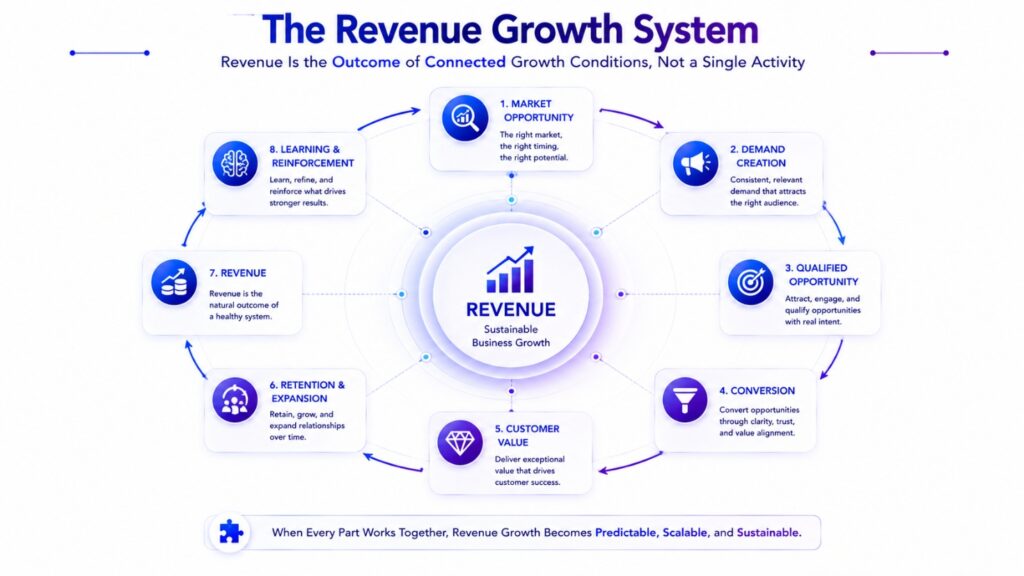
revenue growth system:
Businesses can be busy every day and still struggle to create consistent revenue growth.
Marketing campaigns are running. Traffic is coming in. Leads are being generated. Sales teams are following up. Customers are being acquired. Yet revenue growth can still feel slower, less predictable, or harder to sustain than expected.
This often leads businesses to add more activity: more marketing, more campaigns, more leads, more sales efforts, or more acquisition. But increasing activity does not automatically strengthen the system responsible for turning that activity into meaningful revenue.
The deeper problem may not be one weak marketing channel, sales process, or conversion point. It may be that the conditions responsible for creating demand, generating qualified opportunities, converting customers, creating customer value, retaining relationships, and learning from outcomes are not functioning as one connected system.
Revenue activity is not the same as a revenue growth system.
That distinction changes the diagnostic question.
Instead of asking only, “What should we do to increase revenue?” a stronger question is:
“Which relationships within the revenue system are limiting the business’s ability to create and sustain growth?”
Revenue growth becomes easier to understand when the business is viewed as a connected architecture rather than a collection of independent activities.
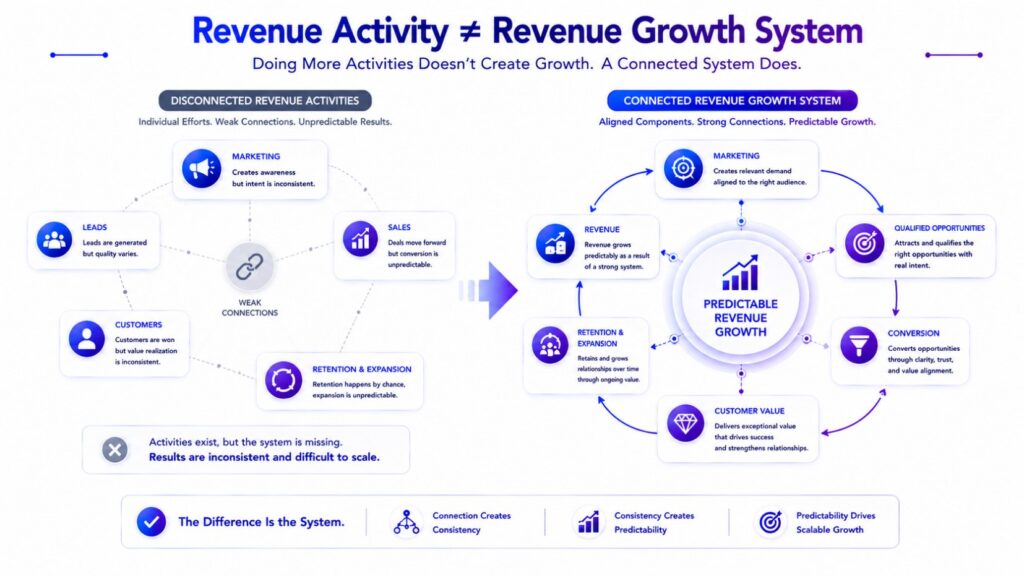
Table of Contents
Why Revenue Growth Feels So Difficult Even When the Business Is Busy
A business can have plenty of activity without having a system that consistently turns that activity into revenue growth.
More Marketing Does Not Automatically Mean More Revenue
Increasing campaigns, content, advertising, or promotional activity can create more attention and opportunities. But if the conditions connecting those opportunities to conversion and customer value remain weak, additional activity may simply increase volume without producing proportional revenue.
More Customers Do Not Automatically Mean More Profitable Growth
Acquiring more customers can increase sales while still leaving the business with weak customer value, retention, or expansion. Revenue growth becomes more meaningful when customer acquisition connects with the value created after the initial purchase.
Revenue Can Improve Temporarily Without Becoming Predictable
A successful campaign, strong sales period, or temporary increase in conversions can create a revenue lift without establishing the conditions required for that performance to continue. Short-term improvement and a stronger growth system are not necessarily the same thing.
Why Businesses Keep Adding Activities Instead of Strengthening the System
When revenue slows, the most visible response is often to add another activity. Businesses may increase marketing, generate more leads, expand sales efforts, or introduce another offer. But these actions do not automatically reveal whether the underlying revenue system is capable of converting and retaining the additional value.
The Hidden Cost of Disconnected Growth Efforts
When marketing, sales, conversion, customer value, and retention are managed as separate activities, weaknesses can remain hidden between them. Each function may appear productive while the connections required for continued revenue growth remain underdeveloped.
A business can be highly active across marketing, sales, conversion, and customer operations while still lacking the connected system required for consistent revenue growth.
For a closer look at the narrower problem of strong marketing activity failing to translate into revenue, see Why Marketing Campaigns Work But Revenue Still Doesn’t Grow.
What Does Revenue Growth Actually Depend On?
Revenue growth is often reduced to sales volume, but sales are only one visible outcome of a much broader system. Sustainable growth depends on whether the conditions before, during, and after a sale work together effectively.
Revenue Is More Than Sales Volume
More sales can increase revenue, but sales volume alone does not explain whether growth is efficient, valuable, or capable of continuing. The broader system determines how opportunities are created, converted, retained, and strengthened.
Demand Must Connect With the Right Opportunities
Demand becomes more valuable when it reaches people whose needs and expectations align with what the business offers. A larger volume of attention does not automatically create a stronger revenue opportunity.
Conversion Must Connect With Meaningful Customer Value
A successful conversion creates a customer relationship, but the revenue system must continue beyond that initial action. The value created for the customer influences the broader economic strength of the relationship.
Customer Value Must Support Continued Revenue
Revenue growth becomes stronger when customers receive meaningful value that supports continued relationships, retention, or appropriate expansion. Otherwise, the business can become increasingly dependent on acquiring new customers to replace lost revenue.
Growth Requires More Than One Successful Stage
A strong demand channel cannot compensate indefinitely for weak conversion. Strong conversion cannot fully compensate for weak customer value. Strong retention cannot eliminate the need for relevant opportunities entering the system.
The broader revenue growth chain can therefore be understood as:
Demand → Opportunity → Conversion → Customer Value → Revenue → Reinforcement
Revenue growth is not produced by one successful activity. It emerges when multiple connected conditions work together.
The Seven Structural Conditions Behind Revenue Growth
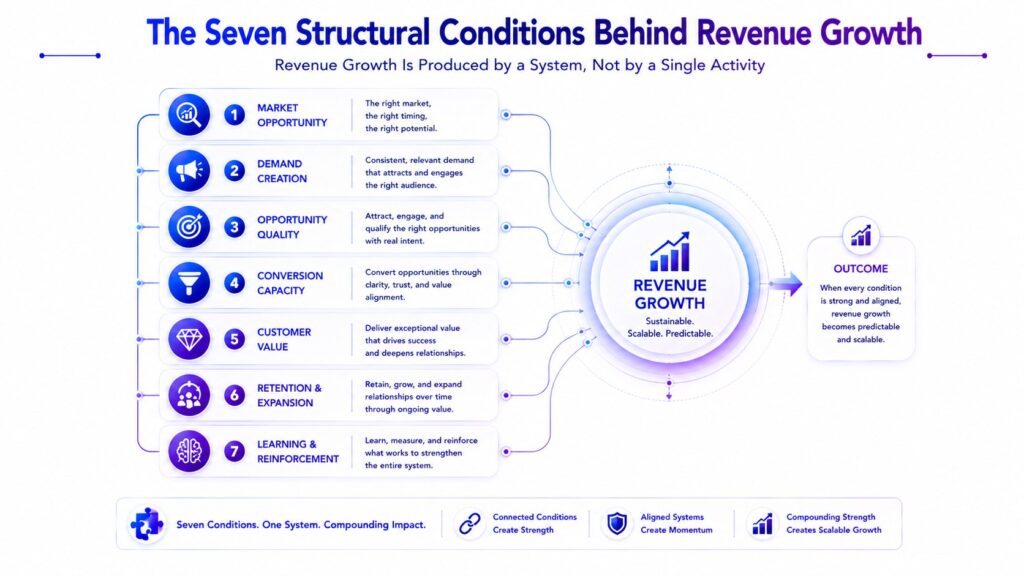
Revenue growth becomes easier to diagnose when the business is viewed through the conditions that support it. These conditions are connected: weakness in one can influence how effectively the others perform.
1. Market Opportunity
Is there sufficient relevant demand within the market for the business to create meaningful growth opportunities?
2. Demand Creation
Can the business consistently create awareness and meaningful interest rather than relying on occasional spikes in attention?
3. Opportunity Quality
Are the opportunities entering the system sufficiently relevant and qualified for the business to serve effectively?
4. Conversion Capacity
Can appropriate opportunities become customers without repeatedly losing value between initial interest and meaningful action?
5. Customer Value
Does the business create meaningful value after acquisition so that customer relationships contribute to stronger economic performance?
6. Retention & Expansion
Can existing customer relationships support continued revenue through retention and appropriate expansion rather than relying entirely on acquiring new customers?
7. Learning & Reinforcement
Can the business understand what is producing meaningful revenue and use that learning to strengthen the conditions that support future growth?
Revenue Outcome
Revenue flows from these connected conditions rather than functioning as an isolated eighth layer. It represents the business outcome produced by the wider growth architecture.
The conceptual architecture can therefore be viewed as:
Market Opportunity → Demand Creation → Opportunity Quality → Conversion Capacity → Customer Value → Retention & Expansion → Learning & Reinforcement → Revenue Growth
A revenue constraint can become visible at the point of sales even when the underlying limitation exists much earlier in the growth system.
This model provides a way to understand the broader conditions behind revenue growth without reducing the diagnosis to one metric, department, or activity.
Why Revenue Problems Keep Moving From One Area to Another
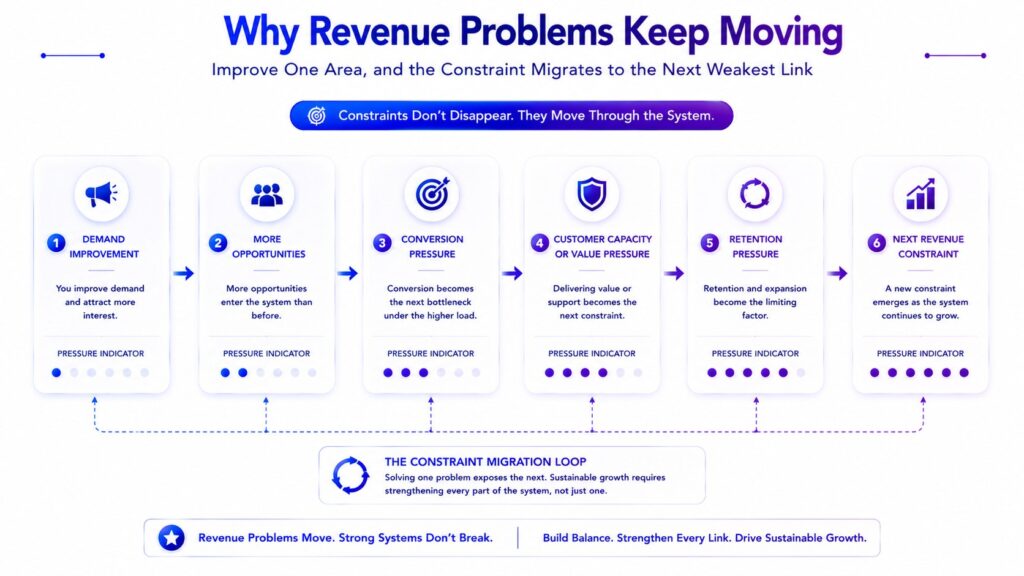
Revenue problems do not always remain in the same part of the business. Improving one condition can change the pressure placed on another, making a previously less visible constraint more noticeable.
Strong Demand Can Expose Conversion Constraints
When demand improves, more opportunities enter the system. If conversion capacity has not developed at the same pace, the business may suddenly experience a stronger conversion constraint.
Better Conversion Can Expose Customer-Value Constraints
Improving conversion can increase the number of customers entering the business. If the system is not creating sufficient customer value after acquisition, the additional customers may not translate into proportionally stronger long-term revenue.
More Customers Can Expose Retention Constraints
As customer volume increases, weaknesses in retention can become more significant. Revenue may rise initially while the business becomes increasingly dependent on replacing customers who do not remain.
Strong Retention Can Still Depend on New Opportunity Creation
Retention can strengthen the value of existing relationships, but it does not remove the need for a healthy flow of relevant new opportunities. A revenue system needs both existing-value strength and continued opportunity creation.
Revenue Improvements Can Reveal the Next System Constraint
A meaningful improvement in one area can therefore change the overall system without eliminating every limitation. What looks like a new problem may actually be the next constraint becoming visible after an earlier one has been reduced.
Constraint Migration
The pattern can be represented conceptually as:
Demand Improvement → More Opportunities → Conversion Pressure → Customer Capacity / Value Pressure → Retention Pressure → Next Revenue Constraint
Solving one revenue constraint can reveal another because the constraints are connected rather than independent.
This is why revenue diagnosis should consider the relationships between growth conditions instead of assuming that the most visible problem is the only constraint affecting the system.
Why More Marketing Does Not Automatically Solve Revenue Growth
Marketing plays an important role in creating demand, but revenue growth depends on what happens across the system after that demand is created. Increasing marketing activity can therefore produce more attention without necessarily producing proportional revenue growth.
Marketing Can Increase Demand Without Increasing Revenue Proportionally
More campaigns, content, or promotional activity can create additional interest. But if downstream conditions cannot convert and retain that opportunity effectively, increased demand may have a limited effect on overall revenue.
Traffic Can Increase Without Improving Opportunity Quality
Higher traffic can expand the number of people entering the system without improving how closely those visitors match the business’s actual offer and customer needs.
Leads Can Increase Without Improving Conversion Capacity
A larger lead volume can create more potential opportunities while leaving the underlying ability to convert appropriate opportunities unchanged. In that situation, lead growth can increase activity without resolving the conversion constraint.
Customers Can Increase Without Improving Customer Value
More customers can produce an initial revenue increase, but if the value created after acquisition remains weak, the business may not develop the stronger economic foundation needed for continued growth.
Acquisition Can Grow While Retention Remains Weak
A business can continue acquiring customers while losing existing relationships. This can create a cycle in which increasing acquisition activity becomes necessary simply to maintain revenue rather than to build stronger growth.
The System Reality
More activity can increase the volume entering a revenue system without increasing the system’s ability to convert, retain, and reinforce that value.
This is why revenue growth cannot be diagnosed by looking at marketing activity alone. The effect of additional demand depends on the conditions connected to it throughout the wider revenue system.
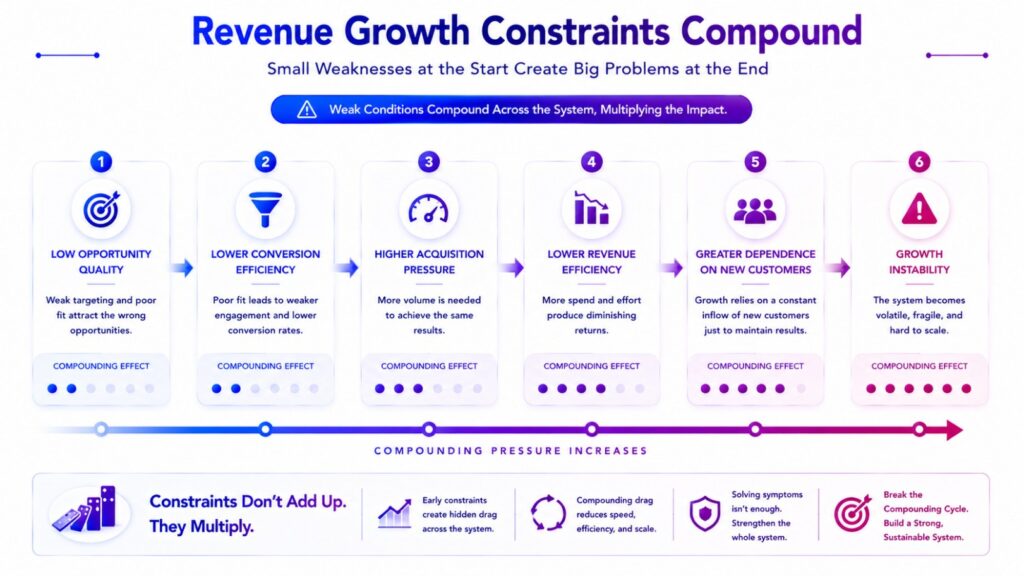
How Revenue Growth Constraints Compound Across the System
Revenue constraints rarely operate independently. A weakness in one part of the system can change the conditions surrounding another, making the overall effect greater than the original weakness alone.
Weak Demand Quality Creates Downstream Pressure
When the opportunities entering the system are poorly aligned with the business, downstream teams may need to work harder to generate meaningful conversions. This can place additional pressure on conversion and acquisition efficiency.
Weak Conversion Amplifies Acquisition Inefficiency
If appropriate opportunities are not converting effectively, the business may need to generate even more opportunities to produce the same revenue outcome. This can make acquisition efforts appear less efficient than they might be within a stronger conversion system.
Weak Customer Value Reduces the Economic Benefit of Acquisition
When customer value remains limited after acquisition, the revenue produced from acquiring each customer may be less capable of supporting continued growth. The business can therefore become more dependent on constantly generating new customers.
Weak Retention Increases Dependence on New Acquisition
When existing customer relationships do not contribute sufficiently to continued revenue, acquisition becomes responsible for replacing lost value as well as creating new growth.
Weak Learning Makes Repeated Problems Harder to Recognize
When the business cannot clearly understand what is influencing meaningful revenue outcomes, recurring weaknesses can remain difficult to distinguish from temporary fluctuations.
Constraint Compounding
The interaction can be understood conceptually as:
Low Opportunity Quality → Lower Conversion Efficiency → Higher Acquisition Pressure → Lower Revenue Efficiency → Greater Dependence on New Customers → Growth Instability
A weakness in one revenue condition can reduce the effectiveness of improvements made somewhere else in the system.
This is why revenue growth should be viewed as an interconnected system. The effect of improving one condition can depend heavily on the strength of the conditions surrounding it.
What a Revenue Growth System Actually Needs
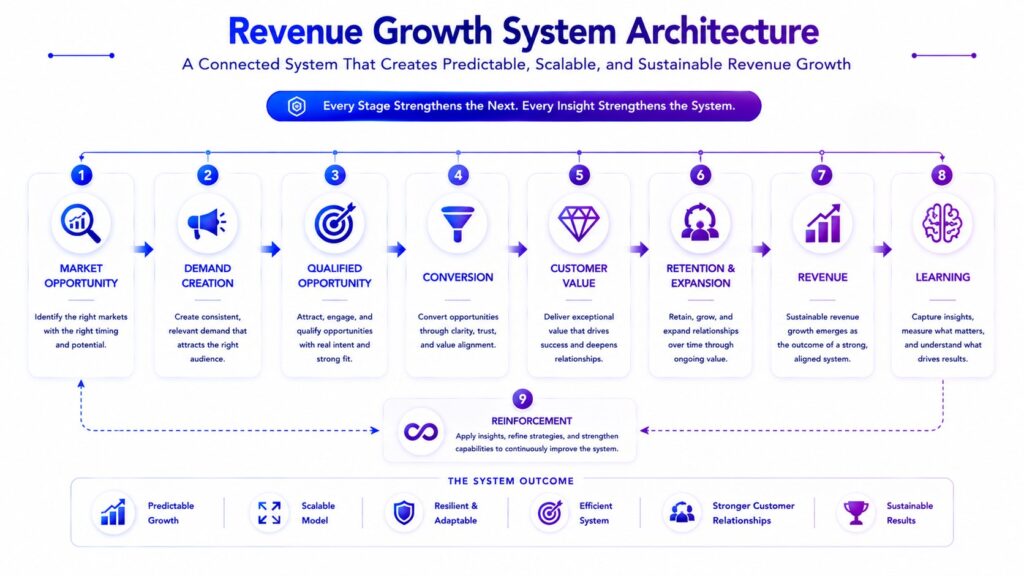
A revenue growth system needs more than successful activity at individual stages. It needs the major conditions influencing revenue to remain connected so that opportunities can move toward meaningful customer value, while learning can inform future strengthening.
Revenue Growth System Architecture
Market Opportunity → Demand Creation → Qualified Opportunity → Conversion → Customer Value → Retention & Expansion → Revenue → Learning → Reinforcement
The Conceptual Questions
Is there sufficient opportunity?
↓
Is demand being created effectively?
↓
Are the right opportunities entering?
↓
Can appropriate opportunities become customers?
↓
Is meaningful customer value being created?
↓
Can relationships continue or expand?
↓
Is revenue actually strengthening?
↓
Do we understand why?
↓
Can what works be reinforced?
These questions provide a high-level way to view the revenue system without assuming that every business follows an identical path. Different businesses may have different channels, customer journeys, revenue models, and growth conditions.
The important point is that the stages should be understood in relationship to one another rather than treated as independent departments or activities.
A stronger revenue growth system connects opportunity, demand, conversion, customer value, retention, revenue outcomes, learning, and reinforcement into a broader structure.
The complete operational methodology for mapping and working with these relationships belongs to the Revenue Growth System framework rather than this conceptual article.
Why Revenue Growth Cannot Be Reduced to One Metric
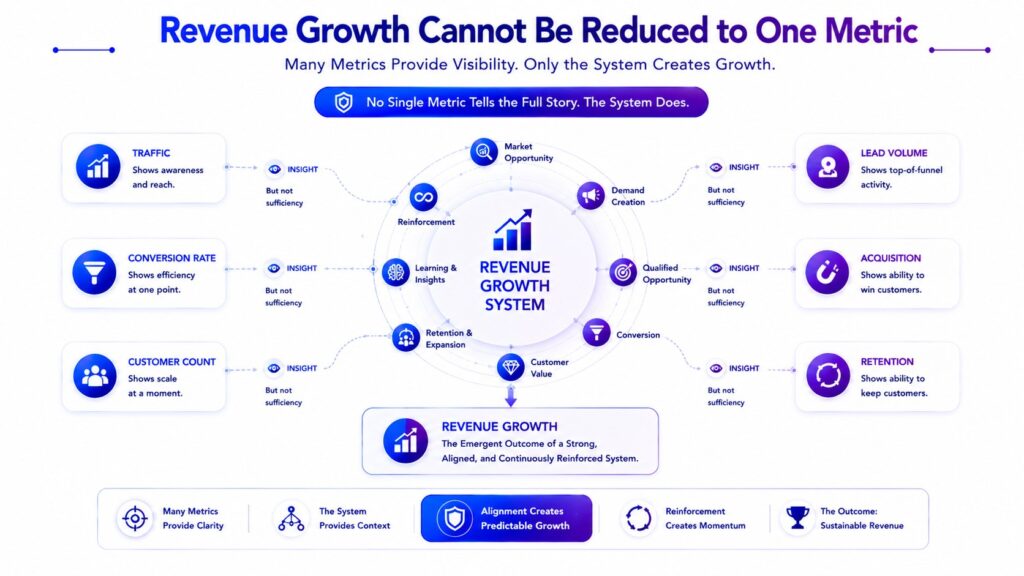
Revenue performance is influenced by multiple connected conditions, which means no single metric can fully explain whether the broader growth system is healthy or constrained.
Revenue Is Not the Same as Traffic
Traffic can create opportunities, but traffic alone does not show whether those opportunities are relevant, converting, creating customer value, or contributing to continued revenue.
Revenue Is Not the Same as Conversion Rate
A higher conversion rate can indicate improvement at a particular stage, but it does not automatically reveal the quality of the opportunities entering the system or the value created after conversion.
Revenue Is Not the Same as Customer Count
More customers can increase revenue, but customer volume alone does not explain retention, customer value, expansion, or the overall economic strength of those relationships.
Revenue Is Not the Same as Lead Volume
Generating more leads can increase potential opportunities without necessarily improving their relevance or the system’s ability to turn appropriate opportunities into meaningful customers.
Revenue Is Not the Same as Acquisition
Customer acquisition is an important part of growth, but acquisition cannot independently determine what happens to customer value, retention, or future revenue.
Revenue Is Not the Same as Retention
Retention protects and extends existing customer value, but strong retention still operates within a wider system that requires relevant opportunities and meaningful customer relationships.
Each metric can provide useful evidence, but no single measurement represents the complete revenue growth system. Looking at revenue metrics in context can help businesses understand what individual numbers reveal—and what they may leave unexplained about the broader business outcome.
Instead of asking:
“Which number should increase?”
ask the broader diagnostic question:
“Which relationships within the revenue system are limiting the business outcome?”
This shift moves the focus from chasing isolated numbers toward understanding the connected conditions that influence revenue growth.
The System Insight: Revenue Growth Is an Architecture Problem
Once revenue is viewed as the outcome of multiple connected conditions, it becomes clear why individual improvements cannot always create sustained growth. Marketing, lead generation, conversion, acquisition, retention, and revenue each represent important parts of the business, but none of them alone represents the complete growth system.
Marketing Activity ≠ Revenue Growth System
Marketing can create demand and attention, but revenue growth depends on what happens to those opportunities throughout the wider system.
Lead Generation ≠ Revenue Growth System
Leads create potential opportunities, but their value depends on relevance, conversion capacity, customer value, and what happens after acquisition.
Conversion ≠ Revenue Growth System
Conversion turns appropriate opportunities into customers, but a successful conversion does not by itself establish continued customer value, retention, or future growth.
Customer Acquisition ≠ Revenue Growth System
Acquisition expands the customer base, but the broader revenue system must determine whether those customers create meaningful and continuing business value.
Retention ≠ Revenue Growth System
Retention can protect existing customer value, but it operates alongside opportunity creation, conversion, customer value, and other conditions that influence overall revenue growth.
Revenue ≠ Revenue Growth System
Revenue is the business outcome produced by the wider system. A revenue increase can therefore occur without proving that the underlying conditions required for continued growth have become stronger.
The Architecture Principle
A revenue growth system is the connected architecture through which market opportunity becomes demand, demand becomes qualified opportunity, opportunities become customers, customers create meaningful value, and learning strengthens the conditions required for continued growth.
This is the central shift from revenue activity to revenue architecture. The question is no longer simply whether individual functions are performing, but whether the relationships between them are strong enough to support continued growth.
From Revenue Growth Problems to Revenue Growth System
Revenue Growth System — Premium
The Revenue Growth System is a comprehensive system framework designed to help businesses understand the interconnected conditions influencing revenue creation, conversion, customer value, retention, and continued growth.
What the Premium System Represents
The Premium level looks beyond individual revenue problems and considers how the broader growth conditions relate to one another.
- Revenue-system visibility
- Cross-stage relationships
- Growth dependencies
- Revenue constraint awareness
- Customer-value connections
- Retention and expansion relationships
- Learning and reinforcement
Blog → Product Boundary
This article helps the reader understand why revenue growth can feel difficult when the underlying system is fragmented.
The Premium Revenue Growth System addresses the broader architecture responsible for creating, converting, retaining, and reinforcing revenue growth.
The article provides the conceptual understanding. The Premium system provides the deeper framework for working with that broader revenue architecture.
Premium value comes from understanding and working with the connected revenue system—not simply from receiving more revenue-growth advice.
Why the Revenue Growth System Is Different
The difference between individual revenue problem content, Core frameworks, and a Premium revenue system is not simply the amount of information provided. Each level addresses a different depth of the business problem.
Individual Problem Content
Focused articles address specific revenue symptoms that businesses can recognize within their day-to-day growth challenges.
Core-Level Frameworks
Core frameworks address specific system-level problems, helping businesses understand a defined growth constraint more systematically.
Premium Revenue Growth Blog
This Premium article explains the interconnected architecture behind revenue growth. It moves beyond one symptom, metric, or department to show why revenue performance can be affected by relationships across the wider system.
Revenue Growth System
The Revenue Growth System provides the comprehensive framework for understanding and working with that broader revenue architecture.
Product Ladder Position
Mini → Focused Diagnostic
↓
Core → Specific System Framework
↓
Premium → Complete Revenue Growth System
Premium must feel broader, deeper, and more connected—not simply longer.
This distinction keeps each level valuable on its own while creating a natural progression for a reader whose revenue problem extends beyond a single component or isolated constraint.
The Revenue Growth Principle: Growth Must Reinforce Itself
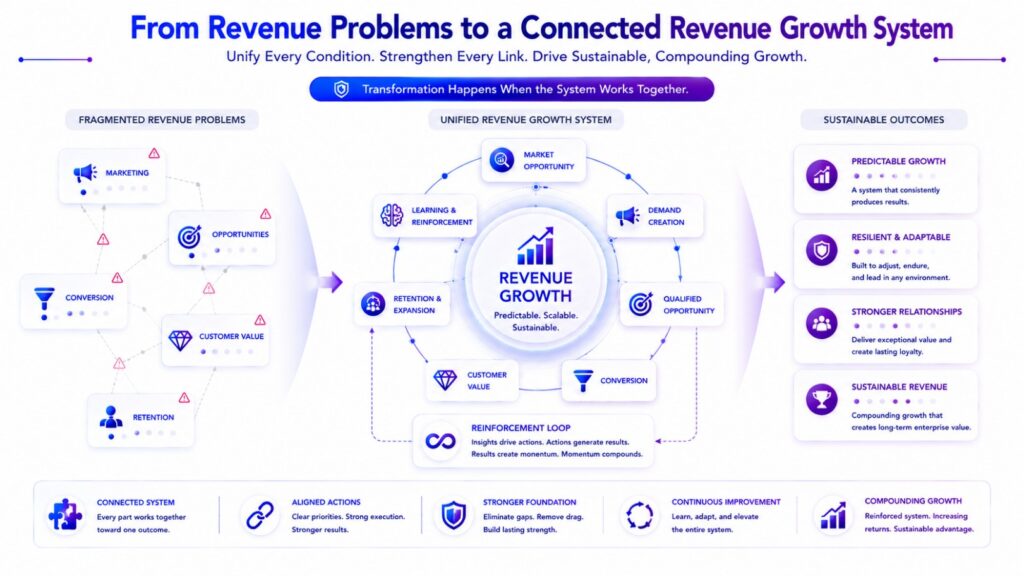
Revenue growth becomes stronger when the system does more than create one successful outcome. Each part should contribute to conditions that can support stronger future performance.
Acquisition Creates Opportunity
Effective acquisition brings relevant opportunities into the revenue system and creates the potential for future customer relationships.
Conversion Turns Opportunity Into Customers
Conversion transforms appropriate opportunities into customers. Its contribution becomes more valuable when those customers can move into a relationship that creates meaningful value.
Customer Value Creates Economic Strength
Meaningful customer value strengthens the economic foundation of the relationship rather than treating the initial purchase as the complete outcome.
Retention Protects Existing Value
Retention helps preserve the value already created through customer relationships and can reduce excessive dependence on continuously replacing lost customers.
Expansion Increases Customer Value
Where appropriate, stronger customer relationships can create opportunities for expansion. This should emerge from genuine customer value rather than from treating expansion as an isolated revenue tactic.
Learning Reveals What Is Working
Revenue outcomes provide information about how the wider system is performing. Useful learning can help the business understand which conditions are contributing to meaningful growth.
Reinforcement Strengthens the System
When useful learning informs future decisions, successful conditions can be strengthened rather than remaining isolated improvements.
The goal is not to maximize every revenue activity independently. It is to create a connected system in which growth creates the conditions for stronger future growth.
This reinforcement principle is what separates a collection of revenue activities from a system designed to learn, strengthen, and continue developing over time.
Conclusion — Revenue Growth Becomes Difficult When the System Is Fragmented
More marketing is not automatically the answer.
More traffic is not automatically the answer.
More leads are not automatically the answer.
More customers are not automatically the answer.
More sales activity is not automatically the answer.
More retention efforts are not automatically the answer.
Each of these activities can contribute to growth, but none can independently create a complete revenue growth system. When the relationships between them remain fragmented, businesses can become increasingly active without becoming proportionally stronger.
The Stronger Diagnostic Sequence
Understand the Revenue System
↓
Recognize Its Conditions
↓
Understand the Dependencies
↓
Locate the Structural Constraint
↓
Understand Its Effect on Other Stages
↓
Strengthen the Important Connections
↓
Create Reinforcement
↓
Build Stronger Revenue Growth
Final Philosophy
Revenue growth becomes stronger when the system producing, converting, retaining, and reinforcing revenue becomes stronger—not simply when one revenue activity improves.
The goal is not to maximize every growth activity independently. It is to understand how the conditions behind revenue connect, where those connections become constrained, and how a stronger system can support continued growth.
When revenue is treated as the outcome of a connected architecture rather than the responsibility of one activity or department, growth becomes a system to understand—not simply a number to chase.
Frequently Asked Questions
Recommended Reading
Why Marketing Campaigns Work But Revenue Still Doesn’t Grow
Explore why successful marketing activity does not always translate into stronger revenue and where the deeper gap may exist.
High Website Traffic Still Fails to Generate Revenue
Understand why increasing website traffic does not automatically create revenue and how opportunity quality, value, and conversion can influence the outcome.
Why Your Sales Funnel Is Not Converting (And Where Customers Are Leaking)
Explore how weaknesses within the conversion journey can limit revenue even when opportunities are already entering the system.
Leave a Reply