
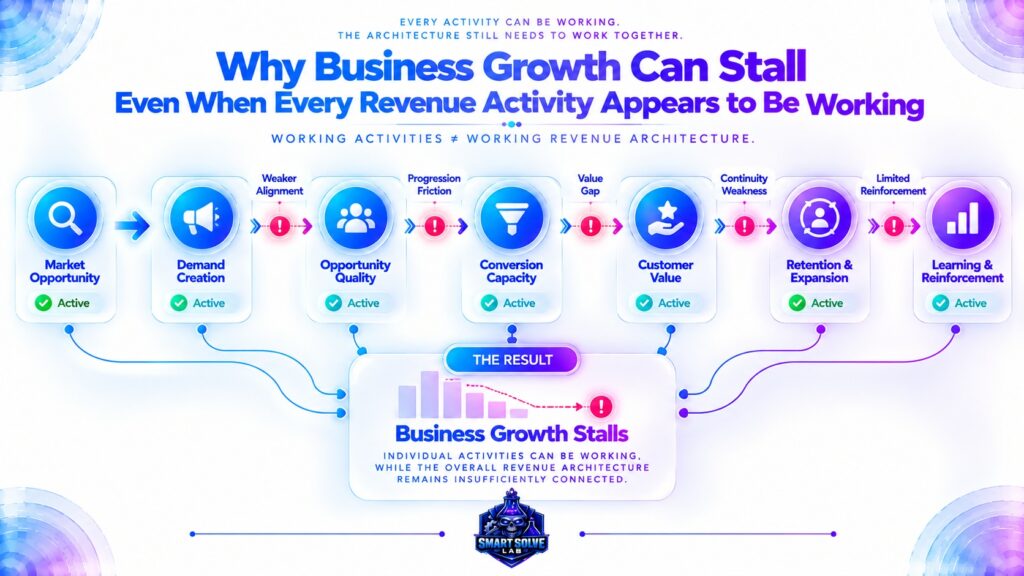
Introduction: business growth stalls
Business growth can be difficult to explain when the major revenue activities appear to be working.
Marketing may be generating demand. Leads and opportunities may be coming in. Sales may be producing customers. Customers may be creating value, returning, or expanding their relationship with the business. Yet despite activity across these areas, overall growth can still feel difficult to sustain.
This can create a misleading picture: each individual activity appears healthy, so the natural response is often to optimize those activities even further. But individual activity performance does not automatically mean the activities are working together as a connected revenue system.
The deeper question is not simply whether each revenue activity is working. It is how those activities connect, influence one another, and reinforce the conditions that support revenue growth.
A business can have several successful revenue activities while still experiencing weak connections between them. Demand may not translate into the right opportunities. Sales may not create enough customer value. Customer value may not translate into strong retention or expansion. And learning from one stage may not sufficiently strengthen the next.
That is where the idea of a connected revenue architecture becomes important.
This article looks at the difference between individual revenue activities and the larger architecture connecting them, why successful activities do not automatically create sustainable growth, where those connections can weaken, and how to recognize when a business may need to examine its revenue architecture at a deeper level.
Table of Contents
Why Business Growth Can Stall Even When Every Revenue Activity Is Working
Business growth can become difficult to explain when the major revenue activities all appear to be working.
Marketing may be active. Demand may be being generated. Leads and opportunities may be coming in. Sales may be producing customers. Customers may be creating value, returning, or expanding their relationship with the business.
Yet even when these activities are producing results individually, overall business growth can still remain difficult to sustain.
This is because activity-level success does not automatically become system-level growth. A business can have several productive revenue activities while the connections between those activities remain weak.
For example, marketing may generate demand without consistently creating the right opportunities. Sales may convert opportunities without creating enough customer value. Customer acquisition may be working while retention and expansion remain insufficient to reinforce future growth.
The issue, therefore, may not be that every activity is failing. It may be that the activities are not functioning together as a connected revenue system.
This is an important distinction when evaluating growth. Looking only at individual activities can make the business appear healthier than the overall revenue pattern suggests.
For a related look at the difference between business activity and revenue outcomes, see Why Marketing Campaigns Work But Revenue Still Doesn’t Grow.
The deeper question is no longer simply, “Is this revenue activity working?” It becomes:
“How are the working activities contributing to one connected revenue architecture?”
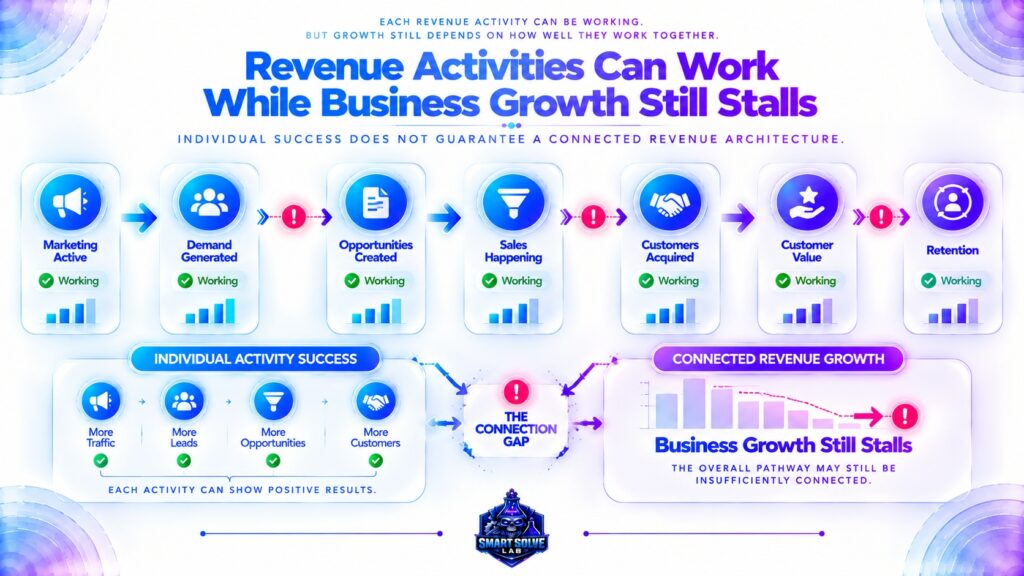
What a Connected Revenue Architecture Actually Means
A connected revenue architecture is the broader structure through which important revenue conditions relate to and reinforce one another.
Revenue should not be viewed as an isolated activity. It is an outcome that can emerge from multiple connected conditions across the business.
These conditions can include:
- Market Opportunity
- Demand Creation
- Opportunity Quality
- Conversion Capacity
- Customer Value
- Retention & Expansion
- Learning & Reinforcement
The important distinction is between revenue activities and revenue architecture.
A revenue activity asks whether a particular action or stage is producing a result. Revenue architecture asks how those results connect with the conditions around them.
For example, generating more demand matters, but the quality of the opportunities created from that demand also matters. Conversion matters, but what happens after conversion matters as well. Customer value can influence what happens next in the relationship, while retention and expansion can provide signals that inform future revenue activity.
This changes the question from “Is this activity working?” to “How does this activity contribute to the larger revenue system?”
That shift—from individual performance to connected conditions—is what makes revenue architecture different from simply managing a collection of revenue activities.
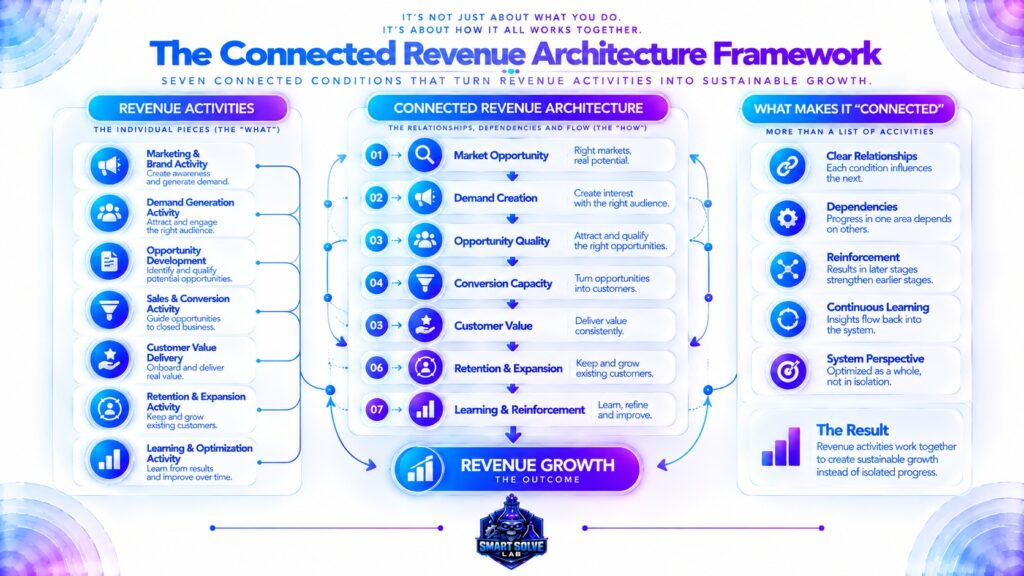
Working Activities vs a Working Revenue System
One of the most important distinctions in revenue growth is the difference between activities that work individually and a revenue system that works collectively.
A marketing function can generate demand without that demand consistently becoming the right opportunities.
A sales process can convert opportunities without the resulting customers creating enough value to support stronger long-term growth.
Customer acquisition can be successful while retention and expansion remain too weak to reinforce the next stage of growth.
In each case, the individual activity may still be producing a measurable result. The difficulty appears when the result does not sufficiently strengthen the condition that follows it or connect back into the wider system.
This means that working activities do not automatically mean the revenue system is working as a whole.
A connected system requires more than isolated success. It requires meaningful relationships between the conditions that create, convert, develop, retain, and reinforce revenue.
That is why a business can have multiple teams reporting positive activity while the overall growth pattern remains difficult to understand or sustain.
The diagnostic question therefore moves beyond individual activity performance:
Are the activities working together strongly enough to support the larger revenue architecture?
Why Individually Successful Revenue Activities Can Still Produce Weak Growth
When several revenue activities are producing results, it is natural to assume that the overall growth system should also be performing strongly. But individual success does not necessarily create a strong connection between revenue conditions.
Demand can be generated without producing enough of the right opportunities. Opportunities can exist without progressing efficiently toward conversion. Sales can happen without creating proportionate customer value. Customers can be acquired without creating sufficient retention or expansion.
In each situation, the activity itself may appear successful when viewed in isolation.
The deeper issue can be what happens between the different areas of the revenue system.
For example, more demand does not automatically mean better opportunity quality. More opportunities do not automatically mean stronger conversion capacity. More sales do not automatically mean greater customer value, and more customers do not automatically create stronger retention or expansion.
This is why examining only individual performance can leave an important part of the growth picture unexplained.
The relevant question becomes whether the results produced in one area are creating conditions that support the next area—or whether important connections remain weak.
Local success can exist alongside a weak overall growth pattern when the relationships between successful activities are not sufficiently connected.
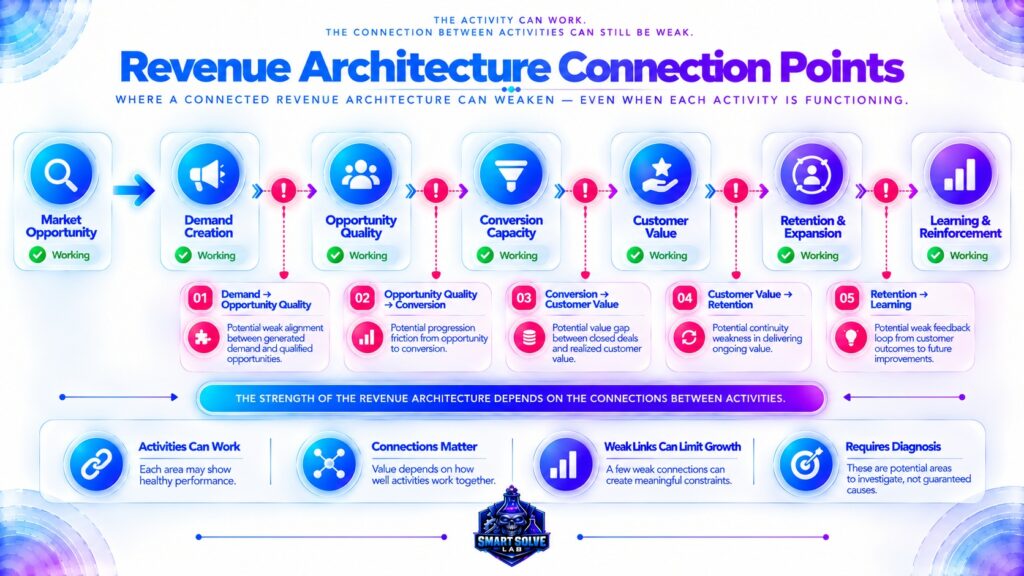
Where Revenue Architecture Can Break Between Connected Conditions
A connected revenue architecture contains multiple conditions that influence the broader path toward revenue growth. These conditions can be understood as:
Market Opportunity → Demand Creation → Opportunity Quality → Conversion Capacity → Customer Value → Retention & Expansion → Learning & Reinforcement
The important point is that potential weakness does not necessarily exist inside an individual condition. It can also appear in the connection between two conditions that are individually functioning.
For example, demand may be generated, but the transition from demand to suitable opportunity quality may be weak. Opportunities may exist, but progression toward conversion may not be sufficiently aligned. Sales may occur, but the resulting customer value may not support stronger continuity. Customer value may exist, but the relationship may not develop into retention or expansion.
Similarly, retention and expansion activity can produce useful signals without those signals being sufficiently connected to future learning and reinforcement.
These connection points matter because revenue architecture is not simply a collection of independent stages. It is a set of conditions whose relationships contribute to the wider system.
For example, if you are trying to understand a problem occurring around the transition from opportunity to conversion, Why Your Sales Funnel Is Not Converting (And Where Customers Are Leaking) provides a more focused view of that conversion-stage problem.
That focused view is different from examining the entire revenue architecture. The broader architectural question is how the conversion condition connects with the conditions before and after it.
A weakness in a connection does not automatically prove that the connection is the cause of weak growth. It identifies an area that may require deeper investigation.
Why Revenue Conditions Need to Reinforce One Another
A connected revenue architecture is not only about having the right revenue activities in place. It is also about whether important conditions support and reinforce one another over time.
Demand and opportunity quality are connected because the value of generating demand depends partly on what kind of opportunities that demand creates.
Opportunity quality and conversion capacity are connected because suitable opportunities still need the conditions required to progress toward a customer decision.
Conversion and customer value are connected because acquiring a customer is not the end of the revenue relationship. What happens after the sale can influence the value created from that customer.
Customer value, retention, and expansion can also reinforce one another. When customers continue to receive meaningful value, the relationship may create conditions for continuity or expansion.
Finally, learning and reinforcement can connect what the business observes from these conditions back into future revenue activity.
This means the revenue system is not simply moving from one activity to another. It can also involve feedback, relationships, and reinforcement across multiple conditions.
When these relationships are weak or disconnected, improving one activity may produce a local improvement without creating a proportionate change across the wider revenue system.
The architectural perspective therefore asks a broader question: Are the important revenue conditions reinforcing one another strongly enough to support the overall growth pattern?
Why More Optimization Does Not Always Fix an Architecture Problem
When growth becomes difficult, the natural response is often to improve the activity that appears closest to the problem.
A business may try to generate more traffic, produce more leads, improve conversion rates, acquire more customers, or increase activity within an already functioning channel.
These improvements can be useful. But a stronger result in one area does not automatically resolve a weakness in the broader revenue architecture.
More traffic, for example, does not automatically create more revenue if the traffic is not translating into suitable opportunities. More leads do not automatically solve an opportunity-quality problem. Better conversion does not automatically increase customer value, and acquiring more customers does not automatically strengthen retention or expansion.
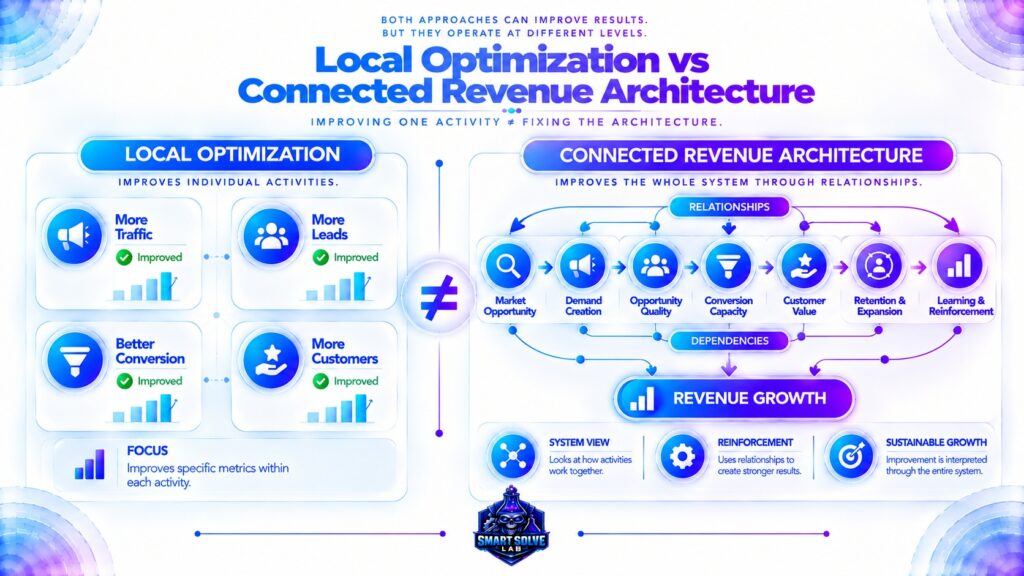
This is the difference between local optimization and architecture-level understanding.
Local optimization focuses on improving a particular activity or stage. Architecture-level thinking examines how that activity connects with the conditions around it.
For example, high website traffic can look like a positive performance signal while the broader revenue outcome remains unclear. A more useful diagnostic question is whether that traffic is connected to the downstream conditions required to create revenue.
For a focused discussion of this type of gap, see High Website Traffic But No Revenue.
The point is not that optimization is unnecessary. Rather, optimization should be understood within the larger system it is expected to strengthen.
When the underlying issue involves relationships between revenue conditions, repeatedly optimizing one activity may improve that activity without addressing the broader architectural question.
The Conditions Behind a Connected Revenue Architecture
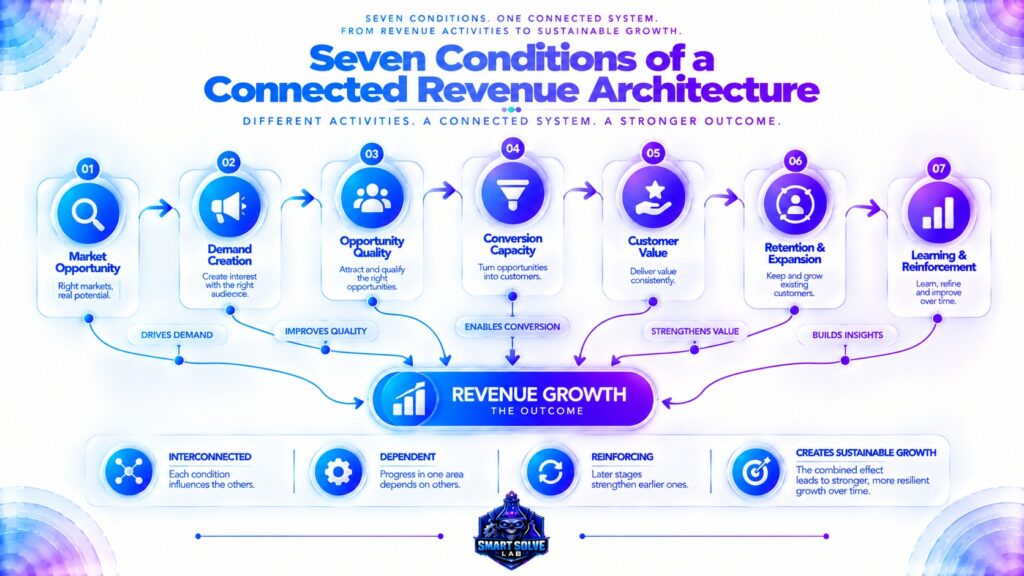
A connected revenue architecture can be understood through several major conditions that contribute to the wider revenue system.
These conditions should not be treated as isolated boxes. Their relationships and reinforcement are important to understanding how the overall architecture functions.
- Market Opportunity — The business needs a meaningful opportunity in the market it is trying to serve.
- Demand Creation — The business needs mechanisms that create awareness, interest, and demand around its relevant opportunity.
- Opportunity Quality — Generated demand needs to develop into opportunities that are sufficiently aligned with what the business can serve.
- Conversion Capacity — Suitable opportunities need the conditions required to progress toward customer decisions.
- Customer Value — Acquiring customers is only one part of the revenue relationship; the value created after acquisition also matters.
- Retention & Expansion — Continuing relationships and opportunities for expansion can contribute to the durability of revenue.
- Learning & Reinforcement — What the business learns from these conditions can inform and strengthen future revenue activity.
Revenue growth can then be understood as an outcome of these connected conditions, rather than as another isolated condition sitting beside them.
This distinction matters because a business can perform well in several individual areas while still having weak relationships between those areas.
The purpose of this architecture is therefore not to provide a simple checklist of activities. It provides a way to think about the conditions that need to connect across the broader revenue system.
This article intentionally stays at the conceptual architecture level. A deeper diagnostic system would require more detailed assessment criteria, relationships, prioritization logic, and diagnostic methodology.
Why Revenue Architecture Can Become Fragmented
Revenue architecture can become fragmented even when the individual functions responsible for growth are active and productive.
One reason is that teams often focus on the metrics and responsibilities closest to their own area. Marketing may focus on demand, sales on opportunities and conversion, customer teams on retention, and other functions on the outcomes they directly influence.
There is nothing inherently wrong with measuring individual performance. The difficulty can arise when those measurements become disconnected from the relationships between functions.
Short-term improvements can also hide architectural weaknesses. A stronger result in one area may temporarily compensate for a weakness elsewhere without resolving the underlying connection.
As more activities are added, the system can become even more complex. More campaigns, more leads, more sales activity, or more customer initiatives can increase the number of moving parts without necessarily strengthening the relationships between them.
This creates an important distinction:
More revenue activity does not necessarily mean more connected revenue architecture.
A fragmented architecture can therefore contain many active and successful components while still producing a growth pattern that is difficult to explain, sustain, or reinforce.
Recognizing this possibility does not mean assuming that fragmentation is the cause of every growth problem. Market conditions, offer strength, pricing, customer experience, demand, operational limitations, and other factors can also affect growth.
The architectural perspective simply creates another level of investigation: are the important revenue conditions connected strongly enough to support one another?
How to Recognize a Revenue Architecture Problem
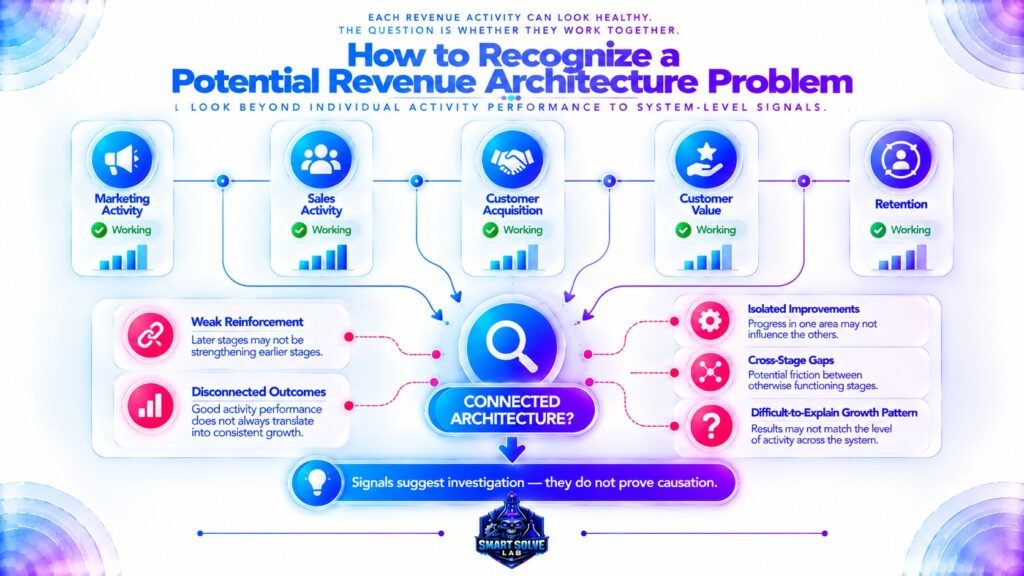
A revenue architecture problem is not identified simply because growth is slow. A business can experience slow or inconsistent growth for many different reasons, including market conditions, audience alignment, pricing, offer strength, conversion friction, customer experience, retention, demand, or operational constraints.
The architectural question becomes relevant when major revenue activities appear to be functioning individually, yet their combined results remain difficult to explain or sustain.
Some signals may suggest that a deeper architectural investigation is worth considering:
- Major revenue activities are active across the business.
- Individual teams or functions can point to positive performance.
- Several important activity metrics appear healthy.
- Growth remains difficult to sustain despite those individual results.
- Improvements in one area do not appear to reinforce improvements elsewhere.
- Different functions explain their success separately, without a clear connection to the wider revenue outcome.
- Revenue performance is heavily dependent on isolated wins.
- The relationship between activity and overall growth remains difficult to explain.
These signals should be treated as indicators for investigation, not proof of causation. They can help a business decide whether it is useful to look beyond individual activity performance and examine the relationships between revenue conditions.
Measurement systems can help businesses observe activities and user or customer behavior. For example, Google Analytics events documentation explains how events can be used to measure interactions and occurrences. Such measurement can provide useful observations, but measurement alone does not establish that a particular architectural relationship caused a revenue outcome.
The deeper diagnostic question is therefore not simply whether activities are producing signals. It is whether those signals connect into a coherent pattern across the wider revenue architecture.
When individual performance looks healthy but the connections between conditions remain unclear, architecture-level investigation may reveal a different layer of the growth problem.
From Individual Revenue Activities to Connected Architecture
Moving from activity-level thinking to architecture-level thinking does not mean ignoring individual performance. It means placing individual performance within the larger system that gives it context.
The first step is to stop evaluating revenue activities entirely in isolation.
Instead of asking only whether an activity is producing a result, consider which condition that activity influences and what happens next.
Demand creation, for example, should be considered in relation to opportunity quality. Opportunity quality can then be considered in relation to conversion capacity. Conversion can be examined alongside customer value, while customer value can be viewed in relation to retention and expansion.
The process continues beyond individual stages because learning from customer and revenue outcomes can inform future activity and reinforcement.
This creates a broader perspective:
Activity → Performance → Relationship → Reinforcement → Architecture
The goal at this stage is not to immediately optimize every component. It is to understand how the components relate to one another and where those relationships may be weak, disconnected, or insufficiently reinforcing.
That shift can make an otherwise confusing growth pattern easier to investigate because the business is no longer looking only at isolated activity results.
It is examining the structure that connects those results.
Key Insight: Revenue Growth Depends on More Than Individual Activity Performance
One of the most important insights in understanding revenue architecture is that working activities do not automatically create a working architecture.
A business can have active marketing, functioning sales processes, customer acquisition, customer value creation, and retention activity while still experiencing difficulty connecting those results into a reinforcing growth pattern.
This is because revenue is influenced by multiple connected conditions rather than by one isolated activity.
Individual optimization can improve a specific part of the system. But when growth difficulty exists between conditions, improving one component alone may not address the broader relationship.
The relationships therefore matter.
How does demand influence opportunity quality? How do opportunities progress toward conversion? What happens to customer value after conversion? How does customer value relate to retention and expansion? And how does learning from those outcomes strengthen future revenue activity?
These questions move the analysis from “Which activity is working?” toward “Are the conditions working together strongly enough?”
That is the central architectural distinction: a collection of successful activities can still produce structural growth difficulty when the relationships between those activities are not sufficiently connected or reinforcing.
From Activity → Performance → Relationship → Reinforcement → Architecture
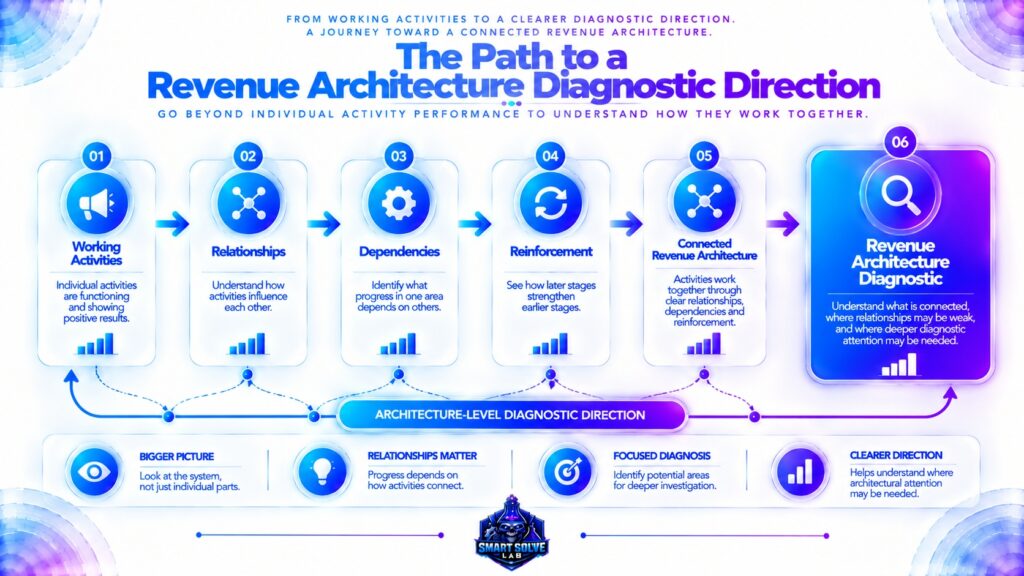
Understanding a connected revenue architecture becomes clearer when the analysis moves through several levels rather than stopping at individual activities.
It can begin with the activity itself: what is the business doing to create, convert, develop, retain, or expand revenue?
The next level is performance: what result is that activity producing?
Then comes the relationship: how does that result connect with another revenue condition?
After that comes reinforcement: does the relationship between those conditions help strengthen future activity, learning, customer value, or another part of the revenue system?
When these relationships are considered together, the business can begin to understand the larger architecture rather than viewing each activity as a separate function.
The conceptual progression is:
Activity → Performance → Relationship → Reinforcement → Connected Architecture → Revenue Growth Understanding
This does not mean that every business will follow the same pattern or that every relationship will produce the same outcome. The purpose is to create a broader way of examining how individual revenue activities connect with the conditions around them.
The deeper diagnostic work begins when a business needs to determine which relationships matter most, where connections may be weak, and what evidence supports further investigation.
Where to Go Next: Diagnose Your Revenue Architecture
If marketing is active, sales are producing customers, customer value is being created, and retention or expansion activity exists—but overall growth remains difficult to sustain—the next useful question may be broader than optimizing one individual activity.
Look at the relationships between the conditions.
Are demand and opportunity quality aligned? Are suitable opportunities progressing toward conversion? Is the value created after conversion supporting continuity? Are retention and expansion signals feeding useful learning back into the revenue system?
These questions can help identify whether the growth challenge may involve the architecture connecting revenue conditions rather than a single isolated activity.
Importantly, the presence of these signals does not automatically establish an architecture problem. They indicate where deeper investigation may be useful.
That is the role of an Revenue Architecture Diagnostic: to move beyond isolated activity performance and examine the structural relationships, dependencies, and potential weak connections across the revenue architecture.
The purpose is not to promise a particular revenue result. It is to create clearer understanding of what is connected, what may be disconnected, and where deeper diagnostic attention may be needed.
Once the architecture is understood at this level, the next question becomes more specific: which relationships require attention, and what evidence supports that direction?
That is where architecture-level diagnosis can provide a more focused starting point before deciding what should be optimized or implemented.
Key Takeaways
- Working revenue activities do not automatically create a working revenue architecture. Individual success and system-level performance are not the same thing.
- Revenue is an outcome of connected conditions. Market opportunity, demand creation, opportunity quality, conversion capacity, customer value, retention and expansion, and learning and reinforcement can all contribute to the wider system.
- The relationships between conditions matter. A weakness may exist between two individually functioning areas rather than entirely inside one activity.
- More optimization does not automatically solve an architecture problem. Improving one activity can create a local improvement without addressing a broader connection.
- Architecture problems should not be assumed. Market conditions, pricing, offer strength, customer experience, demand, and operational factors can also affect growth.
- Architecture-level thinking changes the diagnostic question. Instead of asking only whether each activity is working, examine whether the important conditions are working together strongly enough to reinforce one another.
- The next step is deeper diagnosis, not automatic optimization. Understanding relationships and potential weak connections can provide a clearer direction for deciding where further attention is needed.
Conclusion
Business growth can stall even when the major revenue activities appear to be working.
Marketing can generate demand, sales can produce customers, customer value can be created, and retention or expansion activity can exist. Yet these individual results do not automatically mean that the wider revenue system is connected strongly enough to support sustainable growth.
The deeper issue may sometimes be found in the relationships between revenue conditions rather than in one isolated activity.
A connected revenue architecture looks beyond individual performance and examines how Market Opportunity, Demand Creation, Opportunity Quality, Conversion Capacity, Customer Value, Retention & Expansion, and Learning & Reinforcement relate to one another.
This does not mean every growth problem is an architecture problem. Market conditions, pricing, offer strength, customer experience, demand, and operational constraints can also influence revenue performance.
The value of an architecture-level perspective is that it provides another layer of understanding when individual activities appear healthy but the overall growth pattern remains difficult to explain or sustain.
The key question is therefore not simply whether every revenue activity is working.
The deeper question is whether those activities are connected strongly enough to reinforce one another and support the wider revenue architecture.
When that question cannot be answered clearly, deeper architectural diagnosis can help identify where relationships, dependencies, or connections may require further investigation.
FAQs
Why can business growth stall when every revenue activity is working?
Individual revenue activities can produce positive results without forming a sufficiently connected revenue system. For example, demand may be generated, sales may occur, and customers may be acquired, while the relationships between these conditions remain weak. Growth can therefore remain difficult to sustain even when several activities are individually functioning.
What is a connected revenue architecture?
A connected revenue architecture is the broader structure through which important revenue conditions relate to and reinforce one another. It can include Market Opportunity, Demand Creation, Opportunity Quality, Conversion Capacity, Customer Value, Retention & Expansion, and Learning & Reinforcement, with revenue growth understood as the outcome of these connected conditions.
What is the difference between revenue activities and revenue architecture?
Revenue activities focus on individual actions or stages and the results they produce. Revenue architecture looks at how those activities and their underlying conditions connect, influence one another, and contribute to the wider revenue system.
Why don’t successful revenue activities automatically create growth?
Because individual success does not guarantee strong connections between revenue conditions. More demand does not automatically create better opportunities, more sales do not automatically create greater customer value, and more customers do not automatically create stronger retention or expansion.
How can I tell if my revenue problem is an architecture problem?
Potential signals include major revenue activities being active, individual performance appearing healthy, improvements occurring in isolated areas, and overall growth remaining difficult to explain or sustain. These signals do not prove an architecture problem; they indicate that examining relationships between revenue conditions may be useful.
Why doesn’t optimizing individual revenue activities always solve growth problems?
Individual optimization can improve a particular activity without addressing weaknesses between connected revenue conditions. If the broader issue involves relationships or dependencies across the revenue system, improving one component may create a local improvement without resolving the wider architectural issue.
How can I diagnose whether my revenue activities are working together?
Start by looking beyond individual activity performance and examine the relationships between major revenue conditions. Consider how demand connects to opportunity quality, opportunities connect to conversion, conversion connects to customer value, customer value connects to retention and expansion, and learning from these outcomes feeds back into future revenue activity. A deeper architecture-level diagnostic can then examine potential weak connections and dependencies more systematically.
Leave a Reply