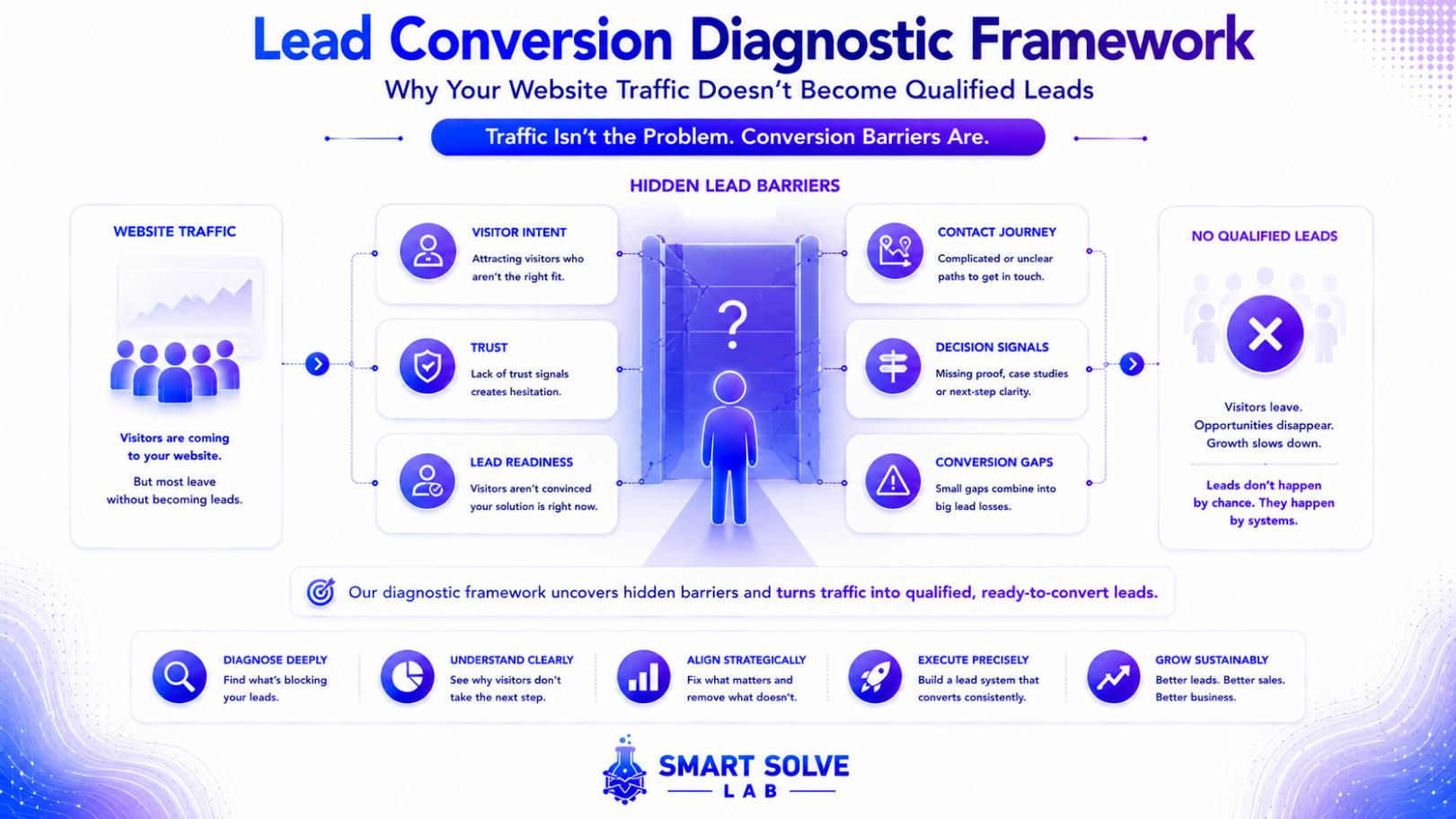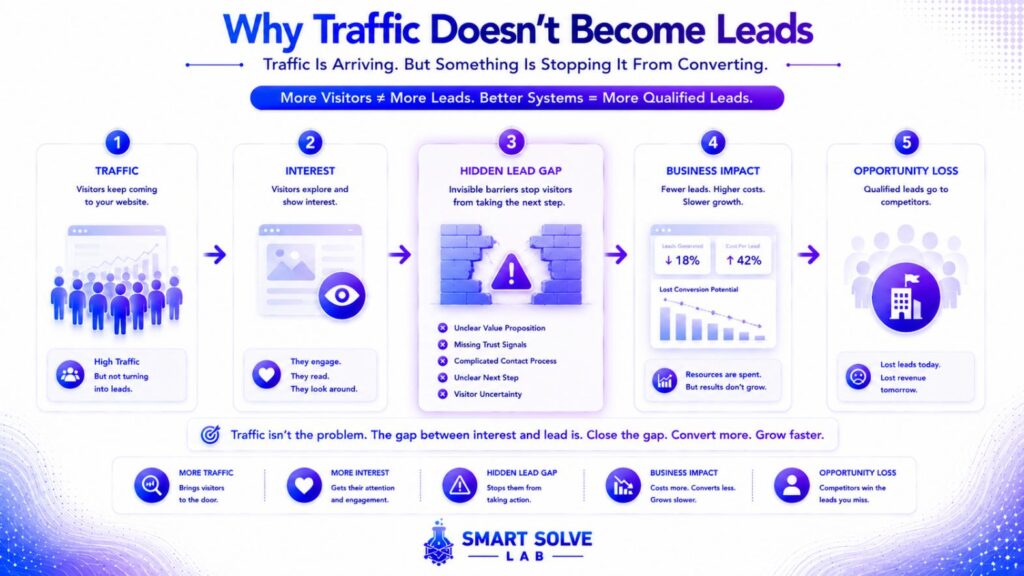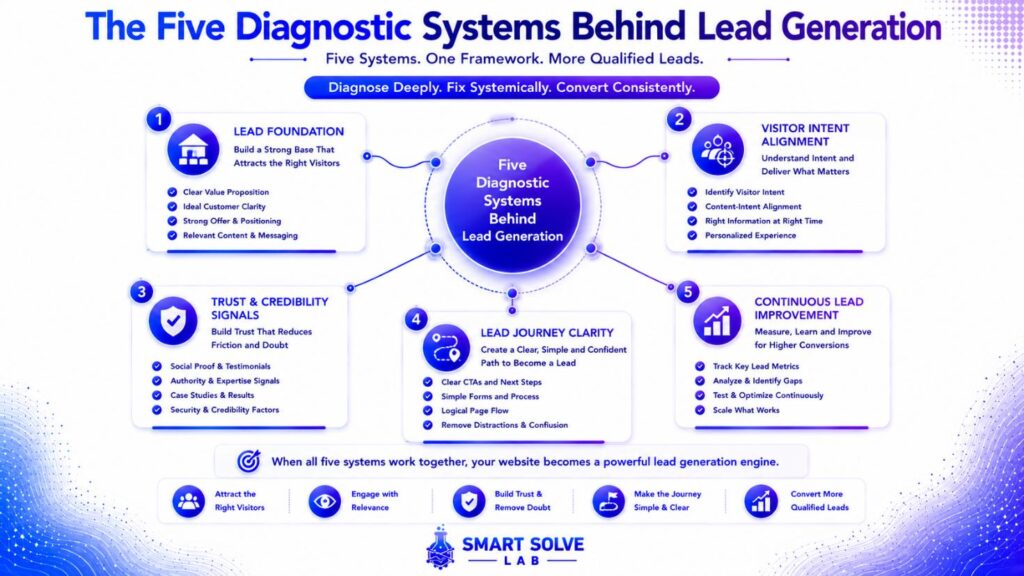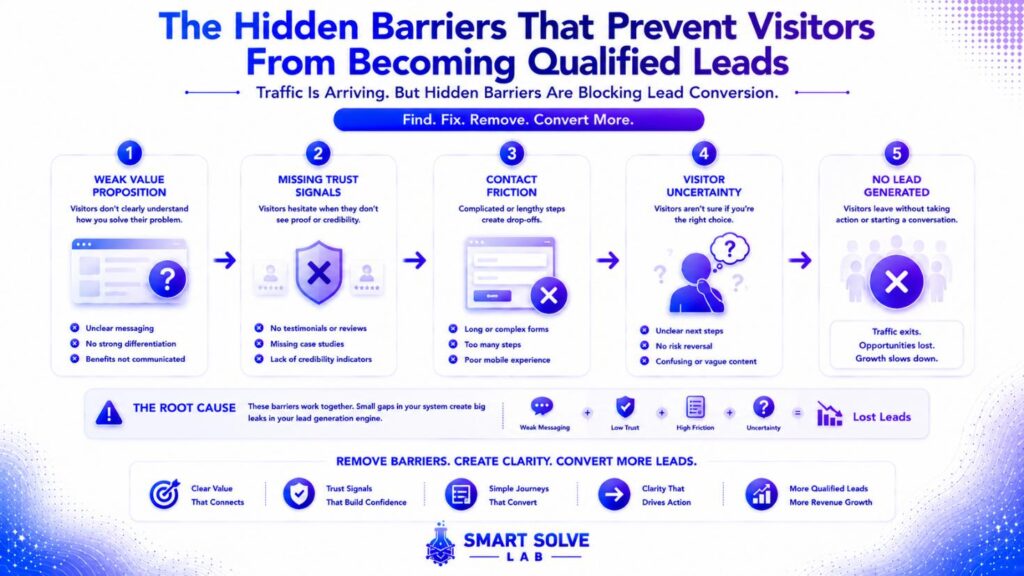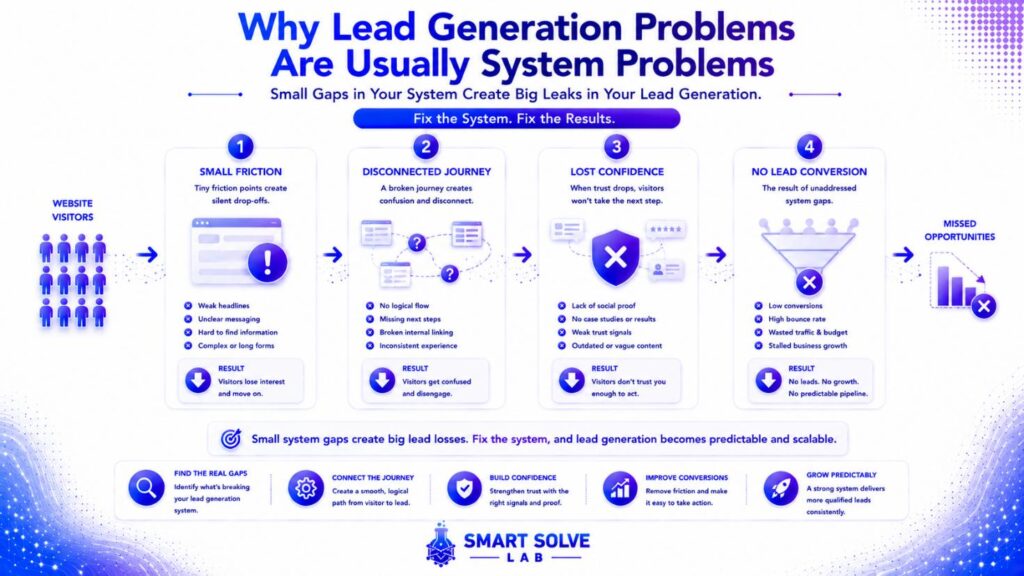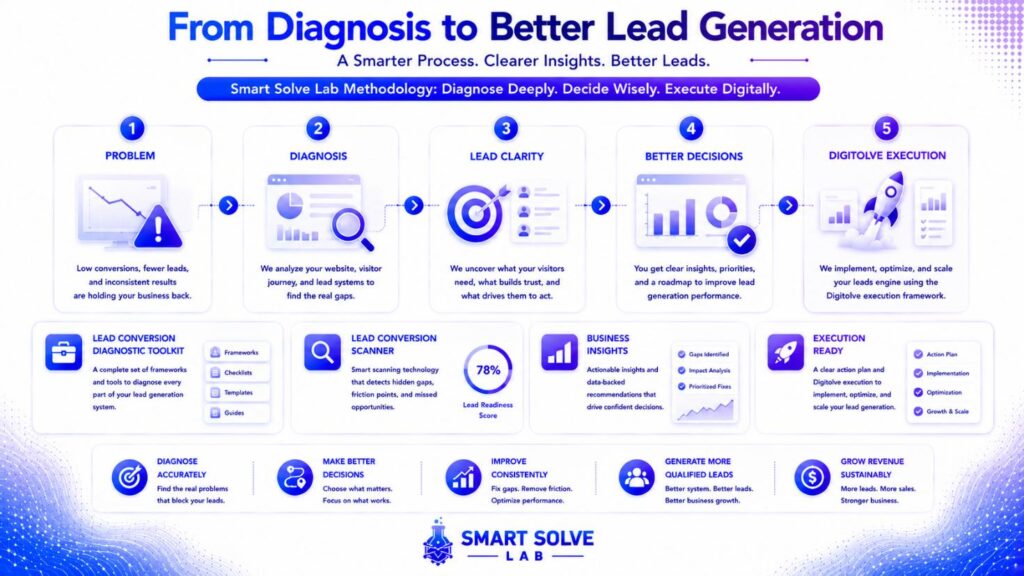
• Why Your Sales Are Not Growing Even When You’re Getting More Leads

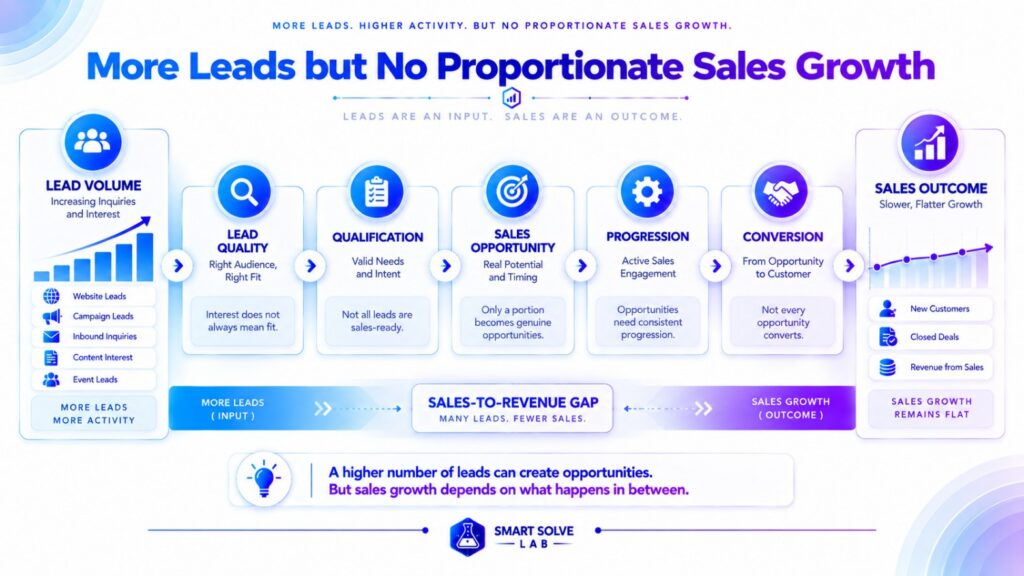
    Sales-to-revenue gap showing increasing leads without proportionate sales growth

    Sales Not growing despite leads:

    A business can generate more leads and still struggle to achieve the sales growth it expects. Lead generation may be increasing, marketing activity may be strong, the sales team may be following up with more prospects, and the pipeline may appear active—yet actual sales can remain unexpectedly flat.

    This creates an important question: if more leads are entering the business, why aren’t sales growing proportionately?

    The problem may not simply be the number of leads being generated. There can be a gap between lead volume and the sales outcome those leads are expected to produce. That gap may be connected to lead quality, qualification, opportunity progression, conversion capacity, customer decision readiness, or another condition within the lead-to-sale pathway.

    This does not mean every sales-growth problem has the same cause. It means that lead generation needs to be understood in relation to what happens after the lead enters the business.

    In this article, we’ll examine why more leads do not always produce more sales, where the lead-to-sale pathway can weaken, and how to identify the areas that may require deeper diagnostic attention.

    Table of Contents

    Why More Leads Do Not Always Produce More Sales

    More Leads Can Create More Activity

    A business can generate more leads and still experience limited sales growth. More leads can increase the amount of activity entering the sales process, but additional activity does not automatically mean that more customers will complete a purchase.

    Lead Volume Is Not Sales Growth

    Lead volume measures how many potential customers are entering the business. Sales growth reflects the number and value of customers actually converting. These outcomes are connected, but they are not interchangeable. A business can see lead volume increase while sales remain flat if the additional leads do not progress effectively toward a sale.

    The Gap Between Leads and Sales

    When leads are increasing but sales are not growing at a similar rate, a gap may exist somewhere between lead generation and the sales outcome. The gap could relate to the quality of incoming leads, qualification, opportunity progression, conversion, or another condition affecting the journey from lead to sale.

    Why More Lead Generation May Not Solve the Problem

    If the existing leads are not progressing effectively, generating even more leads may simply increase the volume entering the same pathway. This can create more work for the sales team without addressing the condition that is limiting sales growth.

    The important question is therefore not simply how many more leads the business can generate, but whether those leads are creating proportionate sales opportunities and outcomes.
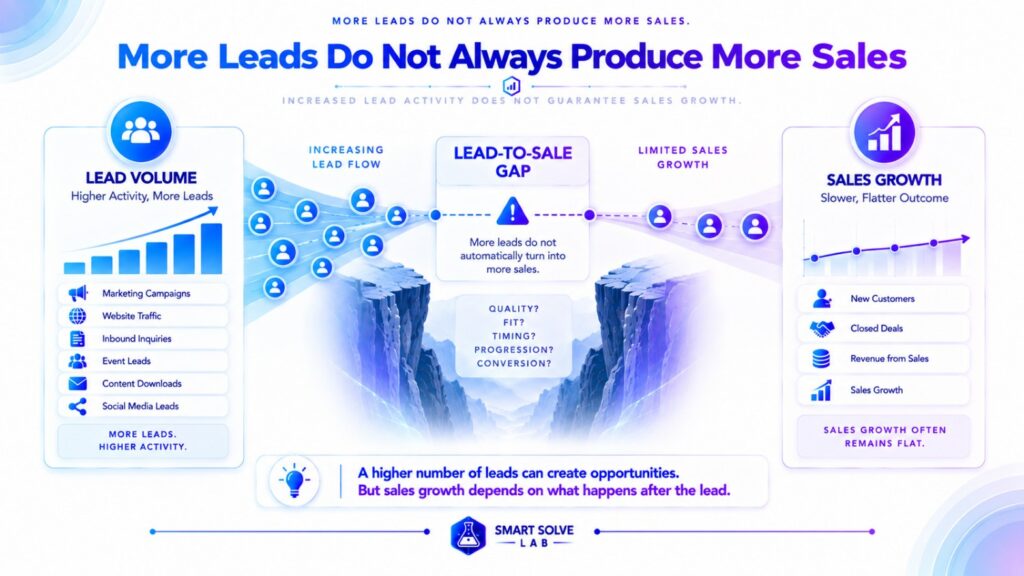
    Increasing lead volume compared with flat sales growth

    What Has to Happen Between a Lead and a Sale

    Lead Quality

    Not every lead has the same level of relevance, intent, or potential value. A growing lead count becomes more meaningful when the additional leads are aligned with the business, its offer, and the type of customer it can realistically serve.

    Lead Qualification

    Leads also need to be distinguished according to whether they represent meaningful sales opportunities. If a large share of incoming leads has limited fit or intent, the sales team may have substantial activity without a comparable increase in genuine opportunities.

    Sales Opportunity

    A qualified lead needs to develop into an opportunity that can realistically progress toward a purchase. This is where the difference between simply receiving a lead and creating a commercially meaningful sales opportunity becomes important.

    Sales Conversation

    The sales interaction can influence whether an opportunity continues moving forward. If relevant opportunities are entering the process but are not progressing through meaningful sales conversations, potential sales value can be lost before the final decision.

    Purchase Decision

    Even when a customer shows interest and reaches a sales opportunity, the journey still needs to reach a purchase decision. Customer readiness, perceived value, fit, and other conditions can influence whether that progression results in an actual sale.

    Why Lead-to-Sale Progression Matters

    The journey from lead to sale is therefore a progression rather than a single event. Looking only at the number of leads can hide where that progression becomes weaker and why additional lead volume may not be producing the expected sales outcome.

    More leads create potential opportunities, but sales growth depends on what happens to those opportunities after they enter the business.
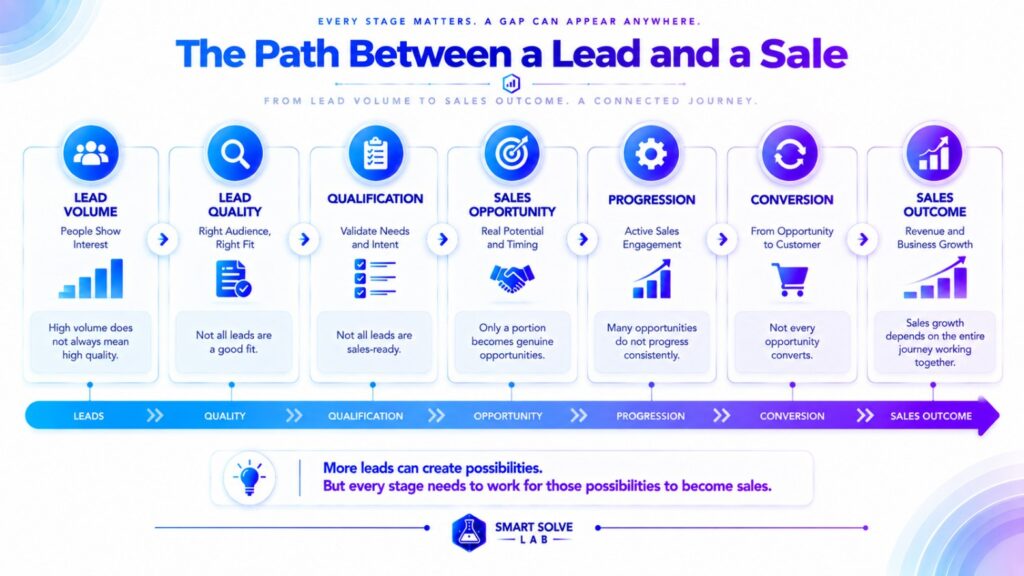
    Lead-to-sale progression pathway from lead quality to sales outcome

    The Sales-to-Revenue Gap

    When Leads Increase but Sales Stay Flat

    A sales-to-revenue gap can become visible when lead volume increases but sales remain flat or grow much more slowly. The business may be generating more potential opportunities, yet the expected sales outcome is not following at the same rate.

    Input vs. Sales Outcome

    Lead generation is an input into the sales process, while sales represent an important business outcome. Comparing the two helps reveal whether increasing lead activity is actually producing the level of sales growth the business expects.

    Where Value Can Be Lost Between Lead and Sale

    Potential sales value can weaken at different points along the lead-to-sale pathway. Leads may have limited relevance, qualification may be inconsistent, opportunities may fail to progress, or suitable opportunities may not convert. The visible sales gap therefore does not automatically identify where the underlying weakness begins.

    Why the Gap Matters More Than Lead Volume

    A growing lead count can create the impression that the sales engine is improving. But if sales do not follow, the more useful question becomes whether those additional leads are progressing toward meaningful sales outcomes.

    The sales-to-revenue gap is therefore not simply about generating too few leads. It is about understanding where increasing lead activity stops translating into proportionate sales growth.
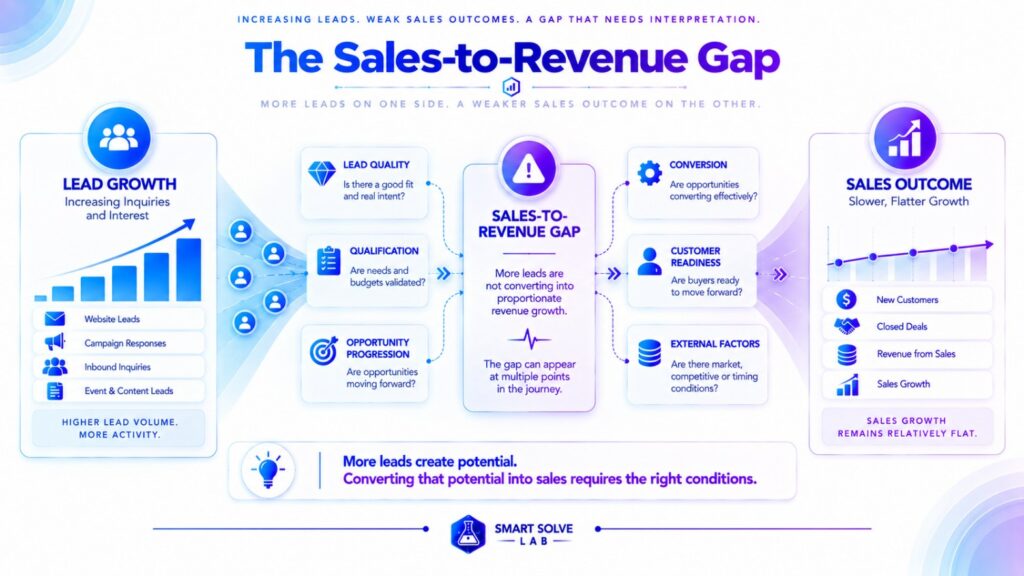
    Sales-to-revenue gap between increasing leads and weak sales outcomes

    Why More Leads Can Sometimes Make the Sales Problem Worse

    More Leads Can Increase Sales Workload

    When lead volume increases, the sales team may need to handle more follow-ups, conversations, qualification activity, and opportunity management. If the additional leads are not producing proportionate sales opportunities, the increase in volume can create more workload without creating equivalent business value.

    Poor-Fit Leads Consume Capacity

    Leads that have limited relevance, weak intent, or poor alignment with the offer can consume sales capacity even when they are unlikely to progress toward a purchase. This can reduce the time and attention available for opportunities with stronger potential.

    Sales Teams Can Become Busier Without Becoming More Effective

    A larger number of leads can make a sales team appear more active because there are more people to contact and more opportunities to manage. However, higher activity does not necessarily mean that the team is converting a greater proportion of meaningful opportunities into sales.

    Volume Can Hide a Quality Problem

    When lead volume becomes the primary measure of progress, a business may overlook whether those leads are actually relevant and capable of progressing through the sales process. This can make a lead-quality or opportunity-quality problem look like a simple need for more volume.

    More leads can therefore increase activity without resolving the condition that is limiting sales growth.

    Why Lead Quality Matters More Than Lead Quantity

    Not Every Lead Has Equal Revenue Potential

    A growing number of leads can look encouraging, but each lead does not necessarily have the same potential to become a valuable customer. Some may have strong relevance and intent, while others may have limited fit with the business, its offer, or its target customer.

    Intent and Fit

    Lead quality is influenced by how closely a potential customer aligns with what the business offers and how seriously they are considering a purchase. When additional leads have weak relevance or limited intent, increasing lead volume may create more activity without creating proportionate sales opportunities.

    Qualified vs. Unqualified Opportunities

    A business can receive many enquiries while having far fewer opportunities that are genuinely capable of progressing toward a sale. Distinguishing between general lead volume and commercially meaningful opportunities can therefore provide a clearer view of what the sales team is actually receiving.

    When Lead Volume Creates a False Sense of Growth

    Lead growth can create a positive signal even when the quality of those leads is declining. If the business measures success mainly through the number of leads generated, it may overlook a weakening connection between lead generation and actual sales potential.

    The more useful question is therefore not only “How many leads are we getting?” but also “What kind of sales opportunities are those leads creating?”

    A business can receive many enquiries while having far fewer opportunities that are genuinely capable of progressing toward a sale. Distinguishing between general lead volume and commercially meaningful opportunities can therefore provide a clearer view of what the sales team is actually receiving. If the gap appears earlier in the journey, Why Your Website Traffic Doesn’t Become Leads explores how hidden barriers can prevent visitors from becoming meaningful leads.
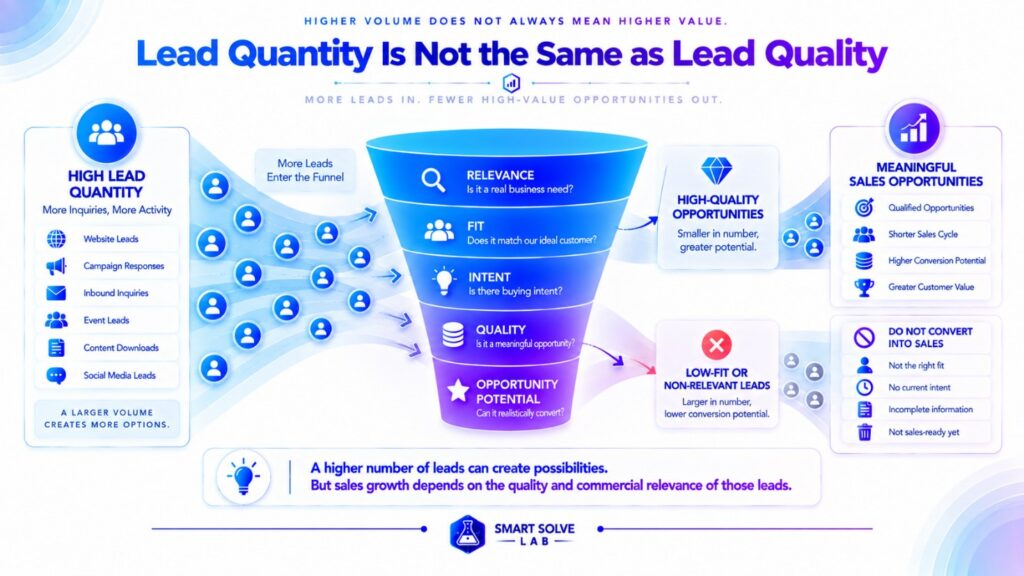
    Lead quality and commercial relevance compared with increasing lead quantity

    Where Leads Can Break Down Before Becoming Sales

    Leads That Are Not Properly Qualified

    Some leads may enter the sales process without having enough relevance, intent, or commercial potential to become strong opportunities. When qualification is weak, the sales team may spend significant time handling leads that are unlikely to progress.

    Leads That Do Not Progress

    Even relevant leads can fail to move forward. A lead may show initial interest but never develop into a meaningful sales opportunity, creating a gap between the number of leads entering the business and the opportunities reaching later stages.

    Leads That Lose Interest

    Some potential customers may engage initially but become less responsive as the sales process continues. This can reduce the number of opportunities that eventually reach a purchase decision and make overall sales growth weaker than the initial lead volume suggests.

    Leads That Reach Sales but Do Not Convert

    Other leads may progress far enough to become genuine sales opportunities but still fail to convert. In these cases, the issue may relate to conversion capacity, customer decision readiness, offer alignment, or another condition affecting the final progression toward a sale.

    Why Different Breakdowns Point to Different Conditions

    These situations may produce a similar visible outcome—sales are not growing as expected—but they do not necessarily have the same underlying cause. Understanding where progression appears to weaken can therefore provide a more useful diagnostic direction than simply increasing lead volume.

    The key is to identify where the lead-to-sale pathway appears to weaken, rather than assuming that every sales problem requires more leads.
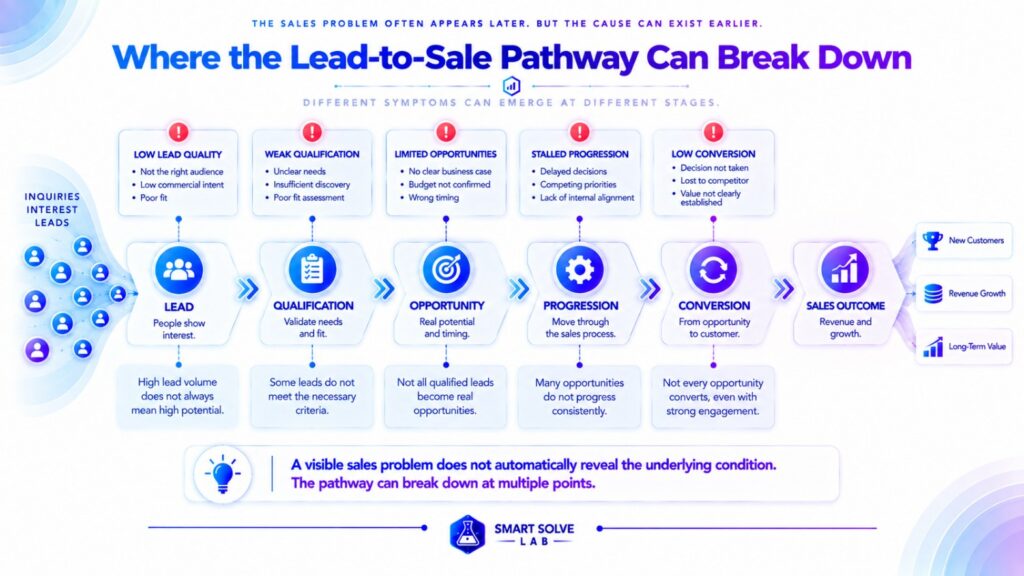
    Potential breakdown points across the lead-to-sale progression

    Why Sales Teams Can Be Busy Without Sales Growing

    More Follow-Ups

    When lead volume increases, sales teams may naturally have more follow-ups to manage. More calls, messages, emails, and meetings can create a high level of sales activity, but that activity does not automatically mean that more opportunities are moving toward a sale.

    More Sales Conversations

    A growing number of sales conversations can indicate that the team is actively engaging with prospects. However, conversations alone do not confirm that prospects are progressing toward a purchase or that the additional activity is producing proportionate sales outcomes.

    More Opportunities in the Pipeline

    A larger pipeline can also create the appearance of stronger sales performance. Yet opportunities may remain at different stages, progress slowly, or fail to convert. The size of the pipeline therefore needs to be understood in relation to the sales outcomes it produces.

    More Work Does Not Guarantee More Closed Sales

    When the sales team is handling more activity without seeing comparable sales growth, simply increasing effort may not address the underlying limitation. The issue may exist in the quality, progression, or conversion of the opportunities being managed.

    Sales Activity vs. Sales Outcome

    Sales activity shows what the team is doing, while sales outcome shows what that activity is producing. Looking at both together can reveal whether increased sales effort is translating into meaningful commercial results.

    A busy sales team can therefore be a sign of high activity without being proof of effective sales growth.

    The Conditions Behind Weak Sales Growth

    Demand Quality

    Sales growth can be affected when the demand entering the business is not sufficiently aligned with the customers the business is trying to serve. Strong lead volume does not necessarily compensate for weak relevance or intent.

    Opportunity Quality

    Leads need to develop into opportunities with genuine potential to progress toward a sale. If many leads enter the business but relatively few become meaningful opportunities, sales growth may remain limited despite increasing lead activity.

    Sales Conversion Capacity

    Even relevant opportunities may not produce sales if the business has difficulty converting them effectively. The limitation may involve how opportunities are handled, progressed, or moved toward a purchase decision.

    Sales Process Friction

    Unnecessary friction within the sales process can make it harder for suitable opportunities to progress. When prospects encounter barriers or delays, potential sales can weaken even when lead generation remains strong.

    Customer Decision Readiness

    A prospect can have genuine interest without being ready to make a purchase decision. Differences in timing, perceived value, confidence, or other decision conditions can influence whether an opportunity progresses to a sale.

    Sales Capacity and Follow-Through

    Growing lead volume can place additional demands on the sales team. If opportunities are not consistently followed through or managed effectively as volume increases, some potential sales may fail to progress.

    These are potential condition areas, not a fixed diagnosis. The same sales symptom can have different underlying causes, which is why the actual limitation needs to be interpreted through evidence rather than assumed from lead volume alone.

    Why the Visible Sales Problem May Not Be the Real Problem

    Sales Can Be Affected by Lead Quality

    When sales are weak, it can be tempting to assume that the sales team simply needs to improve its conversion performance. But if the leads entering the process have weak relevance or intent, the visible sales problem may actually begin before the sales conversation.

    Sales Can Be Affected by Offer Alignment

    Even relevant prospects may not progress when the offer does not align clearly with what they need or value. In such cases, the sales outcome can be affected by a condition that is not limited to sales activity itself.

    Sales Can Be Affected by Conversion Friction

    A suitable opportunity may still encounter barriers during the progression toward purchase. Delays, uncertainty, unclear value, or other forms of friction can reduce the likelihood that an opportunity will reach a sales outcome.

    Sales Can Be Affected by Customer Readiness

    A prospect may be interested but not sufficiently ready to make a purchase decision. This distinction matters because weak sales outcomes do not always mean that the opportunity was poorly handled; the customer’s decision conditions can also influence progression.

    Why the First Visible Symptom Needs Deeper Examination

    The first visible symptom is often where the problem becomes noticeable, not necessarily where it begins. Looking beyond the immediate sales result can help distinguish between a sales conversion issue and an earlier condition affecting the lead-to-sale pathway.

    A weak sales outcome should therefore be treated as a signal to investigate the pathway, rather than as automatic proof that the sales team is the underlying problem.

    How to Diagnose a Sales-to-Revenue Gap

    Are Leads Actually Increasing?

    First, establish whether lead volume is genuinely increasing rather than assuming that a larger number of leads is being generated. This creates the starting point for comparing lead activity with the sales outcome.

    Are Qualified Opportunities Increasing?

    Next, consider whether the increase in leads is producing a comparable increase in meaningful sales opportunities. If lead volume grows while qualified opportunities remain limited, the gap may be appearing before the later stages of the sales process.

    Are Sales Increasing at the Expected Rate?

    The next question is whether sales are moving proportionately with the additional opportunities being generated. When sales remain flat or grow significantly more slowly, the difference becomes a useful signal that a sales-to-revenue gap may exist.

    Where Does Lead-to-Sale Progression Weaken?

    Once a gap is visible, attention can move toward the progression from lead to qualification, opportunity, conversion, and final sales outcome. The purpose is to understand where progression appears weaker, rather than immediately assuming which condition is responsible.

    What Evidence Supports the Signal?

    A possible constraint should not be treated as a confirmed diagnosis simply because it appears plausible. The stronger approach is to examine the available evidence and determine whether the observed signals support that direction. For website and digital activity data, Google Analytics dimensions and metrics can help provide measurable signals for understanding what is happening across relevant user and page interactions.

    Is the Visible Sales Problem Coming From Somewhere Earlier?

    A sales conversion problem may sometimes reflect an earlier issue with lead quality, opportunity quality, or customer readiness. Looking across the pathway helps prevent the business from treating the first visible symptom as the complete diagnosis.

    The goal is not to immediately decide what the business should change. The goal is to clarify where the sales-to-revenue gap appears and which condition may require deeper diagnostic attention.
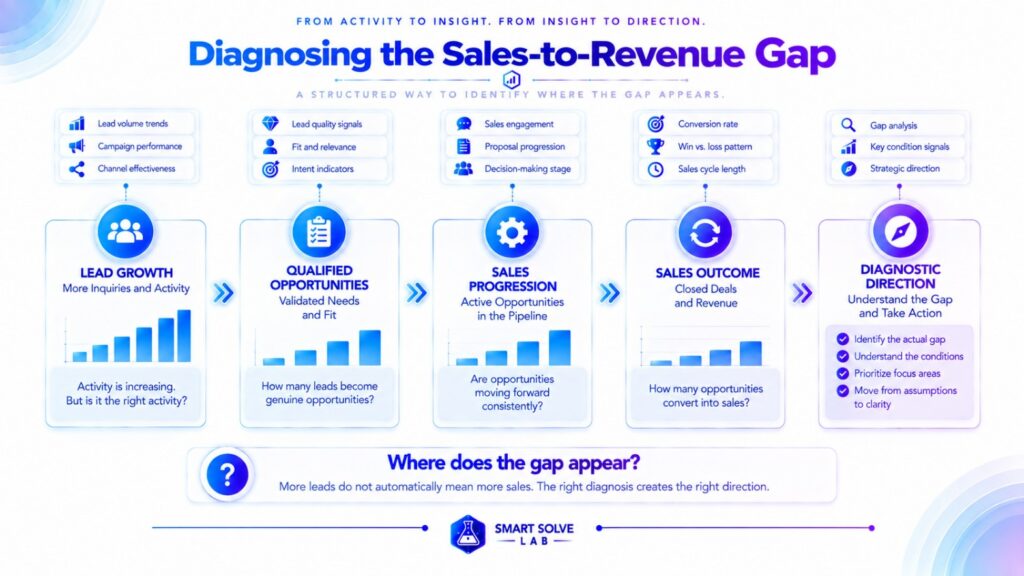
    Diagnostic framework for identifying where lead-to-sale progression weakens

    From Lead Generation to Sales Alignment

    Stop Measuring Leads in Isolation

    Lead volume can be useful, but it becomes more meaningful when considered alongside the sales outcome it is expected to influence. Looking at leads alone can make growth appear stronger than the actual commercial result.

    Connect Lead Quality With Sales Outcomes

    The quality and relevance of incoming leads can influence how many meaningful opportunities the business is able to create. Connecting lead signals with sales outcomes can therefore provide a clearer view of whether additional lead activity is producing genuine commercial value.

    Examine Progression, Not Just Volume

    The number of leads entering the business is only one part of the picture. Understanding how those leads progress toward qualified opportunities, sales conversations, and eventual purchase can reveal where the expected sales outcome begins to weaken.

    Identify Where the Sales Gap Appears

    When lead activity and sales outcomes are considered together, the business can begin to identify where a potential gap appears within the lead-to-sale pathway. This creates a more useful starting point for understanding the conditions that may deserve further attention.

    Determine What Needs Deeper Diagnosis

    Once a potential gap becomes visible, the next step is not automatically to increase lead generation or change the sales process. The more useful question is which condition requires deeper examination before deciding what action should be taken.

    Sales alignment means understanding whether lead generation is creating the quality, progression, and sales outcomes the business actually needs—not simply whether lead volume is increasing.

    The Key Insight: More Leads Are Valuable Only When They Create More Sales Opportunities

    Lead Growth Is an Input

    Increasing lead volume can expand the number of potential customers entering the business. But lead growth remains an input into the wider sales process rather than proof that the business has achieved sales growth.

    Sales Growth Is an Outcome

    Sales growth reflects what the business ultimately produces from its available opportunities. When lead volume increases without a comparable improvement in sales, the difference between the input and outcome becomes an important signal to examine.

    Quality Influences Progression

    Relevant and commercially meaningful leads have a stronger basis for progressing toward genuine sales opportunities. When quality is weak, additional lead volume may create more activity without creating equivalent sales potential.

    Conversion Influences Economic Value

    Even suitable opportunities still need to progress toward a purchase before they create a sales outcome. When conversion weakens, potential value can remain trapped within the sales pathway despite strong lead generation activity.

    More Volume Cannot Automatically Repair a Weak Sales Boundary

    If the limitation exists somewhere between lead generation and sales conversion, increasing the number of leads may simply send more volume through the same weak point. Understanding the gap first can therefore be more useful than automatically increasing activity.

    The central insight is simple: more leads create more potential, but sales growth depends on what the business is able to turn those leads into.

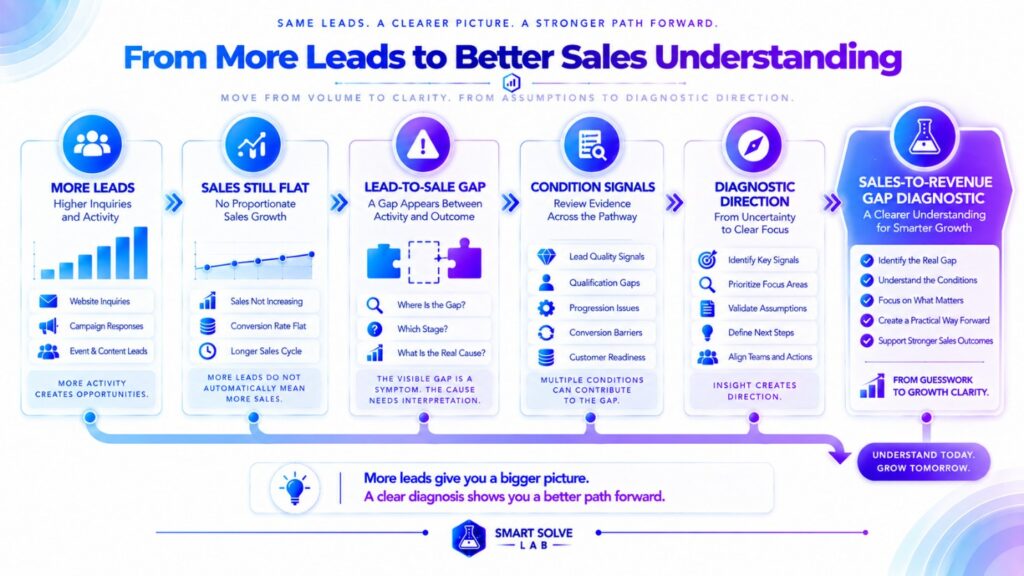
    From More Leads to Better Sales Understanding

    From Volume → Quality

    Increasing lead volume can be useful when those additional leads are relevant to the business and capable of becoming meaningful opportunities. The focus therefore needs to move beyond how many leads are being generated toward what those leads actually represent.

    From Activity → Outcome

    Sales activity can increase through more follow-ups, conversations, and opportunities in the pipeline. But the more important question is whether that additional activity is producing a comparable improvement in sales outcomes.

    From Symptoms → Conditions

    Flat sales can be the visible symptom of a deeper condition somewhere in the lead-to-sale pathway. Looking at quality, qualification, progression, conversion, and customer readiness can help create a more useful direction for understanding what may be limiting the outcome.

    From More Leads → Better Diagnostic Direction

    Once the relationship between lead activity and sales outcomes becomes clearer, the business can move away from automatically pursuing more volume and toward understanding where deeper examination may be needed.

    The shift is from asking “How can we generate more leads?” to asking “What is preventing the leads we already generate from producing proportionate sales growth?”

    Where to Go Next: Diagnose Your Sales-to-Revenue Gap

    When Leads Are Growing but Sales Are Not

    If lead volume is increasing but sales are not growing at a comparable rate, the first priority is to understand where the gap may be occurring rather than simply generating more leads.

    When Sales Activity Is High but Results Remain Weak

    A sales team may be handling more follow-ups, conversations, and opportunities while the final sales outcome remains limited. When activity is high but results remain weak, the underlying condition deserves closer examination.

    When Lead Quality Is Unclear

    If the business knows that leads are increasing but cannot clearly determine whether those leads have sufficient relevance, intent, or commercial potential, lead volume alone cannot explain the sales outcome.

    When You Cannot Identify Where Lead-to-Sale Progression Breaks

    When it is unclear whether the gap relates to lead quality, qualification, opportunity progression, conversion, customer readiness, or another condition, a focused diagnostic can provide a clearer starting point for deeper investigation.

    The Next Logical Step: Sales-to-Revenue Gap Diagnostic

    The Sales-to-Revenue Gap Diagnostic is designed for this specific situation. It helps businesses examine the relationship between increasing lead volume and sales outcomes, identify where a potential lead-to-sale gap appears, interpret the conditions that may be contributing to it, and determine where deeper diagnostic attention may be needed.

    The goal is not to promise more sales. The goal is to replace uncertainty about the lead-to-sale gap with clearer diagnostic direction.

    The Sales Growth Diagnostic Path

    Understand the Sales Gap

    Sales-to-Revenue Gap Diagnostic — Identify and interpret the lead-to-sale gap

    Sales Conversion Improvement System — Move diagnosis toward execution

    Sales Growth Analyzer — Future tool for structured analysis and decision support
    Key Takeaways

    • More leads do not automatically mean more sales. Lead volume is an input, while sales growth is an outcome.
    • Lead quality matters. A larger number of poorly aligned leads may create more activity without creating proportionate sales opportunities.
    • Sales activity and sales outcomes are different. More follow-ups, conversations, and pipeline activity do not guarantee more closed sales.
    • The lead-to-sale pathway can weaken at different points. Qualification, opportunity progression, conversion, customer readiness, and other conditions can influence the final outcome.
    • The visible sales problem may not be the underlying problem. A weak sales result can sometimes be connected to an earlier condition in the pathway.
    • Better diagnosis can be more useful than simply generating more leads. Understanding where the sales-to-revenue gap appears creates a stronger basis for deciding what deserves deeper attention.

    The key question is not only how many leads the business is generating, but how effectively those leads are progressing toward proportionate sales growth.

    Conclusion

    Getting more leads is usually a positive signal, but lead growth alone does not guarantee sales growth. A business can generate more enquiries, increase sales activity, and expand its pipeline while still seeing sales remain flat or grow more slowly than expected.

    When this happens, the more useful question is not simply whether the business needs more leads. It is whether the leads being generated are creating meaningful opportunities and progressing effectively toward sales.

    Lead quality, qualification, opportunity progression, conversion, customer readiness, and sales follow-through can all represent different conditions within the wider lead-to-sale pathway. The visible sales problem therefore needs to be understood as a signal rather than automatically treated as the complete diagnosis.

    If your leads are growing but sales are not growing proportionately, understanding where the sales-to-revenue gap appears can provide a much clearer starting point for deeper diagnostic attention.

    That is the purpose of the Sales-to-Revenue Gap Diagnostic: not to promise guaranteed sales growth, but to help businesses identify and interpret where increasing lead volume may be failing to translate into proportionate sales outcomes.

    FAQs

    Why are my leads increasing but sales are not growing?

    Increasing leads does not automatically produce increasing sales. The gap may be related to lead quality, qualification, opportunity progression, conversion, customer readiness, or another condition within the lead-to-sale pathway.

    Can more leads actually make a sales problem worse?

    Yes. If existing leads are not progressing effectively, generating more leads can increase sales workload without producing proportionate sales opportunities or outcomes.

    Why is lead quality more important than lead quantity?

    Not every lead has the same relevance, intent, or commercial potential. A smaller number of well-aligned leads can create stronger sales opportunities than a larger volume of poorly aligned leads.

    What is the sales-to-revenue gap?

    The sales-to-revenue gap describes the difference that can appear when lead generation increases but sales do not grow proportionately. It helps direct attention toward where the lead-to-sale pathway may be weakening.

    How can poor conversion affect sales growth?

    When suitable opportunities fail to progress toward a purchase, potential sales value can be lost even when lead generation remains strong. This can contribute to a gap between lead activity and sales outcomes.

    Why can a sales team be busy without increasing sales?

    A sales team can handle more follow-ups, conversations, and opportunities without achieving proportionate sales growth. High activity does not automatically mean that meaningful opportunities are progressing effectively.

    How can I identify what is limiting my sales growth?

    Start by comparing lead growth with qualified opportunities, progression, and sales outcomes. When the relationship between these signals is unclear, a focused sales-to-revenue diagnostic can help identify where deeper diagnostic attention may be needed.

    Recommended Reading

  • Conversion System: How to Build a Connected System That Turns Customer Interest Into Growth

    Connected conversion system showing customer interest through conversion and learning
    From individual conversion points to one connected system.

    Why Conversion Problems Rarely Exist in Isolation

    A conversion problem may appear in one place while the conditions influencing it exist across the wider customer journey.

    A page may receive enough traffic but fail to generate action. Leads may arrive but remain inconsistent. Customers may enter the buying journey and disappear before completing the intended action. Conversion improvements may produce short-term gains, only for performance to stall again later.

    These situations are often treated as separate problems. One page gets optimized. A funnel step gets adjusted. A call to action gets changed. More traffic is pursued. Another conversion point is tested.

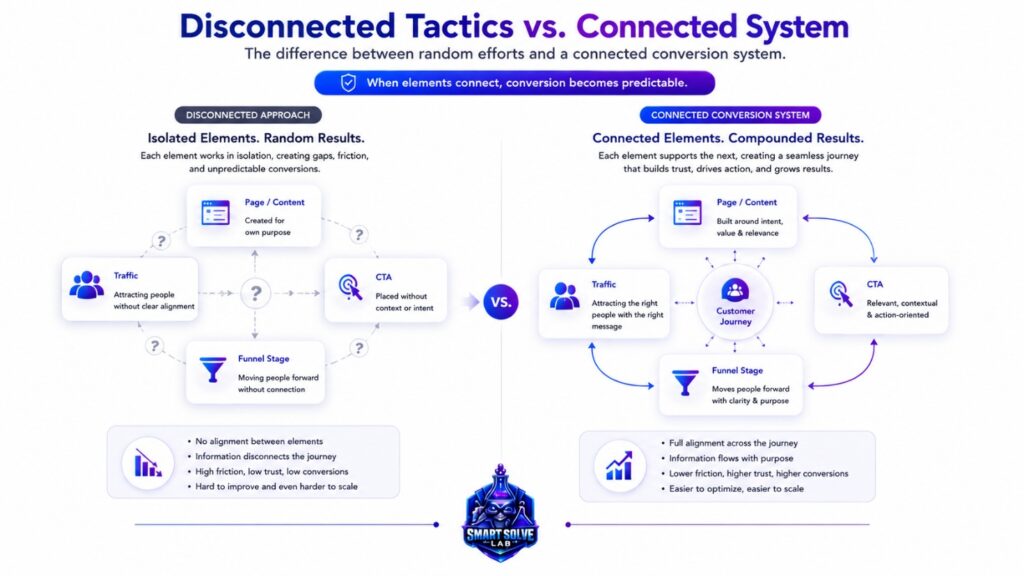
    But when related problems keep appearing, the deeper issue may not be the individual component being optimized. The problem may exist in the connections between the components that make conversion possible.

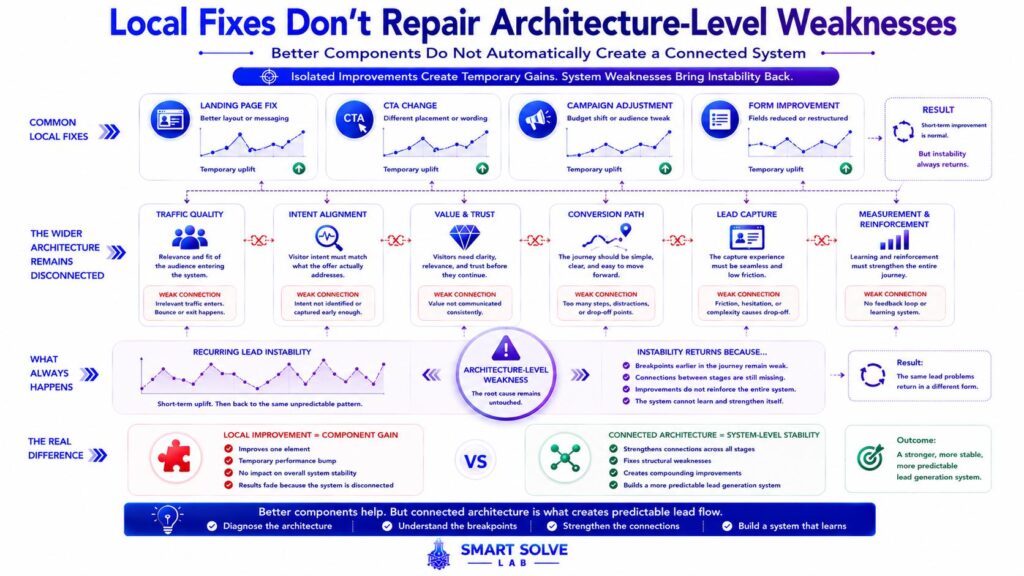
    This is why fixing one conversion point does not always fix the wider system. A local improvement can strengthen one part of the journey while leaving another structural weakness unresolved. In some cases, improving one stage simply exposes a weakness further upstream or downstream.

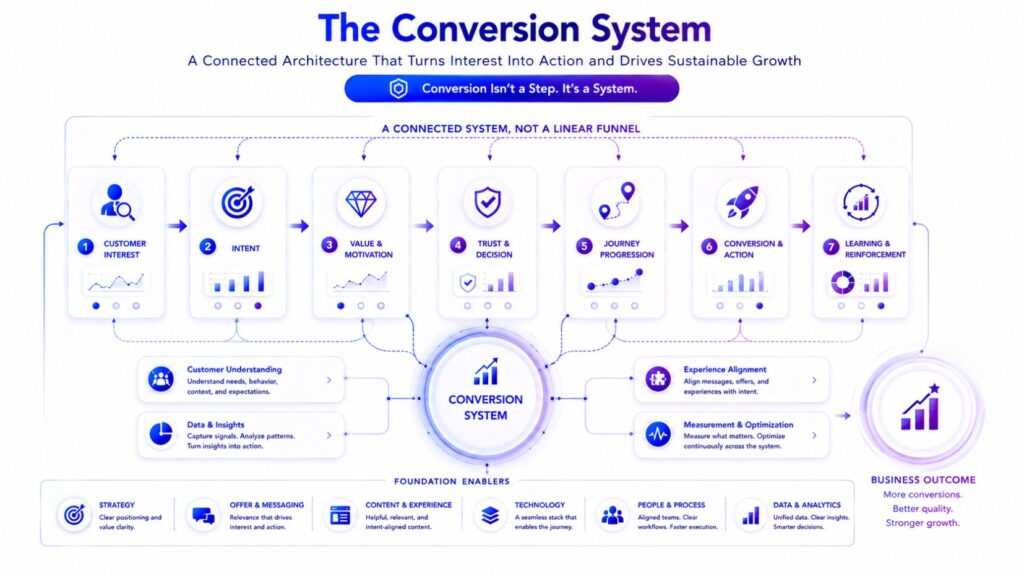
    A conversion system looks beyond individual pages, buttons, forms, or funnel stages. It considers how customer interest, intent, value, trust, progression, action, measurement, and learning work together to move someone from initial interest toward a meaningful outcome.

    The central idea is simple:

    Conversion performance is not created by one page, one funnel stage, or one optimization. It emerges from the connected system through which customer intent, value, trust, progression, action, and learning work together.

    Understanding that system changes the question from “Which conversion element should we fix?” to “How are the different parts of the conversion journey influencing one another?”

    This pillar explores that wider perspective. It will help you understand what a conversion system is, why conversion problems repeat, how lead generation and customer progression connect with conversion, why isolated optimization eventually reaches limits, and how individual conversion problems can be understood as part of a larger connected system.

    Comparison of isolated conversion components and a connected conversion system

    Table of Contents

    Why Conversion Problems Rarely Exist in Isolation

    Conversion problems rarely stay confined to the exact place where they become visible.

    A business may notice that a landing page is not producing enough action, a lead form is receiving fewer submissions, or customers are leaving before completing a purchase. Because the problem appears at a specific point, it is natural to focus attention on that point first.

    But the visible conversion problem may only be the symptom of a wider weakness somewhere in the connected customer journey.

    For example, a weak conversion point may be influenced by what happened before the customer reached it. The visitor may not have arrived with the right intent. The value may not have been clear enough. Trust may not have developed sufficiently. The next step may not feel natural. Or an earlier stage may have weakened the customer’s motivation to continue.

    This means the location where conversion performance becomes visible is not always the location where the underlying weakness began.

    That distinction matters because businesses can spend significant time improving individual conversion points while the relationships between those points remain weak. A page may improve, a campaign may perform better, or a funnel step may produce a temporary gain, yet another weakness can appear further along the journey.

    The result can become a repeating cycle:

    Visible Problem → Local Fix → Temporary Improvement → Another Weakness → New Conversion Problem

    The deeper question, therefore, is not simply whether an individual conversion component is working. It is whether the connected conditions around that component are strong enough to support customer progression.

    This is where system thinking becomes important. Instead of examining conversion as a collection of independent points, a conversion system looks at how the important parts interact and influence one another.

    Once those relationships become visible, individual conversion problems can be understood in a wider context rather than treated as isolated failures.

    What Is a Conversion System?

    A conversion system is the connected set of conditions, stages, and relationships that help move a potential customer from initial interest toward meaningful action.

    Conversion is therefore more than a button, landing page, form, or individual funnel stage. Each component may influence what happens before it, what happens after it, and whether the customer has enough clarity and confidence to continue.

    A connected conversion journey can be understood at a high level as:

    Customer Interest → Intent → Value & Motivation → Trust & Decision → Journey Progression → Action → Learning & Reinforcement

    The important point is not to treat these stages as separate checklists. Their relationships matter.

    Customer intent influences how value is perceived. Value and motivation influence whether someone wants to continue. Trust affects decision confidence. Journey progression determines whether the next step feels coherent. The resulting actions then create evidence that can be measured and learned from.

    This is the difference between looking at conversion components and looking at a conversion system.

    A collection of individually functional components does not automatically create a strong conversion system. If the connections between those components are weak, customers can still experience confusion, hesitation, friction, or a lack of confidence.

    System thinking therefore asks a broader question:

    How effectively do the important parts of the customer journey connect to support progression from interest to action?

    Once conversion is viewed this way, a weak conversion point becomes more than an isolated metric or page-level issue. It becomes evidence that should be understood within the wider system surrounding it.

    Why Conversion Problems Keep Repeating

    When the same or related conversion problems continue appearing across different pages, campaigns, or stages of the customer journey, repeatedly fixing individual symptoms may not be enough.

    A common pattern looks like this:

    Symptom → Local Fix → Temporary Improvement → Hidden Structural Weakness → New Symptom → Repeat

    The local fix may genuinely improve the point being addressed. The problem is that the wider system can still contain weaknesses that influence other stages of the journey.

    For example, improving one conversion page may increase action at that point while an upstream weakness in intent alignment remains unresolved. Similarly, improving lead capture may not solve inconsistent lead quality if the earlier stages are attracting poorly aligned opportunities.

    These relationships create structural dependencies across the conversion journey. One stage can influence another, which means the visible symptom is not always the root problem.

    That is why recurring conversion problems deserve a wider question: what connects the problems that keep appearing?

    Understanding those connections can reveal whether several apparently separate symptoms are actually different expressions of the same underlying weakness.

    For a deeper look at this specific problem, see why conversion problems keep repeating even after fixing individual pages.

    Recurring conversion problems are often system failures disguised as isolated symptoms.

    The Core Layers of a Conversion System

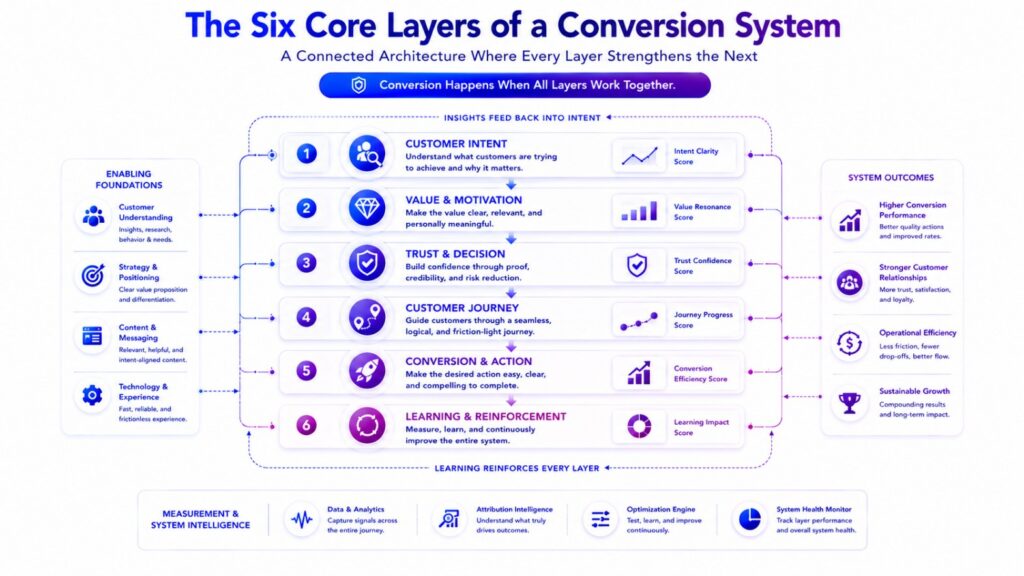
    A connected conversion system can be understood through several core layers. These layers should not be treated as six independent checklists. Their real importance comes from how they interact to support customer progression.

    1. Customer Intent

    Conversion begins with understanding whether the people entering the journey have a meaningful reason to continue. Customer intent influences what they expect, what they are looking for, and how ready they are to take the next step.

    If intent is poorly aligned with the journey, later conversion stages may struggle even when the individual components appear functional.

    2. Value & Motivation

    Interest alone does not guarantee progression. Customers need enough perceived value and motivation to believe that continuing the journey is worthwhile.

    This layer connects what the customer wants with what the business is offering and how clearly that value is communicated.

    3. Trust & Decision

    Before meaningful action, customers often need sufficient confidence in the business, offer, and next step. Trust therefore plays an important role in whether interest develops into decision readiness.

    A weakness in trust can interrupt progression even when intent and value are relatively strong.

    4. Customer Journey

    The journey connects the different stages through which a customer progresses. Each transition should make sense in relation to what came before and what the customer is expected to do next.

    When those transitions become unclear or disconnected, friction can appear across the journey rather than at only one visible conversion point.

    5. Conversion & Action

    This is where customer progression becomes a measurable action, such as submitting a lead form, requesting information, starting a purchase, or completing another intended conversion.

    However, the action itself should not be viewed in isolation. Its performance is influenced by the conditions established across the earlier layers.

    6. Learning & Reinforcement

    A conversion system also needs to learn from what happens. Measurement can provide evidence about which pathways are performing differently, where weaknesses may exist, and what deserves further attention.

    Learning then becomes useful when stronger pathways and useful improvements are reinforced rather than treated as isolated wins.

    Together, these layers form a connected system:

    Customer Intent → Value & Motivation → Trust & Decision → Customer Journey → Conversion & Action → Learning & Reinforcement

    The strength of the system depends not simply on whether each layer exists, but on whether the connections between them support consistent customer progression.

    Six connected layers of a conversion system from customer intent to learning

    How Intent, Value, Trust, and Action Connect

    Customer progression does not usually happen because of one isolated conversion element. It develops through a sequence of connected conditions that influence whether someone continues from initial interest toward action.

    Intent Alignment

    The journey begins with intent. Customers arrive with expectations, questions, needs, and different levels of readiness. When the journey aligns with that intent, progression becomes more relevant and coherent.

    Perceived Value

    Once intent is aligned, customers need a clear reason to continue. Perceived value helps answer the question of whether taking the next step is worthwhile.

    Motivation

    Value and motivation work together. Even when an offer appears relevant, customers may not progress if the perceived reason to act is not strong enough at that point in the journey.

    Trust Before Commitment

    Before taking a meaningful action, customers often need confidence that the business, offer, and next step are credible and appropriate for them. Trust therefore becomes an important bridge between interest and decision.

    Journey Clarity

    Customers also need to understand what happens next. A clear journey reduces uncertainty about progression and helps connect one stage of the experience with the next.

    Decision Confidence

    When intent, value, trust, and journey clarity work together, customers can develop greater confidence in their decision. This does not guarantee action, but it creates stronger conditions for meaningful progression.

    From Interest to Action

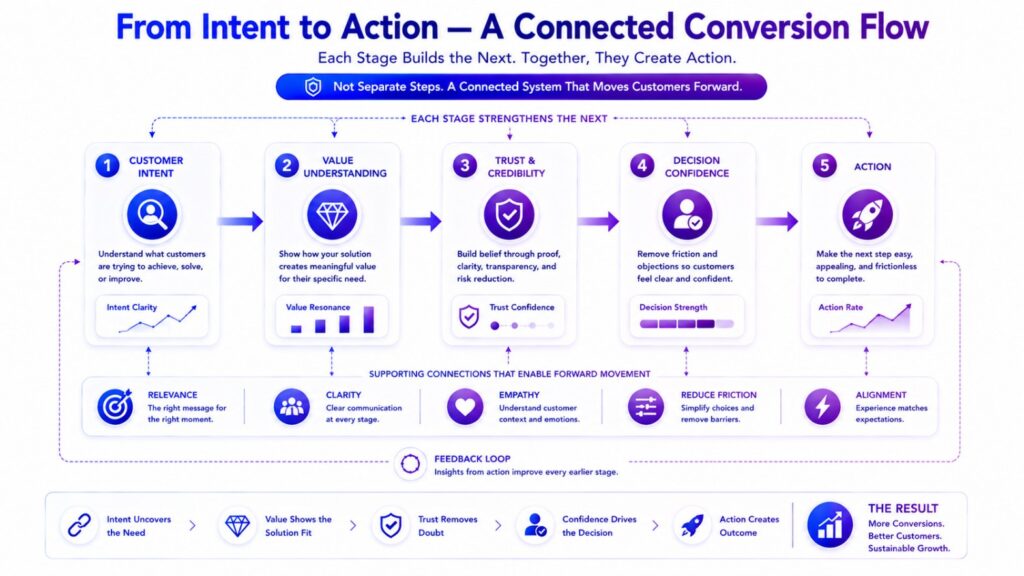
    At a high level, these relationships can be understood as:

    Intent → Value → Trust → Confidence → Action

    The important insight is that these are not independent conversion levers. A weakness earlier in the sequence can influence what happens later. Understanding the connection therefore provides a more useful view of conversion performance than examining the final action alone.

    Conversion flow connecting customer intent, value, trust, confidence, and action

    Why Lead Generation and Conversion Cannot Be Separated

    Lead generation is often treated as a separate activity from conversion. One team focuses on bringing visitors, while another focuses on turning those visitors into leads or customers.

    But within a connected conversion system, these stages influence one another. The quality of incoming opportunities, the alignment of customer intent, the value being communicated, the level of trust, and the path toward action can all affect whether lead generation becomes meaningful business opportunity.

    Qualified Traffic vs. Raw Traffic

    More traffic does not automatically mean more valuable conversion opportunities. What matters is whether incoming visitors have sufficient relevance and intent to progress through the journey.

    Intent Alignment

    Once qualified visitors enter the system, their expectations need to align with the journey they encounter. Misalignment can weaken progression even when traffic volume appears healthy.

    Value & Trust

    Visitors need enough value clarity and confidence to continue. If the perceived value or trust conditions are weak, potential opportunities may disappear before reaching the lead-capture stage.

    Conversion Path

    The path from initial interest to lead action needs to connect logically. Unclear transitions or structural friction can interrupt progression between otherwise functional stages.

    Lead Capture

    Lead capture is an important conversion point, but it should not be viewed as the entire lead-generation system. Its performance depends partly on the quality and progression of the journey that leads customers toward it.

    Measurement & Reinforcement

    Measurement provides evidence about which pathways are producing stronger outcomes and where weaknesses may exist. That evidence can then help identify which parts of the system deserve further attention and reinforcement.

    The connected relationship can be understood at a high level as:

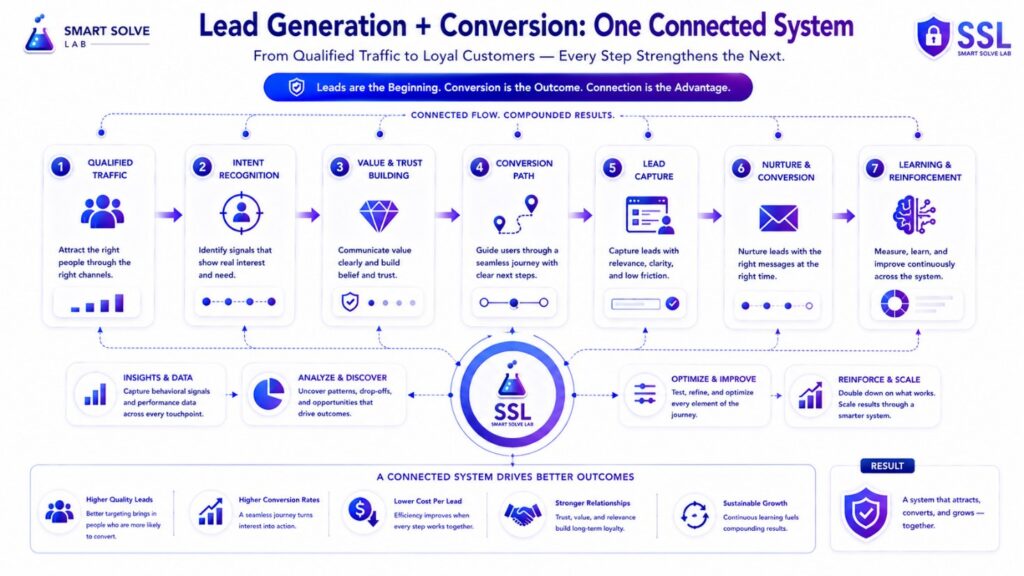
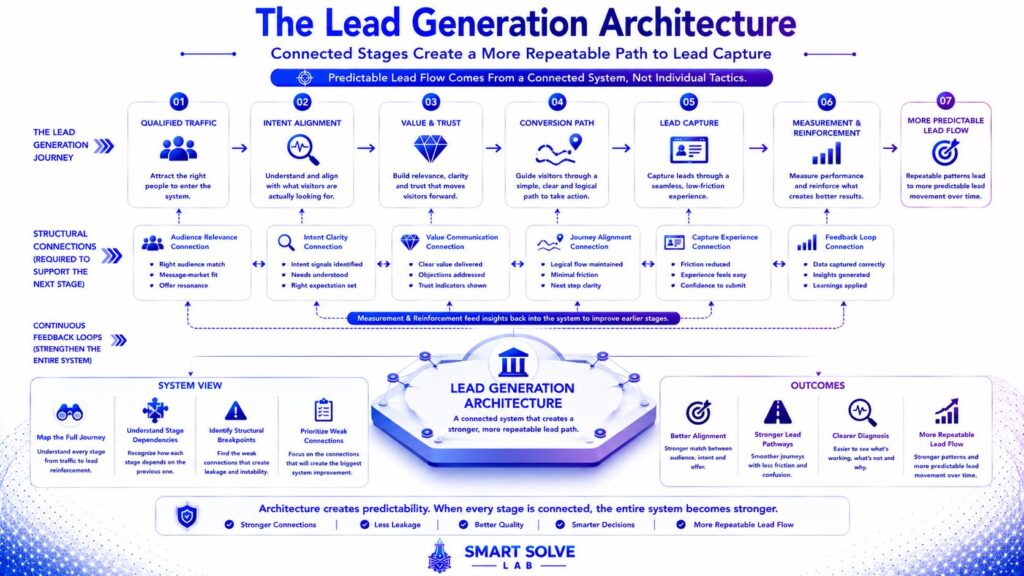
    Qualified Traffic → Intent → Value & Trust → Conversion Path → Lead Capture → Learning & Reinforcement

    This is why lead generation and conversion should not be analyzed as completely separate systems. Weakness in one stage can influence performance in another, making the connections between them important to understand.

    For a deeper exploration of why lead flow can become inconsistent, see why lead generation feels unpredictable.

    Connected lead generation and conversion system from qualified traffic to learning

    Why Customers Drop Off Before Buying

    When customers leave before completing an intended action, the visible exit point can make the problem appear easy to identify. A business may see where people stop progressing and naturally assume that the problem exists at that exact stage.

    But customer progression is connected. The point where a customer leaves may only be where an earlier weakness finally becomes visible.

    Where Customer Progression Weakens

    Progression can weaken when intent becomes misaligned, value becomes unclear, trust is insufficient, the next step creates uncertainty, or friction develops between stages of the journey.

    Why the Exit Point May Only Be a Symptom

    A customer may leave at one stage because something weakened their confidence earlier. The visible drop-off therefore provides useful evidence, but it does not automatically explain where the journey first became weak.

    Upstream and Downstream Influence

    Earlier stages can influence later decisions, while weaknesses in one stage can also affect what happens afterward. This makes customer drop-off a journey-level issue rather than simply a page-level metric.

    Journey Friction

    Friction can emerge through unclear transitions, inconsistent expectations, weak value communication, insufficient trust, or unnecessary complexity. Individually, these may appear small, but together they can interrupt progression.

    Progression, Not Just Exit Tracking

    Tracking where customers leave is valuable because it provides evidence. But understanding conversion requires going beyond the exit point and asking what conditions influenced the customer’s progression toward that point.

    The point where a customer leaves is not necessarily the point where the journey first became weak.

    For a deeper examination of this journey-level problem, see why customers drop off before buying.

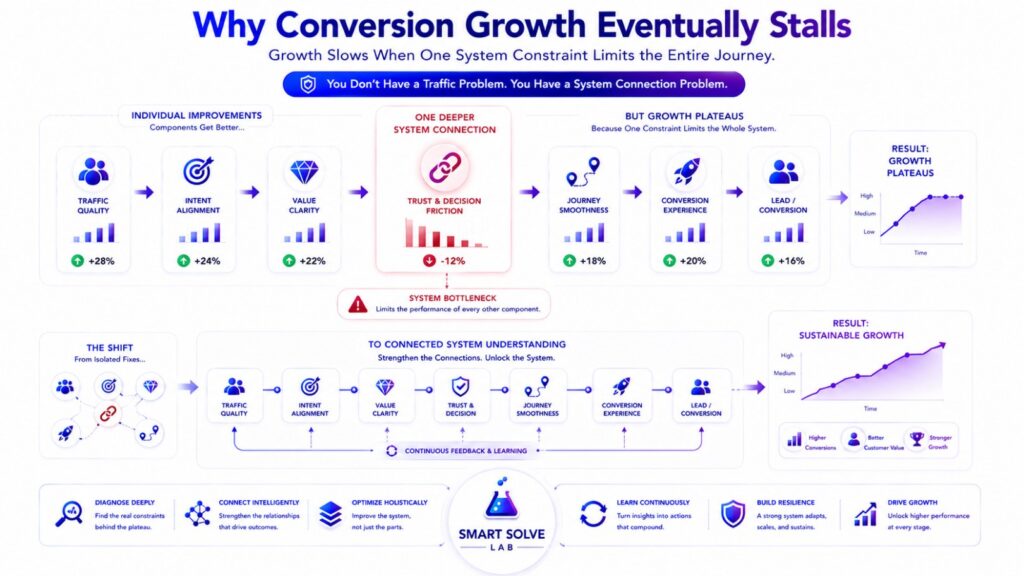
    Why Conversion Growth Eventually Stalls

    Conversion optimization can produce meaningful improvements, but those improvements do not always continue indefinitely. A business may optimize individual pages, strengthen specific funnel stages, or improve individual conversion points and still reach a point where further changes produce smaller gains.

    This can happen because isolated improvements operate within the limits of the wider conversion system.

    Component Optimization Has Limits

    Improving an individual component can strengthen that part of the journey, but it cannot automatically remove weaknesses elsewhere. Once the most visible issues have been addressed, remaining constraints may exist in the relationships between stages.

    Structural Constraints

    A structural constraint is a weakness within the connected system that limits what the wider conversion journey can achieve. The constraint may not be located at the point where performance appears weakest.

    This creates an important distinction between optimizing a component and understanding what is limiting the system.

    Dependencies Between Conversion Stages

    Conversion stages depend on one another. Stronger performance at one stage may have limited impact if another connected stage cannot support the resulting progression.

    For example, improving action at one point may not create sustained growth if customer intent, value, trust, journey continuity, or learning remains weak elsewhere in the system.

    Why More Optimization Is Not Always the Answer

    When improvements begin producing smaller gains, the answer is not necessarily to optimize more aggressively. The more useful question may be whether the underlying system contains a constraint that is limiting the impact of further optimization.

    At that point, conversion thinking needs to move from “What else can we optimize?” toward “What is limiting the system?”

    From Component Optimization to System Understanding

    System-level understanding helps businesses see why improvements may plateau even when individual components continue to receive attention.

    Conversion growth can stall when isolated improvements reach the limits of the underlying system.

    The goal is therefore not to stop optimizing individual components. It is to understand when component-level optimization is no longer enough and when the relationships and structural conditions across the wider conversion system need attention.

    For a deeper exploration of this specific growth constraint, see why your conversion growth stalls.

    Conversion growth system showing a structural constraint limiting performance

    From Individual Conversion Fixes to Conversion Architecture

    Individual conversion fixes can be useful when a specific problem is clearly understood. But when multiple symptoms appear across the customer journey, treating each one separately can make the wider system increasingly difficult to understand.

    Individual Symptoms

    A business may begin with visible symptoms such as weak page conversion, inconsistent leads, customer drop-off, or stalled growth. Each symptom can appear to belong to a different part of the business.

    System-Level Diagnosis

    The next step is to examine whether these symptoms are connected. Instead of asking only why one component is underperforming, the focus shifts toward understanding how different stages influence one another.

    Connected Relationships

    Conversion performance depends on relationships between intent, value, trust, progression, action, and learning. Weakness in one relationship can influence performance elsewhere, even when individual components appear functional.

    Dependencies and Priorities

    Once relationships become visible, it becomes easier to recognize that not every weakness deserves equal attention at the same time. Some issues may influence several other stages, while others may have a more limited effect.

    This creates a need for system-level prioritization rather than simply fixing whichever problem happens to be most visible.

    Why the System Matters More Than a Single Component

    A conversion architecture brings these relationships into a wider view. It focuses on how the important parts of the conversion journey fit together and whether they collectively support customer progression.

    This does not mean individual conversion components stop mattering. Rather, their performance becomes easier to understand when viewed within the architecture that connects them.

    For a deeper exploration of why businesses often fail to build this wider structure, see why most businesses never build a conversion architecture.

    The shift is from fixing isolated conversion symptoms to understanding the connected architecture that allows those components to work together.

    The Revenue Connection: Conversion Is Part of a Larger Growth System

    Conversion does not operate independently from the rest of the business. While conversion determines how effectively customer interest progresses toward action, that progression exists within a broader growth system.

    Market Opportunity

    Growth begins with the opportunity available in the market. Customer needs, demand, positioning, and the relevance of the business offering influence whether meaningful opportunities can enter the wider system.

    Demand Creation

    Demand creation helps bring potential customers into contact with the business. But generating attention alone does not create sustainable growth if the resulting opportunities are poorly aligned with what the business can convert and serve.

    Opportunity Quality

    The quality and relevance of incoming opportunities influence what the conversion system can realistically achieve. A strong conversion process cannot compensate indefinitely for a fundamental lack of suitable opportunities.

    Conversion Capacity

    Conversion is the part of the wider system that helps turn relevant customer interest into meaningful action. Its performance depends on the connected conditions explored throughout this pillar: intent, value, trust, journey progression, action, and learning.

    Customer Value

    Conversion is not the final destination of growth. The value created after conversion also matters because the broader business outcome depends on what happens beyond the initial action.

    Retention & Expansion

    Customer relationships can continue beyond the first conversion. Retention, repeat value, and expansion therefore connect conversion with the longer-term growth system.

    Learning & Reinforcement

    What the business learns from customer behavior, conversion outcomes, and ongoing performance can strengthen future decisions. Learning creates the opportunity to reinforce stronger pathways rather than repeatedly treating every outcome as an isolated event.

    At a high level, the wider relationship can be understood as:

    Market Opportunity → Demand Creation → Opportunity Quality → Conversion Capacity → Customer Value → Retention & Expansion → Learning & Reinforcement

    Conversion is therefore a critical part of growth, but conversion itself exists inside a larger revenue system.

    For a deeper look at why these connected conditions can make revenue growth difficult to understand, see why revenue growth feels so difficult.

    How to Diagnose a Weak Conversion System

    Once conversion is viewed as a connected system, diagnosing weakness requires looking beyond the most visible problem. The objective is not simply to find where performance is low, but to understand what may be influencing that weakness across the wider journey.

    Where Is the Visible Symptom?

    Begin with what can actually be observed. A weak conversion point, inconsistent lead flow, customer drop-off, or stalled growth provides a starting signal for investigation.

    Where Might the Weakness Have Begun?

    The visible symptom may not represent the beginning of the problem. Earlier stages can shape customer expectations, motivation, trust, and progression, so the wider journey needs to be considered.

    Which Stages Influence It?

    Look at the relationships surrounding the problem. Ask which upstream or downstream stages could be influencing the observed outcome rather than assuming the nearest component is responsible.

    What Evidence Supports the Diagnosis?

    Good diagnosis should be grounded in evidence rather than assumptions. Metrics, customer behavior, journey patterns, and observed outcomes can provide useful signals, but individual measurements should be interpreted within their wider context.

    Which Weakness Deserves Attention First?

    Not every identified weakness has the same importance. Some structural issues may influence several connected stages, while others may have a narrower effect. The goal is to understand which weakness deserves attention based on its relationship with the wider system.

    What Should Be Reinforced After Improvement?

    Improvement should not end when one problem appears to be resolved. The system should continue learning from what changes, identifying what works more effectively, and reinforcing stronger pathways where appropriate.

    At a high level, this diagnostic thinking can be represented as:

    Observe → Map → Connect → Understand → Prioritize → Reinforce

    This is a conceptual way to think about system diagnosis—not a substitute for detailed assessment. Its purpose is to shift attention from isolated symptoms toward the relationships and structural conditions that influence conversion performance.

    Building a More Connected Conversion System

    A stronger conversion system is not created by optimizing every component independently. It develops when the important parts of the customer journey connect clearly enough to support progression, learning, and reinforcement.

    Align the Customer Journey

    Start by ensuring that the journey makes sense from the customer’s perspective. Each stage should connect naturally with the expectations, needs, and decisions established in the stages before it.

    Strengthen Weak Connections

    When a system contains a weak transition between stages, improving the connection can be more valuable than repeatedly optimizing the individual components on either side of it.

    Reduce Isolated Optimization

    Individual optimization still has a place, but it should not become the default response to every conversion problem. Improvements should be considered in relation to the wider journey and the conditions surrounding the target component.

    Prioritize Structural Issues

    Not every weakness has equal influence. A structural issue affecting several connected stages may deserve attention before a smaller problem that affects only one point in the journey.

    Create Learning Loops

    A connected system should learn from what happens. Observed outcomes and customer behavior can provide evidence that helps the business understand which pathways are stronger, where weaknesses remain, and what deserves further investigation.

    Reinforce What Works

    When stronger pathways or improvements are identified, they should become part of the system’s ongoing learning process. Reinforcement helps prevent useful improvements from remaining isolated successes.

    The broader principle is:

    The goal is not to optimize every conversion component independently, but to strengthen the connections that allow the system to perform more coherently.

    A connected conversion system therefore becomes less about continuously reacting to individual symptoms and more about understanding, strengthening, and learning from the relationships that shape customer progression.

    Common Conversion System Mistakes

    Many conversion problems become harder to resolve when businesses evaluate individual activities without considering how those activities connect across the wider system.

    Optimizing One Page in Isolation

    A page can be improved while weaknesses elsewhere in the customer journey remain unresolved. Treating the page as the complete problem can therefore limit the usefulness of the improvement.

    Treating Traffic as the Entire Problem

    More traffic does not automatically resolve conversion weakness. If intent, value, trust, journey progression, or action conditions remain weak, increasing traffic may simply send more visitors into the same structural weakness.

    Treating Leads as the Final Outcome

    Lead generation is an important stage, but leads are not the complete growth outcome. Their quality, progression, conversion, customer value, and longer-term relationship with the business also matter.

    Assuming the Drop-Off Point Is the Root Cause

    The place where customers leave provides useful evidence, but it does not necessarily reveal where the journey first became weak. Looking only at the exit point can therefore miss upstream influences.

    Chasing Metrics Without Understanding Relationships

    Metrics can show what is happening, but individual numbers do not always explain why it is happening. A metric becomes more useful when interpreted alongside the connected stages and conditions that influence it.

    Fixing Symptoms Without Examining Dependencies

    Repeatedly fixing visible symptoms can create a cycle of temporary improvements followed by new problems. Examining dependencies helps reveal whether apparently separate issues are connected.

    Adding More Activity Instead of Strengthening the System

    More campaigns, more traffic, more optimization, or more conversion experiments do not automatically create a stronger system. Sometimes the more important step is understanding and strengthening the relationships that already exist within the journey.

    The common thread behind these mistakes is the same: treating connected conversion problems as if they were independent problems.

    A stronger approach begins by understanding the system before deciding which individual component deserves further optimization.

    The Conversion System Framework

    Understanding a conversion system becomes more useful when the major relationships can be viewed as one connected way of thinking. The purpose of this framework is to help move from visible conversion problems toward broader system understanding.

    Understand

    Begin by understanding the conversion problem in context. Identify what is happening, what outcome is being affected, and what the visible evidence actually shows.

    Map

    Map the relevant customer journey and the stages surrounding the problem. This creates a wider view instead of examining one conversion point in isolation.

    Connect

    Connect the stages, symptoms, and conditions that may influence one another. This helps reveal relationships that may otherwise remain hidden.

    Diagnose

    Examine the connected system to understand where meaningful weaknesses may exist. The objective is to move beyond the visible symptom toward a clearer explanation of the wider problem.

    Prioritize

    Once potential weaknesses are understood, consider which ones deserve attention first based on their relationship with the wider conversion system.

    Strengthen

    Strengthen the areas and connections that are most important to customer progression. Improvement should be considered as part of the wider system rather than as an isolated adjustment.

    Learn

    Observe what happens after changes are made. Outcomes and customer behavior provide evidence that can improve understanding of how the system is functioning.

    Reinforce

    When stronger pathways or useful improvements become clear, reinforce them so that learning becomes part of the ongoing conversion system rather than a one-time optimization exercise.

    Understand → Map → Connect → Diagnose → Prioritize → Strengthen → Learn → Reinforce

    This framework provides a high-level way to think about conversion as a connected system. It is not intended to replace detailed diagnostic tools or operational processes; rather, it gives the reader a structured mental model for moving from individual problems toward system thinking.

    The Complete Conversion System — Putting It All Together

    By this point, conversion can be understood as more than a collection of pages, funnel stages, or individual optimization opportunities. It is a connected system in which different conditions influence how customers progress from initial interest toward meaningful action.

    From Customer Interest to Action

    The complete conversion journey can be viewed at a high level as:

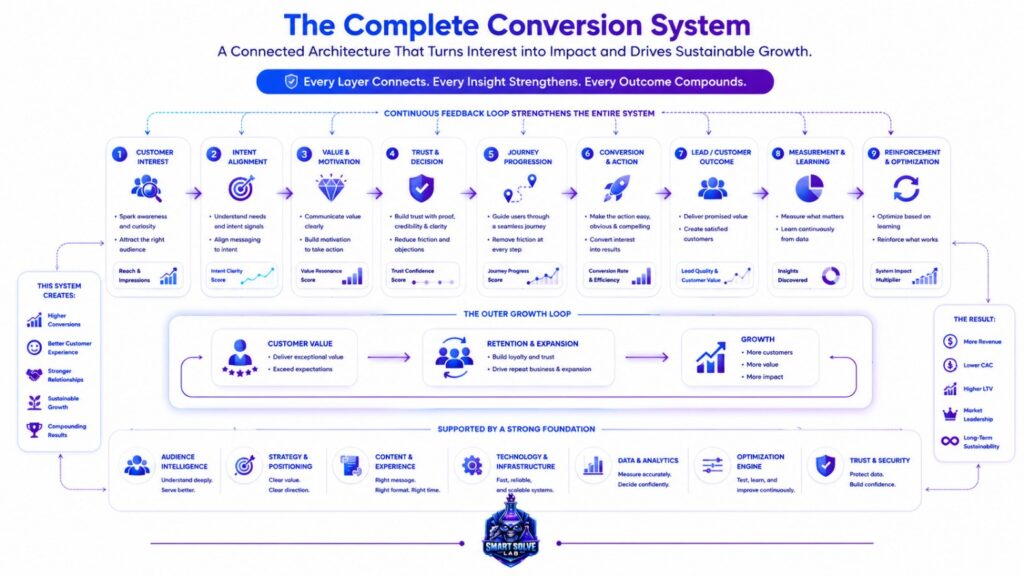
    Customer Interest → Intent Alignment → Value & Motivation → Trust & Decision → Journey Progression → Conversion & Action → Lead / Customer Outcome → Measurement & Learning → Reinforcement

    Each stage contributes something different, but none of them exists completely in isolation.

    Why the Connections Matter

    Intent affects how relevant the journey feels. Value and motivation influence whether customers see a reason to continue. Trust and decision confidence affect commitment. Journey progression connects one stage with the next. Action creates measurable outcomes, while learning provides evidence that can help the system improve.

    A weakness in one connection can therefore influence performance elsewhere, even when the individual components appear functional.

    From Conversion to Customer Value

    Conversion is an important transition, but it is not the complete business outcome. What happens after the initial action can influence customer value, retention, expansion, and the longer-term growth system.

    This creates a broader relationship:

    Conversion System → Customer Value → Retention & Expansion → Growth

    The Central Principle

    A stronger conversion system is not defined by one optimized component. It is defined by how effectively the important parts connect, support progression, and learn from what happens.

    When the system is viewed this way, individual conversion problems become signals within a larger architecture rather than completely separate problems requiring unrelated fixes.

    The objective is not to make every component perfect in isolation. It is to create enough coherence between the important parts of the journey that customer progression, learning, and improvement can work together more effectively.

    Complete conversion system connecting intent, value, trust, progression, action, learning, and growth
    A connected conversion system turns individual stages into a coherent growth architecture.

    From Individual Conversion Problems to System Thinking

    Individual Conversion Problems

    Conversion problems often first appear as individual issues: a weak landing page, poor lead quality, customer drop-off, low form completion, or limited progression toward action. These visible problems are important, but they may represent only one part of a wider conversion system.

    Core System Problems

    When similar problems continue across different pages, stages, or customer interactions, the issue may be larger than any single component. The focus begins to shift from fixing individual symptoms toward understanding the relationships and dependencies connecting the conversion journey.

    Premium Architecture Problems

    At a deeper level, multiple connected weaknesses can point toward an architecture problem. When conversion components influence one another across the wider customer journey, understanding the larger architecture becomes necessary before meaningful structural improvement can take place.

    Conversion System Pillar

    The Conversion System brings these levels together by moving from individual problems toward connected system thinking. Instead of viewing each conversion issue as an isolated event, businesses can begin to understand how intent, value, trust, progression, action, learning, and reinforcement interact as one system.

    The Shift in Thinking

    The important shift is not simply from one optimization tactic to another. It is from asking “What is wrong with this conversion point?” to asking “What is happening across the system that is producing this outcome?”

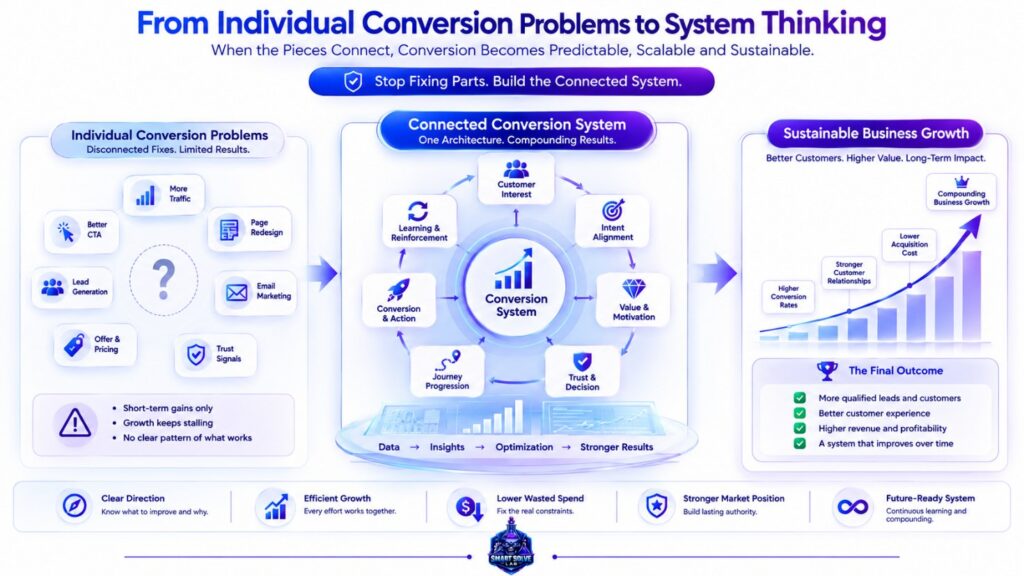
    Individual problems reveal symptoms. System thinking reveals relationships.

    Conversion system evolving from individual problems to connected system thinking

    Key Takeaways

    Conversion Is a System, Not a Single Element

    Conversion performance does not come from one page, button, funnel stage, or optimization. It emerges from how the important parts of the customer journey connect and support one another.

    Symptoms Do Not Always Reveal Root Causes

    A visible conversion problem may only be the point where a wider weakness becomes noticeable. Understanding what happens before and around that problem can reveal a more meaningful direction for diagnosis.

    Customer Progression Depends on Connected Conditions

    Intent, value, trust, confidence, journey clarity, and action influence one another. Weakness in one area can affect progression elsewhere in the system.

    Lead Generation and Conversion Influence One Another

    Generating more traffic or leads does not automatically create better conversion outcomes. The quality of intent, value alignment, trust, conversion path, and learning process also matter.

    Local Optimization Can Expose Wider Constraints

    Improving one conversion component can sometimes reveal another weakness rather than solving the wider problem. This is why isolated optimization has limits when structural dependencies remain unresolved.

    Metrics Provide Evidence, Not Complete Explanations

    Conversion metrics can show what is happening, but they do not always explain why it is happening. Reviewing Google Analytics dimensions and metrics can help businesses understand the evidence available in their data, but stronger diagnosis still requires understanding the relationships behind the observed numbers.

    Sustainable Improvement Requires Learning and Reinforcement

    A stronger conversion system does not stop at making an improvement. It learns from customer behavior, strengthens what works, and uses those insights to support future decisions.

    Stronger Conversion Comes From Stronger System Connections

    The ultimate goal is not to optimize every component independently. It is to create a more connected system in which customer intent, value, trust, progression, action, learning, and reinforcement work together more coherently.

    Where to Go Next

    Start With the Specific Conversion Problem

    Begin with the conversion problem you can actually observe. Identify what is happening, where it appears, and what evidence is available before assuming the cause.

    Move Toward the Relevant Diagnostic Layer

    Once the problem is clear, examine the part of the conversion system most closely connected to it. A focused diagnostic approach can provide more useful understanding than applying unrelated optimization tactics.

    Build Toward System Understanding

    If the problem connects with other stages, broaden the view. Understanding the relationships between intent, value, trust, journey progression, action, and learning can reveal why an apparently isolated issue continues to affect performance.

    Move From System Understanding to Architecture

    When multiple connected conversion weaknesses exist, the next step is to understand the larger architecture behind them. This is where individual problem diagnosis develops into a more complete view of how the conversion system is structured.

    Separate Diagnosis From Execution

    Strong improvement begins with understanding the problem before deciding how to implement the solution. Smart Solve Lab focuses on diagnosis, clarity, frameworks, and architecture—helping businesses understand what is happening and why before execution begins.

    The right next step depends on the level of the problem: specific issue, system weakness, or connected architecture.

    Understand the Conversion System

    If individual conversion fixes keep producing temporary or disconnected improvements, the next step is to understand the wider system behind those outcomes.

    A connected conversion system helps you look beyond isolated pages, funnel stages, or metrics and examine how customer intent, value, trust, progression, action, and learning work together.

    Explore the Conversion System resources and identify the diagnostic framework most relevant to your current conversion problem.

    FAQs

    What is a conversion system?

    A conversion system is the connected set of conditions and stages through which customer interest develops into intent, value, trust, progression, action, and learning. It focuses on how these parts work together rather than treating each conversion point in isolation.

    How is a conversion system different from a conversion funnel?

    A funnel mainly describes the progression of customers through stages. A conversion system looks more broadly at the relationships, dependencies, conditions, and learning processes that influence how effectively customers move through those stages.

    Why do conversion problems keep repeating?

    Conversion problems can repeat when businesses fix visible symptoms without examining the wider system relationships that contribute to them. A local improvement may not resolve an underlying structural weakness.

    Why doesn’t fixing one conversion page always solve the problem?

    A page may be affected by conditions outside the page itself, including customer intent, value alignment, trust, journey progression, or the quality of traffic reaching it. Improving one component does not necessarily resolve weaknesses elsewhere.

    How do customer intent and trust affect conversion?

    Intent influences whether the customer is aligned with the offer, while trust affects confidence in taking the next step. When value, intent, trust, and journey clarity work together, progression toward action can become more coherent.

    Why are lead generation and conversion connected?

    Lead generation does not operate separately from conversion. The quality and intent of incoming traffic, the value and trust presented, the conversion path, and the learning process can all influence what happens after a visitor arrives.

    How should businesses think about conversion drop-offs?

    A drop-off point should be treated as evidence rather than automatically assumed to be the root cause. The journey should be examined around that point to understand where customer progression may have first become weaker.

    How can a conversion system become more sustainable?

    A more sustainable conversion system comes from strengthening important connections, addressing structural weaknesses, learning from customer behavior, and reinforcing improvements instead of relying only on isolated optimization.

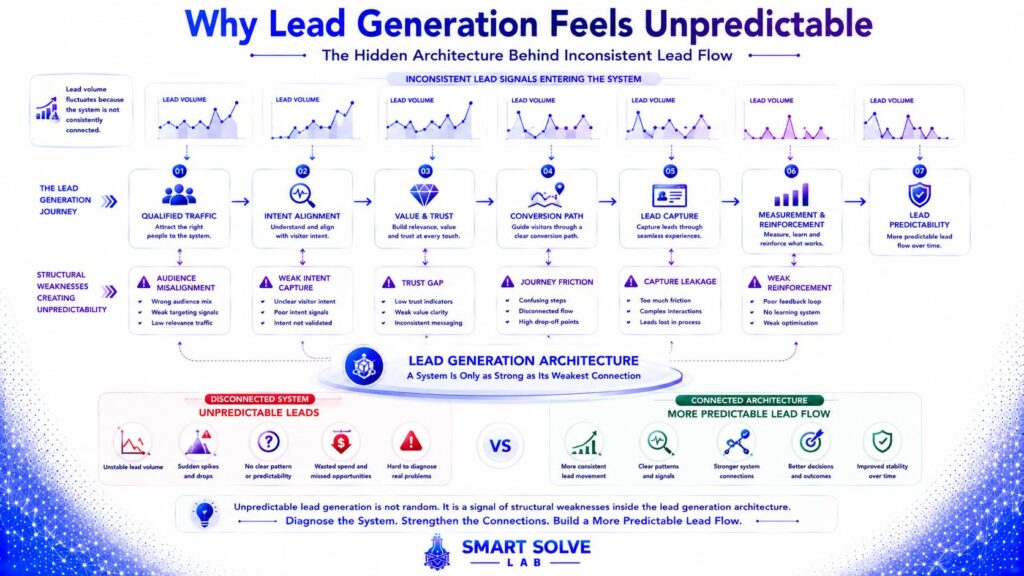
  • Why Lead Generation Feels Unpredictable (And Why More Traffic Doesn’t Fix It)

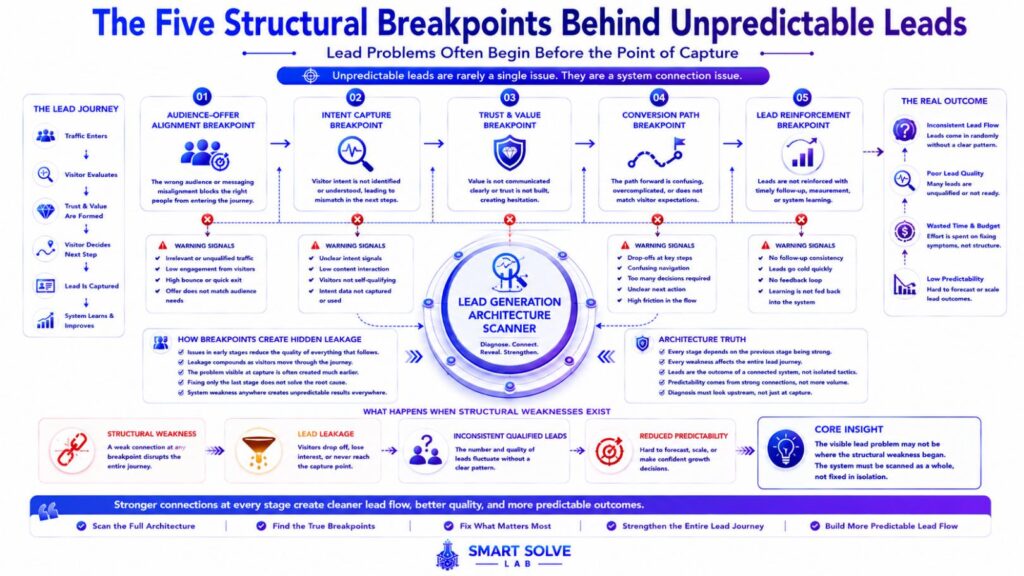
    lead generation feels unpredictable system showing structural gaps between qualified traffic and lead capture.
    Unpredictable leads often signal disconnected stages across the lead generation system.

    lead generation feels unpredictable,

    Some weeks, leads arrive consistently.

    Then suddenly, they slow down.

    A campaign that generated strong inquiries last month produces almost nothing this month. Website traffic may remain healthy—or even increase—yet the number of qualified leads moves unpredictably.

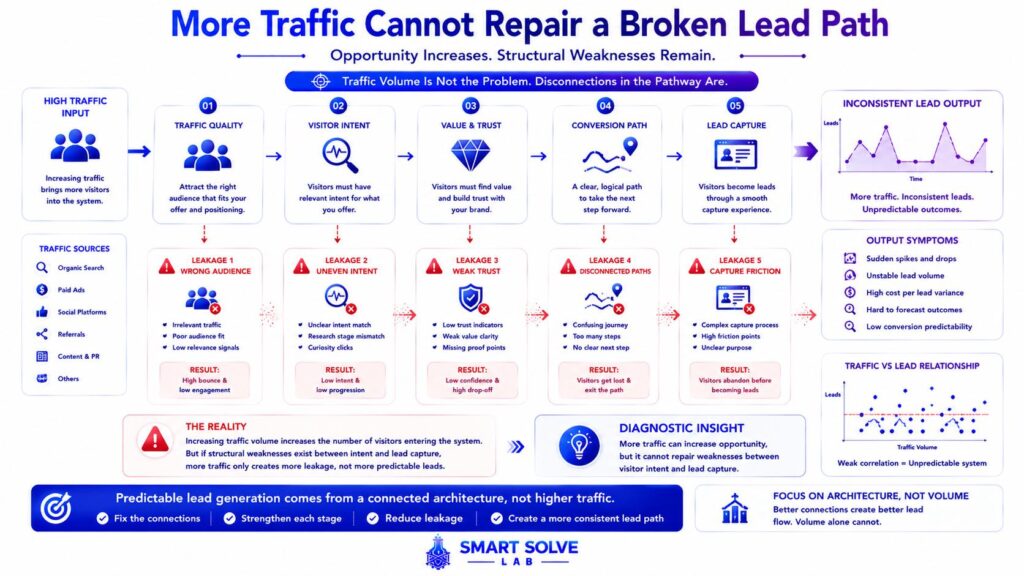
    This often creates an obvious reaction: we need more traffic.

    More content is published. More campaigns are launched. More visitors are pushed toward landing pages. Calls to action are changed. Individual pages are adjusted.

    Sometimes those changes create a temporary improvement.

    But the inconsistency returns.

    That is because unpredictable lead generation is often not simply a traffic-volume problem. It can be a structural signal that the stages responsible for turning qualified visitors into leads are not working together consistently.

    A visitor does not become a lead because traffic exists alone.

    They move through a connected journey:

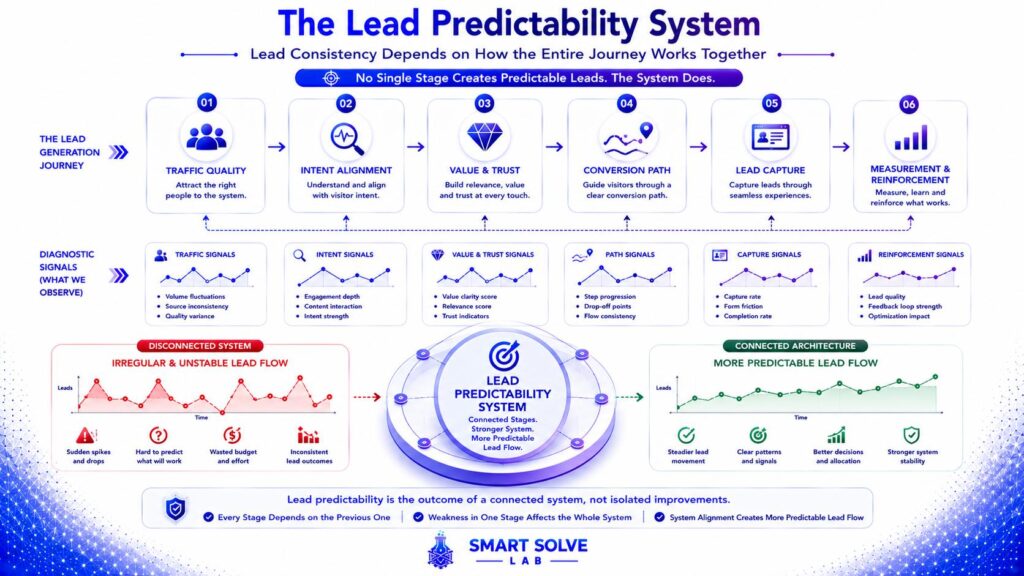
    Traffic Quality → Intent Alignment → Value & Trust → Conversion Path → Lead Capture → Measurement & Reinforcement

    Weakness at any point can affect what happens further downstream.

    You may attract plenty of visitors, but they may not match the offer. The right visitors may arrive but fail to recognize the next step. Interest may exist without enough trust to support action. A strong prospect may encounter friction before reaching lead capture. Or the business may generate leads successfully through certain pathways without understanding which signals made those pathways work.

    The visible symptom appears at the end:

    inconsistent leads.

    But the structural weakness may have started much earlier.

    This is why increasing traffic alone rarely creates lead predictability. More visitors can increase opportunity, but they cannot automatically repair disconnected stages between visitor intent and lead capture.

    The more useful question, therefore, is not simply:

    “How can we generate more leads?”

    It is:

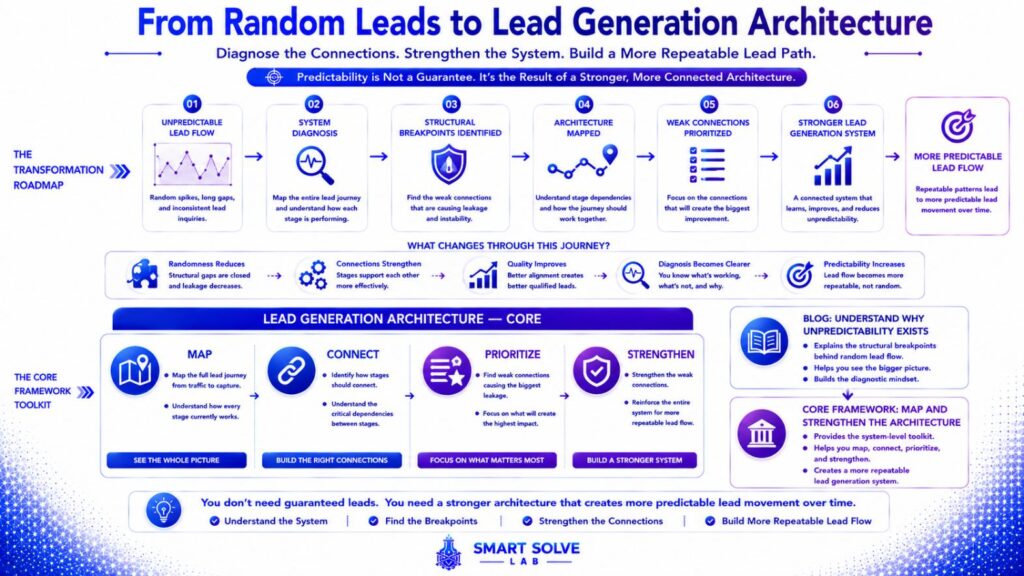
    “Where is the lead generation architecture losing consistency?”

    In this guide, we’ll examine what unpredictable lead generation actually means, the structural breakpoints that create it, why isolated fixes often fail to stabilize performance, and what a connected system needs to create a more repeatable path from qualified interest to lead capture.

    Lead predictability system connecting traffic quality, intent, trust, conversion paths, lead capture, and reinforcement.
    Lead consistency depends on how effectively each stage of the lead journey works with the next.

    Table of Contents

    What Does “Unpredictable Lead Generation” Actually Mean?

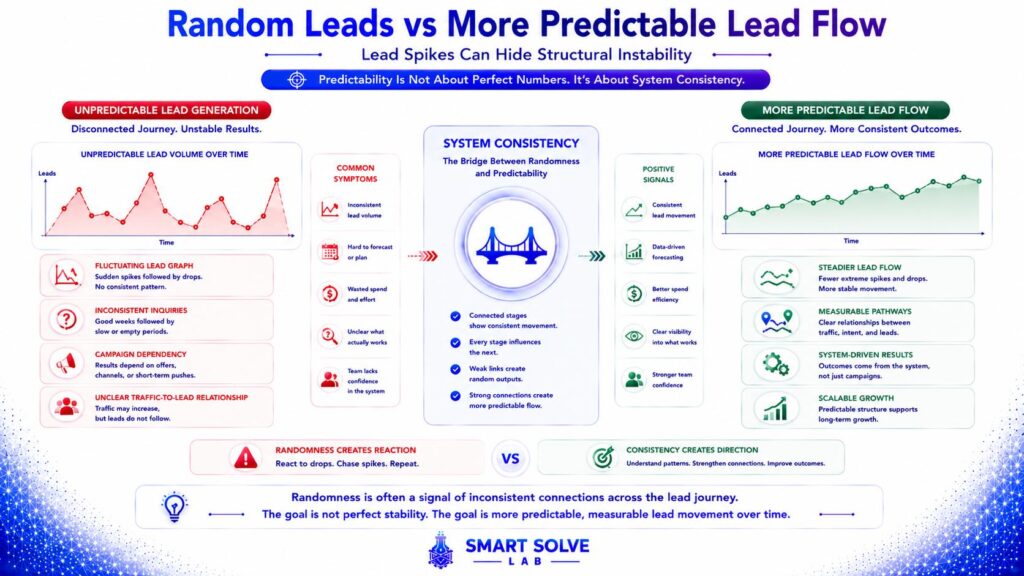
    Unpredictable lead generation does not simply mean that a business receives fewer leads than it wants.

    The deeper problem is inconsistency.

    One week may produce several qualified enquiries. The next may produce almost none. A campaign may perform strongly for a short period and then lose momentum. Website traffic may remain relatively healthy while lead volume continues to rise and fall without an obvious explanation.

    This makes lead generation difficult to understand, forecast, and improve.

    Occasional Leads vs Predictable Lead Flow

    Occasional leads prove that a business can generate interest.

    They do not necessarily prove that the lead generation system is working consistently.

    A business might receive leads because one article ranks well, a campaign temporarily attracts high-intent visitors, a referral sends qualified prospects, or a particular landing path happens to work effectively.

    But if those results depend heavily on isolated sources or temporary conditions, lead flow can quickly change when those conditions change.

    A stronger system does not mean producing exactly the same number of leads every day.

    Normal variation will always exist.

    The goal is to create a more repeatable pathway through which qualified visitors can move from initial interest toward meaningful contact.

    Why Lead Spikes Create a False Sense of Performance

    A sudden increase in leads can look like evidence that the entire lead generation strategy is working.

    Sometimes it is.

    But a spike can also hide structural instability.

    For example, one campaign might generate a burst of qualified prospects while other traffic sources produce almost no leads. Overall numbers temporarily improve, but the wider journey remains weak.

    When the campaign ends, lead volume falls again.

    Looking only at the spike can therefore create the wrong conclusion:

    “Lead generation is working—we just need more traffic.”

    The more useful question is:

    “Which pathway produced these leads, and can the wider system support that pathway consistently?”

    That shifts attention from temporary outcomes toward the architecture producing them.

    Good Traffic but Inconsistent Inquiries

    Traffic and leads represent different stages of the customer journey.

    Traffic shows that people are reaching the website.

    Lead generation requires something more: the right visitors must recognize relevance, develop sufficient trust, understand the value being offered, and find a clear path toward taking the next step.

    This is why a website can maintain healthy visitor numbers while enquiries fluctuate significantly.

    If your broader problem is that visitors consistently arrive but rarely become leads, the diagnostic distinction is explored further in website traffic doesn’t become leads:

    Why Campaign Performance Changes Without Clear Explanation

    Businesses often evaluate lead generation one channel or campaign at a time.

    SEO produces leads.

    Then paid traffic produces leads.

    Then a particular content asset performs well.

    Later, those same activities produce different results.

    The temptation is to treat every change as an isolated marketing problem.

    But campaign performance sits inside a larger system.

    The audience entering the website may change. Visitor intent may differ. Trust requirements may be higher. The conversion pathway may not match the new traffic source. Or the business may lack sufficient measurement to understand which combination of signals previously produced qualified leads.

    The campaign may be where the change becomes visible without necessarily being where the weakness originated.

    The Missing Connection Between Traffic and Lead Volume

    A simple model assumes:

    More Traffic → More Leads

    A system-level model recognizes several stages between them:

    Traffic Quality → Intent Alignment → Value & Trust → Conversion Path → Lead Capture → Measurement & Reinforcement → More Predictable Lead Flow

    Each connection matters.

    If traffic quality weakens, fewer relevant prospects enter.

    If intent and the offer become misaligned, relevant visitors may not progress.

    If trust is insufficient, interest may never become action.

    If the conversion path contains friction, motivated visitors can still disappear.

    And if successful pathways are not measured and reinforced, the business may struggle to understand why leads increased—or why they later disappeared.

    What Randomness Reveals About the Wider System

    Lead variability by itself does not prove that an architecture is broken. Markets, seasonality, demand, competition, and normal customer behavior can all cause fluctuations.

    But persistent unexplained unpredictability is a diagnostic signal worth investigating.

    Instead of immediately asking how to generate more leads, examine whether the stages already responsible for generating them are connected consistently.

    The important distinction is:

    Occasional lead generation shows that conversion can happen. More predictable lead generation requires understanding and strengthening the system that makes it happen repeatedly.

    That distinction takes us to the next problem: why simply adding more traffic cannot make an inconsistent lead-generation architecture predictable.

    Comparison between random lead spikes and more predictable lead flow created by a connected system.
    Lead spikes can look successful while hiding instability across the wider lead generation system.

    Why More Traffic Doesn’t Make Lead Generation Predictable

    When lead generation becomes inconsistent, increasing website traffic can feel like the most logical solution.

    If 1,000 visitors produce a certain number of leads, bringing in 2,000 visitors should produce more.

    That assumption makes sense mathematically, but lead generation does not depend on visitor volume alone. Traffic creates opportunity. Whether that opportunity becomes a qualified lead depends on what happens after the visitor arrives.

    A business can therefore increase traffic significantly while continuing to experience the same pattern: strong lead periods followed by unexplained drops.

    The reason is simple:

    More visitors entering an inconsistent system do not automatically make the system more consistent.

    Traffic Quality Changes

    Not all traffic carries the same potential to become a lead.

    Two traffic sources can send the same number of visitors while producing very different outcomes.

    One may attract people actively searching for a solution. Another may attract visitors who are researching a broad topic, comparing possibilities, or simply looking for information.

    This means traffic volume can remain stable—or increase—while the proportion of visitors who genuinely match the business’s offer changes.

    For lead generation, the more useful question is not only:

    “How much traffic are we receiving?”

    It is also:

    “Are the right potential buyers entering the system?”

    If traffic quality fluctuates, lead volume can fluctuate with it.

    Visitor Intent Is Uneven

    Even relevant visitors do not arrive with identical intentions.

    One visitor may be ready to request information.

    Another may be comparing providers.

    Another may recognize the problem but still be exploring possible solutions.

    Another may simply want educational information.

    If every visitor is presented with the same pathway regardless of their intent, some potentially valuable prospects may never reach an appropriate next step.

    This creates an important distinction:

    Relevant traffic is not automatically lead-ready traffic.

    A stronger lead-generation architecture must account for the connection between what brought the visitor to the website and what that visitor is prepared to do next.

    Conversion Paths Are Inconsistent

    The path visitors take after arriving also matters.

    Some visitors enter through a service page.

    Others discover the business through an educational article, landing page, search result, referral, or campaign.

    Those entry points can create very different journeys.

    One pathway may make the value proposition and next step immediately clear. Another may leave the visitor moving between pages without a clear direction. A third may create interest but introduce friction before the visitor reaches lead capture.

    This means two equally qualified visitors can produce different outcomes simply because they encounter different paths through the system.

    When this happens repeatedly, the business may interpret the result as unpredictable demand when part of the unpredictability actually exists within the journey itself.

    Lead Capture Depends on Multiple Signals

    A lead is rarely produced by one element in isolation.

    A CTA can invite action, but the visitor still needs a reason to click it.

    A form can capture information, but the visitor still needs sufficient confidence to complete it.

    A landing page can present an offer, but that offer still needs to align with the visitor’s intent.

    Several signals therefore work together:

    Relevance → Value Clarity → Trust → Journey Clarity → Appropriate Next Step → Lead Capture

    If one connection weakens, the effect may appear further downstream as fewer leads.

    This is why businesses experiencing traffic but no conversions often need to examine what happens between visitor arrival and meaningful action—not simply how many people reach the website.

    More Traffic Can Magnify the Existing System

    Increasing traffic is valuable when the underlying pathway is capable of handling that opportunity effectively.

    But traffic itself does not repair audience misalignment.

    It does not create missing trust.

    It does not reconnect a fragmented journey.

    And it does not explain which lead pathways should be reinforced.

    In some cases, increasing traffic can actually make the underlying problem harder to recognize because top-level visitor metrics improve while lead efficiency remains unstable.

    The system may look busier without becoming stronger.

    More traffic can increase opportunity, but it cannot repair weaknesses between visitor intent and lead capture.

    That distinction changes the diagnostic question.

    Instead of asking:

    “How do we send more people into the funnel?”

    A Core-level diagnosis asks:

    “Where does the existing lead-generation architecture stop turning qualified opportunity into consistent lead progression?”

    Answering that requires looking beyond traffic volume and identifying the structural breakpoints that can occur across the entire lead journey.

    High website traffic flowing through structural weaknesses that cause inconsistent lead generation.
    More traffic increases opportunity, but it cannot repair weaknesses between visitor intent and lead capture.

    The Five Structural Breakpoints Behind Unpredictable Leads

    When lead generation becomes inconsistent, the visible problem usually appears at the end of the journey:

    fewer leads.

    But the point where the outcome becomes visible is not necessarily where the problem began.

    A visitor may fail to submit a form because the conversion path contains friction. But they may also reach that point with weak purchase intent, insufficient trust, or an unclear understanding of the offer.

    This is why lead generation needs to be examined as a connected architecture rather than a single conversion event.

    The following five structural breakpoints help explain where that architecture can lose consistency.

    1. Audience–Offer Alignment Breakpoint

    The first breakpoint can occur before a visitor meaningfully engages with the website.

    A business may attract substantial traffic while only a portion of those visitors closely match the problem, solution, or offer being presented.

    This creates a fundamental question:

    Are the right potential buyers entering the system?

    High traffic from broadly relevant topics can look promising at the analytics level. But if those visitors have weak commercial relevance to the offer, the system begins with a smaller pool of genuine lead opportunities than the traffic number suggests.

    This does not mean every visitor needs immediate buying intent.

    It means there should be sufficient alignment between:

    Audience Need → Problem Relevance → Offer Fit

    When that alignment varies significantly between traffic sources, content, or campaigns, lead generation can vary with it.

    2. Intent Capture Breakpoint

    Reaching the right audience is only the beginning.

    The next challenge is recognizing what that visitor is trying to accomplish.

    Some visitors are learning.

    Some are evaluating.

    Some are comparing alternatives.

    Others may already be looking for a provider or a specific solution.

    If the website does not connect those different levels of intent with an appropriate next step, valuable interest can exist without becoming measurable lead activity.

    This creates the second diagnostic question:

    Is meaningful visitor interest being recognized and directed toward an appropriate next step?

    The problem here is larger than whether a CTA exists.

    A button cannot compensate for a journey that fails to connect visitor intent with a relevant progression path.

    3. Trust & Value Breakpoint

    Even when the audience and intent are aligned, visitors still need sufficient confidence to move forward.

    They need to understand:

    What is being offered?

    Why is it relevant to their situation?

    Why should they trust this business enough to take the next step?

    If value remains vague or confidence remains weak, visitors can show meaningful engagement without becoming leads.

    This is particularly important in longer or more considered buying journeys, where prospects may need multiple signals before they are comfortable progressing.

    The structural issue is therefore not simply:

    “Do we have trust signals?”

    It is:

    “Does the journey provide enough value clarity and confidence at the point where the visitor is being asked to progress?”

    4. Conversion Path Breakpoint

    An interested visitor can still disappear if the route from interest to action is disconnected.

    The visitor may understand the offer and trust the business, yet encounter:

    • unclear next steps,
    • competing pathways,
    • unnecessary friction,
    • disconnected page transitions,
    • or a lead-capture point that does not match their current level of intent.

    This creates a gap between willingness to progress and ability to progress easily.

    The conversion path should therefore be viewed as a connection:

    Interest → Progression → Appropriate Action → Lead Capture

    When that connection varies across pages or entry points, lead outcomes can become inconsistent even when demand itself has not disappeared.

    5. Lead Reinforcement Breakpoint

    The fifth breakpoint appears after the business has already demonstrated that it can generate leads.

    Suppose certain content, traffic sources, journeys, or offers repeatedly contribute to qualified inquiries.

    Can the business identify those patterns?

    Can it distinguish strong pathways from weak ones?

    Can it understand where prospects are progressing or disappearing?

    And can those insights be used to strengthen the wider architecture?

    Without this reinforcement layer, businesses can experience successful lead periods without clearly understanding why they worked.

    When performance later changes, there is little structural knowledge available to explain the difference.

    This is why measurement matters at the architecture level—not simply as a collection of top-level metrics. Structured lead-generation approaches increasingly connect audience understanding, buyer journeys, and measurement rather than treating them as isolated activities.

    The Breakpoints Are Connected

    These five breakpoints should not be diagnosed as five completely separate problems.

    A weakness in one stage can influence what appears to be a problem somewhere else.

    For example:

    Weak Audience Alignment

    Lower Intent Quality

    Weaker Engagement

    Fewer Visitors Progress

    Lower Lead Capture

    The analytics may show a lead-capture problem.

    But changing the form would not necessarily address the original weakness.

    That leads to one of the most important diagnostic principles in this architecture:

    A lead-generation problem can appear at the point of capture even when the weakness began much earlier in the customer journey.

    The goal is therefore not to assume that every breakpoint is broken.

    It is to determine which connection is weakening the journey and how that weakness affects the stages around it.

    That is what moves lead diagnosis from isolated symptoms toward a system-level understanding.

    Five structural lead generation breakpoints affecting audience alignment, intent, trust, conversion paths, and reinforcement.
    A lead-generation problem may appear at capture even when the underlying weakness began much earlier in the journey.

    Why Fixing Individual Pages Doesn’t Stabilize Lead Generation

    When leads become inconsistent, businesses naturally start looking for the page or element that appears to be underperforming.

    The landing page gets redesigned.

    The CTA is changed.

    A form is shortened.

    A campaign is adjusted.

    Sometimes these changes genuinely improve performance.

    The problem is not that individual optimization is useless. The problem is assuming that improving one component will automatically stabilize the entire lead-generation journey.

    If the underlying weakness exists between multiple stages, a local improvement may strengthen one point while leaving the wider architecture disconnected.

    Landing Page Fixes Can Improve a Component

    A stronger landing page can make an offer easier to understand, improve relevance, or create a clearer path toward action.

    That is valuable.

    But the landing page still receives visitors from somewhere.

    If those visitors have weak intent, poor audience–offer alignment, or insufficient context before reaching the page, improving the page alone may not solve the larger lead problem.

    Think of the landing page as one component inside a longer journey:

    Traffic Source → Visitor Intent → Landing Experience → Trust → Action → Lead Capture

    Improving one component can strengthen that component without repairing weaknesses before or after it.

    CTA Changes Can Improve an Interaction

    The same principle applies to calls to action.

    Changing CTA wording, position, visibility, or presentation may improve an interaction.

    But a CTA sits near the end of several earlier decisions.

    Before clicking, a visitor normally needs to understand:

    • why the offer is relevant,
    • what value the next step provides,
    • whether the business appears credible,
    • and whether taking action feels appropriate for their current intent.

    If those conditions are weak, repeatedly changing the CTA can treat the visible symptom rather than the structural cause.

    Campaign Changes Can Improve an Entry Point

    Campaign optimization can also improve lead generation temporarily.

    A stronger campaign may attract a better audience or generate more qualified visits.

    But once those visitors enter the website, they still depend on the rest of the architecture.

    If the journey after arrival is inconsistent, better acquisition can increase the number of opportunities entering the system without ensuring that those opportunities progress successfully.

    This creates an important distinction:

    Campaign performance determines how opportunity enters the system.

    Lead-generation architecture determines what happens to that opportunity across the wider journey.

    Why Local Improvements Don’t Automatically Repair Cross-Stage Weaknesses

    Imagine that each individual component performs reasonably well:

    The content attracts visitors.

    The landing page explains the offer.

    The CTA is visible.

    The form works correctly.

    Yet leads remain inconsistent.

    The weakness may exist between those components rather than inside any single one.

    For example:

    Content creates one expectation

    Landing page presents another

    Visitor intent weakens

    CTA asks for too much commitment

    Lead capture falls

    Each component can appear functional when examined separately.

    The connection between them is what breaks.

    This is why Core-level diagnosis asks not only:

    “Which component is weak?”

    but also:

    “Which connection between components is weak?”

    How Lead Problems Move Across the Journey

    One structural weakness can create symptoms elsewhere.

    Weak audience alignment may later look like poor landing-page performance.

    Insufficient trust may look like a CTA problem.

    An unclear progression path may look like a form-abandonment problem.

    Poor measurement may make a successful pathway appear random because the business cannot identify what contributed to the result.

    This makes lead-generation diagnosis difficult when every symptom is treated independently.

    The place where performance drops is not always the place where the underlying weakness originated.

    Why Repeated Fixes Can Create Temporary Improvements Without Predictability

    This explains why some businesses enter a repeating optimization cycle:

    Lead volume falls

    Fix a landing page

    Performance improves

    Leads decline again

    Change the CTA

    Performance shifts

    Another problem appears

    Launch or adjust another campaign

    Individual improvements may be completely legitimate.

    But if the same pattern keeps returning, the business needs to examine whether those individual components belong to a wider structural problem.

    This connects directly with the broader issue of conversion problems keep repeating—where repeatedly repairing individual pages can leave the underlying system weakness unresolved.

    Internal Link — Anchor Text: conversion problems keep repeating
    URL:

    The Shift From Component Optimization to Architecture Diagnosis

    The solution is not to stop improving individual pages, CTAs, forms, or campaigns.

    It is to understand where those components sit within the complete lead journey.

    A system-level view asks:

    What brings qualified visitors in?

    How is their intent aligned?

    Where is value and trust established?

    How do they progress toward action?

    Where is the lead captured?

    How does measurement reveal what should be reinforced?

    Once those connections become visible, individual improvements can be prioritized according to the role they play in the wider architecture.

    A better component can improve one interaction. A stronger architecture improves how the components work together.

    That is the transition from repeatedly reacting to lead-generation symptoms toward understanding the system responsible for producing them.

    Individual marketing fixes compared with connected lead generation architecture for improving lead consistency.
    Improving individual components does not automatically repair weaknesses between stages of the lead journey.

    What a More Predictable Lead Generation System Actually Needs

    If unpredictable leads are created by weaknesses across multiple stages, the solution cannot be reduced to one landing page, one campaign, or one conversion tactic.

    The business needs a connected pathway that helps the right visitors move from initial interest toward lead capture—and a measurement layer that reveals where that pathway is strengthening or weakening.

    At a system level, that journey looks like this:

    Qualified Traffic

    Intent Alignment

    Value & Trust

    Conversion Path

    Lead Capture

    Measurement & Reinforcement

    More Predictable Lead Flow

    Each stage has a different responsibility, but its effectiveness also depends on how well it connects with the stages around it.

    Qualified Traffic Creates the Right Opportunity

    The system begins with traffic, but not simply with traffic volume.

    A lead-generation architecture needs enough of the right potential buyers entering the journey.

    That means there should be reasonable alignment between the audience being attracted and the problem, solution, or offer the business provides.

    Qualified traffic does not guarantee a lead.

    It creates a stronger opportunity for the rest of the architecture to work.

    This distinction matters because increasing visitor numbers without considering audience relevance can make top-level metrics look healthier while lead consistency remains weak.

    Intent Alignment Connects Interest With the Right Next Step

    Once a relevant visitor arrives, the system needs to account for what that person is trying to accomplish.

    A visitor researching a problem may need a different progression path from someone actively evaluating a solution.

    Intent alignment helps connect:

    Why the visitor arrived → What they need now → What appropriate next step exists

    Without that connection, even relevant visitors can become disconnected from the journey.

    The objective is not to force every visitor toward immediate lead capture.

    It is to create a logical progression between their current intent and the next meaningful action.

    Value & Trust Support Progression

    Interest alone does not create sufficient confidence to act.

    As visitors move through the journey, they need to understand both the value of progressing and whether the business is credible enough to justify that progression.

    Value and trust therefore act as a bridge between interest and action.

    When this bridge is weak, a visitor may:

    read,

    engage,

    explore,

    and even return—

    without becoming a lead.

    A stronger architecture ensures that value clarity and confidence develop alongside the visitor journey rather than appearing only at the final conversion point.

    The Conversion Path Connects Interest to Action

    Once a visitor has sufficient relevance, intent, value understanding, and trust, there still needs to be a clear route toward action.

    That route may involve several interactions.

    What matters at the architecture level is whether those interactions form a coherent progression.

    The path should answer:

    Where does the visitor go next?

    Does that next step make sense for their current intent?

    Can they progress without unnecessary friction or confusion?

    A conversion path is therefore more than an individual page.

    It is the connection between the stages that move a qualified prospect toward lead capture.

    Lead Capture Turns Progression Into a Measurable Opportunity

    Lead capture is where visitor progression becomes identifiable to the business.

    This may be the most visible stage of lead generation, but it should not be mistaken for the entire system.

    A weak lead result does not automatically mean the capture mechanism itself is the problem.

    The visitor reaching that point carries the effects of everything that happened earlier:

    Traffic Quality + Intent Alignment + Value + Trust + Journey Experience

    That is why lead capture should be evaluated in context rather than diagnosed in isolation.

    Measurement & Reinforcement Create System Learning

    Generating leads is only one part of building a more repeatable system.

    The business also needs to understand what happened across the journey.

    Which pathways contribute to lead generation?

    Where do prospects stop progressing?

    Which entry points produce stronger lead opportunities?

    Where does performance change?

    Which successful pathways deserve closer attention?

    Measurement turns individual outcomes into information that can support better diagnosis.

    This does not mean that analytics can explain every reason behind customer behavior. It means the business gains evidence about where progression occurs and where investigation may be needed.

    Google Analytics, for example, supports lead-generation measurement through recommended lead events and funnel/path exploration. Its documentation specifically describes measuring stages such as visits, form interactions and submissions, and using funnel exploration to investigate drop-off across the lead-generation process.

    This measurement layer creates the foundation for reinforcement: identifying useful patterns, investigating weak connections, and making better-informed decisions about where the architecture needs attention.

    Predictability Comes From Connections, Not Perfection

    A connected lead-generation architecture does not guarantee identical lead numbers every week.

    Customer demand changes.

    Markets change.

    Traffic sources fluctuate.

    Buying cycles differ.

    External conditions can affect results.

    So the objective is not perfect predictability.

    The objective is to reduce avoidable structural inconsistency by making the path from qualified interest to lead capture easier to understand, diagnose, and strengthen.

    That is why the final stage should be described as:

    More Predictable Lead Flow

    —not guaranteed predictable lead flow.

    Lead consistency becomes stronger when qualified traffic, intent, trust, conversion pathways, lead capture, and measurement operate as connected stages rather than isolated marketing activities.

    Once these stages are viewed together, an important conclusion emerges:

    The problem is no longer simply about generating more leads.

    It is about the architecture responsible for producing them.

    Lead generation architecture connecting qualified traffic, intent, trust, conversion paths, lead capture, and reinforcement.
    More predictable lead flow develops when the stages responsible for attracting, aligning, persuading, and capturing demand operate as a connected architecture.

    The System Insight: Lead Generation Is an Architecture Problem

    When lead generation is viewed one tactic at a time, every decline can appear to have a different cause.

    Traffic falls, so the business focuses on acquisition.

    Visitors arrive but do not act, so attention moves to the landing page.

    Engagement improves but inquiries remain weak, so the CTA becomes the next target.

    Each response may address a genuine issue. But this fragmented view can hide a more important reality:

    Lead generation is not created by any one of these components independently.

    It emerges from the way multiple stages work together.

    Traffic Alone Is Not a Lead System

    Traffic creates access to potential buyers.

    It does not determine whether those visitors are sufficiently aligned with the offer, understand its value, trust the business, or encounter an appropriate path toward action.

    That is why:

    Traffic ≠ Lead System

    A website can attract significant traffic and still struggle to create consistent qualified inquiries if the stages after acquisition are weak or disconnected.

    A Landing Page Alone Is Not a Lead System

    A landing page can clarify an offer and support progression.

    But its performance is influenced by what happens before the visitor arrives.

    What did the visitor expect?

    What problem were they trying to solve?

    How strong was their intent?

    Does the page continue the journey that brought them there?

    The page operates inside a wider architecture.

    Landing Page ≠ Lead System

    A CTA Alone Is Not a Lead System

    A CTA provides a direction for action.

    But the visitor must first have enough reason to take that action.

    If relevance is weak, value is unclear, trust is insufficient, or the requested next step does not match visitor intent, the CTA is being asked to solve a problem that began earlier.

    CTA ≠ Lead System

    Content Alone Is Not a Lead System

    Content can attract attention, demonstrate expertise, answer questions, and create demand.

    But content becomes part of lead generation only when it connects logically with the wider visitor journey.

    A visitor may consume valuable content without ever understanding:

    What should I do next?

    How does this business help with my problem?

    Which next step is appropriate for me?

    Content can therefore perform well as content while remaining weakly connected to lead progression.

    Content ≠ Lead System

    A Campaign Alone Is Not a Lead System

    Campaigns can create concentrated demand and bring qualified prospects into the business.

    But campaign success still depends on what happens after those prospects arrive.

    If the campaign promise, website experience, trust signals, progression path, and lead-capture opportunity do not support one another, acquisition strength can be lost downstream.

    Campaign ≠ Lead System

    The Architecture Exists Between the Components

    This is the key shift from tactical optimization to system-level diagnosis.

    Instead of looking only at the individual components:

    Traffic

    Content

    Landing Pages

    CTAs

    Lead Capture

    Measurement

    look at the connections between them.

    Does qualified traffic reach a journey aligned with its intent?

    Does that journey establish sufficient value and trust?

    Does interest have a logical path toward action?

    Does lead capture match the stage of the visitor?

    Can measurement reveal which pathways are working and which connections need investigation?

    Those relationships form the lead generation architecture.

    A weakness inside a component matters.

    But a weakness between components can be equally important—and much easier to overlook when marketing activities are evaluated separately.

    Architecture Changes the Diagnostic Question

    A tactical question asks:

    “Which page should we fix?”

    An architecture question asks:

    “Where does progression become inconsistent across the journey?”

    A tactical question asks:

    “Which CTA should we change?”

    An architecture question asks:

    “Does the requested action match the visitor’s intent and the journey that preceded it?”

    A tactical question asks:

    “How do we get more traffic?”

    An architecture question asks:

    “Can the existing system consistently convert qualified opportunity into meaningful lead progression?”

    This does not make tactical improvements unimportant.

    It gives those improvements context.

    Instead of optimizing whatever symptom is most visible, the business can begin identifying which connection has the greatest structural importance.

    Lead generation becomes more predictable when the stages responsible for attracting, aligning, persuading, capturing, and reinforcing qualified demand operate as a connected architecture.

    That is the central system insight behind this entire diagnosis.

    The goal is not to eliminate every normal fluctuation in lead volume.

    It is to create a system where the journey from qualified interest to lead capture is sufficiently connected that weaknesses can be identified, priorities can be understood, and successful pathways can be strengthened more deliberately.

    That brings us to the final shift:

    from reacting to random lead outcomes to mapping the architecture responsible for producing them.

    From Random Leads to a Repeatable Lead Generation Architecture

    Once lead generation is understood as an architecture problem, the objective changes.

    Instead of constantly reacting to whichever metric, page, or campaign appears weak, the business can begin examining the complete path that turns qualified interest into a lead.

    That does not mean every stage needs to be rebuilt.

    It means the stages need to be visible enough to understand:

    where opportunity enters,

    where progression weakens,

    which connections matter most,

    and where improvement should be prioritized.

    This is the difference between repeatedly fixing lead-generation symptoms and strengthening the architecture responsible for producing them.

    Start by Mapping the Complete Lead Journey

    The first step is seeing the journey as one connected system:

    Qualified Traffic

    Intent Alignment

    Value & Trust

    Conversion Path

    Lead Capture

    Measurement & Reinforcement

    When these stages are evaluated separately, important dependencies can remain hidden.

    For example, weak lead capture may initially look like a form problem.

    But mapping the complete journey may reveal that visitors arriving at the form were never sufficiently aligned with the offer—or that trust weakened before they reached it.

    Architecture mapping provides context.

    It helps distinguish where a symptom appears from where the weakness may have originated.

    Connect the Stages Instead of Optimizing Them in Isolation

    Once the journey is visible, the next question becomes:

    Does each stage prepare the visitor for the stage that follows?

    Qualified traffic should connect with relevant intent.

    Intent should connect with a clear value proposition.

    Value and trust should support progression.

    The conversion path should make that progression possible.

    Lead capture should represent an appropriate next step.

    Measurement should reveal what happens across those connections.

    This creates a more useful diagnostic model:

    Stage Performance + Connection Quality = System Understanding

    A strong individual component cannot fully compensate for a weak connection surrounding it.

    That is why architecture-level thinking focuses on both.

    Identify the Structural Breakpoints

    The objective is not to assume that every part of the system is failing.

    Instead, identify where progression becomes inconsistent.

    That could involve:

    Audience–Offer Alignment

    Intent Capture

    Trust & Value

    Conversion Path

    Lead Reinforcement

    Different businesses may experience different combinations of weaknesses.

    The important point is that diagnosis should precede major intervention.

    Without diagnosis, teams can spend time improving components that are not responsible for the most important constraint.

    Prioritize the Weak Connections

    Finding several weaknesses does not mean every weakness deserves equal attention at the same time.

    One structural problem may influence several downstream outcomes.

    For example:

    Audience Misalignment

    Weak Intent

    Low Engagement

    Poor Progression

    Weak Lead Capture

    In this situation, concentrating first on the final capture point could leave the upstream constraint untouched.

    Architecture-level prioritization asks:

    Which weak connection has the greatest influence on the journey around it?

    That creates a more deliberate basis for deciding what deserves attention first.

    Strengthen the Architecture, Not Just the Symptom

    This is where the role of a Core framework becomes different from a diagnostic blog.

    This article can help identify why lead generation feels unpredictable and explain the structural relationships behind that unpredictability.

    But understanding the problem and systematically working through the architecture are different jobs.

    The Lead Generation Architecture — Core is designed around that second job.

    Its role is to provide a system-level framework for understanding how:

    Qualified Traffic → Visitor Intent → Value & Trust → Conversion Path → Lead Capture → Reinforcement

    work together—and where structural weaknesses may be limiting lead consistency.

    The progression is:

    Map → Connect → Prioritize → Strengthen

    Not:

    Apply random tactic → Wait → React → Apply another tactic

    That distinction protects the business from treating every lead fluctuation as an isolated marketing failure.

    What the Architecture Can—and Cannot—Do

    A stronger architecture does not promise a fixed number of leads.

    It cannot eliminate changes in demand, market conditions, competition, seasonality, buyer behavior, or other factors outside the system.

    Its value is different.

    It creates a clearer structure for understanding the factors the business can examine and improve.

    That can make lead generation easier to diagnose, weaknesses easier to prioritize, and successful pathways easier to understand.

    The outcome we are working toward is therefore not perfect predictability.

    It is a more repeatable and understandable lead-generation system.

    The goal is not to control every fluctuation in lead volume. It is to build an architecture strong enough to understand where qualified opportunities progress, where they break, and what deserves attention next.

    That is the shift from random lead-generation activity toward a connected Lead Generation Architecture.

    Conclusion — Predictable Leads Start With a Stronger System

    When lead generation feels unpredictable, the natural response is often to increase activity.

    More traffic.

    More campaigns.

    More content.

    More CTAs.

    More page-level optimization.

    Each of these can have value. But none of them, by itself, creates a connected lead-generation system.

    If qualified visitors enter the website but their intent is poorly aligned, increasing traffic will not repair that connection.

    If visitors understand the offer but do not develop enough trust to progress, another campaign will not necessarily solve the problem.

    If prospects are interested but encounter a disconnected conversion path, changing one CTA may improve an interaction without strengthening the wider journey.

    And if successful lead pathways are never properly measured and understood, periods of strong performance can continue to feel difficult to explain or repeat.

    That is why unpredictable lead generation needs to be examined beyond individual tactics.

    The more useful system view is:

    Qualified Traffic

    Intent Alignment

    Value & Trust

    Conversion Path

    Lead Capture

    Measurement & Reinforcement

    More Predictable Lead Flow

    The strength of this architecture does not depend on every stage performing perfectly.

    It depends on understanding how those stages connect—and identifying where those connections become weak.

    From Lead Symptoms to System Clarity

    Throughout this guide, one principle has remained consistent:

    The place where a lead-generation problem becomes visible may not be where the problem began.

    Low lead capture could originate in audience alignment.

    Weak CTA response could reflect insufficient trust.

    Landing-page underperformance could begin with mismatched visitor intent.

    Campaign inconsistency could expose a weakness further downstream in the customer journey.

    This is why diagnosis matters before optimization.

    Instead of immediately asking:

    “What should we change?”

    the stronger question is:

    “Where is the architecture losing qualified progression?”

    That question creates the clarity needed to decide what deserves attention.

    More Activity Is Not the Same as a Stronger System

    Generating more opportunities can support growth.

    But adding more activity to a disconnected architecture can also create more complexity without revealing the underlying constraint.

    The objective is therefore not simply:

    More Traffic → More Leads

    It is to strengthen the path between them:

    Diagnose the Architecture → Identify Weak Connections → Prioritize Structural Breakpoints → Strengthen the System

    This creates a more deliberate approach to lead generation—one based on understanding how the system works rather than repeatedly reacting to individual symptoms.

    Build a More Repeatable Path to Lead Capture

    No framework can guarantee a perfectly stable number of leads.

    Demand changes. Buyer behavior changes. Markets and competitive conditions change.

    But a business can improve the architecture within its control.

    It can understand where qualified opportunities enter.

    It can examine whether intent and value remain aligned.

    It can identify where trust or progression weakens.

    It can evaluate how lead capture connects with the journey before it.

    And it can use measurement to understand which pathways deserve reinforcement.

    That is the foundation of a stronger Lead Generation Architecture.

    Diagnose the architecture. Identify the weak connections. Strengthen the system. Build a more repeatable path from qualified interest to lead capture.

    The goal is not simply to generate another temporary spike in leads.

    It is to understand—and strengthen—the system responsible for producing them.

    Roadmap from unpredictable leads through system diagnosis to stronger lead generation architecture.
    Diagnose the architecture, identify weak connections, and build a more repeatable path from qualified interest to lead capture.

    If you want to continue diagnosing the wider journey between website traffic, visitor behavior, and lead generation, these related Smart Solve Lab guides explore the closest connected problems.

    Why Your Website Traffic Doesn’t Become Leads (Even When Visitors Keep Coming)
    Explore why website visitors can continue arriving without turning into meaningful lead opportunities.

    Why Your Website Gets Traffic But No Conversions (Even When Visitors Keep Coming)
    Understand the hidden conversion gaps that can prevent traffic from progressing toward meaningful business actions.

    Why Conversion Problems Keep Repeating (Even After Fixing Individual Pages)
    Learn why isolated page-level fixes may create temporary improvements while wider system weaknesses remain unresolved.

    Frequently Asked Questions

    Why does lead generation feel so unpredictable?

    Lead generation can feel unpredictable when the stages between attracting qualified visitors and capturing leads do not work together consistently. Changes in traffic quality, visitor intent, trust, conversion pathways, or measurement can all affect lead flow. External factors such as demand and seasonality can also create normal fluctuations.

    Will getting more website traffic generate more leads?

    More traffic can create more opportunities, but it does not automatically create more qualified leads. If visitors are poorly aligned with the offer or weaknesses exist between intent, trust, progression, and lead capture, increasing traffic may simply send more people into the same weak system.

    What are the main causes of inconsistent lead generation?

    Common structural causes include audience–offer misalignment, weak intent capture, insufficient value or trust, disconnected conversion paths, and weak measurement or reinforcement. The visible lead problem may appear near lead capture even when the underlying weakness began earlier in the journey.

    Why do my leads fluctuate even when website traffic stays consistent?

    Similar traffic volume does not necessarily mean similar traffic quality or visitor intent. The sources, needs, expectations, and readiness of visitors can change. Differences in how those visitors move through the website can also affect the number of qualified leads generated.

    Why don’t landing page or CTA fixes stabilize my leads?

    Landing pages and CTAs are individual components of a wider lead journey. Improving them can produce meaningful gains, but those improvements may not resolve weaknesses in audience alignment, trust, intent, conversion pathways, or other connected stages.

    What is a Lead Generation Architecture?

    A Lead Generation Architecture is a system-level way of examining how qualified traffic, intent alignment, value and trust, conversion pathways, lead capture, measurement, and reinforcement work together. It helps businesses understand the connections responsible for moving qualified interest toward lead capture

    Can a lead generation system make leads completely predictable?

    No. Lead volume is also affected by factors such as market demand, seasonality, competition, buyer behavior, and other external conditions. The goal of a stronger architecture is not guaranteed lead numbers; it is to create a more understandable and repeatable pathway from qualified interest to lead capture

    What should I diagnose first when lead generation becomes inconsistent?

    Start by examining the complete journey rather than immediately changing the final conversion point. Determine whether the right audience is entering, whether visitor intent aligns with the offer, whether sufficient value and trust develop, whether the conversion path is clear, and whether measurement can reveal where progression weakens.

  • Why Your Website Traffic Doesn’t Become Leads (Even When Visitors Keep Coming)

    Why Your Website Traffic Doesn’t Become Leads (Even When Visitors Keep Coming)

    Website traffic doesn’t become leads:

    Website traffic is often seen as a sign of digital success.

    Businesses invest significant time and resources into improving search visibility, publishing content, and attracting more visitors with the expectation that increased traffic will naturally generate more enquiries, leads, and business opportunities.

    However, many organizations experience a different reality.

    Their websites receive consistent traffic, yet very few visitors become qualified leads.

    This creates one of the most common business growth challenges:

    Why does website traffic fail to generate meaningful business opportunities?

    The answer is not always a lack of visitors.

    In many cases, hidden barriers within the lead generation journey prevent interested visitors from taking the next step. While traffic may indicate visibility, it does not automatically indicate that visitors are prepared to engage with the business.

    Understanding these hidden barriers is the first step toward improving lead generation.

    How to Diagnose Lead Conversion Problems Systematically

    Lead generation problems rarely result from a single mistake.

    They usually emerge when multiple business systems—such as visitor intent, trust, messaging, contact readiness, and the overall lead journey—become disconnected.

    This guide explains why website traffic does not always become qualified leads, explores the hidden systems influencing lead generation, and demonstrates how businesses can diagnose lead conversion problems before attempting optimization.

    You will learn:

    • Why website traffic often fails to generate qualified leads.
    • The hidden barriers that interrupt the lead generation journey.
    • Why lead generation problems are usually system problems.
    • The diagnostic systems businesses should evaluate before improving lead performance.

    Remember:

    More traffic does not automatically create more leads.

    Better diagnosis creates better decisions, and better decisions create sustainable business growth.


    Diagnostic Insight

    Lead generation problems are rarely caused by low traffic alone. They usually emerge when multiple business systems reduce visitor confidence before meaningful contact occurs. Effective diagnosis identifies these hidden barriers before businesses invest in lead generation optimization.

    What Does “Traffic Doesn’t Become Leads” Really Mean?

    Business diagnostic showing why website visitors fail to become qualified leads
    Understanding the hidden gap between website traffic and lead generation.


    Website traffic and lead generation are often treated as if they are the same business outcome.

    In reality, they measure two very different stages of business growth.

    Traffic shows that people are finding your website.

    Leads show that visitors are willing to begin a business relationship.

    A website can attract thousands of visitors every month while producing very few enquiries, consultations, or qualified prospects.

    The real challenge is not simply attracting attention.

    The challenge is understanding why interested visitors choose not to take the next step.


    The Problem

    Many businesses invest heavily in SEO, content marketing, and digital advertising to increase website traffic.

    When visitor numbers grow but lead generation remains stagnant, it often creates confusion.

    The immediate assumption is that more traffic is needed.

    However, the real issue frequently exists within the lead conversion journey rather than the traffic itself.


    The Hidden Reality

    Most lead generation problems are not caused by a lack of visibility.

    They usually develop because visitors encounter hidden barriers before they feel confident enough to make contact.

    These barriers may include:

    • Unclear business messaging
    • Weak trust signals
    • Poor lead journey clarity
    • Uncertain next steps
    • Misaligned visitor expectations

    Individually, these issues may appear minor.

    Together, they can significantly reduce lead generation.


    Deep Insight

    Generating traffic creates opportunity.

    Generating leads creates business growth.

    Between these two stages lies a complex decision journey where visitors evaluate whether they trust the business, understand the value being offered, and feel confident enough to begin a conversation.

    Without understanding this journey, businesses often mistake a lead generation problem for a traffic problem.


    Why This Happens

    Visitors rarely become leads immediately after arriving on a website.

    Before taking action, they evaluate whether the business understands their problem, offers a relevant solution, and appears trustworthy.

    When these signals are weak or disconnected, visitors often leave without making contact.


    Real Business Scenario

    Imagine a business receiving steady organic traffic every week.

    Analytics show that visitors spend time reading pages and exploring services.

    Despite healthy traffic, enquiry forms receive very few submissions.

    The business assumes it needs more visitors.

    In reality, existing visitors may simply lack the confidence or clarity needed to become qualified leads.


    What This Means

    Traffic measures visibility.

    Leads measure business readiness.

    When traffic grows without corresponding lead generation, businesses should investigate the hidden systems influencing visitor decisions rather than focusing exclusively on attracting more traffic.


    Critical Takeaway

    Website traffic creates opportunity.

    Lead generation creates business value.

    Understanding the hidden barriers between these two stages is the first step toward building a stronger lead generation system.

    Diagnosis should always come before optimization.

    Why Website Visitors Don’t Become Qualified Leads (The Hidden Lead Barriers)


    Traffic creates opportunities, but opportunities only become valuable when visitors are willing to start a conversation with your business.

    Many businesses successfully attract relevant visitors, yet very few of those visitors become enquiries, consultation requests, or qualified leads.

    The difference lies in the hidden barriers that influence customer decisions before contact ever takes place.

    Traffic Doesn’t Equal Lead Generation

    A visitor arriving on your website does not automatically indicate buying intent.

    Some visitors are researching.

    Others are comparing alternatives.

    Many are simply evaluating whether your business appears capable of solving their problem.

    Lead generation begins only when visitors develop enough confidence to move beyond exploration and initiate contact.


    Hidden Lead Conversion Barriers

    Lead conversion barriers are often invisible.

    Visitors may appreciate your content and understand your services while still choosing not to become a lead.

    Common barriers include:

    • Unclear business positioning
    • Weak value communication
    • Limited trust signals
    • Uncertain contact expectations
    • Poor alignment with visitor needs

    These barriers quietly reduce lead generation without affecting traffic levels.


    Weak Lead Motivation Signals

    Visitors need a compelling reason to take the next step.

    If the benefits of contacting your business are unclear, many will postpone the decision.

    Even highly interested visitors may think:

    “I’ll come back later.”

    Unfortunately, many never return.


    Low Trust Before Contact

    Making first contact requires confidence.

    Before sharing personal information or requesting a consultation, visitors naturally evaluate whether a business appears trustworthy, experienced, and capable of delivering meaningful results.

    For a deeper understanding of how trust influences customer decisions, read Why Customers Leave Without Taking Action (Even When They Seem Interested)


    The Cost of Lost Lead Opportunities

    Every visitor who leaves without becoming a lead represents more than a missed enquiry.

    Businesses also lose:

    • Potential long-term customers
    • Future revenue opportunities
    • Valuable business relationships
    • Insights into customer decision-making

    Over time, these missed opportunities can significantly reduce business growth, even when website traffic continues to increase.


    Section Summary

    Website visitors rarely become qualified leads simply because they arrive on your website.

    Lead generation depends on reducing hidden decision barriers and building enough confidence for visitors to begin a business relationship.

    The next section explores the five diagnostic systems that influence successful lead generation.

    The Five Diagnostic Systems Behind Lead Generation

    Five diagnostic systems influencing website lead generation
    The five connected systems behind successful lead generation.

    Website visitors rarely become qualified leads because of one single factor.

    Successful lead generation develops when multiple business systems work together to build confidence, communicate value, and guide visitors toward meaningful contact.

    When one of these systems becomes weak, the entire lead generation journey becomes less effective.

    Understanding these diagnostic systems helps businesses identify where lead conversion begins to break down before attempting optimization.

    Every successful lead generation system depends on multiple connected business systems. When one system weakens, the entire lead journey becomes less effective, reducing visitor confidence before meaningful contact ever begins.


    Lead Foundation

    Every successful lead generation system begins with a strong foundation.

    Visitors should quickly understand what your business offers, who it serves, and why your solution is relevant to their needs.

    Without this clarity, visitors may struggle to see the value of taking the next step.


    Visitor Intent Alignment

    Lead generation improves when business messaging aligns with visitor expectations.

    People arrive with specific questions, problems, or goals.

    If the website experience does not match those expectations, uncertainty increases and visitors become less likely to initiate contact.

    Understanding visitor intent is a critical part of diagnosing lead conversion problems.


    Trust & Credibility Signals

    Visitors rarely become leads based on information alone.

    They also evaluate whether the business appears credible, experienced, and capable of delivering the promised outcome.

    Trust signals reduce uncertainty and help visitors feel confident enough to begin a conversation.


    Lead Journey Clarity

    A successful lead journey should feel simple and predictable.

    Visitors should always understand the next logical step without unnecessary confusion or friction.

    When the contact process becomes complicated or unclear, even interested visitors may abandon the journey before becoming a lead.


    Continuous Lead Improvement

    Lead generation is an ongoing process rather than a one-time achievement.

    Customer expectations evolve.

    Markets change.

    Business priorities shift.

    Organizations that regularly evaluate their lead generation systems are better positioned to identify hidden weaknesses and strengthen long-term business growth.


    Section Summary

    These five diagnostic systems provide a structured framework for understanding why some websites consistently generate qualified leads while others struggle despite attracting significant traffic.

    Understanding these systems creates clarity.

    Implementing and strengthening them requires structured execution, which belongs inside the Lead Capture Optimization Toolkit in Digitolve after the diagnostic process is complete.

    The Hidden Barriers That Prevent Website Visitors From Becoming Leads

    Hidden business barriers preventing website visitors from becoming leads
    Identifying the barriers that reduce lead generation performance.

    Website visitors rarely decide to become leads because of a single reason.

    More often, they leave because multiple hidden barriers reduce their confidence, create uncertainty, or make the next step feel unnecessary.

    These barriers are easy to overlook because they do not always affect website traffic.

    Instead, they quietly reduce the percentage of visitors who become qualified leads.

    Identifying these barriers helps businesses understand where lead generation begins to break down.


    Weak Value Proposition

    Visitors need to quickly understand why your business is the right solution.

    If your value proposition is vague, generic, or fails to address the visitor’s primary problem, many potential leads will continue searching for alternatives.

    A strong value proposition reduces uncertainty and encourages deeper engagement.


    Unclear Lead Offer

    Visitors are more likely to become leads when they clearly understand what they will receive after making contact.

    If the offer, consultation, demonstration, or next step is not communicated effectively, hesitation naturally increases.

    Clear expectations create greater confidence.


    Missing Trust Signals

    Trust influences every stage of the lead generation journey.

    Without visible evidence of credibility, expertise, or reliability, visitors may delay making contact even when they are interested in the solution.

    Businesses that consistently build trust reduce perceived risk and improve lead generation opportunities.

    For additional insights into trust-based decision making, read Why Customers Visit Your Website But Don’t Buy (Fix the Trust Gap)


    Confusing Contact Journey

    Becoming a lead should feel simple.

    When visitors struggle to find contact information, encounter unnecessary steps, or become unsure about what happens next, many abandon the process before completing it.

    A clear and predictable contact journey encourages greater participation.


    Visitor Uncertainty

    Many visitors leave because important questions remain unanswered.

    They may wonder:

    • Is this the right solution?
    • Can this business solve my problem?
    • What happens after I contact them?
    • Is now the right time to reach out?

    When uncertainty remains, action is often delayed.


    Hidden Business Gaps

    Lead generation problems often originate behind the scenes.

    Misalignment between business messaging, visitor expectations, trust signals, and contact readiness creates hidden system weaknesses that quietly reduce lead performance.

    These issues are rarely solved through isolated changes.

    They require systematic diagnosis to identify where the lead journey is weakening.


    Section Summary

    Hidden lead barriers reduce business growth long before visitors decide whether to make contact.

    By identifying these barriers, businesses gain a clearer understanding of why website traffic fails to become qualified leads and where meaningful improvements should begin.

    The next section explains why lead generation problems are usually system problems rather than isolated marketing issues.

    Why Lead Generation Problems Are Usually System Problems

    Business system gaps affecting website lead generation
    Small system gaps can create significant lead generation losses.


    Lead generation problems are often mistaken for marketing problems.

    Businesses may believe they need more traffic, better advertisements, or more content.

    While these improvements can help, they rarely solve the underlying issue if the lead generation system itself is not functioning effectively.

    Lead generation is not the result of one successful page or one effective campaign.

    It is the outcome of multiple connected business systems working together.

    When one system weakens, the entire lead journey becomes less effective.


    Small Friction Creates Large Lead Losses

    Small barriers may appear insignificant when viewed individually.

    However, when hundreds or thousands of visitors experience the same friction, the overall business impact becomes substantial.

    A slightly unclear message, a missing trust signal, or an uncertain next step can quietly reduce lead generation over time.


    Disconnected Lead Journeys

    Visitors rarely become leads immediately.

    Their journey often includes several stages:

    • Discovering the business
    • Understanding the problem
    • Evaluating possible solutions
    • Building trust
    • Deciding whether to make contact

    When these stages feel disconnected, visitors become less confident and are more likely to leave before becoming qualified leads.


    Why Isolated Improvements Rarely Work

    Businesses often focus on improving one element at a time.

    They may redesign a contact form, rewrite a headline, or update a landing page.

    Although these changes can produce short-term improvements, they rarely solve deeper lead generation problems if the surrounding systems remain weak.

    Sustainable improvement comes from understanding how the complete lead journey functions as one connected system.


    Systems Create Consistent Lead Generation

    Businesses that consistently generate qualified leads rarely depend on isolated tactics.

    Instead, they strengthen the relationships between visitor intent, trust, messaging, lead readiness, and customer decision-making.

    This system-based approach allows businesses to identify the highest-impact barriers before investing time and resources into optimizations.


    Section Summary

    Lead generation problems are usually symptoms of deeper system weaknesses rather than isolated marketing issues.

    Effective diagnosis helps businesses understand how different parts of the lead journey influence one another, creating a stronger foundation for future growth.

    The next section explains how diagnostic insights can guide businesses from problem identification toward structured lead generation improvement.

    From Diagnosis to Better Lead Generation


    Understanding why website traffic fails to become qualified leads is the first step toward improving business growth.

    Rather than making assumptions or applying isolated improvements, businesses benefit from identifying the highest-impact barriers affecting their lead generation system.

    A structured diagnostic approach helps separate symptoms from root causes, allowing future improvements to become more focused and effective.


    The Role of the Lead Conversion Diagnostic Toolkit

    The Lead Conversion Diagnostic Toolkit is designed to help businesses systematically identify where lead generation begins to break down.

    Instead of focusing on individual pages or isolated performance metrics, it evaluates the complete lead journey to uncover hidden barriers affecting visitor intent, trust, contact readiness, and decision-making.

    This diagnostic process provides greater clarity before any optimization begins.


    From Diagnosis to Execution

    After identifying the highest-impact lead conversion barriers, businesses can implement a structured lead generation system through Digitolve’s Lead Capture Optimization Toolkit.

    Diagnosis explains where the lead journey is weakening.

    Execution focuses on strengthening those systems through practical frameworks, implementation strategies, and repeatable business processes.

    Together, diagnosis and execution create a more sustainable approach to lead generation.


    Continuous Evaluation Creates Better Lead Decisions

    Lead generation is never a one-time process.

    Customer expectations evolve, markets change, and new opportunities continue to emerge.

    Businesses that regularly evaluate their lead generation systems are better positioned to identify hidden weaknesses before they affect long-term growth.

    Google also recommends creating helpful, reliable, people-first experiences by continuously improving content based on user needs rather than treating optimization as a one-time activity.


    Section Summary

    Effective lead generation begins with accurate diagnosis.

    By identifying hidden lead conversion barriers before implementing solutions, businesses make better strategic decisions, strengthen customer journeys, and build more sustainable lead generation systems over time.

    Lead conversion diagnostic process from problem identification to execution
    Moving from diagnosis to stronger lead generation systems.

    Conclusion

    Website traffic is an important indicator of digital visibility, but visibility alone does not create business growth.

    Real growth begins when visitors develop enough confidence to become qualified leads.

    When traffic increases but enquiries remain low, the problem is rarely solved by attracting even more visitors. More often, it reflects hidden weaknesses within the lead generation system that influence how people evaluate, trust, and engage with a business.

    Throughout this guide, we explored how lead generation depends on multiple connected systems rather than a single marketing tactic. Visitor intent, business messaging, trust signals, journey clarity, and continuous evaluation all influence whether a visitor decides to take the next step.

    Understanding these relationships allows businesses to move beyond assumptions and focus on the factors that have the greatest impact on long-term lead generation.

    Instead of asking, “How can we get more traffic?”, a more valuable question is:

    “Why aren’t our current visitors becoming qualified leads?”

    The answer to that question provides the clarity needed for smarter business decisions and more sustainable growth.


    Diagnostic Insight

    Businesses often assume they have a traffic problem when they actually have a lead conversion problem.

    Before investing additional time and resources into SEO, advertising, or content creation, diagnose whether existing visitors already have the potential to become qualified leads.

    Accurate diagnosis reduces guesswork, improves decision-making, and creates a stronger foundation for future optimization.

    Remember:

    Diagnosis before optimization.

    Clarity before execution.

    Systems before tactics.

    These principles help businesses build sustainable lead generation systems rather than relying on temporary improvements.


    To continue strengthening your understanding of digital growth diagnostics, explore these related guides:


    Frequently Asked Questions (FAQs)

    Why does my website receive traffic but generate very few leads?

    This usually indicates hidden barriers within your lead generation system rather than a lack of visibility. Visitors may not clearly understand your value proposition, trust your business enough to make contact, or know what action to take next.

    Can increasing website traffic solve lead generation problems?

    Not always. More traffic increases opportunities, but if the underlying lead conversion system is weak, additional visitors may produce little improvement. Diagnosing the existing lead journey is often more valuable than simply increasing traffic.

    What is the difference between website traffic and lead generation?

    Website traffic measures how many people visit your website. Lead generation measures how many of those visitors are willing to begin a business relationship by submitting an enquiry, requesting a consultation, or providing their contact information.

    Why are lead generation problems considered system problems?

    Lead generation depends on several connected factors, including visitor intent, trust, messaging, user experience, and journey clarity. Weakness in any of these areas can reduce lead conversion, even if traffic levels remain strong.

    What should businesses do before optimizing lead generation?

    Businesses should first identify where the lead journey is breaking down. A structured diagnostic approach provides the clarity needed to prioritize improvements and avoid making decisions based on assumptions.