
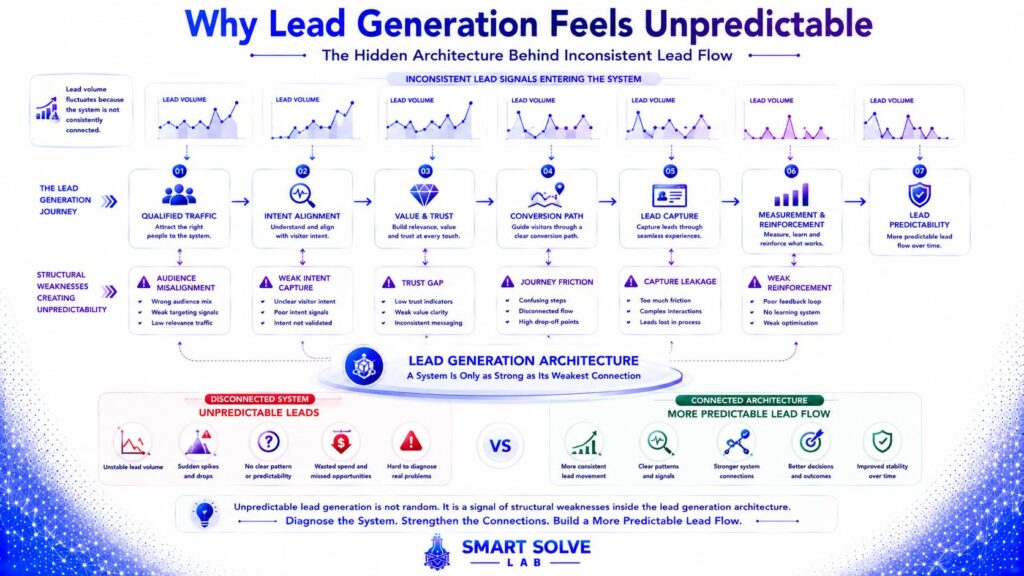
lead generation feels unpredictable,
Some weeks, leads arrive consistently.
Then suddenly, they slow down.
A campaign that generated strong inquiries last month produces almost nothing this month. Website traffic may remain healthy—or even increase—yet the number of qualified leads moves unpredictably.
This often creates an obvious reaction: we need more traffic.
More content is published. More campaigns are launched. More visitors are pushed toward landing pages. Calls to action are changed. Individual pages are adjusted.
Sometimes those changes create a temporary improvement.
But the inconsistency returns.
That is because unpredictable lead generation is often not simply a traffic-volume problem. It can be a structural signal that the stages responsible for turning qualified visitors into leads are not working together consistently.
A visitor does not become a lead because traffic exists alone.
They move through a connected journey:
Traffic Quality → Intent Alignment → Value & Trust → Conversion Path → Lead Capture → Measurement & Reinforcement
Weakness at any point can affect what happens further downstream.
You may attract plenty of visitors, but they may not match the offer. The right visitors may arrive but fail to recognize the next step. Interest may exist without enough trust to support action. A strong prospect may encounter friction before reaching lead capture. Or the business may generate leads successfully through certain pathways without understanding which signals made those pathways work.
The visible symptom appears at the end:
inconsistent leads.
But the structural weakness may have started much earlier.
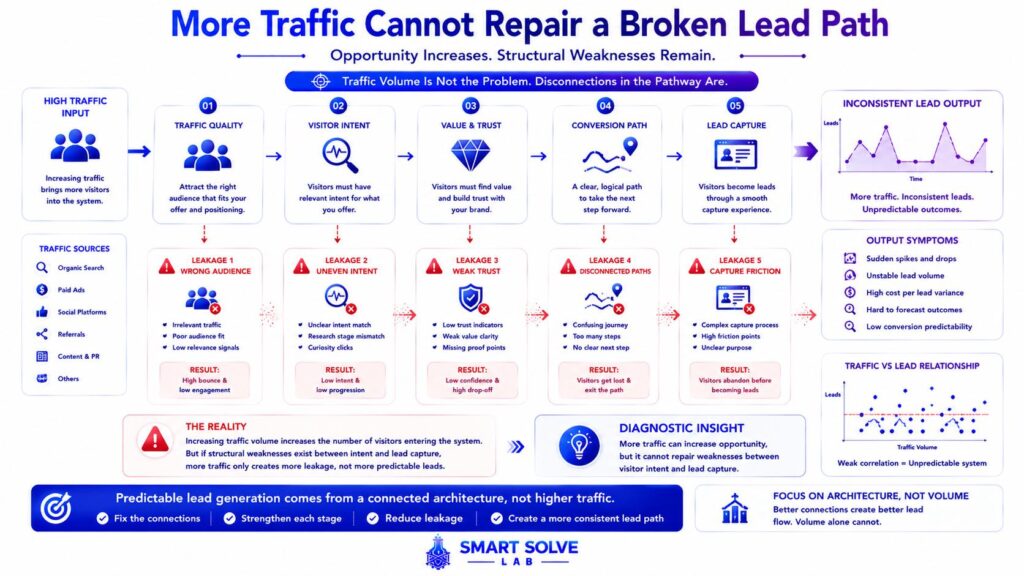
This is why increasing traffic alone rarely creates lead predictability. More visitors can increase opportunity, but they cannot automatically repair disconnected stages between visitor intent and lead capture.
The more useful question, therefore, is not simply:
“How can we generate more leads?”
It is:
“Where is the lead generation architecture losing consistency?”
In this guide, we’ll examine what unpredictable lead generation actually means, the structural breakpoints that create it, why isolated fixes often fail to stabilize performance, and what a connected system needs to create a more repeatable path from qualified interest to lead capture.
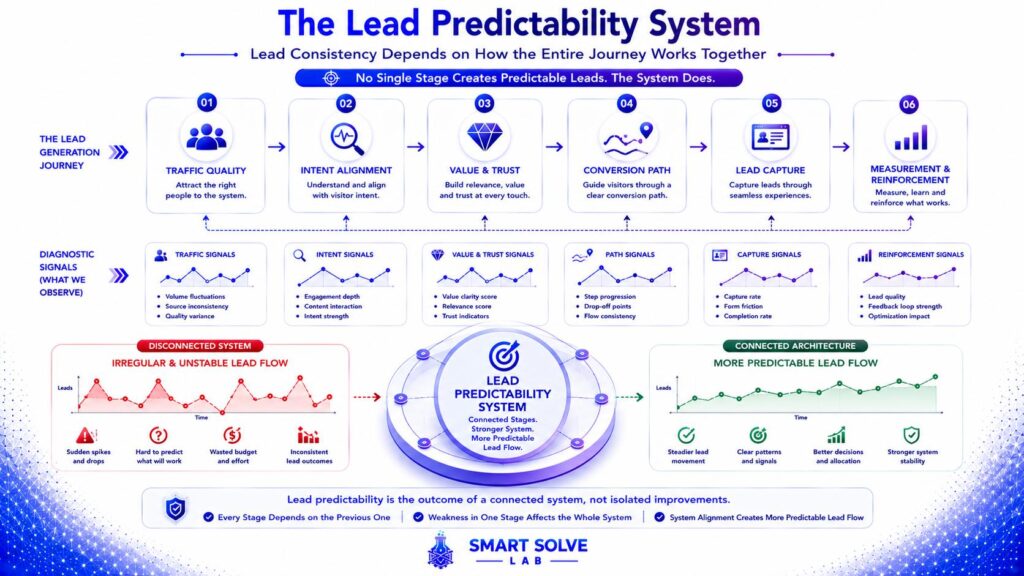
Table of Contents
What Does “Unpredictable Lead Generation” Actually Mean?
Unpredictable lead generation does not simply mean that a business receives fewer leads than it wants.
The deeper problem is inconsistency.
One week may produce several qualified enquiries. The next may produce almost none. A campaign may perform strongly for a short period and then lose momentum. Website traffic may remain relatively healthy while lead volume continues to rise and fall without an obvious explanation.
This makes lead generation difficult to understand, forecast, and improve.
Occasional Leads vs Predictable Lead Flow
Occasional leads prove that a business can generate interest.
They do not necessarily prove that the lead generation system is working consistently.
A business might receive leads because one article ranks well, a campaign temporarily attracts high-intent visitors, a referral sends qualified prospects, or a particular landing path happens to work effectively.
But if those results depend heavily on isolated sources or temporary conditions, lead flow can quickly change when those conditions change.
A stronger system does not mean producing exactly the same number of leads every day.
Normal variation will always exist.
The goal is to create a more repeatable pathway through which qualified visitors can move from initial interest toward meaningful contact.
Why Lead Spikes Create a False Sense of Performance
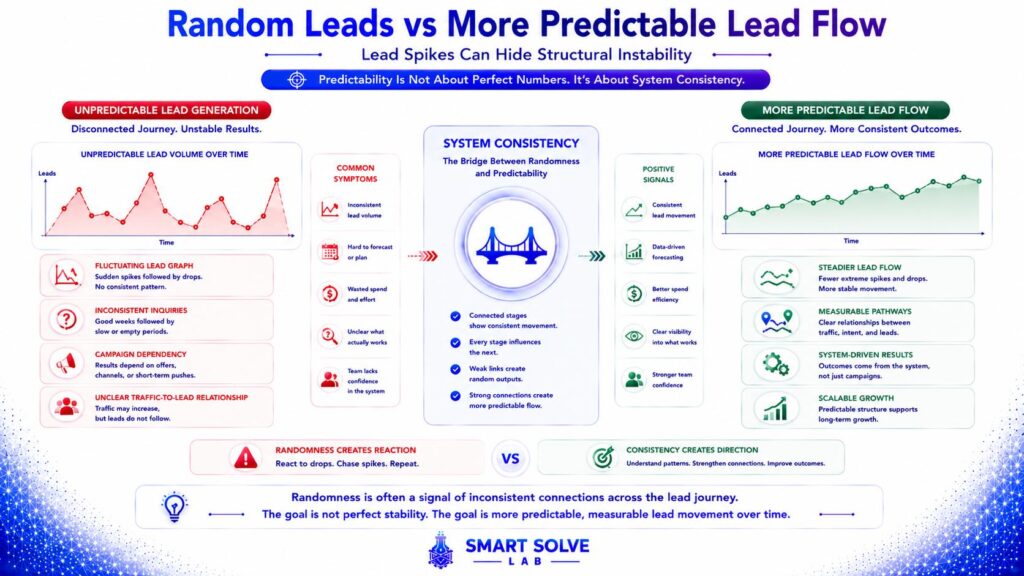
A sudden increase in leads can look like evidence that the entire lead generation strategy is working.
Sometimes it is.
But a spike can also hide structural instability.
For example, one campaign might generate a burst of qualified prospects while other traffic sources produce almost no leads. Overall numbers temporarily improve, but the wider journey remains weak.
When the campaign ends, lead volume falls again.
Looking only at the spike can therefore create the wrong conclusion:
“Lead generation is working—we just need more traffic.”
The more useful question is:
“Which pathway produced these leads, and can the wider system support that pathway consistently?”
That shifts attention from temporary outcomes toward the architecture producing them.
Good Traffic but Inconsistent Inquiries
Traffic and leads represent different stages of the customer journey.
Traffic shows that people are reaching the website.
Lead generation requires something more: the right visitors must recognize relevance, develop sufficient trust, understand the value being offered, and find a clear path toward taking the next step.
This is why a website can maintain healthy visitor numbers while enquiries fluctuate significantly.
If your broader problem is that visitors consistently arrive but rarely become leads, the diagnostic distinction is explored further in website traffic doesn’t become leads:
Why Campaign Performance Changes Without Clear Explanation
Businesses often evaluate lead generation one channel or campaign at a time.
SEO produces leads.
Then paid traffic produces leads.
Then a particular content asset performs well.
Later, those same activities produce different results.
The temptation is to treat every change as an isolated marketing problem.
But campaign performance sits inside a larger system.
The audience entering the website may change. Visitor intent may differ. Trust requirements may be higher. The conversion pathway may not match the new traffic source. Or the business may lack sufficient measurement to understand which combination of signals previously produced qualified leads.
The campaign may be where the change becomes visible without necessarily being where the weakness originated.
The Missing Connection Between Traffic and Lead Volume
A simple model assumes:
More Traffic → More Leads
A system-level model recognizes several stages between them:
Traffic Quality → Intent Alignment → Value & Trust → Conversion Path → Lead Capture → Measurement & Reinforcement → More Predictable Lead Flow
Each connection matters.
If traffic quality weakens, fewer relevant prospects enter.
If intent and the offer become misaligned, relevant visitors may not progress.
If trust is insufficient, interest may never become action.
If the conversion path contains friction, motivated visitors can still disappear.
And if successful pathways are not measured and reinforced, the business may struggle to understand why leads increased—or why they later disappeared.
What Randomness Reveals About the Wider System
Lead variability by itself does not prove that an architecture is broken. Markets, seasonality, demand, competition, and normal customer behavior can all cause fluctuations.
But persistent unexplained unpredictability is a diagnostic signal worth investigating.
Instead of immediately asking how to generate more leads, examine whether the stages already responsible for generating them are connected consistently.
The important distinction is:
Occasional lead generation shows that conversion can happen. More predictable lead generation requires understanding and strengthening the system that makes it happen repeatedly.
That distinction takes us to the next problem: why simply adding more traffic cannot make an inconsistent lead-generation architecture predictable.
Why More Traffic Doesn’t Make Lead Generation Predictable
When lead generation becomes inconsistent, increasing website traffic can feel like the most logical solution.
If 1,000 visitors produce a certain number of leads, bringing in 2,000 visitors should produce more.
That assumption makes sense mathematically, but lead generation does not depend on visitor volume alone. Traffic creates opportunity. Whether that opportunity becomes a qualified lead depends on what happens after the visitor arrives.
A business can therefore increase traffic significantly while continuing to experience the same pattern: strong lead periods followed by unexplained drops.
The reason is simple:
More visitors entering an inconsistent system do not automatically make the system more consistent.
Traffic Quality Changes
Not all traffic carries the same potential to become a lead.
Two traffic sources can send the same number of visitors while producing very different outcomes.
One may attract people actively searching for a solution. Another may attract visitors who are researching a broad topic, comparing possibilities, or simply looking for information.
This means traffic volume can remain stable—or increase—while the proportion of visitors who genuinely match the business’s offer changes.
For lead generation, the more useful question is not only:
“How much traffic are we receiving?”
It is also:
“Are the right potential buyers entering the system?”
If traffic quality fluctuates, lead volume can fluctuate with it.
Visitor Intent Is Uneven
Even relevant visitors do not arrive with identical intentions.
One visitor may be ready to request information.
Another may be comparing providers.
Another may recognize the problem but still be exploring possible solutions.
Another may simply want educational information.
If every visitor is presented with the same pathway regardless of their intent, some potentially valuable prospects may never reach an appropriate next step.
This creates an important distinction:
Relevant traffic is not automatically lead-ready traffic.
A stronger lead-generation architecture must account for the connection between what brought the visitor to the website and what that visitor is prepared to do next.
Conversion Paths Are Inconsistent
The path visitors take after arriving also matters.
Some visitors enter through a service page.
Others discover the business through an educational article, landing page, search result, referral, or campaign.
Those entry points can create very different journeys.
One pathway may make the value proposition and next step immediately clear. Another may leave the visitor moving between pages without a clear direction. A third may create interest but introduce friction before the visitor reaches lead capture.
This means two equally qualified visitors can produce different outcomes simply because they encounter different paths through the system.
When this happens repeatedly, the business may interpret the result as unpredictable demand when part of the unpredictability actually exists within the journey itself.
Lead Capture Depends on Multiple Signals
A lead is rarely produced by one element in isolation.
A CTA can invite action, but the visitor still needs a reason to click it.
A form can capture information, but the visitor still needs sufficient confidence to complete it.
A landing page can present an offer, but that offer still needs to align with the visitor’s intent.
Several signals therefore work together:
Relevance → Value Clarity → Trust → Journey Clarity → Appropriate Next Step → Lead Capture
If one connection weakens, the effect may appear further downstream as fewer leads.
This is why businesses experiencing traffic but no conversions often need to examine what happens between visitor arrival and meaningful action—not simply how many people reach the website.
More Traffic Can Magnify the Existing System
Increasing traffic is valuable when the underlying pathway is capable of handling that opportunity effectively.
But traffic itself does not repair audience misalignment.
It does not create missing trust.
It does not reconnect a fragmented journey.
And it does not explain which lead pathways should be reinforced.
In some cases, increasing traffic can actually make the underlying problem harder to recognize because top-level visitor metrics improve while lead efficiency remains unstable.
The system may look busier without becoming stronger.
More traffic can increase opportunity, but it cannot repair weaknesses between visitor intent and lead capture.
That distinction changes the diagnostic question.
Instead of asking:
“How do we send more people into the funnel?”
A Core-level diagnosis asks:
“Where does the existing lead-generation architecture stop turning qualified opportunity into consistent lead progression?”
Answering that requires looking beyond traffic volume and identifying the structural breakpoints that can occur across the entire lead journey.
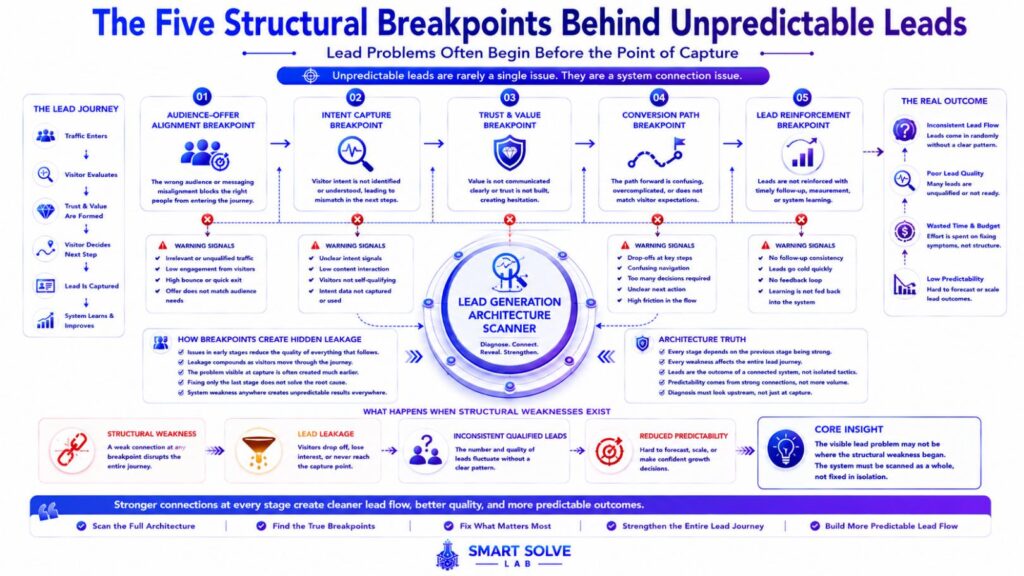
The Five Structural Breakpoints Behind Unpredictable Leads
When lead generation becomes inconsistent, the visible problem usually appears at the end of the journey:
fewer leads.
But the point where the outcome becomes visible is not necessarily where the problem began.
A visitor may fail to submit a form because the conversion path contains friction. But they may also reach that point with weak purchase intent, insufficient trust, or an unclear understanding of the offer.
This is why lead generation needs to be examined as a connected architecture rather than a single conversion event.
The following five structural breakpoints help explain where that architecture can lose consistency.
1. Audience–Offer Alignment Breakpoint
The first breakpoint can occur before a visitor meaningfully engages with the website.
A business may attract substantial traffic while only a portion of those visitors closely match the problem, solution, or offer being presented.
This creates a fundamental question:
Are the right potential buyers entering the system?
High traffic from broadly relevant topics can look promising at the analytics level. But if those visitors have weak commercial relevance to the offer, the system begins with a smaller pool of genuine lead opportunities than the traffic number suggests.
This does not mean every visitor needs immediate buying intent.
It means there should be sufficient alignment between:
Audience Need → Problem Relevance → Offer Fit
When that alignment varies significantly between traffic sources, content, or campaigns, lead generation can vary with it.
2. Intent Capture Breakpoint
Reaching the right audience is only the beginning.
The next challenge is recognizing what that visitor is trying to accomplish.
Some visitors are learning.
Some are evaluating.
Some are comparing alternatives.
Others may already be looking for a provider or a specific solution.
If the website does not connect those different levels of intent with an appropriate next step, valuable interest can exist without becoming measurable lead activity.
This creates the second diagnostic question:
Is meaningful visitor interest being recognized and directed toward an appropriate next step?
The problem here is larger than whether a CTA exists.
A button cannot compensate for a journey that fails to connect visitor intent with a relevant progression path.
3. Trust & Value Breakpoint
Even when the audience and intent are aligned, visitors still need sufficient confidence to move forward.
They need to understand:
What is being offered?
Why is it relevant to their situation?
Why should they trust this business enough to take the next step?
If value remains vague or confidence remains weak, visitors can show meaningful engagement without becoming leads.
This is particularly important in longer or more considered buying journeys, where prospects may need multiple signals before they are comfortable progressing.
The structural issue is therefore not simply:
“Do we have trust signals?”
It is:
“Does the journey provide enough value clarity and confidence at the point where the visitor is being asked to progress?”
4. Conversion Path Breakpoint
An interested visitor can still disappear if the route from interest to action is disconnected.
The visitor may understand the offer and trust the business, yet encounter:
- unclear next steps,
- competing pathways,
- unnecessary friction,
- disconnected page transitions,
- or a lead-capture point that does not match their current level of intent.
This creates a gap between willingness to progress and ability to progress easily.
The conversion path should therefore be viewed as a connection:
Interest → Progression → Appropriate Action → Lead Capture
When that connection varies across pages or entry points, lead outcomes can become inconsistent even when demand itself has not disappeared.
5. Lead Reinforcement Breakpoint
The fifth breakpoint appears after the business has already demonstrated that it can generate leads.
Suppose certain content, traffic sources, journeys, or offers repeatedly contribute to qualified inquiries.
Can the business identify those patterns?
Can it distinguish strong pathways from weak ones?
Can it understand where prospects are progressing or disappearing?
And can those insights be used to strengthen the wider architecture?
Without this reinforcement layer, businesses can experience successful lead periods without clearly understanding why they worked.
When performance later changes, there is little structural knowledge available to explain the difference.
This is why measurement matters at the architecture level—not simply as a collection of top-level metrics. Structured lead-generation approaches increasingly connect audience understanding, buyer journeys, and measurement rather than treating them as isolated activities.
The Breakpoints Are Connected
These five breakpoints should not be diagnosed as five completely separate problems.
A weakness in one stage can influence what appears to be a problem somewhere else.
For example:
Weak Audience Alignment
↓
Lower Intent Quality
↓
Weaker Engagement
↓
Fewer Visitors Progress
↓
Lower Lead Capture
The analytics may show a lead-capture problem.
But changing the form would not necessarily address the original weakness.
That leads to one of the most important diagnostic principles in this architecture:
A lead-generation problem can appear at the point of capture even when the weakness began much earlier in the customer journey.
The goal is therefore not to assume that every breakpoint is broken.
It is to determine which connection is weakening the journey and how that weakness affects the stages around it.
That is what moves lead diagnosis from isolated symptoms toward a system-level understanding.
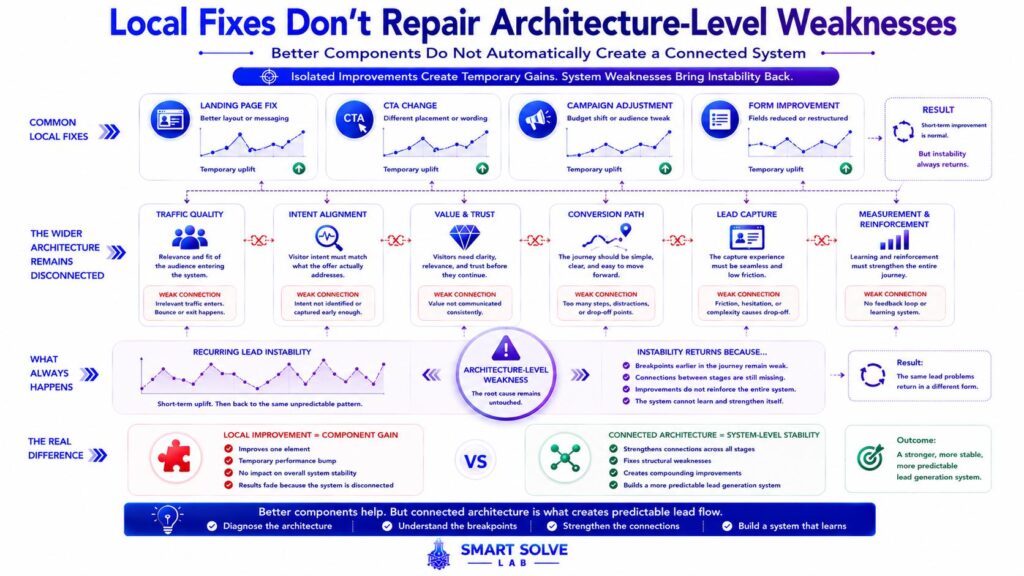
Why Fixing Individual Pages Doesn’t Stabilize Lead Generation
When leads become inconsistent, businesses naturally start looking for the page or element that appears to be underperforming.
The landing page gets redesigned.
The CTA is changed.
A form is shortened.
A campaign is adjusted.
Sometimes these changes genuinely improve performance.
The problem is not that individual optimization is useless. The problem is assuming that improving one component will automatically stabilize the entire lead-generation journey.
If the underlying weakness exists between multiple stages, a local improvement may strengthen one point while leaving the wider architecture disconnected.
Landing Page Fixes Can Improve a Component
A stronger landing page can make an offer easier to understand, improve relevance, or create a clearer path toward action.
That is valuable.
But the landing page still receives visitors from somewhere.
If those visitors have weak intent, poor audience–offer alignment, or insufficient context before reaching the page, improving the page alone may not solve the larger lead problem.
Think of the landing page as one component inside a longer journey:
Traffic Source → Visitor Intent → Landing Experience → Trust → Action → Lead Capture
Improving one component can strengthen that component without repairing weaknesses before or after it.
CTA Changes Can Improve an Interaction
The same principle applies to calls to action.
Changing CTA wording, position, visibility, or presentation may improve an interaction.
But a CTA sits near the end of several earlier decisions.
Before clicking, a visitor normally needs to understand:
- why the offer is relevant,
- what value the next step provides,
- whether the business appears credible,
- and whether taking action feels appropriate for their current intent.
If those conditions are weak, repeatedly changing the CTA can treat the visible symptom rather than the structural cause.
Campaign Changes Can Improve an Entry Point
Campaign optimization can also improve lead generation temporarily.
A stronger campaign may attract a better audience or generate more qualified visits.
But once those visitors enter the website, they still depend on the rest of the architecture.
If the journey after arrival is inconsistent, better acquisition can increase the number of opportunities entering the system without ensuring that those opportunities progress successfully.
This creates an important distinction:
Campaign performance determines how opportunity enters the system.
Lead-generation architecture determines what happens to that opportunity across the wider journey.
Why Local Improvements Don’t Automatically Repair Cross-Stage Weaknesses
Imagine that each individual component performs reasonably well:
The content attracts visitors.
The landing page explains the offer.
The CTA is visible.
The form works correctly.
Yet leads remain inconsistent.
The weakness may exist between those components rather than inside any single one.
For example:
Content creates one expectation
↓
Landing page presents another
↓
Visitor intent weakens
↓
CTA asks for too much commitment
↓
Lead capture falls
Each component can appear functional when examined separately.
The connection between them is what breaks.
This is why Core-level diagnosis asks not only:
“Which component is weak?”
but also:
“Which connection between components is weak?”
How Lead Problems Move Across the Journey
One structural weakness can create symptoms elsewhere.
Weak audience alignment may later look like poor landing-page performance.
Insufficient trust may look like a CTA problem.
An unclear progression path may look like a form-abandonment problem.
Poor measurement may make a successful pathway appear random because the business cannot identify what contributed to the result.
This makes lead-generation diagnosis difficult when every symptom is treated independently.
The place where performance drops is not always the place where the underlying weakness originated.
Why Repeated Fixes Can Create Temporary Improvements Without Predictability
This explains why some businesses enter a repeating optimization cycle:
Lead volume falls
↓
Fix a landing page
↓
Performance improves
↓
Leads decline again
↓
Change the CTA
↓
Performance shifts
↓
Another problem appears
↓
Launch or adjust another campaign
Individual improvements may be completely legitimate.
But if the same pattern keeps returning, the business needs to examine whether those individual components belong to a wider structural problem.
This connects directly with the broader issue of conversion problems keep repeating—where repeatedly repairing individual pages can leave the underlying system weakness unresolved.
Internal Link — Anchor Text: conversion problems keep repeating
URL:
The Shift From Component Optimization to Architecture Diagnosis
The solution is not to stop improving individual pages, CTAs, forms, or campaigns.
It is to understand where those components sit within the complete lead journey.
A system-level view asks:
What brings qualified visitors in?
↓
How is their intent aligned?
↓
Where is value and trust established?
↓
How do they progress toward action?
↓
Where is the lead captured?
↓
How does measurement reveal what should be reinforced?
Once those connections become visible, individual improvements can be prioritized according to the role they play in the wider architecture.
A better component can improve one interaction. A stronger architecture improves how the components work together.
That is the transition from repeatedly reacting to lead-generation symptoms toward understanding the system responsible for producing them.
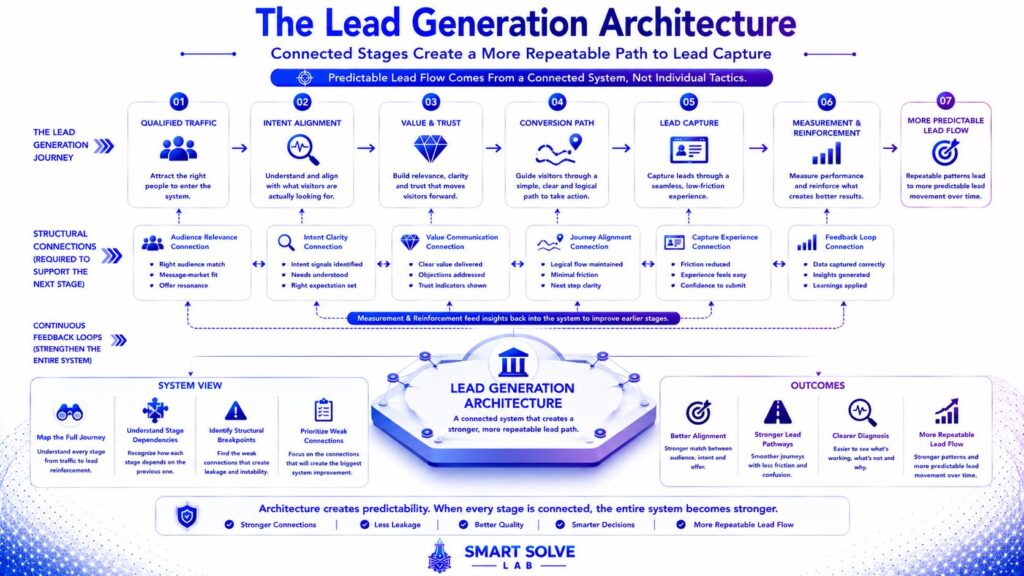
What a More Predictable Lead Generation System Actually Needs
If unpredictable leads are created by weaknesses across multiple stages, the solution cannot be reduced to one landing page, one campaign, or one conversion tactic.
The business needs a connected pathway that helps the right visitors move from initial interest toward lead capture—and a measurement layer that reveals where that pathway is strengthening or weakening.
At a system level, that journey looks like this:
Qualified Traffic
↓
Intent Alignment
↓
Value & Trust
↓
Conversion Path
↓
Lead Capture
↓
Measurement & Reinforcement
↓
More Predictable Lead Flow
Each stage has a different responsibility, but its effectiveness also depends on how well it connects with the stages around it.
Qualified Traffic Creates the Right Opportunity
The system begins with traffic, but not simply with traffic volume.
A lead-generation architecture needs enough of the right potential buyers entering the journey.
That means there should be reasonable alignment between the audience being attracted and the problem, solution, or offer the business provides.
Qualified traffic does not guarantee a lead.
It creates a stronger opportunity for the rest of the architecture to work.
This distinction matters because increasing visitor numbers without considering audience relevance can make top-level metrics look healthier while lead consistency remains weak.
Intent Alignment Connects Interest With the Right Next Step
Once a relevant visitor arrives, the system needs to account for what that person is trying to accomplish.
A visitor researching a problem may need a different progression path from someone actively evaluating a solution.
Intent alignment helps connect:
Why the visitor arrived → What they need now → What appropriate next step exists
Without that connection, even relevant visitors can become disconnected from the journey.
The objective is not to force every visitor toward immediate lead capture.
It is to create a logical progression between their current intent and the next meaningful action.
Value & Trust Support Progression
Interest alone does not create sufficient confidence to act.
As visitors move through the journey, they need to understand both the value of progressing and whether the business is credible enough to justify that progression.
Value and trust therefore act as a bridge between interest and action.
When this bridge is weak, a visitor may:
read,
engage,
explore,
and even return—
without becoming a lead.
A stronger architecture ensures that value clarity and confidence develop alongside the visitor journey rather than appearing only at the final conversion point.
The Conversion Path Connects Interest to Action
Once a visitor has sufficient relevance, intent, value understanding, and trust, there still needs to be a clear route toward action.
That route may involve several interactions.
What matters at the architecture level is whether those interactions form a coherent progression.
The path should answer:
Where does the visitor go next?
Does that next step make sense for their current intent?
Can they progress without unnecessary friction or confusion?
A conversion path is therefore more than an individual page.
It is the connection between the stages that move a qualified prospect toward lead capture.
Lead Capture Turns Progression Into a Measurable Opportunity
Lead capture is where visitor progression becomes identifiable to the business.
This may be the most visible stage of lead generation, but it should not be mistaken for the entire system.
A weak lead result does not automatically mean the capture mechanism itself is the problem.
The visitor reaching that point carries the effects of everything that happened earlier:
Traffic Quality + Intent Alignment + Value + Trust + Journey Experience
That is why lead capture should be evaluated in context rather than diagnosed in isolation.
Measurement & Reinforcement Create System Learning
Generating leads is only one part of building a more repeatable system.
The business also needs to understand what happened across the journey.
Which pathways contribute to lead generation?
Where do prospects stop progressing?
Which entry points produce stronger lead opportunities?
Where does performance change?
Which successful pathways deserve closer attention?
Measurement turns individual outcomes into information that can support better diagnosis.
This does not mean that analytics can explain every reason behind customer behavior. It means the business gains evidence about where progression occurs and where investigation may be needed.
Google Analytics, for example, supports lead-generation measurement through recommended lead events and funnel/path exploration. Its documentation specifically describes measuring stages such as visits, form interactions and submissions, and using funnel exploration to investigate drop-off across the lead-generation process.
This measurement layer creates the foundation for reinforcement: identifying useful patterns, investigating weak connections, and making better-informed decisions about where the architecture needs attention.
Predictability Comes From Connections, Not Perfection
A connected lead-generation architecture does not guarantee identical lead numbers every week.
Customer demand changes.
Markets change.
Traffic sources fluctuate.
Buying cycles differ.
External conditions can affect results.
So the objective is not perfect predictability.
The objective is to reduce avoidable structural inconsistency by making the path from qualified interest to lead capture easier to understand, diagnose, and strengthen.
That is why the final stage should be described as:
More Predictable Lead Flow
—not guaranteed predictable lead flow.
Lead consistency becomes stronger when qualified traffic, intent, trust, conversion pathways, lead capture, and measurement operate as connected stages rather than isolated marketing activities.
Once these stages are viewed together, an important conclusion emerges:
The problem is no longer simply about generating more leads.
It is about the architecture responsible for producing them.
The System Insight: Lead Generation Is an Architecture Problem
When lead generation is viewed one tactic at a time, every decline can appear to have a different cause.
Traffic falls, so the business focuses on acquisition.
Visitors arrive but do not act, so attention moves to the landing page.
Engagement improves but inquiries remain weak, so the CTA becomes the next target.
Each response may address a genuine issue. But this fragmented view can hide a more important reality:
Lead generation is not created by any one of these components independently.
It emerges from the way multiple stages work together.
Traffic Alone Is Not a Lead System
Traffic creates access to potential buyers.
It does not determine whether those visitors are sufficiently aligned with the offer, understand its value, trust the business, or encounter an appropriate path toward action.
That is why:
Traffic ≠ Lead System
A website can attract significant traffic and still struggle to create consistent qualified inquiries if the stages after acquisition are weak or disconnected.
A Landing Page Alone Is Not a Lead System
A landing page can clarify an offer and support progression.
But its performance is influenced by what happens before the visitor arrives.
What did the visitor expect?
What problem were they trying to solve?
How strong was their intent?
Does the page continue the journey that brought them there?
The page operates inside a wider architecture.
Landing Page ≠ Lead System
A CTA Alone Is Not a Lead System
A CTA provides a direction for action.
But the visitor must first have enough reason to take that action.
If relevance is weak, value is unclear, trust is insufficient, or the requested next step does not match visitor intent, the CTA is being asked to solve a problem that began earlier.
CTA ≠ Lead System
Content Alone Is Not a Lead System
Content can attract attention, demonstrate expertise, answer questions, and create demand.
But content becomes part of lead generation only when it connects logically with the wider visitor journey.
A visitor may consume valuable content without ever understanding:
What should I do next?
How does this business help with my problem?
Which next step is appropriate for me?
Content can therefore perform well as content while remaining weakly connected to lead progression.
Content ≠ Lead System
A Campaign Alone Is Not a Lead System
Campaigns can create concentrated demand and bring qualified prospects into the business.
But campaign success still depends on what happens after those prospects arrive.
If the campaign promise, website experience, trust signals, progression path, and lead-capture opportunity do not support one another, acquisition strength can be lost downstream.
Campaign ≠ Lead System
The Architecture Exists Between the Components
This is the key shift from tactical optimization to system-level diagnosis.
Instead of looking only at the individual components:
Traffic
Content
Landing Pages
CTAs
Lead Capture
Measurement
look at the connections between them.
Does qualified traffic reach a journey aligned with its intent?
Does that journey establish sufficient value and trust?
Does interest have a logical path toward action?
Does lead capture match the stage of the visitor?
Can measurement reveal which pathways are working and which connections need investigation?
Those relationships form the lead generation architecture.
A weakness inside a component matters.
But a weakness between components can be equally important—and much easier to overlook when marketing activities are evaluated separately.
Architecture Changes the Diagnostic Question
A tactical question asks:
“Which page should we fix?”
An architecture question asks:
“Where does progression become inconsistent across the journey?”
A tactical question asks:
“Which CTA should we change?”
An architecture question asks:
“Does the requested action match the visitor’s intent and the journey that preceded it?”
A tactical question asks:
“How do we get more traffic?”
An architecture question asks:
“Can the existing system consistently convert qualified opportunity into meaningful lead progression?”
This does not make tactical improvements unimportant.
It gives those improvements context.
Instead of optimizing whatever symptom is most visible, the business can begin identifying which connection has the greatest structural importance.
Lead generation becomes more predictable when the stages responsible for attracting, aligning, persuading, capturing, and reinforcing qualified demand operate as a connected architecture.
That is the central system insight behind this entire diagnosis.
The goal is not to eliminate every normal fluctuation in lead volume.
It is to create a system where the journey from qualified interest to lead capture is sufficiently connected that weaknesses can be identified, priorities can be understood, and successful pathways can be strengthened more deliberately.
That brings us to the final shift:
from reacting to random lead outcomes to mapping the architecture responsible for producing them.
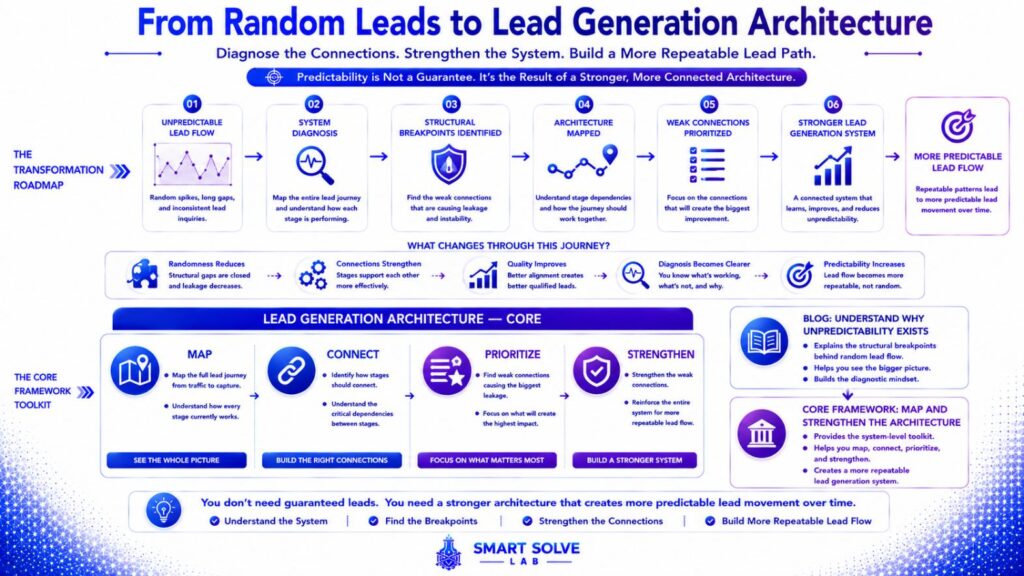
From Random Leads to a Repeatable Lead Generation Architecture
Once lead generation is understood as an architecture problem, the objective changes.
Instead of constantly reacting to whichever metric, page, or campaign appears weak, the business can begin examining the complete path that turns qualified interest into a lead.
That does not mean every stage needs to be rebuilt.
It means the stages need to be visible enough to understand:
where opportunity enters,
where progression weakens,
which connections matter most,
and where improvement should be prioritized.
This is the difference between repeatedly fixing lead-generation symptoms and strengthening the architecture responsible for producing them.
Start by Mapping the Complete Lead Journey
The first step is seeing the journey as one connected system:
Qualified Traffic
↓
Intent Alignment
↓
Value & Trust
↓
Conversion Path
↓
Lead Capture
↓
Measurement & Reinforcement
When these stages are evaluated separately, important dependencies can remain hidden.
For example, weak lead capture may initially look like a form problem.
But mapping the complete journey may reveal that visitors arriving at the form were never sufficiently aligned with the offer—or that trust weakened before they reached it.
Architecture mapping provides context.
It helps distinguish where a symptom appears from where the weakness may have originated.
Connect the Stages Instead of Optimizing Them in Isolation
Once the journey is visible, the next question becomes:
Does each stage prepare the visitor for the stage that follows?
Qualified traffic should connect with relevant intent.
Intent should connect with a clear value proposition.
Value and trust should support progression.
The conversion path should make that progression possible.
Lead capture should represent an appropriate next step.
Measurement should reveal what happens across those connections.
This creates a more useful diagnostic model:
Stage Performance + Connection Quality = System Understanding
A strong individual component cannot fully compensate for a weak connection surrounding it.
That is why architecture-level thinking focuses on both.
Identify the Structural Breakpoints
The objective is not to assume that every part of the system is failing.
Instead, identify where progression becomes inconsistent.
That could involve:
Audience–Offer Alignment
Intent Capture
Trust & Value
Conversion Path
Lead Reinforcement
Different businesses may experience different combinations of weaknesses.
The important point is that diagnosis should precede major intervention.
Without diagnosis, teams can spend time improving components that are not responsible for the most important constraint.
Prioritize the Weak Connections
Finding several weaknesses does not mean every weakness deserves equal attention at the same time.
One structural problem may influence several downstream outcomes.
For example:
Audience Misalignment
↓
Weak Intent
↓
Low Engagement
↓
Poor Progression
↓
Weak Lead Capture
In this situation, concentrating first on the final capture point could leave the upstream constraint untouched.
Architecture-level prioritization asks:
Which weak connection has the greatest influence on the journey around it?
That creates a more deliberate basis for deciding what deserves attention first.
Strengthen the Architecture, Not Just the Symptom
This is where the role of a Core framework becomes different from a diagnostic blog.
This article can help identify why lead generation feels unpredictable and explain the structural relationships behind that unpredictability.
But understanding the problem and systematically working through the architecture are different jobs.
The Lead Generation Architecture — Core is designed around that second job.
Its role is to provide a system-level framework for understanding how:
Qualified Traffic → Visitor Intent → Value & Trust → Conversion Path → Lead Capture → Reinforcement
work together—and where structural weaknesses may be limiting lead consistency.
The progression is:
Map → Connect → Prioritize → Strengthen
Not:
Apply random tactic → Wait → React → Apply another tactic
That distinction protects the business from treating every lead fluctuation as an isolated marketing failure.
What the Architecture Can—and Cannot—Do
A stronger architecture does not promise a fixed number of leads.
It cannot eliminate changes in demand, market conditions, competition, seasonality, buyer behavior, or other factors outside the system.
Its value is different.
It creates a clearer structure for understanding the factors the business can examine and improve.
That can make lead generation easier to diagnose, weaknesses easier to prioritize, and successful pathways easier to understand.
The outcome we are working toward is therefore not perfect predictability.
It is a more repeatable and understandable lead-generation system.
The goal is not to control every fluctuation in lead volume. It is to build an architecture strong enough to understand where qualified opportunities progress, where they break, and what deserves attention next.
That is the shift from random lead-generation activity toward a connected Lead Generation Architecture.
Conclusion — Predictable Leads Start With a Stronger System
When lead generation feels unpredictable, the natural response is often to increase activity.
More traffic.
More campaigns.
More content.
More CTAs.
More page-level optimization.
Each of these can have value. But none of them, by itself, creates a connected lead-generation system.
If qualified visitors enter the website but their intent is poorly aligned, increasing traffic will not repair that connection.
If visitors understand the offer but do not develop enough trust to progress, another campaign will not necessarily solve the problem.
If prospects are interested but encounter a disconnected conversion path, changing one CTA may improve an interaction without strengthening the wider journey.
And if successful lead pathways are never properly measured and understood, periods of strong performance can continue to feel difficult to explain or repeat.
That is why unpredictable lead generation needs to be examined beyond individual tactics.
The more useful system view is:
Qualified Traffic
↓
Intent Alignment
↓
Value & Trust
↓
Conversion Path
↓
Lead Capture
↓
Measurement & Reinforcement
↓
More Predictable Lead Flow
The strength of this architecture does not depend on every stage performing perfectly.
It depends on understanding how those stages connect—and identifying where those connections become weak.
From Lead Symptoms to System Clarity
Throughout this guide, one principle has remained consistent:
The place where a lead-generation problem becomes visible may not be where the problem began.
Low lead capture could originate in audience alignment.
Weak CTA response could reflect insufficient trust.
Landing-page underperformance could begin with mismatched visitor intent.
Campaign inconsistency could expose a weakness further downstream in the customer journey.
This is why diagnosis matters before optimization.
Instead of immediately asking:
“What should we change?”
the stronger question is:
“Where is the architecture losing qualified progression?”
That question creates the clarity needed to decide what deserves attention.
More Activity Is Not the Same as a Stronger System
Generating more opportunities can support growth.
But adding more activity to a disconnected architecture can also create more complexity without revealing the underlying constraint.
The objective is therefore not simply:
More Traffic → More Leads
It is to strengthen the path between them:
Diagnose the Architecture → Identify Weak Connections → Prioritize Structural Breakpoints → Strengthen the System
This creates a more deliberate approach to lead generation—one based on understanding how the system works rather than repeatedly reacting to individual symptoms.
Build a More Repeatable Path to Lead Capture
No framework can guarantee a perfectly stable number of leads.
Demand changes. Buyer behavior changes. Markets and competitive conditions change.
But a business can improve the architecture within its control.
It can understand where qualified opportunities enter.
It can examine whether intent and value remain aligned.
It can identify where trust or progression weakens.
It can evaluate how lead capture connects with the journey before it.
And it can use measurement to understand which pathways deserve reinforcement.
That is the foundation of a stronger Lead Generation Architecture.
Diagnose the architecture. Identify the weak connections. Strengthen the system. Build a more repeatable path from qualified interest to lead capture.
The goal is not simply to generate another temporary spike in leads.
It is to understand—and strengthen—the system responsible for producing them.
Recommended Reading
If you want to continue diagnosing the wider journey between website traffic, visitor behavior, and lead generation, these related Smart Solve Lab guides explore the closest connected problems.
Why Your Website Traffic Doesn’t Become Leads (Even When Visitors Keep Coming)
Explore why website visitors can continue arriving without turning into meaningful lead opportunities.
Why Your Website Gets Traffic But No Conversions (Even When Visitors Keep Coming)
Understand the hidden conversion gaps that can prevent traffic from progressing toward meaningful business actions.
Why Conversion Problems Keep Repeating (Even After Fixing Individual Pages)
Learn why isolated page-level fixes may create temporary improvements while wider system weaknesses remain unresolved.
Frequently Asked Questions
Why does lead generation feel so unpredictable?
Lead generation can feel unpredictable when the stages between attracting qualified visitors and capturing leads do not work together consistently. Changes in traffic quality, visitor intent, trust, conversion pathways, or measurement can all affect lead flow. External factors such as demand and seasonality can also create normal fluctuations.
Will getting more website traffic generate more leads?
More traffic can create more opportunities, but it does not automatically create more qualified leads. If visitors are poorly aligned with the offer or weaknesses exist between intent, trust, progression, and lead capture, increasing traffic may simply send more people into the same weak system.
What are the main causes of inconsistent lead generation?
Common structural causes include audience–offer misalignment, weak intent capture, insufficient value or trust, disconnected conversion paths, and weak measurement or reinforcement. The visible lead problem may appear near lead capture even when the underlying weakness began earlier in the journey.
Why do my leads fluctuate even when website traffic stays consistent?
Similar traffic volume does not necessarily mean similar traffic quality or visitor intent. The sources, needs, expectations, and readiness of visitors can change. Differences in how those visitors move through the website can also affect the number of qualified leads generated.
Why don’t landing page or CTA fixes stabilize my leads?
Landing pages and CTAs are individual components of a wider lead journey. Improving them can produce meaningful gains, but those improvements may not resolve weaknesses in audience alignment, trust, intent, conversion pathways, or other connected stages.
What is a Lead Generation Architecture?
A Lead Generation Architecture is a system-level way of examining how qualified traffic, intent alignment, value and trust, conversion pathways, lead capture, measurement, and reinforcement work together. It helps businesses understand the connections responsible for moving qualified interest toward lead capture
Can a lead generation system make leads completely predictable?
No. Lead volume is also affected by factors such as market demand, seasonality, competition, buyer behavior, and other external conditions. The goal of a stronger architecture is not guaranteed lead numbers; it is to create a more understandable and repeatable pathway from qualified interest to lead capture
What should I diagnose first when lead generation becomes inconsistent?
Start by examining the complete journey rather than immediately changing the final conversion point. Determine whether the right audience is entering, whether visitor intent aligns with the offer, whether sufficient value and trust develop, whether the conversion path is clear, and whether measurement can reveal where progression weakens.
Leave a Reply