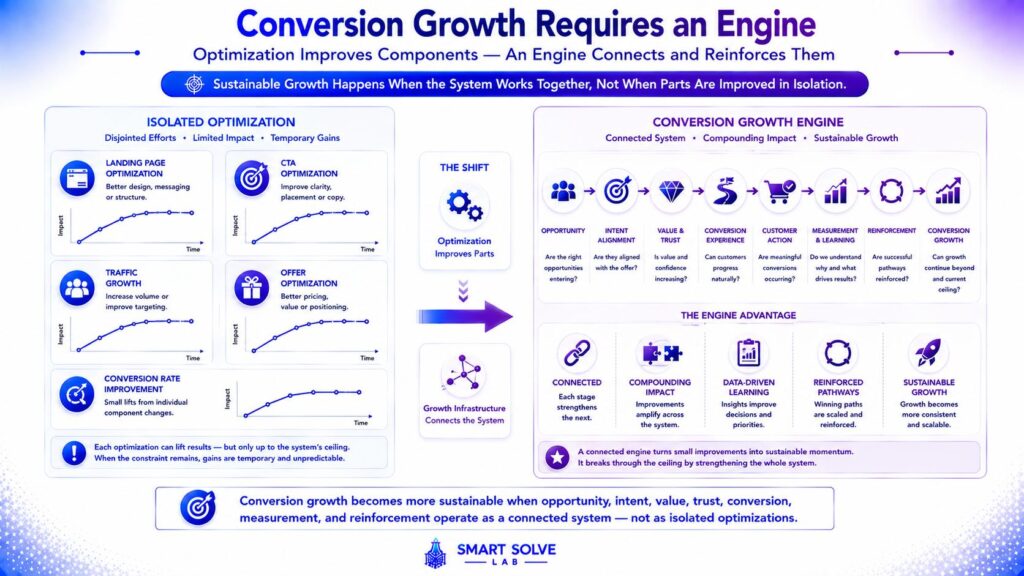
• Conversion System: How to Build a Connected System That Turns Customer Interest Into Growth

    Connected conversion system showing customer interest through conversion and learning
    From individual conversion points to one connected system.

    Why Conversion Problems Rarely Exist in Isolation

    A conversion problem may appear in one place while the conditions influencing it exist across the wider customer journey.

    A page may receive enough traffic but fail to generate action. Leads may arrive but remain inconsistent. Customers may enter the buying journey and disappear before completing the intended action. Conversion improvements may produce short-term gains, only for performance to stall again later.

    These situations are often treated as separate problems. One page gets optimized. A funnel step gets adjusted. A call to action gets changed. More traffic is pursued. Another conversion point is tested.

    But when related problems keep appearing, the deeper issue may not be the individual component being optimized. The problem may exist in the connections between the components that make conversion possible.

    This is why fixing one conversion point does not always fix the wider system. A local improvement can strengthen one part of the journey while leaving another structural weakness unresolved. In some cases, improving one stage simply exposes a weakness further upstream or downstream.

    A conversion system looks beyond individual pages, buttons, forms, or funnel stages. It considers how customer interest, intent, value, trust, progression, action, measurement, and learning work together to move someone from initial interest toward a meaningful outcome.

    The central idea is simple:

    Conversion performance is not created by one page, one funnel stage, or one optimization. It emerges from the connected system through which customer intent, value, trust, progression, action, and learning work together.

    Understanding that system changes the question from “Which conversion element should we fix?” to “How are the different parts of the conversion journey influencing one another?”

    This pillar explores that wider perspective. It will help you understand what a conversion system is, why conversion problems repeat, how lead generation and customer progression connect with conversion, why isolated optimization eventually reaches limits, and how individual conversion problems can be understood as part of a larger connected system.
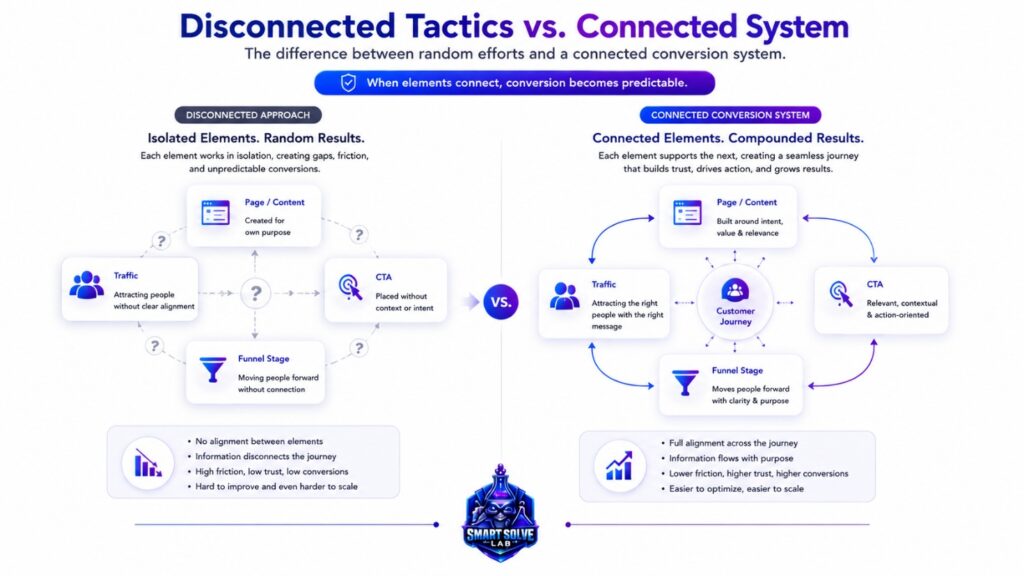
    Comparison of isolated conversion components and a connected conversion system

    Table of Contents

    Why Conversion Problems Rarely Exist in Isolation

    Conversion problems rarely stay confined to the exact place where they become visible.

    A business may notice that a landing page is not producing enough action, a lead form is receiving fewer submissions, or customers are leaving before completing a purchase. Because the problem appears at a specific point, it is natural to focus attention on that point first.

    But the visible conversion problem may only be the symptom of a wider weakness somewhere in the connected customer journey.

    For example, a weak conversion point may be influenced by what happened before the customer reached it. The visitor may not have arrived with the right intent. The value may not have been clear enough. Trust may not have developed sufficiently. The next step may not feel natural. Or an earlier stage may have weakened the customer’s motivation to continue.

    This means the location where conversion performance becomes visible is not always the location where the underlying weakness began.

    That distinction matters because businesses can spend significant time improving individual conversion points while the relationships between those points remain weak. A page may improve, a campaign may perform better, or a funnel step may produce a temporary gain, yet another weakness can appear further along the journey.

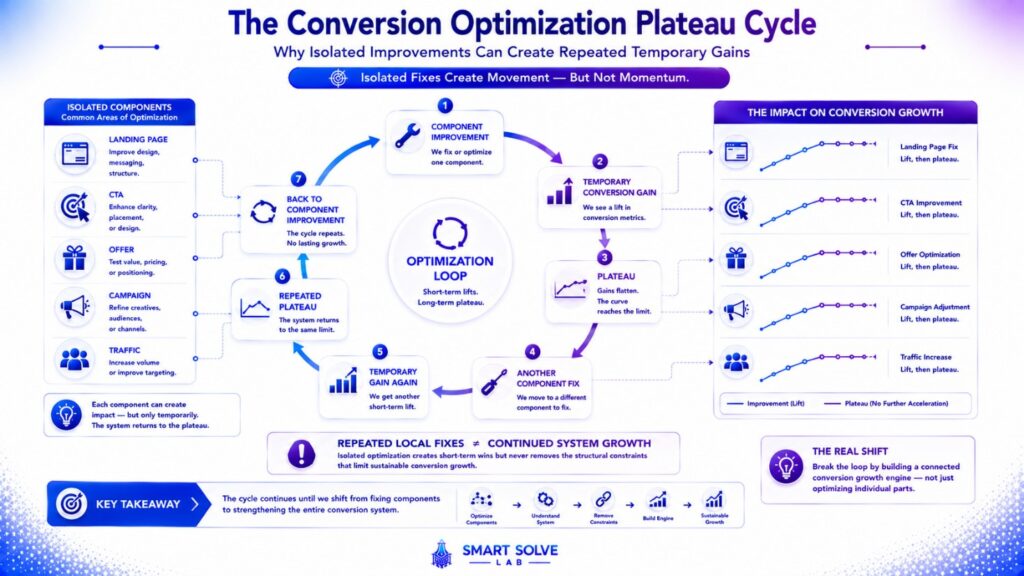
    The result can become a repeating cycle:

    Visible Problem → Local Fix → Temporary Improvement → Another Weakness → New Conversion Problem

    The deeper question, therefore, is not simply whether an individual conversion component is working. It is whether the connected conditions around that component are strong enough to support customer progression.

    This is where system thinking becomes important. Instead of examining conversion as a collection of independent points, a conversion system looks at how the important parts interact and influence one another.

    Once those relationships become visible, individual conversion problems can be understood in a wider context rather than treated as isolated failures.

    What Is a Conversion System?

    A conversion system is the connected set of conditions, stages, and relationships that help move a potential customer from initial interest toward meaningful action.

    Conversion is therefore more than a button, landing page, form, or individual funnel stage. Each component may influence what happens before it, what happens after it, and whether the customer has enough clarity and confidence to continue.

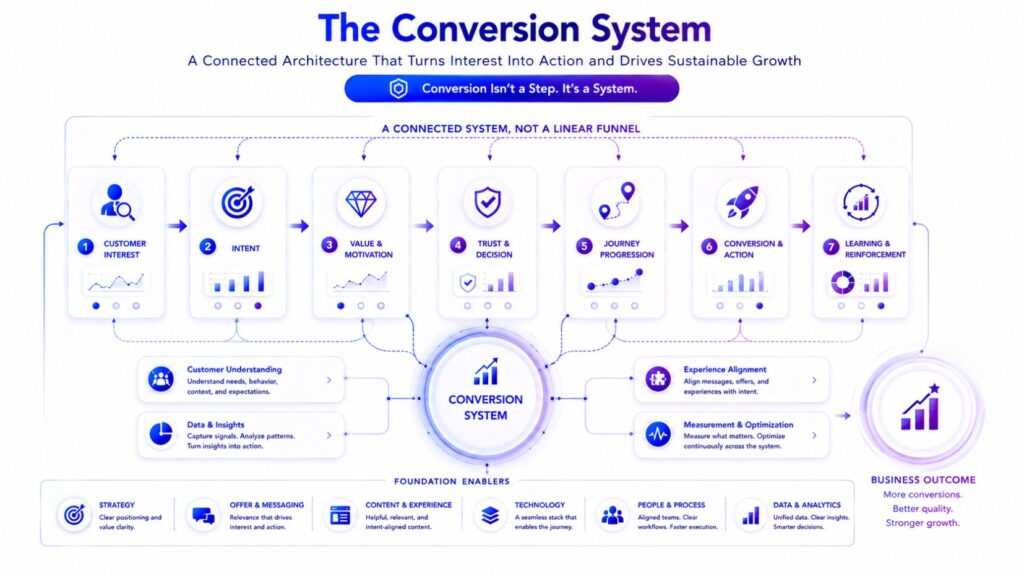
    A connected conversion journey can be understood at a high level as:

    Customer Interest → Intent → Value & Motivation → Trust & Decision → Journey Progression → Action → Learning & Reinforcement

    The important point is not to treat these stages as separate checklists. Their relationships matter.

    Customer intent influences how value is perceived. Value and motivation influence whether someone wants to continue. Trust affects decision confidence. Journey progression determines whether the next step feels coherent. The resulting actions then create evidence that can be measured and learned from.

    This is the difference between looking at conversion components and looking at a conversion system.

    A collection of individually functional components does not automatically create a strong conversion system. If the connections between those components are weak, customers can still experience confusion, hesitation, friction, or a lack of confidence.

    System thinking therefore asks a broader question:

    How effectively do the important parts of the customer journey connect to support progression from interest to action?

    Once conversion is viewed this way, a weak conversion point becomes more than an isolated metric or page-level issue. It becomes evidence that should be understood within the wider system surrounding it.

    Why Conversion Problems Keep Repeating

    When the same or related conversion problems continue appearing across different pages, campaigns, or stages of the customer journey, repeatedly fixing individual symptoms may not be enough.

    A common pattern looks like this:

    Symptom → Local Fix → Temporary Improvement → Hidden Structural Weakness → New Symptom → Repeat

    The local fix may genuinely improve the point being addressed. The problem is that the wider system can still contain weaknesses that influence other stages of the journey.

    For example, improving one conversion page may increase action at that point while an upstream weakness in intent alignment remains unresolved. Similarly, improving lead capture may not solve inconsistent lead quality if the earlier stages are attracting poorly aligned opportunities.

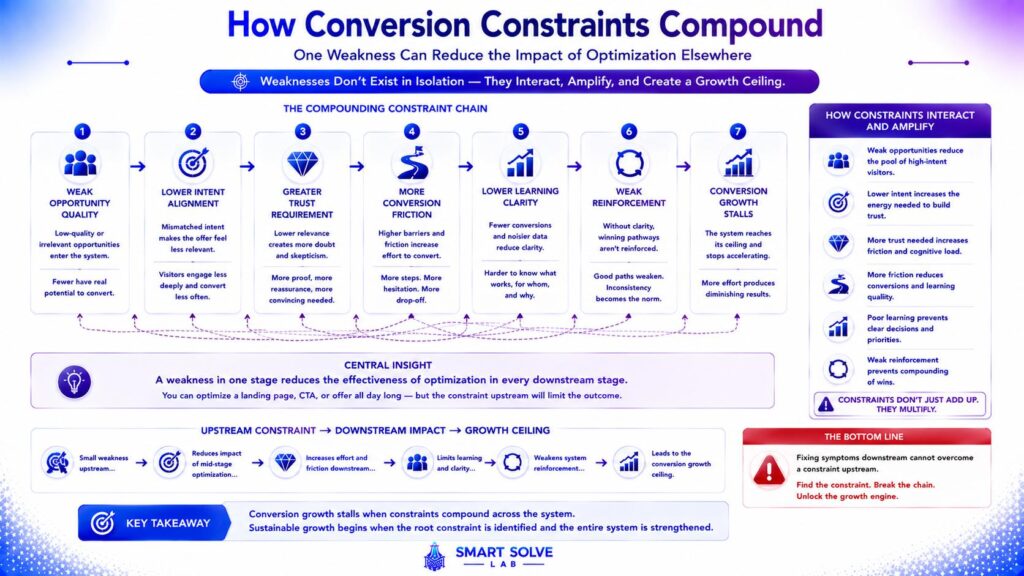
    These relationships create structural dependencies across the conversion journey. One stage can influence another, which means the visible symptom is not always the root problem.

    That is why recurring conversion problems deserve a wider question: what connects the problems that keep appearing?

    Understanding those connections can reveal whether several apparently separate symptoms are actually different expressions of the same underlying weakness.

    For a deeper look at this specific problem, see why conversion problems keep repeating even after fixing individual pages.

    Recurring conversion problems are often system failures disguised as isolated symptoms.

    The Core Layers of a Conversion System

    A connected conversion system can be understood through several core layers. These layers should not be treated as six independent checklists. Their real importance comes from how they interact to support customer progression.

    1. Customer Intent

    Conversion begins with understanding whether the people entering the journey have a meaningful reason to continue. Customer intent influences what they expect, what they are looking for, and how ready they are to take the next step.

    If intent is poorly aligned with the journey, later conversion stages may struggle even when the individual components appear functional.

    2. Value & Motivation

    Interest alone does not guarantee progression. Customers need enough perceived value and motivation to believe that continuing the journey is worthwhile.

    This layer connects what the customer wants with what the business is offering and how clearly that value is communicated.

    3. Trust & Decision

    Before meaningful action, customers often need sufficient confidence in the business, offer, and next step. Trust therefore plays an important role in whether interest develops into decision readiness.

    A weakness in trust can interrupt progression even when intent and value are relatively strong.

    4. Customer Journey

    The journey connects the different stages through which a customer progresses. Each transition should make sense in relation to what came before and what the customer is expected to do next.

    When those transitions become unclear or disconnected, friction can appear across the journey rather than at only one visible conversion point.

    5. Conversion & Action

    This is where customer progression becomes a measurable action, such as submitting a lead form, requesting information, starting a purchase, or completing another intended conversion.

    However, the action itself should not be viewed in isolation. Its performance is influenced by the conditions established across the earlier layers.

    6. Learning & Reinforcement

    A conversion system also needs to learn from what happens. Measurement can provide evidence about which pathways are performing differently, where weaknesses may exist, and what deserves further attention.

    Learning then becomes useful when stronger pathways and useful improvements are reinforced rather than treated as isolated wins.

    Together, these layers form a connected system:

    Customer Intent → Value & Motivation → Trust & Decision → Customer Journey → Conversion & Action → Learning & Reinforcement

    The strength of the system depends not simply on whether each layer exists, but on whether the connections between them support consistent customer progression.
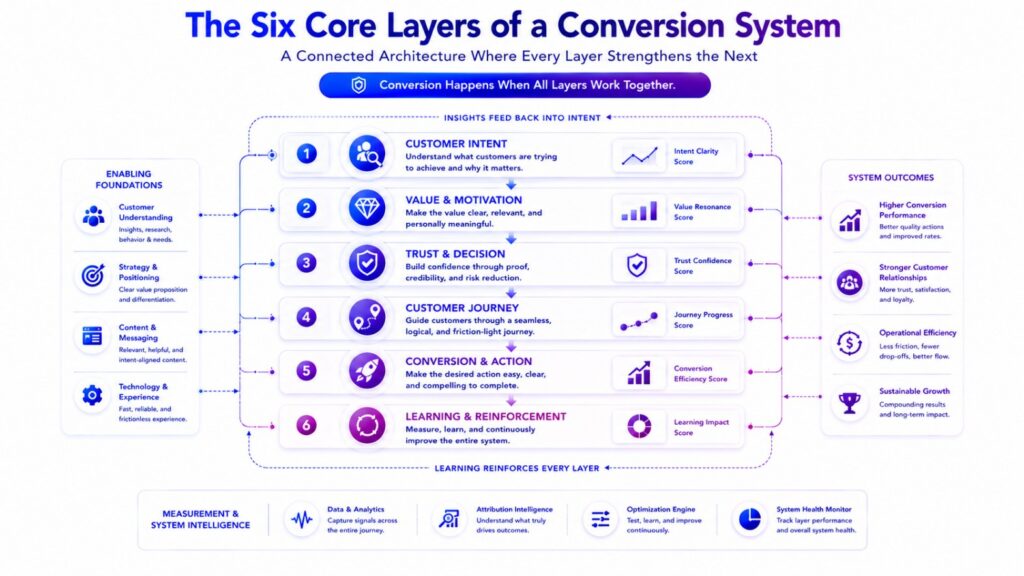
    Six connected layers of a conversion system from customer intent to learning

    How Intent, Value, Trust, and Action Connect

    Customer progression does not usually happen because of one isolated conversion element. It develops through a sequence of connected conditions that influence whether someone continues from initial interest toward action.

    Intent Alignment

    The journey begins with intent. Customers arrive with expectations, questions, needs, and different levels of readiness. When the journey aligns with that intent, progression becomes more relevant and coherent.

    Perceived Value

    Once intent is aligned, customers need a clear reason to continue. Perceived value helps answer the question of whether taking the next step is worthwhile.

    Motivation

    Value and motivation work together. Even when an offer appears relevant, customers may not progress if the perceived reason to act is not strong enough at that point in the journey.

    Trust Before Commitment

    Before taking a meaningful action, customers often need confidence that the business, offer, and next step are credible and appropriate for them. Trust therefore becomes an important bridge between interest and decision.

    Journey Clarity

    Customers also need to understand what happens next. A clear journey reduces uncertainty about progression and helps connect one stage of the experience with the next.

    Decision Confidence

    When intent, value, trust, and journey clarity work together, customers can develop greater confidence in their decision. This does not guarantee action, but it creates stronger conditions for meaningful progression.

    From Interest to Action

    At a high level, these relationships can be understood as:

    Intent → Value → Trust → Confidence → Action

    The important insight is that these are not independent conversion levers. A weakness earlier in the sequence can influence what happens later. Understanding the connection therefore provides a more useful view of conversion performance than examining the final action alone.
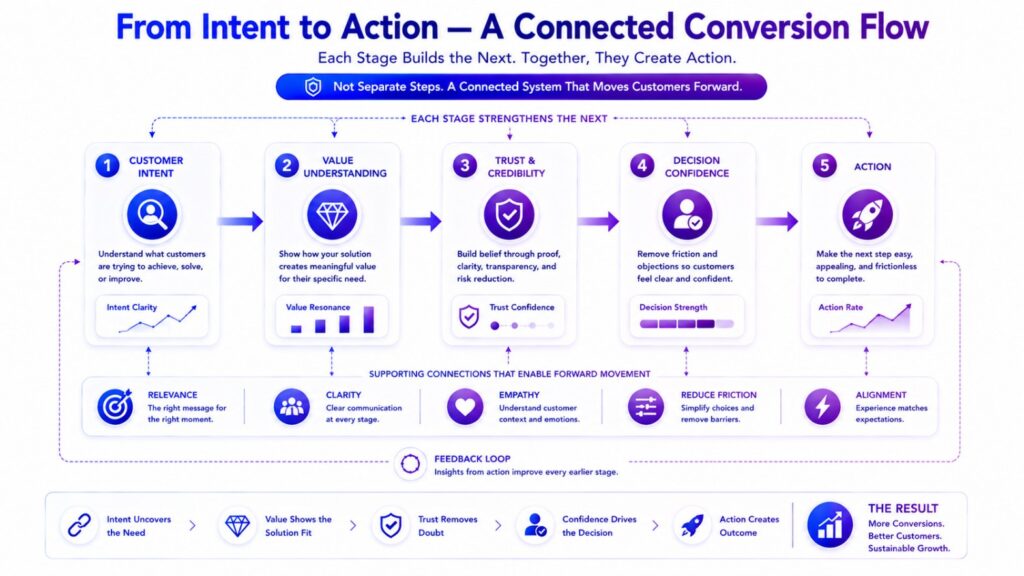
    Conversion flow connecting customer intent, value, trust, confidence, and action

    Why Lead Generation and Conversion Cannot Be Separated

    Lead generation is often treated as a separate activity from conversion. One team focuses on bringing visitors, while another focuses on turning those visitors into leads or customers.

    But within a connected conversion system, these stages influence one another. The quality of incoming opportunities, the alignment of customer intent, the value being communicated, the level of trust, and the path toward action can all affect whether lead generation becomes meaningful business opportunity.

    Qualified Traffic vs. Raw Traffic

    More traffic does not automatically mean more valuable conversion opportunities. What matters is whether incoming visitors have sufficient relevance and intent to progress through the journey.

    Intent Alignment

    Once qualified visitors enter the system, their expectations need to align with the journey they encounter. Misalignment can weaken progression even when traffic volume appears healthy.

    Value & Trust

    Visitors need enough value clarity and confidence to continue. If the perceived value or trust conditions are weak, potential opportunities may disappear before reaching the lead-capture stage.

    Conversion Path

    The path from initial interest to lead action needs to connect logically. Unclear transitions or structural friction can interrupt progression between otherwise functional stages.

    Lead Capture

    Lead capture is an important conversion point, but it should not be viewed as the entire lead-generation system. Its performance depends partly on the quality and progression of the journey that leads customers toward it.

    Measurement & Reinforcement

    Measurement provides evidence about which pathways are producing stronger outcomes and where weaknesses may exist. That evidence can then help identify which parts of the system deserve further attention and reinforcement.

    The connected relationship can be understood at a high level as:

    Qualified Traffic → Intent → Value & Trust → Conversion Path → Lead Capture → Learning & Reinforcement

    This is why lead generation and conversion should not be analyzed as completely separate systems. Weakness in one stage can influence performance in another, making the connections between them important to understand.

    For a deeper exploration of why lead flow can become inconsistent, see why lead generation feels unpredictable.
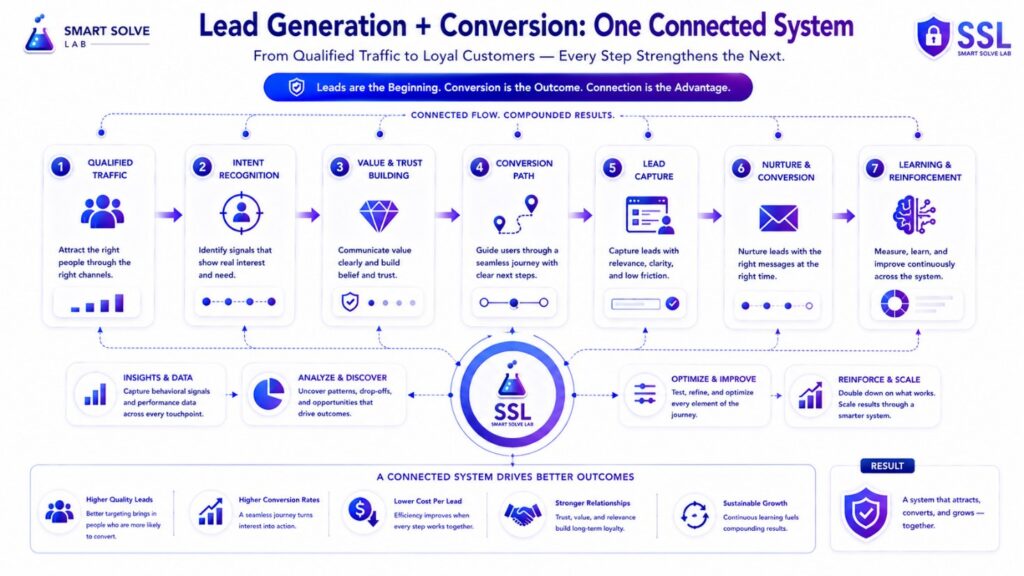
    Connected lead generation and conversion system from qualified traffic to learning

    Why Customers Drop Off Before Buying

    When customers leave before completing an intended action, the visible exit point can make the problem appear easy to identify. A business may see where people stop progressing and naturally assume that the problem exists at that exact stage.

    But customer progression is connected. The point where a customer leaves may only be where an earlier weakness finally becomes visible.

    Where Customer Progression Weakens

    Progression can weaken when intent becomes misaligned, value becomes unclear, trust is insufficient, the next step creates uncertainty, or friction develops between stages of the journey.

    Why the Exit Point May Only Be a Symptom

    A customer may leave at one stage because something weakened their confidence earlier. The visible drop-off therefore provides useful evidence, but it does not automatically explain where the journey first became weak.

    Upstream and Downstream Influence

    Earlier stages can influence later decisions, while weaknesses in one stage can also affect what happens afterward. This makes customer drop-off a journey-level issue rather than simply a page-level metric.

    Journey Friction

    Friction can emerge through unclear transitions, inconsistent expectations, weak value communication, insufficient trust, or unnecessary complexity. Individually, these may appear small, but together they can interrupt progression.

    Progression, Not Just Exit Tracking

    Tracking where customers leave is valuable because it provides evidence. But understanding conversion requires going beyond the exit point and asking what conditions influenced the customer’s progression toward that point.

    The point where a customer leaves is not necessarily the point where the journey first became weak.

    For a deeper examination of this journey-level problem, see why customers drop off before buying.

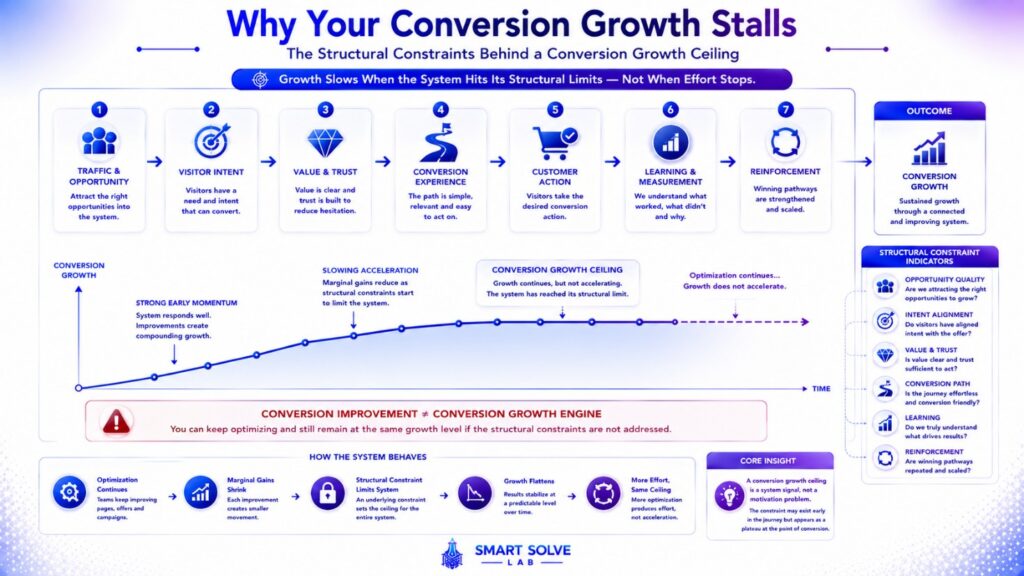
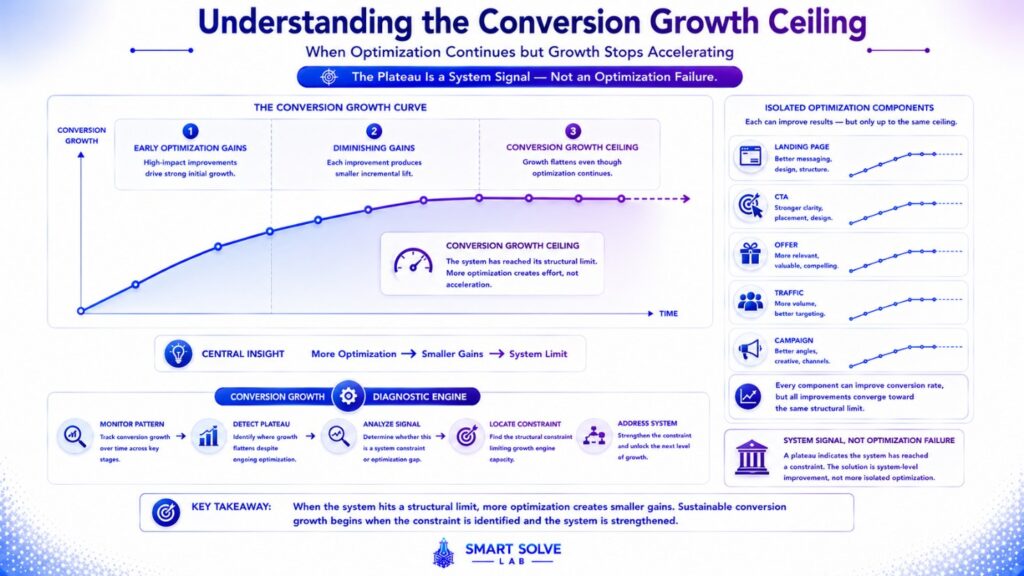
    Why Conversion Growth Eventually Stalls

    Conversion optimization can produce meaningful improvements, but those improvements do not always continue indefinitely. A business may optimize individual pages, strengthen specific funnel stages, or improve individual conversion points and still reach a point where further changes produce smaller gains.

    This can happen because isolated improvements operate within the limits of the wider conversion system.

    Component Optimization Has Limits

    Improving an individual component can strengthen that part of the journey, but it cannot automatically remove weaknesses elsewhere. Once the most visible issues have been addressed, remaining constraints may exist in the relationships between stages.

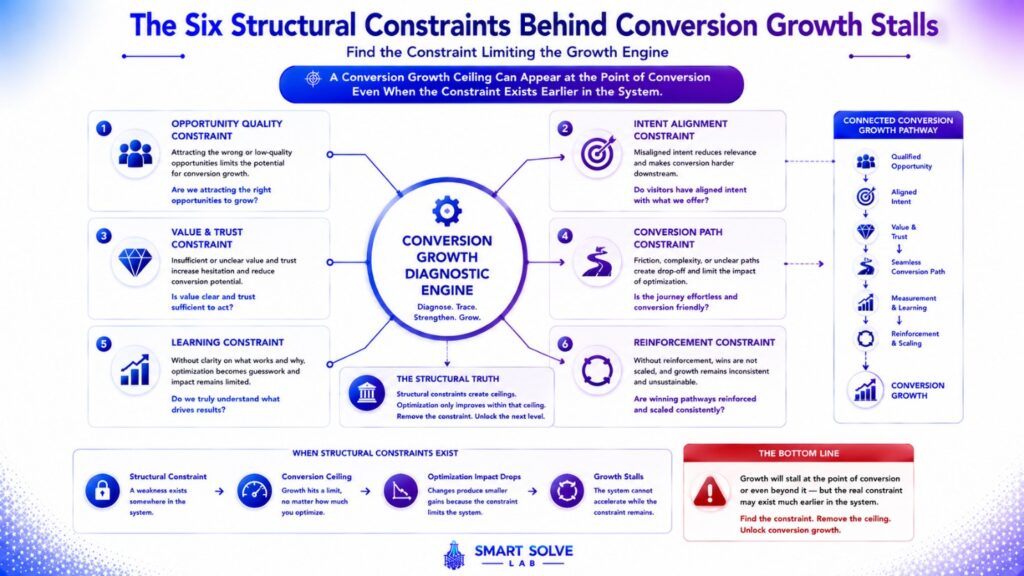
    Structural Constraints

    A structural constraint is a weakness within the connected system that limits what the wider conversion journey can achieve. The constraint may not be located at the point where performance appears weakest.

    This creates an important distinction between optimizing a component and understanding what is limiting the system.

    Dependencies Between Conversion Stages

    Conversion stages depend on one another. Stronger performance at one stage may have limited impact if another connected stage cannot support the resulting progression.

    For example, improving action at one point may not create sustained growth if customer intent, value, trust, journey continuity, or learning remains weak elsewhere in the system.

    Why More Optimization Is Not Always the Answer

    When improvements begin producing smaller gains, the answer is not necessarily to optimize more aggressively. The more useful question may be whether the underlying system contains a constraint that is limiting the impact of further optimization.

    At that point, conversion thinking needs to move from “What else can we optimize?” toward “What is limiting the system?”

    From Component Optimization to System Understanding

    System-level understanding helps businesses see why improvements may plateau even when individual components continue to receive attention.

    Conversion growth can stall when isolated improvements reach the limits of the underlying system.

    The goal is therefore not to stop optimizing individual components. It is to understand when component-level optimization is no longer enough and when the relationships and structural conditions across the wider conversion system need attention.

    For a deeper exploration of this specific growth constraint, see why your conversion growth stalls.
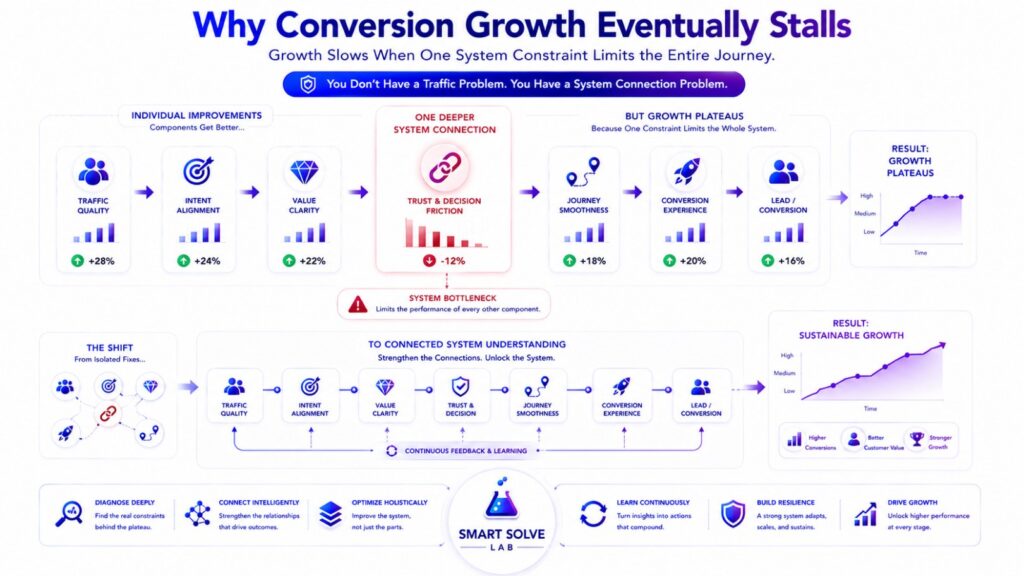
    Conversion growth system showing a structural constraint limiting performance

    From Individual Conversion Fixes to Conversion Architecture

    Individual conversion fixes can be useful when a specific problem is clearly understood. But when multiple symptoms appear across the customer journey, treating each one separately can make the wider system increasingly difficult to understand.

    Individual Symptoms

    A business may begin with visible symptoms such as weak page conversion, inconsistent leads, customer drop-off, or stalled growth. Each symptom can appear to belong to a different part of the business.

    System-Level Diagnosis

    The next step is to examine whether these symptoms are connected. Instead of asking only why one component is underperforming, the focus shifts toward understanding how different stages influence one another.

    Connected Relationships

    Conversion performance depends on relationships between intent, value, trust, progression, action, and learning. Weakness in one relationship can influence performance elsewhere, even when individual components appear functional.

    Dependencies and Priorities

    Once relationships become visible, it becomes easier to recognize that not every weakness deserves equal attention at the same time. Some issues may influence several other stages, while others may have a more limited effect.

    This creates a need for system-level prioritization rather than simply fixing whichever problem happens to be most visible.

    Why the System Matters More Than a Single Component

    A conversion architecture brings these relationships into a wider view. It focuses on how the important parts of the conversion journey fit together and whether they collectively support customer progression.

    This does not mean individual conversion components stop mattering. Rather, their performance becomes easier to understand when viewed within the architecture that connects them.

    For a deeper exploration of why businesses often fail to build this wider structure, see why most businesses never build a conversion architecture.

    The shift is from fixing isolated conversion symptoms to understanding the connected architecture that allows those components to work together.

    The Revenue Connection: Conversion Is Part of a Larger Growth System

    Conversion does not operate independently from the rest of the business. While conversion determines how effectively customer interest progresses toward action, that progression exists within a broader growth system.

    Market Opportunity

    Growth begins with the opportunity available in the market. Customer needs, demand, positioning, and the relevance of the business offering influence whether meaningful opportunities can enter the wider system.

    Demand Creation

    Demand creation helps bring potential customers into contact with the business. But generating attention alone does not create sustainable growth if the resulting opportunities are poorly aligned with what the business can convert and serve.

    Opportunity Quality

    The quality and relevance of incoming opportunities influence what the conversion system can realistically achieve. A strong conversion process cannot compensate indefinitely for a fundamental lack of suitable opportunities.

    Conversion Capacity

    Conversion is the part of the wider system that helps turn relevant customer interest into meaningful action. Its performance depends on the connected conditions explored throughout this pillar: intent, value, trust, journey progression, action, and learning.

    Customer Value

    Conversion is not the final destination of growth. The value created after conversion also matters because the broader business outcome depends on what happens beyond the initial action.

    Retention & Expansion

    Customer relationships can continue beyond the first conversion. Retention, repeat value, and expansion therefore connect conversion with the longer-term growth system.

    Learning & Reinforcement

    What the business learns from customer behavior, conversion outcomes, and ongoing performance can strengthen future decisions. Learning creates the opportunity to reinforce stronger pathways rather than repeatedly treating every outcome as an isolated event.

    At a high level, the wider relationship can be understood as:

    Market Opportunity → Demand Creation → Opportunity Quality → Conversion Capacity → Customer Value → Retention & Expansion → Learning & Reinforcement

    Conversion is therefore a critical part of growth, but conversion itself exists inside a larger revenue system.

    For a deeper look at why these connected conditions can make revenue growth difficult to understand, see why revenue growth feels so difficult.

    How to Diagnose a Weak Conversion System

    Once conversion is viewed as a connected system, diagnosing weakness requires looking beyond the most visible problem. The objective is not simply to find where performance is low, but to understand what may be influencing that weakness across the wider journey.

    Where Is the Visible Symptom?

    Begin with what can actually be observed. A weak conversion point, inconsistent lead flow, customer drop-off, or stalled growth provides a starting signal for investigation.

    Where Might the Weakness Have Begun?

    The visible symptom may not represent the beginning of the problem. Earlier stages can shape customer expectations, motivation, trust, and progression, so the wider journey needs to be considered.

    Which Stages Influence It?

    Look at the relationships surrounding the problem. Ask which upstream or downstream stages could be influencing the observed outcome rather than assuming the nearest component is responsible.

    What Evidence Supports the Diagnosis?

    Good diagnosis should be grounded in evidence rather than assumptions. Metrics, customer behavior, journey patterns, and observed outcomes can provide useful signals, but individual measurements should be interpreted within their wider context.

    Which Weakness Deserves Attention First?

    Not every identified weakness has the same importance. Some structural issues may influence several connected stages, while others may have a narrower effect. The goal is to understand which weakness deserves attention based on its relationship with the wider system.

    What Should Be Reinforced After Improvement?

    Improvement should not end when one problem appears to be resolved. The system should continue learning from what changes, identifying what works more effectively, and reinforcing stronger pathways where appropriate.

    At a high level, this diagnostic thinking can be represented as:

    Observe → Map → Connect → Understand → Prioritize → Reinforce

    This is a conceptual way to think about system diagnosis—not a substitute for detailed assessment. Its purpose is to shift attention from isolated symptoms toward the relationships and structural conditions that influence conversion performance.

    Building a More Connected Conversion System

    A stronger conversion system is not created by optimizing every component independently. It develops when the important parts of the customer journey connect clearly enough to support progression, learning, and reinforcement.

    Align the Customer Journey

    Start by ensuring that the journey makes sense from the customer’s perspective. Each stage should connect naturally with the expectations, needs, and decisions established in the stages before it.

    Strengthen Weak Connections

    When a system contains a weak transition between stages, improving the connection can be more valuable than repeatedly optimizing the individual components on either side of it.

    Reduce Isolated Optimization

    Individual optimization still has a place, but it should not become the default response to every conversion problem. Improvements should be considered in relation to the wider journey and the conditions surrounding the target component.

    Prioritize Structural Issues

    Not every weakness has equal influence. A structural issue affecting several connected stages may deserve attention before a smaller problem that affects only one point in the journey.

    Create Learning Loops

    A connected system should learn from what happens. Observed outcomes and customer behavior can provide evidence that helps the business understand which pathways are stronger, where weaknesses remain, and what deserves further investigation.

    Reinforce What Works

    When stronger pathways or improvements are identified, they should become part of the system’s ongoing learning process. Reinforcement helps prevent useful improvements from remaining isolated successes.

    The broader principle is:

    The goal is not to optimize every conversion component independently, but to strengthen the connections that allow the system to perform more coherently.

    A connected conversion system therefore becomes less about continuously reacting to individual symptoms and more about understanding, strengthening, and learning from the relationships that shape customer progression.

    Common Conversion System Mistakes

    Many conversion problems become harder to resolve when businesses evaluate individual activities without considering how those activities connect across the wider system.

    Optimizing One Page in Isolation

    A page can be improved while weaknesses elsewhere in the customer journey remain unresolved. Treating the page as the complete problem can therefore limit the usefulness of the improvement.

    Treating Traffic as the Entire Problem

    More traffic does not automatically resolve conversion weakness. If intent, value, trust, journey progression, or action conditions remain weak, increasing traffic may simply send more visitors into the same structural weakness.

    Treating Leads as the Final Outcome

    Lead generation is an important stage, but leads are not the complete growth outcome. Their quality, progression, conversion, customer value, and longer-term relationship with the business also matter.

    Assuming the Drop-Off Point Is the Root Cause

    The place where customers leave provides useful evidence, but it does not necessarily reveal where the journey first became weak. Looking only at the exit point can therefore miss upstream influences.

    Chasing Metrics Without Understanding Relationships

    Metrics can show what is happening, but individual numbers do not always explain why it is happening. A metric becomes more useful when interpreted alongside the connected stages and conditions that influence it.

    Fixing Symptoms Without Examining Dependencies

    Repeatedly fixing visible symptoms can create a cycle of temporary improvements followed by new problems. Examining dependencies helps reveal whether apparently separate issues are connected.

    Adding More Activity Instead of Strengthening the System

    More campaigns, more traffic, more optimization, or more conversion experiments do not automatically create a stronger system. Sometimes the more important step is understanding and strengthening the relationships that already exist within the journey.

    The common thread behind these mistakes is the same: treating connected conversion problems as if they were independent problems.

    A stronger approach begins by understanding the system before deciding which individual component deserves further optimization.

    The Conversion System Framework

    Understanding a conversion system becomes more useful when the major relationships can be viewed as one connected way of thinking. The purpose of this framework is to help move from visible conversion problems toward broader system understanding.

    Understand

    Begin by understanding the conversion problem in context. Identify what is happening, what outcome is being affected, and what the visible evidence actually shows.

    Map

    Map the relevant customer journey and the stages surrounding the problem. This creates a wider view instead of examining one conversion point in isolation.

    Connect

    Connect the stages, symptoms, and conditions that may influence one another. This helps reveal relationships that may otherwise remain hidden.

    Diagnose

    Examine the connected system to understand where meaningful weaknesses may exist. The objective is to move beyond the visible symptom toward a clearer explanation of the wider problem.

    Prioritize

    Once potential weaknesses are understood, consider which ones deserve attention first based on their relationship with the wider conversion system.

    Strengthen

    Strengthen the areas and connections that are most important to customer progression. Improvement should be considered as part of the wider system rather than as an isolated adjustment.

    Learn

    Observe what happens after changes are made. Outcomes and customer behavior provide evidence that can improve understanding of how the system is functioning.

    Reinforce

    When stronger pathways or useful improvements become clear, reinforce them so that learning becomes part of the ongoing conversion system rather than a one-time optimization exercise.

    Understand → Map → Connect → Diagnose → Prioritize → Strengthen → Learn → Reinforce

    This framework provides a high-level way to think about conversion as a connected system. It is not intended to replace detailed diagnostic tools or operational processes; rather, it gives the reader a structured mental model for moving from individual problems toward system thinking.

    The Complete Conversion System — Putting It All Together

    By this point, conversion can be understood as more than a collection of pages, funnel stages, or individual optimization opportunities. It is a connected system in which different conditions influence how customers progress from initial interest toward meaningful action.

    From Customer Interest to Action

    The complete conversion journey can be viewed at a high level as:

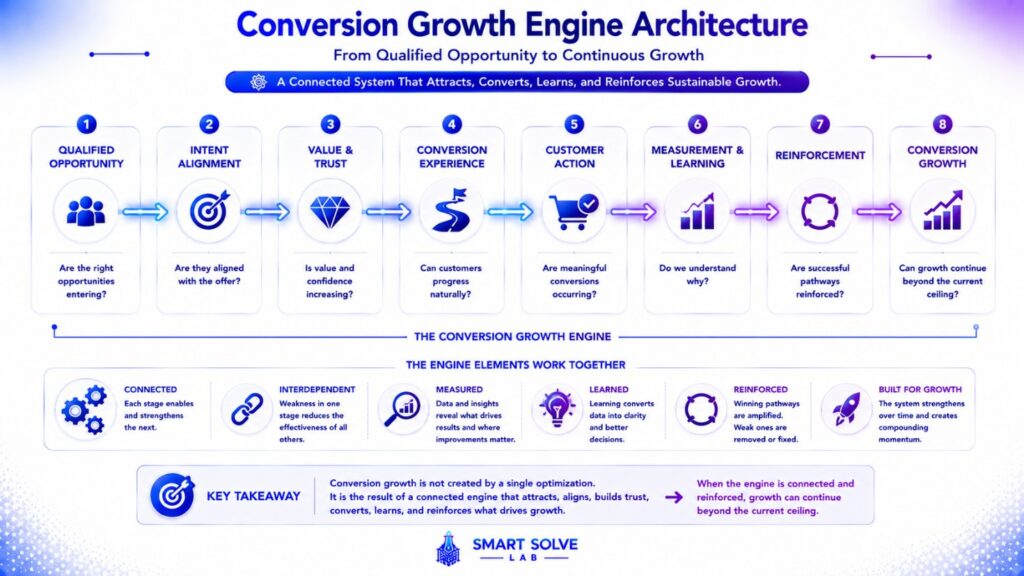
    Customer Interest → Intent Alignment → Value & Motivation → Trust & Decision → Journey Progression → Conversion & Action → Lead / Customer Outcome → Measurement & Learning → Reinforcement

    Each stage contributes something different, but none of them exists completely in isolation.

    Why the Connections Matter

    Intent affects how relevant the journey feels. Value and motivation influence whether customers see a reason to continue. Trust and decision confidence affect commitment. Journey progression connects one stage with the next. Action creates measurable outcomes, while learning provides evidence that can help the system improve.

    A weakness in one connection can therefore influence performance elsewhere, even when the individual components appear functional.

    From Conversion to Customer Value

    Conversion is an important transition, but it is not the complete business outcome. What happens after the initial action can influence customer value, retention, expansion, and the longer-term growth system.

    This creates a broader relationship:

    Conversion System → Customer Value → Retention & Expansion → Growth

    The Central Principle

    A stronger conversion system is not defined by one optimized component. It is defined by how effectively the important parts connect, support progression, and learn from what happens.

    When the system is viewed this way, individual conversion problems become signals within a larger architecture rather than completely separate problems requiring unrelated fixes.

    The objective is not to make every component perfect in isolation. It is to create enough coherence between the important parts of the journey that customer progression, learning, and improvement can work together more effectively.
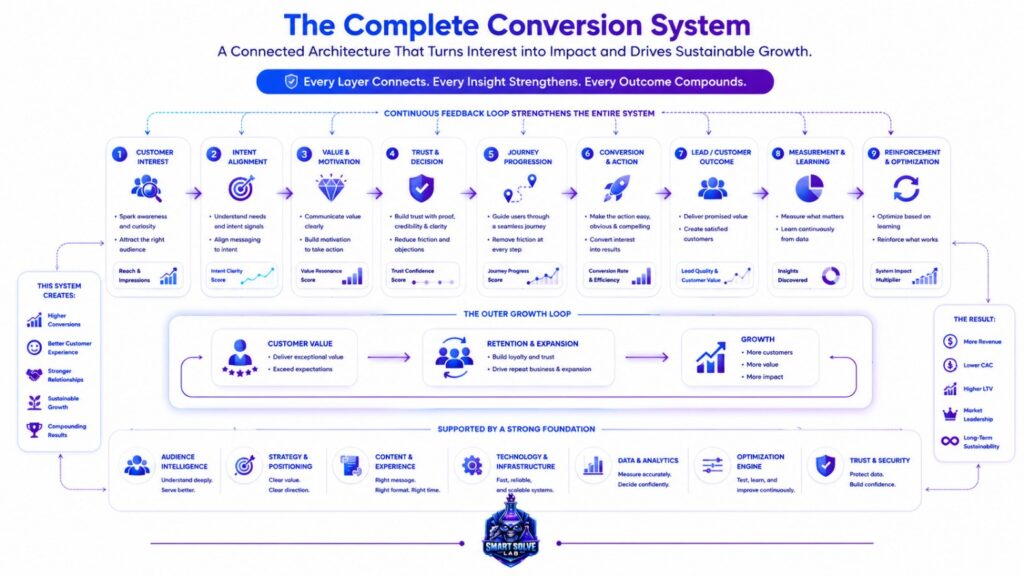
    Complete conversion system connecting intent, value, trust, progression, action, learning, and growth
    A connected conversion system turns individual stages into a coherent growth architecture.

    From Individual Conversion Problems to System Thinking

    Individual Conversion Problems

    Conversion problems often first appear as individual issues: a weak landing page, poor lead quality, customer drop-off, low form completion, or limited progression toward action. These visible problems are important, but they may represent only one part of a wider conversion system.

    Core System Problems

    When similar problems continue across different pages, stages, or customer interactions, the issue may be larger than any single component. The focus begins to shift from fixing individual symptoms toward understanding the relationships and dependencies connecting the conversion journey.

    Premium Architecture Problems

    At a deeper level, multiple connected weaknesses can point toward an architecture problem. When conversion components influence one another across the wider customer journey, understanding the larger architecture becomes necessary before meaningful structural improvement can take place.

    Conversion System Pillar

    The Conversion System brings these levels together by moving from individual problems toward connected system thinking. Instead of viewing each conversion issue as an isolated event, businesses can begin to understand how intent, value, trust, progression, action, learning, and reinforcement interact as one system.

    The Shift in Thinking

    The important shift is not simply from one optimization tactic to another. It is from asking “What is wrong with this conversion point?” to asking “What is happening across the system that is producing this outcome?”

    Individual problems reveal symptoms. System thinking reveals relationships.
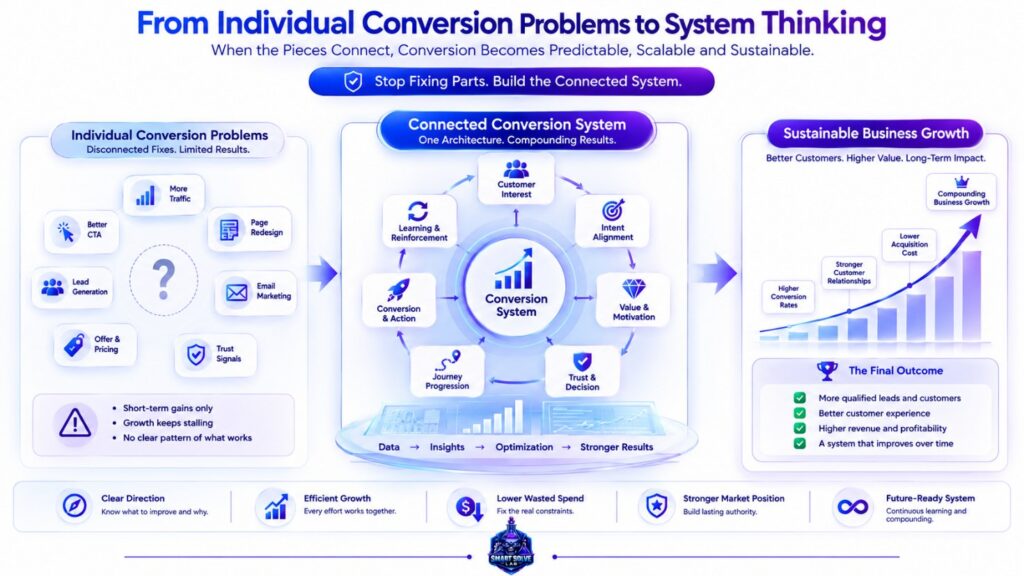
    Conversion system evolving from individual problems to connected system thinking

    Key Takeaways

    Conversion Is a System, Not a Single Element

    Conversion performance does not come from one page, button, funnel stage, or optimization. It emerges from how the important parts of the customer journey connect and support one another.

    Symptoms Do Not Always Reveal Root Causes

    A visible conversion problem may only be the point where a wider weakness becomes noticeable. Understanding what happens before and around that problem can reveal a more meaningful direction for diagnosis.

    Customer Progression Depends on Connected Conditions

    Intent, value, trust, confidence, journey clarity, and action influence one another. Weakness in one area can affect progression elsewhere in the system.

    Lead Generation and Conversion Influence One Another

    Generating more traffic or leads does not automatically create better conversion outcomes. The quality of intent, value alignment, trust, conversion path, and learning process also matter.

    Local Optimization Can Expose Wider Constraints

    Improving one conversion component can sometimes reveal another weakness rather than solving the wider problem. This is why isolated optimization has limits when structural dependencies remain unresolved.

    Metrics Provide Evidence, Not Complete Explanations

    Conversion metrics can show what is happening, but they do not always explain why it is happening. Reviewing Google Analytics dimensions and metrics can help businesses understand the evidence available in their data, but stronger diagnosis still requires understanding the relationships behind the observed numbers.

    Sustainable Improvement Requires Learning and Reinforcement

    A stronger conversion system does not stop at making an improvement. It learns from customer behavior, strengthens what works, and uses those insights to support future decisions.

    Stronger Conversion Comes From Stronger System Connections

    The ultimate goal is not to optimize every component independently. It is to create a more connected system in which customer intent, value, trust, progression, action, learning, and reinforcement work together more coherently.

    Where to Go Next

    Start With the Specific Conversion Problem

    Begin with the conversion problem you can actually observe. Identify what is happening, where it appears, and what evidence is available before assuming the cause.

    Move Toward the Relevant Diagnostic Layer

    Once the problem is clear, examine the part of the conversion system most closely connected to it. A focused diagnostic approach can provide more useful understanding than applying unrelated optimization tactics.

    Build Toward System Understanding

    If the problem connects with other stages, broaden the view. Understanding the relationships between intent, value, trust, journey progression, action, and learning can reveal why an apparently isolated issue continues to affect performance.

    Move From System Understanding to Architecture

    When multiple connected conversion weaknesses exist, the next step is to understand the larger architecture behind them. This is where individual problem diagnosis develops into a more complete view of how the conversion system is structured.

    Separate Diagnosis From Execution

    Strong improvement begins with understanding the problem before deciding how to implement the solution. Smart Solve Lab focuses on diagnosis, clarity, frameworks, and architecture—helping businesses understand what is happening and why before execution begins.

    The right next step depends on the level of the problem: specific issue, system weakness, or connected architecture.

    Understand the Conversion System

    If individual conversion fixes keep producing temporary or disconnected improvements, the next step is to understand the wider system behind those outcomes.

    A connected conversion system helps you look beyond isolated pages, funnel stages, or metrics and examine how customer intent, value, trust, progression, action, and learning work together.

    Explore the Conversion System resources and identify the diagnostic framework most relevant to your current conversion problem.

    FAQs

    What is a conversion system?

    A conversion system is the connected set of conditions and stages through which customer interest develops into intent, value, trust, progression, action, and learning. It focuses on how these parts work together rather than treating each conversion point in isolation.

    How is a conversion system different from a conversion funnel?

    A funnel mainly describes the progression of customers through stages. A conversion system looks more broadly at the relationships, dependencies, conditions, and learning processes that influence how effectively customers move through those stages.

    Why do conversion problems keep repeating?

    Conversion problems can repeat when businesses fix visible symptoms without examining the wider system relationships that contribute to them. A local improvement may not resolve an underlying structural weakness.

    Why doesn’t fixing one conversion page always solve the problem?

    A page may be affected by conditions outside the page itself, including customer intent, value alignment, trust, journey progression, or the quality of traffic reaching it. Improving one component does not necessarily resolve weaknesses elsewhere.

    How do customer intent and trust affect conversion?

    Intent influences whether the customer is aligned with the offer, while trust affects confidence in taking the next step. When value, intent, trust, and journey clarity work together, progression toward action can become more coherent.

    Why are lead generation and conversion connected?

    Lead generation does not operate separately from conversion. The quality and intent of incoming traffic, the value and trust presented, the conversion path, and the learning process can all influence what happens after a visitor arrives.

    How should businesses think about conversion drop-offs?

    A drop-off point should be treated as evidence rather than automatically assumed to be the root cause. The journey should be examined around that point to understand where customer progression may have first become weaker.

    How can a conversion system become more sustainable?

    A more sustainable conversion system comes from strengthening important connections, addressing structural weaknesses, learning from customer behavior, and reinforcing improvements instead of relying only on isolated optimization.
  • Why Most Businesses Never Build a Conversion Architecture

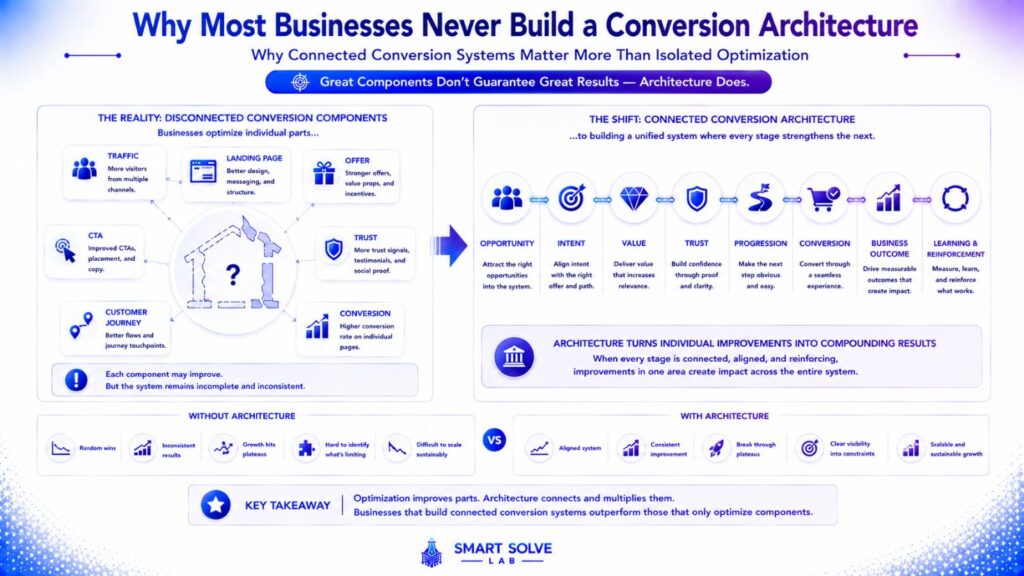
    Why most businesses never build a connected conversion architecture
    Strong conversion components need a connected architecture to work together effectively.

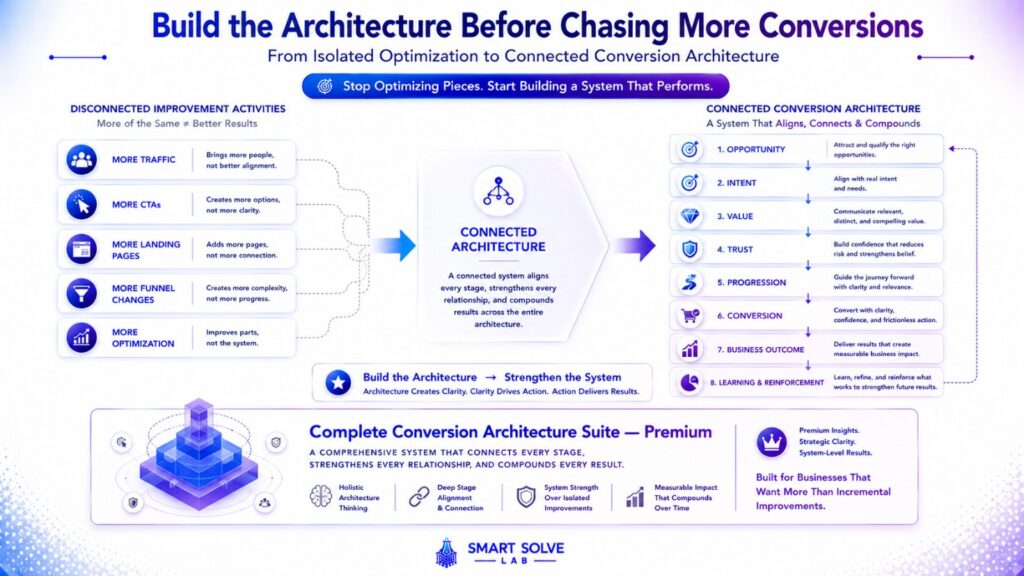
    conversion architecture:

    Businesses spend considerable time improving conversion performance.

    They bring in more traffic, redesign landing pages, strengthen offers, adjust CTAs, improve trust signals, refine funnels, and study conversion data. Each improvement may solve a genuine problem.

    Yet the overall conversion system can still remain fragmented.

    One component improves while another becomes the next constraint. A stronger landing page may not solve weak visitor intent. A better offer may not repair a trust gap. More traffic may create more opportunities without fixing what happens after visitors arrive.

    Over time, this creates a familiar pattern:

    More Optimization

    Local Improvement

    Another Constraint

    Another Fix

    Another Optimization Cycle

    The deeper issue is that many businesses optimize components, but never intentionally build the architecture connecting those components.

    A business can therefore have strong individual conversion elements and still lack the structure required for those elements to work together effectively.

    Most businesses do not struggle because one conversion component is missing. They struggle because the components responsible for turning opportunity into meaningful business outcomes were never designed as one connected architecture.

    This changes the question.

    Instead of asking only:

    “Which conversion element should we optimize next?”

    the more important question becomes:

    “How are the different conditions that influence conversion connected—and where does the wider system depend on those connections?”

    That is the foundation of conversion architecture.

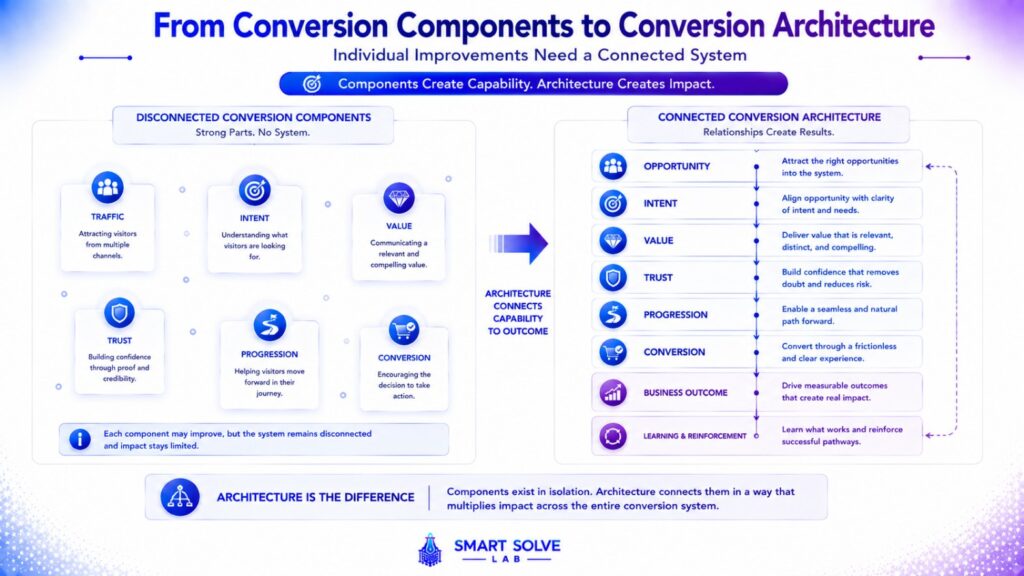
    Conversion components connected into a complete conversion architecture
    Individual conversion improvements become more powerful when connected through a broader system.

    Table of Contents

    Why Most Businesses Optimize Conversions Without Building an Architecture

    Conversion optimization often begins with a visible problem.

    A landing page is underperforming, so the page is changed. A CTA receives fewer clicks, so the CTA is adjusted. Traffic increases without producing enough conversions, so more campaigns are launched.

    These actions can be useful. The problem begins when every issue is treated as an independent component problem.

    More Traffic, More Pages, More CTAs — But No Connected System

    Businesses can continuously add conversion elements without creating meaningful relationships between them.

    More traffic may increase opportunity, but it does not automatically improve intent alignment.

    More pages may provide more information, but they do not automatically make value clearer.

    More CTAs may create more opportunities to act, but they do not automatically create confidence or readiness.

    The business may therefore become more optimized without becoming more connected.

    Why Individual Conversion Improvements Feel Disconnected

    A component can improve while another part of the customer journey remains constrained.

    For example, a stronger offer may improve perceived value, while the visitors reaching that offer are still poorly aligned with it. A better landing page may improve engagement, while later progression remains unclear.

    This creates a situation where improvements appear successful locally but produce limited change across the wider conversion system.

    The Hidden Cost of Building Conversion Components Separately

    When components are developed independently, the connections between them can remain undefined.

    The business may know what each component is supposed to accomplish without understanding how one stage affects the next.

    That can make it difficult to determine whether a weak result is caused by the component itself or by a dependency somewhere else in the system.

    When Components Work Individually but the System Still Underperforms

    This is one of the most important architecture problems.

    A business can have:

    Good Traffic

    Strong Content

    A Valuable Offer

    A Professional Landing Page

    Clear CTAs

    Trust Signals

    and still experience weak or inconsistent conversion performance.

    The problem may not be the quality of any single component.

    It may be the connections between them.

    Why Conversion Growth Eventually Exposes Structural Gaps

    As businesses continue optimizing, obvious weaknesses are often addressed first.

    Eventually, however, improvements can become smaller because the remaining limitations are less visible and more interconnected.

    A local improvement may simply expose another dependency further along the journey.

    A business can have strong conversion components and still lack the architecture required to make those components work together.

    This is where conversion optimization begins to reach beyond individual pages, CTAs, offers, or campaigns and becomes a question of system architecture.

    For a practical look at the symptom that often exposes this problem, see Why Your Website Gets Traffic But No Conversions.

    What Is a Conversion Architecture?

    Conversion architecture is the connected structure through which opportunity becomes aligned with intent, value becomes understood, trust develops, customers progress, meaningful actions occur, and the resulting learning strengthens future conversion performance.

    A Funnel Shows Movement

    A funnel can show how people move through different stages toward a desired outcome. It can help describe where visitors enter, progress, and eventually leave or convert.

    But a funnel primarily describes movement through stages. It does not necessarily explain how the conditions within those stages depend on one another.

    A Conversion Path Shows a Route

    A conversion path describes a particular route toward an action. It may show how a visitor moves from an entry point through relevant experiences before reaching a conversion opportunity.

    That route can be useful, but a business may have many different paths depending on the visitor, intent, offer, channel, and stage of decision-making.

    Conversion Architecture Defines the Connections

    Conversion architecture looks beyond an individual path and considers how the broader conversion conditions, components, dependencies, and outcomes work together.

    It asks whether the different parts of the system support one another rather than simply whether each part exists.

    A conversion path describes where someone moves. Conversion architecture examines how the system is designed to support that movement.

    The distinction matters because a business can have multiple effective-looking conversion paths while still lacking a coherent structure connecting the conditions that influence conversion across the wider journey.

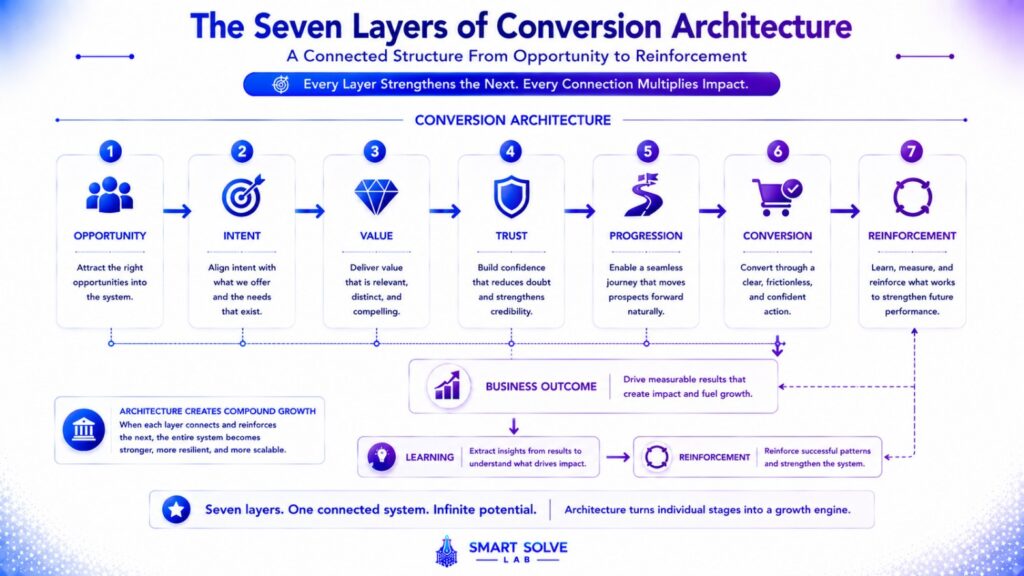
    The Seven Layers of Conversion Architecture

    A complete conversion architecture can be understood through seven connected functional layers. Each layer represents a different condition that contributes to how opportunities progress toward meaningful business outcomes.

    1. Opportunity Layer

    The opportunity layer concerns where relevant potential customers enter the system. The quality and relevance of those opportunities influence what becomes possible in the stages that follow.

    2. Intent Layer

    The intent layer considers whether visitor needs, expectations, and readiness align with what the business offers. Strong alignment creates a more appropriate foundation for continued progression.

    3. Value Layer

    The value layer focuses on how clearly the relevance and meaningful value of the solution become understood. Visitors need enough clarity to recognize why continuing the journey matters to them.

    4. Trust Layer

    The trust layer concerns the development of sufficient confidence for continued progression. As the required commitment increases, the customer may need stronger reasons to believe that moving forward is appropriate.

    5. Progression Layer

    The progression layer focuses on how people move from one meaningful decision stage to the next. Each transition should support continued understanding and make the next appropriate step reasonably clear.

    6. Conversion Layer

    The conversion layer concerns how appropriate customer action is supported. The objective is not simply to generate an action, but to support meaningful action that connects with the broader business journey.

    7. Reinforcement Layer

    The reinforcement layer brings outcomes and learning back into the wider system. Useful observations and successful patterns can inform future strengthening rather than remaining isolated improvements.

    Business Outcome

    Business outcomes should be understood as results flowing from the architecture rather than as a separate eighth layer. Conversion activity becomes more meaningful when its relationship to broader business outcomes can be understood.

    The conceptual flow can therefore be viewed as:

    Opportunity → Intent → Value → Trust → Progression → Conversion → Business Outcome → Learning → Reinforcement

    A weakness in one layer can affect the effectiveness of the layers that depend on it.

    This article introduces these layers as a conceptual model. The deeper work of mapping, assessing, and strengthening a complete conversion architecture belongs to the appropriate Premium framework rather than being fully operationalized here.

    Seven layers of conversion architecture from opportunity to reinforcement
    A connected conversion architecture links opportunity, intent, value, trust, progression, conversion, and reinforcement.

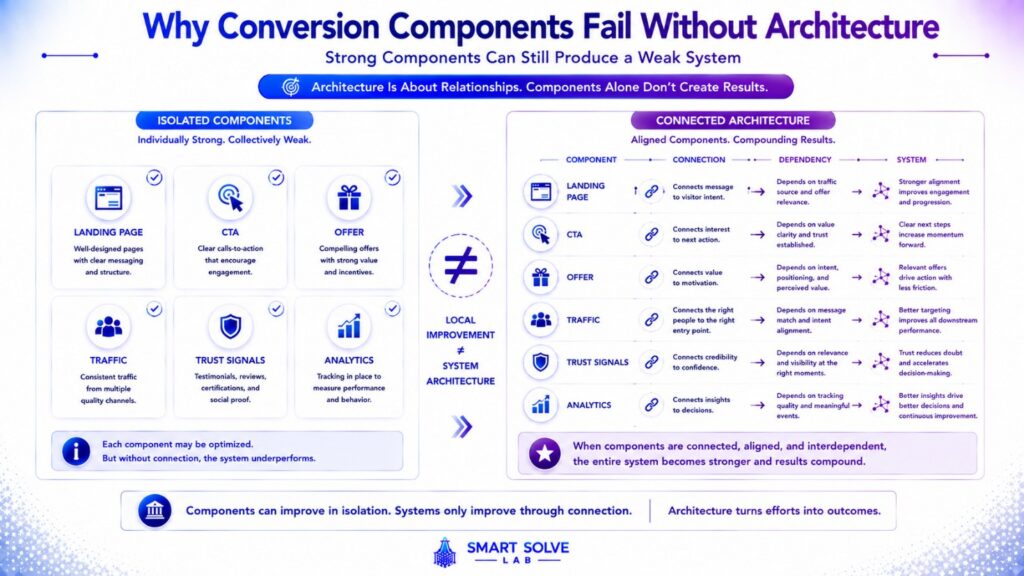
    Why Conversion Components Fail When the Architecture Is Missing

    Individual conversion components can be useful and well designed while the wider system still struggles to perform consistently. The reason is simple: each component operates within a network of relationships that can influence what happens before and after it.

    A Landing Page Cannot Carry the Entire Conversion System

    A landing page can improve clarity, relevance, and progression at a particular point in the journey. But it cannot independently control the quality of opportunities entering the system, the visitor’s intent, the development of trust, or what happens after the visitor moves forward.

    A CTA Cannot Create Readiness by Itself

    A clear call to action can make the next step easier to understand, but clarity does not automatically create sufficient value, trust, or decision confidence. A CTA can support progression without being responsible for the conditions that make progression possible.

    An Offer Cannot Repair Misaligned Intent

    A strong offer may communicate meaningful value, but its effectiveness depends partly on whether it reaches people whose needs and expectations are aligned with what the offer provides.

    Trust Signals Cannot Replace Value Clarity

    Trust can strengthen confidence, but trust signals cannot compensate indefinitely for an experience where the customer does not clearly understand the value or relevance of the solution.

    Traffic Cannot Repair a Disconnected Conversion System

    Additional traffic can create more opportunities, but it cannot automatically repair weaknesses between opportunity, intent, value, trust, progression, and conversion. More visitors can increase the scale of a system without fixing the system itself.

    Analytics Cannot Repair a Broken Customer Journey

    Measurement can help a business observe what is happening, but data alone does not create a connected customer journey. Learning becomes useful when it contributes to a stronger understanding of how the wider system operates.

    The relationship can therefore be understood as:

    Component → Connection → Dependency → System

    A component can be improved locally while the larger system remains constrained by a different dependency. This is why conversion architecture looks beyond individual components and examines how those components function together.

    Conversion components failing without a connected architecture
    Improving individual conversion components does not automatically create a connected system.

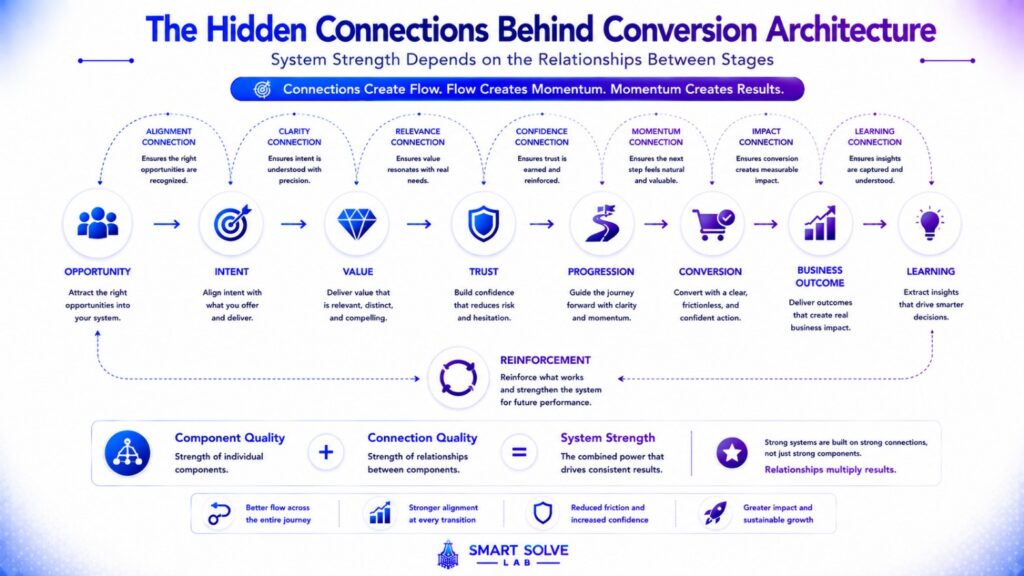
    The Hidden Connections That Make Conversion Architecture Work

    Conversion architecture is not defined only by the quality of its individual components. It also depends on whether the relationships between those components support a coherent progression from opportunity toward meaningful business outcomes.

    Opportunity → Intent

    Does the opportunity entering the system align with the people and needs the business is actually designed to serve?

    Intent → Value

    Does the system communicate value that matches the visitor’s current need and decision stage?

    Value → Trust

    Does clearer value create enough confidence for the visitor to continue exploring or progressing?

    Trust → Progression

    Does developing confidence support the next appropriate decision rather than leaving the customer uncertain about what to do next?

    Progression → Conversion

    Does the journey make meaningful action understandable and appropriate for the customer’s current level of readiness?

    Conversion → Business Outcome

    Does the conversion represent meaningful business value rather than simply becoming another isolated metric?

    Business Outcome → Learning

    Can the business understand what the resulting outcomes reveal about the performance and relationships within the wider system?

    Learning → Reinforcement

    Can useful learning inform future improvements so that successful patterns do not remain isolated events?

    The strength of a conversion system depends not only on the quality of its components, but also on the quality of the connections between them.

    These connections do not mean that every customer follows one identical path. They represent the broader relationships that influence how different parts of the conversion system work together.

    Hidden connections between conversion architecture stages
    The strength of a conversion system depends on the connections between its components.

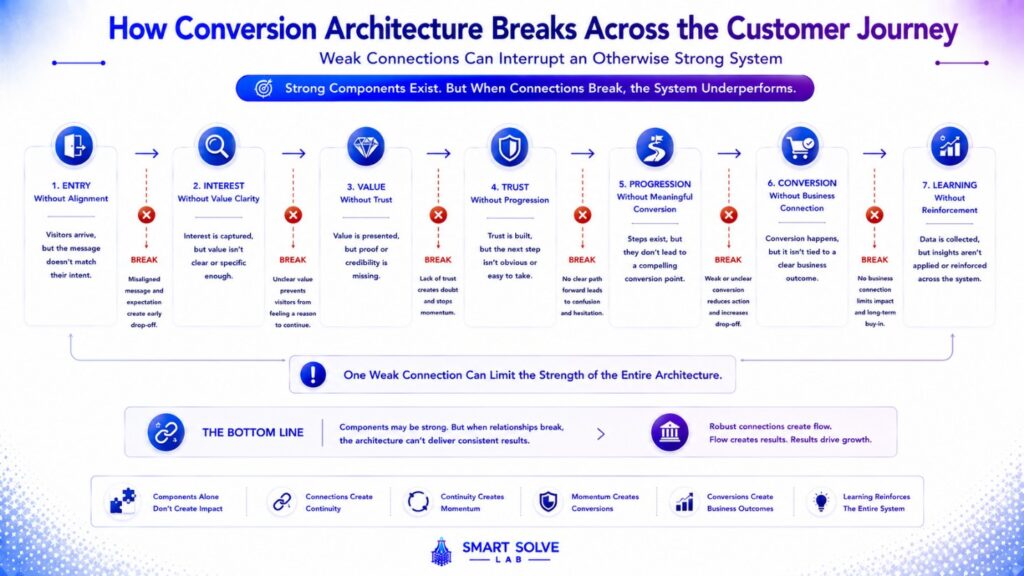
    How Conversion Architecture Breaks Across the Customer Journey

    A conversion architecture can contain all the major components a business needs and still underperform when the connections between those components are weak.

    The problem may appear at one point in the journey, but the underlying weakness can exist earlier. This is why architecture-level thinking looks at how each stage influences the conditions that follow.

    Entry Without Alignment

    Opportunities may enter the system without being sufficiently aligned with the needs, expectations, or intent the business is designed to serve.

    Interest Without Value Clarity

    Attention may exist, but the visitor may not clearly understand why the solution is relevant or valuable enough to continue.

    Value Without Trust

    The offer may make sense to the visitor, yet confidence may remain insufficient for the level of commitment being requested.

    Trust Without Progression

    A customer may develop confidence in the business but still encounter an unclear or disconnected next step. Trust alone does not guarantee continued movement.

    Progression Without Meaningful Conversion

    A visitor may move through several stages of the journey without reaching the action that represents meaningful progress for the business.

    Conversion Without Business Connection

    An action may occur, but its relationship to meaningful business outcomes may remain unclear. A conversion becomes more valuable when it can be understood within the broader business context.

    Learning Without Reinforcement

    A business may collect performance information without turning useful learning into stronger future decisions. When learning remains isolated, the architecture has difficulty becoming stronger over time.

    A conversion architecture becomes fragile when the connections between its stages do not consistently support progression toward meaningful outcomes.

    This is broader than any single customer-drop-off problem. Customer progression is one important part of the architecture, but the complete system also includes the opportunity, intent, value, trust, conversion, business outcome, and reinforcement relationships surrounding it.

    For a deeper look at customer progression and the reasons interested customers can leave before completing a purchase, explore Why Customers Drop Off Before Buying.

    How conversion architecture breaks across the customer journey
    Weak connections between conversion stages can interrupt an otherwise strong customer journey.

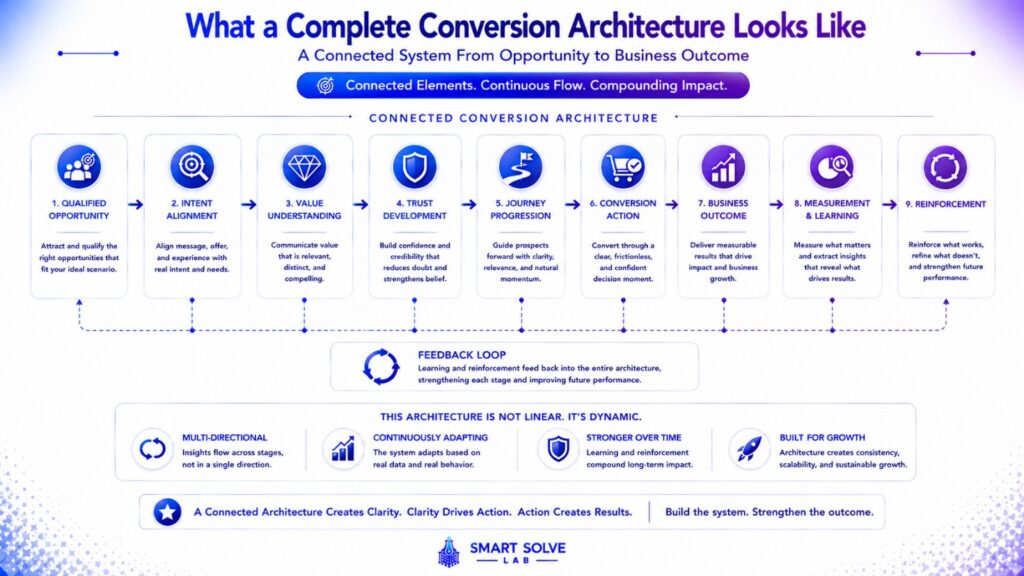
    What a Complete Conversion Architecture Looks Like

    A complete conversion architecture brings the major conditions influencing conversion into one connected conceptual system. Its purpose is not to suggest that every customer follows one identical linear path, but to show how different conditions can work together to support meaningful business outcomes.

    Qualified Opportunity

    The system begins with relevant opportunities entering the broader conversion environment. The quality and relevance of those opportunities influence what becomes possible in the stages that follow.

    Intent Alignment

    Those opportunities need to be reasonably aligned with the problem, need, or solution being addressed. Alignment creates a stronger foundation for the rest of the journey.

    Value Understanding

    As people continue, they need enough clarity to understand why the solution matters and how it relates to their situation.

    Trust Development

    Understanding alone may not be sufficient. Confidence needs to develop as the level of commitment increases, helping the customer feel more comfortable progressing.

    Journey Progression

    The customer then moves through meaningful decision stages. Each stage should connect naturally enough that progression does not depend on isolated components working perfectly on their own.

    Conversion Action

    Meaningful action occurs when the customer has sufficient relevance, value understanding, confidence, and readiness to move forward.

    Business Outcome

    The resulting conversion should connect to a meaningful business outcome. This helps distinguish useful conversion activity from isolated actions that have limited business significance.

    Measurement & Learning

    Performance creates information about what is happening within the wider system. Measurement can help the business understand outcomes and identify useful patterns without reducing the architecture to a single metric.

    Reinforcement

    Useful learning can then inform future strengthening. This creates the possibility for successful patterns to contribute to a more connected system over time.

    The high-level architecture can therefore be represented.

    Complete conversion architecture from qualified opportunity to reinforcement
    A complete conversion architecture connects opportunity, intent, value, trust, progression, conversion, outcomes, learning, and reinforcement.

    Why Architecture Must Come Before Optimization

    Optimization becomes more useful when it happens within a system whose relationships are already understood. Without that context, businesses can repeatedly improve individual components without knowing whether those improvements are addressing the conditions that actually limit conversion performance.

    Architecture Makes Relationships Visible

    Architecture provides a broader view of how conversion components relate to one another. Instead of examining a landing page, offer, CTA, or customer journey in isolation, the business can consider how each contributes to the wider conversion system.

    Dependencies Become Easier to Recognize

    One stage can influence the effectiveness of another. Understanding these relationships makes it easier to recognize why an apparently strong component may still produce limited results when another part of the system remains constrained.

    Structural Constraints Can Be Distinguished From Local Problems

    Not every weak result is caused by the component where the weakness becomes visible. A broader architecture perspective helps separate a local issue from a condition that may be affecting several connected stages.

    Optimization Becomes More Focused

    When the wider system is understood, optimization can become more purposeful. Instead of changing components simply because they appear to need improvement, businesses can make decisions with greater awareness of the relationships surrounding those components.

    Future Improvements Have a Stronger Context

    A connected architecture also provides context for future improvements. Measurement can help businesses understand how users progress through defined steps and where movement changes across a journey. For an authoritative reference on examining user journeys and identifying where users complete or abandon steps, see Google Analytics Funnel Exploration.

    Optimization becomes more valuable when the system’s relationships are understood before individual components are repeatedly changed.

    Architecture therefore does not replace optimization. It gives optimization a stronger context by helping businesses understand what each component is connected to and why those relationships matter.

    The System Insight: Conversion Is an Architecture Problem

    Once the relationships between conversion components become visible, an important distinction emerges: conversion performance cannot be understood fully by examining individual components alone.

    Traffic ≠ Conversion Architecture

    Traffic creates opportunities, but architecture determines how those opportunities interact with the conditions that influence conversion.

    Landing Page ≠ Conversion Architecture

    A landing page can support a specific stage of the journey, but it does not represent the complete structure connecting opportunity, intent, value, trust, progression, and business outcomes.

    CTA ≠ Conversion Architecture

    A CTA can guide an action, but it cannot independently create the relevance, confidence, or readiness required for that action.

    Offer ≠ Conversion Architecture

    An offer communicates value, but its effectiveness depends on the context surrounding it, including visitor intent, trust, progression, and the broader conversion experience.

    Funnel ≠ Conversion Architecture

    A funnel can illustrate movement between stages, but a complete architecture also considers the relationships and dependencies that influence how those stages work together.

    Conversion Rate ≠ Conversion Architecture

    Conversion rate is an important performance signal, but it represents only one measurement within a much broader system of opportunities, decisions, outcomes, learning, and reinforcement.

    Analytics ≠ Conversion Architecture

    Analytics can provide valuable evidence about what is happening, but measurement alone does not create the relationships required for a connected conversion system.

    Conversion architecture is the connected structure that determines how opportunities become aligned, value becomes understood, trust develops, customers progress, meaningful actions occur, business outcomes are connected, and learning can strengthen the system over time.

    This is why architecture thinking sits above individual conversion optimization. It provides the conceptual context for understanding how the different parts of the conversion ecosystem belong together without reducing the entire system to one page, metric, funnel, or tactic.

    From Conversion Problems to Complete Conversion Architecture

    Understanding individual conversion problems is an important starting point, but connected systems require a broader perspective. Once multiple conversion components, dependencies, and outcomes interact, the business needs more than isolated optimization.
    Complete Conversion Architecture Suite — Premium

    The Complete Conversion Architecture Suite is positioned as a comprehensive architecture framework designed to help businesses understand, map, connect, and strengthen the systems that influence conversion across the broader customer and business journey.

    What the Premium Suite Represents

    The Premium level represents a broader view of conversion architecture, where individual problems are considered within the context of the wider system.

    • Complete system visibility
    • Cross-stage relationships
    • Architecture mapping
    • Dependency understanding
    • Structural constraint awareness
    • Connected conversion pathways
    • Reinforcement thinking

    The purpose is not to provide another collection of isolated conversion tactics. It is to create a higher-level understanding of how the broader conversion ecosystem fits together.

    The Article and the Premium Framework Have Different Jobs

    This article explains why a complete conversion architecture is necessary and what makes architecture different from isolated optimization.

    The Premium Suite is designed to provide the deeper framework for actually working with that architecture.

    That distinction protects the value of the Premium product while giving readers enough conceptual clarity to understand why a broader architecture may be necessary.

    From isolated conversion optimization to complete conversion architecture
    A stronger conversion system begins with connected architecture rather than endless isolated optimization.

    Why the Complete Conversion Architecture Is Different

    The difference between a focused conversion article, a Core framework, and a Premium architecture framework is not simply the amount of information provided. Each level addresses a different depth of problem.

    Blog

    The blog explains why businesses struggle to build connected conversion systems. Its purpose is to create problem clarity and introduce the architectural way of thinking.

    Core Frameworks

    Core frameworks address specific system-level conversion problems and constraints. They help businesses examine a defined area of the conversion system in greater depth.

    Premium Architecture

    The Premium level addresses the broader conversion ecosystem as a connected architecture. It moves beyond one isolated problem and considers how multiple conversion conditions relate to the wider system.

    Premium Suite

    The Complete Conversion Architecture Suite provides the comprehensive framework for working with that broader architecture. Its value comes from the depth and completeness of the architecture framework rather than from simply adding more conversion tips.

    The SSL Product Hierarchy

    The progression can therefore be understood as:

    Mini
    Individual symptoms and focused problems

    Core
    Specific system-level diagnosis and frameworks

    Premium Blog
    Complete conversion architecture thinking

    Premium Suite
    Comprehensive architecture framework

    This hierarchy allows each level to perform a distinct role without requiring the Premium article to reveal the deeper operational methodology of the Premium Suite.

    The Architecture Principle: No Conversion Component Exists in Isolation

    Once conversion is viewed as an architecture rather than a collection of separate optimization tasks, the role of each component becomes clearer.

    Upstream Conditions Influence Downstream Performance

    What happens earlier in the journey can influence how effectively later stages perform. A downstream component may appear weak when the conditions supporting it were already weakened upstream.

    Dependencies Connect Local Problems

    A visible conversion problem may therefore be connected to conditions that exist elsewhere in the system. Understanding those relationships creates a more accurate picture than evaluating each component independently.

    Connections Influence System Strength

    Strong components do not automatically create a strong system. The quality of the connections between those components also influences whether the wider architecture can support consistent progression toward meaningful outcomes.

    Architecture Provides Context

    Architecture gives businesses a broader context for understanding where individual conversion improvements fit within the wider system. This helps prevent every visible weakness from becoming a separate optimization project.

    Reinforcement Allows Learning to Strengthen Future Decisions

    When useful learning can inform future decisions, the system has an opportunity to become stronger over time rather than repeatedly treating every improvement as an isolated event.

    The goal is not to optimize every conversion component equally. It is to understand how the architecture connects those components and where the most important relationships require attention.

    This is the central principle behind conversion architecture: the system becomes more valuable when its components are understood as connected parts of a larger structure rather than independent pieces of optimization.

    Conclusion — Build the Architecture Before Chasing More Conversions

    More traffic is not automatically the answer.

    More landing pages are not automatically the answer.

    More CTAs are not automatically the answer.

    More funnel changes are not automatically the answer.

    More optimization is not automatically the answer.

    These actions can all have a legitimate place in a conversion strategy. But when they are treated as isolated solutions, businesses can continue improving individual components without strengthening the architecture connecting them.

    The Stronger Strategic Perspective

    Instead of endlessly asking what should be optimized next, businesses can step back and understand the broader conversion system:

    Understand the Conversion System

    Recognize Its Layers

    Understand the Dependencies

    Identify Structural Gaps

    Strengthen the Important Connections

    Build a More Connected Architecture

    Learn and Reinforce

    Final Philosophy

    Businesses do not build sustainable conversion growth by endlessly improving isolated components. They build stronger systems by creating an architecture in which opportunity, intent, value, trust, progression, conversion, business outcomes, learning, and reinforcement can work together.

    The goal is not to make every component perfect or eliminate every possible conversion problem. The goal is to create a connected structure that gives those components the context they need to contribute to meaningful business outcomes.

    When the architecture becomes clearer, optimization has a stronger foundation—and future improvements can be understood as part of a system rather than as another disconnected fix.

    Frequently Asked Questions

    What is conversion architecture?

    Conversion architecture is the connected structure through which opportunity, intent, value, trust, progression, conversion, business outcomes, learning, and reinforcement work together as part of a broader system.

    How is conversion architecture different from a conversion funnel?

    A funnel mainly illustrates movement through stages, while conversion architecture considers the broader relationships and dependencies connecting those stages and influencing how the overall system performs.

    Why do businesses struggle with conversion even when individual components are strong?

    Individual components can perform well while the connections between them remain weak. A strong landing page, offer, CTA, or traffic source cannot independently repair constraints elsewhere in the conversion system.

    Why is architecture important before optimization?

    Architecture provides context for understanding how conversion components depend on one another. This can make optimization more focused instead of treating every visible weakness as an isolated problem.

    What does a complete conversion architecture include?

    At a conceptual level, it connects opportunity, intent, value, trust, progression, conversion, business outcomes, learning, and reinforcement. The exact architecture will vary according to the business and its customer journey.

    Recommended Reading

    Why Your Website Gets Traffic But No Conversions

    Explore why increasing website traffic does not automatically lead to stronger conversion performance and what may be happening between traffic and conversion.

    Why Conversion Problems Keep Repeating

    Understand why fixing individual conversion problems can produce temporary improvements while deeper system-level weaknesses continue to affect performance.

    Why Customers Drop Off Before Buying

    Explore how customer progression, trust, value, and cross-stage dependencies can influence where interested customers stop moving toward purchase.

  • Why Your Conversion Growth Stalls (And Why More Optimization Doesn’t Always Fix It)

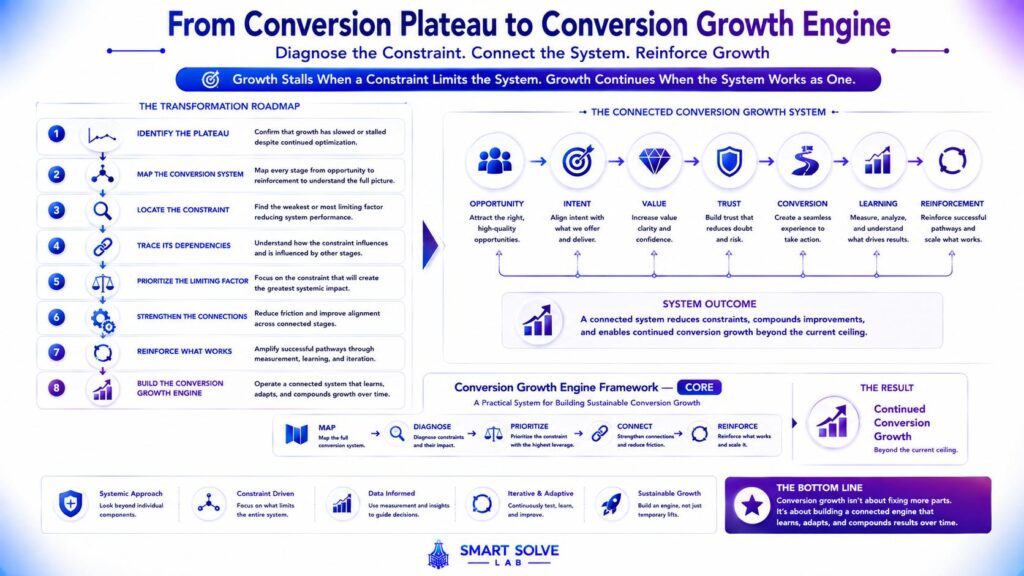
    Why conversion growth stalls when optimization reaches a system limit
    Conversion growth can stall when isolated optimization reaches the limits of the underlying system.

    conversion growth stalls :

    At first, conversion growth can feel relatively straightforward.

    A business improves a landing page, clarifies an offer, strengthens a call to action, improves the customer journey, or attracts more qualified visitors—and conversion performance begins to improve. These early gains create momentum and can make it seem as though continued optimization will naturally produce continued growth.

    But eventually, something changes.

    The improvements become smaller. A new optimization produces only a modest gain. Another change improves one metric but has little effect on overall growth. More traffic creates more opportunities, yet conversion growth does not accelerate at the same rate. Businesses continue optimizing, but the conversion system seems increasingly resistant to further improvement.

    This is where many businesses misdiagnose the problem.

    They assume they simply need more optimization.

    So they continue changing landing pages, CTAs, offers, campaigns, and other conversion components. Some changes produce temporary improvements, but the overall growth pattern eventually returns to the same plateau.

    The problem may no longer be the individual conversion component.

    It may be the system connecting those components.

    Conversion growth depends on more than the ability of one page or one interaction to convert a visitor. Qualified opportunities need to enter the system. Those opportunities need to align with the offer and their intent. Value and trust need to strengthen as commitment increases. The conversion experience needs to support meaningful action. And the business needs enough learning and reinforcement to understand what is working and strengthen the pathways that support continued growth.

    That creates a connected progression:

    Traffic & Opportunity

    Visitor Intent

    Value & Trust

    Conversion Experience

    Customer Action

    Learning & Reinforcement

    Conversion Growth

    When these stages work together, optimization can contribute to a stronger growth system. But when one or more structural constraints limit the system, improving individual components may produce increasingly smaller returns.

    This creates an important distinction:

    Conversion improvement is not the same as a conversion growth engine.

    A business can improve its conversion rate without building the conditions required for continued conversion growth.

    The important question, therefore, is not simply:

    “What should we optimize next?”

    It is:

    “Has the conversion system reached a structural limit—and if so, where is that limit coming from?”

    In this article, we’ll examine why conversion growth stalls, what a conversion growth ceiling can reveal about the underlying system, which structural constraints can limit continued growth, why isolated optimization eventually reaches its limits, and how a connected conversion growth engine creates a stronger foundation for continued improvement.

    Table of Contents

    Conversion growth ceiling showing diminishing gains from continued optimization
    Continued optimization can produce smaller gains when the conversion system reaches a structural ceiling.

    What Does “Conversion Growth Has Stalled” Actually Mean?

    A conversion growth stall does not necessarily mean that conversions have stopped completely. More often, it means that conversion performance is no longer improving at the same pace despite continued effort and optimization.

    A business may still be generating leads, sales, sign-ups, or other desired actions. The problem is that each new improvement produces less meaningful growth than the previous one.

    This distinction matters because a business can have a healthy conversion rate while still experiencing a conversion growth problem.

    For example, a landing page may improve its conversion rate from one period to another, yet overall conversion growth may remain limited because the quality of incoming opportunities has changed, visitor intent is weaker, or another stage of the system has become the constraint.

    The question is therefore not simply whether conversions are happening.

    The better question is:

    Is the system continuing to create additional conversion growth from continued effort?

    Conversion Improvement vs. Sustainable Conversion Growth

    A conversion improvement is a positive change in one part of the system.

    A stronger headline may improve response. A clearer offer may increase engagement. A better customer journey may improve progression. A more relevant audience may produce higher-quality opportunities.

    These improvements can be valuable.

    But sustainable conversion growth requires more than improving individual components. It requires the broader system to continue producing, learning from, and reinforcing meaningful conversion opportunities.

    This creates an important distinction:

    Conversion Improvement

    → Better performance in a component or stage

    Conversion Growth

    → Continued improvement across the connected system

    A business can therefore experience several successful optimization wins without building the conditions required for continued growth.

    Why Early Gains Are Easier Than Later Gains

    Early optimization often targets obvious weaknesses.

    A confusing message becomes clearer. A poorly aligned offer becomes more relevant. A weak transition becomes easier to understand. These changes can unlock opportunities that were previously being lost.

    As those obvious constraints are addressed, however, the remaining weaknesses may become less visible and more interconnected.

    The next improvement may depend on fixing something upstream.

    A conversion page may be performing reasonably well, but the quality of visitors reaching it may limit further growth. Alternatively, traffic may be strong while visitor intent is poorly aligned with the offer.

    At this stage, simply making another isolated change may produce only a small improvement.

    This is one reason conversion growth can feel increasingly difficult even when a business is still optimizing actively.

    When Conversion Rates Improve but Growth Still Slows

    Conversion rate and conversion growth are related, but they are not identical.

    A business can improve the percentage of visitors who convert while overall growth remains constrained by the number or quality of opportunities entering the system.

    Likewise, more opportunities may enter the system while conversion growth remains limited because intent, trust, value clarity, or progression becomes the bottleneck.

    This means that looking at one conversion metric in isolation can hide the structural condition of the wider system.

    A stronger diagnosis considers both:

    How efficiently are opportunities converting?

    and

    How effectively is the overall system creating additional conversion growth?

    Why More Optimization Can Produce Smaller Gains

    When businesses encounter smaller gains, the natural response is often to optimize more aggressively.

    But more optimization does not automatically mean more growth.

    If the underlying constraint exists somewhere else in the system, repeatedly improving the same component eventually reaches a limit. The component may already be performing reasonably well relative to the conditions surrounding it.

    At that point, further optimization can produce diminishing gains because the system does not have enough capacity elsewhere to convert those improvements into meaningful additional growth.

    This is why a plateau should not automatically be interpreted as an optimization failure.

    It may instead be a system signal.

    What a Conversion Plateau Reveals About the System

    A conversion plateau can indicate that the current system has reached the limit of what isolated improvements can produce.

    The visible conversion point may appear to be the problem, but the actual constraint could exist earlier in the journey—or even in the learning and reinforcement mechanisms that determine which improvements are repeated and expanded.

    The diagnostic question therefore changes from:

    “What should we optimize next?”

    to:

    “What is currently limiting the system’s ability to produce additional conversion growth?”

    That shift is crucial.

    A conversion plateau does not automatically mean that optimization has failed. It may indicate that the current conversion system has reached the limit of what isolated improvements can produce.

    This is also why recurring conversion problems deserve attention at the system level rather than being treated as a series of unrelated page-level issues.

    conversion problems keep repeating

    Why More Conversion Optimization Doesn’t Always Create More Growth

    Once a business has addressed its most obvious conversion weaknesses, continued optimization does not necessarily produce the same level of growth.

    A landing page can become clearer. A CTA can become easier to understand. An offer can become more relevant. A campaign can bring in additional visitors. Each improvement may be valuable, yet overall conversion growth can still slow down.

    The reason is simple: conversion performance is influenced by connected conditions across the entire system.

    When one component improves but the conditions around it remain constrained, the improvement eventually reaches a limit.

    Local Improvements Have a Limited Reach

    An improvement made at one stage can only directly influence the conditions that stage controls.

    A stronger landing page can improve the experience for visitors who reach it, but it cannot determine whether those visitors are the right audience.

    A clearer CTA can make the next action easier to understand, but it cannot create sufficient trust if customers remain uncertain about the offer.

    An improved offer can increase perceived value, but it cannot automatically repair poor traffic quality or a disconnected customer journey.

    This creates a natural limit to component-level optimization.

    The important question becomes whether improvements in one stage are supported by the stages around it.

    Traffic Quality Can Limit Conversion Potential

    More visitors create more opportunities, but not every additional visitor represents an equally valuable conversion opportunity.

    If incoming traffic has weak relevance or lower purchase intent, the system may receive more visitors without receiving more qualified opportunities. Conversion growth can therefore remain constrained even while traffic continues increasing.

    This is why conversion growth cannot be separated completely from the quality of opportunities entering the system.

    More traffic can increase opportunity volume, but it does not automatically increase the quality of those opportunities.

    When opportunity quality becomes the constraint, repeatedly optimizing the final conversion interaction may produce increasingly smaller gains.

    Intent and Offer Alignment Can Become the Constraint

    Even when traffic quality is reasonable, visitors need to recognize that the offer matches what they are trying to accomplish.

    A visitor can have a genuine need and still fail to progress if the offer does not align clearly with their current intent.

    For example, a visitor who is still evaluating possible solutions may not respond to an experience designed for someone already ready to purchase. Conversely, a highly motivated visitor may lose momentum when the journey does not provide a clear path toward the appropriate action.

    In both situations, the conversion problem is not necessarily the final conversion component.

    The constraint exists in the relationship between visitor intent and the offer.

    Trust Improvements Eventually Encounter Structural Limits

    Trust can strongly influence conversion decisions, but trust-building elements cannot compensate indefinitely for weaknesses elsewhere in the system.

    Testimonials, credibility signals, guarantees, evidence, and reassurance can strengthen confidence. However, if customers still do not understand the value of the offer or the journey creates unnecessary uncertainty, adding more trust signals will not automatically resolve the deeper constraint.

    Trust operates within a larger conversion architecture.

    It becomes more effective when relevance and value are already clear and customers have a logical path toward action.

    Conversion Experience Can Improve Without Expanding the Growth Engine

    Improving the conversion experience can produce meaningful gains.

    However, a better conversion experience does not automatically expand the capacity of the entire conversion system.

    If opportunity quality, intent alignment, value, learning, or reinforcement remains constrained, the improved conversion experience eventually operates within those limits.

    This can create a recurring cycle:

    Component Improvement

    Conversion Gain

    System Constraint Appears

    Another Component Improvement

    Temporary Gain

    Another Constraint Appears

    The problem is not that optimization is ineffective.

    The problem is that isolated optimization cannot indefinitely compensate for structural constraints elsewhere in the system.

    Improving one conversion component can create a temporary performance gain, but it cannot indefinitely expand the capacity of a disconnected conversion system.

    This is the point where businesses need to stop asking only “What should we optimize next?” and start asking:

    “What is limiting the conversion system’s ability to produce additional growth?”

    That question moves the diagnosis from individual conversion components toward the underlying Conversion Growth Engine.

    The Six Structural Constraints That Can Stall Conversion Growth

    Conversion growth can stall even when individual components appear to be performing reasonably well. The constraint may exist earlier in the system, between stages, or in the business’s ability to learn from and reinforce what is working.

    The important point is that these constraints should not be treated as six unrelated problems. They are connected conditions that collectively determine how much conversion growth the current system can support.

    1. Opportunity Quality Constraint

    The first question is whether enough relevant and qualified opportunities are entering the conversion system.

    A business can have an effective conversion experience and still struggle to grow if the incoming opportunities are poorly aligned with the product, service, or customer profile.

    More traffic does not automatically remove this constraint. If additional visitors have weak relevance or low intent, increasing volume may produce little meaningful conversion growth.

    The diagnostic question is:

    Are enough relevant and qualified opportunities entering the system?

    2. Intent Alignment Constraint

    Once opportunities enter the system, their intent needs to align with what the business is offering and what the customer is currently ready to do.

    A visitor may have a genuine problem but still be too early in the decision process for the requested action. Another visitor may be ready to move forward but encounter a journey that does not match that readiness.

    When intent and progression become disconnected, conversion opportunities can be lost before customers reach the final conversion stage.

    The diagnostic question is:

    Are visitors sufficiently aligned with the offer and their current decision stage?

    3. Value & Trust Constraint

    Customers need both value clarity and sufficient confidence to continue toward action.

    Value answers the question:

    “Why does this solution matter to me?”

    Trust answers another:

    “Why should I feel confident choosing it?”

    If either remains weak, customers may remain interested without developing enough confidence to convert.

    The diagnostic question is:

    Does the system continuously strengthen perceived value and decision confidence?

    4. Conversion Path Constraint

    Even when customers understand the value and trust the solution, progression can still weaken if the path toward action is unclear or unnecessarily difficult.

    The conversion path should allow interested customers to move naturally from one decision to the next without disconnected transitions or avoidable friction.

    This does not mean every customer should be pushed toward immediate action. It means the journey should provide a logical next step appropriate to the customer’s current level of readiness.

    The diagnostic question is:

    Can interested visitors progress naturally toward meaningful action?

    5. Learning Constraint

    Conversion growth requires more than generating conversions. The business also needs to understand what is influencing those conversions.

    Without sufficient learning, businesses may continue optimizing based on visible symptoms rather than understanding the conditions actually driving performance.

    This can create a cycle where changes are repeatedly made, but the business remains uncertain about why growth improved, stalled, or declined.

    The diagnostic question is:

    Can the business identify what is actually driving or limiting conversion performance?

    6. Reinforcement Constraint

    Even when a successful conversion pathway is discovered, growth can remain limited if that pathway is not strengthened and expanded.

    A useful conversion insight should influence future decisions. Successful pathways should become clearer, stronger, and more consistently supported across the system.

    Without reinforcement, improvements can remain isolated events rather than becoming part of a stronger growth engine.

    The diagnostic question is:

    Are successful conversion pathways being strengthened and expanded—or are improvements remaining isolated?

    Diagnostic Principle

    These six constraints should not be viewed independently.

    A weakness in opportunity quality can affect intent. Weak intent can increase the importance of value and trust. Reduced confidence can make customers more sensitive to friction. Limited learning can make those weaknesses harder to identify, while weak reinforcement can prevent successful improvements from becoming repeatable system strengths.

    Most importantly:

    A conversion growth ceiling can appear at the point of conversion even when the underlying constraint exists earlier in the system.

    This is why diagnosing only the visible conversion point can produce incomplete conclusions. The constraint limiting growth may exist upstream, downstream, or in the connections between stages.

    Six structural constraints that can stall conversion growth
    Conversion growth can stall when structural constraints limit opportunity, intent, trust, conversion, learning, or reinforcement.

    Why Fixing Conversion Components One at a Time Eventually Stops Working

    Once the major structural constraints are understood, another pattern becomes visible: businesses can spend a great deal of time improving individual conversion components without creating the conditions required for continued growth.

    This does not mean component optimization is unnecessary. Individual improvements can be useful and can produce measurable gains. The problem appears when every slowdown is treated as another isolated component that needs to be fixed.

    The business then enters an optimization cycle instead of building a stronger conversion growth system.

    Landing Page Improvements Can Reach a Ceiling

    A landing page can become clearer, more relevant, and easier to navigate. These improvements may increase conversion performance when the page contains genuine weaknesses.

    But a landing page can only influence the opportunities that reach it.

    If traffic quality is weak, visitor intent is misaligned, or trust has not developed sufficiently, continuing to optimize the landing page may produce increasingly smaller gains.

    The page may no longer be the primary constraint.

    CTA Improvements Can Reach a Ceiling

    A clearer call to action can make the next step easier to understand. It can reduce ambiguity and help customers recognize what they should do next.

    But clarity of direction does not automatically create readiness to act.

    If customers remain uncertain about the value of the offer or lack sufficient confidence, repeatedly changing the CTA may improve the interaction without resolving the underlying hesitation.

    A CTA can guide progression, but it cannot carry the entire conversion system.

    Offer Changes Can Improve One Segment Without Expanding the System

    Changing an offer can improve alignment for a particular audience segment.

    However, a stronger offer does not automatically solve problems involving opportunity quality, customer intent, trust, progression, measurement, or reinforcement.

    An offer can therefore perform better for one group while the overall conversion system remains constrained elsewhere.

    This is an important distinction between improving an offer and expanding the capacity of the conversion system.

    Campaign Optimization Can Increase Opportunity Without Fixing Downstream Constraints

    Campaign improvements can increase the number of visitors or potential customers entering the system.

    But if the downstream experience cannot convert those opportunities effectively, additional volume may simply expose the same structural weakness at a larger scale.

    More opportunity does not automatically mean more conversion growth.

    If intent alignment, value, trust, or conversion progression remains constrained, campaign optimization alone cannot remove that limitation.

    Why Repeated Micro-Optimizations Produce Diminishing Gains

    When every slowdown leads to another small component-level adjustment, the pattern can become predictable:

    Component Improvement

    Temporary Conversion Gain

    Plateau

    Another Component Fix

    Temporary Gain

    Repeated Plateau

    Each improvement may be valid in isolation. The problem is that the business is repeatedly treating the visible symptom rather than examining the system that determines whether those improvements can continue producing growth.

    This creates an optimization cycle rather than a growth engine.

    The difference is important.

    An optimization cycle asks:

    “What can we improve next?”

    A growth engine asks:

    “What is currently limiting the system, and what must become stronger for growth to continue?”

    Once the business reaches this point, continued progress depends less on finding another isolated improvement and more on understanding the dependencies between conversion stages.

    Conversion optimization cycle showing repeated temporary gains and plateaus
    Repeated component-level fixes can create temporary gains without producing sustained conversion growth.

    How Conversion Growth Constraints Compound Across the System

    Conversion constraints rarely operate in isolation. A weakness in one stage can change the conditions under which another stage performs, making downstream optimization less effective than expected.

    This is why a conversion problem can sometimes appear difficult to explain. The visible performance issue may occur at the conversion point, while the conditions creating that weakness developed much earlier in the system.

    Weak Opportunity Quality Can Affect Intent Alignment

    When the system attracts a large number of poorly aligned opportunities, the proportion of visitors with meaningful intent can decline.

    This creates pressure on every stage that follows.

    Even a strong conversion experience may struggle when the incoming opportunity pool does not contain enough relevant prospects.

    Lower Intent Can Increase the Trust Requirement

    When customers are less certain about whether a solution matches their needs, they naturally require more confidence before progressing.

    The system may therefore need to overcome greater uncertainty before customers are willing to take meaningful action.

    If value and trust do not strengthen accordingly, conversion performance can become constrained.

    Greater Uncertainty Can Increase Sensitivity to Friction

    Customers who already feel uncertain are often less tolerant of unnecessary effort.

    A transition that might feel perfectly reasonable to a highly confident customer can become another reason to hesitate when earlier stages have already weakened confidence.

    This means friction is not experienced independently.

    Its impact depends partly on the condition of the customer when they encounter it.

    Weak Learning Can Hide the Real Constraint

    When businesses cannot clearly understand what is driving or limiting conversion performance, they may continue optimizing visible components without identifying the underlying constraint.

    This creates a feedback problem.

    The business changes something.

    Performance changes.

    The reason is unclear.

    Another component is changed.

    The system remains difficult to diagnose.

    Without meaningful learning, optimization becomes increasingly reactive.

    Weak Reinforcement Prevents Gains From Becoming System Strengths

    Even when a successful pathway is identified, the improvement may remain isolated if the business does not strengthen and extend what it has learned.

    A successful conversion pathway should become an input for future decisions rather than a one-time improvement.

    Without reinforcement, the system can repeatedly rediscover similar improvements instead of building upon them.

    How the Constraints Interact

    The broader relationship can be represented as:

    Weak Opportunity Quality

    Lower Intent Alignment

    Greater Trust Requirement

    More Conversion Friction

    Lower Learning Clarity

    Weak Reinforcement

    Conversion Growth Stalls

    The sequence does not mean that every business experiences these constraints in exactly this order. Rather, it illustrates how weaknesses can interact and amplify one another across a connected conversion system.

    One unresolved constraint can reduce the effectiveness of optimization performed somewhere else.

    A weakness in one stage can reduce the effectiveness of optimization performed in another stage.

    This is why identifying a single low-converting component is not always enough. The more important diagnostic task is understanding the dependencies between conversion stages and determining which constraint is limiting the system most significantly.

    Conversion growth constraints compounding across the conversion system
    One upstream weakness can reduce the effectiveness of optimization performed elsewhere in the conversion system.

    What a Conversion Growth Engine Actually Needs

    Once the structural constraints are understood, the next question is what a stronger conversion growth system needs in order to support continued improvement.

    The answer is not another isolated optimization tactic. A growth engine requires connected stages that work together—from the quality of opportunities entering the system to the learning and reinforcement that help successful pathways become stronger over time.

    Conversion Growth Engine Architecture

    A connected conversion growth system can be represented as:

    Qualified Opportunity

    Intent Alignment

    Value & Trust

    Conversion Experience

    Customer Action

    Measurement & Learning

    Reinforcement

    Conversion Growth

    Each stage has a different responsibility, but none operates completely independently.

    Qualified Opportunity — Are the Right Opportunities Entering?

    Growth begins with opportunity quality.

    The system needs a sufficient flow of relevant prospects whose problems, needs, or circumstances align with the solution being offered.

    This does not mean maximizing traffic at any cost. It means creating enough qualified opportunity for the downstream conversion system to work with meaningful potential.

    Intent Alignment — Are Opportunities Aligned With the Offer?

    Once relevant opportunities enter, their intent needs to align with the offer and the stage of their decision process.

    A customer who is still exploring a problem may need a different progression path from someone actively comparing solutions.

    When the next experience matches the customer’s intent, progression becomes more natural.

    Value & Trust — Is Confidence Increasing?

    Customers need to understand both why the solution matters and why they should feel confident continuing.

    Value creates relevance.

    Trust strengthens confidence.

    Together, they help customers move from interest toward meaningful consideration.

    As commitment increases, the system should continue strengthening both rather than assuming that early interest automatically carries through to purchase.

    Conversion Experience — Can Customers Progress Naturally?

    The conversion experience should make meaningful action clear and reasonable.

    Customers should understand what happens next, why the action is appropriate, and how it connects to the value they are seeking.

    A strong conversion experience does not attempt to force every visitor into the same action. It supports progression according to the customer’s level of readiness.

    Customer Action — Are Meaningful Conversions Occurring?

    The system ultimately needs to produce meaningful customer actions.

    These may differ depending on the business model, but the important point is that the action should represent genuine progression rather than simply creating another engagement metric.

    Conversion growth becomes more useful when the system measures actions that actually contribute to business objectives.

    Measurement & Learning — Do We Understand Why Performance Changes?

    A growth engine needs feedback.

    Businesses need to understand not only whether conversion performance changed, but also what the available evidence suggests about the conditions influencing that change.

    Without learning, businesses can easily confuse correlation with cause, repeat ineffective changes, or overlook the actual constraint.

    This is where measurement becomes part of the growth architecture rather than simply a reporting activity.

    Reinforcement — Are Successful Pathways Becoming Stronger?

    Learning becomes valuable when it influences future decisions.

    When a pathway consistently supports stronger progression, the system should be able to reinforce what has been learned rather than treating each improvement as an isolated event.

    This creates a feedback loop:

    Measure

    Learn

    Identify What Supports Progression

    Reinforce

    Improve the System

    Measure Again

    Over time, this reinforcement layer helps the conversion system build upon what it learns rather than repeatedly starting from scratch.

    Can Growth Continue Beyond the Current Ceiling?

    The ultimate question is not whether every stage is perfect.

    It is whether the system can continue learning, strengthening connections, and expanding the conditions that support meaningful conversion growth.

    A stronger engine therefore combines:

    Opportunity

    Intent

    Value & Trust

    Conversion

    Learning

    Reinforcement

    Rather than treating these as separate optimization tasks, the system connects them into one growth architecture.

    For businesses evaluating customer journeys and conversion performance, measurement can help reveal where users progress or fail across important steps. Google Analytics’ official Funnel Exploration documentation provides a useful reference for analyzing user journeys and identifying where users complete or abandon steps.

    This external reference supports the measurement and learning component of the architecture without turning the article into a tactical analytics tutorial.

    Conversion Growth Engine architecture from qualified opportunity to continued growth
    A connected conversion growth engine links opportunity, intent, value, trust, action, learning, and reinforcement.

    The System Insight: Conversion Growth Requires an Engine, Not Just Optimization

    At this point, the distinction becomes clearer: improving individual conversion components can create valuable gains, but those improvements are not the same as building the system that allows conversion growth to continue.

    A business can have a well-designed landing page, a strong offer, effective CTAs, and healthy conversion metrics while still experiencing a growth ceiling. The missing element may be the connections between these components.

    Landing Page Optimization ≠ Growth Engine

    A landing page can improve relevance, clarity, and progression.

    But it cannot independently control the quality of opportunities entering the system, the customer’s intent, the development of trust, or the learning and reinforcement that follow conversion.

    It is one component of the engine—not the engine itself.

    CTA Optimization ≠ Growth Engine

    A CTA can make the next action clearer.

    But clarity of direction does not automatically create customer readiness, trust, or sufficient perceived value.

    A stronger CTA can improve an interaction without resolving the structural constraint limiting the wider system.

    Traffic Growth ≠ Growth Engine

    More traffic creates more potential opportunities.

    But traffic volume alone does not guarantee qualified opportunities, aligned intent, meaningful conversions, or continued growth.

    A business can increase traffic while its conversion system remains constrained by factors further downstream.

    Offer Optimization ≠ Growth Engine

    A stronger offer can improve relevance and perceived value.

    But even a compelling offer depends on the right opportunities reaching it, customers understanding its relevance, trusting the business, and having a clear path toward action.

    The offer is an important part of the system—but it does not operate independently from the rest.

    Conversion Rate ≠ Growth Engine

    A conversion rate is an important performance signal, but it represents only one part of the broader growth picture.

    A higher conversion rate does not automatically mean the system has developed the ability to generate continued growth.

    Conversion growth depends on the interaction between opportunity, intent, value, trust, conversion, learning, and reinforcement.

    Optimization vs. Growth Infrastructure

    This creates an important distinction:

    Optimization improves individual parts of the existing system.

    Growth Infrastructure connects those parts so the system can learn, adapt, and reinforce what supports continued growth.

    Optimization asks:

    “How can this component perform better?”

    Growth infrastructure asks:

    “How do these components work together to create and reinforce growth?”

    That difference becomes increasingly important as a business matures. Early growth can often come from fixing obvious weaknesses. Continued growth requires understanding the system that determines whether those improvements can keep producing meaningful results.

    Conversion growth becomes more sustainable when opportunity, intent, value, trust, conversion, measurement, and reinforcement operate as a connected system rather than isolated optimization activities.

    The goal is therefore not to stop optimizing individual components. It is to place those improvements inside a stronger architecture where each improvement can contribute to the wider conversion growth system.

    Comparison between isolated conversion optimization and a connected conversion growth engine
    Optimization improves individual components; a growth engine connects and reinforces the conditions that support continued growth.

    From Conversion Plateau to Conversion Growth Engine

    Once a conversion growth plateau is recognized as a system-level signal, the next step is to move from observation to structured diagnosis.

    The goal is not to optimize every part of the conversion system equally. It is to understand where growth is being constrained, why that constraint exists, and which connected weaknesses should be addressed first.

    Conversion Growth Engine Framework — Core

    The Conversion Growth Engine Framework is designed as a system-level approach for understanding the conditions that influence conversion growth.

    Rather than treating landing pages, offers, traffic, customer journeys, and conversion metrics as separate optimization tasks, the framework connects them into a broader architecture.

    Its purpose is to help businesses:

    Map

    Diagnose

    Prioritize

    Connect

    Reinforce

    This creates a more structured path from identifying a conversion plateau to understanding what is limiting the system’s ability to continue growing.

    Map the Conversion Growth System

    The first step is to understand how the major conditions contributing to conversion growth are connected.

    This means looking beyond the final conversion point and examining the progression from opportunity through intent, value, trust, conversion, learning, and reinforcement.

    Mapping creates visibility into the system before decisions are made about what should be changed.

    Diagnose Structural Constraints

    Once the system is mapped, the next objective is to identify where progression or growth is being constrained.

    The important question is not simply:

    “Which component is performing poorly?”

    It is:

    “Which structural condition is limiting the performance of the wider system?”

    This distinction helps prevent businesses from repeatedly fixing symptoms while leaving the underlying constraint untouched.

    Prioritize the Most Limiting Factors

    Not every weakness deserves equal attention.

    Some constraints have a much wider influence because they affect multiple stages of the conversion system. Others may be localized and have limited downstream impact.

    A system-level framework therefore needs to help businesses distinguish between problems that are merely visible and problems that are genuinely limiting growth.

    The objective is to prioritize the constraint that can most meaningfully improve the system—not to optimize everything at once.

    Conversion growth depends on relationships between stages.

    Opportunity quality influences intent.

    Intent influences how value is perceived.

    Value and trust influence progression.

    Progression influences conversion.

    Learning influences future decisions.

    Reinforcement determines whether successful pathways become stronger.

    Understanding these dependencies helps explain why improving one component may produce limited results when an upstream constraint remains unresolved.

    Reinforce What Supports Continued Growth

    The final direction is reinforcement.

    When the system identifies pathways that consistently support meaningful conversion performance, those pathways should become part of the broader growth architecture rather than remaining isolated improvements.

    This creates a continuous loop:

    Map

    Diagnose

    Prioritize

    Connect

    Reinforce

    Learn

    Strengthen the System

    The framework therefore focuses on building a stronger conversion growth architecture rather than providing another collection of isolated conversion tactics.

    Blog → Product Boundary

    This article explains why conversion growth stalls and how structural constraints, dependencies, optimization limits, learning, and reinforcement contribute to the problem.

    The Conversion Growth Engine Framework goes one level deeper by providing the structured framework for:

    Map → Diagnose → Prioritize → Connect → Reinforce

    That boundary is intentional.

    The blog creates clarity around the problem.

    The Core framework provides the architecture for systematically examining and strengthening it.

    Conclusion — Conversion Growth Stalls When the System Reaches Its Limit

    Conversion growth does not always stall because a business has stopped optimizing.

    Sometimes, the business has simply reached the point where isolated improvements can no longer overcome the constraints of the wider conversion system.

    More CTA tests are not automatically the answer.

    More landing-page redesigns are not automatically the answer.

    More traffic is not automatically the answer.

    More campaigns are not automatically the answer.

    More isolated optimization is not automatically the answer.

    The stronger diagnostic sequence is to step back and examine the system as a whole.

    The Stronger Diagnostic Sequence

    Identify the Plateau

    Recognize that conversion performance is no longer improving at the expected rate.

    Map the Conversion System

    Understand how opportunity, intent, value, trust, conversion, learning, and reinforcement connect.

    Locate the Constraint

    Identify the condition currently limiting additional conversion growth.

    Trace Its Dependencies

    Understand how upstream and downstream stages influence that constraint.

    Prioritize the Limiting Factor

    Focus attention on the structural weakness with the greatest influence on the system.

    Strengthen the Connections

    Improve how the relevant stages work together rather than optimizing them in isolation.

    Reinforce What Works

    Use learning to strengthen pathways that consistently support meaningful conversion performance.

    This sequence changes the question from “What should we optimize next?” to “What is preventing the system from producing more growth?”

    That is a much stronger question because it recognizes that conversion growth is not produced by one component.

    It is produced by a connected system that can attract meaningful opportunities, align them with the right intent, build value and trust, support action, learn from performance, and reinforce what works.

    Conversion growth does not come from endlessly optimizing isolated components. It becomes stronger when the system that produces, learns from, and reinforces conversion performance becomes stronger.

    The goal is therefore not to eliminate every conversion weakness or guarantee unlimited growth. The goal is to understand the current growth constraint and strengthen the system so that future improvements have a stronger foundation.

    When conversion growth stalls, the most useful next step may not be another isolated optimization.

    It may be a better diagnosis of the Conversion Growth Engine itself.

    After Conclusion

    Roadmap from conversion plateau to Conversion Growth Engine Framework
    Diagnose the constraint, connect the system, and reinforce the pathways that support continued conversion growth.

    Continue exploring related Smart Solve Lab articles on conversion problems, customer journeys, and lead generation:

    Why Conversion Problems Keep Repeating (Even After Fixing Individual Pages)

    Why Your Website Gets Traffic But No Conversions (Even When Visitors Keep Coming)

    Why Lead Generation Feels Unpredictable (And Why More Traffic Doesn’t Fix It)

    Frequently Asked Questions (FAQs)

    Why does conversion growth stall?

    Conversion growth can stall when isolated improvements reach the limits of the underlying conversion system. The constraint may exist in opportunity quality, visitor intent, value and trust, conversion progression, learning, or reinforcement rather than in the final conversion component alone.

    Is a conversion plateau the same as a conversion failure?

    No. A conversion plateau means performance may still be healthy but is no longer improving at the same rate. It can indicate that the current system has reached the limit of what isolated optimization can produce.

    Why does more traffic not always increase conversion growth?

    More traffic creates additional opportunities, but those opportunities may not have sufficient relevance or intent. If opportunity quality or another downstream stage is constrained, increasing traffic may produce more visitors without proportionally increasing meaningful conversions.

    Why do repeated conversion optimizations produce smaller gains?

    Early improvements often address obvious weaknesses. As those issues are resolved, remaining constraints can become more interconnected. Further changes to individual components may therefore produce diminishing gains because the wider system is limiting their impact.

    What are the main constraints that can stall conversion growth?

    The six core constraints are opportunity quality, intent alignment, value and trust, conversion path, learning, and reinforcement. These constraints can interact, meaning a weakness in one stage may reduce the effectiveness of optimization elsewhere.

    What is the difference between conversion optimization and a conversion growth engine?

    Conversion optimization improves individual components or interactions. A conversion growth engine connects opportunity, intent, value, trust, conversion, learning, and reinforcement so that improvements can contribute to a stronger overall growth system.

    How can businesses diagnose a conversion growth ceiling?

    Start by identifying the plateau, map the connected conversion system, locate the limiting constraint, trace its dependencies, prioritize the most influential weakness, and then strengthen and reinforce the relevant connections.

    Does a stronger conversion growth system guarantee continued growth?

    No. A stronger system can improve the conditions that support conversion growth, but business performance is influenced by many factors outside the framework’s control. The objective is to create a more connected, measurable, and reinforceable growth system—not to promise unlimited results.