Why Conversion Problems Rarely Exist in Isolation
A conversion problem may appear in one place while the conditions influencing it exist across the wider customer journey.
A page may receive enough traffic but fail to generate action. Leads may arrive but remain inconsistent. Customers may enter the buying journey and disappear before completing the intended action. Conversion improvements may produce short-term gains, only for performance to stall again later.
These situations are often treated as separate problems. One page gets optimized. A funnel step gets adjusted. A call to action gets changed. More traffic is pursued. Another conversion point is tested.
But when related problems keep appearing, the deeper issue may not be the individual component being optimized. The problem may exist in the connections between the components that make conversion possible.
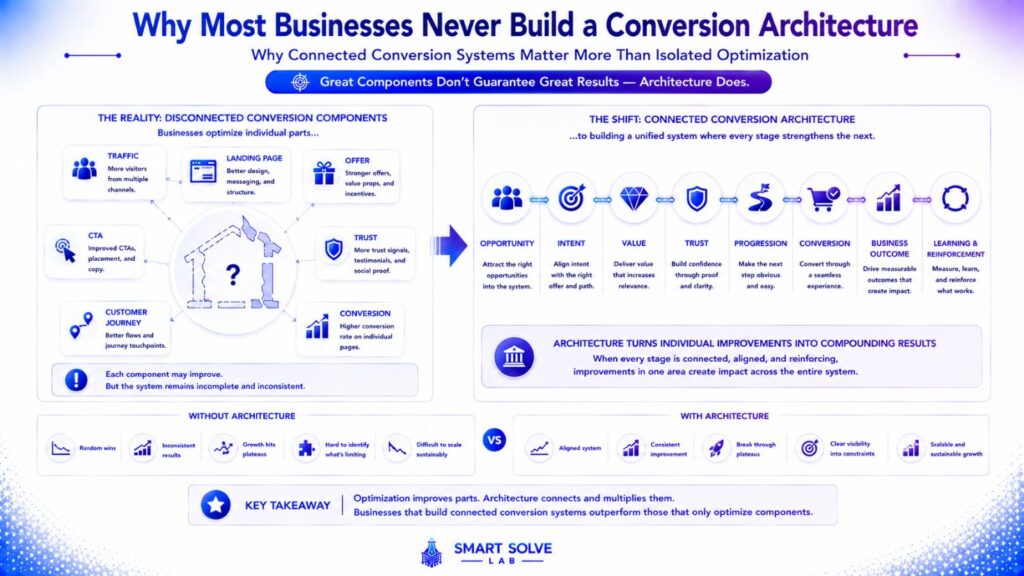
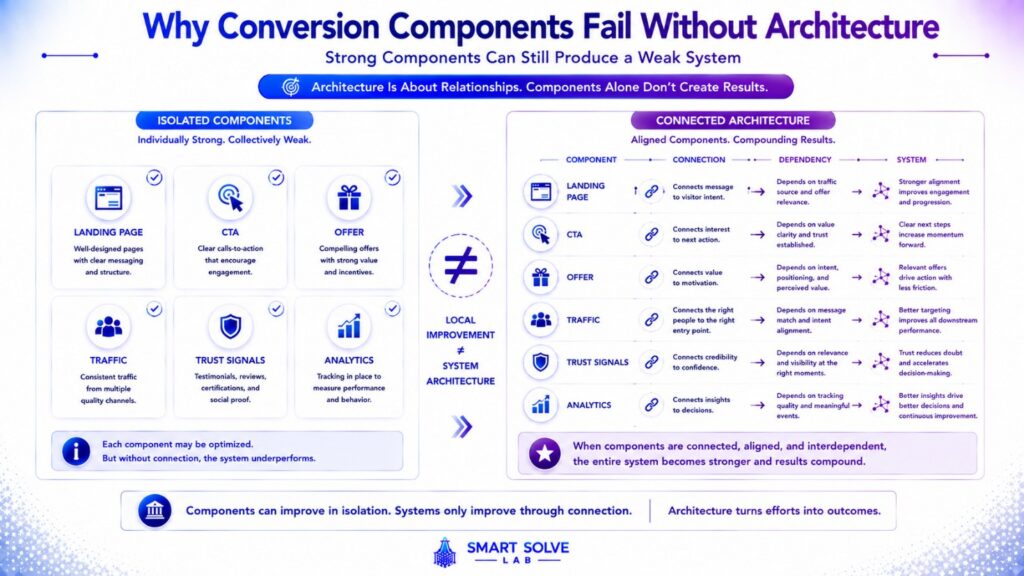
This is why fixing one conversion point does not always fix the wider system. A local improvement can strengthen one part of the journey while leaving another structural weakness unresolved. In some cases, improving one stage simply exposes a weakness further upstream or downstream.
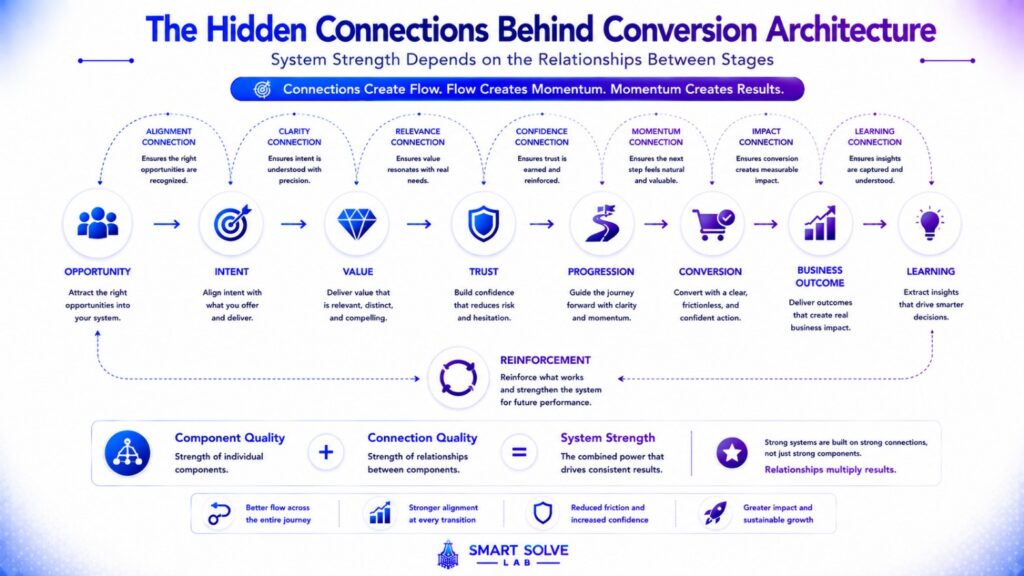
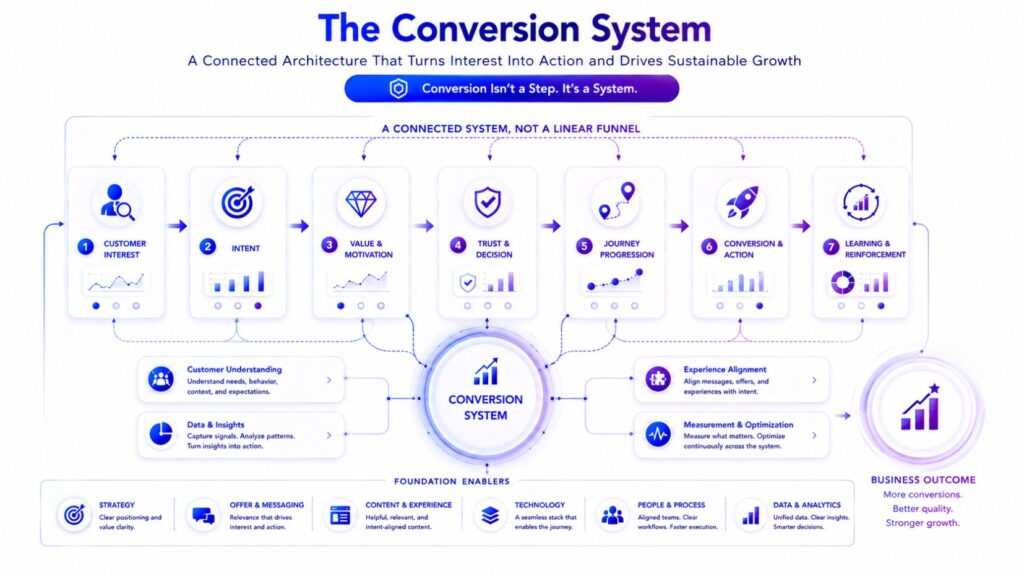
A conversion system looks beyond individual pages, buttons, forms, or funnel stages. It considers how customer interest, intent, value, trust, progression, action, measurement, and learning work together to move someone from initial interest toward a meaningful outcome.
The central idea is simple:
Conversion performance is not created by one page, one funnel stage, or one optimization. It emerges from the connected system through which customer intent, value, trust, progression, action, and learning work together.
Understanding that system changes the question from “Which conversion element should we fix?” to “How are the different parts of the conversion journey influencing one another?”
This pillar explores that wider perspective. It will help you understand what a conversion system is, why conversion problems repeat, how lead generation and customer progression connect with conversion, why isolated optimization eventually reaches limits, and how individual conversion problems can be understood as part of a larger connected system.
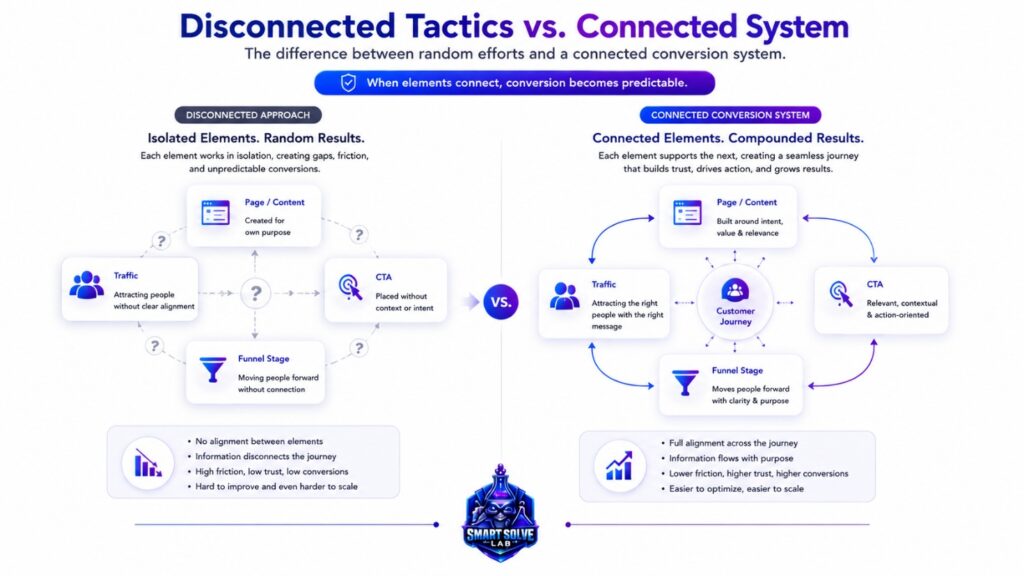
Table of Contents
Why Conversion Problems Rarely Exist in Isolation
Conversion problems rarely stay confined to the exact place where they become visible.
A business may notice that a landing page is not producing enough action, a lead form is receiving fewer submissions, or customers are leaving before completing a purchase. Because the problem appears at a specific point, it is natural to focus attention on that point first.
But the visible conversion problem may only be the symptom of a wider weakness somewhere in the connected customer journey.
For example, a weak conversion point may be influenced by what happened before the customer reached it. The visitor may not have arrived with the right intent. The value may not have been clear enough. Trust may not have developed sufficiently. The next step may not feel natural. Or an earlier stage may have weakened the customer’s motivation to continue.
This means the location where conversion performance becomes visible is not always the location where the underlying weakness began.
That distinction matters because businesses can spend significant time improving individual conversion points while the relationships between those points remain weak. A page may improve, a campaign may perform better, or a funnel step may produce a temporary gain, yet another weakness can appear further along the journey.
The result can become a repeating cycle:
Visible Problem → Local Fix → Temporary Improvement → Another Weakness → New Conversion Problem
The deeper question, therefore, is not simply whether an individual conversion component is working. It is whether the connected conditions around that component are strong enough to support customer progression.
This is where system thinking becomes important. Instead of examining conversion as a collection of independent points, a conversion system looks at how the important parts interact and influence one another.
Once those relationships become visible, individual conversion problems can be understood in a wider context rather than treated as isolated failures.
What Is a Conversion System?
A conversion system is the connected set of conditions, stages, and relationships that help move a potential customer from initial interest toward meaningful action.
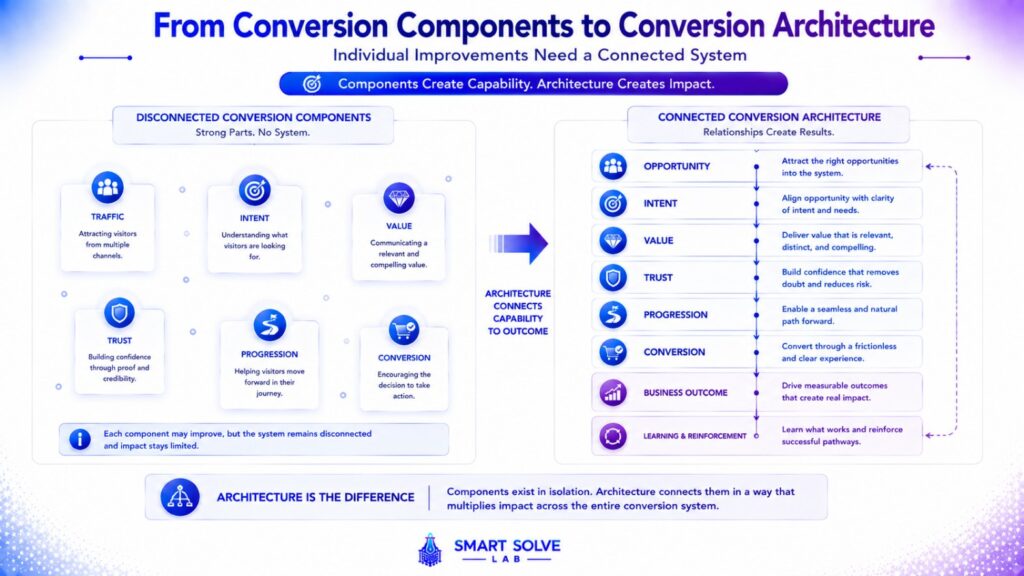
Conversion is therefore more than a button, landing page, form, or individual funnel stage. Each component may influence what happens before it, what happens after it, and whether the customer has enough clarity and confidence to continue.
A connected conversion journey can be understood at a high level as:
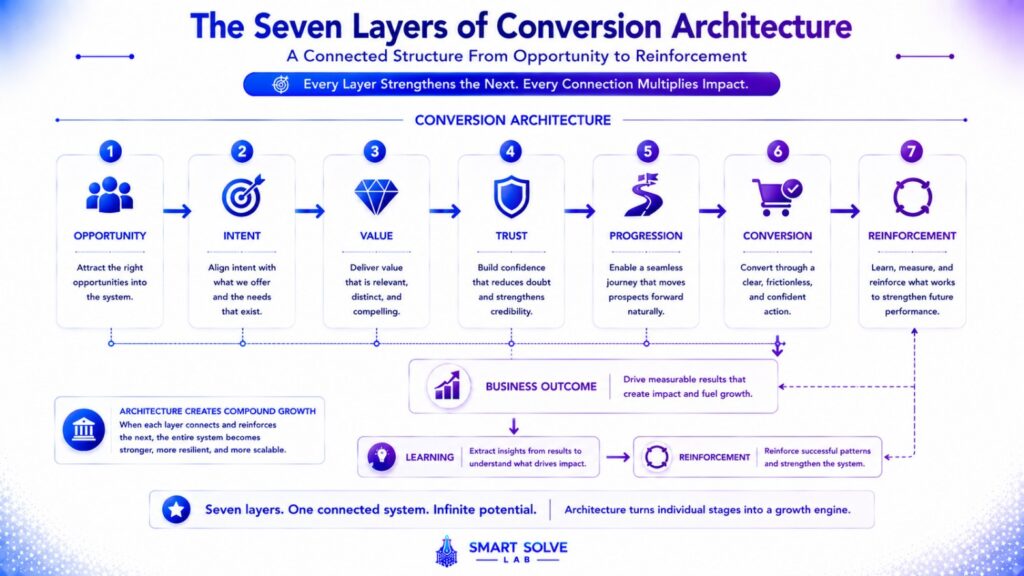
Customer Interest → Intent → Value & Motivation → Trust & Decision → Journey Progression → Action → Learning & Reinforcement
The important point is not to treat these stages as separate checklists. Their relationships matter.
Customer intent influences how value is perceived. Value and motivation influence whether someone wants to continue. Trust affects decision confidence. Journey progression determines whether the next step feels coherent. The resulting actions then create evidence that can be measured and learned from.
This is the difference between looking at conversion components and looking at a conversion system.
A collection of individually functional components does not automatically create a strong conversion system. If the connections between those components are weak, customers can still experience confusion, hesitation, friction, or a lack of confidence.
System thinking therefore asks a broader question:
How effectively do the important parts of the customer journey connect to support progression from interest to action?
Once conversion is viewed this way, a weak conversion point becomes more than an isolated metric or page-level issue. It becomes evidence that should be understood within the wider system surrounding it.
Why Conversion Problems Keep Repeating
When the same or related conversion problems continue appearing across different pages, campaigns, or stages of the customer journey, repeatedly fixing individual symptoms may not be enough.
A common pattern looks like this:
Symptom → Local Fix → Temporary Improvement → Hidden Structural Weakness → New Symptom → Repeat
The local fix may genuinely improve the point being addressed. The problem is that the wider system can still contain weaknesses that influence other stages of the journey.
For example, improving one conversion page may increase action at that point while an upstream weakness in intent alignment remains unresolved. Similarly, improving lead capture may not solve inconsistent lead quality if the earlier stages are attracting poorly aligned opportunities.
These relationships create structural dependencies across the conversion journey. One stage can influence another, which means the visible symptom is not always the root problem.
That is why recurring conversion problems deserve a wider question: what connects the problems that keep appearing?
Understanding those connections can reveal whether several apparently separate symptoms are actually different expressions of the same underlying weakness.
For a deeper look at this specific problem, see why conversion problems keep repeating even after fixing individual pages.
Recurring conversion problems are often system failures disguised as isolated symptoms.
The Core Layers of a Conversion System
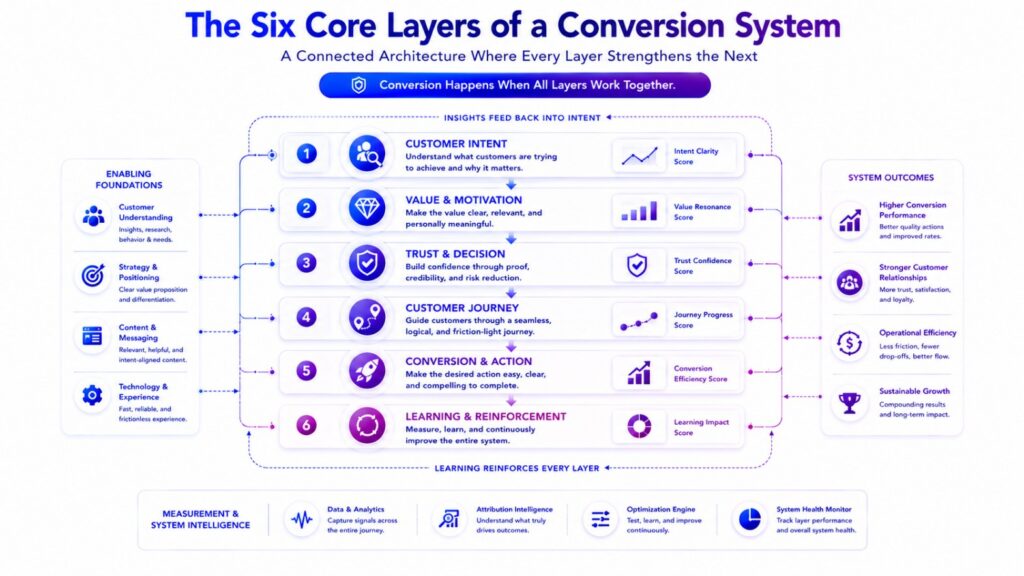
A connected conversion system can be understood through several core layers. These layers should not be treated as six independent checklists. Their real importance comes from how they interact to support customer progression.
1. Customer Intent
Conversion begins with understanding whether the people entering the journey have a meaningful reason to continue. Customer intent influences what they expect, what they are looking for, and how ready they are to take the next step.
If intent is poorly aligned with the journey, later conversion stages may struggle even when the individual components appear functional.
2. Value & Motivation
Interest alone does not guarantee progression. Customers need enough perceived value and motivation to believe that continuing the journey is worthwhile.
This layer connects what the customer wants with what the business is offering and how clearly that value is communicated.
3. Trust & Decision
Before meaningful action, customers often need sufficient confidence in the business, offer, and next step. Trust therefore plays an important role in whether interest develops into decision readiness.
A weakness in trust can interrupt progression even when intent and value are relatively strong.
4. Customer Journey
The journey connects the different stages through which a customer progresses. Each transition should make sense in relation to what came before and what the customer is expected to do next.
When those transitions become unclear or disconnected, friction can appear across the journey rather than at only one visible conversion point.
5. Conversion & Action
This is where customer progression becomes a measurable action, such as submitting a lead form, requesting information, starting a purchase, or completing another intended conversion.
However, the action itself should not be viewed in isolation. Its performance is influenced by the conditions established across the earlier layers.
6. Learning & Reinforcement
A conversion system also needs to learn from what happens. Measurement can provide evidence about which pathways are performing differently, where weaknesses may exist, and what deserves further attention.
Learning then becomes useful when stronger pathways and useful improvements are reinforced rather than treated as isolated wins.
Together, these layers form a connected system:
Customer Intent → Value & Motivation → Trust & Decision → Customer Journey → Conversion & Action → Learning & Reinforcement
The strength of the system depends not simply on whether each layer exists, but on whether the connections between them support consistent customer progression.
How Intent, Value, Trust, and Action Connect
Customer progression does not usually happen because of one isolated conversion element. It develops through a sequence of connected conditions that influence whether someone continues from initial interest toward action.
Intent Alignment
The journey begins with intent. Customers arrive with expectations, questions, needs, and different levels of readiness. When the journey aligns with that intent, progression becomes more relevant and coherent.
Perceived Value
Once intent is aligned, customers need a clear reason to continue. Perceived value helps answer the question of whether taking the next step is worthwhile.
Motivation
Value and motivation work together. Even when an offer appears relevant, customers may not progress if the perceived reason to act is not strong enough at that point in the journey.
Trust Before Commitment
Before taking a meaningful action, customers often need confidence that the business, offer, and next step are credible and appropriate for them. Trust therefore becomes an important bridge between interest and decision.
Journey Clarity
Customers also need to understand what happens next. A clear journey reduces uncertainty about progression and helps connect one stage of the experience with the next.
Decision Confidence
When intent, value, trust, and journey clarity work together, customers can develop greater confidence in their decision. This does not guarantee action, but it creates stronger conditions for meaningful progression.
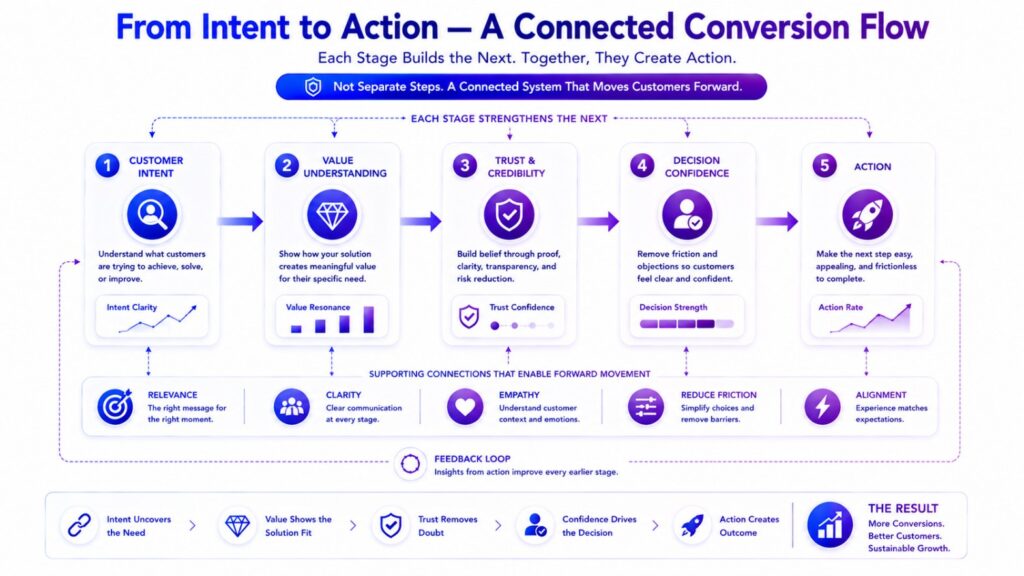
From Interest to Action
At a high level, these relationships can be understood as:
Intent → Value → Trust → Confidence → Action
The important insight is that these are not independent conversion levers. A weakness earlier in the sequence can influence what happens later. Understanding the connection therefore provides a more useful view of conversion performance than examining the final action alone.
Why Lead Generation and Conversion Cannot Be Separated
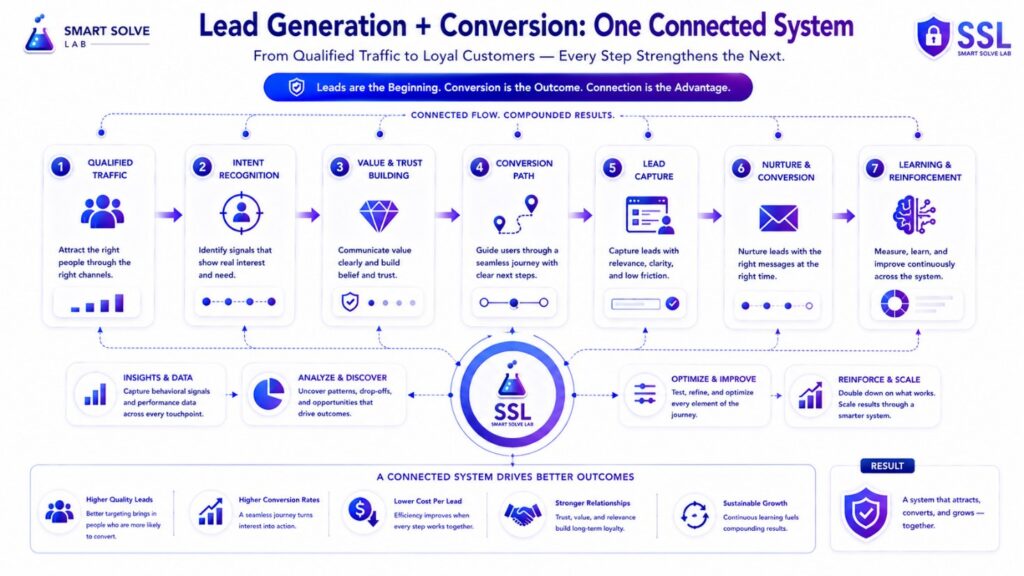
Lead generation is often treated as a separate activity from conversion. One team focuses on bringing visitors, while another focuses on turning those visitors into leads or customers.
But within a connected conversion system, these stages influence one another. The quality of incoming opportunities, the alignment of customer intent, the value being communicated, the level of trust, and the path toward action can all affect whether lead generation becomes meaningful business opportunity.
Qualified Traffic vs. Raw Traffic
More traffic does not automatically mean more valuable conversion opportunities. What matters is whether incoming visitors have sufficient relevance and intent to progress through the journey.
Intent Alignment
Once qualified visitors enter the system, their expectations need to align with the journey they encounter. Misalignment can weaken progression even when traffic volume appears healthy.
Value & Trust
Visitors need enough value clarity and confidence to continue. If the perceived value or trust conditions are weak, potential opportunities may disappear before reaching the lead-capture stage.
Conversion Path
The path from initial interest to lead action needs to connect logically. Unclear transitions or structural friction can interrupt progression between otherwise functional stages.
Lead Capture
Lead capture is an important conversion point, but it should not be viewed as the entire lead-generation system. Its performance depends partly on the quality and progression of the journey that leads customers toward it.
Measurement & Reinforcement
Measurement provides evidence about which pathways are producing stronger outcomes and where weaknesses may exist. That evidence can then help identify which parts of the system deserve further attention and reinforcement.
The connected relationship can be understood at a high level as:
Qualified Traffic → Intent → Value & Trust → Conversion Path → Lead Capture → Learning & Reinforcement
This is why lead generation and conversion should not be analyzed as completely separate systems. Weakness in one stage can influence performance in another, making the connections between them important to understand.
For a deeper exploration of why lead flow can become inconsistent, see why lead generation feels unpredictable.
Why Customers Drop Off Before Buying
When customers leave before completing an intended action, the visible exit point can make the problem appear easy to identify. A business may see where people stop progressing and naturally assume that the problem exists at that exact stage.
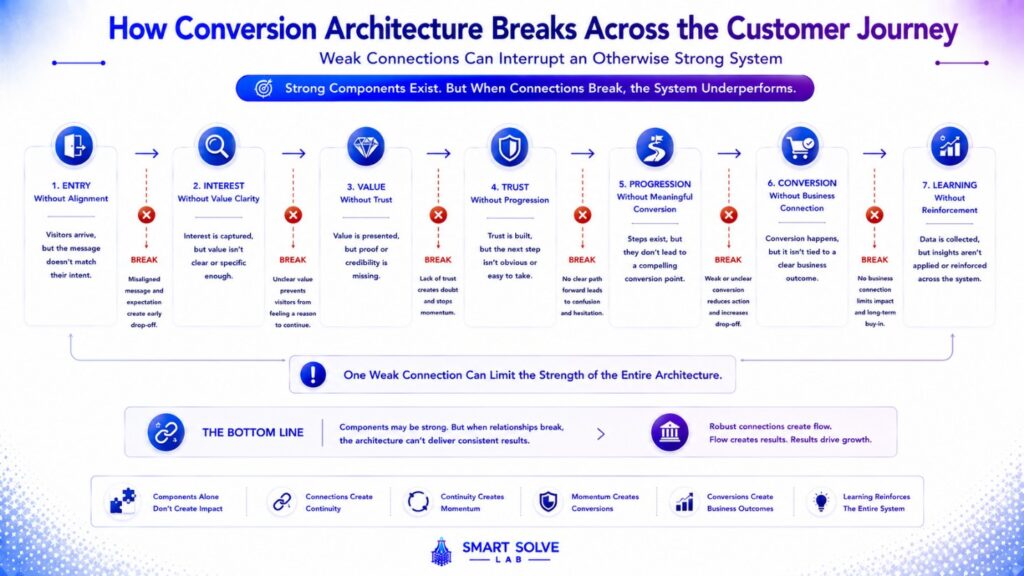
But customer progression is connected. The point where a customer leaves may only be where an earlier weakness finally becomes visible.
Where Customer Progression Weakens
Progression can weaken when intent becomes misaligned, value becomes unclear, trust is insufficient, the next step creates uncertainty, or friction develops between stages of the journey.
Why the Exit Point May Only Be a Symptom
A customer may leave at one stage because something weakened their confidence earlier. The visible drop-off therefore provides useful evidence, but it does not automatically explain where the journey first became weak.
Upstream and Downstream Influence
Earlier stages can influence later decisions, while weaknesses in one stage can also affect what happens afterward. This makes customer drop-off a journey-level issue rather than simply a page-level metric.
Journey Friction
Friction can emerge through unclear transitions, inconsistent expectations, weak value communication, insufficient trust, or unnecessary complexity. Individually, these may appear small, but together they can interrupt progression.
Progression, Not Just Exit Tracking
Tracking where customers leave is valuable because it provides evidence. But understanding conversion requires going beyond the exit point and asking what conditions influenced the customer’s progression toward that point.
The point where a customer leaves is not necessarily the point where the journey first became weak.
For a deeper examination of this journey-level problem, see why customers drop off before buying.
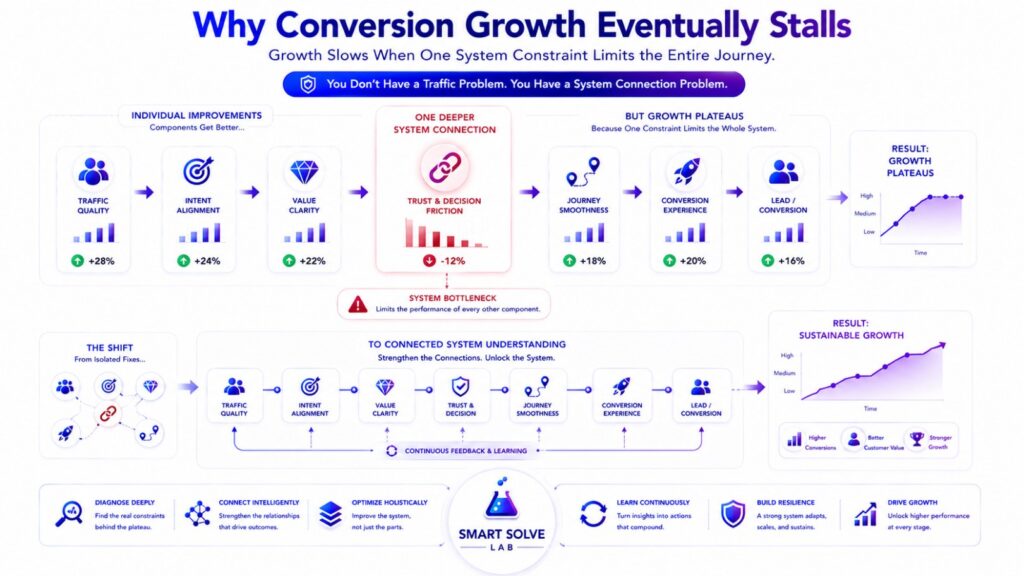
Why Conversion Growth Eventually Stalls
Conversion optimization can produce meaningful improvements, but those improvements do not always continue indefinitely. A business may optimize individual pages, strengthen specific funnel stages, or improve individual conversion points and still reach a point where further changes produce smaller gains.
This can happen because isolated improvements operate within the limits of the wider conversion system.
Component Optimization Has Limits
Improving an individual component can strengthen that part of the journey, but it cannot automatically remove weaknesses elsewhere. Once the most visible issues have been addressed, remaining constraints may exist in the relationships between stages.
Structural Constraints
A structural constraint is a weakness within the connected system that limits what the wider conversion journey can achieve. The constraint may not be located at the point where performance appears weakest.
This creates an important distinction between optimizing a component and understanding what is limiting the system.
Dependencies Between Conversion Stages
Conversion stages depend on one another. Stronger performance at one stage may have limited impact if another connected stage cannot support the resulting progression.
For example, improving action at one point may not create sustained growth if customer intent, value, trust, journey continuity, or learning remains weak elsewhere in the system.
Why More Optimization Is Not Always the Answer
When improvements begin producing smaller gains, the answer is not necessarily to optimize more aggressively. The more useful question may be whether the underlying system contains a constraint that is limiting the impact of further optimization.
At that point, conversion thinking needs to move from “What else can we optimize?” toward “What is limiting the system?”
From Component Optimization to System Understanding
System-level understanding helps businesses see why improvements may plateau even when individual components continue to receive attention.
Conversion growth can stall when isolated improvements reach the limits of the underlying system.
The goal is therefore not to stop optimizing individual components. It is to understand when component-level optimization is no longer enough and when the relationships and structural conditions across the wider conversion system need attention.
For a deeper exploration of this specific growth constraint, see why your conversion growth stalls.
From Individual Conversion Fixes to Conversion Architecture
Individual conversion fixes can be useful when a specific problem is clearly understood. But when multiple symptoms appear across the customer journey, treating each one separately can make the wider system increasingly difficult to understand.
Individual Symptoms
A business may begin with visible symptoms such as weak page conversion, inconsistent leads, customer drop-off, or stalled growth. Each symptom can appear to belong to a different part of the business.
System-Level Diagnosis
The next step is to examine whether these symptoms are connected. Instead of asking only why one component is underperforming, the focus shifts toward understanding how different stages influence one another.
Connected Relationships
Conversion performance depends on relationships between intent, value, trust, progression, action, and learning. Weakness in one relationship can influence performance elsewhere, even when individual components appear functional.
Dependencies and Priorities
Once relationships become visible, it becomes easier to recognize that not every weakness deserves equal attention at the same time. Some issues may influence several other stages, while others may have a more limited effect.
This creates a need for system-level prioritization rather than simply fixing whichever problem happens to be most visible.
Why the System Matters More Than a Single Component
A conversion architecture brings these relationships into a wider view. It focuses on how the important parts of the conversion journey fit together and whether they collectively support customer progression.
This does not mean individual conversion components stop mattering. Rather, their performance becomes easier to understand when viewed within the architecture that connects them.
For a deeper exploration of why businesses often fail to build this wider structure, see why most businesses never build a conversion architecture.
The shift is from fixing isolated conversion symptoms to understanding the connected architecture that allows those components to work together.
The Revenue Connection: Conversion Is Part of a Larger Growth System
Conversion does not operate independently from the rest of the business. While conversion determines how effectively customer interest progresses toward action, that progression exists within a broader growth system.
Market Opportunity
Growth begins with the opportunity available in the market. Customer needs, demand, positioning, and the relevance of the business offering influence whether meaningful opportunities can enter the wider system.
Demand Creation
Demand creation helps bring potential customers into contact with the business. But generating attention alone does not create sustainable growth if the resulting opportunities are poorly aligned with what the business can convert and serve.
Opportunity Quality
The quality and relevance of incoming opportunities influence what the conversion system can realistically achieve. A strong conversion process cannot compensate indefinitely for a fundamental lack of suitable opportunities.
Conversion Capacity
Conversion is the part of the wider system that helps turn relevant customer interest into meaningful action. Its performance depends on the connected conditions explored throughout this pillar: intent, value, trust, journey progression, action, and learning.
Customer Value
Conversion is not the final destination of growth. The value created after conversion also matters because the broader business outcome depends on what happens beyond the initial action.
Retention & Expansion
Customer relationships can continue beyond the first conversion. Retention, repeat value, and expansion therefore connect conversion with the longer-term growth system.
Learning & Reinforcement
What the business learns from customer behavior, conversion outcomes, and ongoing performance can strengthen future decisions. Learning creates the opportunity to reinforce stronger pathways rather than repeatedly treating every outcome as an isolated event.
At a high level, the wider relationship can be understood as:
Market Opportunity → Demand Creation → Opportunity Quality → Conversion Capacity → Customer Value → Retention & Expansion → Learning & Reinforcement
Conversion is therefore a critical part of growth, but conversion itself exists inside a larger revenue system.
For a deeper look at why these connected conditions can make revenue growth difficult to understand, see why revenue growth feels so difficult.
How to Diagnose a Weak Conversion System
Once conversion is viewed as a connected system, diagnosing weakness requires looking beyond the most visible problem. The objective is not simply to find where performance is low, but to understand what may be influencing that weakness across the wider journey.
Where Is the Visible Symptom?
Begin with what can actually be observed. A weak conversion point, inconsistent lead flow, customer drop-off, or stalled growth provides a starting signal for investigation.
Where Might the Weakness Have Begun?
The visible symptom may not represent the beginning of the problem. Earlier stages can shape customer expectations, motivation, trust, and progression, so the wider journey needs to be considered.
Which Stages Influence It?
Look at the relationships surrounding the problem. Ask which upstream or downstream stages could be influencing the observed outcome rather than assuming the nearest component is responsible.
What Evidence Supports the Diagnosis?
Good diagnosis should be grounded in evidence rather than assumptions. Metrics, customer behavior, journey patterns, and observed outcomes can provide useful signals, but individual measurements should be interpreted within their wider context.
Which Weakness Deserves Attention First?
Not every identified weakness has the same importance. Some structural issues may influence several connected stages, while others may have a narrower effect. The goal is to understand which weakness deserves attention based on its relationship with the wider system.
What Should Be Reinforced After Improvement?
Improvement should not end when one problem appears to be resolved. The system should continue learning from what changes, identifying what works more effectively, and reinforcing stronger pathways where appropriate.
At a high level, this diagnostic thinking can be represented as:
Observe → Map → Connect → Understand → Prioritize → Reinforce
This is a conceptual way to think about system diagnosis—not a substitute for detailed assessment. Its purpose is to shift attention from isolated symptoms toward the relationships and structural conditions that influence conversion performance.
Building a More Connected Conversion System
A stronger conversion system is not created by optimizing every component independently. It develops when the important parts of the customer journey connect clearly enough to support progression, learning, and reinforcement.
Align the Customer Journey
Start by ensuring that the journey makes sense from the customer’s perspective. Each stage should connect naturally with the expectations, needs, and decisions established in the stages before it.
Strengthen Weak Connections
When a system contains a weak transition between stages, improving the connection can be more valuable than repeatedly optimizing the individual components on either side of it.
Reduce Isolated Optimization
Individual optimization still has a place, but it should not become the default response to every conversion problem. Improvements should be considered in relation to the wider journey and the conditions surrounding the target component.
Prioritize Structural Issues
Not every weakness has equal influence. A structural issue affecting several connected stages may deserve attention before a smaller problem that affects only one point in the journey.
Create Learning Loops
A connected system should learn from what happens. Observed outcomes and customer behavior can provide evidence that helps the business understand which pathways are stronger, where weaknesses remain, and what deserves further investigation.
Reinforce What Works
When stronger pathways or improvements are identified, they should become part of the system’s ongoing learning process. Reinforcement helps prevent useful improvements from remaining isolated successes.
The broader principle is:
The goal is not to optimize every conversion component independently, but to strengthen the connections that allow the system to perform more coherently.
A connected conversion system therefore becomes less about continuously reacting to individual symptoms and more about understanding, strengthening, and learning from the relationships that shape customer progression.
Common Conversion System Mistakes
Many conversion problems become harder to resolve when businesses evaluate individual activities without considering how those activities connect across the wider system.
Optimizing One Page in Isolation
A page can be improved while weaknesses elsewhere in the customer journey remain unresolved. Treating the page as the complete problem can therefore limit the usefulness of the improvement.
Treating Traffic as the Entire Problem
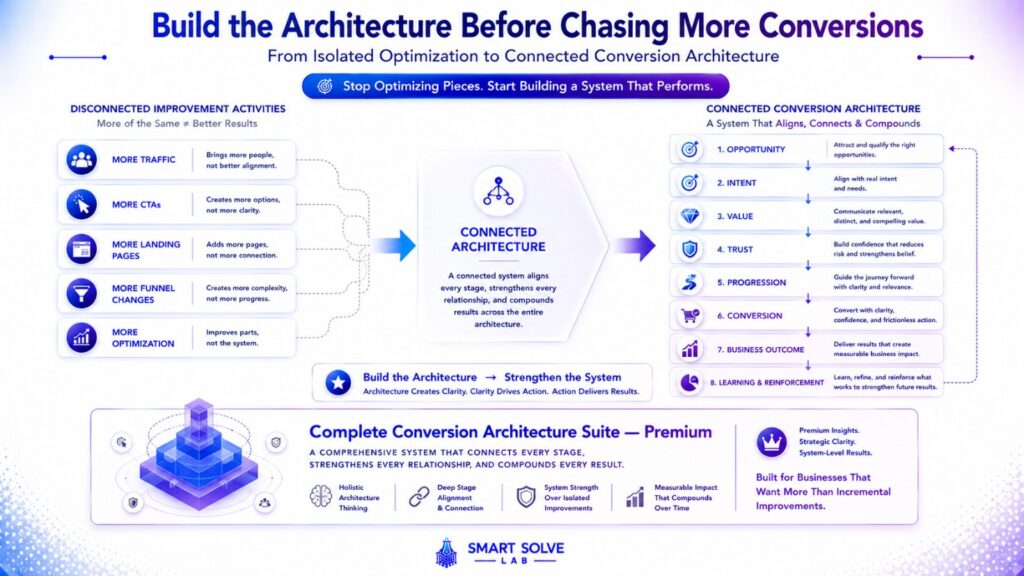
More traffic does not automatically resolve conversion weakness. If intent, value, trust, journey progression, or action conditions remain weak, increasing traffic may simply send more visitors into the same structural weakness.
Treating Leads as the Final Outcome
Lead generation is an important stage, but leads are not the complete growth outcome. Their quality, progression, conversion, customer value, and longer-term relationship with the business also matter.
Assuming the Drop-Off Point Is the Root Cause
The place where customers leave provides useful evidence, but it does not necessarily reveal where the journey first became weak. Looking only at the exit point can therefore miss upstream influences.
Chasing Metrics Without Understanding Relationships
Metrics can show what is happening, but individual numbers do not always explain why it is happening. A metric becomes more useful when interpreted alongside the connected stages and conditions that influence it.
Fixing Symptoms Without Examining Dependencies
Repeatedly fixing visible symptoms can create a cycle of temporary improvements followed by new problems. Examining dependencies helps reveal whether apparently separate issues are connected.
Adding More Activity Instead of Strengthening the System
More campaigns, more traffic, more optimization, or more conversion experiments do not automatically create a stronger system. Sometimes the more important step is understanding and strengthening the relationships that already exist within the journey.
The common thread behind these mistakes is the same: treating connected conversion problems as if they were independent problems.
A stronger approach begins by understanding the system before deciding which individual component deserves further optimization.
The Conversion System Framework
Understanding a conversion system becomes more useful when the major relationships can be viewed as one connected way of thinking. The purpose of this framework is to help move from visible conversion problems toward broader system understanding.
Understand
Begin by understanding the conversion problem in context. Identify what is happening, what outcome is being affected, and what the visible evidence actually shows.
Map
Map the relevant customer journey and the stages surrounding the problem. This creates a wider view instead of examining one conversion point in isolation.
Connect
Connect the stages, symptoms, and conditions that may influence one another. This helps reveal relationships that may otherwise remain hidden.
Diagnose
Examine the connected system to understand where meaningful weaknesses may exist. The objective is to move beyond the visible symptom toward a clearer explanation of the wider problem.
Prioritize
Once potential weaknesses are understood, consider which ones deserve attention first based on their relationship with the wider conversion system.
Strengthen
Strengthen the areas and connections that are most important to customer progression. Improvement should be considered as part of the wider system rather than as an isolated adjustment.
Learn
Observe what happens after changes are made. Outcomes and customer behavior provide evidence that can improve understanding of how the system is functioning.
Reinforce
When stronger pathways or useful improvements become clear, reinforce them so that learning becomes part of the ongoing conversion system rather than a one-time optimization exercise.
Understand → Map → Connect → Diagnose → Prioritize → Strengthen → Learn → Reinforce
This framework provides a high-level way to think about conversion as a connected system. It is not intended to replace detailed diagnostic tools or operational processes; rather, it gives the reader a structured mental model for moving from individual problems toward system thinking.
The Complete Conversion System — Putting It All Together
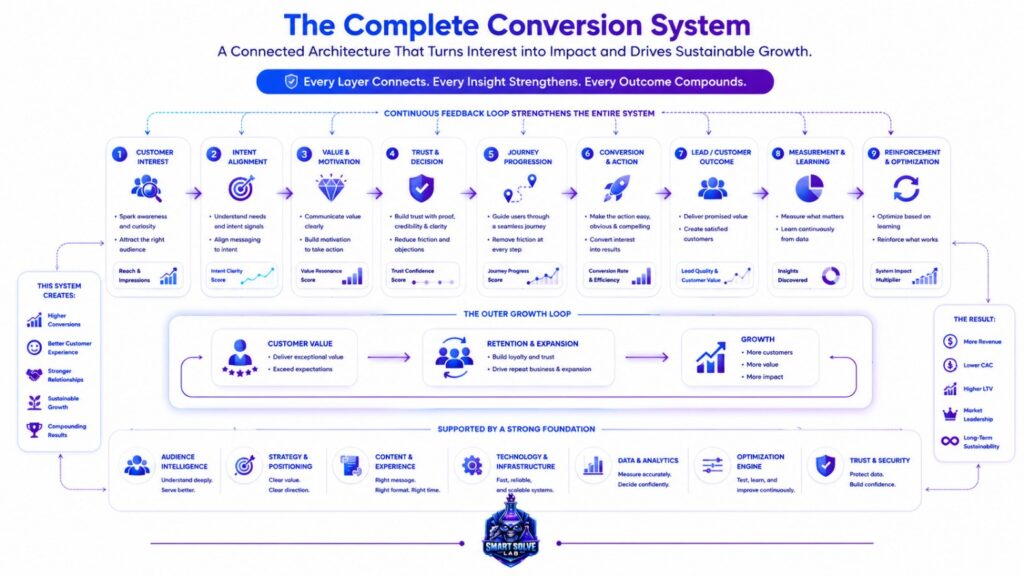
By this point, conversion can be understood as more than a collection of pages, funnel stages, or individual optimization opportunities. It is a connected system in which different conditions influence how customers progress from initial interest toward meaningful action.
From Customer Interest to Action
The complete conversion journey can be viewed at a high level as:
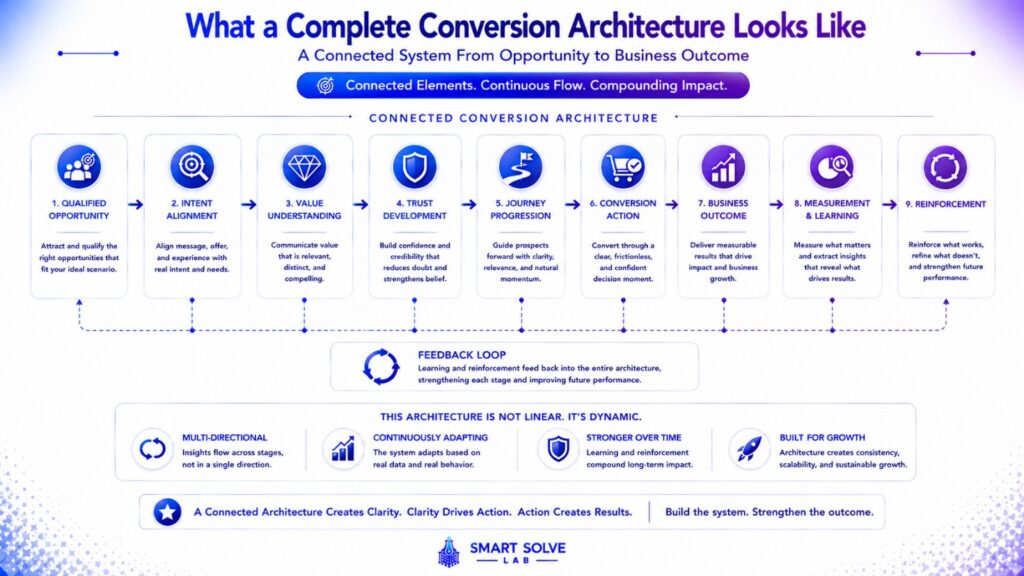
Customer Interest → Intent Alignment → Value & Motivation → Trust & Decision → Journey Progression → Conversion & Action → Lead / Customer Outcome → Measurement & Learning → Reinforcement
Each stage contributes something different, but none of them exists completely in isolation.
Why the Connections Matter
Intent affects how relevant the journey feels. Value and motivation influence whether customers see a reason to continue. Trust and decision confidence affect commitment. Journey progression connects one stage with the next. Action creates measurable outcomes, while learning provides evidence that can help the system improve.
A weakness in one connection can therefore influence performance elsewhere, even when the individual components appear functional.
From Conversion to Customer Value
Conversion is an important transition, but it is not the complete business outcome. What happens after the initial action can influence customer value, retention, expansion, and the longer-term growth system.
This creates a broader relationship:
Conversion System → Customer Value → Retention & Expansion → Growth
The Central Principle
A stronger conversion system is not defined by one optimized component. It is defined by how effectively the important parts connect, support progression, and learn from what happens.
When the system is viewed this way, individual conversion problems become signals within a larger architecture rather than completely separate problems requiring unrelated fixes.
The objective is not to make every component perfect in isolation. It is to create enough coherence between the important parts of the journey that customer progression, learning, and improvement can work together more effectively.
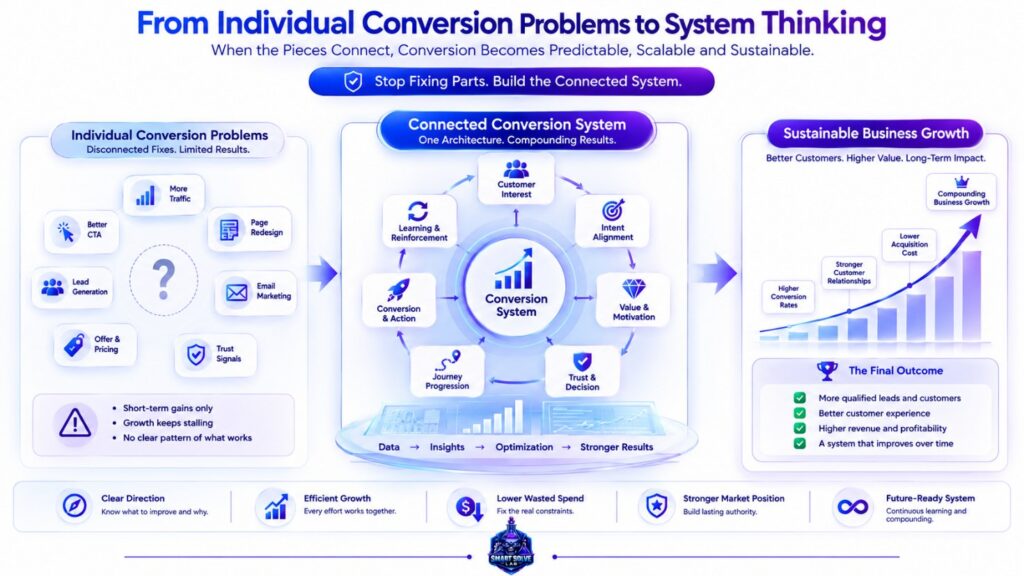
From Individual Conversion Problems to System Thinking
Individual Conversion Problems
Conversion problems often first appear as individual issues: a weak landing page, poor lead quality, customer drop-off, low form completion, or limited progression toward action. These visible problems are important, but they may represent only one part of a wider conversion system.
Core System Problems
When similar problems continue across different pages, stages, or customer interactions, the issue may be larger than any single component. The focus begins to shift from fixing individual symptoms toward understanding the relationships and dependencies connecting the conversion journey.
Premium Architecture Problems
At a deeper level, multiple connected weaknesses can point toward an architecture problem. When conversion components influence one another across the wider customer journey, understanding the larger architecture becomes necessary before meaningful structural improvement can take place.
Conversion System Pillar
The Conversion System brings these levels together by moving from individual problems toward connected system thinking. Instead of viewing each conversion issue as an isolated event, businesses can begin to understand how intent, value, trust, progression, action, learning, and reinforcement interact as one system.
The Shift in Thinking
The important shift is not simply from one optimization tactic to another. It is from asking “What is wrong with this conversion point?” to asking “What is happening across the system that is producing this outcome?”
Individual problems reveal symptoms. System thinking reveals relationships.
Key Takeaways
Conversion Is a System, Not a Single Element
Conversion performance does not come from one page, button, funnel stage, or optimization. It emerges from how the important parts of the customer journey connect and support one another.
Symptoms Do Not Always Reveal Root Causes
A visible conversion problem may only be the point where a wider weakness becomes noticeable. Understanding what happens before and around that problem can reveal a more meaningful direction for diagnosis.
Customer Progression Depends on Connected Conditions
Intent, value, trust, confidence, journey clarity, and action influence one another. Weakness in one area can affect progression elsewhere in the system.
Lead Generation and Conversion Influence One Another
Generating more traffic or leads does not automatically create better conversion outcomes. The quality of intent, value alignment, trust, conversion path, and learning process also matter.
Local Optimization Can Expose Wider Constraints
Improving one conversion component can sometimes reveal another weakness rather than solving the wider problem. This is why isolated optimization has limits when structural dependencies remain unresolved.
Metrics Provide Evidence, Not Complete Explanations
Conversion metrics can show what is happening, but they do not always explain why it is happening. Reviewing Google Analytics dimensions and metrics can help businesses understand the evidence available in their data, but stronger diagnosis still requires understanding the relationships behind the observed numbers.
Sustainable Improvement Requires Learning and Reinforcement
A stronger conversion system does not stop at making an improvement. It learns from customer behavior, strengthens what works, and uses those insights to support future decisions.
Stronger Conversion Comes From Stronger System Connections
The ultimate goal is not to optimize every component independently. It is to create a more connected system in which customer intent, value, trust, progression, action, learning, and reinforcement work together more coherently.
Where to Go Next
Start With the Specific Conversion Problem
Begin with the conversion problem you can actually observe. Identify what is happening, where it appears, and what evidence is available before assuming the cause.
Move Toward the Relevant Diagnostic Layer
Once the problem is clear, examine the part of the conversion system most closely connected to it. A focused diagnostic approach can provide more useful understanding than applying unrelated optimization tactics.
Build Toward System Understanding
If the problem connects with other stages, broaden the view. Understanding the relationships between intent, value, trust, journey progression, action, and learning can reveal why an apparently isolated issue continues to affect performance.
Move From System Understanding to Architecture
When multiple connected conversion weaknesses exist, the next step is to understand the larger architecture behind them. This is where individual problem diagnosis develops into a more complete view of how the conversion system is structured.
Separate Diagnosis From Execution
Strong improvement begins with understanding the problem before deciding how to implement the solution. Smart Solve Lab focuses on diagnosis, clarity, frameworks, and architecture—helping businesses understand what is happening and why before execution begins.
The right next step depends on the level of the problem: specific issue, system weakness, or connected architecture.
Understand the Conversion System
If individual conversion fixes keep producing temporary or disconnected improvements, the next step is to understand the wider system behind those outcomes.
A connected conversion system helps you look beyond isolated pages, funnel stages, or metrics and examine how customer intent, value, trust, progression, action, and learning work together.
Explore the Conversion System resources and identify the diagnostic framework most relevant to your current conversion problem.
FAQs
What is a conversion system?
A conversion system is the connected set of conditions and stages through which customer interest develops into intent, value, trust, progression, action, and learning. It focuses on how these parts work together rather than treating each conversion point in isolation.
How is a conversion system different from a conversion funnel?
A funnel mainly describes the progression of customers through stages. A conversion system looks more broadly at the relationships, dependencies, conditions, and learning processes that influence how effectively customers move through those stages.
Why do conversion problems keep repeating?
Conversion problems can repeat when businesses fix visible symptoms without examining the wider system relationships that contribute to them. A local improvement may not resolve an underlying structural weakness.
Why doesn’t fixing one conversion page always solve the problem?
A page may be affected by conditions outside the page itself, including customer intent, value alignment, trust, journey progression, or the quality of traffic reaching it. Improving one component does not necessarily resolve weaknesses elsewhere.
How do customer intent and trust affect conversion?
Intent influences whether the customer is aligned with the offer, while trust affects confidence in taking the next step. When value, intent, trust, and journey clarity work together, progression toward action can become more coherent.
Why are lead generation and conversion connected?
Lead generation does not operate separately from conversion. The quality and intent of incoming traffic, the value and trust presented, the conversion path, and the learning process can all influence what happens after a visitor arrives.
How should businesses think about conversion drop-offs?
A drop-off point should be treated as evidence rather than automatically assumed to be the root cause. The journey should be examined around that point to understand where customer progression may have first become weaker.
How can a conversion system become more sustainable?
A more sustainable conversion system comes from strengthening important connections, addressing structural weaknesses, learning from customer behavior, and reinforcing improvements instead of relying only on isolated optimization.