
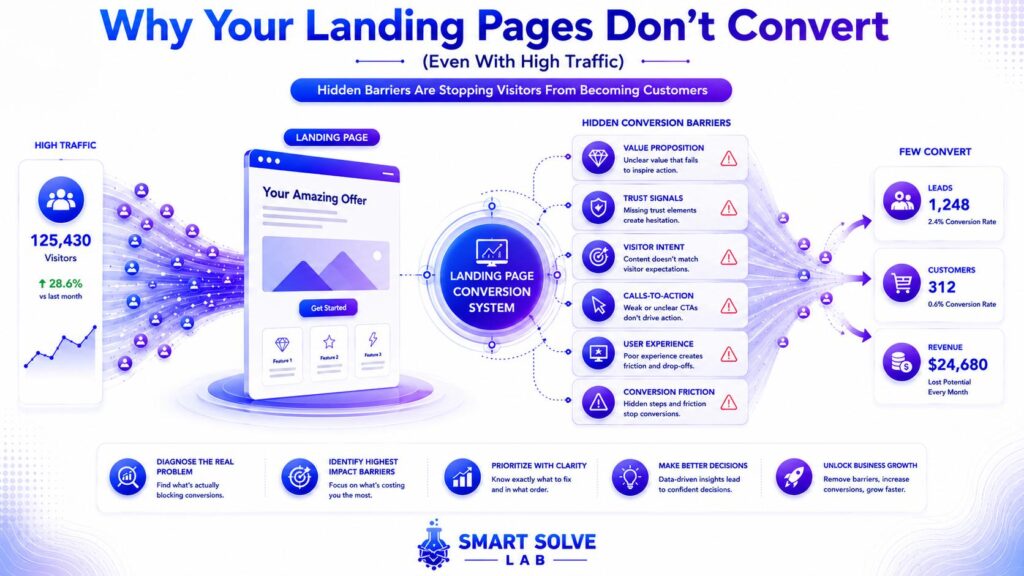
Landing pages don’t convert:
A landing page can attract hundreds or even thousands of visitors every month, yet still fail to generate meaningful business results.
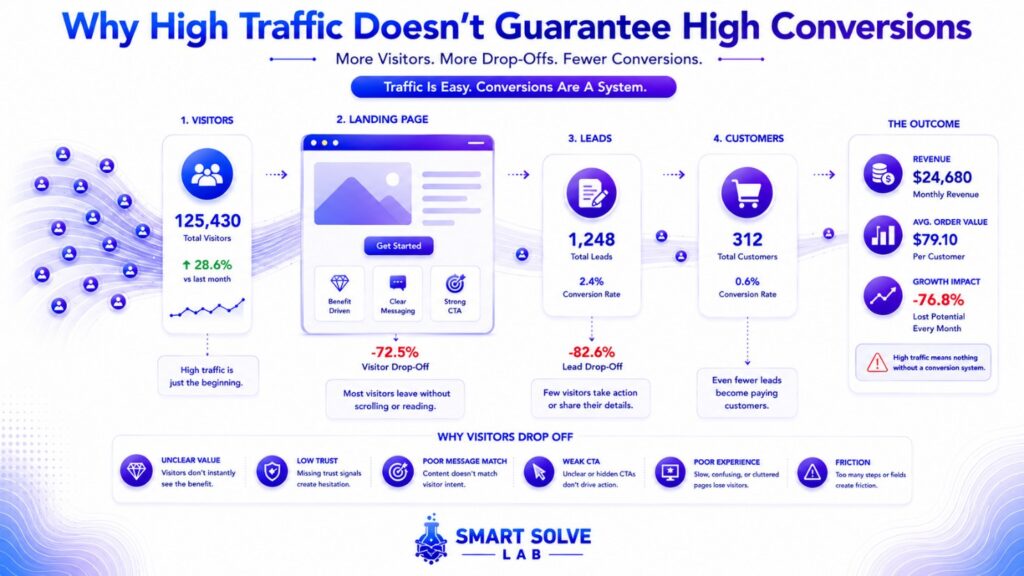
For many businesses, this creates a confusing situation. Traffic reports appear encouraging, marketing campaigns continue to bring visitors, but leads, enquiries, and sales remain far below expectations. The natural assumption is often that more traffic is needed. In reality, the problem frequently exists much deeper within the conversion journey.
A landing page is not designed simply to attract visitors. Its purpose is to guide the right people toward taking a specific action. When that journey breaks down, increasing traffic alone rarely improves business growth. More visitors simply pass through the same broken system.
This is why many conversion problems cannot be solved by isolated improvements such as changing a headline, redesigning a button, or rewriting a call-to-action. These adjustments may produce small gains, but they rarely address the underlying business issues preventing visitors from becoming customers.
In this guide, you’ll learn why landing pages often struggle to convert even when traffic is growing, the hidden conversion barriers that businesses commonly overlook, and how to systematically diagnose these problems before investing in optimization.
Understanding the problem is the first step toward building stronger conversion systems. Once the root causes become clear, businesses can make better decisions, prioritize meaningful improvements, and create more sustainable growth over time.
Table of Contents
What Does “Landing Pages Don’t Convert” Really Mean?
The Problem
Many businesses judge the success of a landing page by the number of visitors it receives. If traffic continues to grow, they assume the page is performing well. However, traffic alone is not the purpose of a landing page.
A landing page is successful only when visitors take the intended action, whether that means submitting a form, requesting a consultation, downloading a resource, or making a purchase. When visitors leave without taking action, the page is not fulfilling its business objective, regardless of how much traffic it attracts.
The Hidden Reality
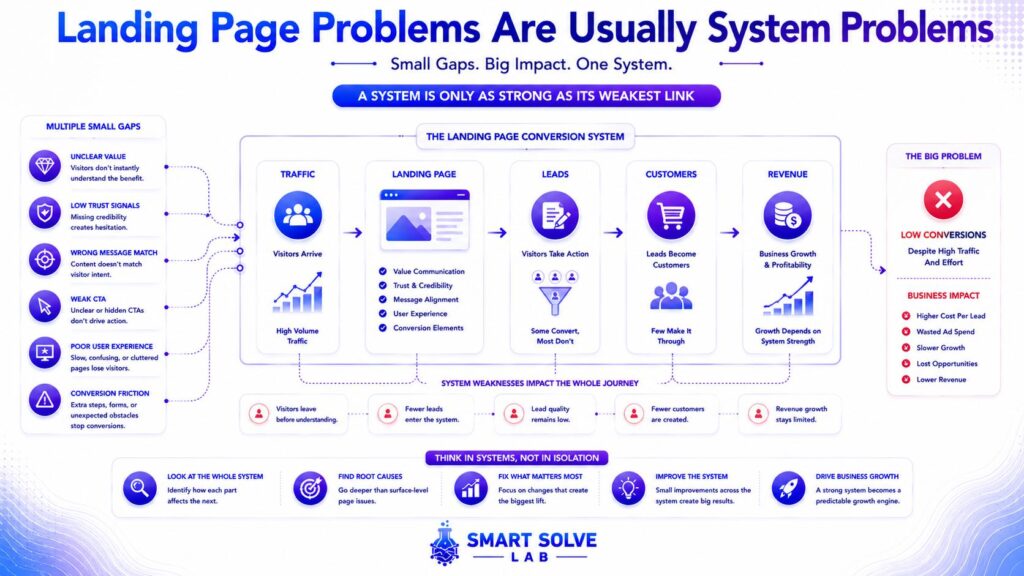
Landing page conversion problems rarely result from a single mistake.
Instead, they usually develop because multiple small weaknesses combine throughout the visitor journey. Weak messaging, low trust, confusing offers, unclear value, or mismatched visitor expectations may each reduce conversion performance. Individually these issues appear minor, but together they create significant barriers that prevent meaningful business results.
Deep Insight
A high-traffic landing page does not automatically indicate a healthy business system.
Traffic measures attention.
Conversions measure trust, clarity, and decision-making.
Businesses that focus only on attracting more visitors often overlook the systems responsible for turning those visitors into qualified leads and customers.
Why This Happens
Many organizations invest heavily in advertising, SEO, and content marketing to increase visitor numbers while giving far less attention to the conversion experience itself.
As a result, the top of the marketing funnel continues growing, but the final business outcomes remain largely unchanged because the underlying conversion barriers have never been diagnosed.
Real Business Scenario
Imagine a business that receives thousands of visitors each month through search engines and marketing campaigns. Analytics reports show healthy traffic growth, yet enquiries and sales remain almost unchanged.
The immediate reaction is often to increase marketing efforts or generate even more traffic. However, the real issue may exist inside the landing page itself, where hidden conversion barriers prevent interested visitors from becoming customers.
What This Means
When a landing page fails to convert, the problem is not always the quality of the traffic.
More often, it indicates that the visitor journey contains hidden weaknesses that reduce confidence, interrupt decision-making, or create unnecessary friction before action can be taken.
Recognizing these hidden barriers is the first step toward understanding why conversion performance remains low despite growing visitor numbers.
Critical Takeaway
Landing pages do not fail simply because they receive insufficient traffic.
They fail when businesses cannot identify the hidden conversion barriers preventing visitors from becoming customers.
Effective business growth begins with accurate diagnosis before any optimization takes place.
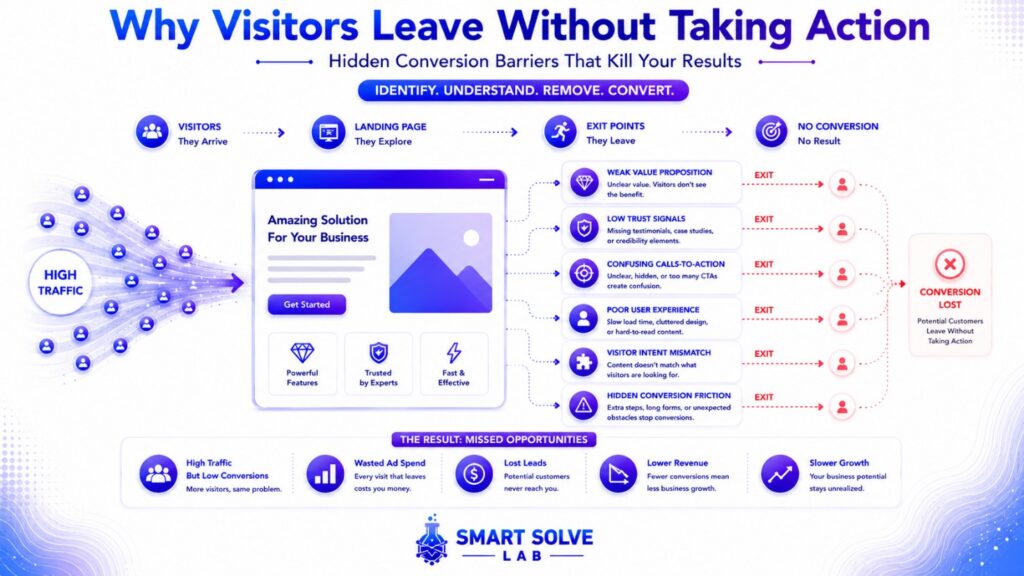
Why Visitors Leave Without Taking Action (The Hidden Conversion Barriers)
Weak Value Proposition
A landing page should immediately communicate why your offer matters and why visitors should choose your business over other alternatives.
When the value proposition is vague, generic, or fails to address the visitor’s primary problem, people often leave without exploring further. Even highly targeted traffic struggles to convert when visitors cannot quickly understand the benefit being offered.
Low Trust Signals
Visitors evaluate credibility before making important decisions.
If your landing page lacks testimonials, case studies, trust indicators, security reassurance, or clear business information, visitors may hesitate to take action regardless of how interested they initially were.
Businesses experiencing broader trust challenges may also benefit from understanding Why Customers Don’t Trust Your Website (And the Digital Trust System That Fixes It).
Poor User Experience
A confusing layout, slow loading speed, difficult navigation, or distracting design elements create unnecessary friction throughout the visitor journey.
Even motivated visitors may abandon the page when completing the next step feels difficult or uncertain.
Google also highlights user experience as an important factor in creating helpful, people-focused content.
Google Search Central — Helpful, People-First Content
Confusing Calls-to-Action
Visitors should never have to guess what action comes next.
When calls-to-action are unclear, inconsistent, or poorly positioned, visitors often postpone making a decision and eventually leave the page without converting.
Visitor Intent Mismatch
Not every visitor arrives with the same goal or expectation.
A landing page may attract relevant traffic but still fail to convert if the content, messaging, or offer does not align with what visitors were actually searching for.
Understanding visitor intent is often more valuable than simply increasing traffic volume.
Businesses facing this challenge should also review Why Your Content Gets Traffic but Visitors Never Convert to better understand how intent gaps affect overall conversion performance.
Section Summary
Most landing page conversion problems are not caused by a single mistake. Instead, they emerge when multiple hidden barriers reduce visitor confidence throughout the customer journey.
Diagnosing these barriers provides a clearer understanding of where the conversion process is weakening before any optimization begins.
The Five Diagnostic Systems Behind Every High-Converting Landing Page
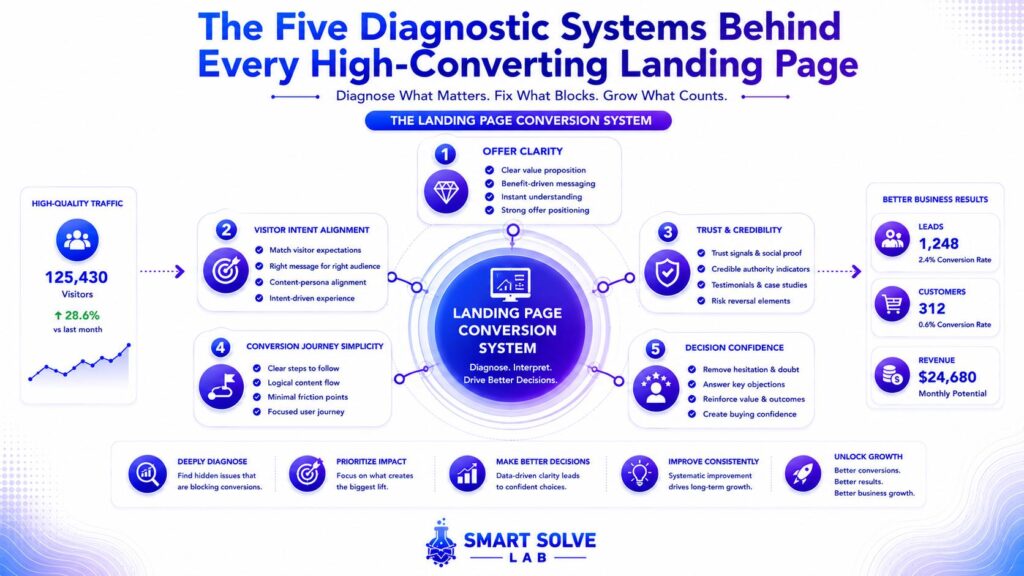
A landing page rarely succeeds because of one exceptional element.
Instead, strong conversion performance develops when multiple business systems work together. A weakness in one system often reduces the effectiveness of every other part of the visitor journey.
Understanding these diagnostic systems helps businesses identify where hidden conversion gaps exist before investing time and resources into optimization.
Conversion Foundation
Every successful landing page begins with a strong conversion foundation.
Visitors should immediately understand the purpose of the page, the value being offered, and the next logical action to take. Without this clarity, even highly qualified traffic may leave before engaging with the offer.
Visitor Intent Alignment
Conversion improves when the landing page aligns with the visitor’s expectations.
If someone searches for a specific solution but arrives on a page discussing something different, uncertainty increases and the likelihood of conversion decreases. Diagnosing visitor intent alignment helps businesses determine whether they are attracting the right audience with the right message.
Trust & Credibility Signals
Visitors rarely convert based on information alone.
They also evaluate whether a business appears trustworthy, experienced, and capable of delivering on its promises. Strong trust signals reduce uncertainty and increase confidence throughout the decision-making process.
For a deeper understanding of how trust influences business growth, explore Why Customers Don’t Trust Your Website (And the Digital Trust System That Fixes It).
Conversion Journey Clarity
A high-converting landing page provides a clear and logical path from interest to action.
Every section should naturally guide visitors toward the next step without unnecessary distractions or confusion. When the conversion journey becomes fragmented, visitors often hesitate or leave before completing the intended action.
Continuous Conversion Improvement
Landing page performance is never static.
Customer expectations evolve, visitor behavior changes, and business goals continue to grow. Businesses that regularly evaluate their landing pages are better positioned to identify hidden conversion gaps before they begin affecting leads, customers, and revenue.
Section Summary
These five diagnostic systems provide a structured framework for understanding why some landing pages consistently convert while others struggle despite attracting significant traffic.
Understanding these systems creates clarity.
Implementing and optimizing them requires structured execution. The Landing Page Conversion Blueprint in Digitolve provides the complete implementation framework after the diagnostic process identifies where the conversion journey is breaking down.
Why Landing Page Conversion Problems Are Usually System Problems
Many businesses assume that poor landing page performance is caused by a single issue.
They redesign the page, rewrite the headline, change the call-to-action, or adjust the layout, expecting conversions to improve immediately.
While these changes may produce small improvements, they rarely solve the underlying business problem.
Landing page conversion problems are usually the result of multiple connected systems working below their full potential.
Small Conversion Gaps Create Large Business Losses
A single conversion barrier may reduce performance only slightly.
However, when several small barriers exist together—such as unclear messaging, weak trust signals, poor visitor intent alignment, and unnecessary friction—they combine to create a significant decline in overall conversion performance.
Over time, these small gaps can lead to missed leads, lost customers, and slower business growth.
Disconnected Customer Journeys
Visitors rarely make decisions based on one section of a landing page.
Instead, they experience the entire journey from the moment they arrive until they either convert or leave.
When different parts of that journey fail to support one another, visitors become uncertain and often abandon the page before taking action.
Businesses interested in understanding broader customer journey challenges should also explore Why Customers Drop Off Before Buying (And the System That Fixes It).
Why Fixing One Page Rarely Solves the Problem
Improving one landing page can increase conversions temporarily.
However, if the underlying conversion system remains weak, similar problems often appear across other pages, campaigns, and customer journeys.
This is why businesses frequently experience inconsistent conversion results despite making continuous improvements.
The Difference Between Tactics and Systems
Individual tactics focus on isolated improvements.
Systems focus on understanding how every part of the conversion journey works together.
Businesses that diagnose conversion performance at the system level gain clearer insights into the root causes affecting leads, customers, and revenue, allowing future improvements to become more strategic and sustainable.
Section Summary
Landing page conversion problems rarely originate from a single mistake.
More often, they develop because multiple hidden gaps weaken the overall customer journey.
Diagnosing these connected systems provides businesses with greater clarity, helping them identify the real causes behind poor conversion performance before moving toward structured implementation.
From Diagnosis to Better Conversion Decisions
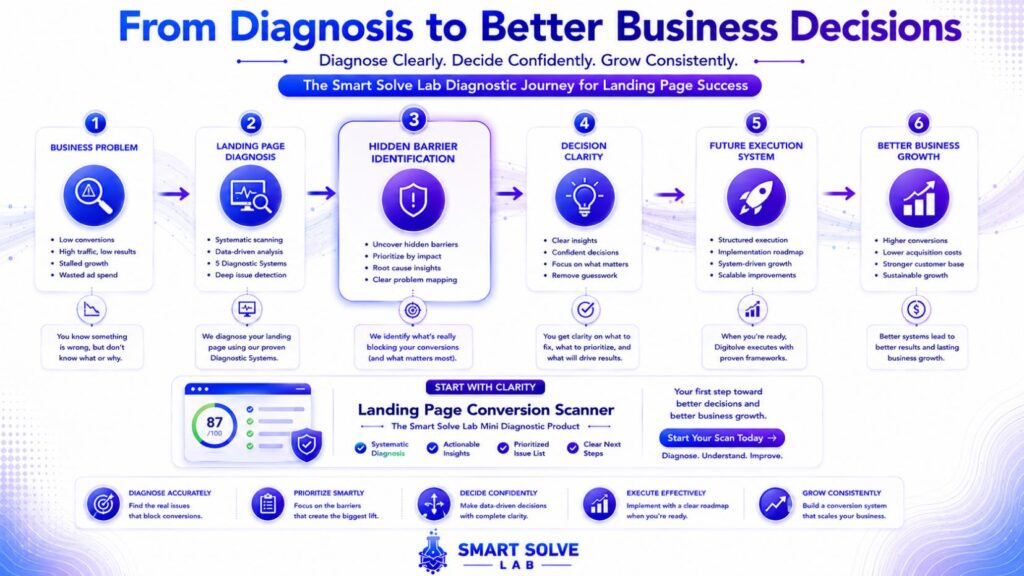
Many businesses respond to poor conversion performance by making immediate changes to their landing pages.
They redesign layouts, rewrite headlines, change call-to-action buttons, or launch new marketing campaigns, hoping that one improvement will solve the problem.
However, meaningful improvements begin only after understanding why visitors are not converting.
Without diagnosing the underlying conversion barriers, businesses often invest time and resources into changes that address symptoms rather than root causes.
The purpose of diagnosis is not to provide instant solutions. Its purpose is to create clarity.
Once businesses understand where their conversion journey is breaking down, they can prioritize improvements with greater confidence and avoid unnecessary trial and error.
The Conversion Gap Diagnostic Toolkit is designed to help businesses systematically identify the hidden barriers affecting visitor behavior, trust, intent alignment, and overall conversion performance.
Rather than relying on assumptions, it provides a structured framework for interpreting conversion problems before implementation begins.
After identifying the highest-impact conversion barriers, businesses can move to structured implementation through the Conversion Optimization Toolkit in Digitolve, where those diagnostic insights are translated into practical execution frameworks.
Diagnostic Insight
Landing page conversion problems rarely result from a single mistake.
They usually emerge when multiple business systems gradually weaken visitor confidence throughout the customer journey.
Better diagnosis leads to better decisions. Better decisions lead to better conversions.
Conclusion
Landing pages do not fail because they receive too little traffic.
More often, they fail because hidden conversion barriers prevent visitors from taking meaningful action. Increasing traffic without understanding these barriers usually leads to the same disappointing results—more visitors, but very little business growth.
Successful businesses recognize that conversion is not driven by isolated tactics. It is the outcome of connected systems that influence visitor confidence, decision-making, and the overall customer journey.
Before investing in redesigns, new marketing campaigns, or additional traffic, it is essential to understand where the conversion journey is breaking down.
The Conversion Gap Diagnostic Toolkit helps businesses systematically identify these hidden weaknesses, providing the clarity needed to make better decisions before implementation begins.
Once the diagnostic process is complete, the next step is building a structured execution system through the Conversion Optimization Toolkit in Digitolve, where those insights are transformed into practical conversion improvements.
Key Takeaways
- Traffic alone does not guarantee conversions.
- Hidden conversion barriers often reduce business performance.
- Most landing page problems are system problems rather than isolated mistakes.
- Accurate diagnosis leads to better business decisions.
- Structured implementation becomes more effective after the real problem is clearly understood.
Final Diagnostic Insight
The goal is not simply to increase conversions.
The goal is to understand why visitors are not converting in the first place.
Better diagnosis creates better decisions. Better decisions build stronger systems. Stronger systems create sustainable business growth.
Frequently Asked Questions
Why don’t my landing pages convert even when traffic is high?
High traffic does not guarantee conversions. Many landing pages struggle because of hidden conversion barriers such as weak messaging, low trust, unclear calls-to-action, or visitor intent mismatch.
Can increasing traffic improve my conversion rate?
Not necessarily. More traffic often produces the same results if the underlying conversion system remains weak. Diagnosing conversion barriers should come before investing in additional traffic.
What are the most common landing page conversion problems?
Common issues include unclear value propositions, weak trust signals, poor user experience, confusing calls-to-action, and disconnected customer journeys. These problems often work together rather than individually.
What is a Landing Page Conversion Scanner?
The Landing Page Conversion Scanner is a diagnostic tool designed to help businesses identify the hidden barriers affecting landing page performance before moving to optimization.
How is diagnosis different from conversion optimization?
Diagnosis identifies why conversion problems exist. Conversion optimization focuses on implementing improvements after those problems have been clearly identified.
What’s the next step after diagnosing landing page conversion problems?
After identifying the highest-impact conversion barriers, businesses can implement structured improvements through the Landing Page Conversion Blueprint in Digitolve.
Recommended Reading
If you’re diagnosing broader conversion and business growth problems, these guides may also help:
Leave a Reply