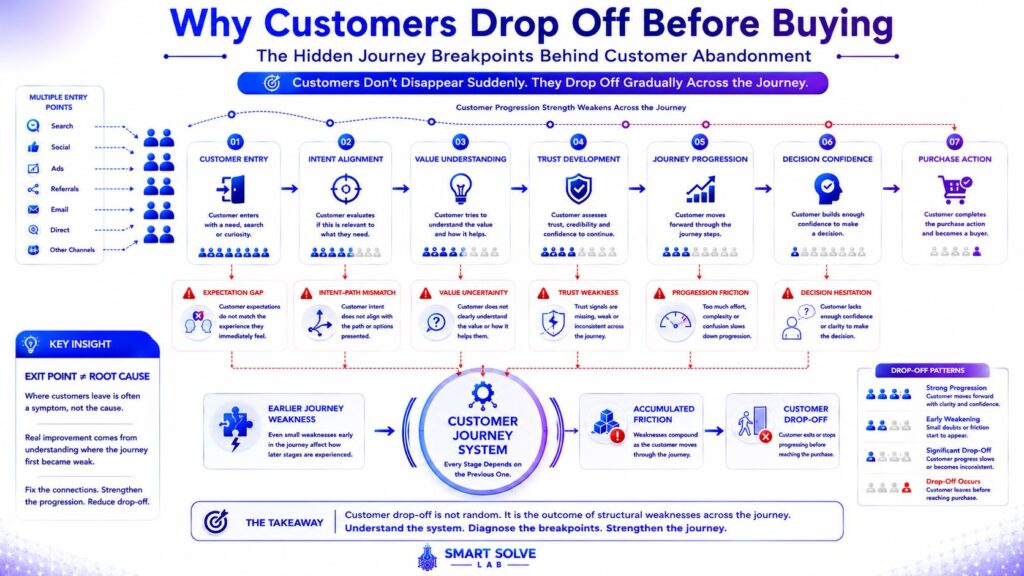
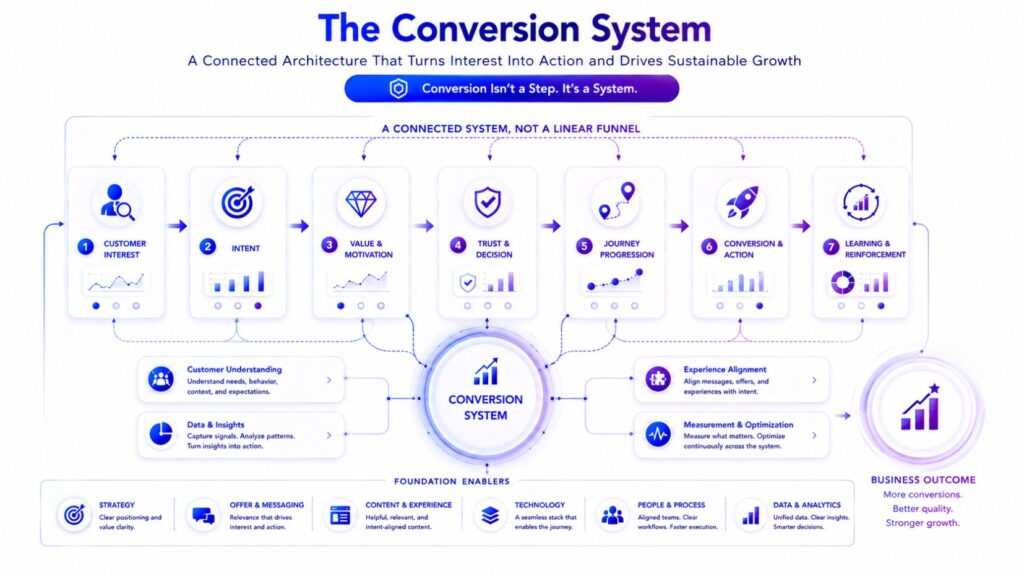
• Why Customers Drop Off Before Buying (And Why Fixing One Page Doesn’t Solve It)

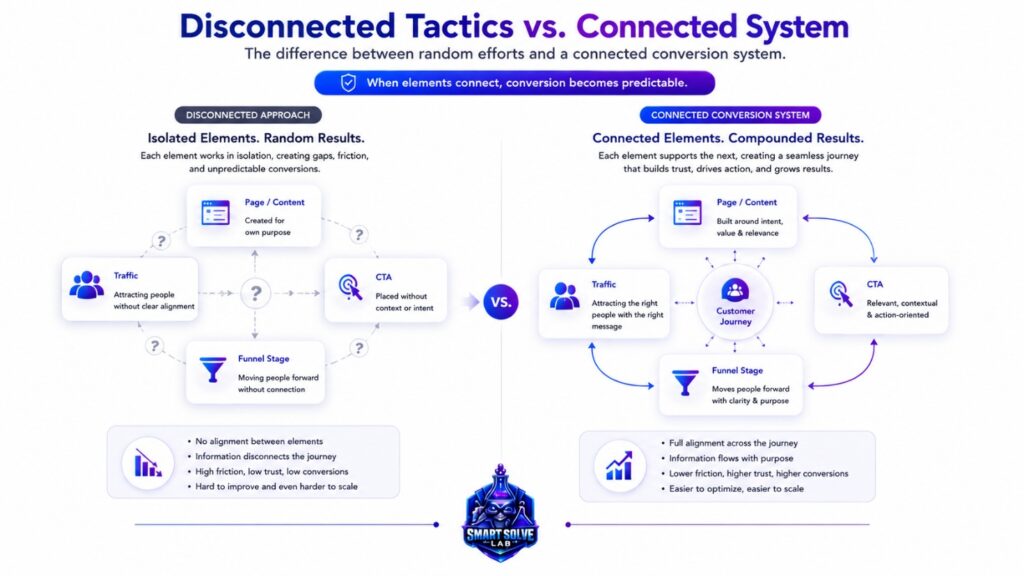
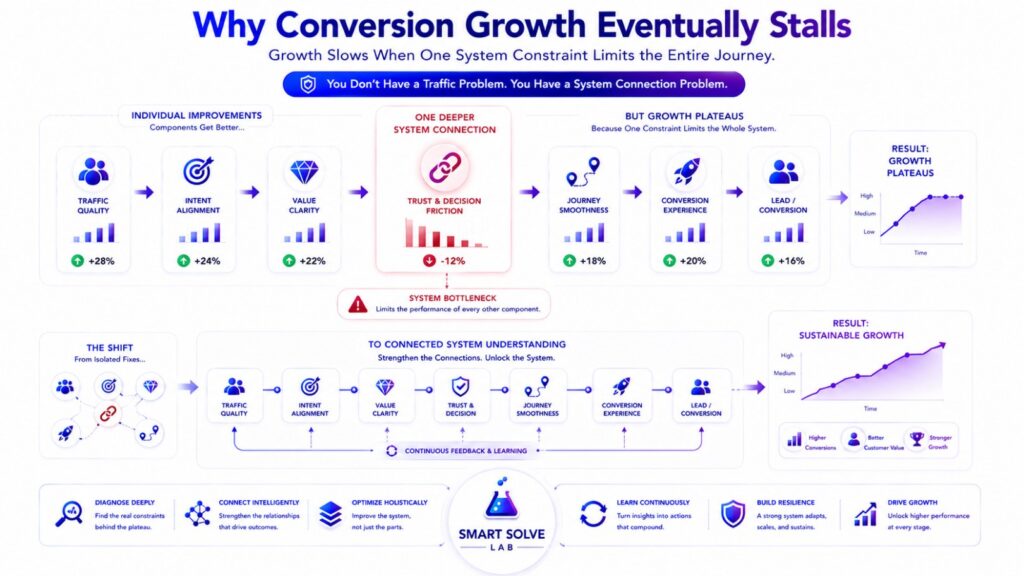
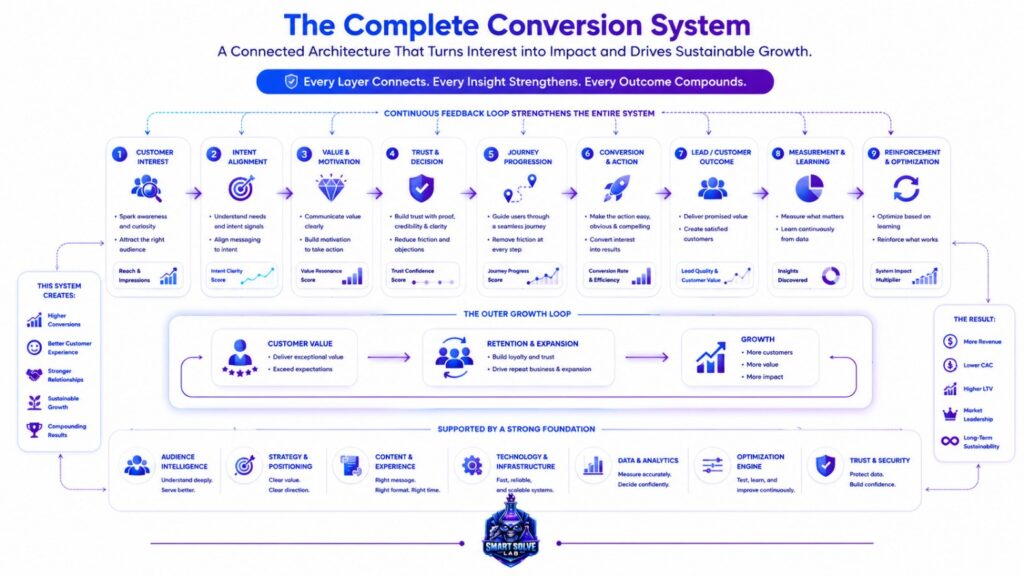
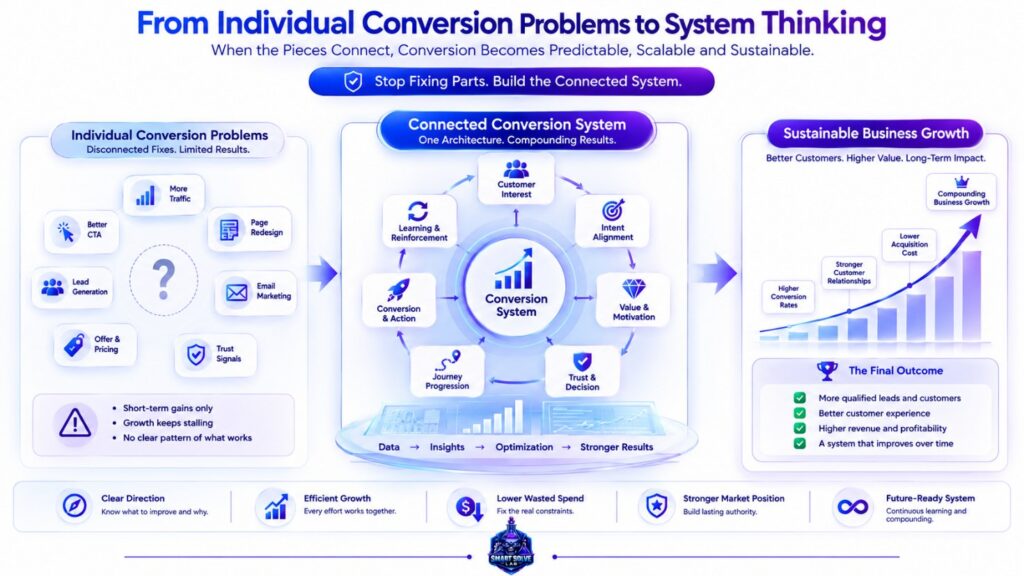
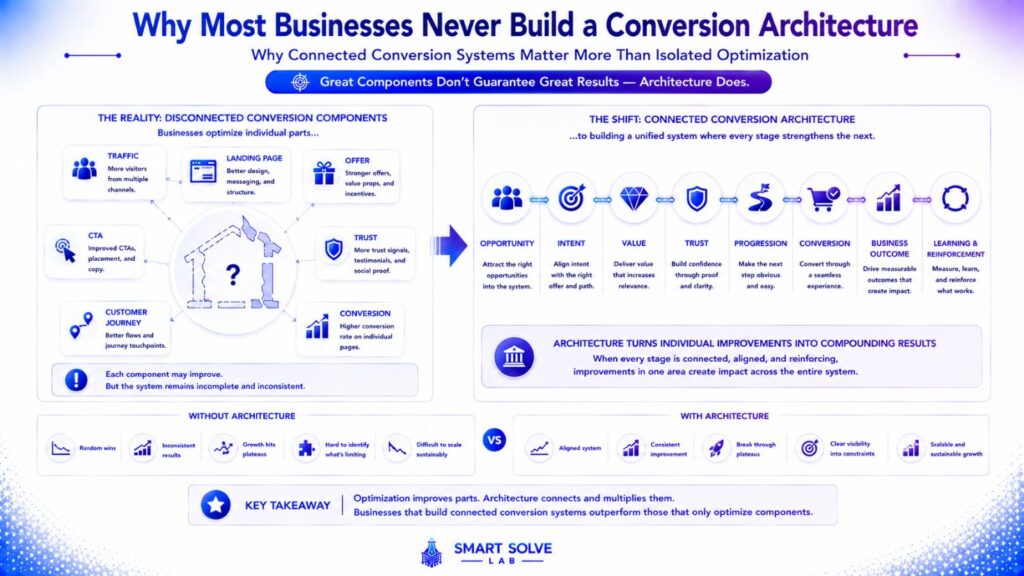
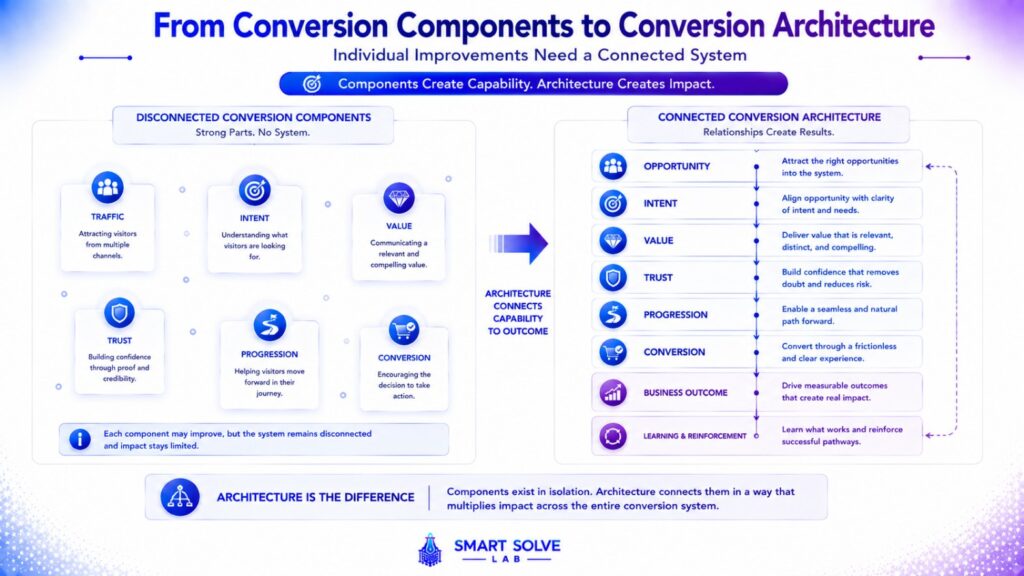
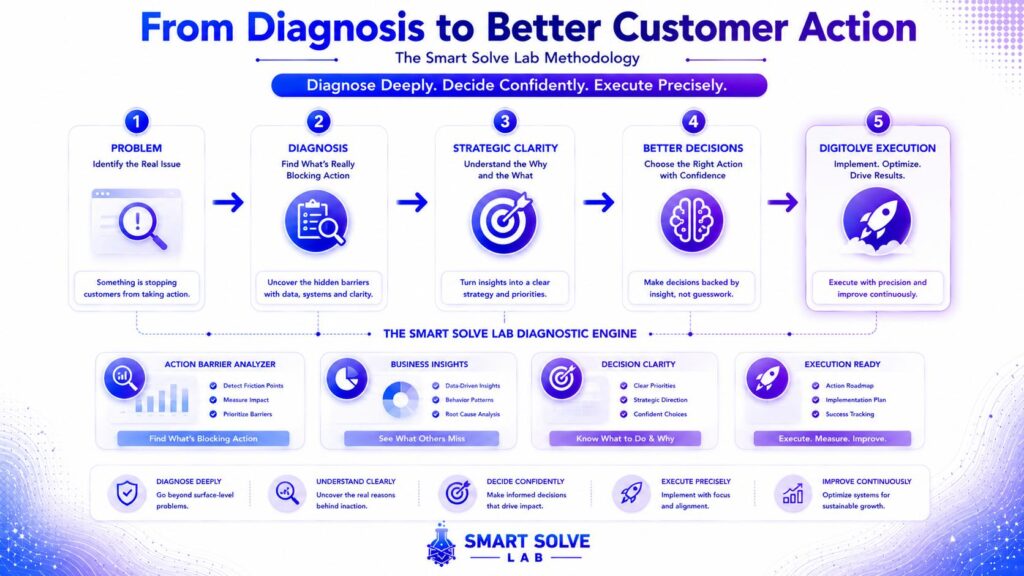
    Customer journey architecture showing why customers drop off before completing a purchase.
    Customer drop-off often begins earlier in the journey than where the customer finally leaves.

    Customers Drop Off Before Buying:

    Customers rarely decide to buy the moment they discover a business. Instead, they move through a series of decisions that gradually shape their confidence, understanding, and willingness to continue. They first determine whether the business is relevant to their needs, then whether the value is clear, whether the information feels trustworthy, and finally whether they have enough confidence to make a purchase. Every stage of this progression influences the next.

    Yet many businesses experience a frustrating pattern. Visitors arrive, browse multiple pages, compare products or services, return later, and sometimes even begin the buying process—only to leave before completing it. Because the most visible problem is where customers exit, businesses often assume the solution is to improve that specific page. They redesign landing pages, rewrite CTA buttons, add testimonials, simplify forms, or change pricing displays, expecting those changes alone to solve the problem.

    Sometimes these improvements produce small gains, but the same pattern of customer drop-off often returns. New visitors continue entering the journey, while many still disappear before buying. This suggests that the visible exit point may not be the place where the customer journey first became weak.

    Customer drop-off is not always an isolated conversion failure. It can be the accumulated outcome of small structural weaknesses that developed earlier across the buying journey. A slight mismatch between customer expectations and the initial experience, gradually decreasing value clarity, trust that fails to strengthen as commitment increases, or friction that interrupts natural progression can combine over time until continuing no longer feels worthwhile. By the time customers leave, the underlying problem may have existed long before the final decision point.

    This distinction is important because the page where customers leave does not necessarily explain why they leave. The exit often reveals the moment when earlier uncertainty, reduced confidence, and accumulated friction become strong enough to stop progression. Focusing only on the final interaction can therefore improve one part of the experience while leaving the deeper journey constraints untouched.

    Understanding customer drop-off requires looking beyond individual pages and examining how customers experience the journey as a connected system. Rather than asking only, “Where did customers leave?”, a more valuable diagnostic question is, “Where did the journey first become weak enough that eventual drop-off became likely?” That shift changes the focus from isolated page optimization to understanding how different stages of the customer journey influence one another.

    In this article, we’ll explore what customer drop-off actually means, why interested customers still leave before buying, the six structural breakpoints that weaken customer progression, how small friction points accumulate across the journey, and what a stronger customer journey architecture needs to support more consistent progression toward confident purchase decisions.

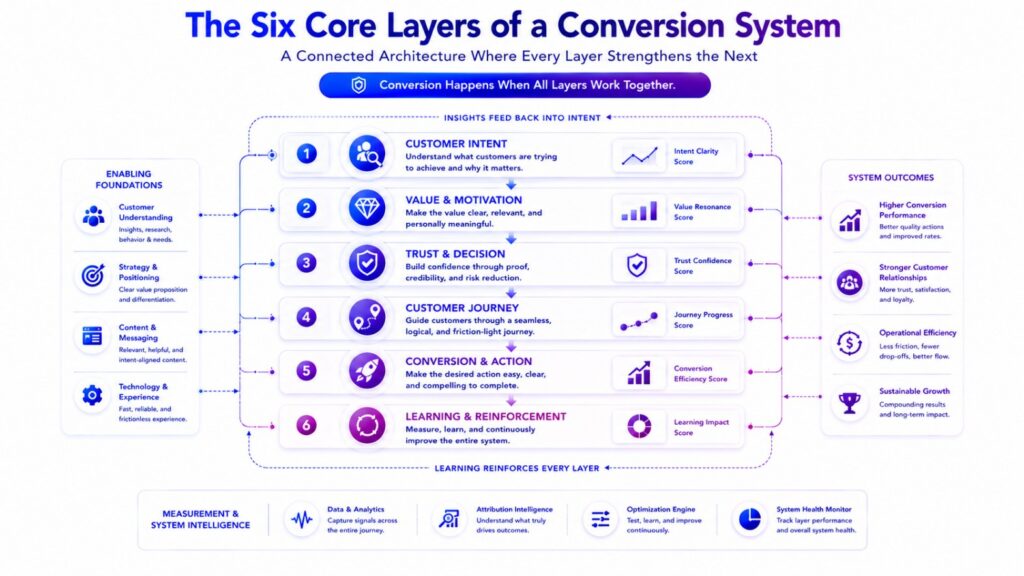
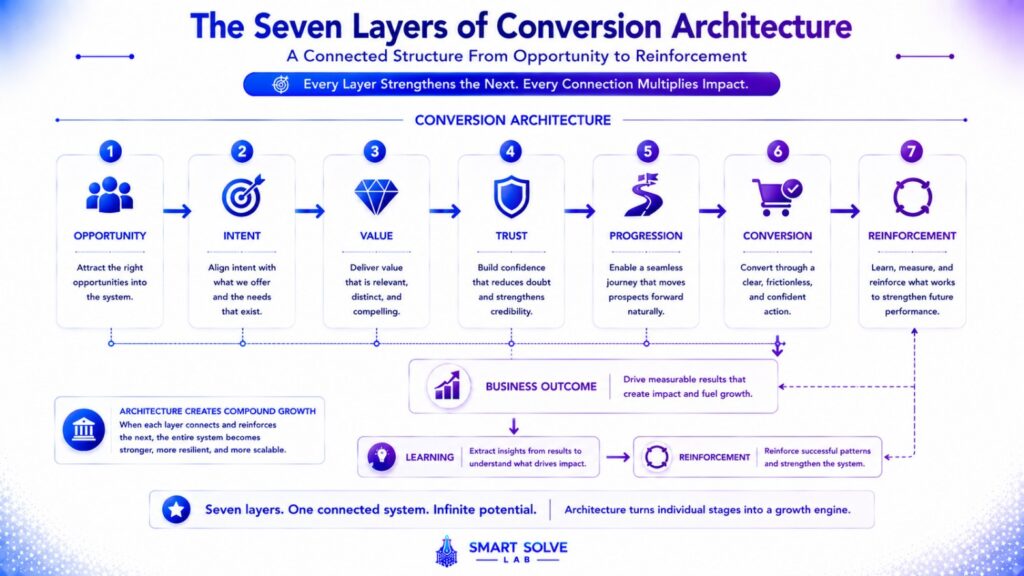
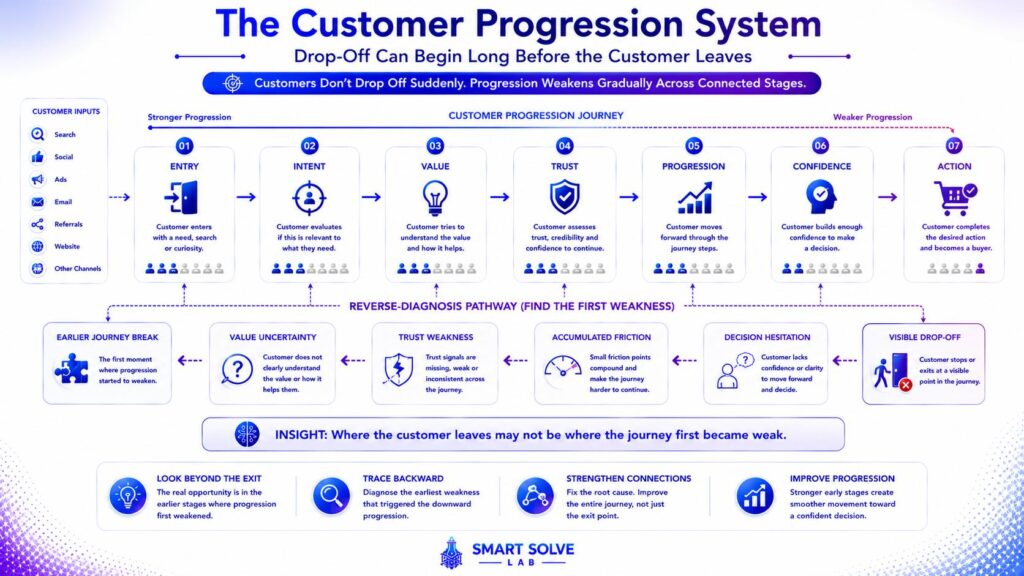
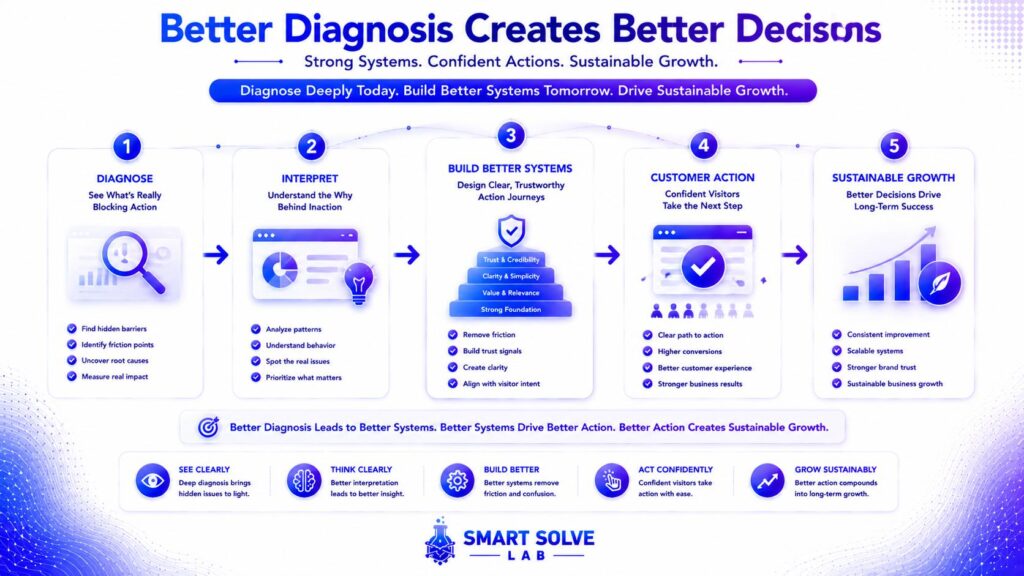
    Customer progression system showing the connected stages that influence buying decisions.
    Customer progression depends on how each stage of the journey supports the next.

    Table of Contents

    What Does Customer Drop-Off Actually Mean?

    When businesses think about customer drop-off, they often focus on the moment a visitor leaves the website. Analytics may show customers abandoning a landing page, exiting a pricing page, closing the checkout process, or leaving after reading a product description. Because these exit points are the most visible part of the journey, they naturally receive the most attention.

    However, customer drop-off is not simply the act of leaving a website. It is the point where a customer’s willingness to continue the buying journey becomes weaker than their motivation to move forward. In many cases, that change begins much earlier than the final exit itself.

    A customer journey is built through a series of connected decisions rather than one single action. Every stage either strengthens or weakens the customer’s confidence to continue. As customers progress, they continually evaluate whether the business understands their needs, whether the offered value remains relevant, whether enough trust has been established, and whether taking the next step feels worthwhile. When one or more of these elements weaken, progression slows. If enough uncertainty accumulates, the journey eventually stops.

    Interest Does Not Automatically Equal Purchase Readiness

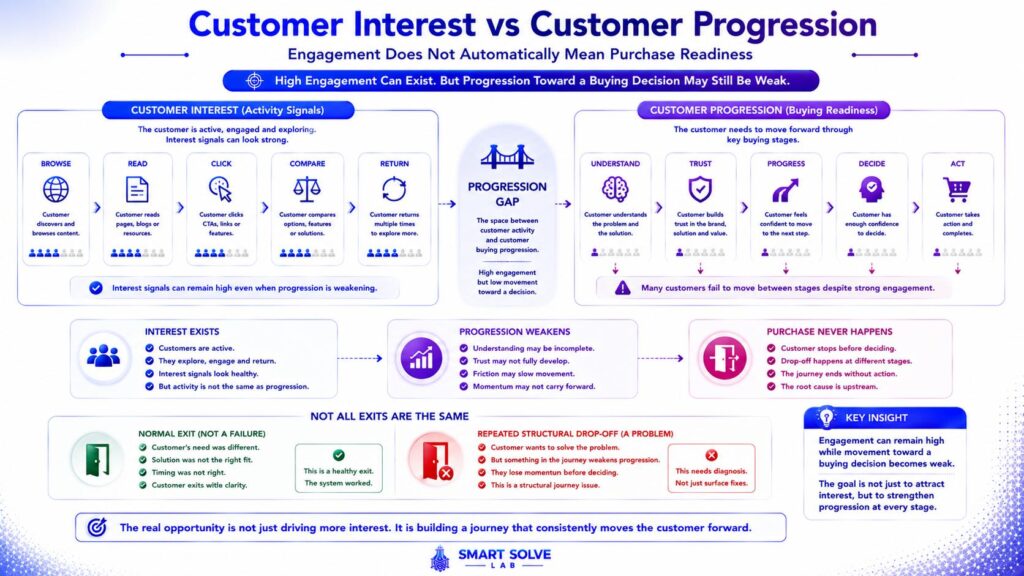
    One of the most common misconceptions is assuming that customer interest automatically means a customer is ready to buy. While interest is an important first step, it represents curiosity rather than commitment.

    Many customers explore websites because they want to learn more, compare available options, or understand whether a solution matches their needs. They may spend several minutes reading content, visit multiple pages, download resources, or return to the website more than once. These behaviors demonstrate engagement, but they do not necessarily indicate that the customer has developed enough confidence to make a purchasing decision.

    As customers move closer to buying, the level of commitment required gradually increases. Each new step asks them to invest more attention, trust, or confidence than the previous one. If the journey does not support this increasing commitment, interested visitors can remain engaged while still deciding not to progress further.

    Where Drop-Off Can Happen Across the Journey

    Customer drop-off should also be viewed as something that can occur between stages of the journey rather than only on individual pages.

    A visitor may leave after discovering that the information does not match their expectations. Another customer may understand the solution but remain uncertain about its value. Others may trust the information but hesitate when the required commitment becomes greater. Some customers reach the final buying stage yet still postpone their decision because earlier questions were never fully resolved.

    This means customer abandonment is often the visible outcome of a progression problem rather than an isolated page problem. The journey itself may contain several transition points where confidence gradually weakens before the customer finally exits.

    Why Engagement Can Exist Without Progression

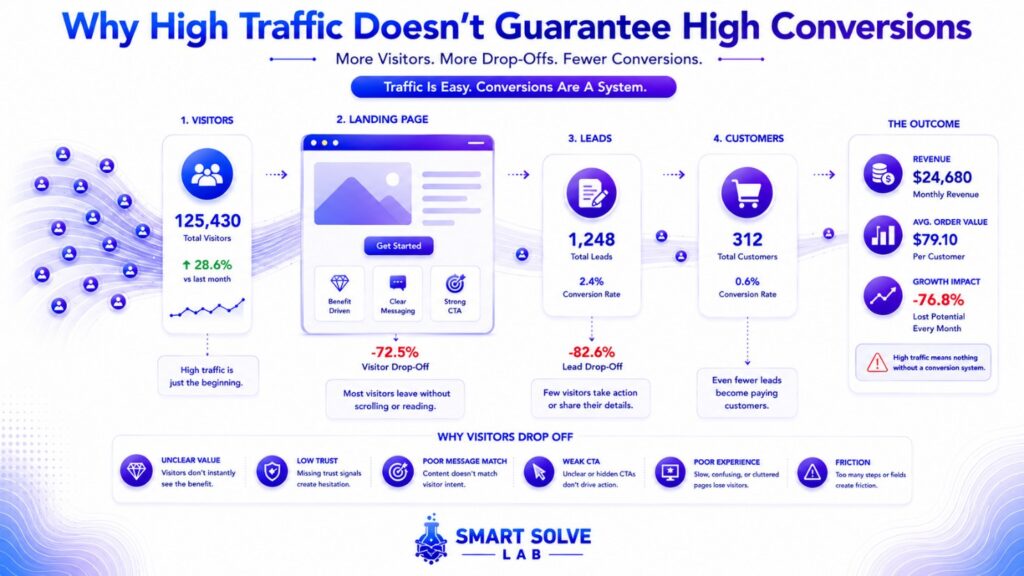
    Businesses sometimes interpret high engagement metrics as evidence that the customer journey is working effectively. Longer session durations, multiple page views, returning visitors, and resource downloads can all appear encouraging. While these signals indicate attention, they do not automatically confirm that customers are moving closer to a buying decision.

    Customers can continue consuming information while remaining uncertain about whether to proceed. They may compare alternatives, revisit important pages, or delay action because essential questions remain unanswered. From a business perspective, engagement appears healthy, yet progression toward purchase becomes increasingly fragile.

    Recognizing the difference between engagement and progression helps explain why some websites generate substantial activity without producing proportional business outcomes.

    Normal Customer Exit vs Structural Drop-Off

    Not every visitor is expected to become a customer. Some people are simply researching, gathering information, or determining whether a solution is relevant to their situation. Their decision to leave does not necessarily indicate a weakness in the customer journey.

    Structural drop-off becomes a concern when similar patterns repeatedly appear among qualified or genuinely interested visitors. If customers who demonstrate clear buying intent consistently struggle to move beyond particular stages of the journey, the issue is less likely to be random behavior and more likely to reflect a structural constraint within the journey itself.

    Distinguishing between normal exits and repeated structural drop-off prevents businesses from trying to optimize for every visitor instead of identifying meaningful progression barriers.

    What Repeated Customer Drop-Off Reveals About the Journey

    When customer drop-off follows consistent patterns over time, it often reveals that one or more stages of the journey are no longer supporting smooth progression. Rather than viewing each abandoned session as an isolated event, businesses can begin looking for recurring weaknesses that influence customer decisions across multiple interactions.

    The most valuable diagnostic question therefore shifts from identifying where customers left to understanding where the journey first started losing momentum. The final exit simply marks the point where accumulated uncertainty became greater than the customer’s confidence to continue.

    Understanding this distinction creates the foundation for diagnosing customer journeys more systematically. Instead of treating every exit page as the primary problem, businesses can begin examining the underlying conditions that gradually weaken customer progression across the entire buying experience.

    Recommended Reading

    customers leave without taking action

    Why Customers Drop Off Even When They Seem Interested

    One of the most confusing challenges for businesses is watching customers show genuine interest without eventually becoming buyers. Visitors explore products, read detailed information, compare solutions, subscribe to emails, return to the website multiple times, or even begin the purchasing process. From the outside, these behaviors suggest that customers are moving steadily toward a buying decision.

    Yet many of them never complete that journey.

    Because customer interest is visible, businesses often assume the final buying stage must be the problem. They may rewrite calls to action, redesign landing pages, or adjust pricing in an attempt to encourage more purchases. While these improvements may influence specific interactions, they do not always explain why interested customers gradually lose the confidence to continue.

    Interest is only the beginning of the customer journey. As customers progress, every new stage asks them to make a slightly larger commitment than the previous one. If the journey does not strengthen confidence at the same pace that commitment increases, progression begins to weaken—even while interest remains.

    Their Intent and the Next Step Don’t Match

    Every customer enters a website with a different level of readiness. Some are only exploring a problem, while others are actively comparing potential solutions or preparing to make a purchase. A strong customer journey recognizes these differences and guides customers toward the next step that matches their current intent.

    Problems arise when the journey asks customers to make a larger commitment than they are prepared for. A visitor who is still trying to understand a solution may immediately encounter requests for consultations, demos, or purchases before enough context has been established. Conversely, customers who are ready to move forward may be slowed down by unnecessary steps that delay progress.

    When customer intent and the required next action become misaligned, progression naturally slows. Customers may remain interested in the solution while deciding that continuing no longer feels appropriate for where they are in their decision-making process.

    Value Becomes Less Clear as They Progress

    Initial curiosity often develops because customers believe a product or service might solve an important problem. However, maintaining that curiosity requires increasing clarity rather than simply providing more information.

    As customers move deeper into the journey, they continuously evaluate whether the solution remains relevant to their situation. If explanations become overly complex, disconnected, or fail to reinforce the original value proposition, understanding begins to weaken. More content does not automatically create more clarity.

    When customers no longer feel confident about the value they are receiving, their motivation to continue gradually declines. They may still find the solution interesting, but uncertainty begins replacing conviction.

    Trust Doesn’t Grow With the Required Commitment

    Trust develops progressively throughout a customer journey. Reading a helpful article requires relatively little trust, while sharing personal information, requesting a proposal, or completing a purchase requires significantly more.

    As commitment increases, customers naturally expect stronger evidence that continuing is the right decision. If trust remains static while the required commitment grows, hesitation becomes increasingly likely.

    This does not necessarily mean customers distrust the business. Instead, they may simply feel that the confidence needed for the next decision has not yet been fully established. The journey continues asking for more commitment without providing an equally strong increase in reassurance.

    Friction Interrupts Momentum

    Every customer journey contains moments where visitors must make decisions, process information, or complete actions. Small amounts of friction are normal, but when unnecessary complexity begins interrupting natural progression, momentum weakens.

    Friction can appear in many forms. Customers may struggle to understand the next logical step, encounter disconnected messaging, experience unnecessary complexity, or feel uncertain about what happens next. Individually, these obstacles may appear minor. Together, they gradually increase the effort required to continue.

    As the journey becomes more demanding, customers begin questioning whether moving forward is worth the additional effort. Eventually, even highly interested visitors may decide to postpone or abandon the process altogether.

    Decision Uncertainty Appears Before Action

    The final stage of a buying journey is rarely determined by a single page or interaction. Instead, it reflects the confidence customers have accumulated throughout every earlier stage.

    When customers reach the point of making a purchase, they often review all the uncertainty they have experienced during the journey. Questions that were never fully answered, value that never became completely clear, trust that never strengthened enough, or friction that repeatedly interrupted progression combine into one final decision.

    As a result, customers may remain genuinely interested in the solution while still deciding not to act. The issue is not necessarily a lack of interest—it is a lack of sufficient confidence to transform that interest into commitment.

    This distinction explains why businesses can attract engaged, qualified visitors yet still experience significant customer drop-off. Interest alone does not carry customers to the finish line. The journey itself must continuously strengthen their confidence, reduce uncertainty, and make each next decision feel both logical and worthwhile.

    Core Insight: A customer can remain interested in the solution while gradually losing confidence in continuing the journey.

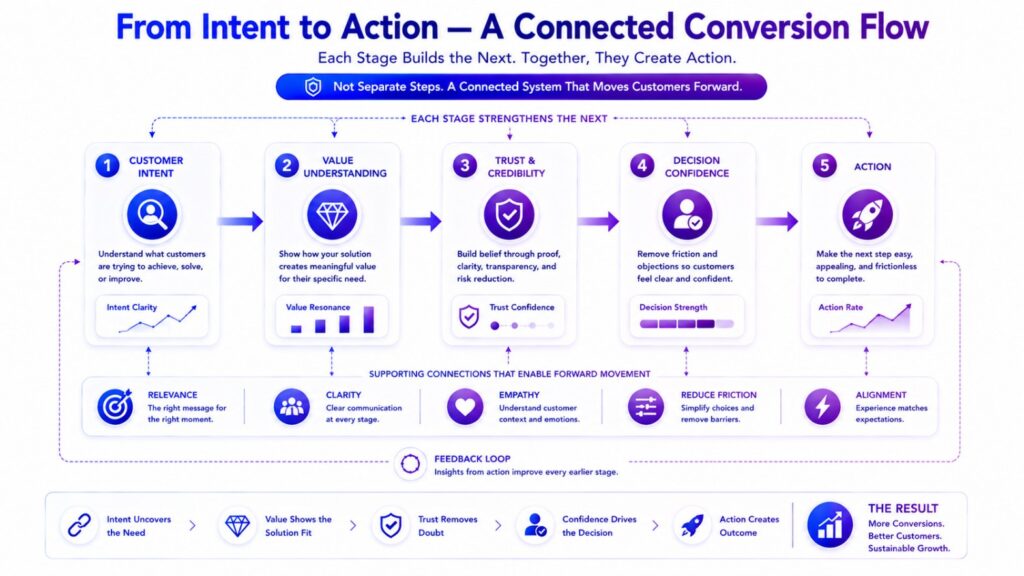
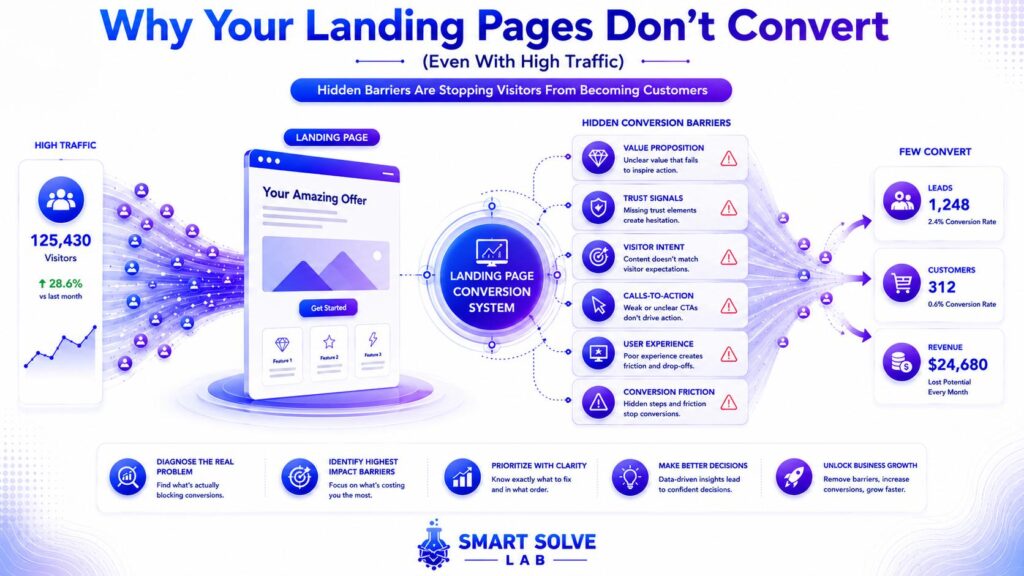
    Comparison between customer interest and customer progression across the buying journey.
    Customer engagement does not always indicate movement toward a buying decision.

    The Six Structural Breakpoints Behind Customer Drop-Off

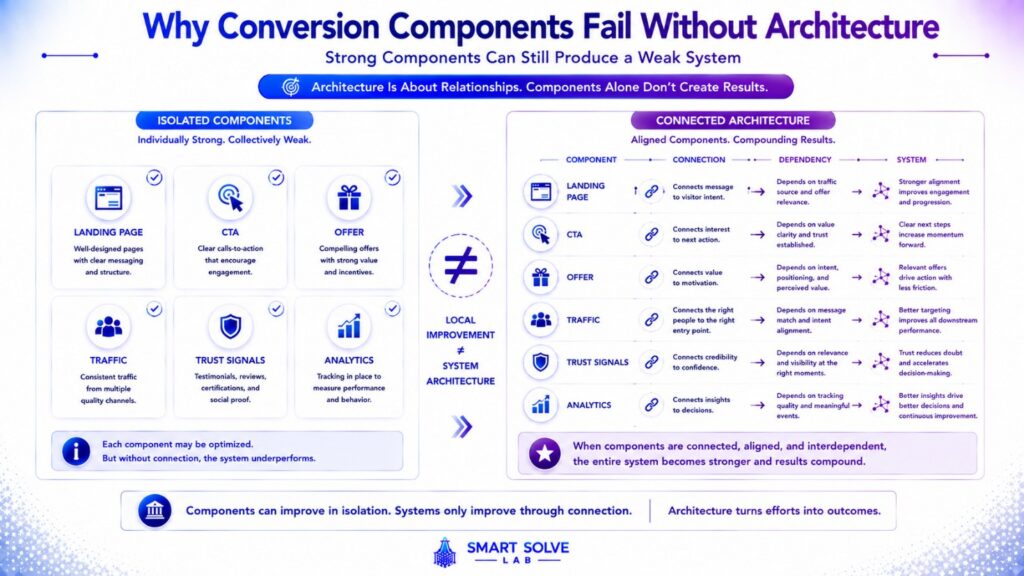
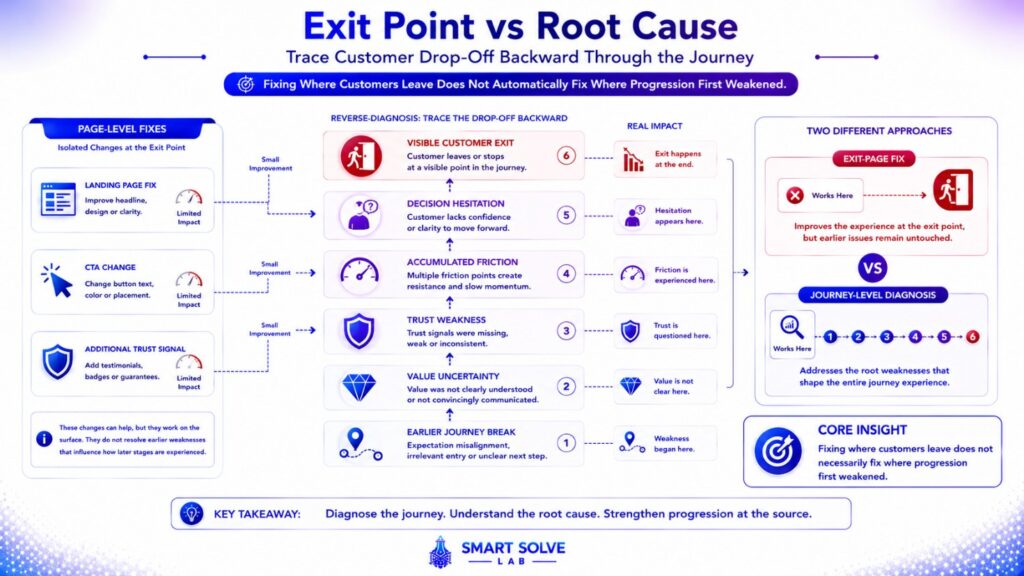
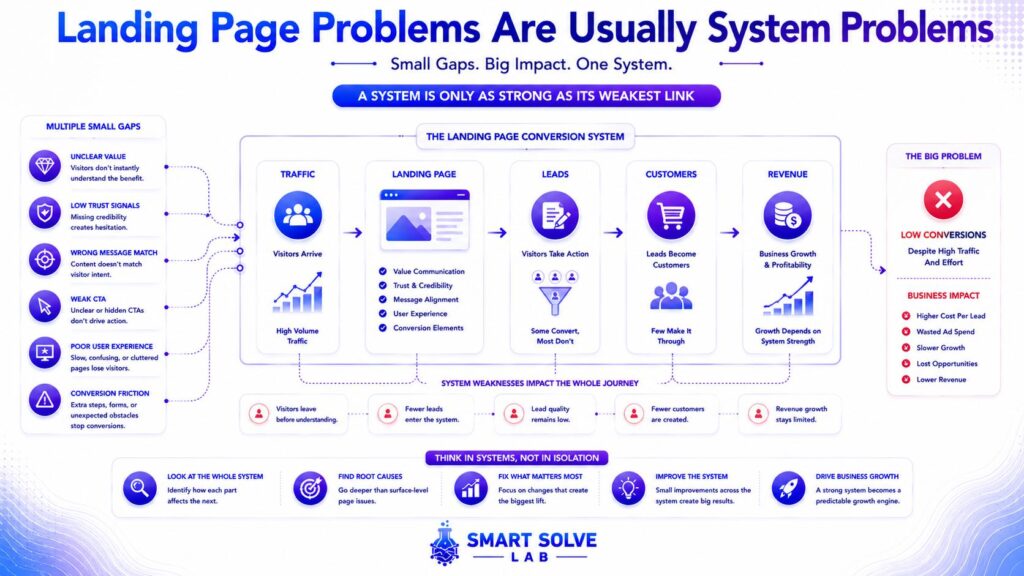
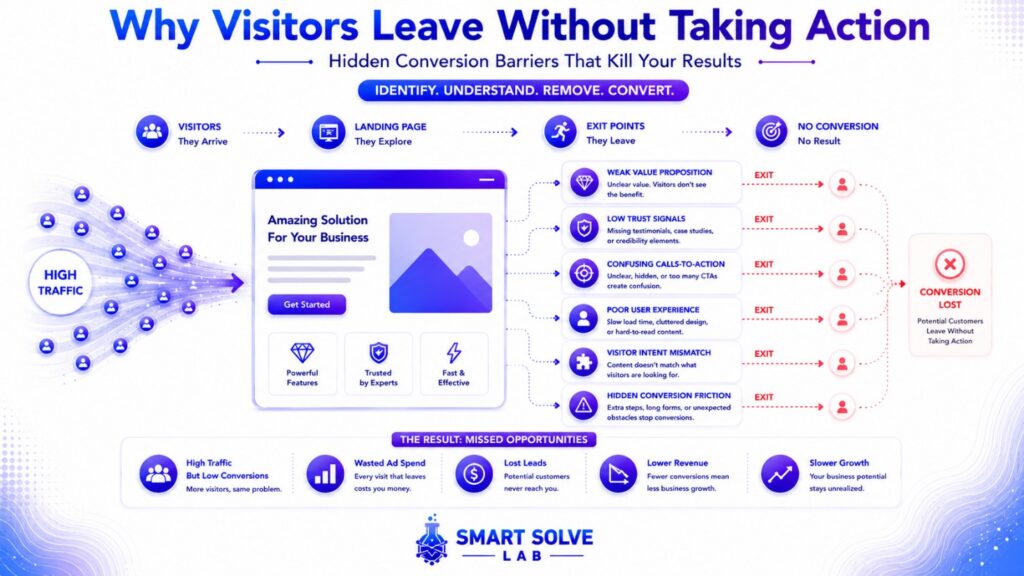
    Reverse customer journey diagnosis tracing customer drop-off back to earlier journey weaknesses.
    The page where customers leave is not always where the journey first became weak.

    If customer drop-off is viewed only as the moment someone leaves a website, businesses naturally concentrate on fixing the page where the exit occurred. However, a customer journey is not a collection of isolated pages. It is a connected progression where every stage influences the customer’s experience of the next.

    When progression repeatedly breaks, the underlying cause often exists within the structure of the journey itself. Certain transition points become weaker over time, allowing uncertainty, hesitation, or friction to accumulate until customers no longer feel confident enough to continue.

    These structural breakpoints do not guarantee that customers will leave. Instead, they reduce the journey’s ability to consistently move interested visitors toward confident purchase decisions.

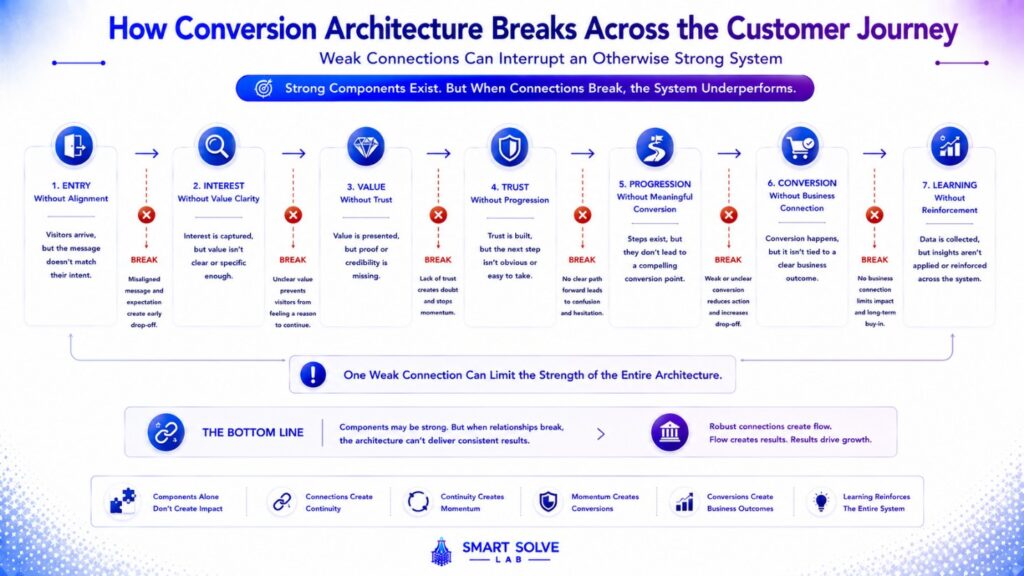
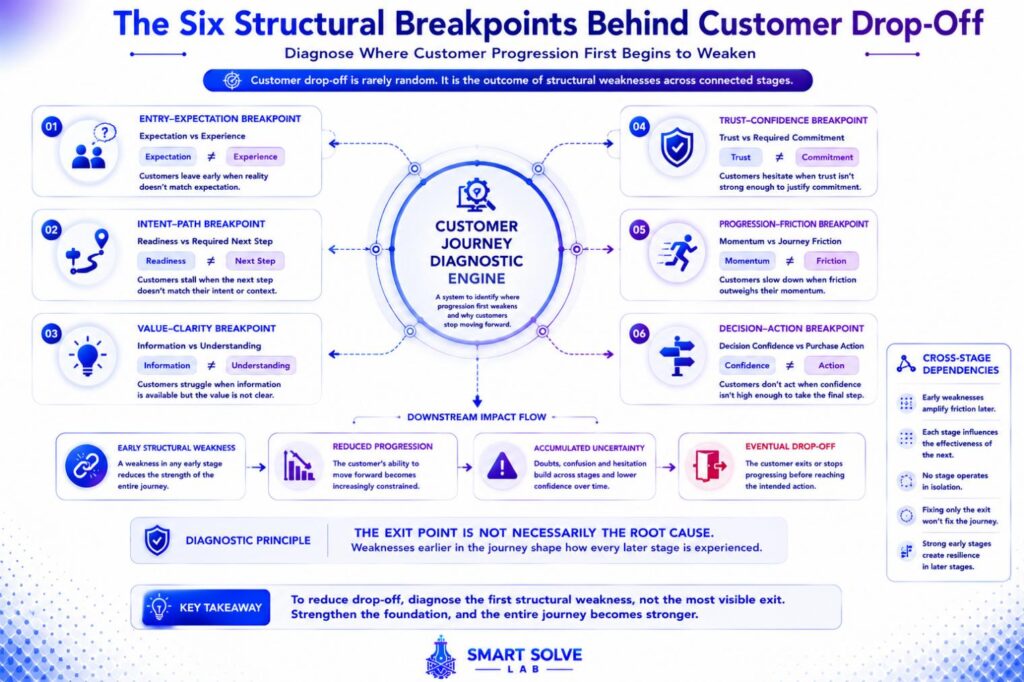
    1. Entry–Expectation Breakpoint

    Every customer begins the journey with an expectation. That expectation may come from a search result, a recommendation, an advertisement, or previous interactions with the business.

    The first experience should reinforce the reason the customer arrived. When the initial experience clearly aligns with the customer’s expectations, confidence begins to develop naturally. The customer feels that continuing the journey is likely to provide the answers or solutions they were looking for.

    Problems emerge when the experience differs from what the customer anticipated. The content may address a different problem, the messaging may feel inconsistent, or the solution may appear less relevant than expected. Although many visitors continue exploring, the first reduction in confidence has already occurred.

    This early mismatch may seem insignificant, but it creates a weaker foundation for every stage that follows.

    2. Intent–Path Breakpoint

    Customers do not all enter the journey with the same level of readiness. Some are still understanding their problem, while others are actively evaluating solutions or preparing to make a purchase.

    A strong customer journey provides a logical next step that matches the customer’s current intent. Rather than pushing every visitor toward the same outcome, it allows progression to feel natural and appropriately paced.

    A structural breakpoint appears when the required next action demands more commitment than the customer is prepared to make. Asking for a consultation before enough understanding exists or delaying obvious next steps for customers who are ready to proceed can both interrupt progression.

    The issue is not necessarily the action itself but the mismatch between customer readiness and journey progression.

    3. Value–Clarity Breakpoint

    As customers move through the buying journey, they continually reassess whether the solution remains valuable to their situation.

    Many businesses respond to uncertainty by adding more information. However, increasing the amount of information does not automatically improve understanding. When explanations become overly detailed, inconsistent, or disconnected from the customer’s priorities, value may become more difficult—not easier—to recognize.

    A customer who understood the initial benefit can gradually become less certain about why continuing still matters.

    Without increasing clarity, interest slowly gives way to hesitation, even though the solution itself may remain highly relevant.

    4. Trust–Confidence Breakpoint

    Trust is not built all at once. It develops progressively as customers continue moving through the journey.

    Early interactions require relatively little confidence. Reading an article or exploring a website asks for far less commitment than requesting a proposal or making a purchase. As commitment increases, customers naturally expect stronger reasons to believe they are making a sound decision.

    A structural breakpoint develops when trust grows more slowly than commitment. Customers may appreciate the business, value its expertise, and still hesitate because they do not yet feel sufficiently confident to take the next step.

    The journey has advanced, but confidence has not advanced at the same pace.

    5. Progression–Friction Breakpoint

    Every transition within the customer journey should make moving forward feel clear and reasonable.

    When unnecessary complexity begins appearing between stages, progression becomes increasingly difficult. Customers may struggle to understand the next logical step, encounter inconsistent messaging, or experience interruptions that reduce momentum.

    Individually, these moments of friction may appear too small to matter. Collectively, however, they require customers to invest additional effort at every stage.

    Over time, progression feels less natural, and continuing the journey demands more energy than customers initially expected.

    6. Decision–Action Breakpoint

    The final buying decision represents the combined outcome of every earlier stage rather than an isolated moment.

    By the time customers reach the purchase stage, they have already formed opinions about relevance, value, trust, and the overall quality of the journey. If earlier uncertainty remains unresolved, the final decision becomes increasingly difficult.

    Many businesses interpret this hesitation as a problem with pricing, checkout, or the final call to action. While those elements certainly matter, they often reveal uncertainty that developed much earlier rather than creating it.

    Customers may arrive at the final decision fully interested in the solution yet still lack the accumulated confidence required to act.

    Diagnostic Principle

    The most important insight is that the point where customers leave is not necessarily the point where the customer journey first became weak.

    Visible customer exits are often the final expression of uncertainty that has gradually accumulated across multiple stages of the journey. Treating the exit page as the primary cause can therefore improve one interaction while leaving earlier structural weaknesses untouched.

    A more effective diagnostic approach asks how each stage influences the next and where customer progression first begins losing strength. Identifying that earlier breakpoint provides a much stronger foundation for understanding why customer drop-off continues to repeat.

    Recommended Reading

    conversion problems keep repeating

    Six structural breakpoints responsible for customer drop-off across the buying journey.
    Customer drop-off is often the result of structural weaknesses that develop earlier in the journey.

    Why Fixing the Exit Page Often Doesn’t Fix Customer Drop-Off

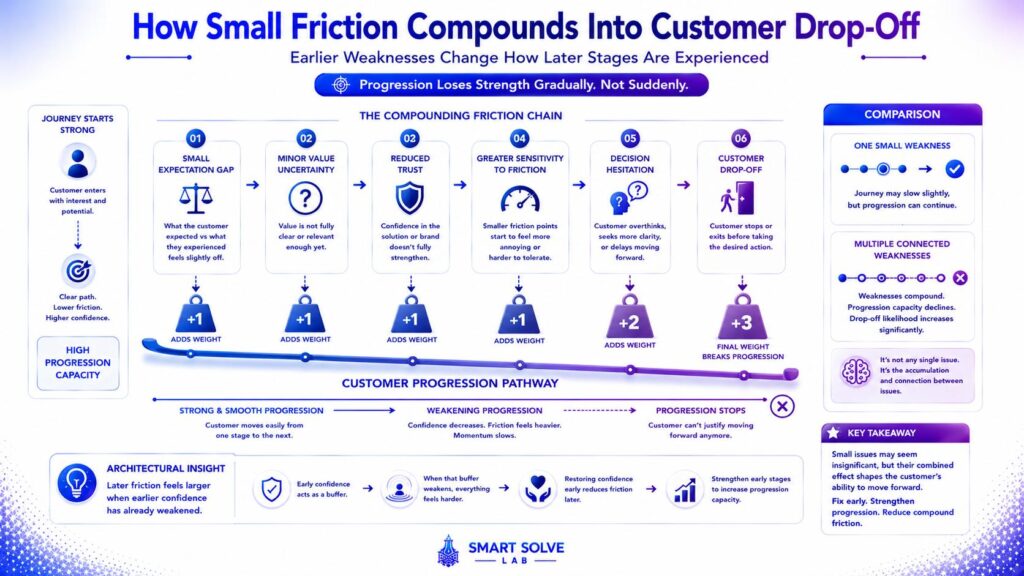
    Compounding customer journey friction reducing progression toward purchase.
    Several small journey weaknesses can combine into one major customer drop-off problem.

    After identifying the six structural breakpoints, it becomes easier to understand why many customer journey improvements produce only temporary results. Businesses frequently optimize the page where customers leave because it represents the most visible part of the problem. If analytics show visitors abandoning a pricing page, checkout, or landing page, the logical response is often to improve that specific interaction.

    While these improvements can certainly enhance the customer experience, they do not automatically resolve the deeper structural conditions that caused confidence to weaken throughout the journey. A customer’s final decision is influenced by every stage that came before it, not solely by the page where the journey ends.

    This is why some businesses continue experiencing similar customer drop-off patterns even after redesigning individual pages. The visible exit changes, but the underlying progression constraints remain.

    The Exit Page May Only Reveal an Earlier Weakness

    The page where customers leave is often the point where accumulated uncertainty finally outweighs their confidence to continue. It is the visible outcome of the journey—not necessarily the beginning of the problem.

    For example, a customer may leave during checkout because they hesitate before making a payment. However, that hesitation may have started much earlier when the value proposition became less clear, important questions remained unanswered, or trust failed to develop alongside increasing commitment.

    By the time customers reach the final stage, they are making decisions based on everything they have experienced throughout the journey. The exit page simply reveals where that accumulated uncertainty became too great to overcome.

    Landing-Page Improvements Can Fix an Interaction Without Fixing Progression

    Landing pages play an important role in introducing customers to a business and guiding early progression. Improving messaging, design, or navigation can strengthen the first interaction and create a better initial experience.

    However, a stronger landing page cannot compensate for weaknesses that appear later in the journey. Customers may begin with greater confidence, but if value becomes less clear, trust fails to grow, or progression becomes increasingly difficult, the earlier improvements eventually lose their influence.

    Optimizing one interaction does not automatically strengthen the entire customer journey. Progression depends on how each stage supports the next rather than how well any single page performs in isolation.

    CTA Changes Can Improve Direction Without Resolving Uncertainty

    Calls to action help customers understand what they should do next. Clearer wording or improved placement may encourage more visitors to continue moving through the journey.

    Yet even the most effective CTA cannot remove uncertainty that developed earlier. Customers may understand exactly what action is being requested while still questioning whether they feel confident enough to take it.

    Direction and confidence are different challenges. A customer who lacks confidence rarely benefits simply from receiving clearer instructions.

    Trust Signals Cannot Repair Poor Value Alignment

    Businesses often respond to customer hesitation by adding testimonials, certifications, guarantees, or other trust-building elements. These additions can reinforce credibility and reduce certain forms of uncertainty.

    However, trust signals are most effective when customers already understand the value being offered. If visitors remain unclear about how the solution addresses their needs, additional proof alone cannot create genuine confidence.

    Customers first need to understand why the solution matters before evidence can strengthen their belief in it. Trust supports value—it does not replace it.

    Customers Carry Earlier Friction Into Later Decisions

    Every stage of the journey influences how customers experience the stages that follow.

    A customer who has already encountered confusing messaging, inconsistent expectations, or unclear value will naturally become more sensitive to additional friction later. Even relatively small obstacles can feel more significant because earlier confidence has already weakened.

    By contrast, customers whose journey has consistently reinforced relevance, understanding, and trust often navigate the same later stages with much greater confidence.

    This demonstrates that later interactions cannot be evaluated independently from everything that happened before them.

    Why Local Fixes Can Produce Gains Without Journey Stability

    Improving individual pages often generates measurable improvements. Conversion rates may increase temporarily, engagement may improve, or more customers may complete specific actions.

    These gains are valuable, but they do not necessarily indicate that the customer journey has become structurally stronger. If earlier weaknesses remain unresolved, customers may simply encounter the same progression constraints further along the journey.

    Long-term improvement comes from strengthening how the entire journey works together rather than continuously optimizing isolated components.

    Reverse Diagnostic Chain

    Instead of beginning with the page where customers leave, a stronger diagnostic approach traces the journey backward.

    Visible Customer Exit

    Decision Hesitation

    Accumulated Friction

    Trust Weakness

    Value Uncertainty

    Earlier Journey Break

    Following this reverse diagnostic sequence helps businesses identify where progression first began weakening instead of focusing only on where customers finally exited. This shift transforms customer drop-off from a page-level optimization problem into a customer journey diagnosis problem.

    How Small Friction Points Compound Across the Customer Journey

    Not every weakness in a customer journey is powerful enough to stop a customer from buying. In fact, many individual problems appear too small to deserve immediate attention. A slightly unclear message, a small delay in understanding value, a minor trust concern, or an unnecessary step may seem insignificant when viewed independently.

    The challenge is that customers do not experience these weaknesses independently. They experience them as one connected journey.

    Every small moment of uncertainty influences how the next stage is perceived. As these moments accumulate, customers gradually become less confident, less motivated, and less willing to continue. By the time they reach the final buying decision, the combined effect of many small weaknesses can become far more influential than any single issue alone.

    This is why customer drop-off often appears unexpected. Businesses may struggle to identify one obvious problem because no single interaction seems severe enough to explain the outcome. The real issue lies in how multiple weaknesses reinforce one another across the journey.

    One Weakness May Not Stop the Journey

    A customer who encounters a small expectation mismatch during the first interaction does not automatically abandon the journey. Many visitors continue exploring because they still believe the solution may be relevant.

    Similarly, a brief moment of uncertainty about value or a small amount of additional effort rarely causes an immediate exit. Customers are generally willing to tolerate minor imperfections when they believe the journey is still moving toward a worthwhile outcome.

    This is why businesses should avoid assuming that every isolated weakness is responsible for customer abandonment. Many customers successfully progress despite encountering occasional friction.

    Multiple Weaknesses Reduce Progression Capacity

    The situation changes when several small weaknesses appear throughout the customer journey.

    A slight expectation mismatch may reduce initial confidence. Later, value becomes less clear than expected. Trust develops more slowly than commitment increases. Additional friction interrupts momentum. Individually, none of these weaknesses may appear serious. Together, however, they gradually reduce the customer’s willingness to continue.

    Rather than one dramatic failure, the journey experiences a gradual decline in progression capacity.

    This cumulative pattern can be visualized as:

    Small Expectation Gap

    Minor Value Uncertainty

    Reduced Trust

    Greater Sensitivity to Friction

    Decision Hesitation

    Customer Drop-Off

    The final decision is influenced not by one isolated weakness but by the combined effect of everything the customer experienced beforehand.

    Earlier Weaknesses Change How Later Stages Are Experienced

    One of the most important principles of customer journey diagnosis is that earlier experiences shape how customers interpret everything that follows.

    A checkout process, consultation request, pricing page, or contact form may appear completely reasonable when viewed in isolation. For customers whose confidence has been strengthened throughout the journey, these stages often feel like natural next steps.

    However, customers who have already experienced uncertainty, inconsistent messaging, or weakening trust perceive the same interactions very differently. The exact same checkout process can feel more complicated. The same request for commitment can seem more demanding. The same purchasing decision can appear more risky.

    The later stage has not necessarily changed. What has changed is the customer’s confidence when arriving there.

    This is why improving only the final interaction often fails to eliminate customer drop-off. The experience of that interaction has already been shaped by everything that happened earlier in the journey.

    Compounding Friction Is a Journey Problem, Not a Page Problem

    Businesses sometimes attempt to eliminate friction by optimizing whichever page shows the highest abandonment rate. While this approach may improve a specific interaction, it rarely explains why customers became increasingly sensitive to friction in the first place.

    Compounding friction develops across connected stages rather than within one isolated page. It reflects how expectation, value, trust, progression, and decision confidence interact over time.

    Reducing avoidable customer drop-off therefore requires understanding how these elements influence one another across the entire journey instead of treating each page as an independent optimization project.

    When businesses begin viewing customer progression as a connected system, small weaknesses become easier to recognize before they accumulate into larger structural constraints. Rather than waiting for customer exits to reveal the problem, they can identify where confidence first begins to weaken and strengthen the journey before that weakness spreads to later stages.

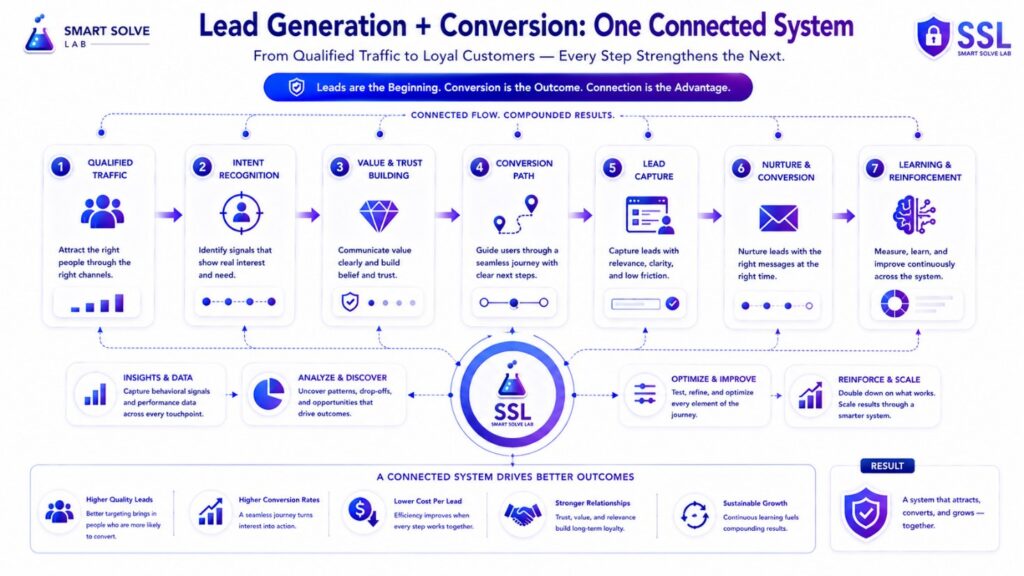
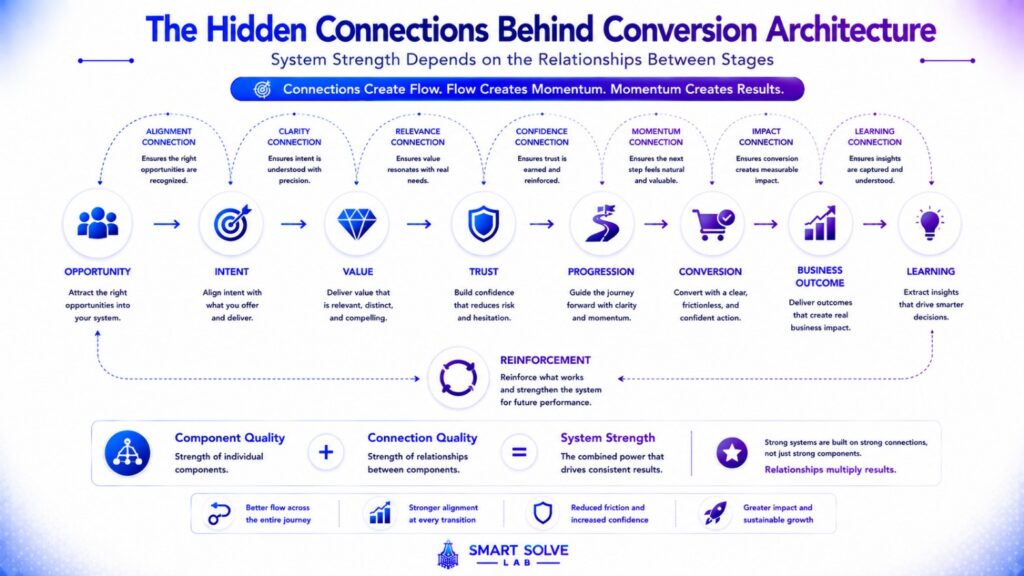
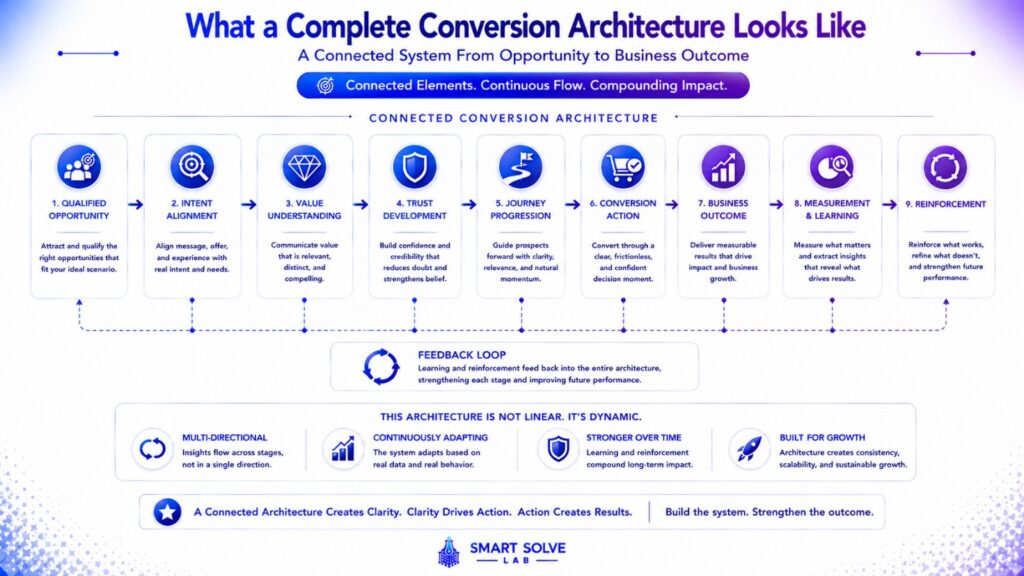
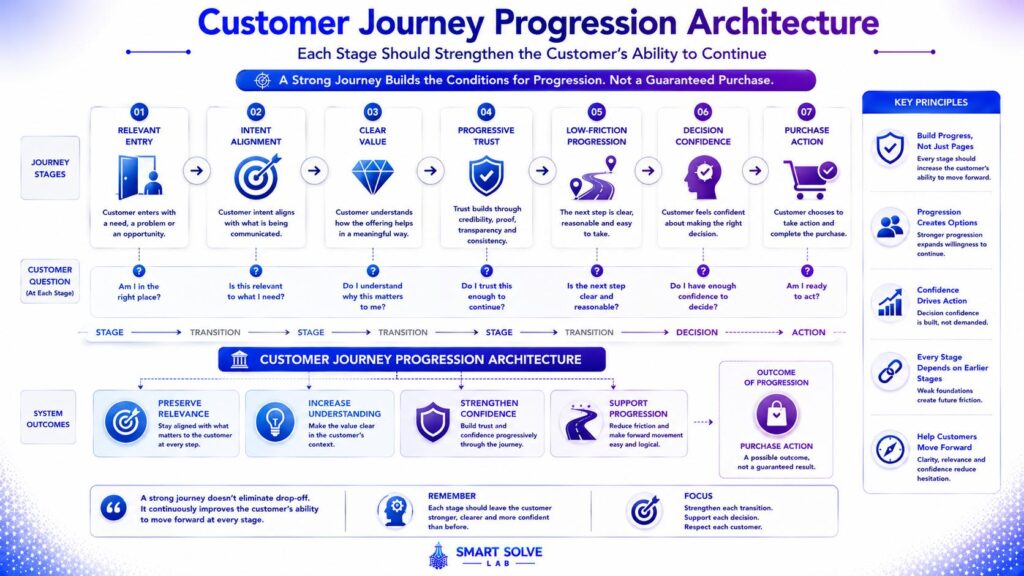
    Customer Journey Optimization Framework connecting customer progression from entry to purchase.
    A stronger customer journey develops when every stage supports the customer’s next decision.

    What a Strong Customer Journey Actually Needs

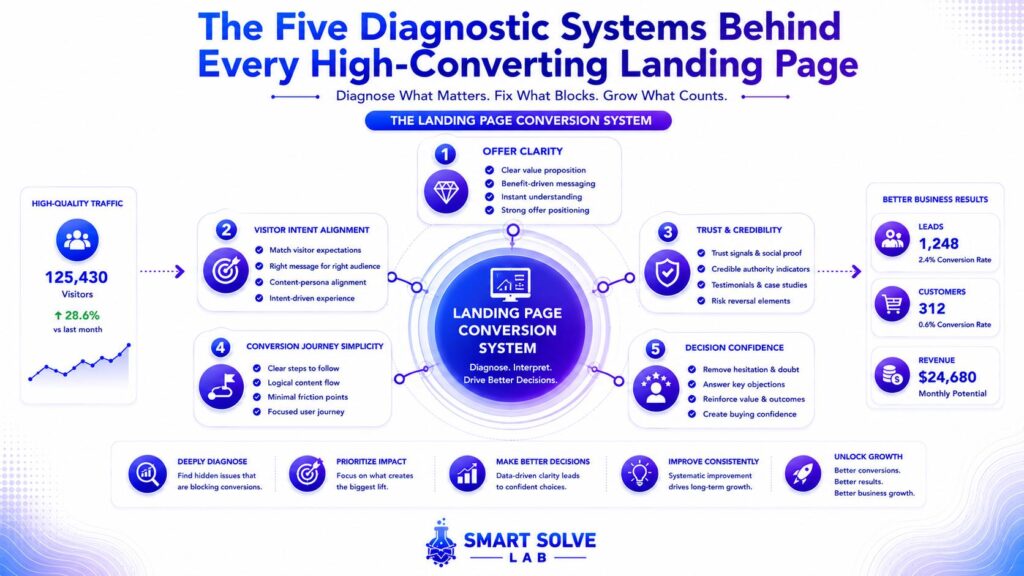
    After identifying where customer progression begins to weaken, the next step is not to optimize every page individually. A stronger customer journey is built by ensuring that each stage prepares customers for the next one. Rather than functioning as separate interactions, the stages should work together as a connected progression that gradually increases understanding, confidence, and readiness to act.

    This perspective shifts the focus from isolated improvements to journey architecture. Instead of asking whether one page performs well, businesses begin asking whether every stage helps customers move naturally toward the next decision.

    A well-connected customer journey does not remove every obstacle or guarantee that every visitor becomes a customer. Its purpose is to reduce avoidable uncertainty by creating a clear and logical progression from initial interest to confident action.

    Customer Journey Progression Architecture

    A strong customer journey can be understood as a sequence of connected stages, each with a specific responsibility.

    Relevant Entry

    Intent Alignment

    Clear Value

    Progressive Trust

    Low-Friction Progression

    Decision Confidence

    Purchase Action

    Each stage strengthens the customer’s ability to continue rather than attempting to complete the entire selling process at once. When one stage performs its role effectively, it creates the conditions that allow the next stage to succeed.

    Every Stage Should Answer a Different Customer Question

    Customers do not move through the buying journey simply because information is available. They progress because each stage resolves an important question that naturally leads to the next decision.

    Am I in the right place?

    The journey begins by confirming that the business understands the customer’s problem and offers something relevant to their needs.

    Is this relevant to what I need?

    Customers then determine whether the solution genuinely connects with their situation rather than presenting a generic promise.

    Do I understand why this matters to me?

    As they continue, value should become clearer instead of becoming more complicated. Customers need increasing understanding, not simply increasing amounts of information.

    Do I trust this enough to continue?

    Because commitment gradually increases throughout the journey, trust should also develop progressively. Confidence cannot remain static while expectations continue rising.

    Is the next step clear and reasonable?

    Every transition should feel logical. Customers should understand why the next action is appropriate without feeling rushed or uncertain.

    Do I have enough confidence to decide?

    Before acting, customers naturally review everything they have experienced throughout the journey. A connected progression strengthens confidence long before this final evaluation occurs.

    Am I ready to act?

    Purchase decisions become easier when earlier stages have consistently reduced uncertainty and supported progression rather than introducing new questions.

    Strong Customer Journeys Reduce Uncertainty at Every Stage

    One of the defining characteristics of an effective customer journey is that uncertainty decreases as customers move forward.

    Early stages reduce uncertainty about relevance.

    Middle stages reduce uncertainty about value.

    Later stages reduce uncertainty about trust, commitment, and decision-making.

    Instead of expecting customers to overcome unanswered questions on their own, the journey continuously supports their progression by making each next decision feel clearer than the previous one.

    Understanding how customers move through these stages is also an important part of improving the overall journey. Measuring meaningful interactions across the buying process helps businesses identify where progression weakens and where additional investigation may be needed. Google’s guidance on customer journey measurement provides a helpful overview of evaluating customer interactions across multiple touchpoints rather than focusing on a single page or session.

    Customer journey measurement

    This type of measurement complements journey diagnosis by providing evidence about where customers slow down, disengage, or leave before completing their intended path.

    Journey Architecture Is Stronger Than Individual Optimization

    Businesses often improve individual pages while expecting overall customer progression to improve automatically. Although page-level optimization remains valuable, it cannot replace a connected journey architecture.

    A customer does not experience one page at a time in isolation. They experience a sequence of decisions, expectations, transitions, and interactions that together shape their confidence.

    When every stage preserves relevance, increases understanding, strengthens trust, reduces unnecessary friction, and prepares customers for the next decision, the journey becomes more resilient. Individual improvements then contribute to a stronger overall system rather than functioning as isolated optimizations.

    The System Insight: Customers Experience a Journey, Not Individual Pages

    One of the biggest reasons businesses struggle to reduce customer drop-off is that they often evaluate the buying experience one page at a time. Landing pages are reviewed separately from product pages, product pages are analyzed independently from checkout, and individual interactions are optimized without considering how they influence the journey as a whole.

    While this approach can improve specific components, it does not necessarily strengthen the customer journey itself.

    Customers do not experience a business as disconnected pages. They experience a continuous sequence of interactions where every stage influences how the next stage is perceived. The confidence they bring into one decision is shaped by everything they experienced before reaching it.

    Understanding this distinction changes how customer drop-off should be diagnosed. Instead of asking whether a single page is performing well, businesses begin examining whether the connections between stages consistently support customer progression.

    Customers Experience Progression, Not Individual Components

    From a business perspective, websites are often organized into separate assets—landing pages, service pages, product pages, pricing pages, contact forms, and checkout processes. Each component has its own purpose and performance metrics.

    Customers, however, rarely think in these categories.

    They experience one continuous journey that moves from discovering a problem to understanding a solution, developing trust, evaluating available options, and deciding whether to take action. Every interaction becomes part of one larger experience rather than an isolated event.

    This means that improving an individual component does not automatically improve the customer’s overall journey. A highly optimized landing page cannot compensate for confusion later in the process, just as a well-designed checkout cannot fully overcome uncertainty that developed much earlier.

    The Connections Between Stages Shape Customer Confidence

    The quality of a customer journey depends not only on how well each stage performs individually but also on how effectively one stage prepares customers for the next.

    A relevant entry should naturally lead to stronger intent alignment.

    Intent alignment should increase understanding of value.

    Greater value clarity should strengthen trust.

    Growing trust should make progression feel easier.

    Reduced friction should support greater decision confidence.

    Decision confidence should make taking action feel like a logical next step.

    When these transitions remain connected, customers experience a journey that gradually reduces uncertainty instead of increasing it. When those connections weaken, even well-designed individual stages struggle to maintain progression.

    Strong Journey Architecture Creates Stronger Customer Progression

    Journey architecture is ultimately about creating consistency across the entire buying experience.

    Rather than optimizing pages independently, businesses begin evaluating how relevance, understanding, trust, progression, and confidence interact as one connected system. Every stage has a distinct responsibility, but each stage also supports the success of the next.

    This systems perspective makes customer drop-off easier to interpret. Instead of viewing abandonment as a failure of one page, it becomes a signal that somewhere within the connected journey, customer progression has gradually weakened.

    Understanding those relationships allows businesses to move beyond isolated improvements and toward a more structured approach to customer journey optimization.
    Core Authority Principle

    Strong customer journeys do not succeed because individual pages are highly optimized.

    They succeed because every stage preserves relevance, increases understanding, strengthens confidence, and makes the next decision easier to take.

    When customer progression is supported consistently across the entire journey, businesses are better positioned to reduce avoidable drop-off and create a more connected buying experience without relying on isolated page-level improvements.

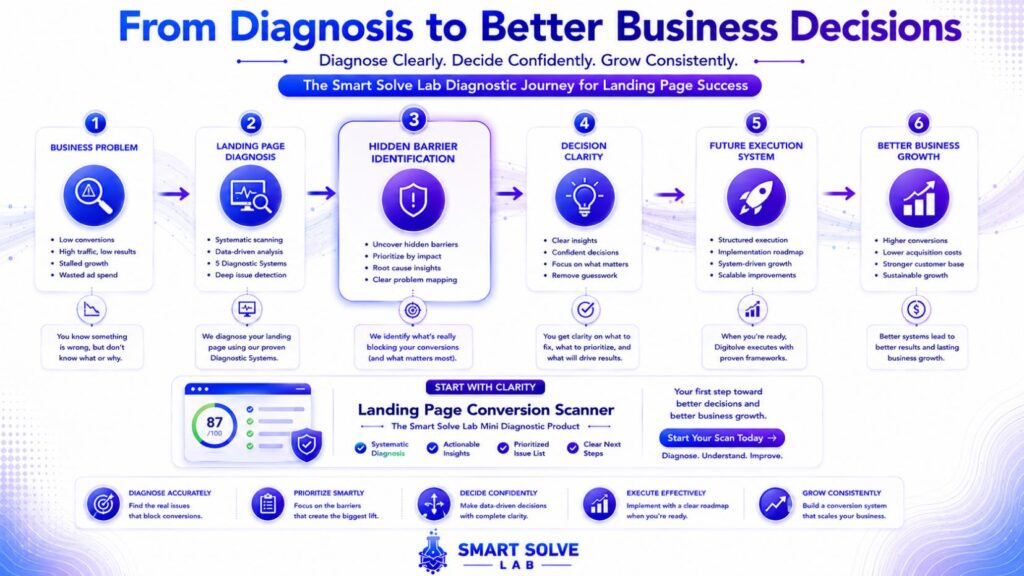
    From Customer Drop-Off to Customer Journey Optimization

    Understanding why customers leave before buying is only the first step. The greater value comes from using that understanding to strengthen the customer journey systematically rather than reacting to individual symptoms.

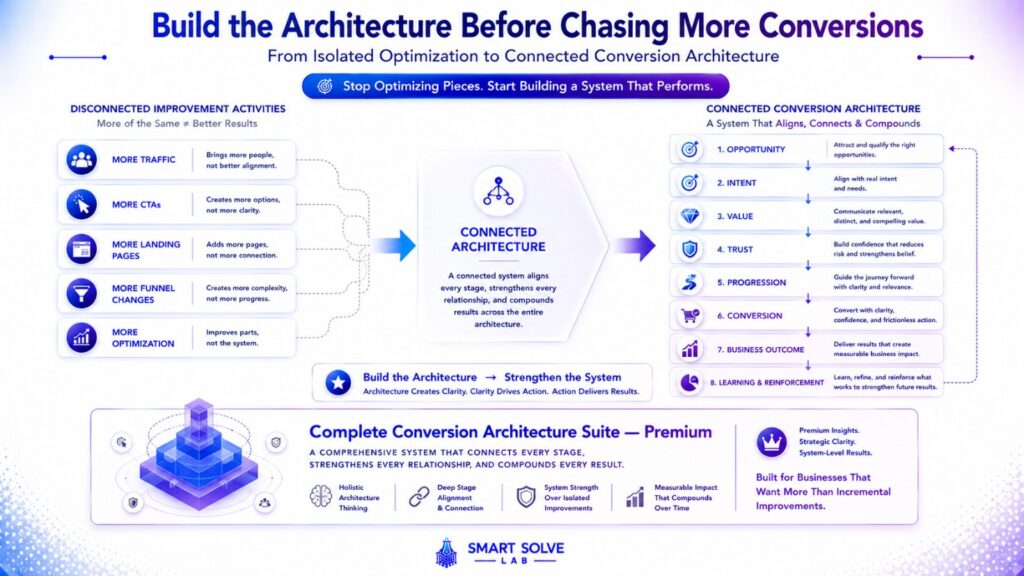
    Many businesses improve isolated pages whenever customer drop-off becomes visible. They redesign landing pages, rewrite calls to action, simplify forms, or adjust individual interactions based on where customers appear to exit. Although these improvements can enhance specific parts of the experience, they often address the visible symptom rather than the structural conditions that allowed progression to weaken in the first place.

    A system-level approach begins differently. Instead of asking how to improve one page, it asks how the entire customer journey functions as a connected progression.

    Customer Journey Optimization Begins With Diagnosis

    Optimization should not begin with assumptions. It begins with understanding how customers actually move through the journey and identifying where progression first starts losing strength.

    Rather than treating every drop-off as an independent problem, businesses can evaluate how customer intent, value understanding, trust, progression, and decision confidence interact across multiple stages. This creates a clearer picture of how different parts of the journey influence one another.

    Only after those relationships become visible does optimization become more purposeful. Improvements are guided by diagnosis instead of guesswork.

    Prioritize Structural Constraints Before Local Improvements

    Not every weakness within a customer journey deserves the same level of attention.

    Some issues affect only one interaction, while others influence several stages simultaneously. A structural constraint that weakens customer progression early in the journey can create downstream effects that appear across multiple pages and decision points.

    Prioritizing these structural constraints allows businesses to strengthen the journey where improvements can have the greatest overall impact. Instead of repeatedly addressing isolated symptoms, they focus on the conditions that shape progression throughout the entire buying experience.

    This approach encourages more strategic decision-making by distinguishing between localized improvements and broader journey constraints.

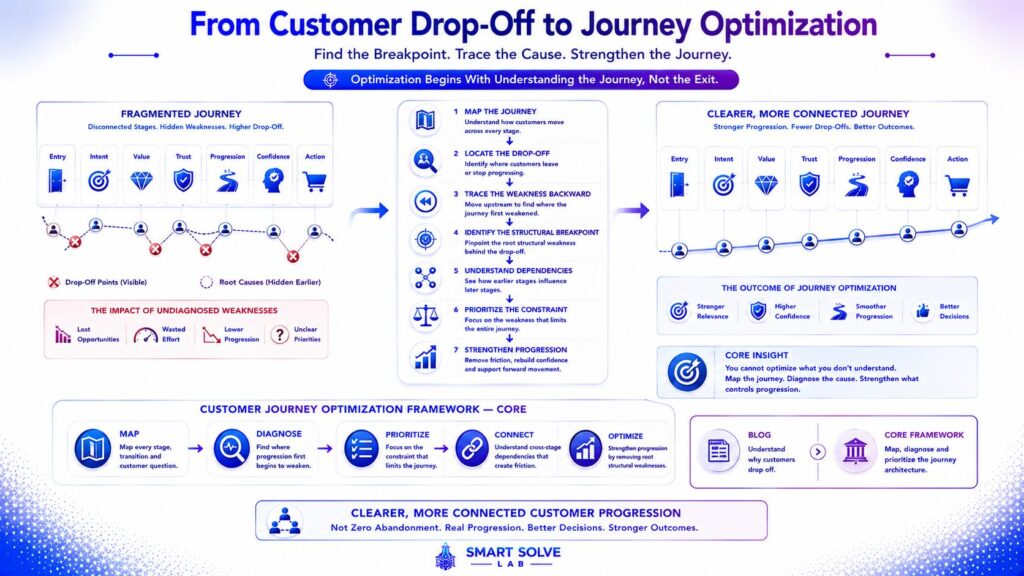
    The Customer Journey Optimization Framework

    The Customer Journey Optimization Framework provides a structured approach for understanding and strengthening customer progression across the buying journey.

    Rather than focusing on isolated conversion elements, the framework helps businesses examine how the journey functions as one connected system.

    Its diagnostic direction follows five progressive stages:

    Map

    Understand how customers move through the complete buying journey.

    Diagnose

    Identify where customer progression first begins to weaken.

    Prioritize

    Determine which structural constraints create the greatest impact on progression.

    Connect

    Understand how different journey stages influence one another.

    Optimize

    Strengthen the customer journey by improving progression rather than isolated interactions.

    The objective is not to optimize every stage equally.

    The objective is to identify where customer progression is breaking, understand what is causing that break, recognize the dependencies influencing it, and prioritize the structural constraint that should be addressed first.

    This creates a more systematic approach than simply responding to whichever page currently experiences the highest customer abandonment.

    Blog → Framework Boundary

    This article has focused on diagnosing why customers drop off before buying and explaining how structural weaknesses across the customer journey gradually reduce progression.

    The Customer Journey Optimization Framework extends that foundation by providing a structured process for mapping the complete buying journey, identifying structural breakpoints, understanding their dependencies, prioritizing journey constraints, and creating a systematic optimization direction.

    Rather than offering isolated conversion tactics, the framework helps businesses evaluate the customer journey as a connected architecture where every stage contributes to the customer’s overall progression.


    Conclusion

    Customer drop-off is rarely explained by one page, one button, or one interaction alone. More often, it reflects a gradual decline in customer confidence that develops across multiple stages of the buying journey.

    By the time customers leave, the visible exit may simply represent the point where accumulated uncertainty finally becomes greater than their willingness to continue. Focusing only on that final interaction can improve a local experience while leaving the underlying journey constraints unchanged.

    A more effective approach begins by understanding how customer progression develops from initial interest to confident action. Instead of asking only where customers leave, businesses can trace the journey backward to discover where progression first became weak, identify the structural breakpoint responsible, understand how that weakness influenced later stages, and prioritize the constraint that most affects the overall journey.

    That diagnostic sequence transforms customer drop-off from a page-level optimization problem into a customer journey architecture problem. As a result, improvements become more strategic, more connected, and more capable of strengthening progression across the entire buying experience.

    Ultimately, the goal is not to eliminate every customer exit. Every buying journey naturally includes visitors who decide not to continue. The objective is to reduce avoidable customer drop-off by creating a clearer, more connected progression that consistently strengthens relevance, understanding, trust, confidence, and readiness to act.

    Roadmap showing the transition from customer drop-off to customer journey optimization.
    Map the journey, diagnose structural breakpoints, strengthen progression, and reduce avoidable customer drop-off.

    Continue exploring related Smart Solve Lab resources to better understand customer progression, conversion challenges, and journey optimization.
    Why Customers Leave Without Taking Action (Even When They Seem Interested)

    Learn why interested visitors often leave without progressing and how repeated inaction can reveal deeper weaknesses across the customer journey.


    Why Conversion Problems Keep Repeating (Even After Fixing Individual Pages)

    Discover why page-level improvements may produce only temporary gains and how recurring conversion problems often indicate broader structural issues.


    Why Customer Engagement Doesn’t Turn Into Revenue (Even When Customers Interact)

    Explore why engagement metrics alone don’t guarantee business results and how stronger customer progression helps transform engagement into meaningful outcomes.

    FAQs

    Why do customers drop off before buying?

    Customers often drop off before buying because their confidence weakens somewhere during the customer journey. This can happen when expectations are not met, value becomes unclear, trust fails to develop, or unnecessary friction interrupts progression. The visible exit is not always the point where the underlying problem began.

    Is customer drop-off always caused by a poor landing page?

    No. While a landing page can influence the first impression, customer drop-off is often the result of multiple connected experiences across the buying journey. Improving one page may help, but it may not resolve structural weaknesses that developed earlier.

    What is the difference between customer engagement and customer progression?

    Customer engagement measures how customers interact with your website, such as reading content, viewing pages, or clicking links. Customer progression focuses on whether those interactions consistently move customers closer to making a confident purchase decision.

    What are structural breakpoints in a customer journey?

    Structural breakpoints are stages where customer progression begins to weaken. These may include expectation mismatches, unclear value, insufficient trust, unnecessary friction, or decision uncertainty that gradually increases the likelihood of customer drop-off.

    Why doesn’t fixing the exit page always reduce customer drop-off?

    The exit page often reflects the point where accumulated uncertainty becomes greater than the customer’s confidence to continue. If earlier stages of the journey remain weak, improving the final interaction alone may produce only temporary improvements.

    How does journey friction affect customer decisions?

    Small friction points rarely stop customers on their own. However, when several minor weaknesses accumulate across the journey, they gradually reduce confidence, increase hesitation, and make customers more likely to leave before completing a purchase.

    What is customer journey optimization?

    Customer journey optimization is the process of understanding how customers move through the buying journey, identifying structural constraints that weaken progression, and strengthening the connections between stages to support clearer, more confident decision-making.

    How can businesses reduce avoidable customer drop-off?

    Businesses can reduce avoidable customer drop-off by mapping the customer journey, identifying where progression first becomes weak, understanding how different stages influence one another, prioritizing structural constraints, and improving the overall journey rather than focusing only on isolated pages.

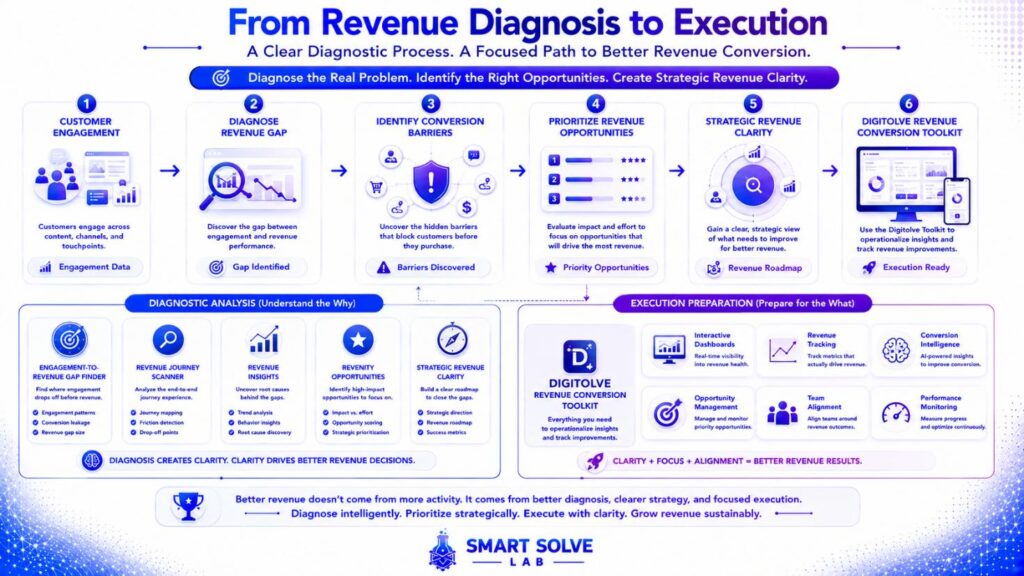
  • Why Customer Engagement Doesn’t Turn Into Revenue (Even When Customers Interact)

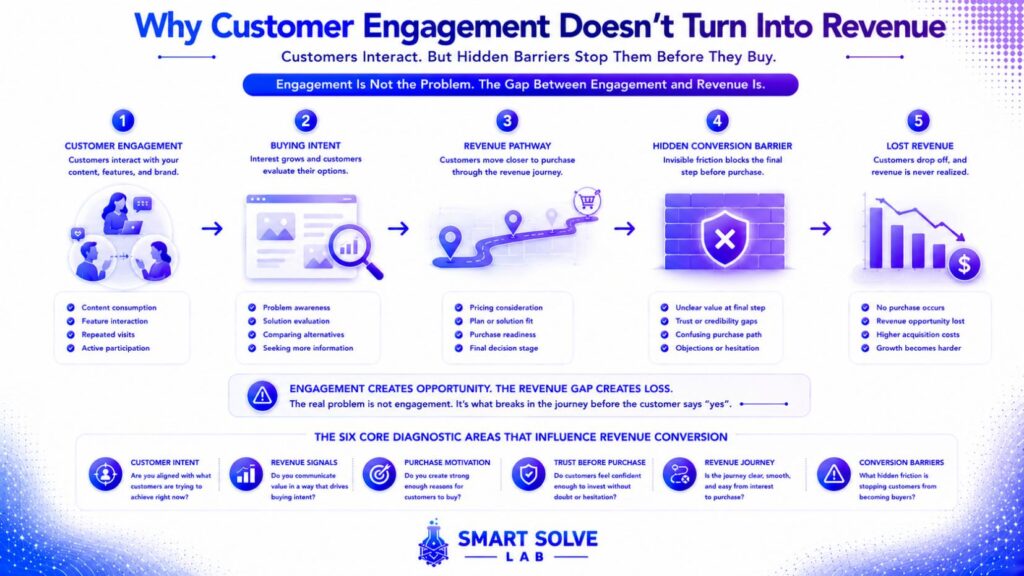
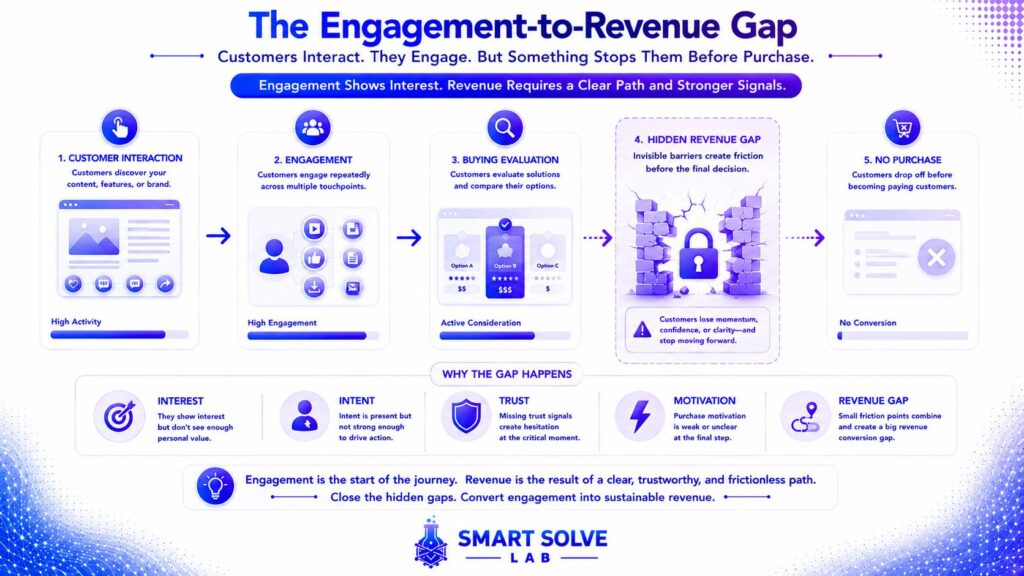
    Diagnostic framework showing why customer engagement does not turn into measurable revenue
    Diagnosing the hidden gap between customer engagement and measurable revenue.

    customer engagement doesn’t turn into revenue:

    Customer engagement is often treated as a strong indicator of business growth.

    When people read content, interact with offers, explore products, open emails, click links, or spend time engaging with a brand, businesses naturally assume that stronger engagement should eventually produce stronger revenue.

    But that does not always happen.

    A business can generate significant customer interaction while revenue remains flat, inconsistent, or far below expectations.

    This creates an important diagnostic question:

    Why does customer engagement fail to turn into measurable revenue?

    The visible problem may appear to be weak sales.

    But the underlying problem often exists somewhere between customer engagement, buying intent, and the revenue journey.

    Customers may interact because they are interested without being ready to buy. They may understand the offer without seeing enough value to make a financial commitment. They may even have strong purchase intent but encounter trust gaps, decision friction, or an unclear path toward becoming a paying customer.

    Understanding where this progression breaks is essential before attempting optimization.
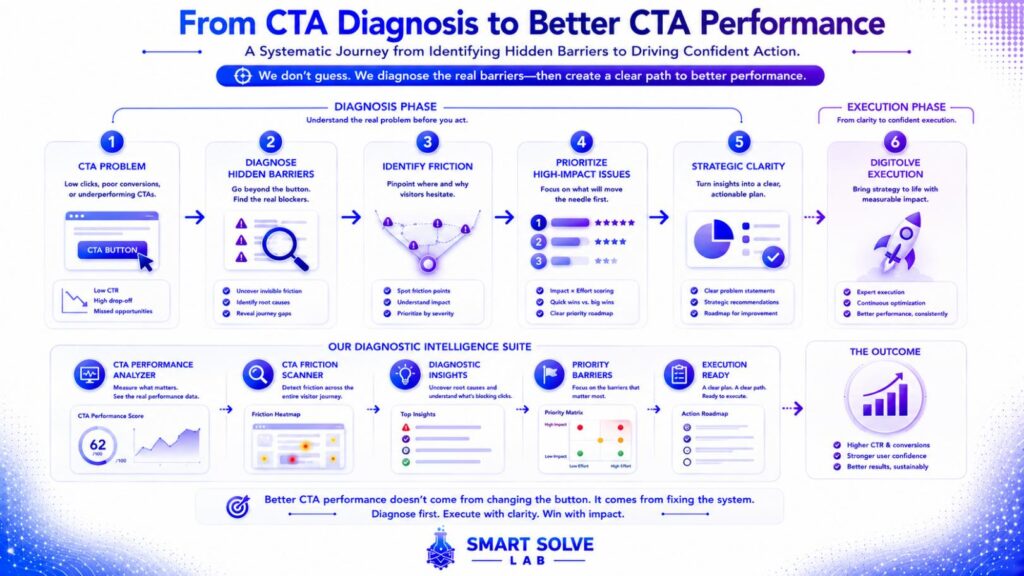
    Why Engagement Metrics Can Be Misleading

    Engagement metrics can provide valuable information about customer attention and interaction.

    However, engagement itself is not revenue.

    Metrics such as:

    • Page views
    • Content interactions
    • Email opens
    • Link clicks
    • Social engagement
    • Time spent exploring an offer

    can indicate interest without confirming commercial intent.

    When businesses evaluate success primarily through engagement metrics, they may overlook whether those interactions are actually progressing customers toward meaningful revenue outcomes.

    The Hidden Gap Between Customer Interaction and Revenue

    Between engagement and revenue lies a customer decision journey.

    A customer may move through several stages:

    Engagement → Evaluation → Buying Intent → Trust → Purchase Decision → Revenue

    If progression weakens at any stage, engagement can remain healthy while revenue performance struggles.

    This creates an engagement-to-revenue gap.

    The challenge is therefore not simply generating more interaction.

    It is understanding where engaged customers stop progressing toward commercial action.

    Why Revenue Problems Often Begin Before the Purchase

    Revenue loss does not always begin at checkout or at the final sales decision.

    The underlying barrier may develop much earlier.

    Customers may lack sufficient buying motivation.

    The perceived value may not justify the commitment.

    Trust may weaken during evaluation.

    The purchase journey may become confusing.

    Or the next step toward becoming a customer may simply feel unclear.

    By the time revenue fails to materialize, the real problem may already have existed across several earlier stages of the customer journey.

    How Systematic Diagnosis Reveals Revenue Gaps

    Effective diagnosis looks beyond engagement numbers and examines how customers progress toward revenue.

    This guide will help you understand:

    • Why strong customer engagement does not automatically generate revenue
    • Where hidden revenue barriers develop
    • How customer intent and purchase motivation influence progression
    • Why trust and journey clarity affect revenue conversion
    • Why revenue conversion problems are often system problems
    • How businesses can identify the highest-impact engagement-to-revenue gaps before optimization

    The goal is not to immediately increase engagement, redesign funnels, or change campaigns.

    The goal is to understand where customer progression toward revenue is breaking down and why.

    Diagnose the engagement-to-revenue gap before optimizing campaigns, funnels, or customer interactions.

    Table of Contents

    What Does “Customer Engagement Doesn’t Turn Into Revenue” Really Mean?

    Customer engagement is valuable, but engagement alone does not guarantee commercial results.

    People can read content, interact with a brand, explore products, click links, or repeatedly return to a website without ever becoming paying customers.

    When this happens, businesses often assume they need more engagement.

    But the real problem may not be the amount of interaction.

    The problem may be that existing engagement is not progressing through the revenue journey.

    The Problem

    A business may have strong engagement metrics:

    • Visitors regularly explore its content
    • Customers interact with campaigns
    • Email engagement remains healthy
    • Product or service pages receive attention
    • Social content generates reactions and conversations

    Yet sales and revenue remain disappointing.

    This creates a disconnect between what appears to be strong customer interest and what the business ultimately earns from that interest.

    The Hidden Reality

    Engagement measures interaction.

    Revenue requires progression.

    Between these two outcomes, customers must move through several decision stages involving intent, perceived value, motivation, trust, and purchase readiness.

    If progression breaks at any of these stages, engagement can continue without producing meaningful commercial results.

    This is closely connected to the broader conversion problem explained in Why Your Website Gets Traffic But No Conversions (Even When Visitors Keep Coming).

    Deep Insight

    Not every engaged customer has the same commercial intent.

    Some customers may be learning.

    Others may be comparing alternatives.

    Some may genuinely want the solution but are not yet ready to purchase.

    This means engagement should be viewed as a signal of customer interest, not automatic evidence of revenue readiness.

    The diagnostic challenge is identifying whether engaged customers are actually progressing toward stronger buying intent—or repeatedly interacting without moving forward.

    Why This Happens

    Customer engagement can become disconnected from revenue when:

    • Engagement attracts attention without building purchase intent
    • Customers understand the offer but lack motivation to buy
    • Trust weakens before financial commitment
    • The revenue pathway becomes unclear
    • Decision friction interrupts customer progression
    • Business activities optimize interaction rather than commercial outcomes

    These weaknesses can exist even when engagement metrics appear positive.

    Real Business Scenario

    Imagine a business publishing educational content that consistently attracts an engaged audience.

    Visitors read multiple articles, subscribe to updates, and regularly return to the website.

    From an engagement perspective, performance appears strong.

    However, very few customers progress toward the business’s paid offer.

    The business might conclude that it needs more content or greater engagement.

    But the deeper diagnostic question is:

    Where does customer progression stop between engagement and purchase intent?

    Until that question is answered, increasing engagement may simply create more interaction without improving revenue.

    What This Means

    High engagement and strong revenue are not interchangeable measures of business performance.

    Engagement creates an opportunity to influence customer progression.

    Revenue occurs when that progression successfully moves through buying intent, trust, decision-making, and purchase.

    Businesses therefore need to understand not only how much customers engage, but also where engaged customers stop moving toward commercial action.

    Critical Takeaway

    Customer engagement is the beginning of an opportunity—not the completion of a revenue journey.

    When engagement remains high but revenue stays low, the most valuable question is not:

    “How can we generate more engagement?”

    It is:

    “Where does existing customer engagement stop progressing toward revenue?”

    Diagnose the engagement-to-revenue gap before optimizing customer interactions.

    Customer engagement stopping before progressing into measurable revenue
    Understanding the hidden gap between customer interaction and revenue progression.

    Why Customer Engagement Still Doesn’t Generate Revenue

    Customer engagement can create the appearance of strong business momentum.

    People may interact with content, respond to campaigns, explore offers, and repeatedly return to a business without progressing toward a purchase.

    The reason is simple:

    Engagement represents interaction. Revenue requires commercial progression.

    Between these two stages, customers must develop sufficient buying intent, motivation, trust, and confidence to make a financial decision.

    When these signals remain weak or disconnected, high engagement can exist alongside disappointing revenue.

    The Hidden Revenue Barriers

    Revenue barriers are not always visible in engagement metrics.

    A customer may actively interact with a business while experiencing hidden hesitation about moving toward a purchase.

    These barriers may include:

    • Weak buying intent
    • Unclear commercial value
    • Insufficient purchase motivation
    • Limited trust
    • Decision uncertainty
    • An unclear revenue pathway

    Because customers can continue engaging despite these barriers, businesses may not immediately recognize that progression has stopped.

    Engagement Doesn’t Automatically Create Buying Intent

    Engagement and buying intent represent different stages of the customer journey.

    Someone may read several articles because the information is useful.

    Another person may follow a business because its content is interesting.

    A customer may even explore a product repeatedly while remaining uncertain about purchasing it.

    These interactions demonstrate interest—but they do not necessarily demonstrate readiness to buy.

    This distinction becomes especially important when businesses receive significant attention but struggle to move visitors toward meaningful business actions. The same progression problem can be seen when website traffic doesn’t become leads.

    Weak Revenue Motivation

    Customers need a compelling reason to move from engagement toward financial commitment.

    They must understand not only what the business offers, but why purchasing the solution is valuable enough to justify the cost, effort, or perceived risk involved.

    When this motivation is weak, customers may continue interacting without progressing.

    The business receives engagement.

    The customer receives information.

    But no meaningful revenue movement occurs.

    Low Purchase Confidence

    Purchasing requires a greater level of confidence than simply engaging.

    Before making a financial commitment, customers may evaluate:

    • Whether the solution genuinely fits their needs
    • Whether the business can deliver the promised value
    • Whether the investment feels worthwhile
    • Whether there are better alternatives
    • Whether purchasing now is the right decision

    If these questions remain unresolved, engagement may continue while the purchase decision is repeatedly delayed.

    Decision Delays

    Not every revenue gap results from complete customer rejection.

    Sometimes customers remain interested but continuously postpone their decision.

    They may intend to return later, compare additional options, wait for more information, or delay the purchase until they feel more confident.

    Repeated decision delays can create a significant gap between apparent customer interest and actual revenue performance.

    The Cost of Lost Revenue Opportunities

    When engaged customers repeatedly fail to progress, businesses lose more than individual sales.

    Over time, the impact may include:

    • Lower conversion efficiency
    • Missed customer opportunities
    • Longer purchase journeys
    • Higher customer acquisition costs
    • Reduced return on marketing investment
    • Slower revenue growth

    This is why increasing engagement alone may not solve the problem.

    Businesses need to understand where engagement stops becoming commercial progression.

    Section Summary

    Customer engagement creates potential, but revenue requires customers to progress beyond interaction.

    When buying intent, motivation, trust, or purchase confidence remains weak, customers can stay highly engaged without becoming paying customers.

    Diagnosing these hidden revenue barriers provides the foundation for understanding the connected systems that influence revenue conversion.

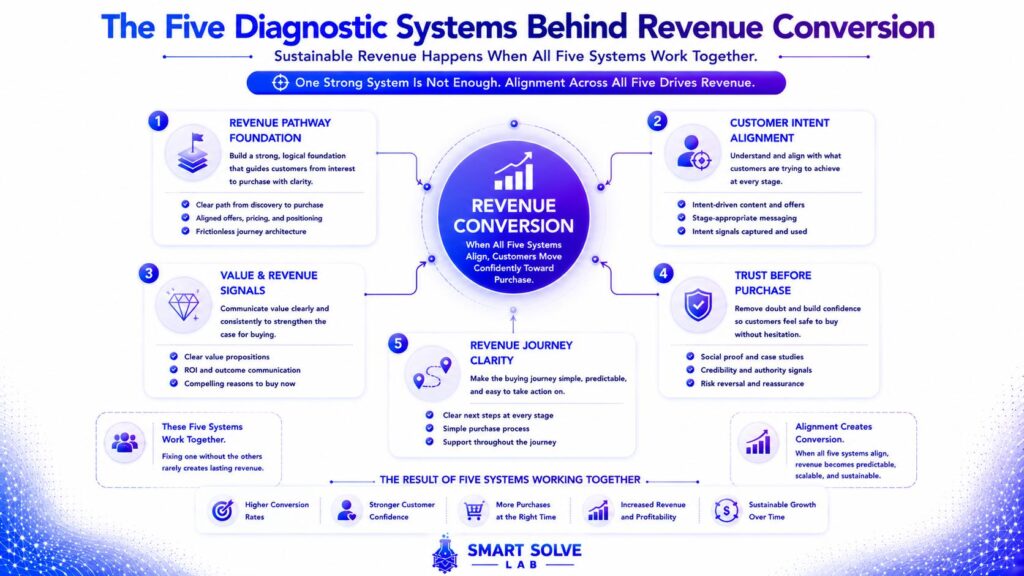
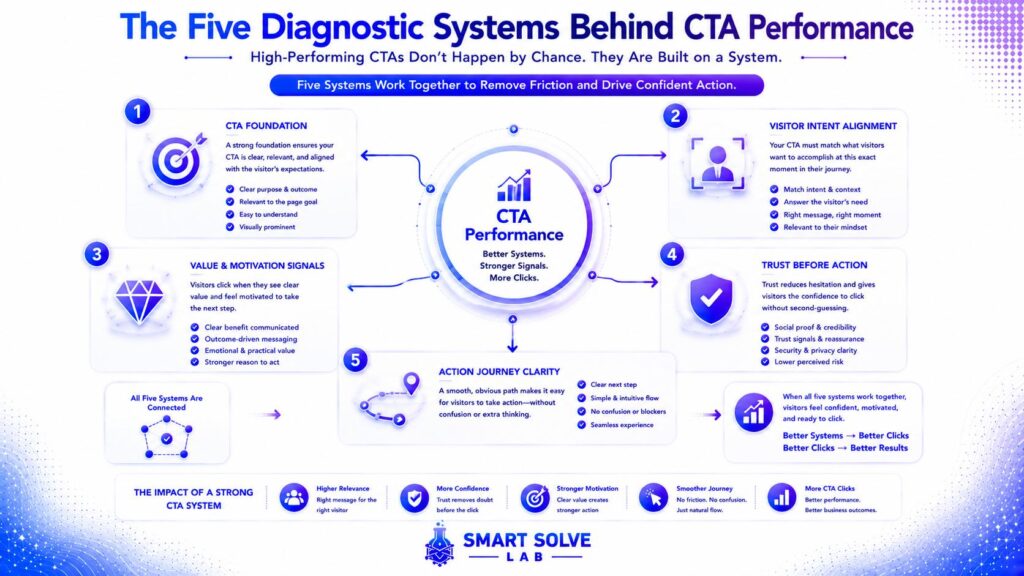
    The Five Diagnostic Systems Behind Revenue Conversion

    Customer engagement becomes commercially valuable only when customers can progress through a connected revenue pathway.

    A business may successfully generate attention and interaction, but revenue conversion depends on several systems working together after that engagement occurs.

    When one of these systems weakens, customers may remain interested while their progression toward purchase slows or stops completely.

    Understanding these five diagnostic systems helps businesses identify where the engagement-to-revenue gap may be developing before attempting optimization.
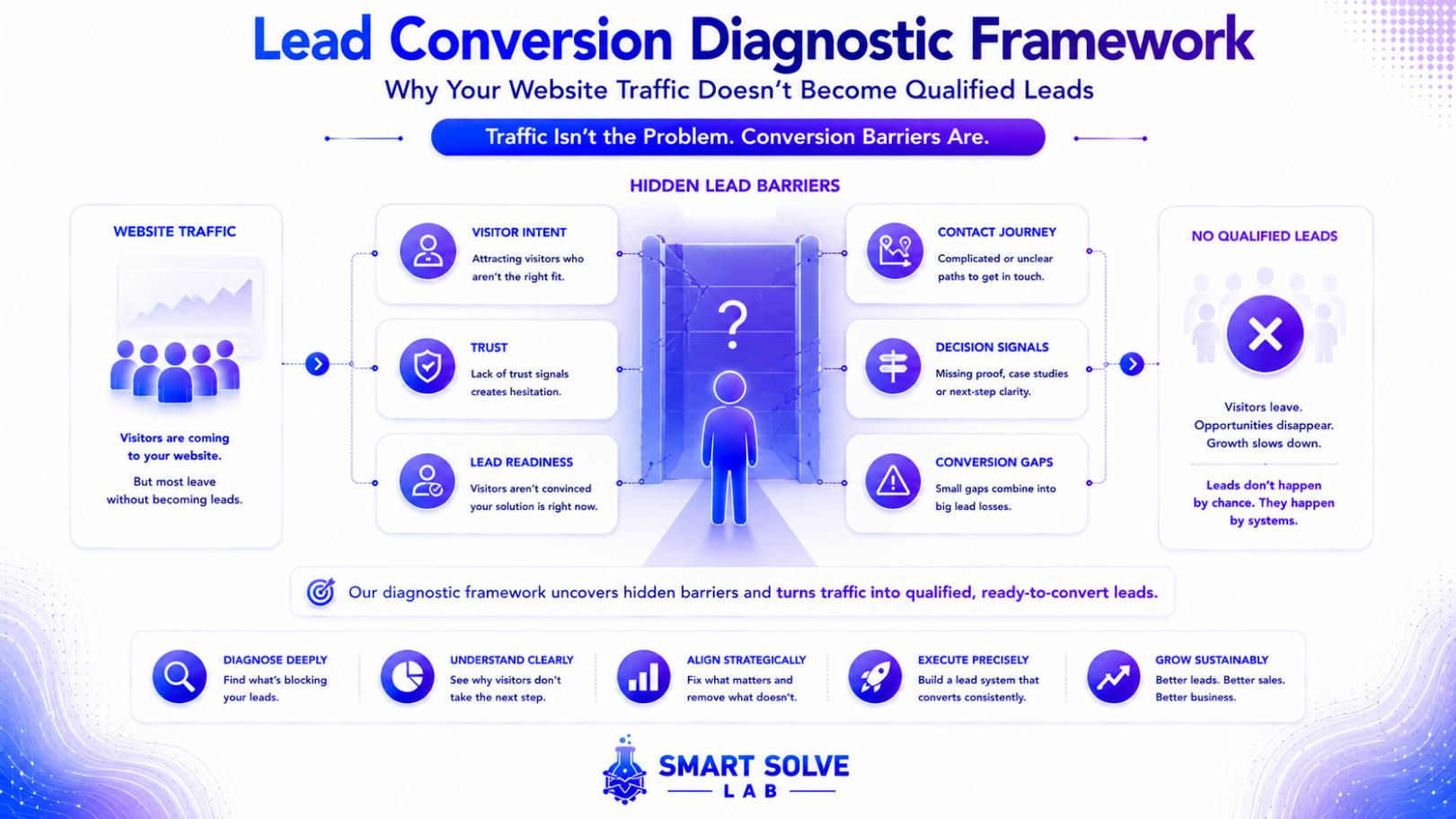
    Revenue Pathway Foundation

    Every sustainable revenue journey needs a clear connection between customer engagement and meaningful commercial outcomes.

    Engagement should not exist as an isolated activity.

    Customers need a logical pathway that allows them to move from initial interaction toward evaluation, decision-making, and eventually purchase.

    A weak revenue pathway foundation may generate substantial engagement without creating a clear route toward becoming a paying customer.

    The diagnostic question is:

    Does customer engagement naturally connect to the next stage of the revenue journey?

    Customer Intent Alignment

    Not every engaged customer has the same level of buying intent.

    Some customers may only be gathering information.

    Others may be comparing solutions.

    Some may already recognize their problem but remain uncertain about which solution to choose.

    Revenue progression becomes more difficult when the business expects customers to move toward purchase before their intent and readiness support that decision.

    Diagnosing customer intent helps businesses understand whether engagement represents curiosity, evaluation, or genuine commercial readiness.

    Value & Revenue Signals

    Customers need to understand why progressing toward a purchase is worthwhile.

    Engagement may demonstrate that the business has captured attention, but revenue requires customers to recognize sufficient value in the solution itself.

    Diagnostic evaluation should therefore consider whether customers clearly understand:

    • The problem the offer addresses
    • The value of solving that problem
    • The expected business or personal outcome
    • Why the solution is relevant to their needs
    • Why progressing toward purchase may be worthwhile

    When these signals remain weak, customers can continue engaging without developing stronger purchase motivation.

    Trust Before Purchase

    Financial commitment generally requires more confidence than ordinary engagement.

    Customers may enjoy a business’s content or interact regularly with its brand while still questioning whether they trust the business enough to purchase.

    Before progressing toward revenue, customers often evaluate credibility, reliability, expertise, perceived risk, and confidence in the promised outcome.

    If sufficient trust has not developed, the revenue journey may stop even when engagement remains strong.

    Revenue Journey Clarity

    Customers should understand how to move from interest toward becoming a paying customer.

    An unclear journey creates uncertainty.

    Customers may understand the offer and recognize its value but still struggle to determine:

    • What they should do next
    • What happens after taking action
    • What level of commitment is required
    • How the purchasing process works
    • Whether they are ready to proceed

    Revenue journey clarity evaluates whether customers can easily understand the progression from engagement to commercial action.

    How These Systems Work Together

    These diagnostic systems should not be evaluated independently.

    A customer may have strong buying intent but insufficient trust.

    Another may trust the business but fail to understand the commercial value.

    Someone else may recognize the value but encounter an unclear pathway toward purchase.

    Each weakness can influence the others.

    Every successful revenue journey depends on multiple connected systems. When one system weakens, customer engagement may remain high while revenue growth slows.

    Section Summary

    Revenue conversion depends on more than generating customer interaction.

    The Revenue Pathway Foundation, Customer Intent Alignment, Value & Revenue Signals, Trust Before Purchase, and Revenue Journey Clarity work together to determine whether engagement successfully progresses toward measurable revenue.

    Diagnosing these systems helps businesses understand where customer progression begins to weaken before campaigns, funnels, offers, or customer interactions are optimized.

    Five diagnostic systems influencing customer engagement and revenue conversion
    The five connected diagnostic systems behind successful revenue conversion.

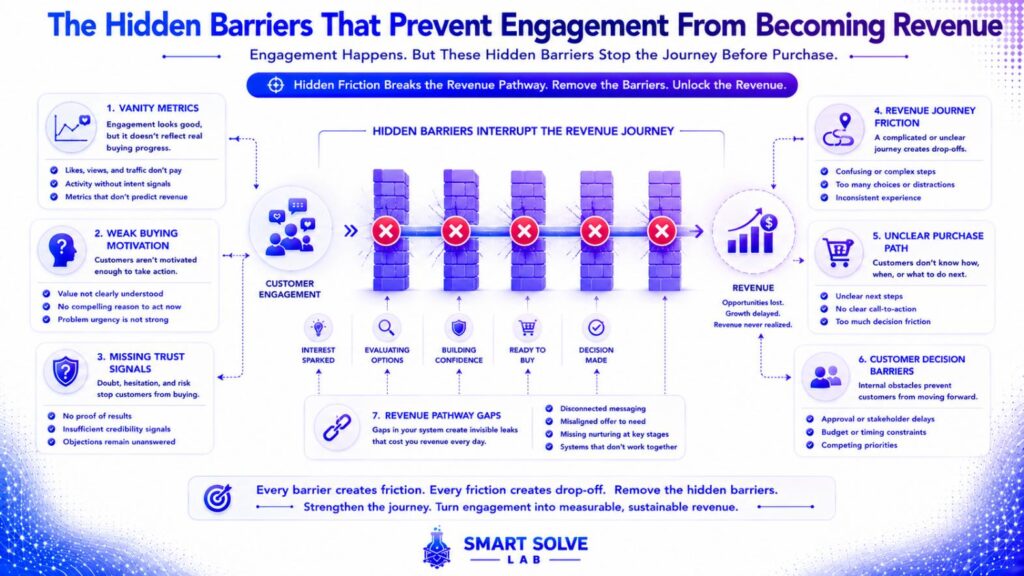
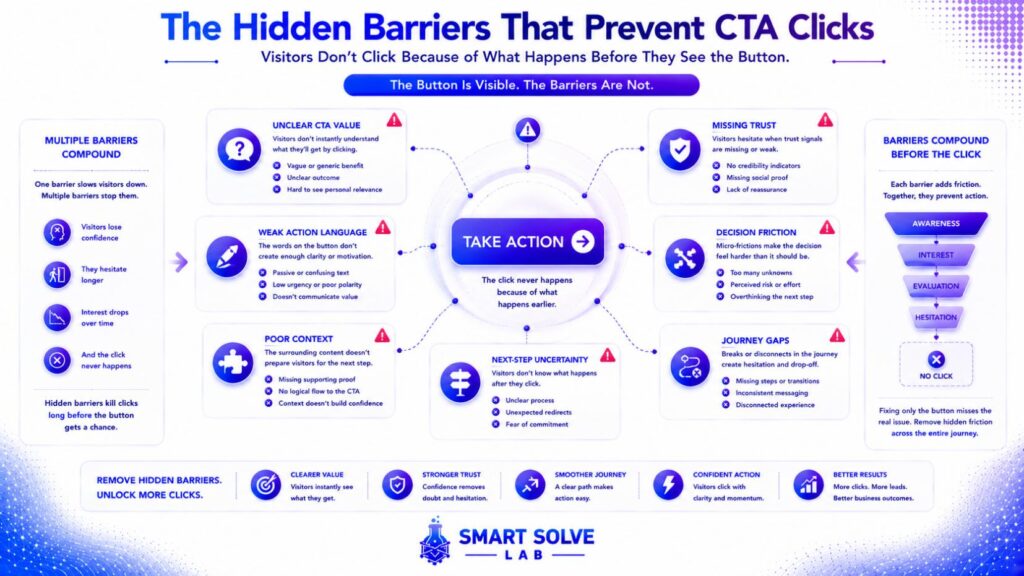
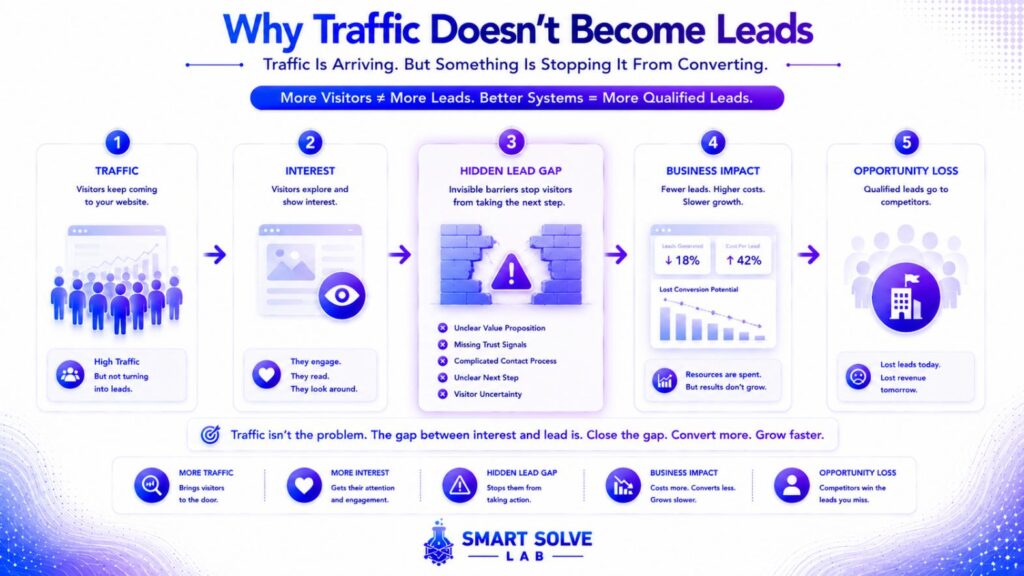
    The Hidden Barriers That Prevent Engagement From Becoming Revenue

    Strong customer engagement can make a business appear commercially successful.

    Customers may regularly interact with content, explore offers, respond to campaigns, and remain connected with the brand.

    However, engagement can continue even when customers are not progressing toward a purchase.

    This happens when hidden barriers interrupt the revenue pathway between customer interest and financial commitment.

    These barriers are often difficult to detect because engagement metrics may remain positive while revenue performance stays weak.

    Vanity Metrics vs Revenue Signals

    Not every engagement metric represents meaningful commercial progression.

    Likes, comments, page views, email opens, and content interactions can indicate customer attention, but they do not necessarily indicate purchase readiness.

    Revenue signals are different.

    They demonstrate that customers are moving closer to meaningful commercial actions such as evaluating an offer, expressing buying intent, requesting information, or beginning a purchase journey.

    When businesses treat all engagement as evidence of revenue potential, they may overestimate the commercial strength of their audience.

    Weak Buying Motivation

    Customers can find a business interesting without feeling strongly motivated to purchase.

    They may understand the offer but fail to see enough urgency, relevance, or value to justify moving forward.

    Weak buying motivation creates a situation where customers remain engaged because the interaction is useful or interesting, but purchasing never becomes a priority.

    The diagnostic challenge is determining whether engagement is actually strengthening purchase motivation—or simply maintaining customer attention.

    Missing Trust Signals

    Revenue requires a higher level of confidence than ordinary engagement.

    Customers may willingly read content, follow a business, or interact with its resources while remaining hesitant about making a financial commitment.

    If credibility, reliability, expertise, or confidence in the expected outcome remains unclear, customers may stop progressing before purchase.

    Trust therefore acts as an important bridge between engagement and revenue.

    Revenue Journey Friction

    Every additional obstacle in the customer journey can make commercial progression more difficult.

    Revenue friction may appear when customers encounter:

    • Unclear next steps
    • Complicated decision processes
    • Unexpected requirements
    • Confusing offers
    • Too many choices
    • Uncertainty about commitment

    Individually, these barriers may appear small.

    Together, they can create enough resistance to prevent engaged customers from progressing toward revenue.

    Unclear Purchase Path

    Customers should understand how to move from interest toward becoming paying customers.

    When the purchase pathway is unclear, even motivated customers may hesitate.

    They may not know which offer is appropriate, where to begin, what happens after taking action, or what level of commitment is required.

    An unclear purchase path can therefore create a significant gap between customer engagement and actual revenue.

    Customer Decision Barriers

    Purchase decisions involve more than interest.

    Customers may still question:

    • Is this the right solution for me?
    • Is the value worth the investment?
    • Can I trust the expected outcome?
    • Should I purchase now or wait?
    • Is there a better alternative?

    When these questions remain unresolved, customers can stay engaged while repeatedly postponing commercial action.

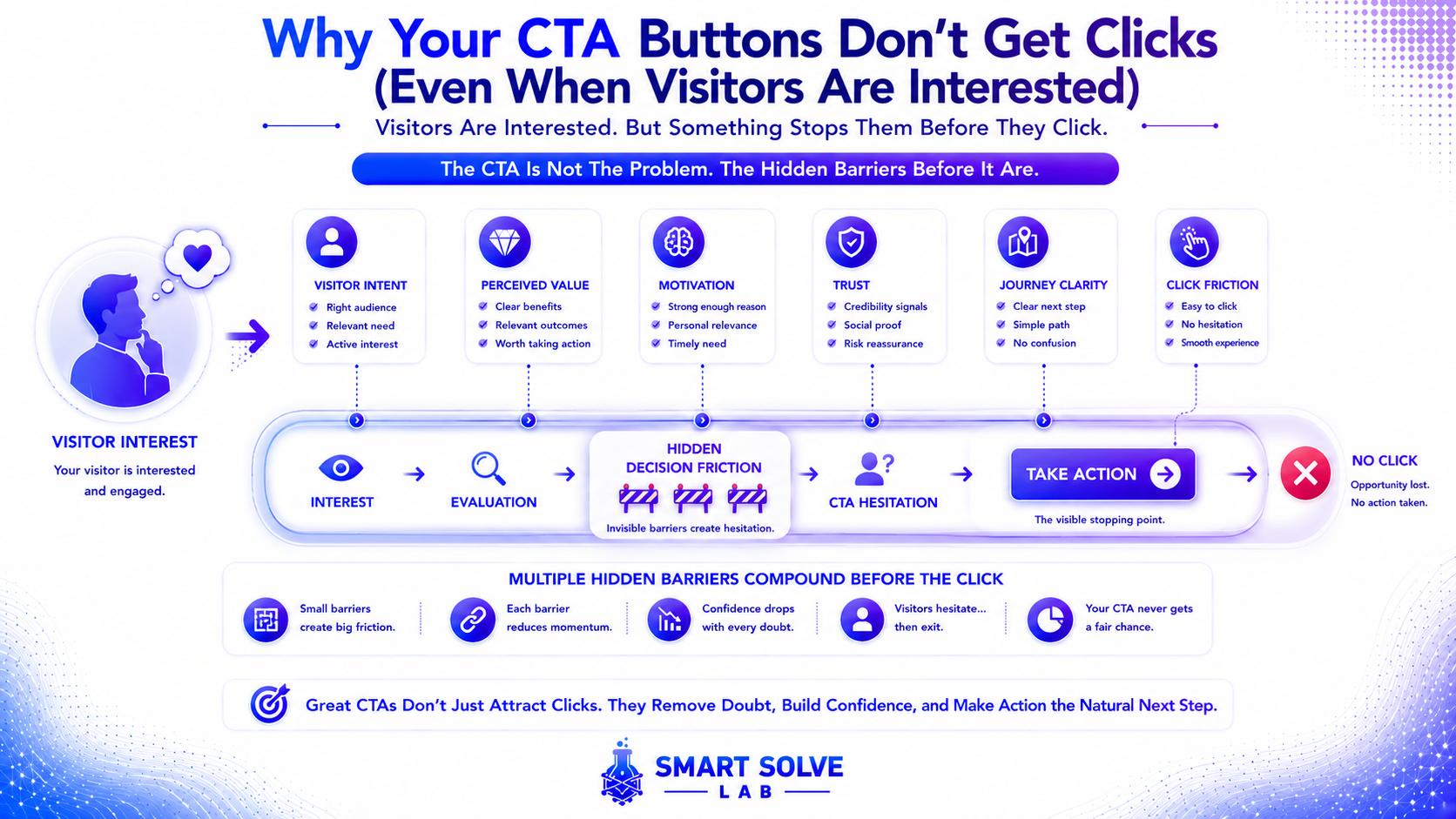
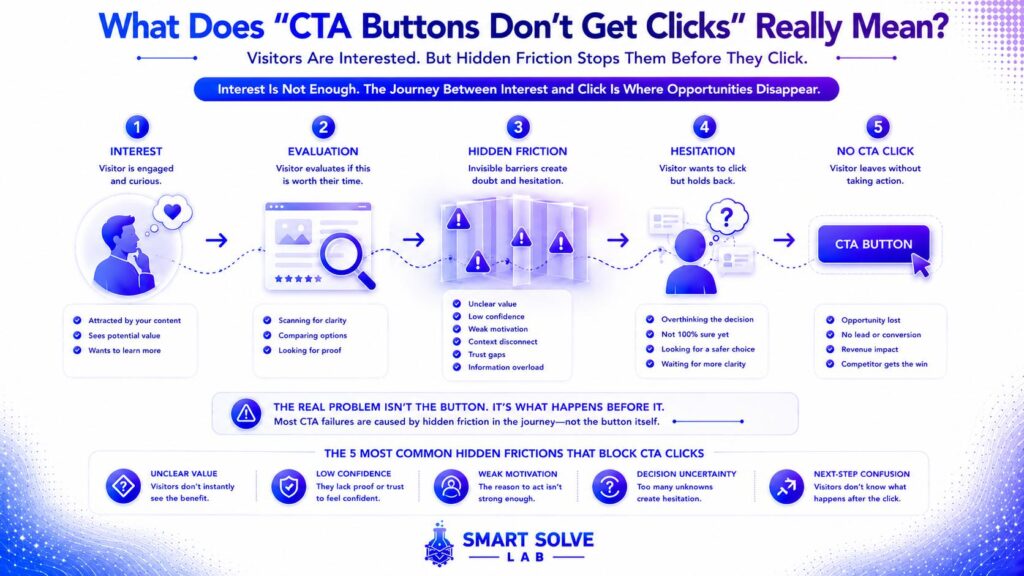
    This same decision friction can also appear earlier in the customer journey when CTA buttons don’t get clicks even when visitors are interested.

    Revenue Pathway Gaps

    Sometimes no single barrier explains weak revenue performance.

    Instead, several small gaps exist across the customer journey.

    Engagement may not connect clearly to buying intent.

    Buying intent may not progress into sufficient trust.

    Trust may exist without a clear purchase pathway.

    These disconnected stages create revenue pathway gaps that quietly prevent customers from moving toward financial commitment.

    Identifying these gaps requires examining the complete progression from engagement to revenue rather than evaluating individual interactions in isolation.

    Section Summary

    Engagement-to-revenue barriers rarely operate independently.

    Weak buying motivation can delay decisions.

    Missing trust can increase perceived risk.

    Journey friction can interrupt progression.

    An unclear purchase path can prevent otherwise interested customers from moving forward.

    Diagnosing how these barriers interact helps businesses understand where customer engagement stops becoming commercial value before attempting optimization.
    Hidden barriers preventing customer engagement from becoming revenue
    Identifying the hidden barriers interrupting customer progression toward revenue.

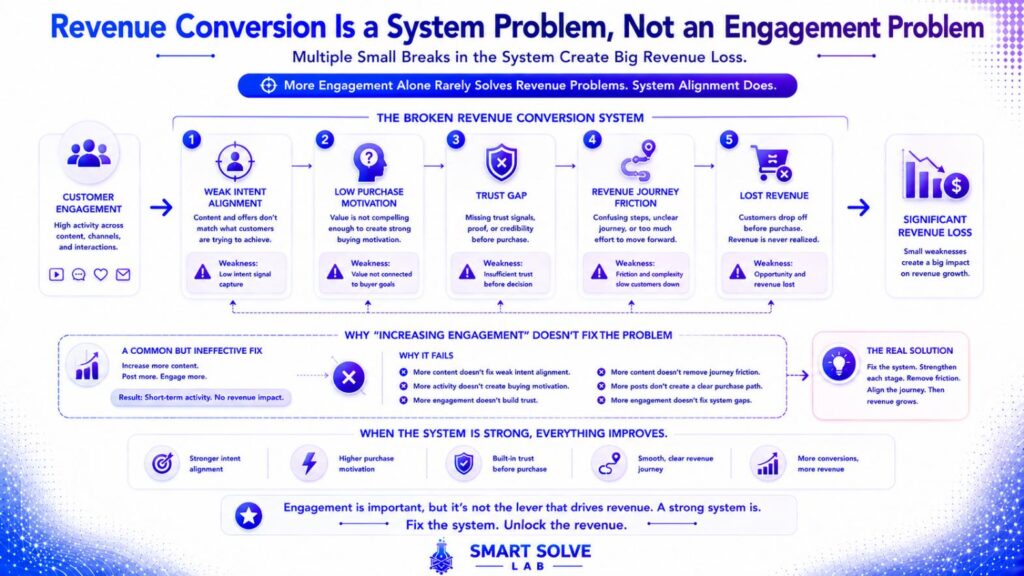
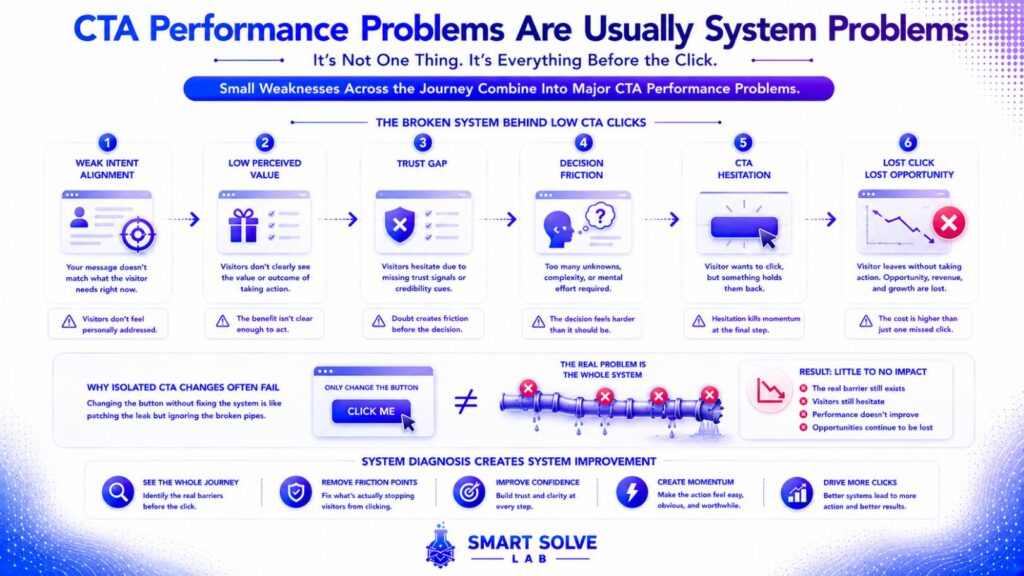
    Why Revenue Conversion Problems Are Usually System Problems

    Revenue conversion problems are often treated as isolated sales or marketing issues.

    When engagement is high but revenue remains low, businesses may respond by increasing promotional activity, creating more campaigns, changing offers, or attempting to generate even more engagement.

    These actions may produce temporary improvements.

    However, if the underlying revenue pathway remains disconnected, higher engagement alone may not create sustainable revenue growth.

    Revenue conversion depends on multiple connected systems working together throughout the customer journey.

    Small Revenue Friction Creates Larger Business Losses

    Small points of friction may appear insignificant when viewed individually.

    A customer may experience slight uncertainty about the offer, limited trust, unclear value, or confusion about the next step.

    One small barrier may not completely stop the customer journey.

    But when several barriers appear together—or repeatedly affect large numbers of customers—the cumulative impact can become significant.

    Over time, small revenue friction can contribute to:

    • Fewer purchase decisions
    • Longer customer journeys
    • Lower conversion efficiency
    • Lost revenue opportunities
    • Reduced return on customer acquisition efforts

    This is why seemingly minor weaknesses should be evaluated as part of the broader revenue system.

    Disconnected Customer Journeys

    Revenue rarely results from one isolated customer interaction.

    Customers typically progress through multiple stages:

    • Initial engagement
    • Problem recognition
    • Solution evaluation
    • Buying intent
    • Trust development
    • Purchase consideration
    • Commercial action

    When these stages are not connected, customers may remain active within one part of the journey without progressing toward the next.

    A business can therefore generate substantial engagement while the pathway toward revenue remains weak.

    Multiple Weak Signals Compound Before Purchase

    Revenue conversion often declines because several small weaknesses combine before the purchase decision.

    A customer may experience:

    • Moderate interest but weak buying intent
    • Clear information but insufficient motivation
    • Strong value perception but limited trust
    • Purchase readiness but an unclear next step

    Each individual weakness may appear manageable.

    Together, they can create enough uncertainty to stop customer progression.

    This is why diagnosing only one conversion element can provide an incomplete picture of the real revenue problem.

    Why Higher Engagement Alone Rarely Increases Revenue

    Increasing engagement can create more opportunities for customer interaction.

    But more interaction does not automatically strengthen buying intent, trust, purchase motivation, or revenue journey clarity.

    If the existing revenue pathway is weak, additional engagement may simply increase the number of customers interacting without purchasing.

    The business sees stronger activity.

    But the underlying engagement-to-revenue gap remains.

    Why Isolated Conversion Changes Misdiagnose Revenue Problems

    Businesses sometimes attempt to solve revenue problems by changing one visible element.

    They may adjust a CTA, modify an offer, redesign a page, or change messaging.

    These improvements can be useful when the specific element is genuinely responsible for the problem.

    However, isolated changes can misdiagnose the situation when revenue weakness originates across several connected stages.

    The visible conversion point may simply be where customer progression finally stops—not where the underlying problem originally began.

    Why Diagnosis Should Come Before Revenue Optimization

    Before optimizing campaigns, funnels, offers, or customer interactions, businesses should understand where the revenue journey is actually weakening.

    A structured diagnosis should evaluate:

    • Where engagement occurs
    • Whether engagement develops into buying intent
    • Whether customers understand the commercial value
    • Whether sufficient purchase motivation exists
    • Whether trust supports financial commitment
    • Whether the revenue pathway is clear
    • Where conversion barriers interrupt progression

    This allows businesses to distinguish between symptoms and root causes.

    Instead of making random improvements, they can identify which barriers deserve priority.

    Section Summary

    Revenue conversion problems are usually the result of connected system weaknesses rather than one isolated failure.

    High engagement cannot compensate for weak buying intent, insufficient trust, unclear value, or a disconnected revenue pathway.

    By diagnosing how these systems interact, businesses can identify where customer progression breaks and prioritize the right improvements before optimization begins.

    Connected system problems preventing customer engagement from generating revenue
    Revenue conversion problems often develop across multiple connected business systems.

    From Diagnosis to Better Revenue Conversion

    Understanding that customer engagement is not progressing into revenue creates an important starting point.

    But identifying the existence of an engagement-to-revenue gap is only the beginning.

    Businesses also need to understand where customer progression is weakening, which barriers have the greatest impact, and which problems should receive attention first.

    This is where structured diagnosis becomes valuable.

    Instead of immediately changing campaigns, funnels, offers, or customer interactions, businesses can first evaluate the complete revenue journey and identify the barriers preventing engagement from becoming measurable commercial value.

    The Role of the Engagement-to-Revenue Gap Finder

    The Engagement-to-Revenue Gap Finder is designed to help businesses systematically diagnose where customer engagement stops progressing toward revenue.

    Rather than evaluating engagement metrics in isolation, the diagnostic process examines the relationship between customer interaction and commercial progression.

    It helps evaluate factors such as:

    • Customer intent
    • Purchase motivation
    • Trust before financial commitment
    • Revenue journey progression
    • Conversion barriers
    • Revenue pathway gaps

    The objective is not simply to determine whether revenue performance is weak.

    It is to identify why engaged customers are not progressing toward measurable revenue.

    The Revenue Journey Scanner supports this process by helping identify where friction or disconnection may be occurring across the customer journey.

    Together, these diagnostic layers help businesses distinguish between surface-level engagement problems and deeper revenue progression barriers.

    Prioritizing the Highest-Impact Revenue Gaps

    Not every weakness within the revenue journey deserves equal attention.

    A business may identify several potential barriers, but some will have a much greater influence on customer progression than others.

    For example, improving engagement volume may provide little benefit if customers already interact frequently but lack sufficient buying motivation.

    Similarly, changing a conversion element may have limited impact if trust is the primary barrier preventing financial commitment.

    Effective diagnosis helps businesses move from:

    Multiple possible problems → Highest-impact barriers → Clear priorities

    This prevents businesses from spreading resources across disconnected improvements without understanding which problems matter most.

    From Diagnosis to Execution

    Once the highest-impact engagement-to-revenue barriers have been identified and prioritized, businesses can move toward structured execution.

    Smart Solve Lab focuses on diagnosing and interpreting the problem:

    Where is customer progression breaking?

    Which barriers are preventing revenue movement?

    Which weaknesses should receive priority?

    Execution begins after this diagnostic clarity has been established.

    Businesses can then use Digitolve’s Revenue Conversion Toolkit to implement structured improvements across the areas identified during diagnosis.

    This creates a clear ecosystem progression:

    Customer Engagement → Revenue Gap Diagnosis → Barrier Identification → Priority Clarity → Structured Execution

    Diagnosis determines what needs attention.

    Execution determines how the identified weaknesses should be improved.

    Keeping these roles separate reduces guesswork and prevents businesses from optimizing the wrong parts of the revenue journey.

    Continuous Evaluation Creates Better Revenue Decisions

    Customer journeys do not remain static.

    Buying behavior can change.

    Customer expectations can evolve.

    Offers can become more or less relevant.

    New friction can develop as campaigns, channels, products, or customer acquisition strategies change.

    For this reason, engagement-to-revenue diagnosis should not be treated as a one-time exercise.

    Businesses should continue evaluating whether customer interactions are progressing toward meaningful outcomes and whether new barriers are emerging across the revenue pathway.

    Google’s guidance on creating helpful, reliable, people-first content similarly emphasizes creating experiences primarily for people rather than focusing only on signals designed to influence performance.

    While this guidance focuses specifically on content, the broader principle is valuable: understanding what customers actually need and experience provides a stronger foundation for sustainable decisions than optimizing isolated metrics alone.

    Section Summary

    Better revenue conversion begins with understanding where customer progression breaks.

    The Engagement-to-Revenue Gap Finder helps diagnose the barriers preventing engagement from becoming measurable revenue, while the Revenue Journey Scanner helps identify where friction and disconnection occur across that progression.

    Once the highest-impact barriers are identified and prioritized, businesses can move toward structured execution with greater clarity.

    Diagnose the gap.

    Identify the barriers.

    Prioritize what matters.

    Then execute with clarity.

    Engagement-to-revenue diagnostic journey from barrier identification to structured execution
    Moving from engagement-to-revenue diagnosis toward strategic clarity and structured execution.

    Conclusion

    Customer engagement is valuable, but engagement alone does not create sustainable revenue.

    Customers can read content, interact with campaigns, explore offers, click links, and remain connected with a business without ever progressing toward a purchase.

    When this happens, the problem is not necessarily a lack of engagement.

    The deeper problem may be a disconnect between customer engagement, buying intent, trust, purchase motivation, and the revenue journey.

    A business therefore needs to understand not only whether customers are interacting—but whether those interactions are actually moving customers toward meaningful commercial outcomes.

    Diagnose Before Optimizing

    When engagement remains strong but revenue stays weak, immediately increasing campaigns, changing funnels, or generating more interactions may not solve the underlying problem.

    Businesses should first ask:

    • Is engagement developing into genuine buying intent?
    • Do customers clearly understand the value of the offer?
    • Is there enough motivation to progress toward purchase?
    • Has sufficient trust developed before financial commitment?
    • Is the pathway from engagement to purchase clear?
    • Where does customer progression begin to slow or stop?
    • Which barriers have the greatest impact on revenue?

    These questions help distinguish between an engagement problem and a deeper revenue progression problem.

    The objective is not simply to generate more activity.

    It is to understand whether existing activity is creating meaningful movement toward revenue.

    Better Diagnosis Creates Better Revenue Decisions

    When businesses understand where customer progression breaks, they can make more focused decisions.

    Instead of optimizing every stage simultaneously, they can prioritize the barriers having the greatest influence on revenue performance.

    This creates a more disciplined progression:

    Engagement → Diagnosis → Barrier Identification → Prioritization → Strategic Clarity → Execution

    Better diagnosis creates better revenue decisions.

    Better revenue decisions create stronger customer journeys.

    Stronger customer journeys support more sustainable business growth.

    Sustainable revenue growth begins by understanding where customer progression breaks before attempting optimization.
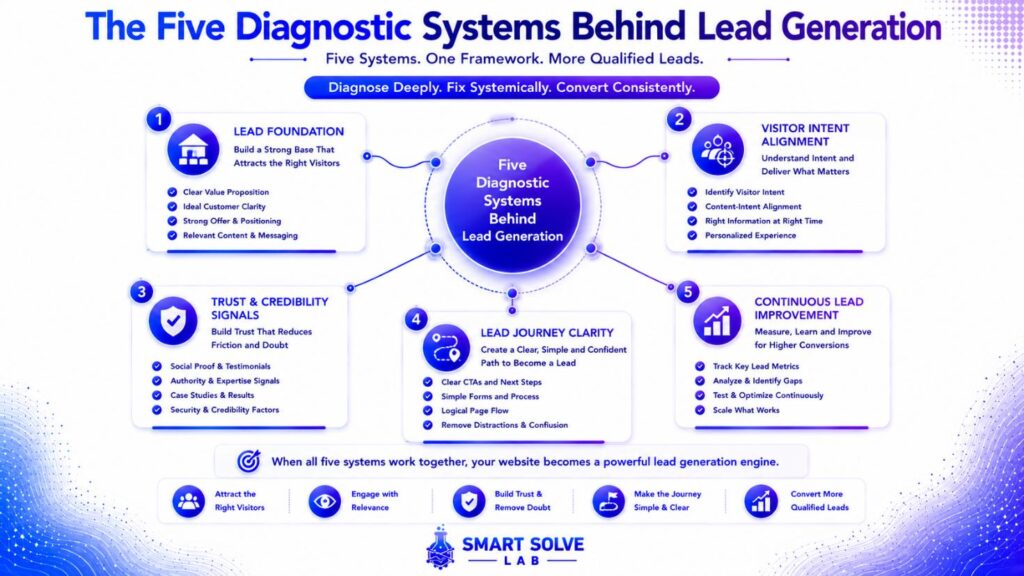

    Diagnostic Insight

    Customer engagement can create the appearance of growth without producing meaningful commercial progress.

    The real diagnostic question is not simply whether customers are interacting with the business.

    It is whether those interactions are strengthening buying intent, motivation, trust, and progression toward purchase.

    When these systems become disconnected, engagement can continue while revenue remains stagnant.

    Effective diagnosis identifies where that progression breaks before businesses begin changing campaigns, funnels, offers, or customer interactions.

    Diagnose the engagement-to-revenue gap before optimizing the journey.


    1. Why Your Website Gets Traffic But No Conversions (Even When Visitors Keep Coming)
    2. Why Your Website Traffic Doesn’t Become Leads (Even When Visitors Keep Coming)
    3. Why Your CTA Buttons Don’t Get Clicks (Even When Visitors Are Interested)

    Frequently Asked Questions

    Why doesn’t customer engagement generate revenue?

    Customer engagement indicates interaction or interest, but revenue requires customers to progress through buying intent, motivation, trust, evaluation, and purchase. If progression breaks at any of these stages, engagement can remain high without generating meaningful revenue.

    Can a business have high engagement but low sales?

    Yes. Customers may regularly interact with content, campaigns, or offers without having sufficient buying intent or purchase readiness. High engagement therefore does not automatically indicate strong revenue performance.

    What is the engagement-to-revenue gap?

    The engagement-to-revenue gap is the disconnect that occurs when customer interaction fails to progress into meaningful commercial outcomes. It can develop because of weak buying intent, insufficient motivation, trust gaps, journey friction, or unclear purchase pathways.

    Why do engaged customers hesitate to buy?

    Engaged customers may hesitate because they do not perceive enough value, lack purchase confidence, remain uncertain about the decision, or do not clearly understand how to progress toward becoming a paying customer.

    What causes revenue conversion friction?

    Revenue conversion friction can result from unclear value, weak purchase motivation, insufficient trust, confusing customer journeys, decision uncertainty, or disconnected stages between engagement and purchase.

    How do I diagnose revenue conversion problems?

    Begin by examining the complete progression from customer engagement to purchase. Evaluate customer intent, purchase motivation, trust, revenue journey clarity, and conversion barriers to identify where commercial progression begins to weaken.

    What is an Engagement-to-Revenue Gap Finder?

    The Engagement-to-Revenue Gap Finder is a diagnostic framework designed to identify the highest-impact barriers preventing customer engagement from becoming measurable revenue. It evaluates customer intent, purchase motivation, trust, revenue journey progression, and conversion barriers before optimization begins.

  • Why Your CTA Buttons Don’t Get Clicks (Even When Visitors Are Interested)

    Why Your CTA Buttons Don’t Get Clicks (Even When Visitors Are Interested)

    Diagnostic framework showing why interested visitors do not click CTA buttons
    Diagnosing the hidden decision friction that prevents interested visitors from clicking calls-to-action.

    CTA buttons don’t get clicks:

    CTA buttons often appear to be one of the simplest elements on a website.

    A visitor sees an offer, reads the message, and clicks the button to take the next step.

    At least, that is how the journey is expected to work.

    In reality, many businesses attract interested visitors who explore their pages, engage with their content, and show signs of genuine interest—yet still fail to click the call-to-action.

    This creates an important diagnostic question:

    Why do interested visitors stop before clicking?

    The visible problem may appear to be the CTA button.

    But the real problem often begins much earlier in the visitor journey.

    Before clicking, visitors evaluate whether the offer feels relevant, whether the next step provides enough value, whether they trust the business, and whether they clearly understand what will happen after taking action.

    When these signals are weak or disconnected, hesitation develops before the visitor ever reaches the point of clicking.

    Why CTA Clicks Matter More Than They Appear

    A CTA click represents more than interaction with a button.

    It often marks the transition between passive interest and meaningful customer action.

    Depending on the business, that action may lead to:

    • Starting an enquiry
    • Requesting a consultation
    • Joining an email list
    • Exploring a product
    • Beginning a purchase journey

    When visitors repeatedly stop at this stage, the business may lose valuable opportunities even when traffic and engagement appear healthy.

    The Hidden Gap Between Visitor Interest and Customer Action

    Interest does not automatically create action.

    A visitor may understand an offer and still hesitate because the perceived value is unclear, trust is insufficient, motivation is weak, or the next step feels uncertain.

    This hidden gap between interest and action is where many CTA performance problems develop.

    Understanding what happens before the click is therefore just as important as analyzing the button itself.

    Why CTA Problems Often Begin Before the Button

    Businesses frequently respond to low CTA performance by changing button text, design, placement, or color.

    But if the real barrier exists earlier in the decision journey, changing the button alone may not solve the problem.

    The CTA may simply be the visible point where a deeper system weakness finally becomes measurable.

    Visitor intent, perceived value, motivation, trust, context, and journey clarity can all influence whether someone ultimately decides to click.

    How Systematic Diagnosis Reveals Hidden Click Barriers

    Effective CTA diagnosis looks beyond the button.

    It examines the connected signals influencing visitor decisions before action occurs.

    This guide will help you understand:

    • Why interested visitors still hesitate before clicking
    • Which hidden barriers can reduce CTA performance
    • How multiple diagnostic systems influence visitor action
    • Why CTA problems are often system problems rather than isolated button issues
    • How businesses can identify high-impact friction before beginning optimization

    The goal is not to immediately change the CTA.

    The goal is to understand why the click is not happening in the first place.

    Diagnose the decision friction before optimizing the button.

    Table of Contents

    What Does “CTA Buttons Don’t Get Clicks” Really Mean?

    When a CTA button receives few clicks, businesses often assume that the button itself is the problem.

    They may question the wording, design, color, size, or placement.

    But low CTA performance does not always mean the button is poorly designed.

    In many cases, the CTA is simply the point where a deeper problem becomes visible.

    Visitors may reach the button without having enough motivation, confidence, or clarity to take the next step.

    Understanding this difference is essential before attempting optimization.
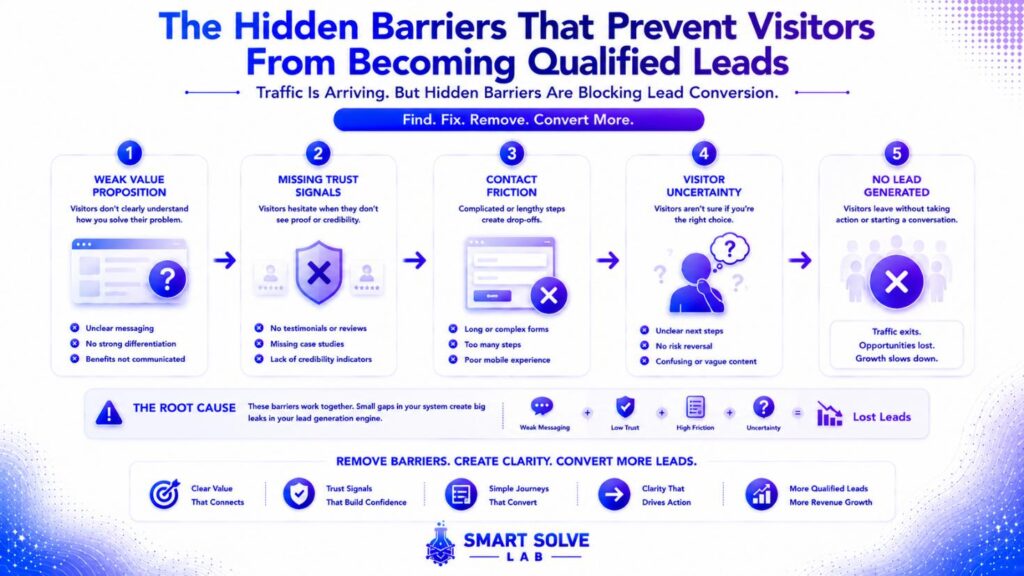
    The Problem

    A business may attract relevant traffic, create valuable content, and present a compelling offer—yet still experience a low CTA click-through rate.

    Visitors arrive.

    They explore the page.

    They may even appear interested.

    But when the opportunity to take action appears, many choose not to click.

    The visible symptom is low CTA engagement.

    The underlying problem may exist somewhere earlier in the visitor’s decision journey.

    The Hidden Reality

    Every CTA asks a visitor to make a decision.

    Before clicking, the visitor may consciously or unconsciously evaluate:

    • Is this action relevant to me?
    • Is the next step worth my time?
    • Can I trust this business?
    • What will happen after I click?
    • Am I ready to move forward?

    If the journey leading to the CTA has not answered these questions effectively, hesitation can develop.

    This is why businesses experiencing broader customer action problems may also struggle with CTA performance. Understanding why customers leave without taking action can reveal how decision friction develops before the final click.

    Deep Insight

    CTA performance is influenced by everything that happens before the button.

    The message visitors read.

    The value they perceive.

    The trust they develop.

    The motivation they feel.

    The clarity they have about the next step.

    The button may be where the visitor stops, but it is not necessarily where the problem begins.

    Why This Happens

    Visitors click when the perceived value of taking action becomes greater than the uncertainty or friction surrounding that action.

    When motivation is weak, trust is incomplete, or the next step feels unclear, visitors may hesitate—even when they are genuinely interested.

    This creates a hidden gap between:

    Interest → Decision → Action

    The CTA sits at the end of this process, which is why diagnosing only the button can overlook the real cause of poor performance.

    Real Business Scenario

    Imagine a service business receiving consistent traffic to an important landing page.

    Visitors spend time reading about the service and exploring its benefits.

    At the bottom of the page, they see a Request a Consultation button.

    Very few click.

    The business may assume the CTA wording needs to change.

    But the deeper barrier could be that visitors do not know what the consultation involves, how much commitment it requires, or what will happen after they submit their information.
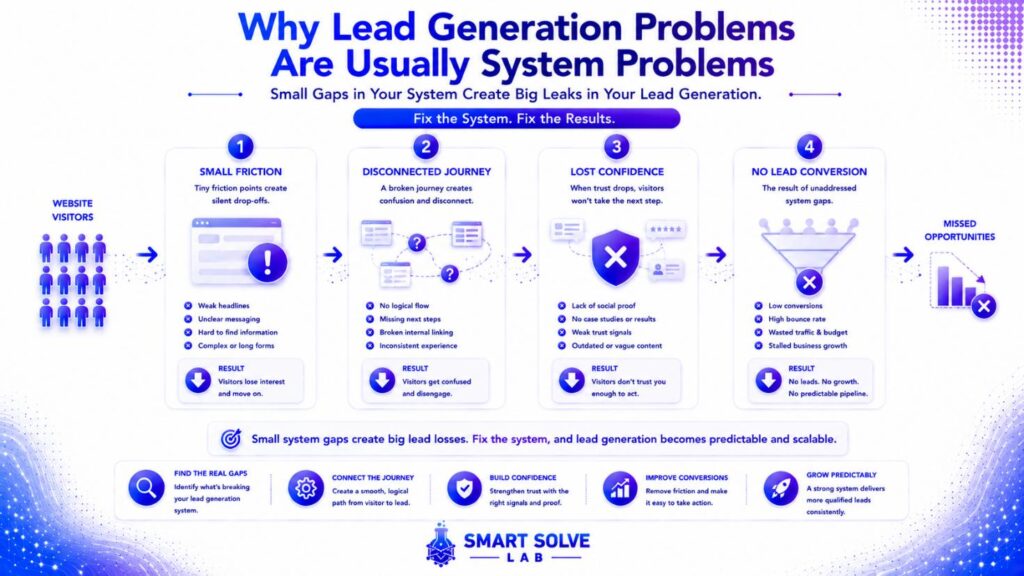
    The CTA is visible.

    The uncertainty behind the CTA is not.

    What This Means

    Low CTA clicks should be treated as a diagnostic signal rather than immediate proof that the button needs optimization.
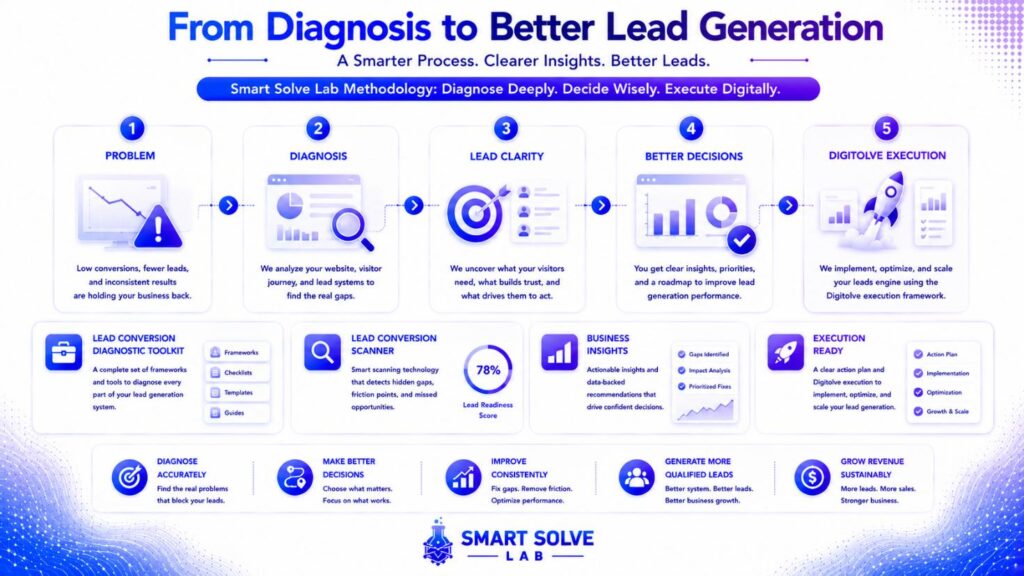
    Before changing copy, design, or placement, businesses should understand what prevents visitors from feeling ready to act.

    The goal is to identify whether the friction comes from the CTA itself—or from the journey leading to it.

    Critical Takeaway

    A CTA button is often the final decision point in a much larger customer journey.

    When visitors do not click, the most valuable question is not simply:

    “What’s wrong with our button?”

    It is:

    “What happened before the button that made visitors hesitate?”

    Diagnose the decision friction before optimizing the CTA.

    Five diagnostic systems that influence CTA performance and visitor clicks
    Understanding the hidden barriers between visitor interest and CTA action.
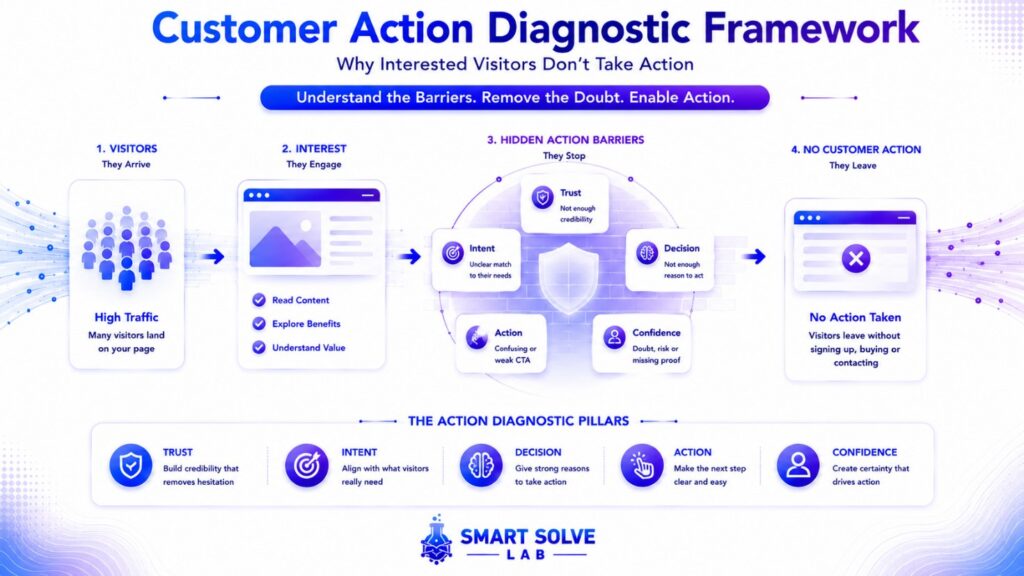
    Why Interested Visitors Still Don’t Click Your CTA

    A visitor can be genuinely interested in an offer and still decide not to click.

    Interest creates attention, but clicking requires a decision.
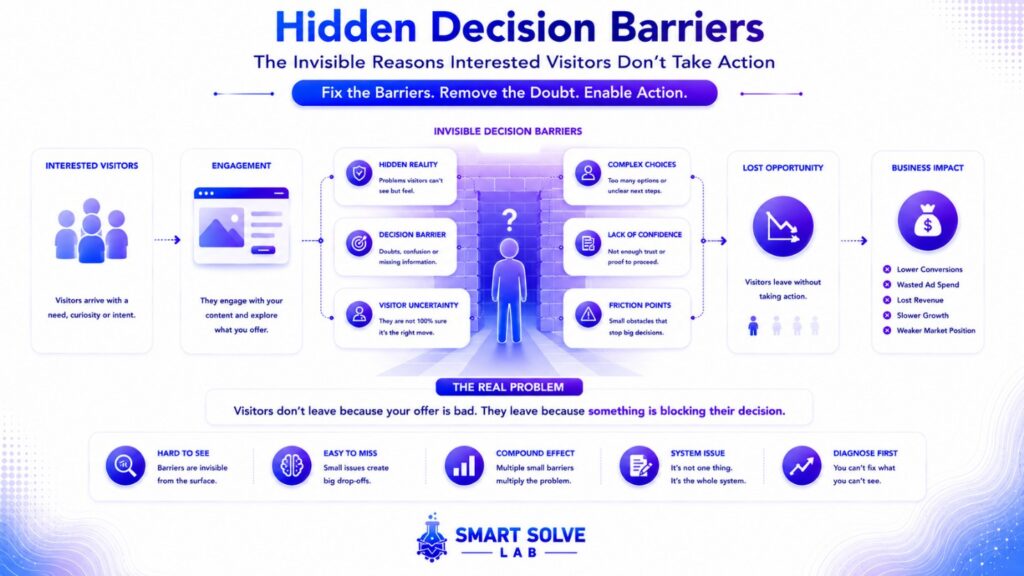
    Between these two stages, visitors evaluate whether taking the next step feels valuable, relevant, trustworthy, and clear.

    When these signals are not strong enough, hidden click barriers develop.

    The visitor may continue reading, explore other parts of the website, or leave entirely—without ever interacting with the CTA.

    The Hidden Click Barriers

    CTA friction is not always obvious.

    Visitors rarely explain why they decided not to click.

    Instead, small uncertainties accumulate throughout the decision journey until taking action no longer feels worthwhile.

    These barriers may include unclear value, insufficient motivation, low confidence, or uncertainty about what happens after the click.

    Individually, each barrier may appear minor.

    Together, they can significantly reduce CTA performance.

    Interest Doesn’t Automatically Create Action

    Interest and action represent different levels of customer commitment.

    A visitor may find an offer relevant without feeling ready to move forward.

    They may want more information.
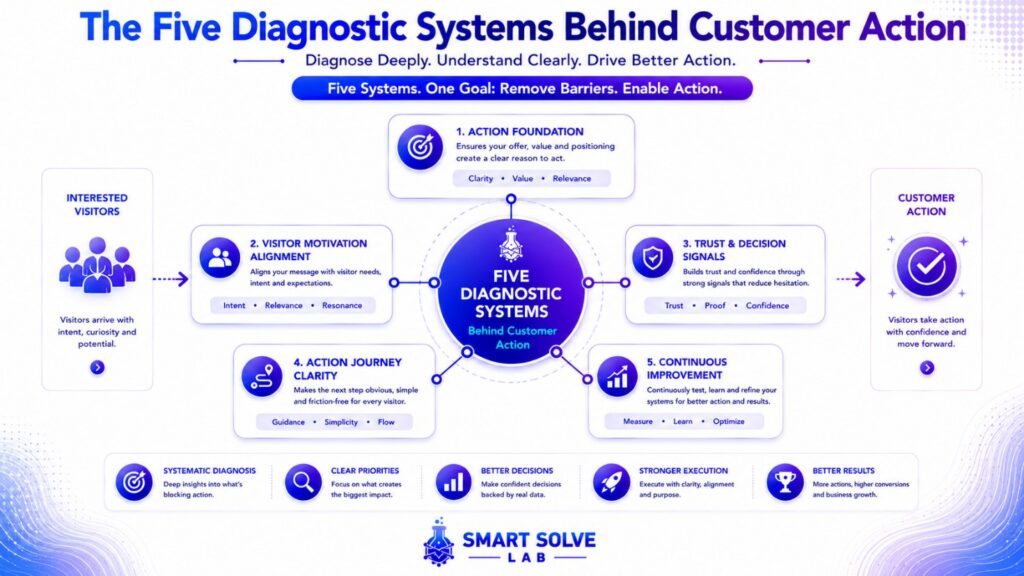
    They may need greater confidence.
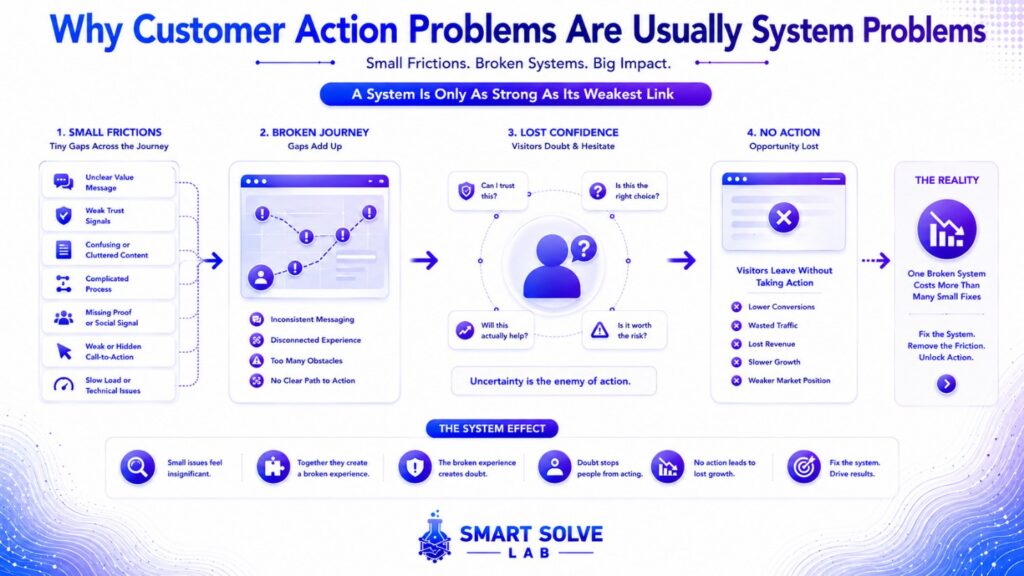
    Or they may simply not see enough value in taking the next step.

    This is why businesses should not assume that interested visitors will naturally click a CTA.

    The journey must support the transition from interest to action.

    Weak Action Motivation

    Every CTA asks visitors to exchange something.

    It may be their:

    • Time
    • Attention
    • Contact information
    • Personal details
    • Money
    • Commitment

    Before clicking, visitors evaluate whether the expected benefit justifies that exchange.

    If the value of taking action is unclear, motivation weakens and hesitation increases.

    CTA Expectation Gaps

    Visitors are more likely to hesitate when they do not understand what the CTA will lead to.

    A button that says Get Started, for example, may create uncertainty if the visitor does not know whether clicking will open a form, begin a purchase, schedule a call, or require immediate payment.

    Clear expectations reduce uncertainty before action.

    This is particularly important on landing pages, where hidden decision barriers can contribute to why landing pages don’t convert even with high traffic.

    Low Confidence Before the Click

    Visitors need enough confidence to move from passive interest to active participation.

    If trust has not been established before the CTA appears, the visitor may hesitate to share information or begin a business interaction.

    The CTA cannot create confidence on its own.

    It depends on the trust and credibility established throughout the journey leading to it.

    Decision Uncertainty

    Even when visitors understand the offer, they may still question whether taking action is the right decision.

    They may wonder:

    • Is this solution right for me?
    • Is this the best next step?
    • Will I be pressured into buying?
    • What happens after I click?
    • Can I change my mind later?

    When these questions remain unanswered, uncertainty can become stronger than motivation.

    The Cost of Lost Click Opportunities

    A missed CTA click may appear to be a small interaction loss.

    But every lost click can represent a missed opportunity to generate:

    • A qualified lead
    • A consultation request
    • A product enquiry
    • An email subscriber
    • A potential customer

    When the same hidden barriers affect large numbers of visitors, small points of friction can create significant conversion and revenue losses over time.

    Section Summary

    Interested visitors do not ignore CTAs simply because they lack interest.

    They often hesitate because the decision journey has not created enough value, motivation, trust, or clarity to support the next action.

    Understanding these hidden click barriers provides the foundation for diagnosing the connected systems that influence CTA performance.

    The Five Diagnostic Systems Behind CTA Performance

    CTA performance is rarely determined by a single element.

    An effective call-to-action depends on multiple connected systems working together before a visitor reaches the point of clicking.

    When these systems are aligned, visitors are more likely to understand the value of taking action and feel confident about moving forward.

    When one or more systems weaken, hesitation can develop—even when the visitor is genuinely interested.

    Understanding these five diagnostic systems helps businesses identify where CTA performance may be breaking down before attempting optimization.

    CTA Foundation

    Every CTA should have a clear strategic purpose within the customer journey.

    The requested action should logically connect the visitor’s current position with the next stage of their journey.

    A CTA foundation becomes weak when the action feels disconnected from the surrounding content or asks visitors to make a commitment they are not yet ready to make.

    The diagnostic question is:

    Does this CTA represent the right next step for the visitor at this stage of the journey?

    Visitor Intent Alignment

    Visitors arrive with different intentions and levels of readiness.

    Some are exploring a problem.

    Others are comparing possible solutions.

    A smaller group may already be prepared to take action.

    CTA performance can weaken when the requested action does not match the visitor’s current intent.

    For example, asking an early-stage visitor to make a high-commitment decision may create unnecessary friction.

    The diagnostic goal is to understand whether the CTA aligns with what the visitor is realistically ready to do next.

    Value & Motivation Signals

    Visitors need a meaningful reason to click.

    Before taking action, they evaluate what they are likely to gain and whether the next step feels worthwhile.

    If the value behind the CTA is unclear, even a well-designed button may receive limited engagement.

    Strong motivation develops when visitors understand:

    • Why the next step matters
    • What benefit they may receive
    • How the action relates to their goal
    • Why taking action now is worthwhile

    The purpose of diagnosis is not to immediately rewrite the CTA, but to determine whether insufficient perceived value is contributing to hesitation.

    Trust Before Action

    Every meaningful CTA requires some level of visitor confidence.

    The greater the commitment involved, the more trust may be required before someone is willing to click.

    Visitors may evaluate the credibility of the business, the perceived risk of taking action, and whether they feel comfortable moving forward.

    If sufficient trust has not developed before the CTA appears, the button itself may become the point where visitors stop.

    The real barrier, however, may have formed much earlier in the journey.

    Action Journey Clarity

    Visitors should understand both what action they are being asked to take and what is likely to happen next.

    Uncertainty creates friction.

    If clicking a CTA could lead to an unknown process, unexpected commitment, or unclear outcome, visitors may hesitate.

    Action journey clarity evaluates whether the transition from the current page to the next step feels logical and predictable.

    The diagnostic question becomes:

    Does the visitor clearly understand where this action will take them?

    How These Systems Work Together

    These five systems should not be evaluated in isolation.

    A visitor may have strong intent but insufficient trust.

    They may trust the business but fail to understand the value of clicking.

    They may understand the value but feel uncertain about what happens next.

    Each weakness can influence the others.

    Every effective call-to-action depends on multiple connected systems. When one system weakens, visitors may hesitate before clicking—even when they are genuinely interested in the offer.

    Section Summary

    CTA performance reflects the combined strength of the systems surrounding the visitor’s decision.

    By evaluating CTA foundation, visitor intent, perceived value, motivation, trust, and action journey clarity, businesses can begin identifying where hidden friction develops before the click.

    This diagnostic understanding creates clarity before optimization begins.

    Hidden CTA barriers causing visitors to hesitate before clicking
    Multiple hidden barriers can create friction before visitors reach the point of action.

    The Hidden Barriers That Prevent CTA Clicks

    CTA buttons are often treated as isolated conversion elements.

    However, visitors rarely decide whether to click based on the button alone.

    Their decision is influenced by everything they experience before reaching the CTA—from how clearly they understand the offer to how confident they feel about taking the next step.

    When these elements create uncertainty, hidden barriers can prevent action even when visitor interest is strong.

    Unclear CTA Value

    Visitors need to understand why clicking the CTA is worthwhile.

    A button may clearly communicate an action, but if the value behind that action is unclear, visitors have little motivation to proceed.

    The real diagnostic question is not simply whether visitors can see the CTA.

    It is whether they understand the benefit of taking the next step.

    Weak Action Language

    CTA language influences how visitors interpret the requested action.

    Generic or ambiguous wording may fail to communicate what the visitor is actually being invited to do.

    However, weak action language should not automatically be treated as a copywriting problem.

    It may indicate a deeper disconnect between the offer, visitor expectations, and the action being requested.

    Poor Context Before the CTA

    A CTA depends heavily on the information surrounding it.

    If visitors encounter the button before they understand the problem, solution, value, or next step, the request for action may feel premature.

    Strong visitor journeys create sufficient context before asking for commitment.

    When that context is missing, the CTA may appear ineffective even though the underlying problem exists earlier on the page.

    This is one reason businesses experiencing broader conversion challenges should also understand why website traffic doesn’t become leads, because CTA friction can be one part of a larger lead conversion problem.

    Missing Trust Signals

    Visitors may understand the offer and recognize its value while still hesitating because they do not feel sufficiently confident about the business.

    The level of trust required often increases with the level of commitment requested.

    A low-risk action may require minimal confidence.

    A consultation, purchase, or submission of personal information may require significantly more.

    When trust is insufficient, the CTA becomes the visible point where hesitation appears.

    Decision Friction

    Every additional question or uncertainty increases the mental effort required to make a decision.

    Visitors may wonder whether they are making the right choice, whether the action requires commitment, or whether a better option exists elsewhere.

    This decision friction can quietly reduce clicks without creating an obvious technical problem.

    The visitor can see the button.

    They simply do not feel ready to use it.

    CTA Placement and Journey Gaps

    CTA placement becomes a problem when it does not match the natural progression of the visitor journey.

    A CTA may appear too early, before sufficient value or trust has been established.

    Alternatively, it may appear too late, after visitor motivation has already declined.

    The diagnostic objective is to understand whether the CTA appears at a logical decision point—not simply whether it is visually prominent.

    Uncertainty About What Happens Next

    One of the most overlooked CTA barriers is uncertainty after the click.

    Visitors may hesitate because they do not know whether clicking will:

    • Open a contact form
    • Request personal information
    • Schedule a meeting
    • Begin a purchase
    • Require payment
    • Create an immediate commitment

    When the next step feels unpredictable, visitors may choose to avoid the action entirely.

    Reducing uncertainty begins with understanding where expectations become unclear.

    Section Summary

    Hidden CTA barriers rarely operate independently.

    Unclear value can weaken motivation.

    Missing trust can increase decision friction.

    Poor context can make the requested action feel premature.

    Next-step uncertainty can prevent an otherwise interested visitor from clicking.

    Diagnosing how these barriers interact helps businesses identify the real source of CTA performance problems before changing button copy, design, or placement.

    Hidden CTA barriers causing visitors to hesitate before clicking
    Multiple hidden barriers can create friction before visitors reach the point of action.

    Why CTA Performance Problems Are Usually System Problems

    CTA performance problems are often treated as isolated button issues.

    When clicks are low, businesses may immediately change the button text, adjust its design, move its position, or experiment with different visual elements.

    These changes may sometimes improve performance.

    However, if the real barrier exists within the broader visitor journey, changing the CTA alone may not address the underlying problem.

    A CTA is part of a connected decision system.

    Visitor intent, perceived value, motivation, trust, context, and journey clarity all influence whether someone ultimately decides to click.

    Small CTA Friction Creates Larger Conversion Losses

    A small point of hesitation may seem insignificant when viewed as a single interaction.

    But when hundreds or thousands of visitors experience the same friction, the cumulative impact can become substantial.

    Even minor uncertainty about the value of taking action or what happens next can reduce clicks across the entire visitor journey.

    Over time, these missed actions may translate into fewer leads, enquiries, sign-ups, or sales opportunities.

    Disconnected Visitor Journeys Create Hesitation

    Visitors need a logical progression from initial interest to meaningful action.

    A typical journey may involve:

    • Recognizing a problem
    • Understanding a possible solution
    • Evaluating the offer
    • Building confidence
    • Deciding whether to proceed
    • Taking the next action

    When these stages feel disconnected, visitors may reach the CTA without being psychologically ready to click.

    The button becomes the visible stopping point, but the underlying friction may have developed much earlier.

    Multiple Weak Signals Compound Before the Click

    CTA hesitation rarely comes from one barrier alone.

    A visitor may experience slightly unclear value, limited trust, weak motivation, and uncertainty about the next step simultaneously.

    Individually, none of these issues may appear serious.

    Together, they can create enough friction to prevent action.

    This is why CTA diagnosis should examine how multiple signals interact throughout the decision journey.

    Why Changing Button Text Alone Rarely Solves the Problem

    Changing CTA wording can be useful when language itself is creating confusion.

    But stronger button copy cannot compensate for a weak value proposition, insufficient trust, poor visitor intent alignment, or an unclear customer journey.

    If visitors do not understand why they should act, simply changing Learn More to Get Started may not solve the deeper problem.

    The button can communicate an action.

    It cannot repair every weakness that occurs before that action.

    Why Isolated CTA Changes Can Misdiagnose the Real Barrier

    When businesses optimize individual CTA elements without understanding the underlying cause, they risk treating symptoms instead of problems.

    A low click-through rate might appear to indicate weak CTA copy.

    In reality, visitors may lack confidence in the offer.

    Similarly, poor CTA engagement may appear to be a placement issue when the actual barrier is uncertainty about what happens after the click.

    Without diagnosis, businesses can spend significant time testing the wrong variables.

    Why Diagnosis Should Come Before Optimization

    Effective CTA improvement begins by identifying where decision friction actually occurs.

    Businesses should first understand:

    • Whether visitor intent matches the requested action
    • Whether the value of clicking is clear
    • Whether sufficient motivation exists
    • Whether trust has been established
    • Whether the next step feels predictable
    • Whether multiple barriers are working together

    Once these factors are understood, optimization decisions can be based on evidence and diagnostic clarity rather than assumptions.

    Section Summary

    CTA performance problems are usually connected to the broader decision system surrounding the button.

    The visible symptom may be a missing click.

    The real cause may exist across multiple stages of the visitor journey.

    By diagnosing these connected barriers first, businesses can identify the highest-impact sources of friction before deciding what should be optimized.

    Connected system problems creating CTA friction and reducing visitor clicks

    CTA performance problems often develop across the customer journey rather than at the button alone.

    From Diagnosis to Better CTA Performance

    Understanding why visitors do not click a CTA is the first step toward improving performance.

    Rather than immediately changing button copy, design, placement, or visual elements, businesses should first identify the highest-impact barriers influencing the visitor’s decision.

    A structured diagnostic approach helps separate visible symptoms from deeper causes and provides greater clarity about where decision friction actually occurs.

    The Role of the CTA Performance Analyzer

    The CTA Performance Analyzer is designed to help businesses systematically evaluate the signals and barriers influencing CTA performance before making optimization decisions.

    Instead of focusing exclusively on the button, the diagnostic process examines factors such as:

    • Visitor intent
    • Perceived value
    • Action motivation
    • Trust before action
    • Journey clarity
    • Click friction

    This helps businesses understand not only that visitors are failing to click, but why hesitation may be developing throughout the decision journey.

    The CTA Friction Scanner supports this diagnostic process by helping identify where the highest-impact points of friction may be occurring.

    Together, these insights create a clearer foundation for prioritizing future improvements.

    From Diagnosis to Execution

    Once the highest-impact CTA performance barriers have been identified, businesses can move from understanding the problem to implementing structured improvements.

    This is where diagnosis and execution serve different roles.

    Smart Solve Lab focuses on identifying and interpreting the barriers affecting CTA performance.

    After diagnosis, businesses can implement a structured improvement process through Digitolve’s CTA Optimization Toolkit.

    This creates a clear progression:

    Diagnose the problem → Identify the friction → Prioritize the barriers → Execute improvements

    By separating diagnosis from execution, businesses can avoid making random changes and focus their resources on the areas most likely to influence customer action.

    Continuous Evaluation Creates Better CTA Decisions

    CTA performance is not static.

    Visitor expectations, customer behavior, offers, and business journeys can change over time.

    This means a CTA that performs effectively today may encounter new friction as the surrounding customer journey evolves.

    Businesses that continuously evaluate visitor needs and behavior are better positioned to identify emerging barriers and make informed decisions.

    Google’s guidance on creating helpful, reliable, people-first content also emphasizes focusing on experiences designed primarily to benefit people. This broader principle reinforces the importance of understanding user needs rather than making changes solely for performance metrics.

    Section Summary

    Better CTA performance begins with understanding the decision journey behind the click.

    The CTA Performance Analyzer helps diagnose the barriers influencing action, while the CTA Friction Scanner helps identify where friction is occurring.

    Once those barriers are understood and prioritized, businesses can move toward structured execution with greater clarity.

    Diagnose first. Identify friction second. Execute with clarity.

    CTA performance diagnostic journey from hidden friction identification to structured execution
    Moving from CTA diagnosis and friction identification toward structured execution.

    Conclusion

    CTA problems rarely exist in isolation.

    A button may be the visible point where customer action stops, but the real barrier may have developed much earlier in the visitor journey.

    Visitors evaluate value, motivation, trust, context, and next-step clarity before deciding whether to click. When these signals fail to work together, even genuinely interested visitors may hesitate.

    This is why low CTA performance should not automatically lead to immediate changes in button copy, design, or placement.

    The better starting point is diagnosis.

    Understanding where decision friction develops helps businesses distinguish between a button-level issue and a broader customer journey problem.

    Diagnose Before Optimizing

    Before attempting to improve CTA performance, businesses should ask:

    • Does the requested action match visitor intent?
    • Is the value of taking the next step clear?
    • Has enough trust been established?
    • Does the visitor feel sufficiently motivated?
    • Is the journey toward action logical?
    • Does the visitor understand what happens after clicking?

    These questions help reveal whether the CTA itself is creating friction or simply exposing weaknesses that already exist elsewhere in the journey.

    Better diagnosis creates better CTA decisions.

    Better CTA decisions create clearer customer journeys.

    Clearer customer journeys support stronger and more sustainable business growth.


    Diagnostic Insight

    CTA performance problems rarely begin with the button alone.

    They often emerge when visitor intent, perceived value, trust, motivation, context, and journey clarity fail to work together.

    Effective diagnosis identifies these hidden barriers before businesses begin changing button copy, design, or placement.

    The most valuable question is therefore not simply:

    “How can we get more people to click?”

    It is:

    “What is preventing interested visitors from feeling ready to take the next action?”

    Diagnose the decision friction before optimizing the button.


    1. Why Customers Leave Without Taking Action (Even When They Seem Interested)
    2. Why Your Landing Pages Don’t Convert (Even With High Traffic)
    3. Why Your Website Traffic Doesn’t Become Leads (Even When Visitors Keep Coming)

    Frequently Asked Questions

    Why don’t visitors click my CTA buttons?

    Visitors may avoid clicking because they lack sufficient motivation, trust, perceived value, or clarity about what happens next. The button may be where hesitation becomes visible, while the actual barrier develops earlier in the decision journey.

    Why do interested visitors ignore calls-to-action?

    Interest does not automatically create action. Visitors may find an offer relevant while still feeling uncertain about whether taking the next step is worthwhile or appropriate for them.

    What causes a low CTA click-through rate?

    A low CTA click-through rate can result from unclear value, weak motivation, insufficient trust, poor context, visitor intent mismatch, decision friction, or uncertainty about the next step.

    Does changing CTA button text increase clicks?

    It can help when the wording itself creates confusion, but changing button text alone may not solve deeper problems involving trust, value, motivation, or journey clarity. Diagnosis should determine the underlying barrier before optimization begins.

    What causes CTA friction?

    CTA friction develops when something makes visitors hesitate before taking action. This may include unclear expectations, perceived risk, insufficient value, low trust, or a requested action that does not match visitor readiness.

    How do I diagnose CTA performance problems?

    Start by evaluating the complete decision journey surrounding the CTA. Examine visitor intent, perceived value, motivation, trust, action clarity, and potential friction to identify where hesitation is developing.

    What is a CTA Performance Analyzer?

    A CTA Performance Analyzer is a diagnostic framework designed to systematically evaluate the factors influencing CTA performance and identify the highest-impact barriers preventing interested visitors from taking the next action.

  • Why Your Website Traffic Doesn’t Become Leads (Even When Visitors Keep Coming)

    Why Your Website Traffic Doesn’t Become Leads (Even When Visitors Keep Coming)

    Website traffic doesn’t become leads:

    Website traffic is often seen as a sign of digital success.

    Businesses invest significant time and resources into improving search visibility, publishing content, and attracting more visitors with the expectation that increased traffic will naturally generate more enquiries, leads, and business opportunities.

    However, many organizations experience a different reality.

    Their websites receive consistent traffic, yet very few visitors become qualified leads.

    This creates one of the most common business growth challenges:

    Why does website traffic fail to generate meaningful business opportunities?

    The answer is not always a lack of visitors.

    In many cases, hidden barriers within the lead generation journey prevent interested visitors from taking the next step. While traffic may indicate visibility, it does not automatically indicate that visitors are prepared to engage with the business.

    Understanding these hidden barriers is the first step toward improving lead generation.

    How to Diagnose Lead Conversion Problems Systematically

    Lead generation problems rarely result from a single mistake.

    They usually emerge when multiple business systems—such as visitor intent, trust, messaging, contact readiness, and the overall lead journey—become disconnected.

    This guide explains why website traffic does not always become qualified leads, explores the hidden systems influencing lead generation, and demonstrates how businesses can diagnose lead conversion problems before attempting optimization.

    You will learn:

    • Why website traffic often fails to generate qualified leads.
    • The hidden barriers that interrupt the lead generation journey.
    • Why lead generation problems are usually system problems.
    • The diagnostic systems businesses should evaluate before improving lead performance.

    Remember:

    More traffic does not automatically create more leads.

    Better diagnosis creates better decisions, and better decisions create sustainable business growth.


    Diagnostic Insight

    Lead generation problems are rarely caused by low traffic alone. They usually emerge when multiple business systems reduce visitor confidence before meaningful contact occurs. Effective diagnosis identifies these hidden barriers before businesses invest in lead generation optimization.

    What Does “Traffic Doesn’t Become Leads” Really Mean?

    Business diagnostic showing why website visitors fail to become qualified leads
    Understanding the hidden gap between website traffic and lead generation.


    Website traffic and lead generation are often treated as if they are the same business outcome.

    In reality, they measure two very different stages of business growth.

    Traffic shows that people are finding your website.

    Leads show that visitors are willing to begin a business relationship.

    A website can attract thousands of visitors every month while producing very few enquiries, consultations, or qualified prospects.

    The real challenge is not simply attracting attention.

    The challenge is understanding why interested visitors choose not to take the next step.


    The Problem

    Many businesses invest heavily in SEO, content marketing, and digital advertising to increase website traffic.

    When visitor numbers grow but lead generation remains stagnant, it often creates confusion.

    The immediate assumption is that more traffic is needed.

    However, the real issue frequently exists within the lead conversion journey rather than the traffic itself.


    The Hidden Reality

    Most lead generation problems are not caused by a lack of visibility.

    They usually develop because visitors encounter hidden barriers before they feel confident enough to make contact.

    These barriers may include:

    • Unclear business messaging
    • Weak trust signals
    • Poor lead journey clarity
    • Uncertain next steps
    • Misaligned visitor expectations

    Individually, these issues may appear minor.

    Together, they can significantly reduce lead generation.


    Deep Insight

    Generating traffic creates opportunity.

    Generating leads creates business growth.

    Between these two stages lies a complex decision journey where visitors evaluate whether they trust the business, understand the value being offered, and feel confident enough to begin a conversation.

    Without understanding this journey, businesses often mistake a lead generation problem for a traffic problem.


    Why This Happens

    Visitors rarely become leads immediately after arriving on a website.

    Before taking action, they evaluate whether the business understands their problem, offers a relevant solution, and appears trustworthy.

    When these signals are weak or disconnected, visitors often leave without making contact.


    Real Business Scenario

    Imagine a business receiving steady organic traffic every week.

    Analytics show that visitors spend time reading pages and exploring services.

    Despite healthy traffic, enquiry forms receive very few submissions.

    The business assumes it needs more visitors.

    In reality, existing visitors may simply lack the confidence or clarity needed to become qualified leads.


    What This Means

    Traffic measures visibility.

    Leads measure business readiness.

    When traffic grows without corresponding lead generation, businesses should investigate the hidden systems influencing visitor decisions rather than focusing exclusively on attracting more traffic.


    Critical Takeaway

    Website traffic creates opportunity.

    Lead generation creates business value.

    Understanding the hidden barriers between these two stages is the first step toward building a stronger lead generation system.

    Diagnosis should always come before optimization.

    Why Website Visitors Don’t Become Qualified Leads (The Hidden Lead Barriers)


    Traffic creates opportunities, but opportunities only become valuable when visitors are willing to start a conversation with your business.

    Many businesses successfully attract relevant visitors, yet very few of those visitors become enquiries, consultation requests, or qualified leads.

    The difference lies in the hidden barriers that influence customer decisions before contact ever takes place.

    Traffic Doesn’t Equal Lead Generation

    A visitor arriving on your website does not automatically indicate buying intent.

    Some visitors are researching.

    Others are comparing alternatives.

    Many are simply evaluating whether your business appears capable of solving their problem.

    Lead generation begins only when visitors develop enough confidence to move beyond exploration and initiate contact.


    Hidden Lead Conversion Barriers

    Lead conversion barriers are often invisible.

    Visitors may appreciate your content and understand your services while still choosing not to become a lead.

    Common barriers include:

    • Unclear business positioning
    • Weak value communication
    • Limited trust signals
    • Uncertain contact expectations
    • Poor alignment with visitor needs

    These barriers quietly reduce lead generation without affecting traffic levels.


    Weak Lead Motivation Signals

    Visitors need a compelling reason to take the next step.

    If the benefits of contacting your business are unclear, many will postpone the decision.

    Even highly interested visitors may think:

    “I’ll come back later.”

    Unfortunately, many never return.


    Low Trust Before Contact

    Making first contact requires confidence.

    Before sharing personal information or requesting a consultation, visitors naturally evaluate whether a business appears trustworthy, experienced, and capable of delivering meaningful results.

    For a deeper understanding of how trust influences customer decisions, read Why Customers Leave Without Taking Action (Even When They Seem Interested)


    The Cost of Lost Lead Opportunities

    Every visitor who leaves without becoming a lead represents more than a missed enquiry.

    Businesses also lose:

    • Potential long-term customers
    • Future revenue opportunities
    • Valuable business relationships
    • Insights into customer decision-making

    Over time, these missed opportunities can significantly reduce business growth, even when website traffic continues to increase.


    Section Summary

    Website visitors rarely become qualified leads simply because they arrive on your website.

    Lead generation depends on reducing hidden decision barriers and building enough confidence for visitors to begin a business relationship.

    The next section explores the five diagnostic systems that influence successful lead generation.

    The Five Diagnostic Systems Behind Lead Generation

    Five diagnostic systems influencing website lead generation
    The five connected systems behind successful lead generation.

    Website visitors rarely become qualified leads because of one single factor.

    Successful lead generation develops when multiple business systems work together to build confidence, communicate value, and guide visitors toward meaningful contact.

    When one of these systems becomes weak, the entire lead generation journey becomes less effective.

    Understanding these diagnostic systems helps businesses identify where lead conversion begins to break down before attempting optimization.

    Every successful lead generation system depends on multiple connected business systems. When one system weakens, the entire lead journey becomes less effective, reducing visitor confidence before meaningful contact ever begins.


    Lead Foundation

    Every successful lead generation system begins with a strong foundation.

    Visitors should quickly understand what your business offers, who it serves, and why your solution is relevant to their needs.

    Without this clarity, visitors may struggle to see the value of taking the next step.


    Visitor Intent Alignment

    Lead generation improves when business messaging aligns with visitor expectations.

    People arrive with specific questions, problems, or goals.

    If the website experience does not match those expectations, uncertainty increases and visitors become less likely to initiate contact.

    Understanding visitor intent is a critical part of diagnosing lead conversion problems.


    Trust & Credibility Signals

    Visitors rarely become leads based on information alone.

    They also evaluate whether the business appears credible, experienced, and capable of delivering the promised outcome.

    Trust signals reduce uncertainty and help visitors feel confident enough to begin a conversation.


    Lead Journey Clarity

    A successful lead journey should feel simple and predictable.

    Visitors should always understand the next logical step without unnecessary confusion or friction.

    When the contact process becomes complicated or unclear, even interested visitors may abandon the journey before becoming a lead.


    Continuous Lead Improvement

    Lead generation is an ongoing process rather than a one-time achievement.

    Customer expectations evolve.

    Markets change.

    Business priorities shift.

    Organizations that regularly evaluate their lead generation systems are better positioned to identify hidden weaknesses and strengthen long-term business growth.


    Section Summary

    These five diagnostic systems provide a structured framework for understanding why some websites consistently generate qualified leads while others struggle despite attracting significant traffic.

    Understanding these systems creates clarity.

    Implementing and strengthening them requires structured execution, which belongs inside the Lead Capture Optimization Toolkit in Digitolve after the diagnostic process is complete.

    The Hidden Barriers That Prevent Website Visitors From Becoming Leads

    Hidden business barriers preventing website visitors from becoming leads
    Identifying the barriers that reduce lead generation performance.

    Website visitors rarely decide to become leads because of a single reason.

    More often, they leave because multiple hidden barriers reduce their confidence, create uncertainty, or make the next step feel unnecessary.

    These barriers are easy to overlook because they do not always affect website traffic.

    Instead, they quietly reduce the percentage of visitors who become qualified leads.

    Identifying these barriers helps businesses understand where lead generation begins to break down.


    Weak Value Proposition

    Visitors need to quickly understand why your business is the right solution.

    If your value proposition is vague, generic, or fails to address the visitor’s primary problem, many potential leads will continue searching for alternatives.

    A strong value proposition reduces uncertainty and encourages deeper engagement.


    Unclear Lead Offer

    Visitors are more likely to become leads when they clearly understand what they will receive after making contact.

    If the offer, consultation, demonstration, or next step is not communicated effectively, hesitation naturally increases.

    Clear expectations create greater confidence.


    Missing Trust Signals

    Trust influences every stage of the lead generation journey.

    Without visible evidence of credibility, expertise, or reliability, visitors may delay making contact even when they are interested in the solution.

    Businesses that consistently build trust reduce perceived risk and improve lead generation opportunities.

    For additional insights into trust-based decision making, read Why Customers Visit Your Website But Don’t Buy (Fix the Trust Gap)


    Confusing Contact Journey

    Becoming a lead should feel simple.

    When visitors struggle to find contact information, encounter unnecessary steps, or become unsure about what happens next, many abandon the process before completing it.

    A clear and predictable contact journey encourages greater participation.


    Visitor Uncertainty

    Many visitors leave because important questions remain unanswered.

    They may wonder:

    • Is this the right solution?
    • Can this business solve my problem?
    • What happens after I contact them?
    • Is now the right time to reach out?

    When uncertainty remains, action is often delayed.


    Hidden Business Gaps

    Lead generation problems often originate behind the scenes.

    Misalignment between business messaging, visitor expectations, trust signals, and contact readiness creates hidden system weaknesses that quietly reduce lead performance.

    These issues are rarely solved through isolated changes.

    They require systematic diagnosis to identify where the lead journey is weakening.


    Section Summary

    Hidden lead barriers reduce business growth long before visitors decide whether to make contact.

    By identifying these barriers, businesses gain a clearer understanding of why website traffic fails to become qualified leads and where meaningful improvements should begin.

    The next section explains why lead generation problems are usually system problems rather than isolated marketing issues.

    Why Lead Generation Problems Are Usually System Problems

    Business system gaps affecting website lead generation
    Small system gaps can create significant lead generation losses.


    Lead generation problems are often mistaken for marketing problems.

    Businesses may believe they need more traffic, better advertisements, or more content.

    While these improvements can help, they rarely solve the underlying issue if the lead generation system itself is not functioning effectively.

    Lead generation is not the result of one successful page or one effective campaign.

    It is the outcome of multiple connected business systems working together.

    When one system weakens, the entire lead journey becomes less effective.


    Small Friction Creates Large Lead Losses

    Small barriers may appear insignificant when viewed individually.

    However, when hundreds or thousands of visitors experience the same friction, the overall business impact becomes substantial.

    A slightly unclear message, a missing trust signal, or an uncertain next step can quietly reduce lead generation over time.


    Disconnected Lead Journeys

    Visitors rarely become leads immediately.

    Their journey often includes several stages:

    • Discovering the business
    • Understanding the problem
    • Evaluating possible solutions
    • Building trust
    • Deciding whether to make contact

    When these stages feel disconnected, visitors become less confident and are more likely to leave before becoming qualified leads.


    Why Isolated Improvements Rarely Work

    Businesses often focus on improving one element at a time.

    They may redesign a contact form, rewrite a headline, or update a landing page.

    Although these changes can produce short-term improvements, they rarely solve deeper lead generation problems if the surrounding systems remain weak.

    Sustainable improvement comes from understanding how the complete lead journey functions as one connected system.


    Systems Create Consistent Lead Generation

    Businesses that consistently generate qualified leads rarely depend on isolated tactics.

    Instead, they strengthen the relationships between visitor intent, trust, messaging, lead readiness, and customer decision-making.

    This system-based approach allows businesses to identify the highest-impact barriers before investing time and resources into optimizations.


    Section Summary

    Lead generation problems are usually symptoms of deeper system weaknesses rather than isolated marketing issues.

    Effective diagnosis helps businesses understand how different parts of the lead journey influence one another, creating a stronger foundation for future growth.

    The next section explains how diagnostic insights can guide businesses from problem identification toward structured lead generation improvement.

    From Diagnosis to Better Lead Generation


    Understanding why website traffic fails to become qualified leads is the first step toward improving business growth.

    Rather than making assumptions or applying isolated improvements, businesses benefit from identifying the highest-impact barriers affecting their lead generation system.

    A structured diagnostic approach helps separate symptoms from root causes, allowing future improvements to become more focused and effective.


    The Role of the Lead Conversion Diagnostic Toolkit

    The Lead Conversion Diagnostic Toolkit is designed to help businesses systematically identify where lead generation begins to break down.

    Instead of focusing on individual pages or isolated performance metrics, it evaluates the complete lead journey to uncover hidden barriers affecting visitor intent, trust, contact readiness, and decision-making.

    This diagnostic process provides greater clarity before any optimization begins.


    From Diagnosis to Execution

    After identifying the highest-impact lead conversion barriers, businesses can implement a structured lead generation system through Digitolve’s Lead Capture Optimization Toolkit.

    Diagnosis explains where the lead journey is weakening.

    Execution focuses on strengthening those systems through practical frameworks, implementation strategies, and repeatable business processes.

    Together, diagnosis and execution create a more sustainable approach to lead generation.


    Continuous Evaluation Creates Better Lead Decisions

    Lead generation is never a one-time process.

    Customer expectations evolve, markets change, and new opportunities continue to emerge.

    Businesses that regularly evaluate their lead generation systems are better positioned to identify hidden weaknesses before they affect long-term growth.

    Google also recommends creating helpful, reliable, people-first experiences by continuously improving content based on user needs rather than treating optimization as a one-time activity.


    Section Summary

    Effective lead generation begins with accurate diagnosis.

    By identifying hidden lead conversion barriers before implementing solutions, businesses make better strategic decisions, strengthen customer journeys, and build more sustainable lead generation systems over time.

    Lead conversion diagnostic process from problem identification to execution
    Moving from diagnosis to stronger lead generation systems.

    Conclusion

    Website traffic is an important indicator of digital visibility, but visibility alone does not create business growth.

    Real growth begins when visitors develop enough confidence to become qualified leads.

    When traffic increases but enquiries remain low, the problem is rarely solved by attracting even more visitors. More often, it reflects hidden weaknesses within the lead generation system that influence how people evaluate, trust, and engage with a business.

    Throughout this guide, we explored how lead generation depends on multiple connected systems rather than a single marketing tactic. Visitor intent, business messaging, trust signals, journey clarity, and continuous evaluation all influence whether a visitor decides to take the next step.

    Understanding these relationships allows businesses to move beyond assumptions and focus on the factors that have the greatest impact on long-term lead generation.

    Instead of asking, “How can we get more traffic?”, a more valuable question is:

    “Why aren’t our current visitors becoming qualified leads?”

    The answer to that question provides the clarity needed for smarter business decisions and more sustainable growth.


    Diagnostic Insight

    Businesses often assume they have a traffic problem when they actually have a lead conversion problem.

    Before investing additional time and resources into SEO, advertising, or content creation, diagnose whether existing visitors already have the potential to become qualified leads.

    Accurate diagnosis reduces guesswork, improves decision-making, and creates a stronger foundation for future optimization.

    Remember:

    Diagnosis before optimization.

    Clarity before execution.

    Systems before tactics.

    These principles help businesses build sustainable lead generation systems rather than relying on temporary improvements.


    To continue strengthening your understanding of digital growth diagnostics, explore these related guides:


    Frequently Asked Questions (FAQs)

    Why does my website receive traffic but generate very few leads?

    This usually indicates hidden barriers within your lead generation system rather than a lack of visibility. Visitors may not clearly understand your value proposition, trust your business enough to make contact, or know what action to take next.

    Can increasing website traffic solve lead generation problems?

    Not always. More traffic increases opportunities, but if the underlying lead conversion system is weak, additional visitors may produce little improvement. Diagnosing the existing lead journey is often more valuable than simply increasing traffic.

    What is the difference between website traffic and lead generation?

    Website traffic measures how many people visit your website. Lead generation measures how many of those visitors are willing to begin a business relationship by submitting an enquiry, requesting a consultation, or providing their contact information.

    Why are lead generation problems considered system problems?

    Lead generation depends on several connected factors, including visitor intent, trust, messaging, user experience, and journey clarity. Weakness in any of these areas can reduce lead conversion, even if traffic levels remain strong.

    What should businesses do before optimizing lead generation?

    Businesses should first identify where the lead journey is breaking down. A structured diagnostic approach provides the clarity needed to prioritize improvements and avoid making decisions based on assumptions.

  • Why Customers Leave Without Taking Action (Even When They Seem Interested)

    Diagnostic system showing why customers leave without taking action due to hidden conversion barriers
    Understanding the hidden barriers that prevent interested visitors from becoming customers.

    Why Customers Leave Without Taking Action:

    A website can attract visitors, generate attention, and create interest — yet many businesses still struggle to turn that interest into meaningful customer action.

    A visitor may read your content, explore your offer, or spend time on your website, but still leave without clicking, enquiring, subscribing, or making a purchase.

    This creates one of the most frustrating business problems:

    Why are interested visitors not moving forward?

    Many businesses assume the solution is simply getting more traffic. However, increasing visitors does not always solve the real problem. When hidden barriers exist inside the customer decision journey, even qualified visitors can leave without taking action.

    The real challenge is not always attracting more people.

    The challenge is understanding what prevents interested visitors from becoming active customers.

    How to Diagnose Hidden Customer Action Barriers Systematically

    Customer action problems rarely come from one single mistake.

    They usually develop when multiple business systems — such as messaging clarity, trust signals, visitor expectations, and decision pathways — become disconnected.

    This guide will help you understand the hidden barriers that influence customer decisions and how businesses can diagnose these problems before attempting optimization.

    You will learn:

    • Why interested visitors leave without taking action
    • How hidden decision barriers affect conversions
    • Why customer action problems are often system problems
    • The diagnostic systems businesses need to evaluate before improving performance

    Remember:

    Better action begins with better understanding.

    Before optimizing customer journeys, businesses must first identify what is preventing customers from moving forward.


    🔒 Diagnostic Insight (SSL Signature Style)

    Customer action problems are rarely visible from the surface. A website may appear functional while hidden barriers quietly reduce confidence, clarity, and decision-making. Effective diagnosis reveals these hidden gaps before businesses invest time and resources into solutions.


    What Does “Customers Leave Without Taking Action” Really Mean?

    Customer action barriers preventing visitors from completing desired actions
    Identifying the hidden factors that stop interested visitors from moving forward.


    When customers leave without taking action, it does not always mean they are not interested.

    Many visitors reach a website with a genuine need, explore the available information, and consider the offer — but still fail to move toward the next step.

    The real issue is often hidden between interest and action.

    A visitor may understand the product, recognize the problem, and even consider the solution, but something within the decision journey creates hesitation.

    This hesitation can appear in different forms:

    • Unclear value
    • Lack of confidence
    • Missing trust signals
    • Confusing next steps
    • Weak alignment between visitor expectations and the offer

    The Problem

    Businesses often measure success through traffic numbers, page views, or visitor growth.

    However, traffic alone does not reveal whether visitors are ready to take action.

    A website can attract hundreds or thousands of visitors while still losing potential customers because the journey from interest to decision contains hidden barriers.

    The problem is not always a lack of visitors.

    The problem is understanding why visitors stop before reaching the desired action.


    The Hidden Reality

    Most customer action problems are not caused by one obvious mistake.

    They usually come from multiple small gaps working together.

    A visitor may hesitate because:

    • The message does not clearly communicate value
    • The next step feels uncertain
    • The business has not built enough confidence
    • The offer does not match the visitor’s expectations

    Individually, these gaps may seem small.

    Together, they can significantly reduce customer action.


    Deep Insight

    Customer decisions are influenced by more than interest alone.

    Before taking action, visitors are constantly evaluating:

    “Is this the right solution for me?”

    “Can I trust this business?”

    “Is this the right time to move forward?”

    When these questions remain unanswered, visitors often leave — even when the solution may be valuable to them.


    Why This Happens

    Customer action depends on a connected system.

    When messaging, trust, user journey, and decision signals are not aligned, visitors experience uncertainty.

    That uncertainty creates friction between interest and action.


    Real Business Scenario

    Imagine a business receiving consistent website traffic from potential customers.

    Visitors read the pages, explore services, and understand the offer.

    However, enquiries remain low.

    The business may assume it needs more traffic.

    But the real issue may be that existing visitors are facing hidden decision barriers preventing them from taking the next step.


    What This Means

    A lack of customer action does not always indicate a traffic problem.

    It may indicate a deeper system weakness affecting how visitors understand, trust, and respond to the business.


    Critical Takeaway

    Customers do not take action simply because they arrive on a website.

    They take action when the complete decision journey creates enough clarity, confidence, and motivation to move forward.

    Diagnosis comes before optimization.


    Why Interested Visitors Still Don’t Take Action (The Hidden Decision Barriers)


    Interest is an important first step in the customer journey, but interest alone does not guarantee action.

    Many visitors may like a product, understand a service, or recognize a business solution — yet still hesitate before making a decision.

    This hesitation usually comes from hidden decision barriers that affect confidence, clarity, and motivation.


    Interest Doesn’t Equal Commitment

    A visitor can show interest without being ready to act.

    Reading a page, watching a video, or exploring an offer shows attention, but the final decision requires stronger signals.

    Customers usually need to understand:

    • Why this solution is right for them
    • Why they should trust the business
    • What will happen after they take action
    • Whether the expected outcome feels valuable

    When these elements are unclear, interest often stops before commitment.


    Hidden Decision Barriers

    Decision barriers are the invisible factors that prevent visitors from moving forward.

    These barriers can include:

    • Unclear messaging
    • Weak confidence in the offer
    • Missing credibility signals
    • Complex decision paths
    • Uncertain outcomes

    A visitor may not leave because the offer is wrong.

    They may leave because the decision process feels difficult.


    Weak Motivation Signals

    Customers need a clear reason to continue.

    When a website does not communicate urgency, relevance, or value effectively, visitors may postpone action.

    Even interested visitors can think:

    “Maybe I will come back later.”

    In many cases, later never happens.


    Low Trust During Decision-Making

    Trust plays a major role when customers decide whether to engage.

    Visitors evaluate whether a business appears reliable, experienced, and capable of delivering the promised result.

    For deeper understanding of how trust affects customer decisions, explore:

    Why Customers Visit Your Website But Don’t Buy (Fix the Trust Gap)


    The Cost of Lost Opportunities

    When interested visitors leave without action, businesses lose more than a single conversion.

    They lose:

    • Potential customers
    • Future revenue opportunities
    • Valuable learning signals
    • Insights about customer behavior

    Small decision barriers repeated across thousands of visitors can create a significant business impact over time.


    Section Summary

    Interested visitors do not always become customers because the decision journey contains hidden barriers.

    Understanding these barriers is the first step toward identifying why customer action breaks down.

    The next step is analyzing the connected systems that influence customer decisions.


    The Five Diagnostic Systems Behind Customer Action

    Five diagnostic systems that influence customer actions and conversions
    A structured view of the systems that shape customer decision-making.

    Customer action rarely depends on one single factor.

    A visitor’s decision is influenced by multiple connected systems that shape how they understand the offer, evaluate trust, and decide whether to move forward.

    When these systems work together, businesses create smoother customer journeys.

    When one or more systems become weak, interested visitors may hesitate, delay decisions, or leave without taking action.

    Understanding these diagnostic systems helps businesses identify where customer action problems are developing before making changes.


    Action Foundation

    Every customer journey begins with a clear foundation.

    Visitors need to quickly understand what the business offers, why it matters, and what action they should take next.

    When the foundation is unclear, visitors may struggle to recognize the value of the solution, even if they have a genuine interest.

    A strong action foundation creates clarity and reduces unnecessary hesitation.


    Visitor Motivation Alignment

    Customer actions improve when business messaging matches visitor needs and expectations.

    A visitor arrives with a specific problem, goal, or expectation.

    If the website experience does not align with that intent, the connection weakens.

    Understanding visitor motivation helps businesses identify whether their message supports the customer’s decision process.


    Trust & Decision Signals

    Trust influences every customer decision.

    Before taking action, visitors evaluate whether the business appears credible, reliable, and capable of delivering the expected outcome.

    Strong trust signals reduce uncertainty and help customers feel more confident moving forward.

    Weak trust signals can create hesitation, even when the offer is valuable.


    Action Journey Clarity

    A customer journey should feel natural and understandable.

    When visitors are unsure about the next step, encounter unnecessary complexity, or cannot clearly understand the process, action becomes less likely.

    A clear journey helps visitors move from interest toward decision with greater confidence.


    Continuous Action Improvement

    Customer behavior changes over time.

    New expectations, market changes, and customer feedback can influence how people interact with a business.

    Businesses that regularly evaluate customer actions can identify new barriers and improve their systems before small problems become larger growth challenges.


    Section Summary

    Customer action problems are usually connected to multiple business systems rather than a single mistake.

    By diagnosing these systems, businesses gain a clearer understanding of what prevents visitors from moving forward.

    The purpose of diagnosis is not to optimize randomly, but to identify the highest-impact barriers before implementing solutions.

    The Hidden Action Barriers That Prevent Customer Decisions


    Customer decisions are rarely blocked by one obvious problem.

    In many cases, visitors leave because multiple small barriers reduce their confidence, create uncertainty, or make the next step feel difficult.

    These barriers often remain hidden because businesses focus on traffic numbers and page performance instead of understanding the complete customer decision journey.

    Identifying these barriers helps businesses understand why interested visitors fail to move forward.


    Unclear Next Steps

    Customers need clarity about what happens after they take action.

    When a website does not clearly communicate the next step, visitors may hesitate because they are unsure about the process.

    A confusing journey creates unnecessary friction and increases the chance that visitors leave before completing an action.


    Weak Value Communication

    Visitors make decisions based on perceived value.

    If a business does not clearly explain how its solution helps solve a specific problem, customers may not recognize why they should continue.

    The offer may be valuable, but unclear communication can prevent visitors from seeing that value.


    Decision Friction

    Every additional difficulty in the customer journey can reduce the likelihood of action.

    Examples include:

    • Too many confusing choices
    • Complicated processes
    • Missing information
    • Unclear expectations

    Small points of friction can create hesitation at critical moments.


    Low Trust Signals

    Customers need confidence before committing.

    When trust elements are missing, visitors may question whether the business can deliver the expected result.

    Trust is built through consistent signals that reduce uncertainty throughout the decision process.


    Visitor Uncertainty

    Sometimes visitors understand the offer but still do not feel ready to act.

    They may have unanswered questions about:

    • Whether the solution fits their situation
    • Whether the investment is worthwhile
    • Whether the expected outcome is realistic

    Uncertainty delays decisions and often causes visitors to leave.


    Hidden Business Gaps

    Action barriers are not always visible from the customer side.

    They can result from deeper gaps between:

    • Business goals and visitor expectations
    • Messaging and customer needs
    • Offer positioning and decision-making process

    These hidden gaps often require systematic diagnosis rather than isolated changes.


    Section Summary

    Customers leave without taking action when the decision journey does not provide enough clarity, confidence, or motivation.

    Understanding these hidden barriers is the first step toward identifying the deeper systems affecting customer decisions.

    Why Customer Action Problems Are Usually System Problems

    How connected system gaps create customer action problems
    Small friction points can create larger business growth problems.


    Customer action problems are often misunderstood as individual page issues.

    Businesses may change a headline, update a button, or redesign a section, but the underlying problem can remain because the real issue exists across the complete customer journey.

    A customer’s decision is influenced by multiple connected systems working together.

    When these systems are not aligned, even interested visitors can hesitate and leave without taking action.


    Small Friction Creates Large Business Losses

    A small barrier may not seem significant when viewed separately.

    However, when the same friction appears repeatedly across hundreds or thousands of visitors, the combined impact can become substantial.

    Small issues such as unclear messaging, weak confidence, or confusing journeys can gradually reduce customer opportunities.


    Disconnected Customer Journeys

    Customers rarely experience a business through a single interaction.

    Their journey may include:

    • Discovering the business
    • Exploring information
    • Evaluating trust
    • Understanding the offer
    • Deciding whether to act

    When these stages feel disconnected, visitors may lose confidence before reaching the final decision.


    Why Isolated Improvements Rarely Work

    Fixing one element can sometimes create short-term improvements, but it may not solve the deeper issue.

    For example, changing a call-to-action button may not improve results if visitors still lack trust or clarity about the offer.

    Sustainable improvement requires understanding how different parts of the customer journey influence each other.


    Systems Create Consistent Customer Actions

    Consistent customer action comes from connected systems, not random adjustments.

    Businesses that diagnose the complete journey can identify:

    • Where customers hesitate
    • Why decisions slow down
    • Which barriers have the highest impact

    This allows improvements to be based on understanding rather than assumptions.


    Section Summary

    Customer action problems are usually symptoms of deeper system weaknesses.

    A strong diagnostic approach helps businesses understand the relationship between visitor behavior, trust, clarity, and decision-making before implementing changes.

    From Diagnosis to Better Customer Action

    Customer action diagnosis process from problem identification to execution
    Turning conversion problems into structured improvement decisions.

    Understanding customer action problems is only the beginning.

    Once businesses identify the hidden barriers affecting customer decisions, they gain the clarity needed to make informed improvements instead of relying on assumptions.

    Effective diagnosis helps businesses focus on the areas that have the greatest impact on customer confidence, decision-making, and long-term business growth.


    Why Diagnosis Comes Before Optimization

    Many businesses immediately begin changing headlines, redesigning pages, or testing new calls-to-action.

    While these improvements may appear helpful, they often produce inconsistent results when the underlying problem has not been clearly identified.

    Diagnosis reduces uncertainty by revealing where the customer journey is actually breaking down.


    Better Decisions Begin With Better Understanding

    Every customer interaction provides valuable signals.

    By understanding visitor behaviour, decision patterns, trust gaps, and customer expectations, businesses can make decisions based on evidence rather than assumptions.

    This creates a stronger foundation for future business improvements.


    Continuous Learning Improves Customer Understanding

    Customer expectations continue to evolve as markets, technologies, and buying behaviours change.

    Businesses that regularly evaluate customer journeys are better prepared to identify new barriers before they begin affecting performance.

    For additional guidance on creating helpful, user-focused experiences, Google recommends prioritising content that genuinely helps people rather than focusing only on search rankings.


    From Diagnosis to Execution

    If your business continues attracting interested visitors who leave without taking action, the first priority is identifying the hidden barriers affecting customer decisions.

    The Action Barrier Analyzer helps businesses diagnose these barriers through a structured diagnostic process, creating the clarity needed before any optimization begins.

    Once the diagnosis is complete, businesses can implement a structured customer action framework through Digitolve’s Customer Action Optimization Toolkit, transforming diagnostic insights into practical business improvements.


    Diagnostic Insight

    Customer action problems rarely begin with a single page or a single decision.

    They usually emerge when multiple business systems gradually reduce visitor confidence throughout the customer journey.

    Better diagnosis creates better decisions. Better decisions create sustainable business growth.

    Better diagnosis creates better customer decisions and sustainable growth
    Strong systems begin with accurate diagnosis.

    Conclusion

    Customers rarely leave without taking action because of a single mistake.

    More often, they leave because multiple hidden barriers gradually reduce their confidence, clarity, and motivation throughout the customer journey.

    Focusing only on increasing traffic or making isolated changes often treats the symptoms rather than the real problem.

    Sustainable business growth begins by understanding why customers hesitate before making important decisions.

    The Action Barrier Analyzer helps businesses systematically identify these hidden barriers, allowing them to make better strategic decisions before investing in optimization.

    Once the diagnosis is complete, the next step is implementing a structured customer action system through the Customer Action Optimization Toolkit in Digitolve, where diagnostic insights become practical business improvements.


    Key Takeaways

    • Customer interest does not automatically lead to customer action.
    • Hidden decision barriers often reduce conversions before businesses recognize them.
    • Customer action problems are usually connected system problems rather than isolated page issues.
    • Accurate diagnosis creates better business decisions.
    • Better systems create more consistent customer actions and long-term business growth.

    Diagnostic Insight

    Customer action problems rarely begin on a single page.

    They usually develop when multiple business systems weaken visitor confidence throughout the decision journey.

    Diagnose before optimizing. Better diagnosis creates better decisions. Better decisions create sustainable business growth.

    Frequently Asked Questions

    Why do customers leave without taking action even when they seem interested?

    Customers often leave because hidden decision barriers reduce their confidence before they reach the final step. These barriers may include unclear messaging, weak trust signals, confusing customer journeys, or uncertainty about the next action.


    What are customer action barriers?

    Customer action barriers are the hidden obstacles that prevent visitors from becoming leads or customers. They often develop across multiple business systems rather than from one isolated problem.


    Why doesn’t website traffic always lead to conversions?

    Traffic measures how many people visit your website, but conversions depend on whether visitors feel confident enough to take action. Without a connected customer action system, increasing traffic alone rarely improves business results.


    How can I identify why customers are not taking action?

    The first step is diagnosing the complete customer journey rather than focusing on individual pages. A structured diagnostic approach helps identify hidden barriers affecting trust, clarity, visitor intent, and decision-making.


    What is the Action Barrier Analyzer?

    The Action Barrier Analyzer is Smart Solve Lab’s diagnostic framework designed to help businesses identify the hidden factors preventing customers from taking meaningful action before implementing optimization strategies.


    What should businesses do after diagnosing customer action problems?

    Once the highest-impact action barriers have been identified, businesses can implement structured improvements through Digitolve’s Customer Action Optimization Toolkit, where diagnostic insights are translated into practical execution frameworks.

  • Why Your Landing Pages Don’t Convert (Even With High Traffic)

    showing the hidden barriers that prevent high-traffic landing pages from converting visitors into customers.

    Landing pages don’t convert:

    A landing page can attract hundreds or even thousands of visitors every month, yet still fail to generate meaningful business results.

    For many businesses, this creates a confusing situation. Traffic reports appear encouraging, marketing campaigns continue to bring visitors, but leads, enquiries, and sales remain far below expectations. The natural assumption is often that more traffic is needed. In reality, the problem frequently exists much deeper within the conversion journey.

    A landing page is not designed simply to attract visitors. Its purpose is to guide the right people toward taking a specific action. When that journey breaks down, increasing traffic alone rarely improves business growth. More visitors simply pass through the same broken system.

    This is why many conversion problems cannot be solved by isolated improvements such as changing a headline, redesigning a button, or rewriting a call-to-action. These adjustments may produce small gains, but they rarely address the underlying business issues preventing visitors from becoming customers.

    In this guide, you’ll learn why landing pages often struggle to convert even when traffic is growing, the hidden conversion barriers that businesses commonly overlook, and how to systematically diagnose these problems before investing in optimization.

    Understanding the problem is the first step toward building stronger conversion systems. Once the root causes become clear, businesses can make better decisions, prioritize meaningful improvements, and create more sustainable growth over time.

    What Does “Landing Pages Don’t Convert” Really Mean?

    Diagram explaining why increasing website traffic does not automatically improve landing page conversions.
    More traffic does not always result in more leads or customers.

    The Problem

    Many businesses judge the success of a landing page by the number of visitors it receives. If traffic continues to grow, they assume the page is performing well. However, traffic alone is not the purpose of a landing page.

    A landing page is successful only when visitors take the intended action, whether that means submitting a form, requesting a consultation, downloading a resource, or making a purchase. When visitors leave without taking action, the page is not fulfilling its business objective, regardless of how much traffic it attracts.


    The Hidden Reality

    Landing page conversion problems rarely result from a single mistake.

    Instead, they usually develop because multiple small weaknesses combine throughout the visitor journey. Weak messaging, low trust, confusing offers, unclear value, or mismatched visitor expectations may each reduce conversion performance. Individually these issues appear minor, but together they create significant barriers that prevent meaningful business results.


    Deep Insight

    A high-traffic landing page does not automatically indicate a healthy business system.

    Traffic measures attention.

    Conversions measure trust, clarity, and decision-making.

    Businesses that focus only on attracting more visitors often overlook the systems responsible for turning those visitors into qualified leads and customers.


    Why This Happens

    Many organizations invest heavily in advertising, SEO, and content marketing to increase visitor numbers while giving far less attention to the conversion experience itself.

    As a result, the top of the marketing funnel continues growing, but the final business outcomes remain largely unchanged because the underlying conversion barriers have never been diagnosed.


    Real Business Scenario

    Imagine a business that receives thousands of visitors each month through search engines and marketing campaigns. Analytics reports show healthy traffic growth, yet enquiries and sales remain almost unchanged.

    The immediate reaction is often to increase marketing efforts or generate even more traffic. However, the real issue may exist inside the landing page itself, where hidden conversion barriers prevent interested visitors from becoming customers.


    What This Means

    When a landing page fails to convert, the problem is not always the quality of the traffic.

    More often, it indicates that the visitor journey contains hidden weaknesses that reduce confidence, interrupt decision-making, or create unnecessary friction before action can be taken.

    Recognizing these hidden barriers is the first step toward understanding why conversion performance remains low despite growing visitor numbers.


    Critical Takeaway

    Landing pages do not fail simply because they receive insufficient traffic.

    They fail when businesses cannot identify the hidden conversion barriers preventing visitors from becoming customers.

    Effective business growth begins with accurate diagnosis before any optimization takes place.

    Why Visitors Leave Without Taking Action (The Hidden Conversion Barriers)

    Weak Value Proposition

    A landing page should immediately communicate why your offer matters and why visitors should choose your business over other alternatives.

    When the value proposition is vague, generic, or fails to address the visitor’s primary problem, people often leave without exploring further. Even highly targeted traffic struggles to convert when visitors cannot quickly understand the benefit being offered.


    Low Trust Signals

    Visitors evaluate credibility before making important decisions.

    If your landing page lacks testimonials, case studies, trust indicators, security reassurance, or clear business information, visitors may hesitate to take action regardless of how interested they initially were.

    Businesses experiencing broader trust challenges may also benefit from understanding Why Customers Don’t Trust Your Website (And the Digital Trust System That Fixes It).


    Poor User Experience

    A confusing layout, slow loading speed, difficult navigation, or distracting design elements create unnecessary friction throughout the visitor journey.

    Even motivated visitors may abandon the page when completing the next step feels difficult or uncertain.

    Google also highlights user experience as an important factor in creating helpful, people-focused content.

    Google Search Central — Helpful, People-First Content


    Confusing Calls-to-Action

    Visitors should never have to guess what action comes next.

    When calls-to-action are unclear, inconsistent, or poorly positioned, visitors often postpone making a decision and eventually leave the page without converting.


    Visitor Intent Mismatch

    Not every visitor arrives with the same goal or expectation.

    A landing page may attract relevant traffic but still fail to convert if the content, messaging, or offer does not align with what visitors were actually searching for.

    Understanding visitor intent is often more valuable than simply increasing traffic volume.

    Businesses facing this challenge should also review Why Your Content Gets Traffic but Visitors Never Convert to better understand how intent gaps affect overall conversion performance.


    Section Summary

    Most landing page conversion problems are not caused by a single mistake. Instead, they emerge when multiple hidden barriers reduce visitor confidence throughout the customer journey.

    Diagnosing these barriers provides a clearer understanding of where the conversion process is weakening before any optimization begins.


    The Five Diagnostic Systems Behind Every High-Converting Landing Page

    Framework showing the five diagnostic systems that influence landing page conversion performance.
    Five connected systems determine long-term landing page conversion success.

    A landing page rarely succeeds because of one exceptional element.

    Instead, strong conversion performance develops when multiple business systems work together. A weakness in one system often reduces the effectiveness of every other part of the visitor journey.

    Understanding these diagnostic systems helps businesses identify where hidden conversion gaps exist before investing time and resources into optimization.


    Conversion Foundation

    Every successful landing page begins with a strong conversion foundation.

    Visitors should immediately understand the purpose of the page, the value being offered, and the next logical action to take. Without this clarity, even highly qualified traffic may leave before engaging with the offer.


    Visitor Intent Alignment

    Conversion improves when the landing page aligns with the visitor’s expectations.

    If someone searches for a specific solution but arrives on a page discussing something different, uncertainty increases and the likelihood of conversion decreases. Diagnosing visitor intent alignment helps businesses determine whether they are attracting the right audience with the right message.


    Trust & Credibility Signals

    Visitors rarely convert based on information alone.

    They also evaluate whether a business appears trustworthy, experienced, and capable of delivering on its promises. Strong trust signals reduce uncertainty and increase confidence throughout the decision-making process.

    For a deeper understanding of how trust influences business growth, explore Why Customers Don’t Trust Your Website (And the Digital Trust System That Fixes It).


    Conversion Journey Clarity

    A high-converting landing page provides a clear and logical path from interest to action.

    Every section should naturally guide visitors toward the next step without unnecessary distractions or confusion. When the conversion journey becomes fragmented, visitors often hesitate or leave before completing the intended action.


    Continuous Conversion Improvement

    Landing page performance is never static.

    Customer expectations evolve, visitor behavior changes, and business goals continue to grow. Businesses that regularly evaluate their landing pages are better positioned to identify hidden conversion gaps before they begin affecting leads, customers, and revenue.


    Section Summary

    These five diagnostic systems provide a structured framework for understanding why some landing pages consistently convert while others struggle despite attracting significant traffic.

    Understanding these systems creates clarity.

    Implementing and optimizing them requires structured execution. The Landing Page Conversion Blueprint in Digitolve provides the complete implementation framework after the diagnostic process identifies where the conversion journey is breaking down.

    Why Landing Page Conversion Problems Are Usually System Problems

    Diagram explaining how multiple connected conversion system weaknesses reduce landing page performance.
    Landing page problems usually result from multiple connected system weaknesses.

    Many businesses assume that poor landing page performance is caused by a single issue.

    They redesign the page, rewrite the headline, change the call-to-action, or adjust the layout, expecting conversions to improve immediately.

    While these changes may produce small improvements, they rarely solve the underlying business problem.

    Landing page conversion problems are usually the result of multiple connected systems working below their full potential.


    Small Conversion Gaps Create Large Business Losses

    A single conversion barrier may reduce performance only slightly.

    However, when several small barriers exist together—such as unclear messaging, weak trust signals, poor visitor intent alignment, and unnecessary friction—they combine to create a significant decline in overall conversion performance.

    Over time, these small gaps can lead to missed leads, lost customers, and slower business growth.


    Disconnected Customer Journeys

    Visitors rarely make decisions based on one section of a landing page.

    Instead, they experience the entire journey from the moment they arrive until they either convert or leave.

    When different parts of that journey fail to support one another, visitors become uncertain and often abandon the page before taking action.

    Businesses interested in understanding broader customer journey challenges should also explore Why Customers Drop Off Before Buying (And the System That Fixes It).


    Why Fixing One Page Rarely Solves the Problem

    Improving one landing page can increase conversions temporarily.

    However, if the underlying conversion system remains weak, similar problems often appear across other pages, campaigns, and customer journeys.

    This is why businesses frequently experience inconsistent conversion results despite making continuous improvements.


    The Difference Between Tactics and Systems

    Individual tactics focus on isolated improvements.

    Systems focus on understanding how every part of the conversion journey works together.

    Businesses that diagnose conversion performance at the system level gain clearer insights into the root causes affecting leads, customers, and revenue, allowing future improvements to become more strategic and sustainable.


    Section Summary

    Landing page conversion problems rarely originate from a single mistake.

    More often, they develop because multiple hidden gaps weaken the overall customer journey.

    Diagnosing these connected systems provides businesses with greater clarity, helping them identify the real causes behind poor conversion performance before moving toward structured implementation.

    From Diagnosis to Better Conversion Decisions

    Illustration showing common hidden barriers that stop visitors from taking action on landing pages.
    Hidden conversion barriers reduce trust and prevent visitors from becoming customers.

    Many businesses respond to poor conversion performance by making immediate changes to their landing pages.

    They redesign layouts, rewrite headlines, change call-to-action buttons, or launch new marketing campaigns, hoping that one improvement will solve the problem.

    However, meaningful improvements begin only after understanding why visitors are not converting.

    Without diagnosing the underlying conversion barriers, businesses often invest time and resources into changes that address symptoms rather than root causes.

    The purpose of diagnosis is not to provide instant solutions. Its purpose is to create clarity.

    Once businesses understand where their conversion journey is breaking down, they can prioritize improvements with greater confidence and avoid unnecessary trial and error.

    The Conversion Gap Diagnostic Toolkit is designed to help businesses systematically identify the hidden barriers affecting visitor behavior, trust, intent alignment, and overall conversion performance.

    Rather than relying on assumptions, it provides a structured framework for interpreting conversion problems before implementation begins.

    After identifying the highest-impact conversion barriers, businesses can move to structured implementation through the Conversion Optimization Toolkit in Digitolve, where those diagnostic insights are translated into practical execution frameworks.


    Diagnostic Insight

    Landing page conversion problems rarely result from a single mistake.

    They usually emerge when multiple business systems gradually weaken visitor confidence throughout the customer journey.

    Better diagnosis leads to better decisions. Better decisions lead to better conversions.

    Visual showing the diagnostic journey from identifying landing page conversion barriers to building a structured conversion system.
    Diagnose first. Implement second. Build systems instead of isolated fixes.

    Conclusion

    Landing pages do not fail because they receive too little traffic.

    More often, they fail because hidden conversion barriers prevent visitors from taking meaningful action. Increasing traffic without understanding these barriers usually leads to the same disappointing results—more visitors, but very little business growth.

    Successful businesses recognize that conversion is not driven by isolated tactics. It is the outcome of connected systems that influence visitor confidence, decision-making, and the overall customer journey.

    Before investing in redesigns, new marketing campaigns, or additional traffic, it is essential to understand where the conversion journey is breaking down.

    The Conversion Gap Diagnostic Toolkit helps businesses systematically identify these hidden weaknesses, providing the clarity needed to make better decisions before implementation begins.

    Once the diagnostic process is complete, the next step is building a structured execution system through the Conversion Optimization Toolkit in Digitolve, where those insights are transformed into practical conversion improvements.


    Key Takeaways

    • Traffic alone does not guarantee conversions.
    • Hidden conversion barriers often reduce business performance.
    • Most landing page problems are system problems rather than isolated mistakes.
    • Accurate diagnosis leads to better business decisions.
    • Structured implementation becomes more effective after the real problem is clearly understood.

    Final Diagnostic Insight

    The goal is not simply to increase conversions.

    The goal is to understand why visitors are not converting in the first place.

    Better diagnosis creates better decisions. Better decisions build stronger systems. Stronger systems create sustainable business growth.

    Frequently Asked Questions

    Why don’t my landing pages convert even when traffic is high?

    High traffic does not guarantee conversions. Many landing pages struggle because of hidden conversion barriers such as weak messaging, low trust, unclear calls-to-action, or visitor intent mismatch.

    Can increasing traffic improve my conversion rate?

    Not necessarily. More traffic often produces the same results if the underlying conversion system remains weak. Diagnosing conversion barriers should come before investing in additional traffic.

    What are the most common landing page conversion problems?

    Common issues include unclear value propositions, weak trust signals, poor user experience, confusing calls-to-action, and disconnected customer journeys. These problems often work together rather than individually.

    What is a Landing Page Conversion Scanner?

    The Landing Page Conversion Scanner is a diagnostic tool designed to help businesses identify the hidden barriers affecting landing page performance before moving to optimization.

    How is diagnosis different from conversion optimization?

    Diagnosis identifies why conversion problems exist. Conversion optimization focuses on implementing improvements after those problems have been clearly identified.

    What’s the next step after diagnosing landing page conversion problems?

    After identifying the highest-impact conversion barriers, businesses can implement structured improvements through the Landing Page Conversion Blueprint in Digitolve.

    If you’re diagnosing broader conversion and business growth problems, these guides may also help: