
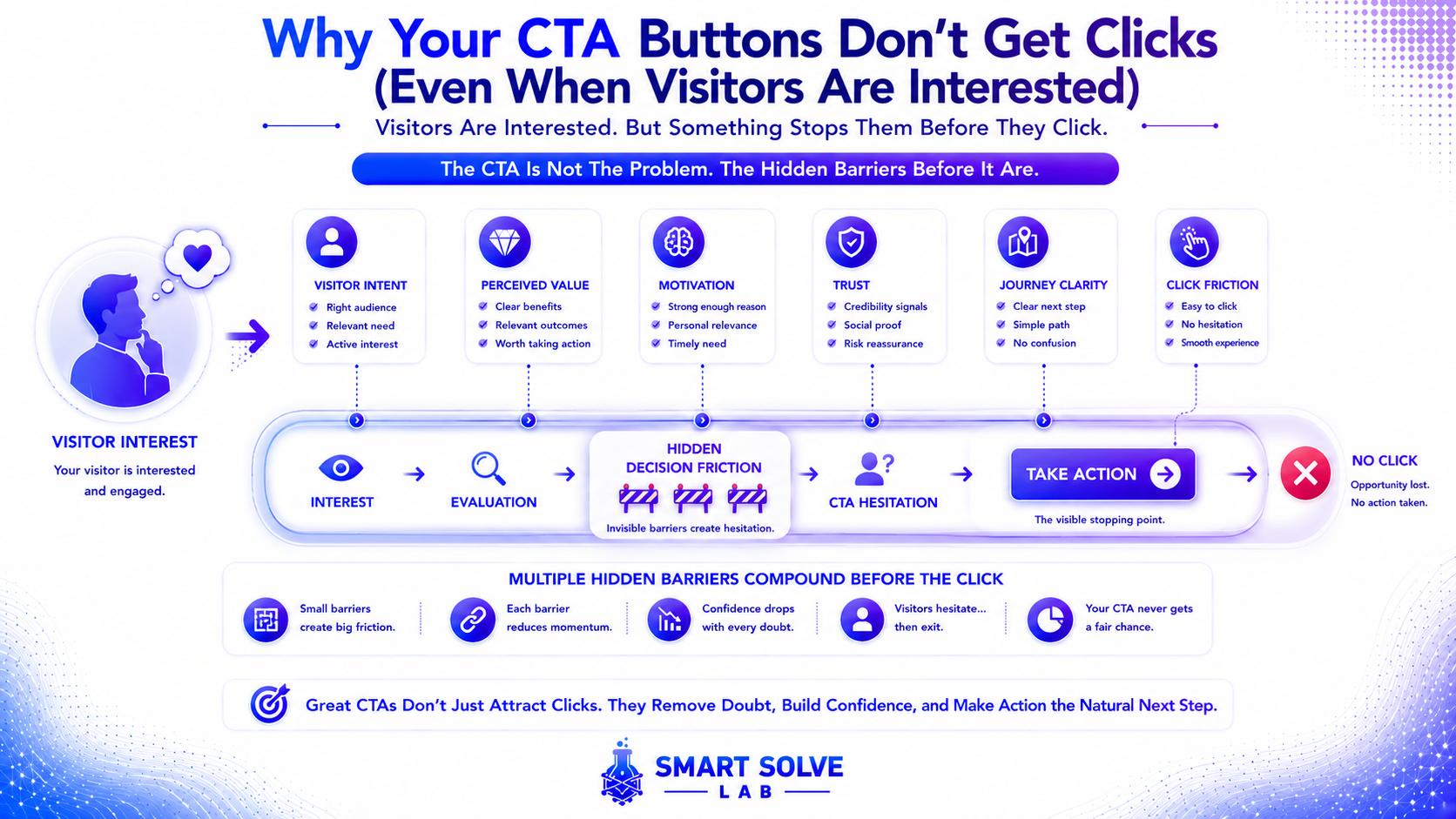
CTA buttons don’t get clicks:
CTA buttons often appear to be one of the simplest elements on a website.
A visitor sees an offer, reads the message, and clicks the button to take the next step.
At least, that is how the journey is expected to work.
In reality, many businesses attract interested visitors who explore their pages, engage with their content, and show signs of genuine interest—yet still fail to click the call-to-action.
This creates an important diagnostic question:
Why do interested visitors stop before clicking?
The visible problem may appear to be the CTA button.
But the real problem often begins much earlier in the visitor journey.
Before clicking, visitors evaluate whether the offer feels relevant, whether the next step provides enough value, whether they trust the business, and whether they clearly understand what will happen after taking action.
When these signals are weak or disconnected, hesitation develops before the visitor ever reaches the point of clicking.
Why CTA Clicks Matter More Than They Appear
A CTA click represents more than interaction with a button.
It often marks the transition between passive interest and meaningful customer action.
Depending on the business, that action may lead to:
- Starting an enquiry
- Requesting a consultation
- Joining an email list
- Exploring a product
- Beginning a purchase journey
When visitors repeatedly stop at this stage, the business may lose valuable opportunities even when traffic and engagement appear healthy.
Interest does not automatically create action.
A visitor may understand an offer and still hesitate because the perceived value is unclear, trust is insufficient, motivation is weak, or the next step feels uncertain.
This hidden gap between interest and action is where many CTA performance problems develop.
Understanding what happens before the click is therefore just as important as analyzing the button itself.
Why CTA Problems Often Begin Before the Button
Businesses frequently respond to low CTA performance by changing button text, design, placement, or color.
But if the real barrier exists earlier in the decision journey, changing the button alone may not solve the problem.
The CTA may simply be the visible point where a deeper system weakness finally becomes measurable.
Visitor intent, perceived value, motivation, trust, context, and journey clarity can all influence whether someone ultimately decides to click.
Effective CTA diagnosis looks beyond the button.
It examines the connected signals influencing visitor decisions before action occurs.
This guide will help you understand:
- Why interested visitors still hesitate before clicking
- Which hidden barriers can reduce CTA performance
- How multiple diagnostic systems influence visitor action
- Why CTA problems are often system problems rather than isolated button issues
- How businesses can identify high-impact friction before beginning optimization
The goal is not to immediately change the CTA.
The goal is to understand why the click is not happening in the first place.
Diagnose the decision friction before optimizing the button.
Table of Contents
What Does “CTA Buttons Don’t Get Clicks” Really Mean?
When a CTA button receives few clicks, businesses often assume that the button itself is the problem.
They may question the wording, design, color, size, or placement.
But low CTA performance does not always mean the button is poorly designed.
In many cases, the CTA is simply the point where a deeper problem becomes visible.
Visitors may reach the button without having enough motivation, confidence, or clarity to take the next step.
Understanding this difference is essential before attempting optimization.
The Problem
A business may attract relevant traffic, create valuable content, and present a compelling offer—yet still experience a low CTA click-through rate.
Visitors arrive.
They explore the page.
They may even appear interested.
But when the opportunity to take action appears, many choose not to click.
The visible symptom is low CTA engagement.
The underlying problem may exist somewhere earlier in the visitor’s decision journey.
The Hidden Reality
Every CTA asks a visitor to make a decision.
Before clicking, the visitor may consciously or unconsciously evaluate:
- Is this action relevant to me?
- Is the next step worth my time?
- Can I trust this business?
- What will happen after I click?
- Am I ready to move forward?
If the journey leading to the CTA has not answered these questions effectively, hesitation can develop.
This is why businesses experiencing broader customer action problems may also struggle with CTA performance. Understanding why customers leave without taking action can reveal how decision friction develops before the final click.
Deep Insight
CTA performance is influenced by everything that happens before the button.
The message visitors read.
The value they perceive.
The trust they develop.
The motivation they feel.
The clarity they have about the next step.
The button may be where the visitor stops, but it is not necessarily where the problem begins.
Why This Happens
Visitors click when the perceived value of taking action becomes greater than the uncertainty or friction surrounding that action.
When motivation is weak, trust is incomplete, or the next step feels unclear, visitors may hesitate—even when they are genuinely interested.
This creates a hidden gap between:
Interest → Decision → Action
The CTA sits at the end of this process, which is why diagnosing only the button can overlook the real cause of poor performance.
Real Business Scenario
Imagine a service business receiving consistent traffic to an important landing page.
Visitors spend time reading about the service and exploring its benefits.
At the bottom of the page, they see a Request a Consultation button.
Very few click.
The business may assume the CTA wording needs to change.
But the deeper barrier could be that visitors do not know what the consultation involves, how much commitment it requires, or what will happen after they submit their information.
The CTA is visible.
The uncertainty behind the CTA is not.
What This Means
Low CTA clicks should be treated as a diagnostic signal rather than immediate proof that the button needs optimization.
Before changing copy, design, or placement, businesses should understand what prevents visitors from feeling ready to act.
The goal is to identify whether the friction comes from the CTA itself—or from the journey leading to it.
Critical Takeaway
A CTA button is often the final decision point in a much larger customer journey.
When visitors do not click, the most valuable question is not simply:
“What’s wrong with our button?”
It is:
“What happened before the button that made visitors hesitate?”
Diagnose the decision friction before optimizing the CTA.
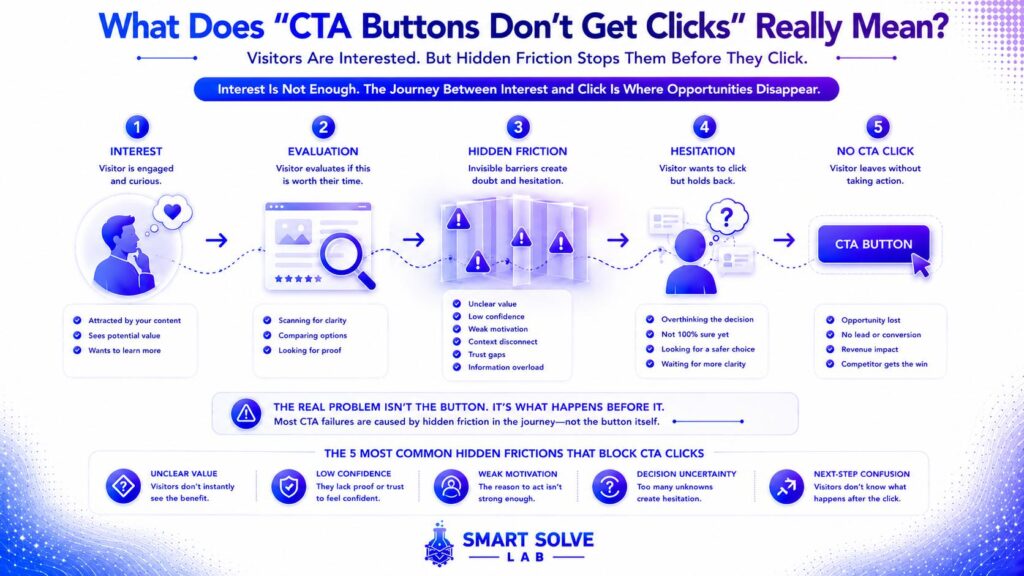
Why Interested Visitors Still Don’t Click Your CTA
A visitor can be genuinely interested in an offer and still decide not to click.
Interest creates attention, but clicking requires a decision.
Between these two stages, visitors evaluate whether taking the next step feels valuable, relevant, trustworthy, and clear.
When these signals are not strong enough, hidden click barriers develop.
The visitor may continue reading, explore other parts of the website, or leave entirely—without ever interacting with the CTA.
The Hidden Click Barriers
CTA friction is not always obvious.
Visitors rarely explain why they decided not to click.
Instead, small uncertainties accumulate throughout the decision journey until taking action no longer feels worthwhile.
These barriers may include unclear value, insufficient motivation, low confidence, or uncertainty about what happens after the click.
Individually, each barrier may appear minor.
Together, they can significantly reduce CTA performance.
Interest Doesn’t Automatically Create Action
Interest and action represent different levels of customer commitment.
A visitor may find an offer relevant without feeling ready to move forward.
They may want more information.
They may need greater confidence.
Or they may simply not see enough value in taking the next step.
This is why businesses should not assume that interested visitors will naturally click a CTA.
The journey must support the transition from interest to action.
Weak Action Motivation
Every CTA asks visitors to exchange something.
It may be their:
- Time
- Attention
- Contact information
- Personal details
- Money
- Commitment
Before clicking, visitors evaluate whether the expected benefit justifies that exchange.
If the value of taking action is unclear, motivation weakens and hesitation increases.
CTA Expectation Gaps
Visitors are more likely to hesitate when they do not understand what the CTA will lead to.
A button that says Get Started, for example, may create uncertainty if the visitor does not know whether clicking will open a form, begin a purchase, schedule a call, or require immediate payment.
Clear expectations reduce uncertainty before action.
This is particularly important on landing pages, where hidden decision barriers can contribute to why landing pages don’t convert even with high traffic.
Low Confidence Before the Click
Visitors need enough confidence to move from passive interest to active participation.
If trust has not been established before the CTA appears, the visitor may hesitate to share information or begin a business interaction.
The CTA cannot create confidence on its own.
It depends on the trust and credibility established throughout the journey leading to it.
Decision Uncertainty
Even when visitors understand the offer, they may still question whether taking action is the right decision.
They may wonder:
- Is this solution right for me?
- Is this the best next step?
- Will I be pressured into buying?
- What happens after I click?
- Can I change my mind later?
When these questions remain unanswered, uncertainty can become stronger than motivation.
The Cost of Lost Click Opportunities
A missed CTA click may appear to be a small interaction loss.
But every lost click can represent a missed opportunity to generate:
- A qualified lead
- A consultation request
- A product enquiry
- An email subscriber
- A potential customer
When the same hidden barriers affect large numbers of visitors, small points of friction can create significant conversion and revenue losses over time.
Section Summary
Interested visitors do not ignore CTAs simply because they lack interest.
They often hesitate because the decision journey has not created enough value, motivation, trust, or clarity to support the next action.
Understanding these hidden click barriers provides the foundation for diagnosing the connected systems that influence CTA performance.
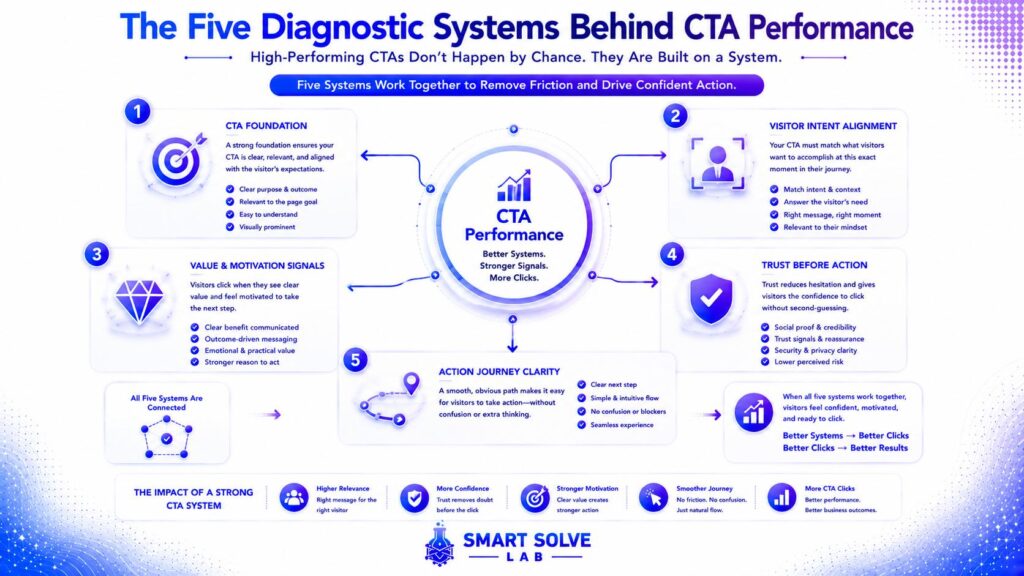
The Five Diagnostic Systems Behind CTA Performance
CTA performance is rarely determined by a single element.
An effective call-to-action depends on multiple connected systems working together before a visitor reaches the point of clicking.
When these systems are aligned, visitors are more likely to understand the value of taking action and feel confident about moving forward.
When one or more systems weaken, hesitation can develop—even when the visitor is genuinely interested.
Understanding these five diagnostic systems helps businesses identify where CTA performance may be breaking down before attempting optimization.
CTA Foundation
Every CTA should have a clear strategic purpose within the customer journey.
The requested action should logically connect the visitor’s current position with the next stage of their journey.
A CTA foundation becomes weak when the action feels disconnected from the surrounding content or asks visitors to make a commitment they are not yet ready to make.
The diagnostic question is:
Does this CTA represent the right next step for the visitor at this stage of the journey?
Visitor Intent Alignment
Visitors arrive with different intentions and levels of readiness.
Some are exploring a problem.
Others are comparing possible solutions.
A smaller group may already be prepared to take action.
CTA performance can weaken when the requested action does not match the visitor’s current intent.
For example, asking an early-stage visitor to make a high-commitment decision may create unnecessary friction.
The diagnostic goal is to understand whether the CTA aligns with what the visitor is realistically ready to do next.
Value & Motivation Signals
Visitors need a meaningful reason to click.
Before taking action, they evaluate what they are likely to gain and whether the next step feels worthwhile.
If the value behind the CTA is unclear, even a well-designed button may receive limited engagement.
Strong motivation develops when visitors understand:
- Why the next step matters
- What benefit they may receive
- How the action relates to their goal
- Why taking action now is worthwhile
The purpose of diagnosis is not to immediately rewrite the CTA, but to determine whether insufficient perceived value is contributing to hesitation.
Trust Before Action
Every meaningful CTA requires some level of visitor confidence.
The greater the commitment involved, the more trust may be required before someone is willing to click.
Visitors may evaluate the credibility of the business, the perceived risk of taking action, and whether they feel comfortable moving forward.
If sufficient trust has not developed before the CTA appears, the button itself may become the point where visitors stop.
The real barrier, however, may have formed much earlier in the journey.
Action Journey Clarity
Visitors should understand both what action they are being asked to take and what is likely to happen next.
Uncertainty creates friction.
If clicking a CTA could lead to an unknown process, unexpected commitment, or unclear outcome, visitors may hesitate.
Action journey clarity evaluates whether the transition from the current page to the next step feels logical and predictable.
The diagnostic question becomes:
Does the visitor clearly understand where this action will take them?
How These Systems Work Together
These five systems should not be evaluated in isolation.
A visitor may have strong intent but insufficient trust.
They may trust the business but fail to understand the value of clicking.
They may understand the value but feel uncertain about what happens next.
Each weakness can influence the others.
Every effective call-to-action depends on multiple connected systems. When one system weakens, visitors may hesitate before clicking—even when they are genuinely interested in the offer.
Section Summary
CTA performance reflects the combined strength of the systems surrounding the visitor’s decision.
By evaluating CTA foundation, visitor intent, perceived value, motivation, trust, and action journey clarity, businesses can begin identifying where hidden friction develops before the click.
This diagnostic understanding creates clarity before optimization begins.
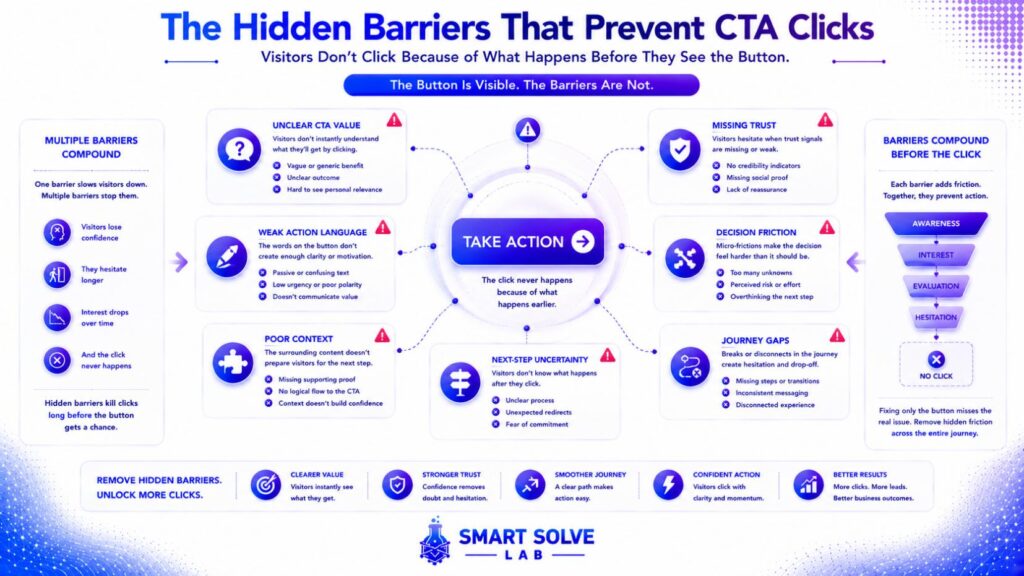
The Hidden Barriers That Prevent CTA Clicks
CTA buttons are often treated as isolated conversion elements.
However, visitors rarely decide whether to click based on the button alone.
Their decision is influenced by everything they experience before reaching the CTA—from how clearly they understand the offer to how confident they feel about taking the next step.
When these elements create uncertainty, hidden barriers can prevent action even when visitor interest is strong.
Unclear CTA Value
Visitors need to understand why clicking the CTA is worthwhile.
A button may clearly communicate an action, but if the value behind that action is unclear, visitors have little motivation to proceed.
The real diagnostic question is not simply whether visitors can see the CTA.
It is whether they understand the benefit of taking the next step.
Weak Action Language
CTA language influences how visitors interpret the requested action.
Generic or ambiguous wording may fail to communicate what the visitor is actually being invited to do.
However, weak action language should not automatically be treated as a copywriting problem.
It may indicate a deeper disconnect between the offer, visitor expectations, and the action being requested.
Poor Context Before the CTA
A CTA depends heavily on the information surrounding it.
If visitors encounter the button before they understand the problem, solution, value, or next step, the request for action may feel premature.
Strong visitor journeys create sufficient context before asking for commitment.
When that context is missing, the CTA may appear ineffective even though the underlying problem exists earlier on the page.
This is one reason businesses experiencing broader conversion challenges should also understand why website traffic doesn’t become leads, because CTA friction can be one part of a larger lead conversion problem.
Missing Trust Signals
Visitors may understand the offer and recognize its value while still hesitating because they do not feel sufficiently confident about the business.
The level of trust required often increases with the level of commitment requested.
A low-risk action may require minimal confidence.
A consultation, purchase, or submission of personal information may require significantly more.
When trust is insufficient, the CTA becomes the visible point where hesitation appears.
Decision Friction
Every additional question or uncertainty increases the mental effort required to make a decision.
Visitors may wonder whether they are making the right choice, whether the action requires commitment, or whether a better option exists elsewhere.
This decision friction can quietly reduce clicks without creating an obvious technical problem.
The visitor can see the button.
They simply do not feel ready to use it.
CTA Placement and Journey Gaps
CTA placement becomes a problem when it does not match the natural progression of the visitor journey.
A CTA may appear too early, before sufficient value or trust has been established.
Alternatively, it may appear too late, after visitor motivation has already declined.
The diagnostic objective is to understand whether the CTA appears at a logical decision point—not simply whether it is visually prominent.
Uncertainty About What Happens Next
One of the most overlooked CTA barriers is uncertainty after the click.
Visitors may hesitate because they do not know whether clicking will:
- Open a contact form
- Request personal information
- Schedule a meeting
- Begin a purchase
- Require payment
- Create an immediate commitment
When the next step feels unpredictable, visitors may choose to avoid the action entirely.
Reducing uncertainty begins with understanding where expectations become unclear.
Section Summary
Hidden CTA barriers rarely operate independently.
Unclear value can weaken motivation.
Missing trust can increase decision friction.
Poor context can make the requested action feel premature.
Next-step uncertainty can prevent an otherwise interested visitor from clicking.
Diagnosing how these barriers interact helps businesses identify the real source of CTA performance problems before changing button copy, design, or placement.
Why CTA Performance Problems Are Usually System Problems
CTA performance problems are often treated as isolated button issues.
When clicks are low, businesses may immediately change the button text, adjust its design, move its position, or experiment with different visual elements.
These changes may sometimes improve performance.
However, if the real barrier exists within the broader visitor journey, changing the CTA alone may not address the underlying problem.
A CTA is part of a connected decision system.
Visitor intent, perceived value, motivation, trust, context, and journey clarity all influence whether someone ultimately decides to click.
Small CTA Friction Creates Larger Conversion Losses
A small point of hesitation may seem insignificant when viewed as a single interaction.
But when hundreds or thousands of visitors experience the same friction, the cumulative impact can become substantial.
Even minor uncertainty about the value of taking action or what happens next can reduce clicks across the entire visitor journey.
Over time, these missed actions may translate into fewer leads, enquiries, sign-ups, or sales opportunities.
Disconnected Visitor Journeys Create Hesitation
Visitors need a logical progression from initial interest to meaningful action.
A typical journey may involve:
- Recognizing a problem
- Understanding a possible solution
- Evaluating the offer
- Building confidence
- Deciding whether to proceed
- Taking the next action
When these stages feel disconnected, visitors may reach the CTA without being psychologically ready to click.
The button becomes the visible stopping point, but the underlying friction may have developed much earlier.
Multiple Weak Signals Compound Before the Click
CTA hesitation rarely comes from one barrier alone.
A visitor may experience slightly unclear value, limited trust, weak motivation, and uncertainty about the next step simultaneously.
Individually, none of these issues may appear serious.
Together, they can create enough friction to prevent action.
This is why CTA diagnosis should examine how multiple signals interact throughout the decision journey.
Why Changing Button Text Alone Rarely Solves the Problem
Changing CTA wording can be useful when language itself is creating confusion.
But stronger button copy cannot compensate for a weak value proposition, insufficient trust, poor visitor intent alignment, or an unclear customer journey.
If visitors do not understand why they should act, simply changing Learn More to Get Started may not solve the deeper problem.
The button can communicate an action.
It cannot repair every weakness that occurs before that action.
Why Isolated CTA Changes Can Misdiagnose the Real Barrier
When businesses optimize individual CTA elements without understanding the underlying cause, they risk treating symptoms instead of problems.
A low click-through rate might appear to indicate weak CTA copy.
In reality, visitors may lack confidence in the offer.
Similarly, poor CTA engagement may appear to be a placement issue when the actual barrier is uncertainty about what happens after the click.
Without diagnosis, businesses can spend significant time testing the wrong variables.
Why Diagnosis Should Come Before Optimization
Effective CTA improvement begins by identifying where decision friction actually occurs.
Businesses should first understand:
- Whether visitor intent matches the requested action
- Whether the value of clicking is clear
- Whether sufficient motivation exists
- Whether trust has been established
- Whether the next step feels predictable
- Whether multiple barriers are working together
Once these factors are understood, optimization decisions can be based on evidence and diagnostic clarity rather than assumptions.
Section Summary
CTA performance problems are usually connected to the broader decision system surrounding the button.
The visible symptom may be a missing click.
The real cause may exist across multiple stages of the visitor journey.
By diagnosing these connected barriers first, businesses can identify the highest-impact sources of friction before deciding what should be optimized.
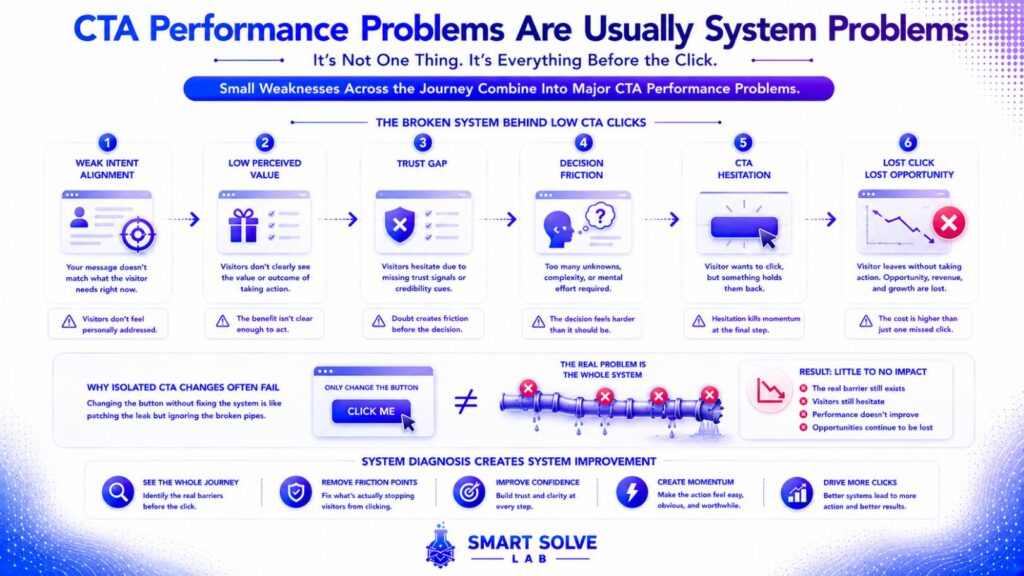
CTA performance problems often develop across the customer journey rather than at the button alone.
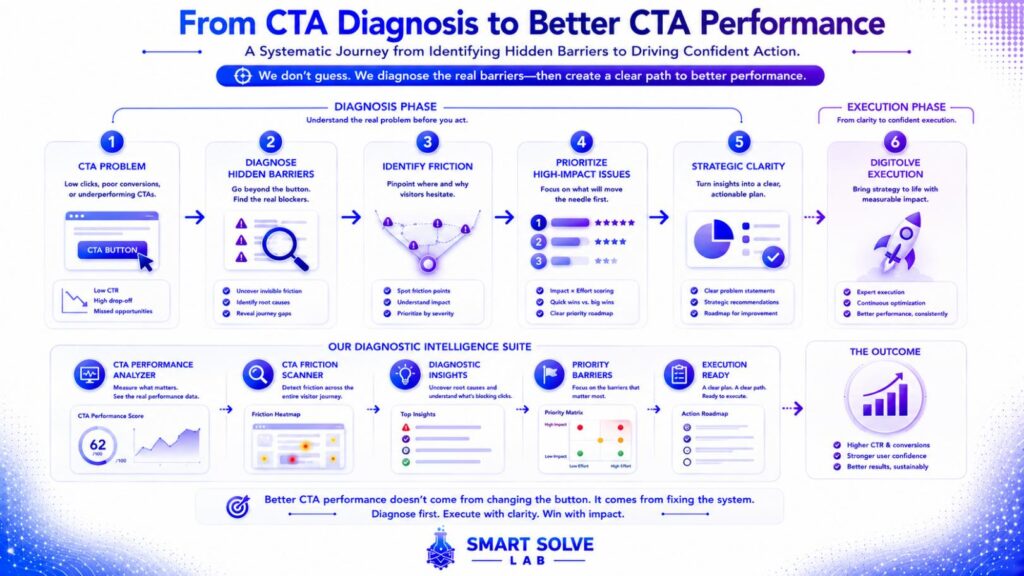
From Diagnosis to Better CTA Performance
Understanding why visitors do not click a CTA is the first step toward improving performance.
Rather than immediately changing button copy, design, placement, or visual elements, businesses should first identify the highest-impact barriers influencing the visitor’s decision.
A structured diagnostic approach helps separate visible symptoms from deeper causes and provides greater clarity about where decision friction actually occurs.
The Role of the CTA Performance Analyzer
The CTA Performance Analyzer is designed to help businesses systematically evaluate the signals and barriers influencing CTA performance before making optimization decisions.
Instead of focusing exclusively on the button, the diagnostic process examines factors such as:
- Visitor intent
- Perceived value
- Action motivation
- Trust before action
- Journey clarity
- Click friction
This helps businesses understand not only that visitors are failing to click, but why hesitation may be developing throughout the decision journey.
The CTA Friction Scanner supports this diagnostic process by helping identify where the highest-impact points of friction may be occurring.
Together, these insights create a clearer foundation for prioritizing future improvements.
From Diagnosis to Execution
Once the highest-impact CTA performance barriers have been identified, businesses can move from understanding the problem to implementing structured improvements.
This is where diagnosis and execution serve different roles.
Smart Solve Lab focuses on identifying and interpreting the barriers affecting CTA performance.
After diagnosis, businesses can implement a structured improvement process through Digitolve’s CTA Optimization Toolkit.
This creates a clear progression:
Diagnose the problem → Identify the friction → Prioritize the barriers → Execute improvements
By separating diagnosis from execution, businesses can avoid making random changes and focus their resources on the areas most likely to influence customer action.
Continuous Evaluation Creates Better CTA Decisions
CTA performance is not static.
Visitor expectations, customer behavior, offers, and business journeys can change over time.
This means a CTA that performs effectively today may encounter new friction as the surrounding customer journey evolves.
Businesses that continuously evaluate visitor needs and behavior are better positioned to identify emerging barriers and make informed decisions.
Google’s guidance on creating helpful, reliable, people-first content also emphasizes focusing on experiences designed primarily to benefit people. This broader principle reinforces the importance of understanding user needs rather than making changes solely for performance metrics.
Section Summary
Better CTA performance begins with understanding the decision journey behind the click.
The CTA Performance Analyzer helps diagnose the barriers influencing action, while the CTA Friction Scanner helps identify where friction is occurring.
Once those barriers are understood and prioritized, businesses can move toward structured execution with greater clarity.
Diagnose first. Identify friction second. Execute with clarity.
Conclusion
CTA problems rarely exist in isolation.
A button may be the visible point where customer action stops, but the real barrier may have developed much earlier in the visitor journey.
Visitors evaluate value, motivation, trust, context, and next-step clarity before deciding whether to click. When these signals fail to work together, even genuinely interested visitors may hesitate.
This is why low CTA performance should not automatically lead to immediate changes in button copy, design, or placement.
The better starting point is diagnosis.
Understanding where decision friction develops helps businesses distinguish between a button-level issue and a broader customer journey problem.
Diagnose Before Optimizing
Before attempting to improve CTA performance, businesses should ask:
- Does the requested action match visitor intent?
- Is the value of taking the next step clear?
- Has enough trust been established?
- Does the visitor feel sufficiently motivated?
- Is the journey toward action logical?
- Does the visitor understand what happens after clicking?
These questions help reveal whether the CTA itself is creating friction or simply exposing weaknesses that already exist elsewhere in the journey.
Better diagnosis creates better CTA decisions.
Better CTA decisions create clearer customer journeys.
Clearer customer journeys support stronger and more sustainable business growth.
Diagnostic Insight
CTA performance problems rarely begin with the button alone.
They often emerge when visitor intent, perceived value, trust, motivation, context, and journey clarity fail to work together.
Effective diagnosis identifies these hidden barriers before businesses begin changing button copy, design, or placement.
The most valuable question is therefore not simply:
“How can we get more people to click?”
It is:
“What is preventing interested visitors from feeling ready to take the next action?”
Diagnose the decision friction before optimizing the button.
Recommended Reading
- Why Customers Leave Without Taking Action (Even When They Seem Interested)
- Why Your Landing Pages Don’t Convert (Even With High Traffic)
- Why Your Website Traffic Doesn’t Become Leads (Even When Visitors Keep Coming)
Frequently Asked Questions
Why don’t visitors click my CTA buttons?
Visitors may avoid clicking because they lack sufficient motivation, trust, perceived value, or clarity about what happens next. The button may be where hesitation becomes visible, while the actual barrier develops earlier in the decision journey.
Why do interested visitors ignore calls-to-action?
Interest does not automatically create action. Visitors may find an offer relevant while still feeling uncertain about whether taking the next step is worthwhile or appropriate for them.
What causes a low CTA click-through rate?
A low CTA click-through rate can result from unclear value, weak motivation, insufficient trust, poor context, visitor intent mismatch, decision friction, or uncertainty about the next step.
Does changing CTA button text increase clicks?
It can help when the wording itself creates confusion, but changing button text alone may not solve deeper problems involving trust, value, motivation, or journey clarity. Diagnosis should determine the underlying barrier before optimization begins.
What causes CTA friction?
CTA friction develops when something makes visitors hesitate before taking action. This may include unclear expectations, perceived risk, insufficient value, low trust, or a requested action that does not match visitor readiness.
How do I diagnose CTA performance problems?
Start by evaluating the complete decision journey surrounding the CTA. Examine visitor intent, perceived value, motivation, trust, action clarity, and potential friction to identify where hesitation is developing.
What is a CTA Performance Analyzer?
A CTA Performance Analyzer is a diagnostic framework designed to systematically evaluate the factors influencing CTA performance and identify the highest-impact barriers preventing interested visitors from taking the next action.
Leave a Reply