
customers not staying:
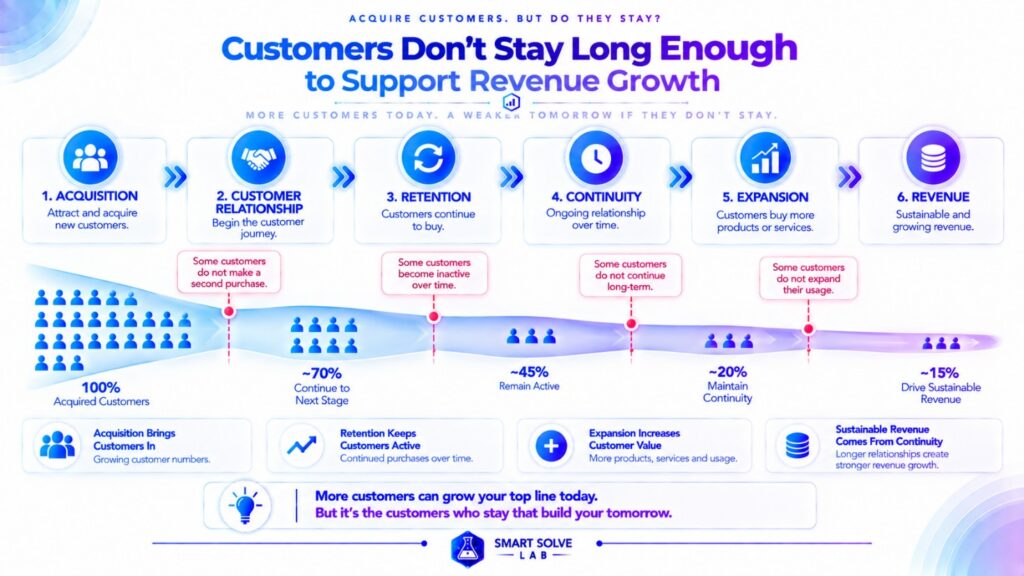
Getting new customers is an important part of growth, but customer acquisition alone does not guarantee sustainable revenue growth. A business may continue attracting new customers while existing customers leave sooner than expected, relationships fail to continue, or expansion opportunities never develop.
This can create a misleading picture of growth. Customer numbers may be increasing, sales activity may remain strong, and acquisition campaigns may continue bringing in new business—yet the underlying customer relationships may not be lasting long enough to support continued revenue contribution.
The important question, therefore, is not simply how many customers a business acquires. It is what happens after acquisition.
Do customers stay? Does the relationship continue? Do existing customers create opportunities for continued or expanded business? And when customers leave, where in the relationship does the breakdown actually occur?
This is where the Retention & Expansion Gap becomes important.
Retention problems are often treated as a simple question of churn: customers are leaving, so the business needs to find out why. But churn is a signal, not automatically the root cause. Customer fit, expectations, experience, ongoing relevance, engagement, relationship continuity, and earlier acquisition conditions can all influence whether a customer relationship continues.
A business can therefore have a visible retention problem while the underlying condition exists somewhere earlier in the customer journey.
This article examines the problem from a diagnostic perspective. Instead of assuming that more acquisition will compensate for customer loss, we will look at the pathway from Acquisition → Customer Relationship → Retention → Continuity → Expansion → Revenue and identify where that pathway can weaken.
The goal is not to provide a complete retention optimization system. The goal is to help you understand where customer relationships are failing to continue or expand, what conditions may be contributing to that gap, and where deeper diagnostic attention may be needed.
Table of Contents
Why More Customers Do Not Always Mean More Sustainable Growth
Acquisition Can Increase Customer Numbers
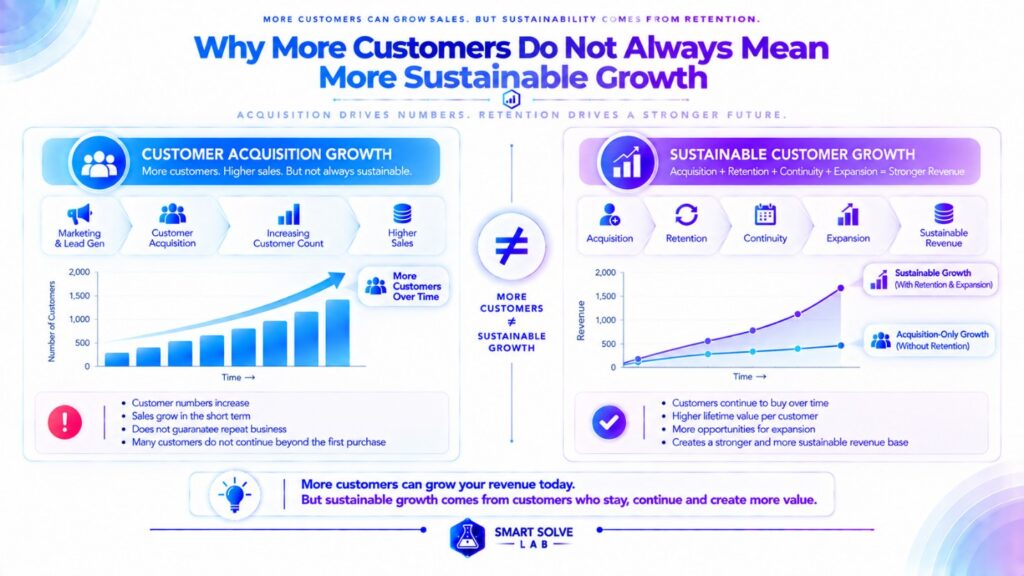
A business can increase its customer count by consistently generating new demand and converting new customers. More customers can indicate that acquisition is working, but customer growth alone does not show whether those relationships will continue long enough to support sustainable revenue growth.
Acquisition creates the opportunity for a customer relationship to develop. It does not, by itself, tell us what happens after the initial transaction.
Customer Growth Is Not the Same as Customer Retention
Customer growth and customer retention describe different parts of the growth journey. Customer growth looks at how many new customers are being added. Retention looks at whether those customer relationships continue over time.
This distinction becomes important when new customers are being added while existing customers are leaving. The total customer count may still appear healthy, even though the underlying customer relationships are becoming less stable.
In other words, a growing customer base can sometimes hide a weakening retention condition.
Why New Customers Can Hide a Retention Problem
Suppose a business acquires 100 new customers during a period but loses a significant portion of previously acquired customers at the same time. The acquisition activity may look successful because new customers are continuously entering the business.
But the more important diagnostic question is what is happening underneath that growth: Are new customers adding to a stable customer base, or are they replacing customers who are leaving?
When acquisition repeatedly compensates for customer loss, the business may remain busy without developing the relationship continuity needed for more sustainable growth.
The Difference Between Acquisition and Relationship Continuity
Acquisition answers one important question: Can the business attract and acquire customers?
Retention asks a different question: Once acquired, does the customer relationship continue?
That difference creates an important diagnostic boundary. A business may have strong acquisition activity while still experiencing a weakness somewhere between the initial customer relationship and continued engagement.
Understanding that distinction helps shift the focus from simply acquiring more customers toward examining what happens after acquisition.
What Customer Retention Actually Means
Staying Beyond the First Purchase
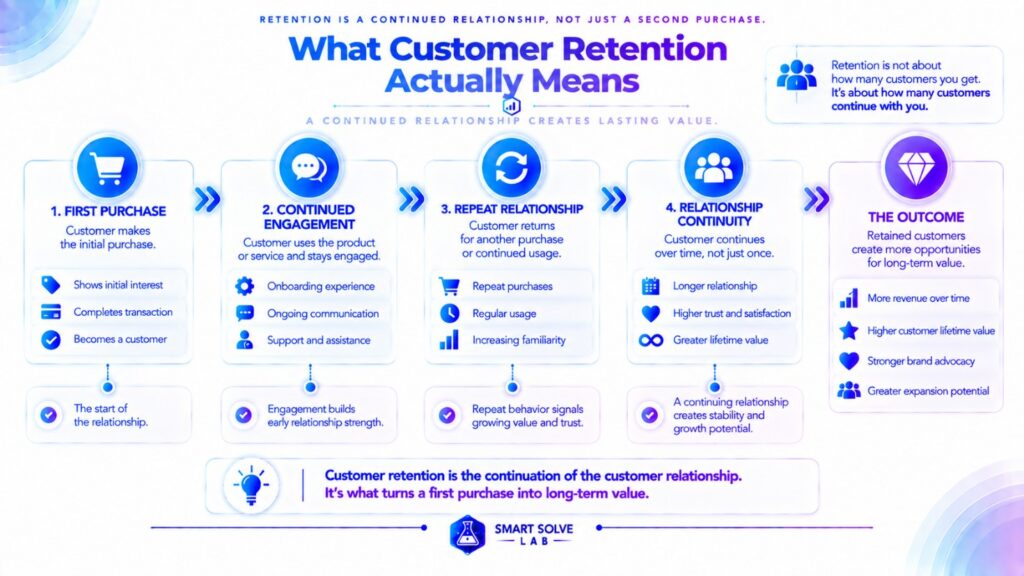
Customer retention begins with what happens after the initial purchase. A customer who completes a first transaction has entered the customer relationship, but that first transaction does not tell us whether the relationship will continue.
Retention therefore looks beyond acquisition and the initial sale to examine whether customers remain connected to the business over time.
Continued Customer Engagement
For a relationship to continue, there usually needs to be some form of ongoing connection between the customer and the business. The exact form of that connection depends on the business model, but the diagnostic question remains similar: Is the relationship continuing, or is it gradually becoming inactive?
A decline in engagement can be an early signal that the customer relationship is weakening before the customer formally leaves.
Repeat Relationships
In businesses where customers can purchase repeatedly, continued purchasing can provide one visible indication that the relationship is continuing. However, retention should not be reduced to repeat transactions alone.
The deeper issue is whether the customer relationship remains sufficiently connected and relevant for continued business interaction.
Relationship Continuity
Relationship continuity describes the ability of a business to maintain its customer relationships after acquisition rather than continually replacing lost customers with new ones.
This makes retention an important layer between customer acquisition and longer-term revenue contribution. Acquisition brings customers into the system; retention determines whether those relationships continue within it.
Why Retention Matters Beyond Customer Count
Looking only at the number of customers can hide important differences in relationship quality and continuity. Two businesses may acquire a similar number of customers while experiencing very different levels of customer retention.
That is why a meaningful retention diagnosis needs to examine more than customer acquisition totals. It needs to understand what happens to the customer relationship after acquisition and whether that relationship continues over time.
The Retention & Expansion Gap
When Acquisition Is Growing but Customers Are Not Staying
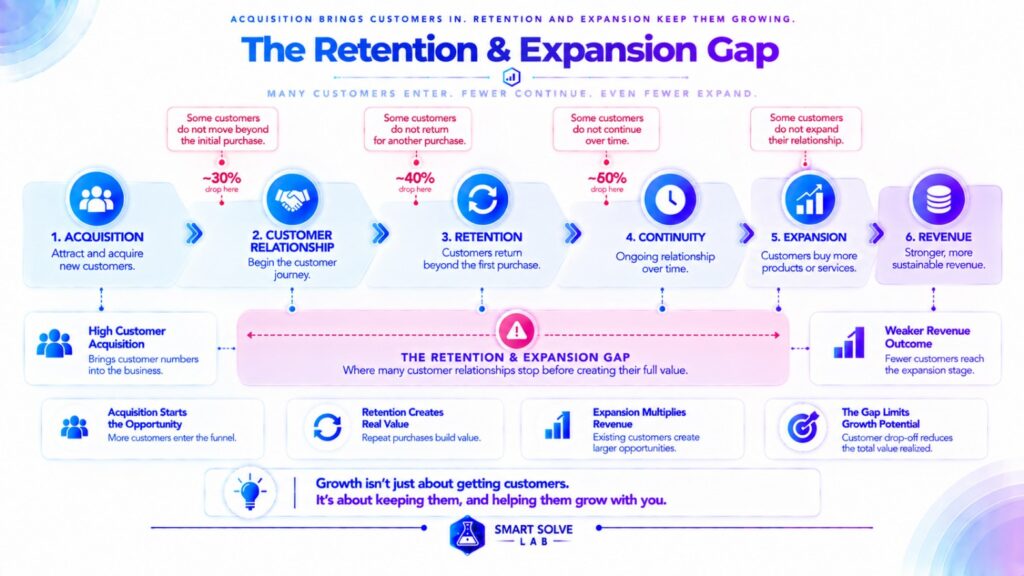
A business can continue acquiring customers while the underlying customer base remains unstable. New customers may enter the business regularly, but if existing relationships are ending too quickly, acquisition growth may be compensating for a retention weakness rather than creating durable customer growth.
This creates a gap between customer acquisition and customer continuity. The business is successfully bringing customers in, but not enough of those relationships may be continuing over time.
When Customer Relationships End Too Early
Retention becomes a concern when customer relationships stop progressing earlier than the business reasonably expects. The exact point can differ by business model, but the diagnostic pattern is similar: a customer enters the relationship, some initial activity occurs, and then the relationship weakens or ends.
The important question is not simply how many customers have left. It is where and when the relationship stopped continuing.
When Existing Customers Are Not Expanding Their Relationship
Retention and expansion are connected, but they are not identical. A customer may remain with a business without significantly increasing the depth or scope of the relationship.
Expansion can involve additional purchases, broader use of an offering, increased relationship scope, or other forms of continued commercial development. When these opportunities consistently fail to emerge, the business may have an expansion gap even when customers are technically being retained.
Why the Gap Matters
The broader issue is the movement from acquisition to sustained customer contribution. Acquisition creates the starting point, but retention determines whether the relationship continues, while expansion determines whether that relationship can develop further.
Therefore, a business experiencing weak retention or limited expansion should not automatically conclude that it simply needs more customers. The more useful diagnostic question is:
Where is the customer relationship failing to continue or expand after acquisition?
Answering that question creates a clearer starting point for understanding the conditions behind the retention and expansion gap.
Why Customer Acquisition Can Hide a Retention Problem
New Customers Can Replace Lost Customers
When a business continuously acquires new customers, it can sometimes maintain a stable or growing customer count even while existing customers are leaving. The incoming customers can replace those who have exited, making the underlying retention problem less visible.
This creates an important diagnostic distinction: customer acquisition can maintain customer volume without necessarily strengthening customer continuity.
Customer Counts Can Look Healthy
A growing customer count can appear to be a positive growth signal. But the number of customers at a particular point in time does not reveal how many relationships are being lost and replaced along the way.
If acquisition is strong enough to offset customer loss, the headline number may remain healthy while the underlying relationship pattern is becoming increasingly dependent on continuous acquisition.
Acquisition Can Mask Customer Churn
Customer churn becomes easier to overlook when new customer inflow remains high. The business may focus on how many customers it is adding rather than examining how long those customers remain connected.
This can lead to a misleading conclusion: that continued acquisition is solving the growth problem when it may actually be masking a weakness in customer retention.
Why More Acquisition Is Not Always the Answer
When customers are leaving too early, adding more customers does not automatically address the reason relationships are ending. It may increase the volume entering the business while leaving the underlying retention condition unchanged.
The better diagnostic approach is to examine both sides of the customer base: who is coming in and what is happening to the customers already acquired?
Only then can the business determine whether its growth challenge is primarily an acquisition issue, a retention issue, or a deeper condition affecting the customer relationship.
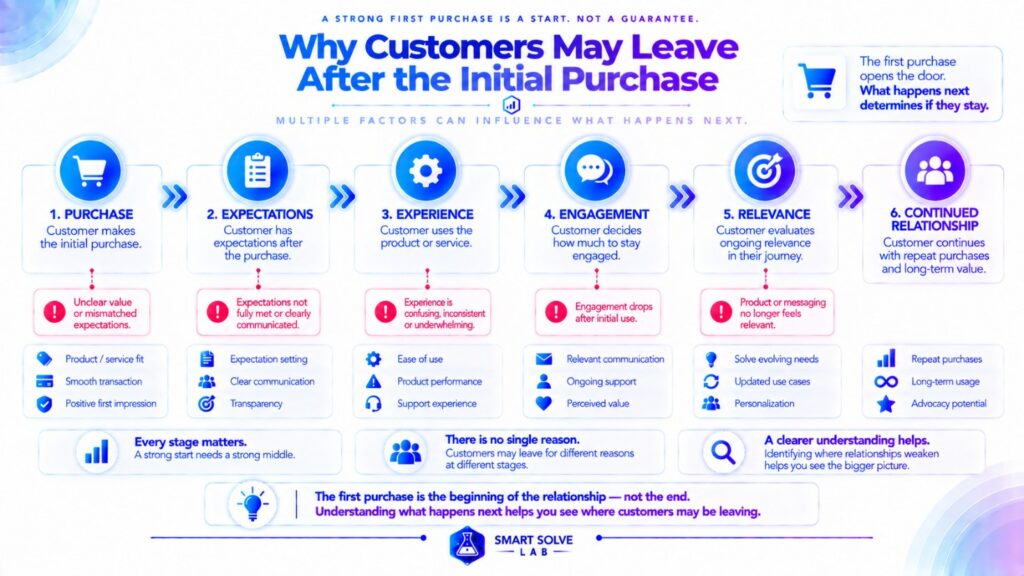
Why Customers May Leave After the Initial Purchase
Expectations Are Not Sustained
The customer relationship begins with a set of expectations formed before or during the purchase. If those expectations are not carried into the ongoing experience, the relationship can weaken after the initial transaction.
This does not automatically mean the product or service is poor. The diagnostic issue is whether there is a meaningful gap between what the customer expected and what the ongoing relationship actually provides.
Ongoing Value Becomes Unclear
Customers need a reason for the relationship to continue. If the ongoing relevance of the product, service, or relationship becomes unclear, continued engagement may weaken.
Here, the focus is not on re-explaining customer value itself. The question is narrower: does the customer still see a sufficient reason to remain connected to the business?
Customer Experience Weakens
The experience after purchase can influence whether a customer continues the relationship. Friction, inconsistency, poor communication, unresolved issues, or an experience that does not match expectations can all become signals that the relationship is weakening.
The visible outcome may be customer loss, but the underlying condition may have developed earlier in the customer experience.
Engagement Declines
A customer relationship can also weaken gradually rather than ending suddenly. Reduced interaction, declining usage, fewer purchases, or decreasing responsiveness may indicate that the relationship is becoming less active.
These signals can matter because the point at which a customer officially leaves may occur after the relationship has already been weakening for some time.
The Relationship Loses Relevance
Customer relationships can change over time. A customer’s needs, circumstances, priorities, or expectations may shift, and an offering that was relevant at acquisition may not remain equally relevant later.
Therefore, customer departure should not automatically be interpreted as a single isolated failure. It may reflect a broader condition affecting expectation alignment, experience, engagement, relevance, or relationship continuity.
This is why churn should be treated as a signal to investigate rather than an automatic explanation of the underlying problem.
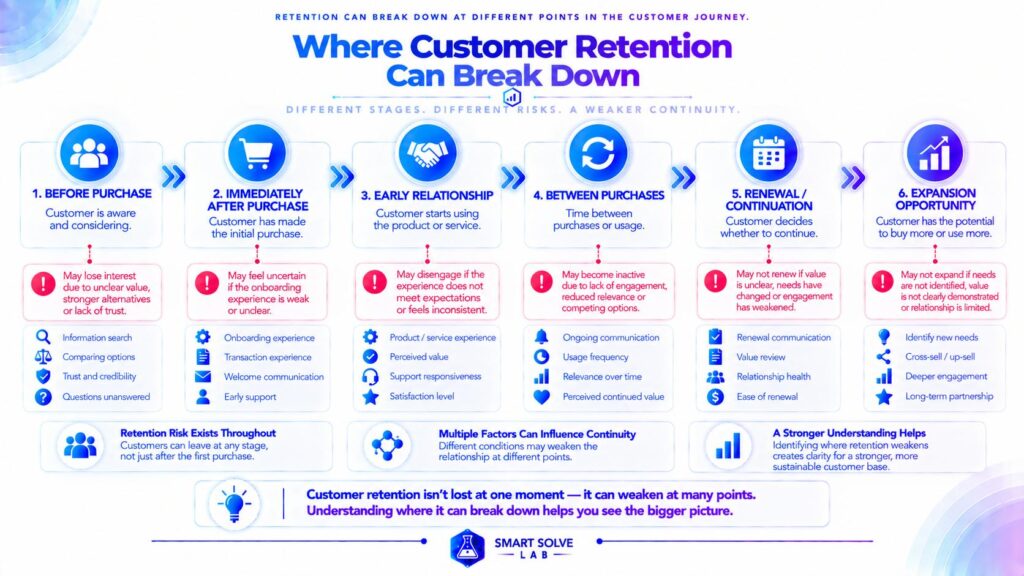
Where Customer Retention Can Break Down
Before the First Purchase
A retention problem can sometimes begin before a customer ever becomes a customer. If the wrong customers are being acquired, expectations are poorly aligned, or the relationship begins with a weak fit, later retention may become difficult even when the initial purchase succeeds.
This means the point where a customer leaves is not necessarily the point where the underlying problem began.
Immediately After Purchase
The period immediately following the first purchase can be an important transition point. The customer moves from acquisition into an ongoing relationship, and any gap between expectations and the actual experience can begin to surface.
If this transition is weak, the relationship may lose momentum before meaningful continuity develops.
During the Early Customer Relationship
Retention can also weaken during the early stages of the relationship. Customers may become less engaged, encounter friction, receive inconsistent communication, or stop seeing a clear reason to continue interacting with the business.
The diagnostic task is to identify whether the relationship is weakening at this stage and what condition may be contributing to that pattern.
Between Purchases
For businesses with repeat-purchase or ongoing relationship models, the period between transactions can reveal another potential weakness. A customer may complete an initial purchase but gradually become inactive when the next interaction or purchase opportunity arrives.
This can indicate that continuity is not developing strongly enough between customer interactions.
At Renewal or Continuation Points
Some customer relationships reach clear continuation points such as renewals, recurring purchases, subscriptions, or contract extensions. If customers consistently stop at these points, the pattern can provide an important retention signal.
Rather than treating the missed renewal as the entire problem, it is more useful to examine what happened throughout the relationship before that point.
During Expansion Opportunities
A customer may remain active without expanding the relationship. When opportunities for broader engagement, additional purchases, or increased relationship scope consistently fail to develop, the issue may extend beyond retention into expansion.
This creates the broader diagnostic pathway: acquisition → relationship → retention → continuity → expansion. Examining where progression weakens helps distinguish a retention gap from an expansion gap.
Why Retention and Expansion Matter to Revenue Growth
Retained Customers Support Revenue Continuity
When customer relationships continue, the business does not have to rely entirely on continuously replacing customers through new acquisition. Retained relationships can provide a more continuous foundation for revenue contribution.
This does not mean retention automatically guarantees revenue growth. It means that customer continuity is an important part of understanding how revenue can develop beyond the initial acquisition.
Existing Relationships Can Create Additional Revenue Opportunities
An existing customer relationship can create opportunities for continued commercial interaction that are different from acquiring a completely new customer. The exact opportunity depends on the business model, but the underlying principle is the same: an established relationship can potentially develop further.
Expansion Can Strengthen Customer Economics
Expansion occurs when an existing customer relationship develops beyond its current scope. This may involve additional purchases, broader adoption, increased usage, or other forms of commercial expansion.
The diagnostic question is not whether every customer should expand. It is whether meaningful expansion opportunities exist and, when they do, whether those relationships are progressing toward them.
Acquisition and Retention Work Together
Acquisition and retention should not be treated as competing growth activities. Acquisition brings new customers into the business, while retention helps determine whether those relationships continue. Expansion can then provide another layer of potential customer contribution.
Looking at these stages together provides a clearer picture of the customer pathway rather than evaluating acquisition activity in isolation.
Why Revenue Growth Cannot Be Viewed Through Acquisition Alone
Revenue growth is influenced by what happens after customers enter the business. If acquisition is increasing but customer relationships are ending quickly or failing to develop further, the business may remain dependent on constant new customer inflow.
This broader connection between acquisition, customer relationships, retention, and revenue is also important when examining why marketing activity can appear successful while the overall revenue outcome remains weaker than expected. For a deeper look at that connected revenue problem, see Why Marketing Campaigns Work But Revenue Still Doesn’t Grow (And the Revenue System That Fixes It).
The key diagnostic shift is therefore simple: do not ask only whether the business is acquiring customers; examine what happens to those relationships after acquisition.
The Conditions Behind Weak Retention
Customer Fit
Retention can become difficult when the customers entering the business are not a strong fit for what the business offers. A customer may complete an initial purchase, but if the underlying fit is weak, continued engagement may naturally become harder.
This makes customer fit an important condition to examine when retention problems appear repeatedly across a customer base.
Expectation Alignment
Customers enter relationships with expectations about what they will receive, how the experience will work, and what the ongoing relationship will look like. When those expectations are not aligned with the actual experience, the relationship can weaken over time.
The diagnostic question is whether the expectations established during acquisition and purchase remain aligned with the customer’s experience afterward.
Product or Service Experience
The experience customers have after purchase can influence whether they continue the relationship. Friction, inconsistency, unresolved problems, or an experience that falls short of expectations can create signals of weakening retention.
However, the visible experience problem should still be examined within the broader customer journey rather than automatically treated as the root cause.
Ongoing Relevance
A relationship can weaken when the offering no longer feels sufficiently relevant to the customer’s current needs or circumstances. What initially created a strong reason to engage may not remain equally relevant over time.
Therefore, declining retention can sometimes indicate that the relationship is losing relevance rather than simply that customers are choosing to leave.
Engagement and Relationship Strength
Customer relationships generally require some level of continued interaction. When engagement gradually declines, it can become an early signal that the relationship is weakening before an actual customer departure occurs.
Examining the strength and continuity of customer engagement can therefore help reveal where the retention pathway may be losing momentum.
Continuation Conditions
Different business models create different conditions for customers to continue. These may include renewals, recurring purchases, ongoing usage, follow-up interactions, or other continuation points.
If customers consistently fail to progress through these points, the pattern can indicate a retention condition that deserves deeper investigation.
Expansion Readiness
Retention and expansion are related but distinct. A customer may remain active without being ready or positioned to expand the relationship.
Expansion readiness therefore becomes relevant when examining whether existing relationships are capable of progressing beyond their current level. The diagnostic goal is not to force expansion, but to determine whether a meaningful expansion opportunity exists and whether something is preventing that progression.
Why the Visible Retention Problem May Not Be the Real Problem
Retention Can Be Affected by Customer Fit
When customers leave, it is tempting to look only at what happened after the purchase. But the underlying condition may have existed before the relationship began.
If acquisition consistently brings in customers whose needs, expectations, or circumstances are poorly aligned with the offering, retention can become difficult even when the post-purchase experience appears reasonable.
Retention Can Be Affected by Offer Alignment
An offer can successfully generate an initial purchase without creating the conditions for a lasting relationship. The initial transaction may solve an immediate need while providing limited reason for continued engagement.
This creates a diagnostic question: Was the relationship structured around a continuing customer need, or primarily around the initial transaction?
Retention Can Be Affected by Customer Experience
A customer may leave because the experience after purchase does not support continued engagement. Communication gaps, friction, inconsistent delivery, or unresolved issues can all contribute to a weakening relationship.
But even here, the visible experience problem may be one part of a broader sequence rather than the complete explanation.
Retention Can Be Affected by Earlier Acquisition Conditions
Sometimes the retention problem begins upstream. The business may be attracting customers through expectations, messaging, targeting, or acquisition conditions that do not translate well into a sustainable customer relationship.
In such cases, trying to fix retention entirely at the end of the customer journey can leave the earlier condition untouched.
Why Churn Is a Signal, Not Automatically the Root Cause
Churn tells us that a customer relationship has ended or weakened. It does not automatically tell us why.
A useful diagnostic approach therefore moves from symptom → signal → condition → deeper diagnosis. Instead of assuming that every customer departure has the same cause, the business needs to examine where the relationship weakened and which conditions may have contributed to that pattern.
This distinction is central to retention diagnosis: finding where customers leave is important, but understanding why the relationship reached that point is what creates meaningful diagnostic direction.
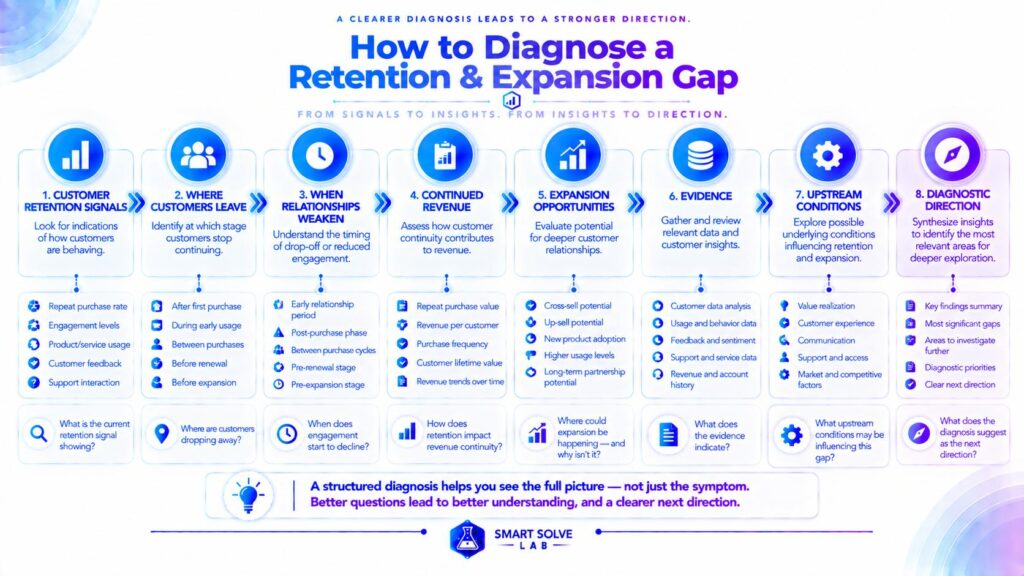
How to Diagnose a Retention & Expansion Gap
Are Customers Actually Staying?
The first step is to establish whether a retention problem actually exists. Customer acquisition numbers alone cannot answer this. The business needs to examine whether customers are continuing their relationships over the period that makes sense for its particular business model.
A useful diagnostic starting point is to compare customer acquisition with customer continuity rather than evaluating new customer growth in isolation.
Where Are Customers Leaving?
Once a retention gap is visible, the next question is where customer relationships are ending. Customers may leave at different points depending on the business model: shortly after purchase, during early engagement, between purchases, at renewal, or before an expected continuation point.
Locating the stage where relationships weaken can make the retention problem more specific and easier to investigate.
When Does the Relationship Weaken?
The timing of customer loss can reveal an important signal. If customers consistently become inactive during a particular stage, that pattern may point toward a condition affecting relationship continuity.
The goal is not to assume that timing proves causation. It is to identify a meaningful pattern that deserves deeper examination.
Are Existing Customers Creating Continued Revenue?
Retention should also be considered in relation to continued customer contribution. A customer relationship may technically remain active while generating little ongoing commercial activity.
Examining whether existing customers continue contributing through the forms of revenue appropriate to the business can help distinguish simple customer presence from meaningful relationship continuity.
Are Expansion Opportunities Developing?
Retention and expansion should be examined separately. A customer may stay without expanding the relationship, while another customer may develop into a broader commercial relationship.
The diagnostic question is whether relevant expansion opportunities are emerging and, when they exist, whether something appears to be limiting their progression.
What Evidence Supports the Retention Signal?
Retention diagnosis should be supported by evidence rather than assumptions. Depending on the business model, useful evidence may include customer cohorts, repeat activity, renewal patterns, engagement trends, customer counts over time, or other relationship-level indicators.
For businesses using Google Analytics, the Google Analytics Retention overview report provides retention-focused reporting that can help examine how users return and engage after acquisition.
The specific evidence required will vary by business model. The important principle is to connect the retention signal to observable customer behavior rather than relying only on impressions or isolated customer stories.
Is the Visible Retention Problem Coming From Somewhere Earlier?
Finally, the business should examine whether the visible retention problem may be connected to an earlier stage. Customer fit, acquisition conditions, expectations, or the initial relationship setup can influence what happens later.
This prevents the diagnosis from stopping at the symptom. The objective is to move from “customers are leaving” toward a more useful question: “What condition may be contributing to the relationship weakening at this point?”
From Customer Acquisition to Relationship Continuity
Stop Measuring Acquisition in Isolation
Acquisition remains an important part of growth, but acquisition numbers cannot fully explain what happens to the customer base afterward. A business may generate strong customer inflow while simultaneously experiencing weak relationship continuity.
This is why acquisition should be viewed as the beginning of the customer pathway rather than the complete growth story.
Connect New Customers With Retention
Once new customers enter the business, their progression through the relationship becomes an important diagnostic layer. Comparing acquisition with retention can reveal whether customer growth is genuinely adding to the customer base or primarily replacing customers who are leaving.
This comparison creates a clearer picture of the relationship between customer acquisition and customer continuity.
Examine What Happens After Acquisition
The first purchase marks a transition from acquisition into an ongoing customer relationship. What happens afterward can reveal whether the relationship is developing as expected.
Examining engagement, continuation points, repeat interactions, renewals, or other relevant relationship signals can help identify where the customer journey begins to weaken.
Identify Where Relationship Continuity Weakens
Not every customer relationship will follow the same path, and not every customer is expected to remain indefinitely. The diagnostic objective is therefore not to eliminate every instance of customer loss.
Instead, it is to identify meaningful patterns: where relationships are consistently weakening, when that weakening occurs, and what conditions may be associated with it.
Determine What Needs Deeper Diagnosis
Once the retention or expansion signal becomes clearer, the next step is to determine which condition deserves deeper attention. The answer may relate to customer fit, expectations, experience, engagement, continuation conditions, or expansion readiness.
This creates a more useful progression from customer acquisition → relationship continuity → diagnostic priority, rather than immediately jumping from customer loss to an assumed solution.
The purpose of this diagnostic perspective is not to provide a complete retention execution system. It is to help the business understand where the relationship pathway is weakening so that the next stage of investigation can be more focused.
The Key Insight: Customer Growth Is Not the Same as Customer Retention
Acquisition Creates the Customer Base
Customer acquisition determines how effectively a business brings new customers into its relationship system. It creates the starting point for future customer interaction, but it does not determine how long those relationships will continue.
A growing number of newly acquired customers can therefore be a positive acquisition signal without automatically proving that the underlying customer base is becoming more sustainable.
Retention Protects Relationship Continuity
Retention addresses what happens after acquisition. When customer relationships continue, the business can build on relationships it has already established instead of depending entirely on a continuous flow of new customers.
This makes retention a distinct growth layer: acquisition brings customers in, while retention helps determine whether those relationships remain part of the business over time.
Expansion Creates Additional Opportunity
Retention is not the end of the customer relationship. Where relevant opportunities exist, an established customer relationship can develop further through additional purchases, broader engagement, increased usage, or other forms of expansion.
Expansion should therefore be viewed as a separate progression from simply keeping a customer active.
Customer Count Alone Cannot Explain Revenue Quality
A customer count provides useful information, but it cannot show the complete relationship pattern behind that number. A business may have many customers while experiencing significant customer loss, weak continuity, or limited expansion among existing relationships.
The more useful diagnostic perspective is to examine how customers move through the relationship rather than relying on customer volume as the primary indicator.
Sustainable Growth Requires More Than Continuous Acquisition
Continuous acquisition can create customer inflow, but sustainable growth requires understanding what happens after customers enter the business.
The broader pathway is therefore:
Acquisition → Customer Relationship → Retention → Continuity → Expansion → Revenue
If the relationship weakens somewhere along this pathway, simply increasing acquisition may not address the underlying condition. The key is to identify where progression is breaking down and determine what deserves deeper diagnostic attention.
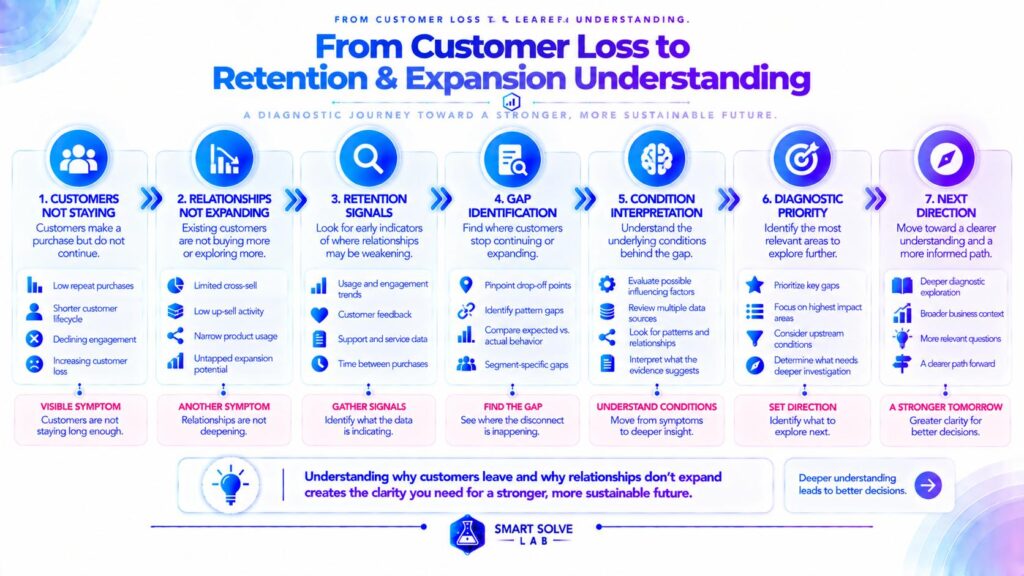
From Customer Loss to Better Retention Understanding
From Customer Count → Customer Continuity
The first shift is to stop viewing the customer base only as a number. Customer count tells us how many customers exist at a given point, while customer continuity helps reveal what is happening to those relationships over time.
This makes the retention question more meaningful: Are customer relationships continuing, or is acquisition repeatedly replacing relationships that are being lost?
From Churn → Retention Conditions
Churn is an observable outcome, but it does not automatically explain the condition behind it. Once customer loss becomes visible, the next step is to examine when the relationship weakened and what circumstances may have contributed.
This moves the diagnosis beyond simply counting lost customers toward understanding the conditions associated with customer departure.
From Acquisition → Relationship
Acquisition marks the beginning of the customer relationship rather than its conclusion. Once a customer enters the business, the relationship needs to progress through the stages relevant to that business model.
Examining this progression helps reveal whether the weakness is occurring after acquisition rather than assuming that more acquisition is required.
From Retention → Expansion
A retained customer is not automatically an expanding customer. Retention asks whether the relationship continues; expansion asks whether an appropriate opportunity exists for that relationship to develop further.
Keeping these two questions separate creates a clearer diagnostic view of the customer relationship.
From Symptoms → Diagnostic Direction
The final shift is from observing a symptom to determining where deeper attention should go. “Customers are leaving” is a useful signal, but it is not yet a diagnosis.
A stronger diagnostic question is:
Where is the customer relationship weakening, what condition may be contributing to that gap, and what should be examined next?
This turns customer loss from a standalone problem into a clearer diagnostic pathway—from customer count → continuity → retention conditions → expansion → diagnostic direction.
Where to Go Next: Diagnose Your Retention & Expansion Gap
If your business is consistently acquiring customers but those customers are not staying long enough, the problem deserves a closer look. The same is true when customers remain active but existing relationships are not developing into appropriate expansion opportunities.
The important step is to move beyond the visible symptom and identify where the customer relationship is actually weakening.
Customers Are Being Acquired but Not Staying
If new customers continue entering the business while existing customers are leaving at a meaningful rate, there may be a gap between acquisition and relationship continuity.
The diagnostic question is not simply how to acquire more customers, but whether something in the customer relationship is limiting continued engagement.
Customer Relationships End Too Early
If customers consistently leave during a particular stage of the relationship, that pattern can provide an important signal. The timing may help identify where deeper investigation should begin.
Repeat or Continued Revenue Is Weak
Where a business model depends on continued purchases, renewals, subscriptions, or ongoing commercial relationships, weak continuation can indicate that customer relationships are not developing as expected.
This does not automatically identify the cause, but it can reveal a meaningful retention signal that deserves further diagnosis.
Existing Customers Are Not Expanding Their Relationship
A customer can remain active without expanding the relationship. If relevant expansion opportunities exist but consistently fail to develop, the business may need to examine whether an expansion condition is limiting progression.
Retention Problems Are Difficult to Locate
Sometimes the business knows that customers are leaving but cannot clearly determine when the relationship weakens or what condition is contributing to the pattern.
That is where a focused diagnostic approach can create clarity by connecting acquisition, relationship continuity, retention, and expansion rather than treating customer loss as an isolated metric.
Next step: If you need a structured way to identify where customer relationships are failing to continue or expand, the Retention & Expansion Gap Diagnostic is designed to help clarify the gap, interpret potential conditions behind it, and determine where deeper diagnostic attention may be needed.
Key Takeaways
- More customers do not automatically mean more sustainable growth. Acquisition creates customer inflow, but retention determines whether those relationships continue.
- Customer growth and customer retention are different signals. A growing customer count can sometimes hide the fact that existing relationships are being lost and replaced.
- The retention problem may begin before the customer leaves. Customer fit, expectations, experience, engagement, relevance, and earlier acquisition conditions can all influence relationship continuity.
- Churn is a signal, not automatically the root cause. Identifying where customers leave is important, but the underlying condition needs deeper examination.
- Retention and expansion are connected but distinct. Retention asks whether the relationship continues; expansion asks whether an appropriate relationship can develop further.
- Customer count alone cannot explain the full revenue relationship. The pathway from acquisition to continuity and expansion provides a more useful diagnostic perspective.
- The key diagnostic question is where the relationship is weakening. Moving from symptom → condition → diagnostic direction creates a clearer path toward the next stage of analysis.
The central insight is simple: acquiring customers starts the relationship, but sustainable customer growth depends on understanding what happens after acquisition.
Conclusion
Customer acquisition is only the beginning of the growth journey. A business can continue bringing in new customers while still struggling with relationships that do not last long enough or expand far enough to support sustainable revenue growth.
That is why customer retention needs to be examined as a distinct layer of the revenue system. The important question is not simply whether customers are leaving, but where the relationship is weakening, when that weakness appears, and what condition may be contributing to it.
Retention and expansion also need to be viewed together without treating them as the same thing. Retention concerns relationship continuity. Expansion concerns the development of an existing relationship when appropriate opportunities exist.
The broader diagnostic pathway is therefore:
Acquisition → Customer Relationship → Retention → Continuity → Expansion → Revenue
When this pathway is examined as a connected system, customer loss becomes more than a number to react to. It becomes a signal that can help reveal where the relationship is failing to progress.
The goal is not to assume that every customer should stay indefinitely or that every customer should expand. The goal is to understand whether meaningful patterns exist, identify the conditions associated with those patterns, and determine where deeper diagnosis is needed.
More customers can create growth potential. But understanding whether those relationships continue and expand is what helps reveal the sustainability of that growth.
FAQs
Why are customers leaving even when new customers are still coming in?
New customer acquisition can sometimes hide a retention problem because incoming customers may replace customers who are leaving. The business may therefore maintain or increase its customer count while the underlying customer relationships remain unstable. The key diagnostic question is whether acquisition is adding to a stable customer base or repeatedly replacing lost relationships.
What is customer retention?
Customer retention refers to the continuation of customer relationships after acquisition and the initial purchase. It looks beyond customer acquisition to understand whether customers remain engaged and connected to the business over time.
Why is customer retention important for revenue growth?
Retention matters because revenue growth does not depend only on continuously acquiring new customers. Continued customer relationships can support ongoing revenue contribution and create opportunities for further relationship development.
Can acquiring more customers hide a retention problem?
Yes. If new customers consistently replace customers who are leaving, acquisition activity can make the customer base appear healthy while underlying retention remains weak. This is why customer acquisition should be examined alongside customer continuity.
What can cause customers to leave after their first purchase?
Possible conditions can include weak customer fit, misaligned expectations, problems in the customer experience, declining engagement, reduced ongoing relevance, or weak continuation conditions. These are potential diagnostic conditions rather than automatic explanations for every customer departure.
What is the difference between retention and expansion?
Retention concerns whether the customer relationship continues, while expansion concerns whether an existing relationship develops further when appropriate opportunities exist. A customer can be retained without expanding the relationship, so the two should be examined as related but distinct signals.
How can I identify what is limiting customer retention?
Start by examining whether customers are staying, where they are leaving, when the relationship weakens, and what evidence supports the pattern. Then consider potential conditions such as customer fit, expectations, experience, engagement, relevance, and continuation conditions.
Recommended Reading
If you want to explore the connected problems behind customer journeys, conversion, and revenue growth, these related Smart Solve Lab guides can help you go deeper:
- Why Customers Drop Off Before Buying (And Why Fixing One Page Doesn’t Solve It) — understand how customer journeys can weaken before a customer relationship develops.
- Why Your Sales Funnel Is Not Converting (And Where Customers Are Leaking) — examine structural gaps that can cause potential customers to drop out of a decision pathway.
- Why Marketing Campaigns Work But Revenue Still Doesn’t Grow (And the Revenue System That Fixes It) — explore how marketing activity connects to the broader revenue pathway.
Leave a Reply