
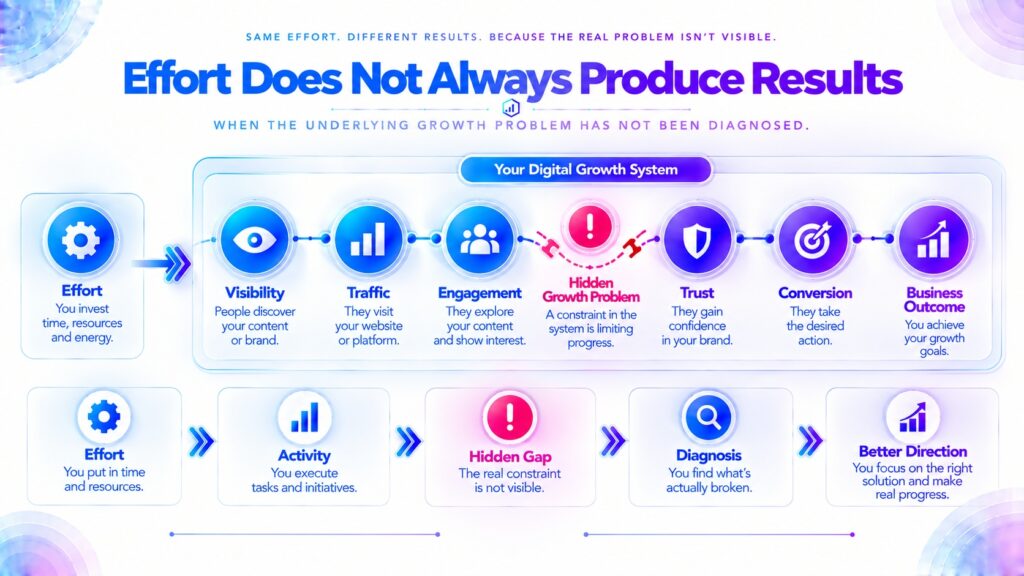
why I’m not getting results:
You’re doing everything right.
You’re creating content.
Trying different strategies.
Putting in the effort every day.
And still…
No meaningful growth.
No consistent results.
No clear progress.
If you’ve ever found yourself thinking, “Why am I not getting results even after doing everything right?”, you’re not alone.
This is where many businesses get stuck.
Not necessarily because they are doing the wrong things—but because they don’t know what is actually preventing those efforts from producing results.
They keep optimizing.
They try new tactics.
They create more content.
They adjust their website.
They change campaigns.
But without first identifying the underlying problem, every new action can become another experiment.
And that creates a bigger problem:
You may be working hard without knowing what actually needs to be fixed.
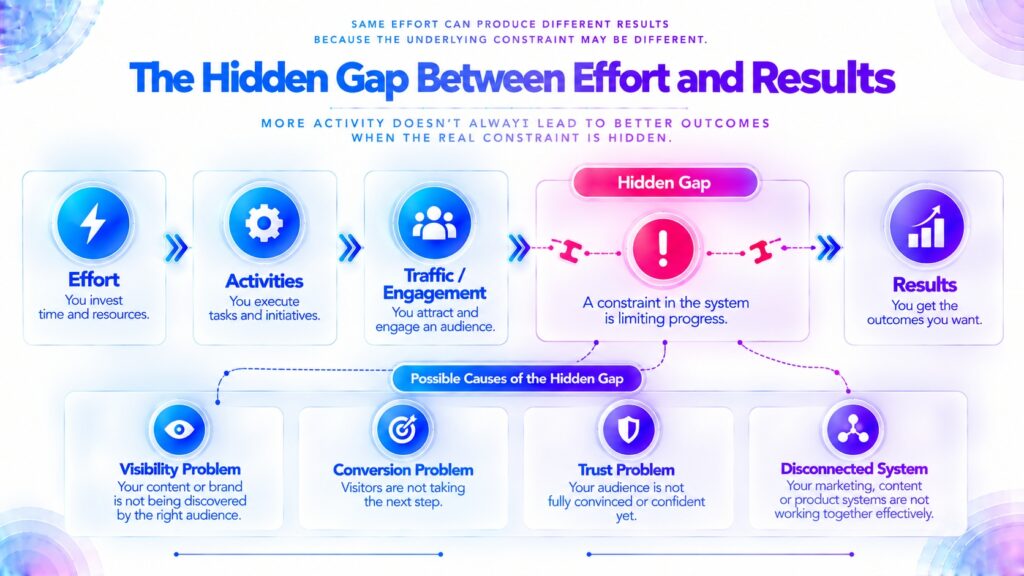
Table of Contents
The Real Problem: You’re Working, But You’re Working Blind
Most businesses don’t fail because they lack effort.
They fail because they lack clarity about where that effort is being lost.
They are doing things.
But they don’t know whether those things are addressing the real problem.
They publish content…
But don’t know why it isn’t generating meaningful action.
They run campaigns…
But don’t know where users are dropping off.
They improve their website…
But don’t know what is stopping visitors from moving forward.
So they keep adjusting everything.
More content.
More campaigns.
More optimization.
More changes.
Without knowing what actually needs fixing.
This creates a cycle:
Action → Weak Result → More Action → More Changes → More Confusion
Eventually, frustration grows because the business appears active from the outside.
Traffic may exist.
Content may be published regularly.
Strategies may be in place.
Yet the expected outcome still doesn’t happen.
The missing piece is often not another tactic.
It is diagnosis.
The Hidden Gap Between Effort and Results
At this stage, businesses often start questioning everything.
Is the strategy wrong?
Is the content wrong?
Is the website wrong?
Do we need more traffic?
Do we need better tools?
Do we need to change the campaign?
Sometimes the answer is yes.
But sometimes the real issue is much more specific:
The business has not identified where the system is breaking down.
This is why two businesses can put similar amounts of effort into digital growth and experience very different results.
One may have a visibility problem.
Another may have a conversion problem.
Another may have a trust problem.
And another may have several disconnected parts that prevent the entire system from working together.
Without identifying the specific gap, businesses tend to treat symptoms instead of causes.
For example:
High traffic + low conversions does not automatically mean the business needs more traffic.
It may mean the existing traffic is reaching a weak conversion experience.
That distinction matters.
Because the solution depends on the diagnosis.
What Is a Diagnostic System?
A diagnostic system is a structured way to identify where a growth process is breaking down and what type of problem may be causing it.
Instead of immediately asking:
“What should we change?”
You first ask:
“Where is the problem happening?”
Then:
“Why is it happening?”
And finally:
“What should we address first?”
A useful diagnostic process helps you examine questions such as:
- Where are users dropping off?
- Which stage of the journey is underperforming?
- Is the problem related to visibility?
- Is traffic arriving but failing to convert?
- Are users interested but lacking confidence?
- Are different parts of the growth system disconnected?
- Which issue should be addressed first?
This changes the approach from random optimization to focused problem-solving.
You are no longer changing everything at once.
You are trying to understand the system before deciding what to change.
Why Most Businesses Skip Diagnosis
The temptation to jump directly into solutions is understandable.
If traffic is low, get more traffic.
If conversions are low, change the landing page.
If sales are low, run another campaign.
If content is underperforming, publish more.
But the visible problem is not always the root problem.
For example:
Low sales could be related to:
- insufficient qualified traffic
- unclear messaging
- weak positioning
- lack of trust
- a confusing user journey
- a poor offer-to-audience match
- friction during the conversion process
The result looks similar.
The causes can be very different.
That is why diagnosis comes before optimization.
The goal is not to create more work.
The goal is to make sure the work you do next is connected to the actual problem.
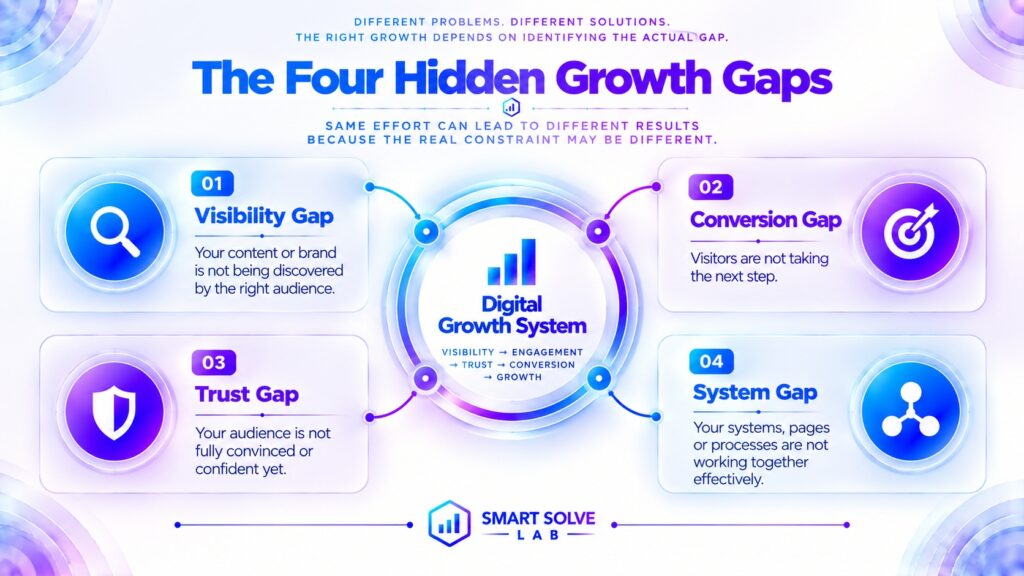
The Four Hidden Growth Gaps
When results do not match the amount of effort being invested, it helps to examine the major areas where a digital growth system can break down.
1. The Visibility Gap
You are creating content and publishing consistently…
But the right audience is not finding you.
This can lead to:
- low discovery
- limited reach
- inconsistent traffic
- weak search visibility
- difficulty reaching relevant audiences
The important question is not simply:
“Are we publishing enough?”
It is:
“Are the right people able to discover us?”
Visibility is about being found by the audience that has a reason to care about what you offer.
If the right audience never reaches your content, later stages of the system have very little to work with.
2. The Conversion Gap
You are getting visitors…
But they are not taking the next step.
They visit.
They read.
They browse.
And then they leave.
This creates an important distinction:
Traffic is not the same thing as conversion.
A website can receive visitors while still struggling to turn that attention into meaningful action.
The problem may involve:
- unclear calls to action
- weak messaging
- poor offer alignment
- confusing navigation
- unnecessary friction
- a disconnected user journey
This is why a traffic increase does not automatically solve a conversion problem.
3. The Trust Gap
Sometimes users understand the offer.
They may even be interested.
But they still hesitate.
Why?
Because taking action requires confidence.
Users may need clearer information about:
- who the business is
- what is being offered
- whether the solution is relevant
- what happens after taking action
- whether the business appears credible
- whether the offer matches their expectations
A website can look polished and still leave important trust questions unanswered.
This creates a trust gap between interest and action.
4. The System Gap
This is where individual problems can become much harder to solve.
Your content exists.
Your website exists.
Your campaigns exist.
Your offers exist.
But the pieces are not properly connected.
Your content may attract attention without guiding users toward the next step.
Your website may explain the business without creating a clear journey.
Your campaigns may generate traffic without connecting that traffic to the right offer.
The individual pieces exist—but the system between them is weak.
That is the System Gap.
Growth does not depend only on having individual tactics.
It also depends on how those tactics work together.
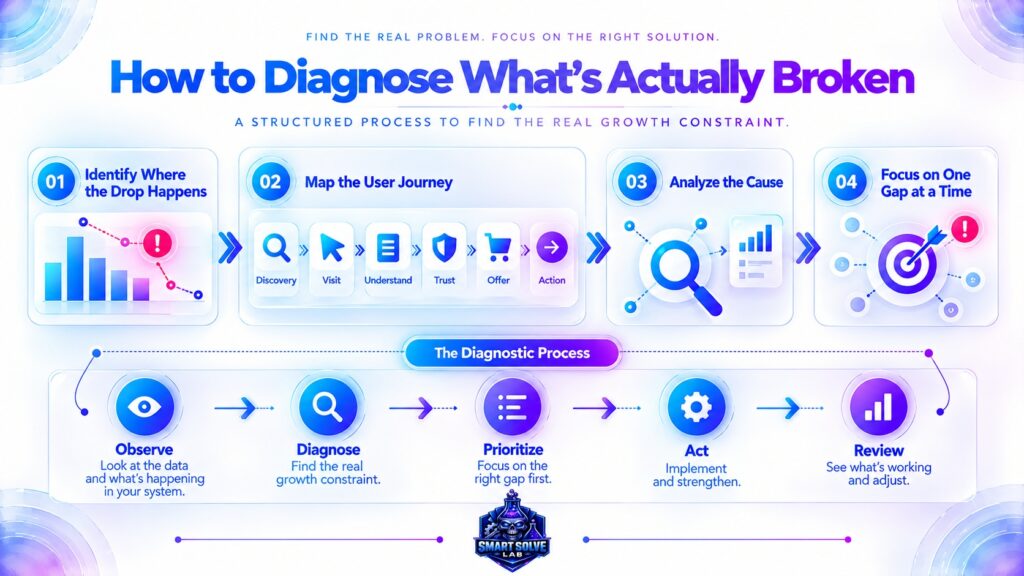
How to Diagnose What’s Actually Broken
Once you recognize that a problem may exist somewhere inside the system, the next step is not to change everything.
Use a structured diagnostic process.
Step 1: Identify Where the Drop Happens
Start with the journey.
Ask:
Where does the expected result stop happening?
For example:
Discovery → Visit → Engagement → Trust → Action
Where does the drop occur?
Is the audience not discovering you?
Are people arriving but leaving quickly?
Are they engaging but not taking action?
Are they reaching the offer but hesitating?
Finding the point of failure immediately narrows the problem.
Instead of trying to fix the entire business, you can investigate one specific stage.
Step 2: Map the User Journey
Next, map what happens from the user’s first interaction to the desired outcome.
For example:
Search / Social / Referral
↓
Website Visit
↓
Content or Landing Page
↓
Understanding
↓
Trust
↓
Offer
↓
Action
Now ask what happens at each stage.
Is the transition clear?
Does the next step make sense?
Does the user have enough information?
Is there unnecessary friction?
Does the content connect naturally to the next stage?
This helps reveal gaps that are difficult to see when looking at individual pages or campaigns in isolation.
Step 3: Analyze the Cause, Not Just the Outcome
Results are symptoms.
The more useful question is:
Why is this happening?
Suppose conversions are low.
Possible causes could include:
- poor audience alignment
- weak messaging
- insufficient trust
- unclear value proposition
- confusing user journey
- friction at the point of action
Do not automatically assume the first explanation is correct.
Investigate the evidence available to you.
For a practical way to understand how your website is performing in Google Search, you can also review Google Search Console’s Performance report, which provides metrics such as clicks, impressions, CTR, and search queries.
The goal is to move from:
“Something is not working.”
to:
“This specific stage appears to be creating the problem, and these factors may be contributing to it.”
That is a much more useful starting point for action.
Step 4: Focus on One Gap at a Time
One of the easiest ways to create more confusion is to change everything simultaneously.
If you change:
- your content
- your website
- your messaging
- your offer
- your traffic strategy
- your conversion process
all at once, it becomes difficult to understand what actually changed the outcome.
Instead:
Identify → Prioritize → Fix → Observe → Continue
Start with the most relevant problem.
Address it.
Observe what changes.
Then move to the next significant gap.
This creates a more controlled improvement process.
What This Looks Like in a Real Scenario
Imagine a business that is publishing content consistently.
It is running campaigns.
Traffic is reaching the website.
From the outside, everything appears active.
But conversions remain inconsistent.
The business assumes:
“We need more traffic.”
So it invests more effort into attracting visitors.
But after examining the user journey, something different becomes visible.
Visitors are arriving.
They are reading the content.
Some are engaging with the website.
But many leave before taking the next action.
The problem is not necessarily a lack of traffic.
The more relevant issue may be a conversion gap.
Now the business has a different direction.
Instead of immediately trying to increase traffic, it can investigate:
- whether the message is clear
- whether the offer matches the visitor’s needs
- whether the next step is obvious
- whether trust concerns are being addressed
- whether the user journey creates unnecessary friction
The diagnosis changes the question.
Instead of:
“How do we get more visitors?”
the question becomes:
“Why aren’t the visitors we already have moving forward?”
That is a much more precise problem to solve.
Why Businesses Stay Stuck
At this point, the pattern becomes easier to see.
Businesses may have:
- knowledge
- tools
- content
- traffic
- strategies
- experience
and still struggle to produce consistent outcomes.
The missing piece can be the connection between observation and action.
Without diagnosis, businesses often move from one tactic to another.
One month it is SEO.
Then content.
Then paid traffic.
Then website redesign.
Then another funnel.
Then another campaign.
The problem is not necessarily that any one of these activities is useless.
The problem is that they may be applied without first identifying the specific constraint.
That creates activity without enough clarity.
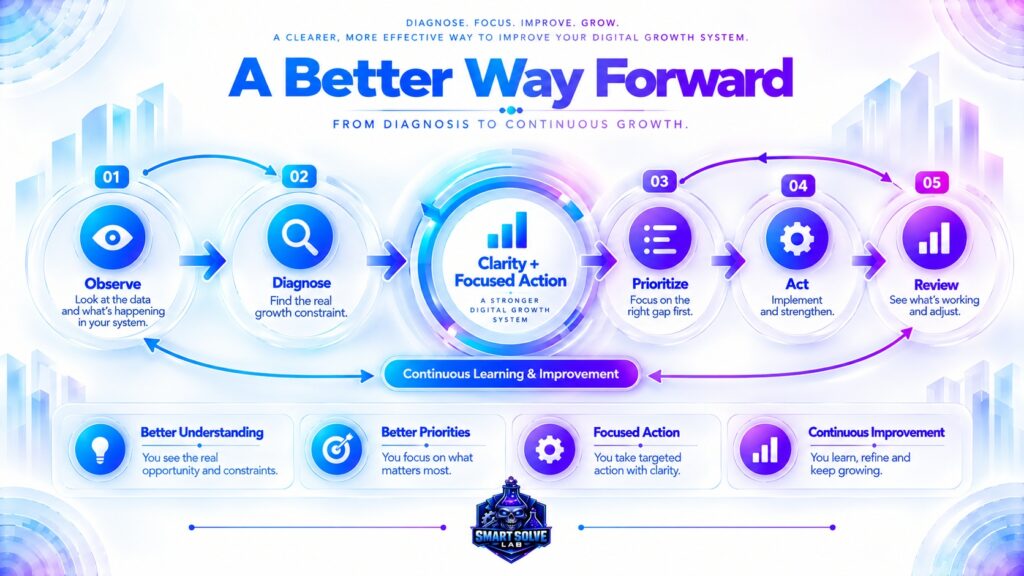
A diagnostic approach creates a different sequence:
Observe → Diagnose → Prioritize → Act → Review
The purpose is not to eliminate experimentation.
It is to make experimentation more informed.
A Better Way Forward
If you are not getting the results you expect despite consistent effort, do not immediately assume that you need to do more.
First ask:
1. Where is the result breaking down?
Find the stage where the expected outcome stops happening.
2. What type of gap does it represent?
Look at visibility, conversion, trust, and system connection.
3. What evidence supports the diagnosis?
Use your available data, user behavior, content performance, journey, and business context.
4. What should be addressed first?
Do not attempt to rebuild everything simultaneously.
5. What changed after the intervention?
Review the result before moving on to the next issue.
This approach does not guarantee instant growth.
What it does is create better decision-making around what to fix next.
And that is often the difference between constantly changing strategies and systematically improving a growth system.
Recommended Reading
If you want to understand individual parts of the growth system in more detail, continue with:
- Why Your Website Gets No Traffic (Even After Months of Work)
- Why Your Content Gets Traffic but Visitors Never Convert
- Why Customers Don’t Trust Your Website (And the System That Fixes It)
- Why Your Sales Funnel Is Not Converting (And Where Customers Are Leaking)
- High Website Traffic Still Fails to Generate Revenue
These articles explore different points where a digital growth system can break down.
FAQs:
Why am I not getting results even after doing everything right?
This can happen when the actions being taken do not address the actual constraint in the growth system. The issue may involve visibility, conversion, trust, user experience, positioning, or the connection between different stages of the customer journey.
Why is my business not growing despite consistent effort?
Consistent effort matters, but effort alone does not identify where the system is breaking down. If the main constraint remains unresolved, additional activity may produce limited improvement.
Why does my marketing seem to work but results don’t follow?
Marketing activity can generate attention, traffic, or engagement without necessarily producing the desired business outcome. The gap may occur later in the user journey, such as during trust-building, offer evaluation, or conversion.
Why do I get traffic but no conversions?
Traffic and conversion are different stages of the growth process. Visitors may be reaching your website but encountering unclear messaging, weak calls to action, insufficient trust, poor offer alignment, or friction in the user journey.
How can I identify what’s actually broken in my system?
Start by identifying where the user journey is losing momentum. Then examine the likely causes rather than changing multiple parts of the system at once.
What is the best way to fix inconsistent results in digital growth?
Start with diagnosis. Identify where the problem occurs, investigate the likely cause, prioritize one meaningful gap, make a focused improvement, and then review what changed.
Leave a Reply