
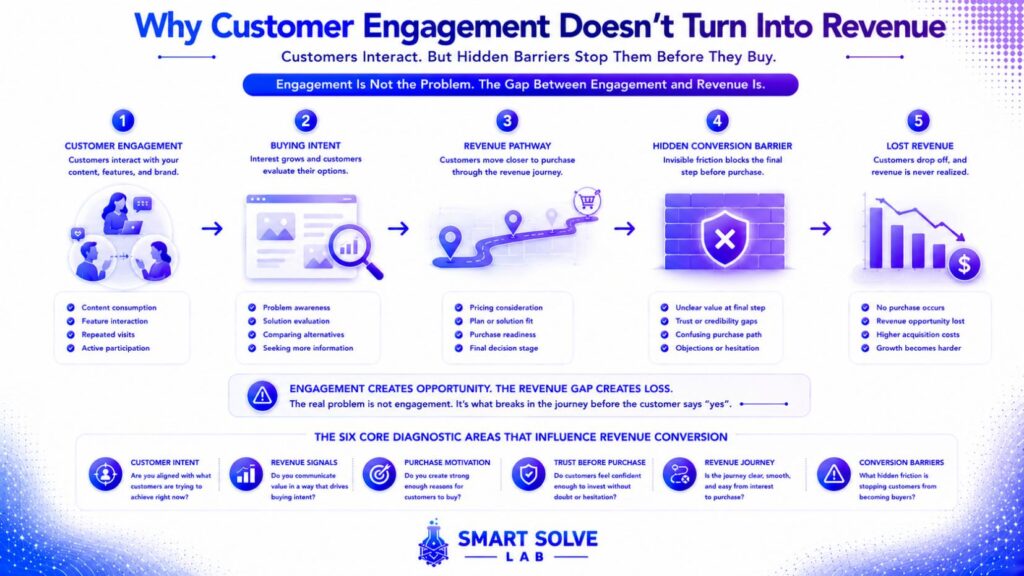
customer engagement doesn’t turn into revenue:
Customer engagement is often treated as a strong indicator of business growth.
When people read content, interact with offers, explore products, open emails, click links, or spend time engaging with a brand, businesses naturally assume that stronger engagement should eventually produce stronger revenue.
But that does not always happen.
A business can generate significant customer interaction while revenue remains flat, inconsistent, or far below expectations.
This creates an important diagnostic question:
Why does customer engagement fail to turn into measurable revenue?
The visible problem may appear to be weak sales.
But the underlying problem often exists somewhere between customer engagement, buying intent, and the revenue journey.
Customers may interact because they are interested without being ready to buy. They may understand the offer without seeing enough value to make a financial commitment. They may even have strong purchase intent but encounter trust gaps, decision friction, or an unclear path toward becoming a paying customer.
Understanding where this progression breaks is essential before attempting optimization.
Why Engagement Metrics Can Be Misleading
Engagement metrics can provide valuable information about customer attention and interaction.
However, engagement itself is not revenue.
Metrics such as:
- Page views
- Content interactions
- Email opens
- Link clicks
- Social engagement
- Time spent exploring an offer
can indicate interest without confirming commercial intent.
When businesses evaluate success primarily through engagement metrics, they may overlook whether those interactions are actually progressing customers toward meaningful revenue outcomes.
Between engagement and revenue lies a customer decision journey.
A customer may move through several stages:
Engagement → Evaluation → Buying Intent → Trust → Purchase Decision → Revenue
If progression weakens at any stage, engagement can remain healthy while revenue performance struggles.
This creates an engagement-to-revenue gap.
The challenge is therefore not simply generating more interaction.
It is understanding where engaged customers stop progressing toward commercial action.
Why Revenue Problems Often Begin Before the Purchase
Revenue loss does not always begin at checkout or at the final sales decision.
The underlying barrier may develop much earlier.
Customers may lack sufficient buying motivation.
The perceived value may not justify the commitment.
Trust may weaken during evaluation.
The purchase journey may become confusing.
Or the next step toward becoming a customer may simply feel unclear.
By the time revenue fails to materialize, the real problem may already have existed across several earlier stages of the customer journey.
How Systematic Diagnosis Reveals Revenue Gaps
Effective diagnosis looks beyond engagement numbers and examines how customers progress toward revenue.
This guide will help you understand:
- Why strong customer engagement does not automatically generate revenue
- Where hidden revenue barriers develop
- How customer intent and purchase motivation influence progression
- Why trust and journey clarity affect revenue conversion
- Why revenue conversion problems are often system problems
- How businesses can identify the highest-impact engagement-to-revenue gaps before optimization
The goal is not to immediately increase engagement, redesign funnels, or change campaigns.
The goal is to understand where customer progression toward revenue is breaking down and why.
Diagnose the engagement-to-revenue gap before optimizing campaigns, funnels, or customer interactions.
Table of Contents
What Does “Customer Engagement Doesn’t Turn Into Revenue” Really Mean?
Customer engagement is valuable, but engagement alone does not guarantee commercial results.
People can read content, interact with a brand, explore products, click links, or repeatedly return to a website without ever becoming paying customers.
When this happens, businesses often assume they need more engagement.
But the real problem may not be the amount of interaction.
The problem may be that existing engagement is not progressing through the revenue journey.
The Problem
A business may have strong engagement metrics:
- Visitors regularly explore its content
- Customers interact with campaigns
- Email engagement remains healthy
- Product or service pages receive attention
- Social content generates reactions and conversations
Yet sales and revenue remain disappointing.
This creates a disconnect between what appears to be strong customer interest and what the business ultimately earns from that interest.
The Hidden Reality
Engagement measures interaction.
Revenue requires progression.
Between these two outcomes, customers must move through several decision stages involving intent, perceived value, motivation, trust, and purchase readiness.
If progression breaks at any of these stages, engagement can continue without producing meaningful commercial results.
This is closely connected to the broader conversion problem explained in Why Your Website Gets Traffic But No Conversions (Even When Visitors Keep Coming).
Deep Insight
Not every engaged customer has the same commercial intent.
Some customers may be learning.
Others may be comparing alternatives.
Some may genuinely want the solution but are not yet ready to purchase.
This means engagement should be viewed as a signal of customer interest, not automatic evidence of revenue readiness.
The diagnostic challenge is identifying whether engaged customers are actually progressing toward stronger buying intent—or repeatedly interacting without moving forward.
Why This Happens
Customer engagement can become disconnected from revenue when:
- Engagement attracts attention without building purchase intent
- Customers understand the offer but lack motivation to buy
- Trust weakens before financial commitment
- The revenue pathway becomes unclear
- Decision friction interrupts customer progression
- Business activities optimize interaction rather than commercial outcomes
These weaknesses can exist even when engagement metrics appear positive.
Real Business Scenario
Imagine a business publishing educational content that consistently attracts an engaged audience.
Visitors read multiple articles, subscribe to updates, and regularly return to the website.
From an engagement perspective, performance appears strong.
However, very few customers progress toward the business’s paid offer.
The business might conclude that it needs more content or greater engagement.
But the deeper diagnostic question is:
Where does customer progression stop between engagement and purchase intent?
Until that question is answered, increasing engagement may simply create more interaction without improving revenue.
What This Means
High engagement and strong revenue are not interchangeable measures of business performance.
Engagement creates an opportunity to influence customer progression.
Revenue occurs when that progression successfully moves through buying intent, trust, decision-making, and purchase.
Businesses therefore need to understand not only how much customers engage, but also where engaged customers stop moving toward commercial action.
Critical Takeaway
Customer engagement is the beginning of an opportunity—not the completion of a revenue journey.
When engagement remains high but revenue stays low, the most valuable question is not:
“How can we generate more engagement?”
It is:
“Where does existing customer engagement stop progressing toward revenue?”
Diagnose the engagement-to-revenue gap before optimizing customer interactions.
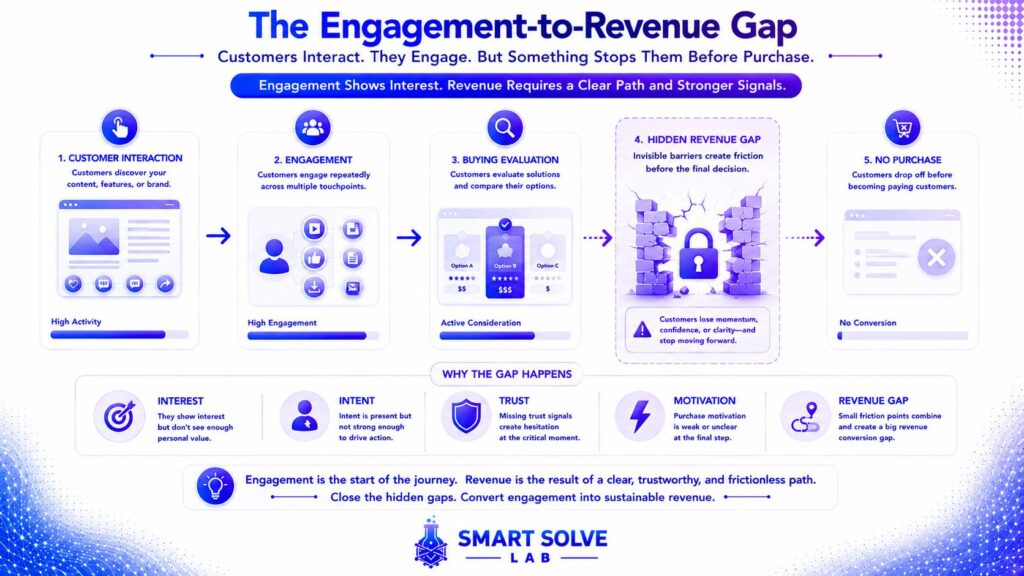
Why Customer Engagement Still Doesn’t Generate Revenue
Customer engagement can create the appearance of strong business momentum.
People may interact with content, respond to campaigns, explore offers, and repeatedly return to a business without progressing toward a purchase.
The reason is simple:
Engagement represents interaction. Revenue requires commercial progression.
Between these two stages, customers must develop sufficient buying intent, motivation, trust, and confidence to make a financial decision.
When these signals remain weak or disconnected, high engagement can exist alongside disappointing revenue.
The Hidden Revenue Barriers
Revenue barriers are not always visible in engagement metrics.
A customer may actively interact with a business while experiencing hidden hesitation about moving toward a purchase.
These barriers may include:
- Weak buying intent
- Unclear commercial value
- Insufficient purchase motivation
- Limited trust
- Decision uncertainty
- An unclear revenue pathway
Because customers can continue engaging despite these barriers, businesses may not immediately recognize that progression has stopped.
Engagement Doesn’t Automatically Create Buying Intent
Engagement and buying intent represent different stages of the customer journey.
Someone may read several articles because the information is useful.
Another person may follow a business because its content is interesting.
A customer may even explore a product repeatedly while remaining uncertain about purchasing it.
These interactions demonstrate interest—but they do not necessarily demonstrate readiness to buy.
This distinction becomes especially important when businesses receive significant attention but struggle to move visitors toward meaningful business actions. The same progression problem can be seen when website traffic doesn’t become leads.
Weak Revenue Motivation
Customers need a compelling reason to move from engagement toward financial commitment.
They must understand not only what the business offers, but why purchasing the solution is valuable enough to justify the cost, effort, or perceived risk involved.
When this motivation is weak, customers may continue interacting without progressing.
The business receives engagement.
The customer receives information.
But no meaningful revenue movement occurs.
Low Purchase Confidence
Purchasing requires a greater level of confidence than simply engaging.
Before making a financial commitment, customers may evaluate:
- Whether the solution genuinely fits their needs
- Whether the business can deliver the promised value
- Whether the investment feels worthwhile
- Whether there are better alternatives
- Whether purchasing now is the right decision
If these questions remain unresolved, engagement may continue while the purchase decision is repeatedly delayed.
Decision Delays
Not every revenue gap results from complete customer rejection.
Sometimes customers remain interested but continuously postpone their decision.
They may intend to return later, compare additional options, wait for more information, or delay the purchase until they feel more confident.
Repeated decision delays can create a significant gap between apparent customer interest and actual revenue performance.
The Cost of Lost Revenue Opportunities
When engaged customers repeatedly fail to progress, businesses lose more than individual sales.
Over time, the impact may include:
- Lower conversion efficiency
- Missed customer opportunities
- Longer purchase journeys
- Higher customer acquisition costs
- Reduced return on marketing investment
- Slower revenue growth
This is why increasing engagement alone may not solve the problem.
Businesses need to understand where engagement stops becoming commercial progression.
Section Summary
Customer engagement creates potential, but revenue requires customers to progress beyond interaction.
When buying intent, motivation, trust, or purchase confidence remains weak, customers can stay highly engaged without becoming paying customers.
Diagnosing these hidden revenue barriers provides the foundation for understanding the connected systems that influence revenue conversion.
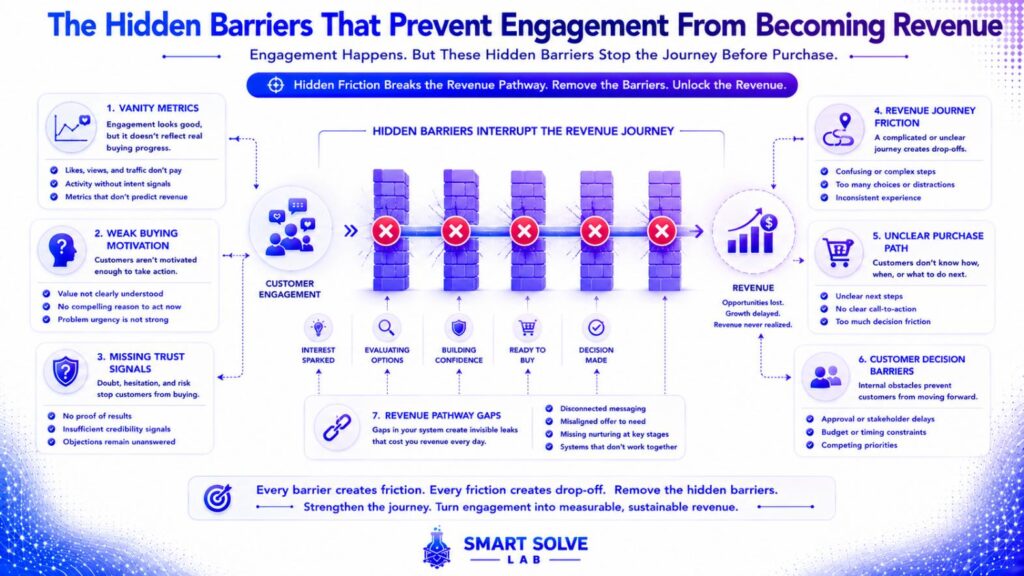
The Five Diagnostic Systems Behind Revenue Conversion
Customer engagement becomes commercially valuable only when customers can progress through a connected revenue pathway.
A business may successfully generate attention and interaction, but revenue conversion depends on several systems working together after that engagement occurs.
When one of these systems weakens, customers may remain interested while their progression toward purchase slows or stops completely.
Understanding these five diagnostic systems helps businesses identify where the engagement-to-revenue gap may be developing before attempting optimization.
Revenue Pathway Foundation
Every sustainable revenue journey needs a clear connection between customer engagement and meaningful commercial outcomes.
Engagement should not exist as an isolated activity.
Customers need a logical pathway that allows them to move from initial interaction toward evaluation, decision-making, and eventually purchase.
A weak revenue pathway foundation may generate substantial engagement without creating a clear route toward becoming a paying customer.
The diagnostic question is:
Does customer engagement naturally connect to the next stage of the revenue journey?
Customer Intent Alignment
Not every engaged customer has the same level of buying intent.
Some customers may only be gathering information.
Others may be comparing solutions.
Some may already recognize their problem but remain uncertain about which solution to choose.
Revenue progression becomes more difficult when the business expects customers to move toward purchase before their intent and readiness support that decision.
Diagnosing customer intent helps businesses understand whether engagement represents curiosity, evaluation, or genuine commercial readiness.
Value & Revenue Signals
Customers need to understand why progressing toward a purchase is worthwhile.
Engagement may demonstrate that the business has captured attention, but revenue requires customers to recognize sufficient value in the solution itself.
Diagnostic evaluation should therefore consider whether customers clearly understand:
- The problem the offer addresses
- The value of solving that problem
- The expected business or personal outcome
- Why the solution is relevant to their needs
- Why progressing toward purchase may be worthwhile
When these signals remain weak, customers can continue engaging without developing stronger purchase motivation.
Trust Before Purchase
Financial commitment generally requires more confidence than ordinary engagement.
Customers may enjoy a business’s content or interact regularly with its brand while still questioning whether they trust the business enough to purchase.
Before progressing toward revenue, customers often evaluate credibility, reliability, expertise, perceived risk, and confidence in the promised outcome.
If sufficient trust has not developed, the revenue journey may stop even when engagement remains strong.
Revenue Journey Clarity
Customers should understand how to move from interest toward becoming a paying customer.
An unclear journey creates uncertainty.
Customers may understand the offer and recognize its value but still struggle to determine:
- What they should do next
- What happens after taking action
- What level of commitment is required
- How the purchasing process works
- Whether they are ready to proceed
Revenue journey clarity evaluates whether customers can easily understand the progression from engagement to commercial action.
How These Systems Work Together
These diagnostic systems should not be evaluated independently.
A customer may have strong buying intent but insufficient trust.
Another may trust the business but fail to understand the commercial value.
Someone else may recognize the value but encounter an unclear pathway toward purchase.
Each weakness can influence the others.
Every successful revenue journey depends on multiple connected systems. When one system weakens, customer engagement may remain high while revenue growth slows.
Section Summary
Revenue conversion depends on more than generating customer interaction.
The Revenue Pathway Foundation, Customer Intent Alignment, Value & Revenue Signals, Trust Before Purchase, and Revenue Journey Clarity work together to determine whether engagement successfully progresses toward measurable revenue.
Diagnosing these systems helps businesses understand where customer progression begins to weaken before campaigns, funnels, offers, or customer interactions are optimized.
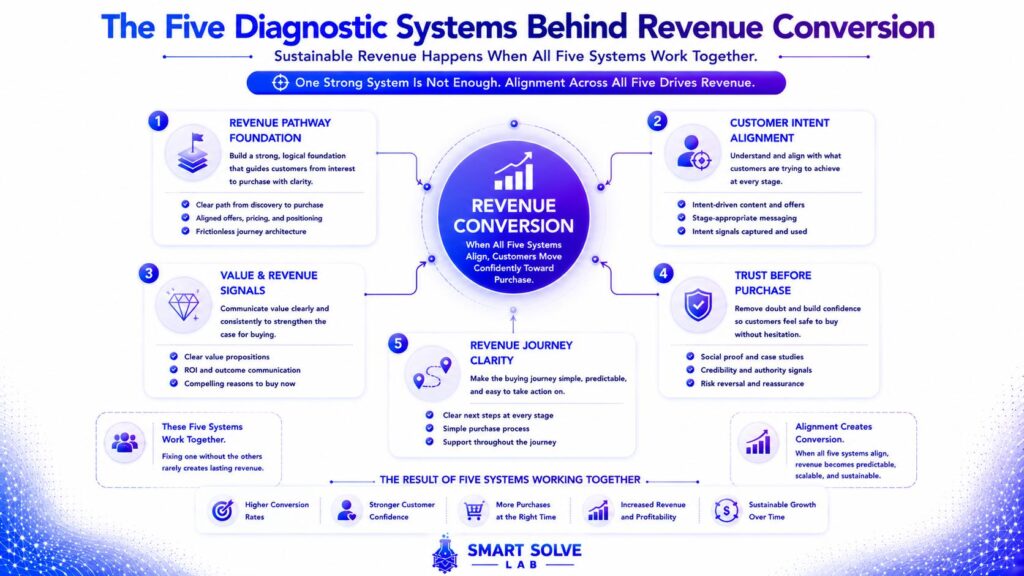
The Hidden Barriers That Prevent Engagement From Becoming Revenue
Strong customer engagement can make a business appear commercially successful.
Customers may regularly interact with content, explore offers, respond to campaigns, and remain connected with the brand.
However, engagement can continue even when customers are not progressing toward a purchase.
This happens when hidden barriers interrupt the revenue pathway between customer interest and financial commitment.
These barriers are often difficult to detect because engagement metrics may remain positive while revenue performance stays weak.
Vanity Metrics vs Revenue Signals
Not every engagement metric represents meaningful commercial progression.
Likes, comments, page views, email opens, and content interactions can indicate customer attention, but they do not necessarily indicate purchase readiness.
Revenue signals are different.
They demonstrate that customers are moving closer to meaningful commercial actions such as evaluating an offer, expressing buying intent, requesting information, or beginning a purchase journey.
When businesses treat all engagement as evidence of revenue potential, they may overestimate the commercial strength of their audience.
Weak Buying Motivation
Customers can find a business interesting without feeling strongly motivated to purchase.
They may understand the offer but fail to see enough urgency, relevance, or value to justify moving forward.
Weak buying motivation creates a situation where customers remain engaged because the interaction is useful or interesting, but purchasing never becomes a priority.
The diagnostic challenge is determining whether engagement is actually strengthening purchase motivation—or simply maintaining customer attention.
Missing Trust Signals
Revenue requires a higher level of confidence than ordinary engagement.
Customers may willingly read content, follow a business, or interact with its resources while remaining hesitant about making a financial commitment.
If credibility, reliability, expertise, or confidence in the expected outcome remains unclear, customers may stop progressing before purchase.
Trust therefore acts as an important bridge between engagement and revenue.
Revenue Journey Friction
Every additional obstacle in the customer journey can make commercial progression more difficult.
Revenue friction may appear when customers encounter:
- Unclear next steps
- Complicated decision processes
- Unexpected requirements
- Confusing offers
- Too many choices
- Uncertainty about commitment
Individually, these barriers may appear small.
Together, they can create enough resistance to prevent engaged customers from progressing toward revenue.
Unclear Purchase Path
Customers should understand how to move from interest toward becoming paying customers.
When the purchase pathway is unclear, even motivated customers may hesitate.
They may not know which offer is appropriate, where to begin, what happens after taking action, or what level of commitment is required.
An unclear purchase path can therefore create a significant gap between customer engagement and actual revenue.
Customer Decision Barriers
Purchase decisions involve more than interest.
Customers may still question:
- Is this the right solution for me?
- Is the value worth the investment?
- Can I trust the expected outcome?
- Should I purchase now or wait?
- Is there a better alternative?
When these questions remain unresolved, customers can stay engaged while repeatedly postponing commercial action.
This same decision friction can also appear earlier in the customer journey when CTA buttons don’t get clicks even when visitors are interested.
Revenue Pathway Gaps
Sometimes no single barrier explains weak revenue performance.
Instead, several small gaps exist across the customer journey.
Engagement may not connect clearly to buying intent.
Buying intent may not progress into sufficient trust.
Trust may exist without a clear purchase pathway.
These disconnected stages create revenue pathway gaps that quietly prevent customers from moving toward financial commitment.
Identifying these gaps requires examining the complete progression from engagement to revenue rather than evaluating individual interactions in isolation.
Section Summary
Engagement-to-revenue barriers rarely operate independently.
Weak buying motivation can delay decisions.
Missing trust can increase perceived risk.
Journey friction can interrupt progression.
An unclear purchase path can prevent otherwise interested customers from moving forward.
Diagnosing how these barriers interact helps businesses understand where customer engagement stops becoming commercial value before attempting optimization.
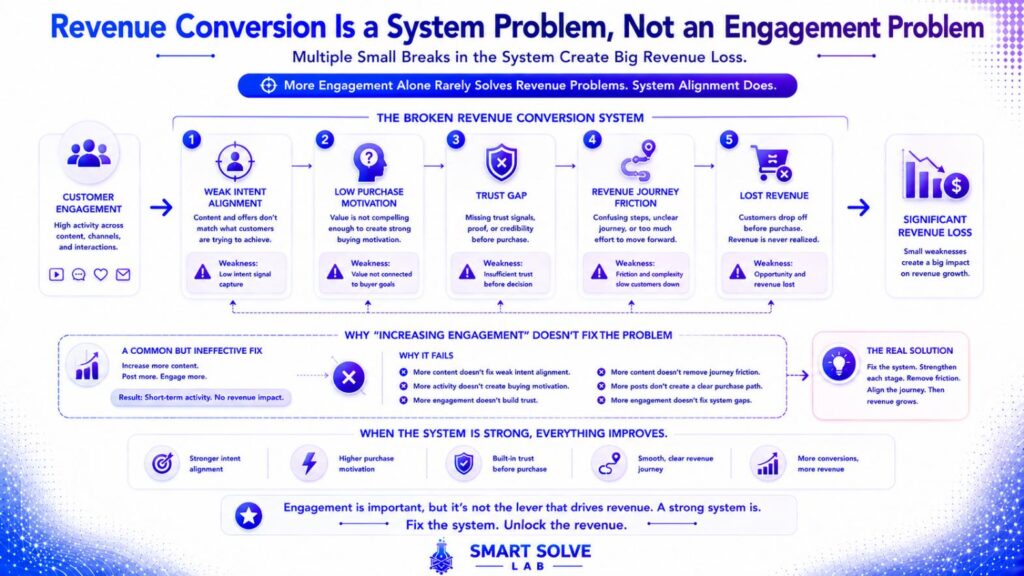
Why Revenue Conversion Problems Are Usually System Problems
Revenue conversion problems are often treated as isolated sales or marketing issues.
When engagement is high but revenue remains low, businesses may respond by increasing promotional activity, creating more campaigns, changing offers, or attempting to generate even more engagement.
These actions may produce temporary improvements.
However, if the underlying revenue pathway remains disconnected, higher engagement alone may not create sustainable revenue growth.
Revenue conversion depends on multiple connected systems working together throughout the customer journey.
Small Revenue Friction Creates Larger Business Losses
Small points of friction may appear insignificant when viewed individually.
A customer may experience slight uncertainty about the offer, limited trust, unclear value, or confusion about the next step.
One small barrier may not completely stop the customer journey.
But when several barriers appear together—or repeatedly affect large numbers of customers—the cumulative impact can become significant.
Over time, small revenue friction can contribute to:
- Fewer purchase decisions
- Longer customer journeys
- Lower conversion efficiency
- Lost revenue opportunities
- Reduced return on customer acquisition efforts
This is why seemingly minor weaknesses should be evaluated as part of the broader revenue system.
Disconnected Customer Journeys
Revenue rarely results from one isolated customer interaction.
Customers typically progress through multiple stages:
- Initial engagement
- Problem recognition
- Solution evaluation
- Buying intent
- Trust development
- Purchase consideration
- Commercial action
When these stages are not connected, customers may remain active within one part of the journey without progressing toward the next.
A business can therefore generate substantial engagement while the pathway toward revenue remains weak.
Multiple Weak Signals Compound Before Purchase
Revenue conversion often declines because several small weaknesses combine before the purchase decision.
A customer may experience:
- Moderate interest but weak buying intent
- Clear information but insufficient motivation
- Strong value perception but limited trust
- Purchase readiness but an unclear next step
Each individual weakness may appear manageable.
Together, they can create enough uncertainty to stop customer progression.
This is why diagnosing only one conversion element can provide an incomplete picture of the real revenue problem.
Why Higher Engagement Alone Rarely Increases Revenue
Increasing engagement can create more opportunities for customer interaction.
But more interaction does not automatically strengthen buying intent, trust, purchase motivation, or revenue journey clarity.
If the existing revenue pathway is weak, additional engagement may simply increase the number of customers interacting without purchasing.
The business sees stronger activity.
But the underlying engagement-to-revenue gap remains.
Why Isolated Conversion Changes Misdiagnose Revenue Problems
Businesses sometimes attempt to solve revenue problems by changing one visible element.
They may adjust a CTA, modify an offer, redesign a page, or change messaging.
These improvements can be useful when the specific element is genuinely responsible for the problem.
However, isolated changes can misdiagnose the situation when revenue weakness originates across several connected stages.
The visible conversion point may simply be where customer progression finally stops—not where the underlying problem originally began.
Why Diagnosis Should Come Before Revenue Optimization
Before optimizing campaigns, funnels, offers, or customer interactions, businesses should understand where the revenue journey is actually weakening.
A structured diagnosis should evaluate:
- Where engagement occurs
- Whether engagement develops into buying intent
- Whether customers understand the commercial value
- Whether sufficient purchase motivation exists
- Whether trust supports financial commitment
- Whether the revenue pathway is clear
- Where conversion barriers interrupt progression
This allows businesses to distinguish between symptoms and root causes.
Instead of making random improvements, they can identify which barriers deserve priority.
Section Summary
Revenue conversion problems are usually the result of connected system weaknesses rather than one isolated failure.
High engagement cannot compensate for weak buying intent, insufficient trust, unclear value, or a disconnected revenue pathway.
By diagnosing how these systems interact, businesses can identify where customer progression breaks and prioritize the right improvements before optimization begins.
From Diagnosis to Better Revenue Conversion
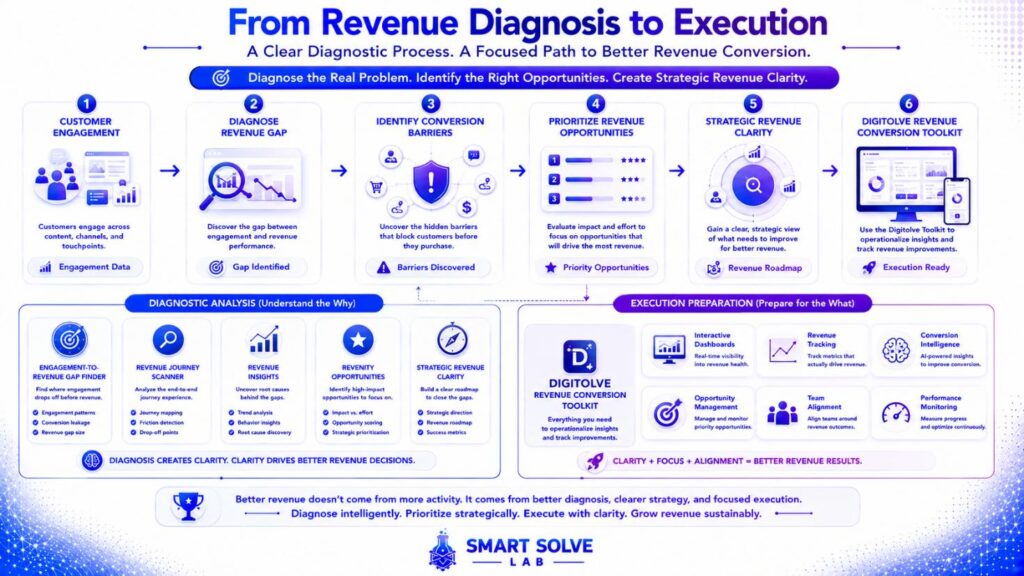
Understanding that customer engagement is not progressing into revenue creates an important starting point.
But identifying the existence of an engagement-to-revenue gap is only the beginning.
Businesses also need to understand where customer progression is weakening, which barriers have the greatest impact, and which problems should receive attention first.
This is where structured diagnosis becomes valuable.
Instead of immediately changing campaigns, funnels, offers, or customer interactions, businesses can first evaluate the complete revenue journey and identify the barriers preventing engagement from becoming measurable commercial value.
The Role of the Engagement-to-Revenue Gap Finder
The Engagement-to-Revenue Gap Finder is designed to help businesses systematically diagnose where customer engagement stops progressing toward revenue.
Rather than evaluating engagement metrics in isolation, the diagnostic process examines the relationship between customer interaction and commercial progression.
It helps evaluate factors such as:
- Customer intent
- Purchase motivation
- Trust before financial commitment
- Revenue journey progression
- Conversion barriers
- Revenue pathway gaps
The objective is not simply to determine whether revenue performance is weak.
It is to identify why engaged customers are not progressing toward measurable revenue.
The Revenue Journey Scanner supports this process by helping identify where friction or disconnection may be occurring across the customer journey.
Together, these diagnostic layers help businesses distinguish between surface-level engagement problems and deeper revenue progression barriers.
Prioritizing the Highest-Impact Revenue Gaps
Not every weakness within the revenue journey deserves equal attention.
A business may identify several potential barriers, but some will have a much greater influence on customer progression than others.
For example, improving engagement volume may provide little benefit if customers already interact frequently but lack sufficient buying motivation.
Similarly, changing a conversion element may have limited impact if trust is the primary barrier preventing financial commitment.
Effective diagnosis helps businesses move from:
Multiple possible problems → Highest-impact barriers → Clear priorities
This prevents businesses from spreading resources across disconnected improvements without understanding which problems matter most.
From Diagnosis to Execution
Once the highest-impact engagement-to-revenue barriers have been identified and prioritized, businesses can move toward structured execution.
Smart Solve Lab focuses on diagnosing and interpreting the problem:
Where is customer progression breaking?
Which barriers are preventing revenue movement?
Which weaknesses should receive priority?
Execution begins after this diagnostic clarity has been established.
Businesses can then use Digitolve’s Revenue Conversion Toolkit to implement structured improvements across the areas identified during diagnosis.
This creates a clear ecosystem progression:
Customer Engagement → Revenue Gap Diagnosis → Barrier Identification → Priority Clarity → Structured Execution
Diagnosis determines what needs attention.
Execution determines how the identified weaknesses should be improved.
Keeping these roles separate reduces guesswork and prevents businesses from optimizing the wrong parts of the revenue journey.
Continuous Evaluation Creates Better Revenue Decisions
Customer journeys do not remain static.
Buying behavior can change.
Customer expectations can evolve.
Offers can become more or less relevant.
New friction can develop as campaigns, channels, products, or customer acquisition strategies change.
For this reason, engagement-to-revenue diagnosis should not be treated as a one-time exercise.
Businesses should continue evaluating whether customer interactions are progressing toward meaningful outcomes and whether new barriers are emerging across the revenue pathway.
Google’s guidance on creating helpful, reliable, people-first content similarly emphasizes creating experiences primarily for people rather than focusing only on signals designed to influence performance.
While this guidance focuses specifically on content, the broader principle is valuable: understanding what customers actually need and experience provides a stronger foundation for sustainable decisions than optimizing isolated metrics alone.
Section Summary
Better revenue conversion begins with understanding where customer progression breaks.
The Engagement-to-Revenue Gap Finder helps diagnose the barriers preventing engagement from becoming measurable revenue, while the Revenue Journey Scanner helps identify where friction and disconnection occur across that progression.
Once the highest-impact barriers are identified and prioritized, businesses can move toward structured execution with greater clarity.
Diagnose the gap.
Identify the barriers.
Prioritize what matters.
Then execute with clarity.
Conclusion
Customer engagement is valuable, but engagement alone does not create sustainable revenue.
Customers can read content, interact with campaigns, explore offers, click links, and remain connected with a business without ever progressing toward a purchase.
When this happens, the problem is not necessarily a lack of engagement.
The deeper problem may be a disconnect between customer engagement, buying intent, trust, purchase motivation, and the revenue journey.
A business therefore needs to understand not only whether customers are interacting—but whether those interactions are actually moving customers toward meaningful commercial outcomes.
Diagnose Before Optimizing
When engagement remains strong but revenue stays weak, immediately increasing campaigns, changing funnels, or generating more interactions may not solve the underlying problem.
Businesses should first ask:
- Is engagement developing into genuine buying intent?
- Do customers clearly understand the value of the offer?
- Is there enough motivation to progress toward purchase?
- Has sufficient trust developed before financial commitment?
- Is the pathway from engagement to purchase clear?
- Where does customer progression begin to slow or stop?
- Which barriers have the greatest impact on revenue?
These questions help distinguish between an engagement problem and a deeper revenue progression problem.
The objective is not simply to generate more activity.
It is to understand whether existing activity is creating meaningful movement toward revenue.
Better Diagnosis Creates Better Revenue Decisions
When businesses understand where customer progression breaks, they can make more focused decisions.
Instead of optimizing every stage simultaneously, they can prioritize the barriers having the greatest influence on revenue performance.
This creates a more disciplined progression:
Engagement → Diagnosis → Barrier Identification → Prioritization → Strategic Clarity → Execution
Better diagnosis creates better revenue decisions.
Better revenue decisions create stronger customer journeys.
Stronger customer journeys support more sustainable business growth.
Sustainable revenue growth begins by understanding where customer progression breaks before attempting optimization.
Diagnostic Insight
Customer engagement can create the appearance of growth without producing meaningful commercial progress.
The real diagnostic question is not simply whether customers are interacting with the business.
It is whether those interactions are strengthening buying intent, motivation, trust, and progression toward purchase.
When these systems become disconnected, engagement can continue while revenue remains stagnant.
Effective diagnosis identifies where that progression breaks before businesses begin changing campaigns, funnels, offers, or customer interactions.
Diagnose the engagement-to-revenue gap before optimizing the journey.
Recommended Reading
- Why Your Website Gets Traffic But No Conversions (Even When Visitors Keep Coming)
- Why Your Website Traffic Doesn’t Become Leads (Even When Visitors Keep Coming)
- Why Your CTA Buttons Don’t Get Clicks (Even When Visitors Are Interested)
Frequently Asked Questions
Why doesn’t customer engagement generate revenue?
Customer engagement indicates interaction or interest, but revenue requires customers to progress through buying intent, motivation, trust, evaluation, and purchase. If progression breaks at any of these stages, engagement can remain high without generating meaningful revenue.
Can a business have high engagement but low sales?
Yes. Customers may regularly interact with content, campaigns, or offers without having sufficient buying intent or purchase readiness. High engagement therefore does not automatically indicate strong revenue performance.
What is the engagement-to-revenue gap?
The engagement-to-revenue gap is the disconnect that occurs when customer interaction fails to progress into meaningful commercial outcomes. It can develop because of weak buying intent, insufficient motivation, trust gaps, journey friction, or unclear purchase pathways.
Why do engaged customers hesitate to buy?
Engaged customers may hesitate because they do not perceive enough value, lack purchase confidence, remain uncertain about the decision, or do not clearly understand how to progress toward becoming a paying customer.
What causes revenue conversion friction?
Revenue conversion friction can result from unclear value, weak purchase motivation, insufficient trust, confusing customer journeys, decision uncertainty, or disconnected stages between engagement and purchase.
How do I diagnose revenue conversion problems?
Begin by examining the complete progression from customer engagement to purchase. Evaluate customer intent, purchase motivation, trust, revenue journey clarity, and conversion barriers to identify where commercial progression begins to weaken.
What is an Engagement-to-Revenue Gap Finder?
The Engagement-to-Revenue Gap Finder is a diagnostic framework designed to identify the highest-impact barriers preventing customer engagement from becoming measurable revenue. It evaluates customer intent, purchase motivation, trust, revenue journey progression, and conversion barriers before optimization begins.
Leave a Reply