
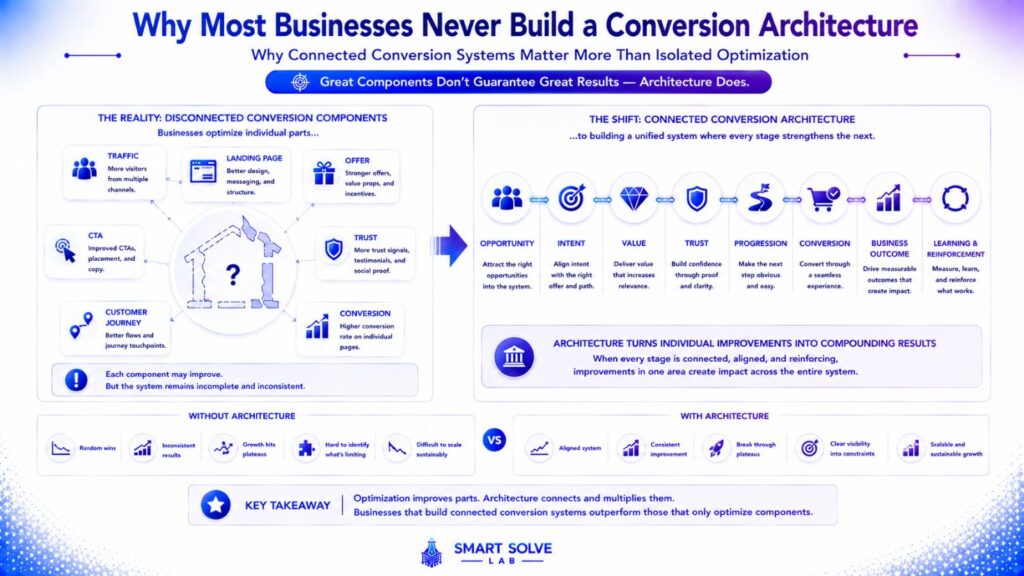
conversion architecture:
Businesses spend considerable time improving conversion performance.
They bring in more traffic, redesign landing pages, strengthen offers, adjust CTAs, improve trust signals, refine funnels, and study conversion data. Each improvement may solve a genuine problem.
Yet the overall conversion system can still remain fragmented.
One component improves while another becomes the next constraint. A stronger landing page may not solve weak visitor intent. A better offer may not repair a trust gap. More traffic may create more opportunities without fixing what happens after visitors arrive.
Over time, this creates a familiar pattern:
More Optimization
↓
Local Improvement
↓
Another Constraint
↓
Another Fix
↓
Another Optimization Cycle
The deeper issue is that many businesses optimize components, but never intentionally build the architecture connecting those components.
A business can therefore have strong individual conversion elements and still lack the structure required for those elements to work together effectively.
Most businesses do not struggle because one conversion component is missing. They struggle because the components responsible for turning opportunity into meaningful business outcomes were never designed as one connected architecture.
This changes the question.
Instead of asking only:
“Which conversion element should we optimize next?”
the more important question becomes:
“How are the different conditions that influence conversion connected—and where does the wider system depend on those connections?”
That is the foundation of conversion architecture.
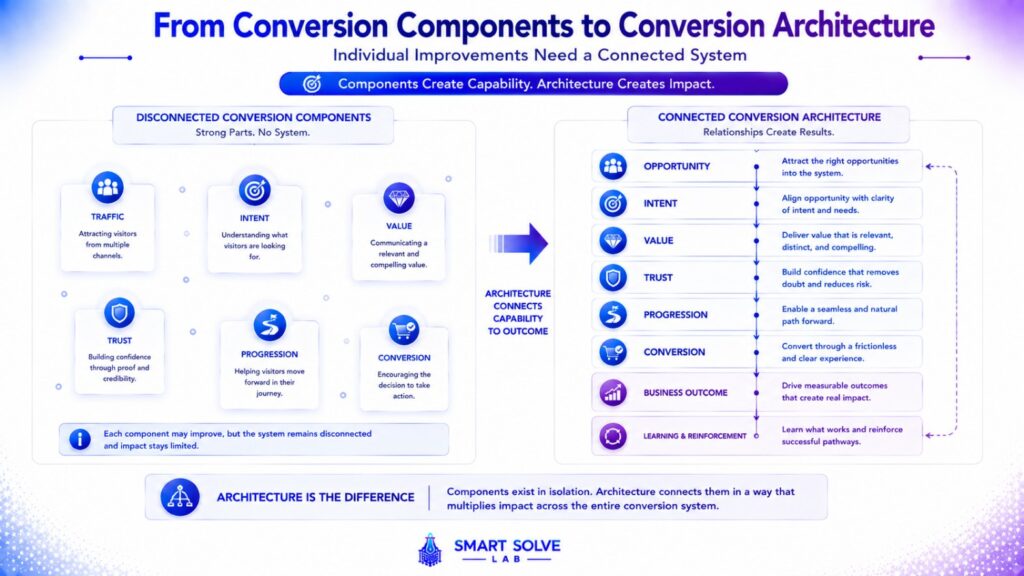
Table of Contents
Why Most Businesses Optimize Conversions Without Building an Architecture
Conversion optimization often begins with a visible problem.
A landing page is underperforming, so the page is changed. A CTA receives fewer clicks, so the CTA is adjusted. Traffic increases without producing enough conversions, so more campaigns are launched.
These actions can be useful. The problem begins when every issue is treated as an independent component problem.
More Traffic, More Pages, More CTAs — But No Connected System
Businesses can continuously add conversion elements without creating meaningful relationships between them.
More traffic may increase opportunity, but it does not automatically improve intent alignment.
More pages may provide more information, but they do not automatically make value clearer.
More CTAs may create more opportunities to act, but they do not automatically create confidence or readiness.
The business may therefore become more optimized without becoming more connected.
Why Individual Conversion Improvements Feel Disconnected
A component can improve while another part of the customer journey remains constrained.
For example, a stronger offer may improve perceived value, while the visitors reaching that offer are still poorly aligned with it. A better landing page may improve engagement, while later progression remains unclear.
This creates a situation where improvements appear successful locally but produce limited change across the wider conversion system.
The Hidden Cost of Building Conversion Components Separately
When components are developed independently, the connections between them can remain undefined.
The business may know what each component is supposed to accomplish without understanding how one stage affects the next.
That can make it difficult to determine whether a weak result is caused by the component itself or by a dependency somewhere else in the system.
When Components Work Individually but the System Still Underperforms
This is one of the most important architecture problems.
A business can have:
Good Traffic
Strong Content
A Valuable Offer
A Professional Landing Page
Clear CTAs
Trust Signals
and still experience weak or inconsistent conversion performance.
The problem may not be the quality of any single component.
It may be the connections between them.
Why Conversion Growth Eventually Exposes Structural Gaps
As businesses continue optimizing, obvious weaknesses are often addressed first.
Eventually, however, improvements can become smaller because the remaining limitations are less visible and more interconnected.
A local improvement may simply expose another dependency further along the journey.
A business can have strong conversion components and still lack the architecture required to make those components work together.
This is where conversion optimization begins to reach beyond individual pages, CTAs, offers, or campaigns and becomes a question of system architecture.
For a practical look at the symptom that often exposes this problem, see Why Your Website Gets Traffic But No Conversions.
What Is a Conversion Architecture?
Conversion architecture is the connected structure through which opportunity becomes aligned with intent, value becomes understood, trust develops, customers progress, meaningful actions occur, and the resulting learning strengthens future conversion performance.
A Funnel Shows Movement
A funnel can show how people move through different stages toward a desired outcome. It can help describe where visitors enter, progress, and eventually leave or convert.
But a funnel primarily describes movement through stages. It does not necessarily explain how the conditions within those stages depend on one another.
A Conversion Path Shows a Route
A conversion path describes a particular route toward an action. It may show how a visitor moves from an entry point through relevant experiences before reaching a conversion opportunity.
That route can be useful, but a business may have many different paths depending on the visitor, intent, offer, channel, and stage of decision-making.
Conversion Architecture Defines the Connections
Conversion architecture looks beyond an individual path and considers how the broader conversion conditions, components, dependencies, and outcomes work together.
It asks whether the different parts of the system support one another rather than simply whether each part exists.
A conversion path describes where someone moves. Conversion architecture examines how the system is designed to support that movement.
The distinction matters because a business can have multiple effective-looking conversion paths while still lacking a coherent structure connecting the conditions that influence conversion across the wider journey.
The Seven Layers of Conversion Architecture
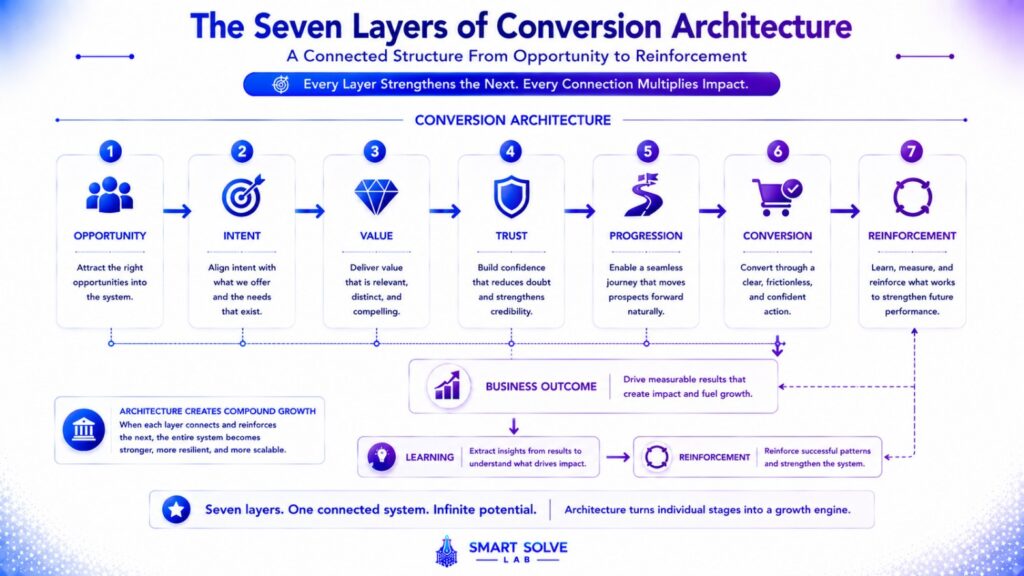
A complete conversion architecture can be understood through seven connected functional layers. Each layer represents a different condition that contributes to how opportunities progress toward meaningful business outcomes.
1. Opportunity Layer
The opportunity layer concerns where relevant potential customers enter the system. The quality and relevance of those opportunities influence what becomes possible in the stages that follow.
2. Intent Layer
The intent layer considers whether visitor needs, expectations, and readiness align with what the business offers. Strong alignment creates a more appropriate foundation for continued progression.
3. Value Layer
The value layer focuses on how clearly the relevance and meaningful value of the solution become understood. Visitors need enough clarity to recognize why continuing the journey matters to them.
4. Trust Layer
The trust layer concerns the development of sufficient confidence for continued progression. As the required commitment increases, the customer may need stronger reasons to believe that moving forward is appropriate.
5. Progression Layer
The progression layer focuses on how people move from one meaningful decision stage to the next. Each transition should support continued understanding and make the next appropriate step reasonably clear.
6. Conversion Layer
The conversion layer concerns how appropriate customer action is supported. The objective is not simply to generate an action, but to support meaningful action that connects with the broader business journey.
7. Reinforcement Layer
The reinforcement layer brings outcomes and learning back into the wider system. Useful observations and successful patterns can inform future strengthening rather than remaining isolated improvements.
Business Outcome
Business outcomes should be understood as results flowing from the architecture rather than as a separate eighth layer. Conversion activity becomes more meaningful when its relationship to broader business outcomes can be understood.
The conceptual flow can therefore be viewed as:
Opportunity → Intent → Value → Trust → Progression → Conversion → Business Outcome → Learning → Reinforcement
A weakness in one layer can affect the effectiveness of the layers that depend on it.
This article introduces these layers as a conceptual model. The deeper work of mapping, assessing, and strengthening a complete conversion architecture belongs to the appropriate Premium framework rather than being fully operationalized here.
Why Conversion Components Fail When the Architecture Is Missing
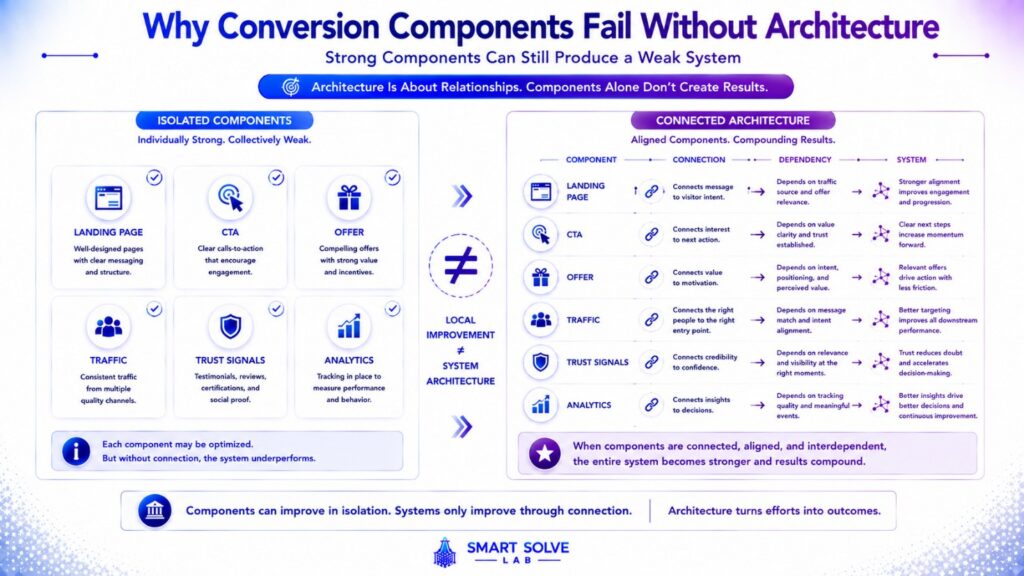
Individual conversion components can be useful and well designed while the wider system still struggles to perform consistently. The reason is simple: each component operates within a network of relationships that can influence what happens before and after it.
A Landing Page Cannot Carry the Entire Conversion System
A landing page can improve clarity, relevance, and progression at a particular point in the journey. But it cannot independently control the quality of opportunities entering the system, the visitor’s intent, the development of trust, or what happens after the visitor moves forward.
A CTA Cannot Create Readiness by Itself
A clear call to action can make the next step easier to understand, but clarity does not automatically create sufficient value, trust, or decision confidence. A CTA can support progression without being responsible for the conditions that make progression possible.
An Offer Cannot Repair Misaligned Intent
A strong offer may communicate meaningful value, but its effectiveness depends partly on whether it reaches people whose needs and expectations are aligned with what the offer provides.
Trust Signals Cannot Replace Value Clarity
Trust can strengthen confidence, but trust signals cannot compensate indefinitely for an experience where the customer does not clearly understand the value or relevance of the solution.
Traffic Cannot Repair a Disconnected Conversion System
Additional traffic can create more opportunities, but it cannot automatically repair weaknesses between opportunity, intent, value, trust, progression, and conversion. More visitors can increase the scale of a system without fixing the system itself.
Analytics Cannot Repair a Broken Customer Journey
Measurement can help a business observe what is happening, but data alone does not create a connected customer journey. Learning becomes useful when it contributes to a stronger understanding of how the wider system operates.
The relationship can therefore be understood as:
Component → Connection → Dependency → System
A component can be improved locally while the larger system remains constrained by a different dependency. This is why conversion architecture looks beyond individual components and examines how those components function together.
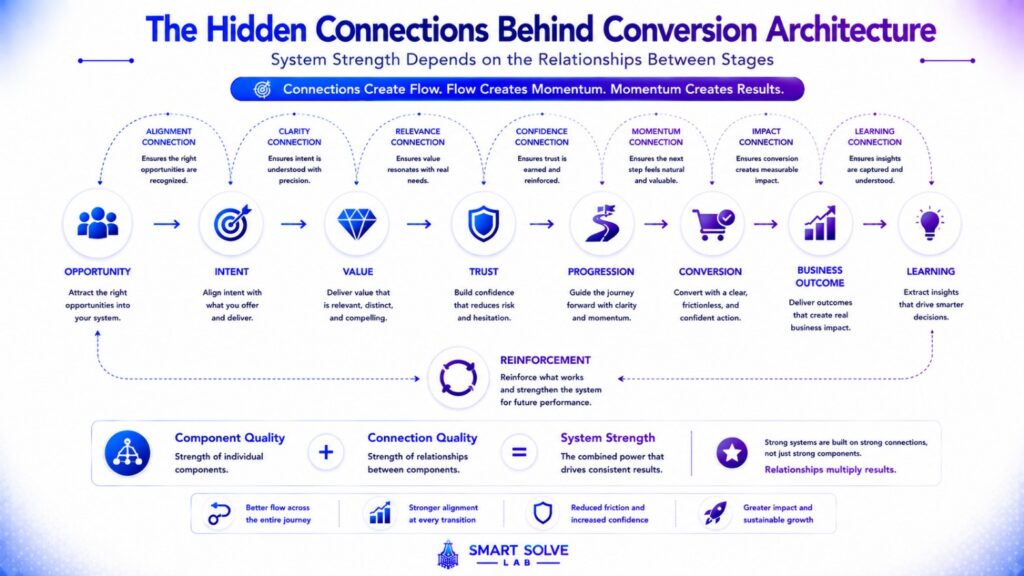
The Hidden Connections That Make Conversion Architecture Work
Conversion architecture is not defined only by the quality of its individual components. It also depends on whether the relationships between those components support a coherent progression from opportunity toward meaningful business outcomes.
Opportunity → Intent
Does the opportunity entering the system align with the people and needs the business is actually designed to serve?
Intent → Value
Does the system communicate value that matches the visitor’s current need and decision stage?
Value → Trust
Does clearer value create enough confidence for the visitor to continue exploring or progressing?
Trust → Progression
Does developing confidence support the next appropriate decision rather than leaving the customer uncertain about what to do next?
Progression → Conversion
Does the journey make meaningful action understandable and appropriate for the customer’s current level of readiness?
Conversion → Business Outcome
Does the conversion represent meaningful business value rather than simply becoming another isolated metric?
Business Outcome → Learning
Can the business understand what the resulting outcomes reveal about the performance and relationships within the wider system?
Learning → Reinforcement
Can useful learning inform future improvements so that successful patterns do not remain isolated events?
The strength of a conversion system depends not only on the quality of its components, but also on the quality of the connections between them.
These connections do not mean that every customer follows one identical path. They represent the broader relationships that influence how different parts of the conversion system work together.
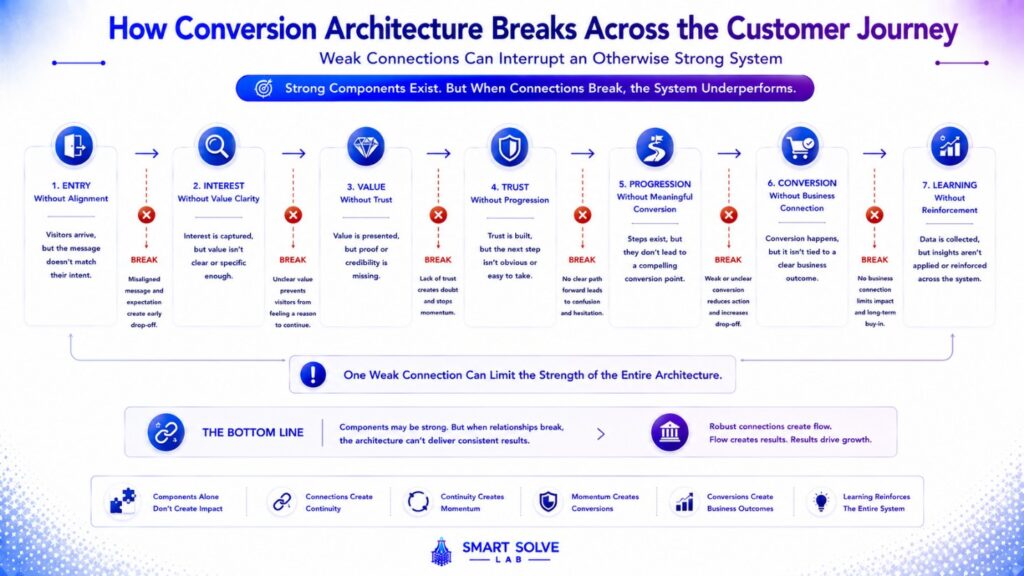
How Conversion Architecture Breaks Across the Customer Journey
A conversion architecture can contain all the major components a business needs and still underperform when the connections between those components are weak.
The problem may appear at one point in the journey, but the underlying weakness can exist earlier. This is why architecture-level thinking looks at how each stage influences the conditions that follow.
Entry Without Alignment
Opportunities may enter the system without being sufficiently aligned with the needs, expectations, or intent the business is designed to serve.
Interest Without Value Clarity
Attention may exist, but the visitor may not clearly understand why the solution is relevant or valuable enough to continue.
Value Without Trust
The offer may make sense to the visitor, yet confidence may remain insufficient for the level of commitment being requested.
Trust Without Progression
A customer may develop confidence in the business but still encounter an unclear or disconnected next step. Trust alone does not guarantee continued movement.
Progression Without Meaningful Conversion
A visitor may move through several stages of the journey without reaching the action that represents meaningful progress for the business.
Conversion Without Business Connection
An action may occur, but its relationship to meaningful business outcomes may remain unclear. A conversion becomes more valuable when it can be understood within the broader business context.
Learning Without Reinforcement
A business may collect performance information without turning useful learning into stronger future decisions. When learning remains isolated, the architecture has difficulty becoming stronger over time.
A conversion architecture becomes fragile when the connections between its stages do not consistently support progression toward meaningful outcomes.
This is broader than any single customer-drop-off problem. Customer progression is one important part of the architecture, but the complete system also includes the opportunity, intent, value, trust, conversion, business outcome, and reinforcement relationships surrounding it.
For a deeper look at customer progression and the reasons interested customers can leave before completing a purchase, explore Why Customers Drop Off Before Buying.
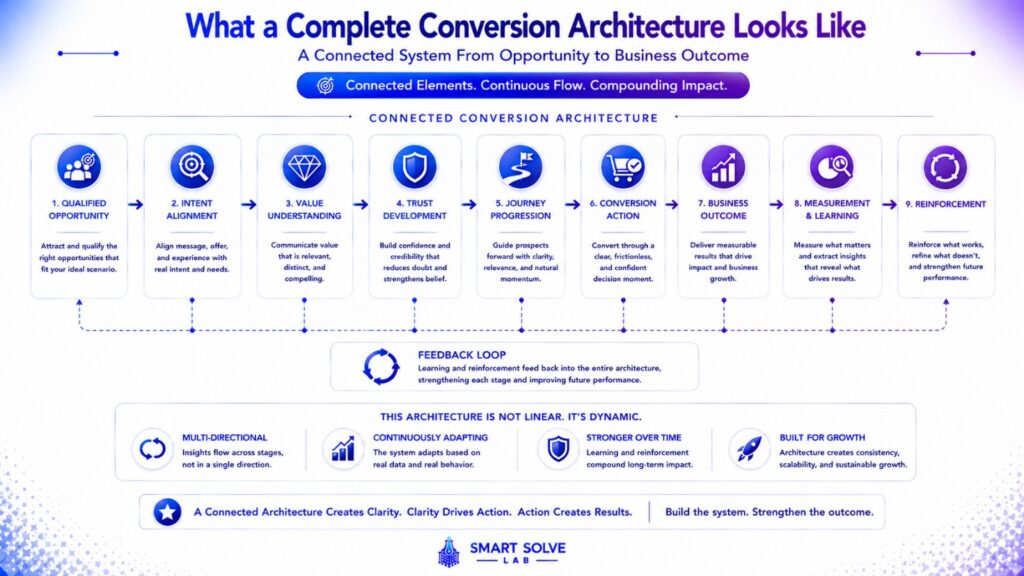
What a Complete Conversion Architecture Looks Like
A complete conversion architecture brings the major conditions influencing conversion into one connected conceptual system. Its purpose is not to suggest that every customer follows one identical linear path, but to show how different conditions can work together to support meaningful business outcomes.
Qualified Opportunity
The system begins with relevant opportunities entering the broader conversion environment. The quality and relevance of those opportunities influence what becomes possible in the stages that follow.
Intent Alignment
Those opportunities need to be reasonably aligned with the problem, need, or solution being addressed. Alignment creates a stronger foundation for the rest of the journey.
Value Understanding
As people continue, they need enough clarity to understand why the solution matters and how it relates to their situation.
Trust Development
Understanding alone may not be sufficient. Confidence needs to develop as the level of commitment increases, helping the customer feel more comfortable progressing.
Journey Progression
The customer then moves through meaningful decision stages. Each stage should connect naturally enough that progression does not depend on isolated components working perfectly on their own.
Conversion Action
Meaningful action occurs when the customer has sufficient relevance, value understanding, confidence, and readiness to move forward.
Business Outcome
The resulting conversion should connect to a meaningful business outcome. This helps distinguish useful conversion activity from isolated actions that have limited business significance.
Measurement & Learning
Performance creates information about what is happening within the wider system. Measurement can help the business understand outcomes and identify useful patterns without reducing the architecture to a single metric.
Reinforcement
Useful learning can then inform future strengthening. This creates the possibility for successful patterns to contribute to a more connected system over time.
The high-level architecture can therefore be represented.
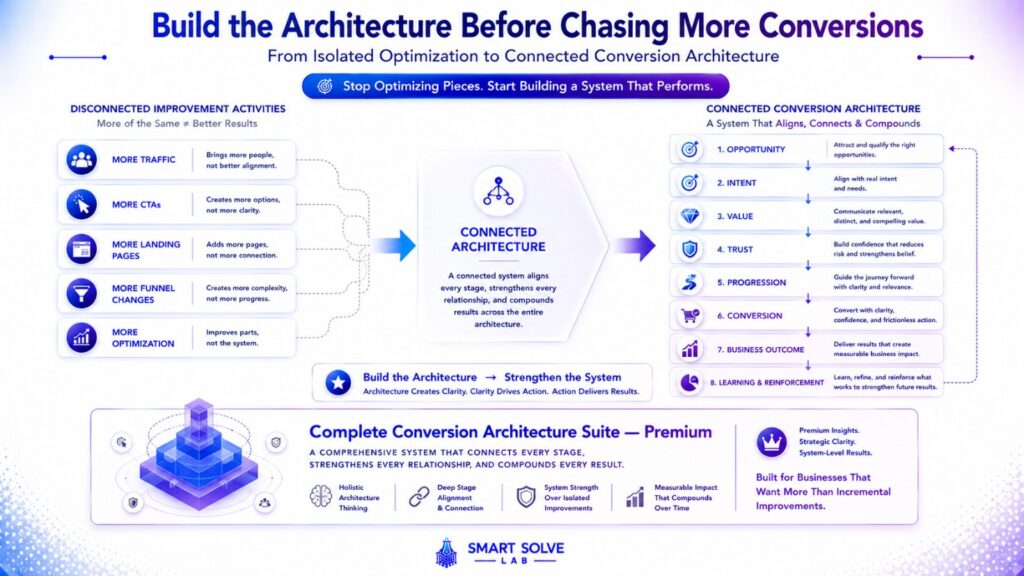
Why Architecture Must Come Before Optimization
Optimization becomes more useful when it happens within a system whose relationships are already understood. Without that context, businesses can repeatedly improve individual components without knowing whether those improvements are addressing the conditions that actually limit conversion performance.
Architecture Makes Relationships Visible
Architecture provides a broader view of how conversion components relate to one another. Instead of examining a landing page, offer, CTA, or customer journey in isolation, the business can consider how each contributes to the wider conversion system.
Dependencies Become Easier to Recognize
One stage can influence the effectiveness of another. Understanding these relationships makes it easier to recognize why an apparently strong component may still produce limited results when another part of the system remains constrained.
Structural Constraints Can Be Distinguished From Local Problems
Not every weak result is caused by the component where the weakness becomes visible. A broader architecture perspective helps separate a local issue from a condition that may be affecting several connected stages.
Optimization Becomes More Focused
When the wider system is understood, optimization can become more purposeful. Instead of changing components simply because they appear to need improvement, businesses can make decisions with greater awareness of the relationships surrounding those components.
Future Improvements Have a Stronger Context
A connected architecture also provides context for future improvements. Measurement can help businesses understand how users progress through defined steps and where movement changes across a journey. For an authoritative reference on examining user journeys and identifying where users complete or abandon steps, see Google Analytics Funnel Exploration.
Optimization becomes more valuable when the system’s relationships are understood before individual components are repeatedly changed.
Architecture therefore does not replace optimization. It gives optimization a stronger context by helping businesses understand what each component is connected to and why those relationships matter.
The System Insight: Conversion Is an Architecture Problem
Once the relationships between conversion components become visible, an important distinction emerges: conversion performance cannot be understood fully by examining individual components alone.
Traffic ≠ Conversion Architecture
Traffic creates opportunities, but architecture determines how those opportunities interact with the conditions that influence conversion.
Landing Page ≠ Conversion Architecture
A landing page can support a specific stage of the journey, but it does not represent the complete structure connecting opportunity, intent, value, trust, progression, and business outcomes.
CTA ≠ Conversion Architecture
A CTA can guide an action, but it cannot independently create the relevance, confidence, or readiness required for that action.
Offer ≠ Conversion Architecture
An offer communicates value, but its effectiveness depends on the context surrounding it, including visitor intent, trust, progression, and the broader conversion experience.
Funnel ≠ Conversion Architecture
A funnel can illustrate movement between stages, but a complete architecture also considers the relationships and dependencies that influence how those stages work together.
Conversion Rate ≠ Conversion Architecture
Conversion rate is an important performance signal, but it represents only one measurement within a much broader system of opportunities, decisions, outcomes, learning, and reinforcement.
Analytics ≠ Conversion Architecture
Analytics can provide valuable evidence about what is happening, but measurement alone does not create the relationships required for a connected conversion system.
Conversion architecture is the connected structure that determines how opportunities become aligned, value becomes understood, trust develops, customers progress, meaningful actions occur, business outcomes are connected, and learning can strengthen the system over time.
This is why architecture thinking sits above individual conversion optimization. It provides the conceptual context for understanding how the different parts of the conversion ecosystem belong together without reducing the entire system to one page, metric, funnel, or tactic.
From Conversion Problems to Complete Conversion Architecture
Understanding individual conversion problems is an important starting point, but connected systems require a broader perspective. Once multiple conversion components, dependencies, and outcomes interact, the business needs more than isolated optimization.
Complete Conversion Architecture Suite — Premium
The Complete Conversion Architecture Suite is positioned as a comprehensive architecture framework designed to help businesses understand, map, connect, and strengthen the systems that influence conversion across the broader customer and business journey.
What the Premium Suite Represents
The Premium level represents a broader view of conversion architecture, where individual problems are considered within the context of the wider system.
- Complete system visibility
- Cross-stage relationships
- Architecture mapping
- Dependency understanding
- Structural constraint awareness
- Connected conversion pathways
- Reinforcement thinking
The purpose is not to provide another collection of isolated conversion tactics. It is to create a higher-level understanding of how the broader conversion ecosystem fits together.
The Article and the Premium Framework Have Different Jobs
This article explains why a complete conversion architecture is necessary and what makes architecture different from isolated optimization.
The Premium Suite is designed to provide the deeper framework for actually working with that architecture.
That distinction protects the value of the Premium product while giving readers enough conceptual clarity to understand why a broader architecture may be necessary.
Why the Complete Conversion Architecture Is Different
The difference between a focused conversion article, a Core framework, and a Premium architecture framework is not simply the amount of information provided. Each level addresses a different depth of problem.
Blog
The blog explains why businesses struggle to build connected conversion systems. Its purpose is to create problem clarity and introduce the architectural way of thinking.
Core Frameworks
Core frameworks address specific system-level conversion problems and constraints. They help businesses examine a defined area of the conversion system in greater depth.
Premium Architecture
The Premium level addresses the broader conversion ecosystem as a connected architecture. It moves beyond one isolated problem and considers how multiple conversion conditions relate to the wider system.
Premium Suite
The Complete Conversion Architecture Suite provides the comprehensive framework for working with that broader architecture. Its value comes from the depth and completeness of the architecture framework rather than from simply adding more conversion tips.
The SSL Product Hierarchy
The progression can therefore be understood as:
Mini
Individual symptoms and focused problems
↓
Core
Specific system-level diagnosis and frameworks
↓
Premium Blog
Complete conversion architecture thinking
↓
Premium Suite
Comprehensive architecture framework
This hierarchy allows each level to perform a distinct role without requiring the Premium article to reveal the deeper operational methodology of the Premium Suite.
The Architecture Principle: No Conversion Component Exists in Isolation
Once conversion is viewed as an architecture rather than a collection of separate optimization tasks, the role of each component becomes clearer.
Upstream Conditions Influence Downstream Performance
What happens earlier in the journey can influence how effectively later stages perform. A downstream component may appear weak when the conditions supporting it were already weakened upstream.
Dependencies Connect Local Problems
A visible conversion problem may therefore be connected to conditions that exist elsewhere in the system. Understanding those relationships creates a more accurate picture than evaluating each component independently.
Connections Influence System Strength
Strong components do not automatically create a strong system. The quality of the connections between those components also influences whether the wider architecture can support consistent progression toward meaningful outcomes.
Architecture Provides Context
Architecture gives businesses a broader context for understanding where individual conversion improvements fit within the wider system. This helps prevent every visible weakness from becoming a separate optimization project.
Reinforcement Allows Learning to Strengthen Future Decisions
When useful learning can inform future decisions, the system has an opportunity to become stronger over time rather than repeatedly treating every improvement as an isolated event.
The goal is not to optimize every conversion component equally. It is to understand how the architecture connects those components and where the most important relationships require attention.
This is the central principle behind conversion architecture: the system becomes more valuable when its components are understood as connected parts of a larger structure rather than independent pieces of optimization.
Conclusion — Build the Architecture Before Chasing More Conversions
More traffic is not automatically the answer.
More landing pages are not automatically the answer.
More CTAs are not automatically the answer.
More funnel changes are not automatically the answer.
More optimization is not automatically the answer.
These actions can all have a legitimate place in a conversion strategy. But when they are treated as isolated solutions, businesses can continue improving individual components without strengthening the architecture connecting them.
The Stronger Strategic Perspective
Instead of endlessly asking what should be optimized next, businesses can step back and understand the broader conversion system:
Understand the Conversion System
↓
Recognize Its Layers
↓
Understand the Dependencies
↓
Identify Structural Gaps
↓
Strengthen the Important Connections
↓
Build a More Connected Architecture
↓
Learn and Reinforce
Final Philosophy
Businesses do not build sustainable conversion growth by endlessly improving isolated components. They build stronger systems by creating an architecture in which opportunity, intent, value, trust, progression, conversion, business outcomes, learning, and reinforcement can work together.
The goal is not to make every component perfect or eliminate every possible conversion problem. The goal is to create a connected structure that gives those components the context they need to contribute to meaningful business outcomes.
When the architecture becomes clearer, optimization has a stronger foundation—and future improvements can be understood as part of a system rather than as another disconnected fix.
Frequently Asked Questions
What is conversion architecture?
Conversion architecture is the connected structure through which opportunity, intent, value, trust, progression, conversion, business outcomes, learning, and reinforcement work together as part of a broader system.
How is conversion architecture different from a conversion funnel?
A funnel mainly illustrates movement through stages, while conversion architecture considers the broader relationships and dependencies connecting those stages and influencing how the overall system performs.
Why do businesses struggle with conversion even when individual components are strong?
Individual components can perform well while the connections between them remain weak. A strong landing page, offer, CTA, or traffic source cannot independently repair constraints elsewhere in the conversion system.
Why is architecture important before optimization?
Architecture provides context for understanding how conversion components depend on one another. This can make optimization more focused instead of treating every visible weakness as an isolated problem.
What does a complete conversion architecture include?
At a conceptual level, it connects opportunity, intent, value, trust, progression, conversion, business outcomes, learning, and reinforcement. The exact architecture will vary according to the business and its customer journey.
Recommended Reading
Why Your Website Gets Traffic But No Conversions
Explore why increasing website traffic does not automatically lead to stronger conversion performance and what may be happening between traffic and conversion.
Why Conversion Problems Keep Repeating
Understand why fixing individual conversion problems can produce temporary improvements while deeper system-level weaknesses continue to affect performance.
Why Customers Drop Off Before Buying
Explore how customer progression, trust, value, and cross-stage dependencies can influence where interested customers stop moving toward purchase.
Leave a Reply